REVIEW 3 major objections 6 minor 121 references
CoMind: Understanding Collaborative Human Activity from Multiple Minds and Views
T0 review · 3 major / 6 minor · reviewed 2026-07-10 · grok-4.5
Pith's one-line read CoMind is a multimodal cooking-collaboration dataset and three Theory-of-Mind vision tasks that show current vision-language models lack social grounding, while fine-tuning on the data substantially closes the gap.
desk verdict Strong multi-agent ego-exo cooking resource with social-cue labels and three hard prediction tasks; the ToM framing is marketing, not a load-bearing flaw. read the letter →
The pith
A machine-rendered reading of the paper's core claim, the machinery that carries it, and where it could break.
The reading
What carries the argument
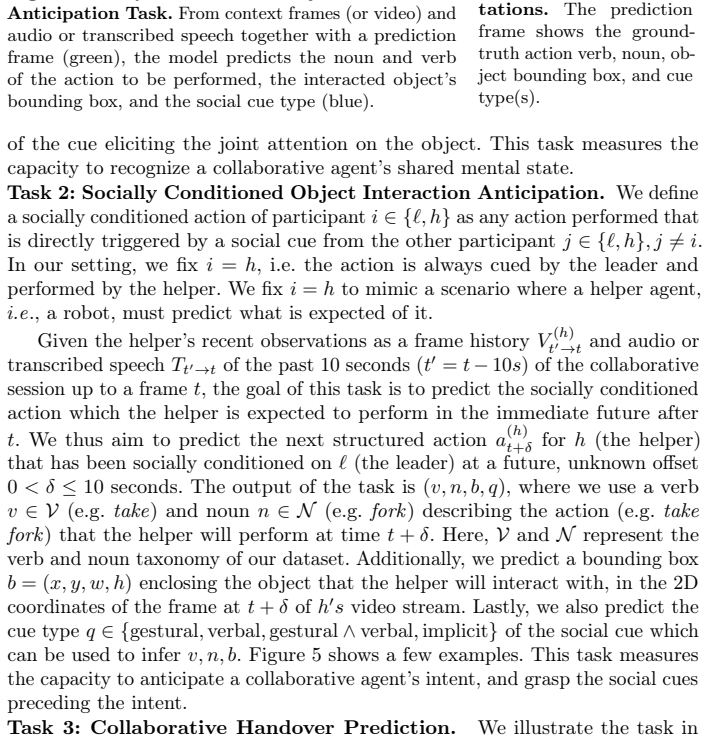
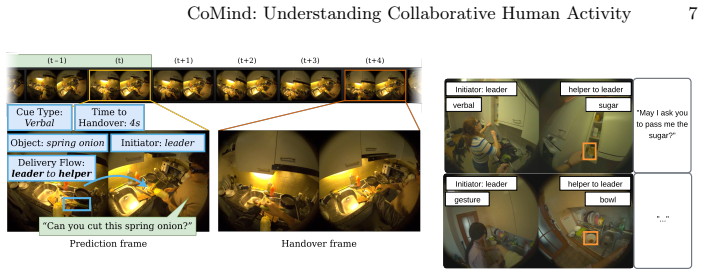
Three interdependent vision tasks that operationalize Theory of Mind for physical collaboration: Joint Attention Estimation (shared object, dual-view boxes, cue type), Socially Conditioned Object Interaction Anticipation (helper’s next verb-noun-box given leader cues), and Collaborative Handover Prediction (time-to-handover, delivery flow, initiator, cue, object box before any reach).
What would settle it
Train models to high accuracy on the three CoMind tasks, then test whether the same models correctly predict a held-out partner’s next need or successful assistance in a new, unscripted kitchen session whose social-cue distribution differs from the training kitchens; failure of transfer would falsify the claim that the tasks capture general collaborative ToM.
Extended reading notes
Core claim
Current state-of-the-art vision-language models exhibit severe deficiencies on three new social-reasoning tasks grounded in real dual-person cooking collaboration—particularly near-zero accuracy on bounding-box localization of jointly attended or soon-to-be-handed objects—while fine-tuning the same open-weight models on CoMind’s training split yields large, consistent lifts (for example action-verb accuracy rising from roughly 0.09–0.14 to 0.64–0.65), establishing the dataset as a usable training and evaluation foundation for socially aware AI.
Load-bearing premise
That success on these three hand-crafted vision tasks is a valid stand-in for Theory of Mind in real collaboration, without independent cognitive or behavioral validation that the tasks measure mental-state inference rather than pattern matching of surface cues.
Editorial extensions
If this is right
- Multimodal perception systems can be trained to detect joint attention and social cues from synchronized first- and third-person video plus gaze and speech.
- Proactive assistive agents can be scored on whether they correctly anticipate a partner’s next object interaction or handover before physical motion begins.
- Collaborative planning models gain temporally aligned, 3D-grounded training data for long-horizon kitchen tasks that include verbal and gestural intent.
- Open-weight vision-language models can be domain-adapted for social grounding, turning near-zero spatial scores into competitive ones after fine-tuning on CoMind.
- Future 3D extensions become feasible by lifting the existing 2D boxes into the provided scene and object scans for embodied spatial reasoning.
Reading between the lines
- Because the tasks fix the helper as the agent that must react to the leader, the same protocol can be reused to train robot helpers that must act without explicit commands.
- The large zero-shot gap on bounding boxes versus moderate category accuracy suggests current VLMs already parse linguistic intent but lack the cross-view geometric binding needed for embodied collaboration.
- Gaze-following and body-pose pseudo-labels already reconstructible from the dual views and Aria MPS data could bootstrap denser social-cue supervision without new manual annotation.
- If the three tasks truly track ToM, performance curves on CoMind should correlate with independent ToM battery scores of the same models on classic false-belief or intention-inference tests.
Signed reviews
Editorial analysis
A structured set of objections, weighed in public.
Referee Report
Summary. CoMind presents a multimodal ego–exocentric dataset of unscripted two-person cooking collaboration (80 sessions, ~41 h dual-view / ~81 h single-view, 125 participants) with synchronized Aria egocentric video, dual GoPro exocentric views, gaze and hand tracking, audio/transcripts, camera trajectories, dense kitchen scans, and scanned object meshes. The authors define three vision benchmarks intended to operationalize Theory of Mind in physical collaboration—Joint Attention Estimation, Socially Conditioned Object Interaction Anticipation, and Collaborative Handover Prediction—with manual annotations for shared objects, social cue types, verbs/nouns, delivery flow, initiator, and time-to-handover. They evaluate multiple closed- and open-weight VLMs under a shared prompting protocol with participant-disjoint train/test splits, report near-zero spatial grounding for most proprietary models, and show large gains after LoRA fine-tuning of Qwen3-VL (e.g., action-verb accuracy rising from ~0.09–0.14 to ~0.64–0.65).
Significance. If the resource and benchmarks hold as described, CoMind fills a clear gap relative to prior ego/exo and multi-agent datasets (Table 1): long-horizon goal-directed physical collaboration with gaze, verbal/gestural cue labels, and 3D scene/object grounding. The participant-disjoint evaluation and the documented fine-tuning gains provide concrete evidence that the training split is useful for socially conditioned perception, not only as a zero-shot stress test. The three tasks are well-specified for proactive assistance research even if one disputes the strongest ToM rhetoric. Public release of data and benchmarks is a genuine contribution to multimodal and embodied social AI.
major comments (3)
- Abstract, Introduction, and §3.1 frame the three vision tasks as a formalization of Theory of Mind for physical collaboration, yet success is defined solely by matching annotated boxes, verbs/nouns, cue types, flow, initiator, and TTH. No human study, correlation with established ToM instruments (those cited in Related Work), or ablation that isolates mental-state inference from surface multimodal pattern matching is provided. The empirical VLM numbers remain valid as a social-perception benchmark; the stronger claim that CoMind advances ToM-capable AI should be tempered to “social cue–conditioned collaborative perception,” or supported by an explicit validation argument.
- §3.4 describes multi-stage human annotation with QA and author review, but the manuscript reports no inter-annotator agreement (e.g., IoU agreement on boxes, Cohen/Fleiss κ on cue type, initiator, delivery flow, or verb/noun labels). For a dataset paper whose central value is the annotations (Tables 2–4, Figs. 13–15, Supp. annotation guides), IAA (or at least double-annotation on a held-out subset) is load-bearing for trusting the reported metrics and the fine-tuning gains.
- §4 evaluates only general VLMs (plus random/most-frequent priors). For Joint Attention Estimation and handover timing/localization, the literature already has specialized gaze, mutual-attention, and action-anticipation models (cited in §2). Without at least one non-VLM or modular baseline (e.g., gaze-intersection + object detector, or a standard anticipation transformer), it is hard to separate “VLMs fail at social grounding” from “the tasks are hard for any current method.” Adding such baselines would strengthen the claim of a significant performance deficiency.
minor comments (6)
- Abstract vs. body: the abstract lists “Action Anticipation” while §3.1 and Tables use “Socially Conditioned Object Interaction Anticipation”; align naming throughout.
- §4: only 5 uniformly sampled frames from the 10 s context are fed to VLMs. An ablation on frame count / video input (beyond the partial Supp. Table S6) would clarify whether spatial failures are partly an input bottleneck.
- Table 4 TTH metric uses a tight ±0.25 s window; report also mean absolute error or a coarser bin so temporal performance is easier to interpret.
- Object hierarchy (L1–L3) and synonym handling for Cat. (L1) are important for reproducibility; point more explicitly from the main text to Supp. §S5 / Fig. S9.
- Fig. 1 / Table 1: “81” hours ego vs. “40h 43m” single-view wording can confuse; state dual-view vs. single-view totals once in a consistent way.
- Minor polish: arXiv id and some model version strings (Claude Opus 4.5/4.6, GPT 5.x) will age quickly—cite system cards with access dates as already partly done in references.
Circularity Check
No circularity: empirical dataset and VLM benchmarks with held-out evaluation; no fitted parameters re-labeled as predictions and no self-referential derivation.
full rationale
CoMind is a resource paper that collects multimodal cooking collaboration data, defines three annotation-driven vision tasks (Joint Attention Estimation, Socially Conditioned Object Interaction Anticipation, Collaborative Handover Prediction), and reports zero-shot and fine-tuned VLM numbers on a participant-disjoint test split. Performance metrics (IoU@0.5, cue-type accuracy, verb/noun matches, TTH, etc.) are obtained by comparing model outputs against human annotations; fine-tuning gains are measured on the same held-out set. There are no equations that define a quantity in terms of itself, no parameters fitted to data and then re-presented as independent predictions, and no uniqueness theorems or ansatzes imported via self-citation that force the central claims. The framing that the three tasks operationalize Theory of Mind is an interpretive claim about task design, not a circular derivation. The empirical results are therefore self-contained against external models and held-out data.
Assumptions & free parameters
free parameters (3)
- context window length (10 s)
- IoU threshold 0.5 and TTH tolerance 0.25 s
- LoRA rank r=64, alpha=128, lr=2e-4, epochs=3–5
assumptions (3)
- ad hoc to paper Success on the three vision tasks is a valid proxy for Theory-of-Mind ability in physical collaboration.
- domain assumption Cooking in real kitchens with unscripted pairs yields representative collaborative social cues.
- domain assumption Human annotations of joint attention, cue type and handover initiator are sufficiently reliable after QA review.
invented entities (2)
-
Socially Conditioned Object Interaction Anticipation task
-
Collaborative Handover Prediction task (pre-reach TTH + initiator + flow)
Cite this review
Pith. "Pith review of CoMind: Understanding Collaborative Human Activity from Multiple Minds and Views." pith.science (2026). https://pith.science/paper/Q2VH56CY
@misc{pith2026260706691,
  author       = {Pith},
  title        = {Pith review of: CoMind: Understanding Collaborative Human Activity from Multiple Minds and Views},
  year         = {2026},
  howpublished = {\url{https://pith.science/paper/Q2VH56CY}},
  note         = {Machine review of arXiv:2607.06691}
}
read the original abstract
Human-human collaboration is a fundamental aspect of everyday life, essential to success in a wide range of goal-directed activities from household tasks to professional teamwork. While much research has focused on modeling coordination and task execution, the cognitive processes that support such collaboration, particularly Theory of Mind (the ability to infer the mental states of others), remain difficult to study in natural settings. To address this gap, we introduce a novel egocentric and exocentric video dataset capturing real-world collaboration in cooking scenarios. The dataset integrates multi-perspective video, high-quality audio, gaze tracking, and 3D scene and object scans, with annotations for shared attention to objects, social cues and interactions between agents, as well as agent-object interactions. We establish benchmarks for Joint Attention Estimation, Socially Conditioned Object Interaction Anticipation, and Collaborative Handover Prediction, enabling research on multimodal perception, proactive assistance, and collaborative planning. By providing temporally aligned, richly annotated multimodal data, CoMind facilitates the development and evaluation of AI systems capable of modeling complex social interactions and reasoning about human behaviors in collaborative environments. Our dataset and benchmarks are made available at https://comind.ethz.ch/.
Figures


Figures from the paper (10 more)


Reference graph
Works this paper leans on
-
[1]
In: Proceedings of the IEEE conference on computer vision and pattern recognition
Abu Farha, Y., Richard, A., Gall, J.: When will you do what?-anticipating temporal occurrences of activities. In: Proceedings of the IEEE conference on computer vision and pattern recognition. pp. 5343–5352 (2018) 16 A. Gavryushin et al
work page 2018
-
[2]
Current directions in psy- chological science26(3), 243–248 (2017)
Adams Jr, R.B., Albohn, D.N., Kveraga, K.: Social vision: Applying a social- functional approach to face and expression perception. Current directions in psy- chological science26(3), 243–248 (2017)
work page 2017
-
[3]
System card (Nov 2025),https://www
Anthropic: Claude opus 4.5 system card. System card (Nov 2025),https://www. anthropic.com/claude-opus-4-5-system-card, accessed 2026-03-04
work page 2025
-
[4]
Anthropic News (Feb 2026),https://www
Anthropic: Introducing claude opus 4.6. Anthropic News (Feb 2026),https://www. anthropic.com/news/claude-opus-4-6, accessed 2026-03-04
work page 2026
-
[5]
Apperly, I.: Mindreaders: the cognitive basis of" theory of mind". Psychology Press (2010)
work page 2010
-
[6]
com/portable-3d-scanners/artec-leo, accessed: 2026-03-04
Artec 3D: Artec leo: Wireless professional 3d scanner (2024),https://www.artec3d. com/portable-3d-scanners/artec-leo, accessed: 2026-03-04
work page 2024
-
[7]
Bai, S., Cai, Y., Chen, R., Chen, K., Chen, X., Cheng, Z., Deng, L., Ding, W., Gao, C., Ge, C., et al.: Qwen3-vl technical report. arXiv preprint arXiv:2511.21631 (2025)
work page Pith review arXiv 2025
-
[8]
Bain, M., Huh, J., Han, T., Zisserman, A.: Whisperx: Time-accurate speech tran- scription of long-form audio (2023),https://arxiv.org/abs/2303.00747
work page Pith review arXiv 2023
Show all 121 references
-
[9]
arXiv preprint arXiv:2411.19167 (2024)
Banerjee, P., Shkodrani, S., Moulon, P., Hampali, S., Han, S., Zhang, F., Zhang, L., Fountain, J., Miller, E., Basol, S., et al.: Hot3d: Hand and object tracking in 3d from egocentric multi-view videos. arXiv preprint arXiv:2411.19167 (2024)
2024 arXiv
-
[10]
In: NeuRIPS Workshop on Gaze Meets ML (2023)
de Belen, R.A., Mohammadi, G., Sowmya, A.: Temporal understanding of gaze communication with gazetransformer. In: NeuRIPS Workshop on Gaze Meets ML (2023)
2023
-
[11]
arXiv preprint arXiv:2506.01608 (2025)
Bonnetto, A., Qi, H., Leong, F., Tashkovska, M., Rad, M., Shokur, S., Hummel, F., Micera, S., Pollefeys, M., Mathis, A.: Epfl-smart-kitchen-30: Densely annotated cooking dataset with 3d kinematics to challenge video and language models. arXiv preprint arXiv:2506.01608 (2025)
2025 arXiv
-
[12]
In: 2011 IEEE/RSJ International Conference on Intelligent Robots and Systems
Cakmak, M., Srinivasa, S.S., Lee, M.K., Forlizzi, J., Kiesler, S.: Human prefer- ences for robot-human hand-over configurations. In: 2011 IEEE/RSJ International Conference on Intelligent Robots and Systems. pp. 1986–1993. IEEE (2011)
2011
-
[13]
arXiv preprint arXiv:2411.00081 (2024)
Chang, M., Chhablani, G., Clegg, A., Cote, M.D., Desai, R., Hlavac, M., Karashchuk, V., Krantz, J., Mottaghi, R., Parashar, P., et al.: Partnr: A benchmark for planning and reasoning in embodied multi-agent tasks. arXiv preprint arXiv:2411.00081 (2024)
2024 arXiv
-
[14]
In: Advances in Neural Information Processing Systems (NeurIPS) Datasets and Benchmarks Track (2025)
Chavan, V., Imgrund, Y., Dao, T., Bai, S., Wang, B., Lu, Z., Heimann, O., Krüger, J.: Indego: A dataset of industrial scenarios and collaborative work for egocentric assistants. In: Advances in Neural Information Processing Systems (NeurIPS) Datasets and Benchmarks Track (2025)
2025
-
[15]
In: Proceedings of the IEEE/CVF Conference on Computer Vision and Pattern Recognition
Chen, J., Mittal, G., Yu, Y., Kong, Y., Chen, M.: Gatehub: Gated history unit with background suppression for online action detection. In: Proceedings of the IEEE/CVF Conference on Computer Vision and Pattern Recognition. pp. 19925– 19934 (2022)
2022
-
[16]
In: Proceedings of the 62nd Annual Meeting of the Association for Computational Linguistics (Volume 1: Long Papers)
Chen, Z., Wu, J., Zhou, J., Wen, B., Bi, G., Jiang, G., Cao, Y., Hu, M., Lai, Y., Xiong, Z., et al.: Tombench: Benchmarking theory of mind in large language models. In: Proceedings of the 62nd Annual Meeting of the Association for Computational Linguistics (Volume 1: Long Pape...
2024
-
[17]
In: Proceedings of the IEEE/CVF Conference on Computer Vision and Pattern Recognition (CVPR)
Chong, E., Wang, Y., Ruiz, N., Rehg, J.M.: Detecting attended visual targets in video. In: Proceedings of the IEEE/CVF Conference on Computer Vision and Pattern Recognition (CVPR). pp. 5396–5406 (2020)
2020
-
[18]
Trends in Cognitive Sciences13(4), 148–153 (2009) CoMind: Understanding Collaborative Human Activity 17
Csibra, G., Gergely, G.: Natural pedagogy. Trends in Cognitive Sciences13(4), 148–153 (2009) CoMind: Understanding Collaborative Human Activity 17
2009
-
[19]
In: Proceedings of the European conference on computer vision (ECCV)
Damen, D., Doughty, H., Farinella, G.M., Fidler, S., Furnari, A., Kazakos, E., Moltisanti, D., Munro, J., Perrett, T., Price, W., et al.: Scaling egocentric vision: The epic-kitchens dataset. In: Proceedings of the European conference on computer vision (ECCV). pp. 720–736 (2018)
2018
-
[20]
International Journal of Computer Vision (IJCV)130, 33–55 (2022),https://doi.org/10.1007/s11263- 021-01531-2
Damen, D., Doughty, H., Farinella, G.M., Furnari, A., Ma, J., Kazakos, E., Molti- santi, D., Munro, J., Perrett, T., Price, W., Wray, M.: Rescaling egocentric vision: Collection, pipeline and challenges for epic-kitchens-100. International Journal of Computer Vision (IJCV)130,...
2022 doi
-
[21]
https://deepmind.google/models/gemma/gemma- 4/ (2026), accessed: July 2026
DeepMind, G.: Gemma 4. https://deepmind.google/models/gemma/gemma- 4/ (2026), accessed: July 2026
2026
-
[22]
https://blog.google/products-and-platforms/products/gemini/gemini- 3-flash/(Dec 2025), google Blog
Doshi, T., the Gemini Team: Gemini 3 flash: Frontier intelligence built for speed. https://blog.google/products-and-platforms/products/gemini/gemini- 3-flash/(Dec 2025), google Blog
2025
-
[23]
In: Proceedings of the 27th ACM International Conference on Multimedia
Dutta, A., Zisserman, A.: The VIA annotation software for images, audio and video. In: Proceedings of the 27th ACM International Conference on Multimedia. MM ’19, ACM, New York, NY, USA (2019)
2019
-
[24]
arXiv preprint arXiv:2308.13561 (2023)
Engel, J., Somasundaram, K., Goesele, M., Sun, A., Gamino, A., Turner, A., Talattof, A., Yuan, A., Souti, B., Meredith, B., et al.: Project aria: A new tool for egocentric multi-modal ai research. arXiv preprint arXiv:2308.13561 (2023)
2023 arXiv
-
[25]
In: Proceedings of the IEEE/CVF International Conference on Computer Vision (ICCV)
Fan, L., Wang, W., Huang, S., Tang, X., Zhu, S.C.: Understanding human gaze com- munication by spatio-temporal graph reasoning. In: Proceedings of the IEEE/CVF International Conference on Computer Vision (ICCV). pp. 5724–5733 (2019)
2019
-
[26]
In: Proceedings of the European Conference on Computer Vision (ECCV) Workshops
Fathi, A., Li, Y., Rehg, J.M.: Learning to recognize daily actions using gaze. In: Proceedings of the European Conference on Computer Vision (ECCV) Workshops. pp. 314–327. Springer (2012)
2012
-
[27]
In: Proceedings of the Computer Vision and Pattern Recognition Conference
Fu, R., Zhang, D., Jiang, A., Fu, W., Funk, A., Ritchie, D., Sridhar, S.: Gigahands: A massive annotated dataset of bimanual hand activities. In: Proceedings of the Computer Vision and Pattern Recognition Conference. pp. 17461–17474 (2025)
2025
-
[28]
IEEE transactions on pattern analysis and machine intelligence 43(11), 4021–4036 (2020)
Furnari, A., Farinella, G.M.: Rolling-unrolling lstms for action anticipation from first-person video. IEEE transactions on pattern analysis and machine intelligence 43(11), 4021–4036 (2020)
2020
-
[29]
In: 2022 26th International Conference on Pattern Recognition (ICPR)
Furnari, A., Farinella, G.M.: Towards streaming egocentric action anticipation. In: 2022 26th International Conference on Pattern Recognition (ICPR). pp. 1250–1257. IEEE (2022)
2022
-
[30]
arXiv preprint arXiv:1707.04818 (2017)
Gao, J., Yang, Z., Nevatia, R.: Red: Reinforced encoder-decoder networks for action anticipation. arXiv preprint arXiv:1707.04818 (2017)
2017 arXiv
-
[31]
In: Proceedings of the IEEE/CVF international conference on computer vision
Girdhar, R., Grauman, K.: Anticipative video transformer. In: Proceedings of the IEEE/CVF international conference on computer vision. pp. 13505–13515 (2021)
2021
-
[32]
In: Proceedings of the IEEE/CVF Conference on Computer Vision and Pattern Recognition
Grauman, K., Westbury, A., Byrne, E., Chavis, Z., Furnari, A., Girdhar, R., Hamburger, J., Jiang, H., Liu, M., Liu, X., et al.: Ego4d: Around the world in 3,000 hours of egocentric video. In: Proceedings of the IEEE/CVF Conference on Computer Vision and Pattern Recognition. pp...
2022
-
[33]
In: Proceedings of the IEEE/CVF Conference on Computer Vision and Pattern Recognition
Grauman, K., Westbury, A., Torresani, L., Kitani, K., Malik, J., Afouras, T., Ashutosh, K., Baiyya, V., Bansal, S., Boote, B., et al.: Ego-exo4d: Understanding skilled human activity from first-and third-person perspectives. In: Proceedings of the IEEE/CVF Conference on Comput...
2024
-
[34]
Neural Computing and Applications35(2), 2007–2024 (2023) 18 A
Guo, Z., Hou, Y., Wang, P., Gao, Z., Xu, M., Li, W.: Ft-hid: a large-scale rgb-d dataset for first-and third-person human interaction analysis. Neural Computing and Applications35(2), 2007–2024 (2023) 18 A. Gavryushin et al
2007
-
[35]
In: ICLR (2022)
Hu, E.J., Shen, Y., Wallis, P., Allen-Zhu, Z., Li, Y., Wang, S., Wang, L., Chen, W.: LoRA: Low-rank adaptation of large language models. In: ICLR (2022)
2022
-
[36]
arXiv preprint arXiv:2306.16545 (2023)
Huang, D., Hilliges, O., Van Gool, L., Wang, X.: Palm: Predicting actions through language models@ ego4d long-term action anticipation challenge 2023. arXiv preprint arXiv:2306.16545 (2023)
2023 arXiv
-
[37]
IEEE Transactions on Human-Machine Systems50(4), 306–316 (2020)
Huang, Y., Cai, M., Sato, Y.: An ego-vision system for discovering human joint attention. IEEE Transactions on Human-Machine Systems50(4), 306–316 (2020)
2020
-
[38]
In: Proceedings of the IEEE/CVF Conference on Computer Vision and Pattern Recognition (2024)
Huang, Y., Chen, G., Xu, J., Zhang, M., Yang, L., Pei, B., Zhang, H., Lu, D., Wang, Y., Wang, L., Qiao, Y.: Egoexolearn: A dataset for bridging asynchronous ego- and exo-centric view of procedural activities in real world. In: Proceedings of the IEEE/CVF Conference on Computer...
2024
-
[39]
In: Proceedings of the IEEE/CVF International Conference on Computer Vision Workshops
Jang, Y., Sullivan, B., Ludwig, C., Gilchrist, I., Damen, D., Mayol-Cuevas, W.: Epic-tent: An egocentric video dataset for camping tent assembly. In: Proceedings of the IEEE/CVF International Conference on Computer Vision Workshops. pp. 0–0 (2019)
2019
-
[40]
In: European Conference on Computer Vision
Jia, B., Chen, Y., Huang, S., Zhu, Y., Zhu, S.C.: Lemma: A multi-view dataset for le arning m ulti-agent m ulti-task a ctivities. In: European Conference on Computer Vision. pp. 767–786. Springer (2020)
2020
-
[41]
arXiv preprint arXiv:2305.16487 (2023)
Khirodkar, R., Bansal, A., Ma, L., Newcombe, R., Vo, M., Kitani, K.: Egohumans: An egocentric 3d multi-human benchmark. arXiv preprint arXiv:2305.16487 (2023)
2023 arXiv
-
[42]
arXiv preprint arXiv:2503.22152 (2025)
Li, Y., Veerabadran, V., Iuzzolino, M.L., Roads, B.D., Celikyilmaz, A., Ridgeway, K.: Egotom: Benchmarking theory of mind reasoning from egocentric videos. arXiv preprint arXiv:2503.22152 (2025)
2025 arXiv
-
[43]
In: Proceedings of the IEEE/CVF conference on computer vision and pattern recognition
Liu, S., Tripathi, S., Majumdar, S., Wang, X.: Joint hand motion and interaction hotspots prediction from egocentric videos. In: Proceedings of the IEEE/CVF conference on computer vision and pattern recognition. pp. 3282–3292 (2022)
2022
-
[44]
arXiv preprint arXiv:2406.19353 (2024)
Liu, Y., Zhang, C., Xing, R., Tang, B., Yang, B., Yi, L.: Core4d: A 4d human- object-human interaction dataset for collaborative object rearrangement. arXiv preprint arXiv:2406.19353 (2024)
2024 arXiv
-
[45]
International Journal of Computer Vision (IJCV) 106, 282–296 (2014)
Marin-Jimenez, M.J., Zisserman, A., Eichner, M., Ferrari, V.: Detecting people looking at each other in videos. International Journal of Computer Vision (IJCV) 106, 282–296 (2014)
2014
-
[46]
In: Proceedings of the IEEE/CVF Winter Conference on Applications of Computer Vision
Mascaró, E.V., Ahn, H., Lee, D.: Intention-conditioned long-term human egocentric action anticipation. In: Proceedings of the IEEE/CVF Winter Conference on Applications of Computer Vision. pp. 6048–6057 (2023)
2023
-
[47]
Technical report, arXiv (2025), https://arxiv.org/pdf/2510.16258, arXiv preprint
McLean, C., Meendering, M., Swartz, T., Gabbay, O., Olsen, A., Jacobs, R., Rosen, N., de Bree, P., Garcia, T., Merrill, G., Sandakly, J., Buffalini, J., Jain, N., Krenn, S., Kumar, M., Markovic, D., Ng, E., Prada, F., Saba, A., Zhang, S., Agrawal, V., Godisart, T., Richard, A....
2025
-
[48]
IEEE transactions on pattern analysis and machine intelligence (TPAMI)10(2021)
Medina, M.J.M.K.V.: Suárez p zisserman a laeo-net++: revisiting people looking at each other in videos. IEEE transactions on pattern analysis and machine intelligence (TPAMI)10(2021)
2021
-
[49]
https://facebookresearch.github.io/projectaria_tools/docs/ARK/mps (2024), accessed: 2026-03-04
Meta Reality Labs Research: Project aria machine perception services (mps). https://facebookresearch.github.io/projectaria_tools/docs/ARK/mps (2024), accessed: 2026-03-04
2024
-
[50]
Advances in Neural Information Processing Systems35, 23765–23779 (2022) CoMind: Understanding Collaborative Human Activity 19
Mittal, H., Morgado, P., Jain, U., Gupta, A.: Learning state-aware visual repre- sentations from audible interactions. Advances in Neural Information Processing Systems35, 23765–23779 (2022) CoMind: Understanding Collaborative Human Activity 19
2022
-
[51]
Current directions in psychological science16, 269–274 (11 2007)
Mundy, P., Newell, L.: Attention, joint attention, and social cognition. Current directions in psychological science16, 269–274 (11 2007)
2007
-
[52]
In: Proceedings of the IEEE/CVF Conference on Computer Vision and Pattern Recognition
Ngo, T.D., Hua, B.S., Nguyen, K.: Isbnet: a 3d point cloud instance segmenta- tion network with instance-aware sampling and box-aware dynamic convolution. In: Proceedings of the IEEE/CVF Conference on Computer Vision and Pattern Recognition. pp. 13550–13559 (2023)
2023
-
[53]
System card (Aug 2024),https://openai.com/index/ gpt-4o-system-card/, accessed 2026-03-04
OpenAI: Gpt-4o system card. System card (Aug 2024),https://openai.com/index/ gpt-4o-system-card/, accessed 2026-03-04
2024
-
[54]
System card addendum (Nov 2025),https://openai.com/index/gpt-5-system-card-addendum- gpt-5-1/, accessed 2026-03-04
OpenAI: Gpt-5.1 instant and gpt-5.1 thinking system card addendum. System card addendum (Nov 2025),https://openai.com/index/gpt-5-system-card-addendum- gpt-5-1/, accessed 2026-03-04
2025
-
[55]
OpenAI Index (Dec 2025),https://openai.com/ index/introducing-gpt-5-2/, accessed 2026-03-04
OpenAI: Introducing gpt-5.2. OpenAI Index (Dec 2025),https://openai.com/ index/introducing-gpt-5-2/, accessed 2026-03-04
2025
-
[56]
IEEE Transactions on Robotics37(6), 1855–1873 (2021)
Ortenzi, V., Cosgun, A., Pardi, T., Chan, W.P., Croft, E., Kulić, D.: Object handovers: a review for robotics. IEEE Transactions on Robotics37(6), 1855–1873 (2021)
2021
-
[57]
In: Proceedings of the IEEE/CVF International Conference on Computer Vision
Osman, N., Camporese, G., Coscia, P., Ballan, L.: Slowfast rolling-unrolling lstms for action anticipation in egocentric videos. In: Proceedings of the IEEE/CVF International Conference on Computer Vision. pp. 3437–3445 (2021)
2021
-
[58]
In: Conference on Computer Vision and Pattern Recognition 2024 (2024),https://eth-ait.github
Pasca, R., Gavryushin, A., Hamza, M., Kuo, Y.L., Mo, K., Van Gool, L., Hilliges, O., Wang, X.: Summarize the past to predict the future: Natural language descriptions of context boost multimodal object interaction anticipation. In: Conference on Computer Vision and Pattern Rec...
2024
-
[59]
In: Proceedings of the Computer Vision and Pattern Recognition Conference
Perrett, T., Darkhalil, A., Sinha, S., Emara, O., Pollard, S., Parida, K.K., Liu, K., Gatti, P., Bansal, S., Flanagan, K., et al.: Hd-epic: A highly-detailed egocentric video dataset. In: Proceedings of the Computer Vision and Pattern Recognition Conference. pp. 23901–23913 (2025)
2025
-
[60]
Behavioral and Brain Sciences1, 515 – 526 (12 1978)
Premack, D., Woodruff, G.: Does a chimpanzee have a theory of mind. Behavioral and Brain Sciences1, 515 – 526 (12 1978)
1978
-
[61]
Puig, X., Ra, K., Boben, M., Li, J., Wang, T., Fidler, S., Torralba, A.: Virtualhome: Simulating household activities via programs (2018)
2018
-
[62]
arXiv preprint arXiv:2010.09890 (2020)
Puig, X., Shu, T., Li, S., Wang, Z., Liao, Y.H., Tenenbaum, J.B., Fidler, S., Torralba, A.: Watch-and-help: A challenge for social perception and human-ai collaboration. arXiv preprint arXiv:2010.09890 (2020)
2010 arXiv
-
[63]
IEEE Transactions on Pattern Analysis and Machine Intelligence (2021)
Qi, Z., Wang, S., Su, C., Su, L., Huang, Q., Tian, Q.: Self-regulated learning for egocentric video activity anticipation. IEEE Transactions on Pattern Analysis and Machine Intelligence (2021)
2021
-
[64]
arXiv preprint arXiv:2501.19061 (2025)
Qiu, H., Shi, Z., Wang, L., Xiong, H., Li, X., Li, H.: Egome: A new dataset and challenge for following me via egocentric view in real world. arXiv preprint arXiv:2501.19061 (2025)
2025 arXiv
-
[65]
In: International conference on machine learning
Rabinowitz, N., Perbet, F., Song, F., Zhang, C., Eslami, S.A., Botvinick, M.: Machine theory of mind. In: International conference on machine learning. pp. 4218–4227. PMLR (2018)
2018
-
[66]
In: International conference on machine learning
Radford, A., Kim, J.W., Xu, T., Brockman, G., McLeavey, C., Sutskever, I.: Robust speech recognition via large-scale weak supervision. In: International conference on machine learning. pp. 28492–28518. PMLR (2023)
2023
-
[67]
Recasens, A., Khosla, A., Vondrick, C., Torralba, A.: Where are they looking? In: NeurIPS (2015)
2015
-
[68]
Joint attention: Communication and other minds: Issues in philosophy and psychology p
Reddy, V.: Understanding attention to self. Joint attention: Communication and other minds: Issues in philosophy and psychology p. 85 (2005) 20 A. Gavryushin et al
2005
-
[69]
In: Proceedings of the IEEE/CVF Conference on Computer Vision and Pattern Recognition
Rizve, M.N., Mittal, G., Yu, Y., Hall, M., Sajeev, S., Shah, M., Chen, M.: Piv- otal: Prior-driven supervision for weakly-supervised temporal action localization. In: Proceedings of the IEEE/CVF Conference on Computer Vision and Pattern Recognition. pp. 22992–23002 (2023)
2023
-
[70]
In: International Conference on Image Analysis and Processing
Rodin, I., Furnari, A., Mavroeidis, D., Farinella, G.M.: Untrimmed action anticipa- tion. In: International Conference on Image Analysis and Processing. pp. 337–348. Springer (2022)
2022
-
[71]
In: Proceedings third international conference on 3-D digital imaging and modeling
Rusinkiewicz, S., Levoy, M.: Efficient variants of the icp algorithm. In: Proceedings third international conference on 3-D digital imaging and modeling. pp. 145–152. IEEE (2001)
2001
-
[72]
In: CVPR (2019)
Sarlin, P.E., Cadena, C., Siegwart, R., Dymczyk, M.: From coarse to fine: Robust hierarchical localization at large scale. In: CVPR (2019)
2019
-
[73]
In: CVPR (2020)
Sarlin, P.E., DeTone, D., Malisiewicz, T., Rabinovich, A.: SuperGlue: Learning feature matching with graph neural networks. In: CVPR (2020)
2020
-
[74]
Behavioral and Brain Sciences 36(4), 393–414 (2013)
Schilbach, L., Timmermans, B., Reddy, V., Costall, A., Bente, G., Schlicht, T., Vogeley, K.: Toward a second-person neuroscience. Behavioral and Brain Sciences 36(4), 393–414 (2013)
2013
-
[75]
Trends in Cognitive Sciences10(2), 70–76 (2006)
Sebanz, N., Bekkering, H., Knoblich, G.: Joint action: bodies and minds moving together. Trends in Cognitive Sciences10(2), 70–76 (2006)
2006
-
[76]
In: Proceedings of the IEEE/CVF Conference on Computer Vision and Pattern Recognition
Sener, F., Chatterjee, D., Shelepov, D., He, K., Singhania, D., Wang, R., Yao, A.: Assembly101: A large-scale multi-view video dataset for understanding procedural activities. In: Proceedings of the IEEE/CVF Conference on Computer Vision and Pattern Recognition. pp. 21096–21106 (2022)
2022
-
[77]
In: Proceedings of the AAAI Conference on Artificial Intelligence (2025)
Shi, H., Ye, S., Fang, X., Jin, C., Isik, L., Kuo, Y.L., Shu, T.: Muma-tom: Multi- modal multi-agent theory of mind. In: Proceedings of the AAAI Conference on Artificial Intelligence (2025)
2025
-
[78]
In: Proceedings of the European Conference on Computer Vision (ECCV)
Shi, Y., Fernando, B., Hartley, R.: Action anticipation with rbf kernelized feature mapping rnn. In: Proceedings of the European Conference on Computer Vision (ECCV). pp. 301–317 (2018)
2018
-
[79]
In: Proceedings of the IEEE/CVF conference on computer vision and pattern recognition
Shridhar, M., Thomason, J., Gordon, D., Bisk, Y., Han, W., Mottaghi, R., Zettle- moyer, L., Fox, D.: Alfred: A benchmark for interpreting grounded instructions for everyday tasks. In: Proceedings of the IEEE/CVF conference on computer vision and pattern recognition. pp. 10740–...
2020
-
[80]
Journal of Multimodal User Interfaces9(3), 223–229 (2015).https: //doi.org/10.1007/s12193-015-0196-1
Six, J., Leman, M.: Synchronizing Multimodal Recordings Using Audio-To-Audio Alignment. Journal of Multimodal User Interfaces9(3), 223–229 (2015).https: //doi.org/10.1007/s12193-015-0196-1
2015 doi
-
[81]
Journal of Human-Robot Interaction2(1), 112–132 (2013)
Strabala, K.W., Lee, M.K., Dragan, A.D., Forlizzi, J.L., Srinivasa, S., Cakmak, M., Micelli, V.: Towards seamless human-robot handovers. Journal of Human-Robot Interaction2(1), 112–132 (2013)
2013
-
[82]
In: European conference on computer vision
Taheri, O., Ghorbani, N., Black, M.J., Tzionas, D.: Grab: A dataset of whole- body human grasping of objects. In: European conference on computer vision. pp. 581–600. Springer (2020)
2020
-
[83]
Behavioral and Brain Sciences 28, 675–735 (11 2005)
Tomasello, M., Carpenter, M., Call, J., Behne, T., Moll, H.: Understanding and sharing intentions: The origins of cultural cognition. Behavioral and Brain Sciences 28, 675–735 (11 2005)
2005
-
[84]
arXiv preprint arXiv:2507.04415 (2025)
Villa-Cueva, E., Ahmed, S., Chevi, R., Cruz, J.C.B., Elzeky, K., Cristobal, F., Aji, A.F., Wang, S., Mihalcea, R., Solorio, T.: Moments: A comprehensive multimodal benchmark for theory of mind. arXiv preprint arXiv:2507.04415 (2025)
2025
-
[85]
In: Proceedings of the IEEE conference on computer vision and pattern recognition
Vondrick, C., Pirsiavash, H., Torralba, A.: Anticipating visual representations from unlabeled video. In: Proceedings of the IEEE conference on computer vision and pattern recognition. pp. 98–106 (2016) CoMind: Understanding Collaborative Human Activity 21
2016
-
[86]
In: Proceedings of the IEEE/CVF International Conference on Computer Vision
Wang, X., Kwon, T., Rad, M., Pan, B., Chakraborty, I., Andrist, S., Bohus, D., Feniello, A., Tekin, B., Frujeri, F.V., et al.: Holoassist: an egocentric human interaction dataset for interactive ai assistants in the real world. In: Proceedings of the IEEE/CVF International Con...
2023
-
[87]
arXiv preprint arXiv:2411.01455 (2024)
Wang, Z., Zhao, X., Stepputtis, S., Kim, W., Wu, T., Sycara, K., Xie, Y.: Himem- former: Hierarchical memory-aware transformer for multi-agent action anticipation. arXiv preprint arXiv:2411.01455 (2024)
2024 arXiv
-
[88]
Advances in Neural Information Processing Systems36, 68736–68748 (2023)
Wiederhold, N., Megyeri, A., Paris, D., Banerjee, S., Banerjee, N.: Hoh: Marker- less multimodal human-object-human handover dataset with large object count. Advances in Neural Information Processing Systems36, 68736–68748 (2023)
2023
-
[89]
In: Proceedings of the Computer Vision and Pattern Recognition Conference
Yang, J., Liu, S., Guo, H., Dong, Y., Zhang, X., Zhang, S., Wang, P., Zhou, Z., Xie, B., Wang, Z., et al.: Egolife: Towards egocentric life assistant. In: Proceedings of the Computer Vision and Pattern Recognition Conference. pp. 28885–28900 (2025)
2025
-
[90]
arXiv preprint arXiv:2602.15989 (2026)
Yang, X., Kukreja, D., Pinkus, D., Sagar, A., Fan, T., Park, J., Shin, S., Cao, J., Liu, J., Ugrinovic, N., Feiszli, M., Malik, J., Dollar, P., Kitani, K.: Sam 3d body: Robust full-body human mesh recovery. arXiv preprint arXiv:2602.15989 (2026)
2026
-
[91]
In: ICCV (2025)
Yang, Y.H., Piccinelli, L., Segu, M., Li, S., Huang, R., Fu, Y., Pollefeys, M., Blum, H., Bauer, Z.: 3d-mood: Lifting 2d to 3d for monocular open-set object detection. In: ICCV (2025)
2025
-
[92]
In: IEEE International Conference and Workshops on Automatic Face and Gesture Recognition (FG)
Ye, Z., Li, Y., Liu, Y., Bridges, C., Rozga, A., Rehg, J.M.: Detecting bids for eye contact using a wearable camera. In: IEEE International Conference and Workshops on Automatic Face and Gesture Recognition (FG). vol. 1, pp. 1–8. IEEE (2015)
2015
-
[93]
In: Proceedings of the IEEE/CVF Winter Conference on Applications of Computer Vision (WACV)
Zhang, C., Fu, C., Wang, S., Agarwal, N., Lee, K., Choi, C., Sun, C.: Object- centric video representation for long-term action anticipation. In: Proceedings of the IEEE/CVF Winter Conference on Applications of Computer Vision (WACV). pp. 6751–6761 (January 2024)
2024
-
[94]
arXiv preprint arXiv:2307.02485 (2023)
Zhang, H., Du, W., Shan, J., Zhou, Q., Du, Y., Tenenbaum, J.B., Shu, T., Gan, C.: Building cooperative embodied agents modularly with large language models. arXiv preprint arXiv:2307.02485 (2023)
2023 arXiv
-
[95]
In: European conference on computer vision
Zhang, S., Ma, Q., Zhang, Y., Qian, Z., Kwon, T., Pollefeys, M., Bogo, F., Tang, S.: Egobody: Human body shape and motion of interacting people from head-mounted devices. In: European conference on computer vision. pp. 180–200. Springer (2022)
2022
-
[96]
arXiv preprint arXiv:2505.18943 (2025)
Zhang, X., Chen, Y., Yeh, S., Li, S.: Metamind: Modeling human social thoughts with metacognitive multi-agent systems. arXiv preprint arXiv:2505.18943 (2025)
2025
-
[97]
{transcript}
Zhao, Q., Wang, S., Zhang, C., Fu, C., Do, M.Q., Agarwal, N., Lee, K., Sun, C.: AntGPT: Can large language models help long-term action anticipation from videos? In: The Twelfth International Conference on Learning Representations (2024) 22 A. Gavryushin et al. Supplementary M...
2024
-
[98]
Cue type: Analyze the frame and classify the underlying cue(s) that reveal the joint attention. Choose from one or more of these four categories (1 to 4 choices): - <gaze>: The eye gaze or head pose of both individuals clearly converges onto the same target object or spatial a...
-
[99]
cue type
Object grounding: Look at the provided image frame. Based on your answers to the previous questions, locate and identify the precise object of joint attention in BOTH views SEPARATELY: - Object category: Provide a short, precise category name of the object being mutually atten...
-
[104]
handover happen offset
Object Grounding: Look at the PROVIDED SINGLE REFERENCE IMAGE FRAME. Based on the context of the video clip and your answers to the previous questions, locate the precise object that is most likely going to be handed over in the future: - Provide a short, precise object catego...
-
[105]
Handover Timing: Approximately how many seconds after the reference image frame will the object handover between two persons occur? (Provide a decimal time offset)
-
[106]
Delivering Flow: Whether the object will be handed over from left person to right person or from right person to left person? (Choose STRICTLY: <left to right> or <right to left>)
-
[107]
(Choose STRICTLY: <left> or <right>)
Initiator: Who initiates the handover? ’Initiation’ refers to the first cue that prompts the handover to occur. (Choose STRICTLY: <left> or <right>)
-
[108]
- <gestural>: The cue is PURELY a physical gesture (e.g., reaching out, pointing) with NO speech
Initiation Type: Classify the initiator’s cue STRICTLY into one of these four categories: - <verbal>: The cue is PURELY spoken (e.g., a verbal request/command). - <gestural>: The cue is PURELY a physical gesture (e.g., reaching out, pointing) with NO speech. - <verbal and gest...
-
[109]
handover happen offset
Object Grounding: Look at the PROVIDED SINGLE REFERENCE IMAGE FRAME. Based on the context of the video clip and your answers to the previous questions, locate the precise object that is most likely going to be handed over in the future: - Provide a short, precise object catego...
-
[110]
Maintain that focus for a short but continuous duration (typically ≥ 0.5 seconds ) 3
Visually attend to the same object or region in the scene, 2. Maintain that focus for a short but continuous duration (typically ≥ 0.5 seconds ) 3. Show behavioral coordination or awareness of the shared focus (e.g., verbal reference, handover, shared gaze, or gesture). Eviden...
-
[111]
Note: Gaze can be noisy
Gaze Convergence (Gaze): The gaze overlays (dots) from both participants land on the same object or within the same small work area. Note: Gaze can be noisy. If the dot is slightly away from an object but the person is clearly reaching for or looking at, consider it "on" the object
-
[112]
If one person is holding an object while the other person cuts it, pours into it, or reaches for it, they are in Joint Attention
Manual Interaction (Action): The strongest cue. If one person is holding an object while the other person cuts it, pours into it, or reaches for it, they are in Joint Attention
-
[113]
presents
Deictic Gestures (Gestures): One person points at, holds up, or "presents" an object to the other. JA begins as soon as the other person looks at that object
-
[114]
Pass me the salt
Verbal/Social Context (Communication): Listen for instructions ("Pass me the salt") or descriptions ("Look at this color"). Use the audio to find the start of the mental connection. If cues conflict, follow this order of importance:
-
[115]
Look at this
Action (Physical touch/interaction is the most reliable). 2. Verbal/Gestures (Explicit intent). 3. Gaze Overlays (Confirmation of visual focus) Confidence level Select the confidence level that best describes the alignment of evidence. Use the Evidence Cues (Gaze, Action, Gest...
-
[116]
Mark the time interval (start and end time). 2. Draw 2 bounding boxes around the object or area both participants are focused on each view
-
[117]
start_time
Assign an object or region label (e.g., cutting board , pan , chicken ). Example output JSON: { "start_time": 12.345, // seconds "end_time": 12.400, // seconds "bbox_left": [x, y, w, h], // pixel coordinates for helper view on the left "bbox_right": [x, y, w, h], // pixel coor...
-
[118]
Would this action still happen if the Leader did nothing?
Play video and watch for Social Cues from Leader 2. When a cue is identified, monitor the Helper 3. Identify the FIRST valid socially cued action 4. Pause the video 5. Create a new timeline with label: <verb> <noun> 6. Select the correct tag from the dropdown associated with t...
-
[119]
space” to pause at the handover moment 2. Press “o
Press “space” to pause at the handover moment 2. Press “o” to annotate the timestamp (press “enter” when textbox appears, you don’t need to input anything)
-
[120]
Input “t_h” in the textbox above the dropdown box (see the example below) for each annotation line
-
[121]
Skip”. 5. click “Add
select anything for dropdown boxes, just as blank filler to add the next annotation line (you don’t need to worry about it, just select any options for each dropdown box). Do not click “Skip”. 5. click “Add” to add a new annotation timeline (one timeline for one handover actio...
-
[122]
Play the video normally and observe both participants’ hands and grasped objects
-
[123]
Identify handover moments where the giver passes the object to the receiver, specifically the transfer point moment where both the giver and receiver are touching the object
-
[124]
left to right
Pause the video and press o to annotate the transfer point timestamp T_h ① 5. Select “left to right” or “right to left” from Delivering Flow ② dropdown box 6. Roll backward to the moment before giver starts reaching for the object 7. Then Slowly Roll backward frame by frame fr...
-
[125]
verbal”, “gestural
Identify initiation type and Initiator by go through the frames before T_h ○ select “verbal”, “gestural” or “implicit” from Initiation Type ⑥ dropdown box ○ select “left” or “right” from Initiator ⑦ dropdown box Save annotations (File → Export annotations) in VIA JSON format. ...
Reviewed July 10, 2026 · model on record in the stance chip above.
Discussion (0). Continue with ORCID to comment.