Planetary Magnetic Field Control of Ion Escape from Weakly Magnetized Planets
Pith reviewed 2026-05-25 01:43 UTC · model grok-4.3
The pith
A weak planetary magnetic field first boosts then reduces ion escape from a Mars-sized world.
A machine-rendered reading of the paper's core claim, the machinery that carries it, and where it could break.
Core claim
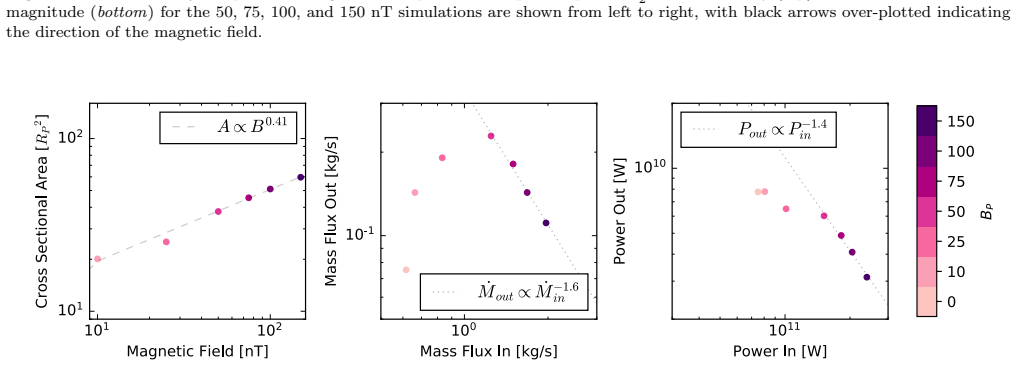
Increasing the strength of a planet's magnetic field enhances ion escape until the magnetic dipole's standoff distance reaches the induced magnetosphere boundary. After this point increasing the planetary magnetic field begins to inhibit ion escape. This reflects a balance between shielding of the southern hemisphere from misaligned ion pickup forces and trapping of escaping ions by an equatorial plasmasphere. The planetary magnetic field associated with the peak ion escape rate is critically dependent on the stellar wind pressure.
What carries the argument
The transition where the magnetic dipole standoff distance equals the induced magnetosphere boundary, marking the shift from net enhancement to net suppression of ion escape via competing shielding and trapping effects.
If this is right
- Escape rate, escape power, polar cap opening angle and effective interaction area vary with magnetic field strength according to fitted power laws up to the transition point.
- Upper and lower limits on these power-law relationships are provided by the simulation results.
- The magnetic field strength that maximizes ion escape scales directly with stellar wind pressure.
- Beyond the transition the shielding and trapping effects reverse the trend and lower the net escape rate.
Where Pith is reading between the lines
- Planets whose magnetic fields place them near the transition may lose atmosphere faster than either unmagnetized or strongly magnetized neighbors under the same wind conditions.
- The same non-monotonic dependence could apply to other solar-system bodies if their size and wind environment place the standoff near the induced boundary.
- Habitability assessments for exoplanets must consider not only the presence of a field but its strength relative to local stellar wind pressure.
Load-bearing premise
The induced magnetosphere boundary position remains unchanged when an intrinsic dipolar field is added.
What would settle it
A simulation or observation in which the induced boundary position is allowed to move with the added dipole field, checking whether the escape-rate peak still occurs exactly when standoff distance matches the new boundary location.
Figures


read the original abstract
Intrinsic magnetic fields have long been thought to shield planets from atmospheric erosion via stellar winds; however, the influence of the plasma environment on atmospheric escape is complex. Here we study the influence of a weak intrinsic dipolar planetary magnetic field on the plasma environment and subsequent ion escape from a Mars sized planet in a global three-dimensional hybrid simulation. We find that increasing the strength of a planet's magnetic field enhances ion escape until the magnetic dipole's standoff distance reaches the induced magnetosphere boundary. After this point increasing the planetary magnetic field begins to inhibit ion escape. This reflects a balance between shielding of the southern hemisphere from ``misaligned" ion pickup forces and trapping of escaping ions by an equatorial plasmasphere. Thus, the planetary magnetic field associated with the peak ion escape rate is critically dependent on the stellar wind pressure. Where possible we have fit power laws for the variation of fundamental parameters (escape rate, escape power, polar cap opening angle and effective interaction area) with magnetic field, and assessed upper and lower limits for the relationships.
Editorial analysis
A structured set of objections, weighed in public.
Referee Report
Summary. The manuscript presents global 3D hybrid plasma simulations of ion escape from a Mars-sized planet with varying weak intrinsic dipolar magnetic field strengths. The central claim is that escape rate increases with field strength until the dipole standoff distance equals the induced magnetosphere boundary, after which escape decreases; this non-monotonic behavior arises from a balance between southern-hemisphere shielding from misaligned pickup forces and equatorial plasmasphere trapping. Power-law fits are reported for escape rate, escape power, polar cap opening angle, and effective interaction area as functions of magnetic field, with the peak escape rate depending on stellar wind pressure.
Significance. If the reported non-monotonic dependence and its physical mechanism hold under scrutiny, the result would meaningfully revise the standard picture that stronger intrinsic fields monotonically suppress atmospheric loss. It would imply an optimal field strength (set by stellar wind pressure) that maximizes escape for weakly magnetized bodies, with direct consequences for models of Mars' atmospheric history and for interpreting escape rates at other solar-system and exoplanet targets.
major comments (2)
- [Abstract / simulation description] The identification of a clear transition point (and the subsequent decline) requires that the induced magnetosphere boundary location remain independent of the added dipole moment. The hybrid simulation necessarily modifies global field draping, compression, and plasma flow when a dipole is introduced; without explicit demonstration that the boundary position is unchanged across the dipole-moment scan, the reported peak and the shielding-vs-trapping interpretation could be an artifact of how the boundary is located or measured in each run.
- [Methods / results] No information is supplied on grid resolution, particle-per-cell counts, numerical convergence tests, or direct comparison against observed Mars escape rates or MHD/hybrid benchmarks. These details are load-bearing for any quantitative claim about the location of the escape-rate maximum and the fitted power-law exponents.
minor comments (2)
- [Abstract] The abstract states that power laws were fitted 'where possible'; the manuscript should explicitly state for which quantities fits were not possible and why, and report the actual exponents, uncertainties, and goodness-of-fit metrics rather than only the existence of fits.
- [Abstract] Notation for the standoff distance, induced boundary, and polar-cap angle should be defined once with symbols and used consistently; the current abstract mixes descriptive phrases with quoted terms such as 'misaligned'.
Simulated Author's Rebuttal
We thank the referee for their constructive comments. We respond to each major comment below and will revise the manuscript accordingly.
read point-by-point responses
-
Referee: [Abstract / simulation description] The identification of a clear transition point (and the subsequent decline) requires that the induced magnetosphere boundary location remain independent of the added dipole moment. The hybrid simulation necessarily modifies global field draping, compression, and plasma flow when a dipole is introduced; without explicit demonstration that the boundary position is unchanged across the dipole-moment scan, the reported peak and the shielding-vs-trapping interpretation could be an artifact of how the boundary is located or measured in each run.
Authors: We agree that explicit demonstration of the independence of the induced magnetosphere boundary (IMB) location is required to substantiate the non-monotonic escape behavior. We will revise the manuscript to include a dedicated analysis and figure showing the measured IMB standoff distance across the dipole-moment scan, using the same identification criteria in all runs, to confirm that the boundary position remains unchanged for the weak dipole strengths examined. revision: yes
-
Referee: [Methods / results] No information is supplied on grid resolution, particle-per-cell counts, numerical convergence tests, or direct comparison against observed Mars escape rates or MHD/hybrid benchmarks. These details are load-bearing for any quantitative claim about the location of the escape-rate maximum and the fitted power-law exponents.
Authors: We agree that these numerical and validation details must be provided. The revised manuscript will include a methods subsection specifying the grid resolution, particle-per-cell counts, results from convergence tests, and direct comparisons of the simulated escape rates to Mars observations as well as other MHD and hybrid benchmarks. revision: yes
Circularity Check
No significant circularity; results from direct hybrid plasma simulations.
full rationale
The paper reports ion escape trends from a series of global 3D hybrid simulations in which planetary dipole strength is varied as an input parameter while holding other conditions fixed. The non-monotonic escape behavior is an observed output of those runs rather than a quantity derived by algebraic reduction, parameter fitting to a target, or self-citation. Post-hoc power-law fits to the simulation data are explicitly labeled as such and do not feed back into the primary claim. No equations, boundary definitions, or uniqueness arguments are shown to collapse to the inputs by construction. The work is therefore self-contained against external benchmarks.
Axiom & Free-Parameter Ledger
free parameters (2)
- magnetic dipole moment
- power-law exponents for escape rate and related quantities
axioms (2)
- domain assumption Hybrid plasma approximation (kinetic ions, fluid electrons) is sufficient to capture the relevant dynamics
- domain assumption Stellar wind pressure controls the location of the induced magnetosphere boundary independently of the intrinsic dipole in the weak-field regime
Lean theorems connected to this paper
-
IndisputableMonolith/Cost/FunctionalEquation.leanwashburn_uniqueness_aczel unclear?
unclearRelation between the paper passage and the cited Recognition theorem.
We find that increasing the strength of a planet's magnetic field enhances ion escape until the magnetic dipole's standoff distance reaches the induced magnetosphere boundary. After this point increasing the planetary magnetic field begins to inhibit ion escape.
-
IndisputableMonolith/Foundation/RealityFromDistinction.leanreality_from_one_distinction unclear?
unclearRelation between the paper passage and the cited Recognition theorem.
Rs = RP (2 Bp² / μ0 ρsw usw²)^{1/6}
What do these tags mean?
- matches
- The paper's claim is directly supported by a theorem in the formal canon.
- supports
- The theorem supports part of the paper's argument, but the paper may add assumptions or extra steps.
- extends
- The paper goes beyond the formal theorem; the theorem is a base layer rather than the whole result.
- uses
- The paper appears to rely on the theorem as machinery.
- contradicts
- The paper's claim conflicts with a theorem or certificate in the canon.
- unclear
- Pith found a possible connection, but the passage is too broad, indirect, or ambiguous to say the theorem truly supports the claim.
Reference graph
Works this paper leans on
-
[1]
doi:10.1002/2016JA022548. L. Chai, W. Wan, Y. Wei, T. Zhang, W. Exner, M. Fraenz, E. Du- binin, M. Feyerabend, U. Motschmann, Y. Ma, J. S. Halekas, Y. Li, Z. Rong, and J. Zhong. The Induced Global Loop- ing Magnetic Field on Mars. ApJ, 871:L27, February 2019. doi:10.3847/2041-8213/aaff6e. J. W. Chamberlain. Charge exchange in a planetary corona - Its effect...
-
[2]
URL http://www.sciencedirect.com/science/article/ pii/0032063374901664. T. E. Cravens. Physics of Solar System Plasmas. November 2004. T. E. Cravens, E. Howell, J. H. Waite, and G. R. Glad- stone. Auroral oxygen precipitation at Jupiter. Jour- nal of Geophysical Research , 100:17153–17162, Sep 1995. doi:10.1029/95JA00970. Margaret O. Dayhoff, Richard V. Ec...
-
[3]
doi:10.1002/2016JA023488. URL https://agupubs. onlinelibrary.wiley.com/doi/abs/10.1002/2016JA023488. C. Dival, E. Kallio, S. Barabash, G. Stenberg, H. Nilsson, Y. Fu- taana, M. Holmstrm, A. Fedorov, R. A. Frahm, R. Jarvinen, and D. A. Brain. A case study of proton precipitation at mars: Mars express observations and hybrid simulations. Journal of Geophysi...
-
[4]
ISSN 2156-2202. doi:10.1029/2012JA017537. URL http://dx.doi.org/10.1029/2012JA017537. A06222. J.-D. do Nascimento, Jr., A. A. Vidotto, P. Petit, C. Folsom, M. Castro, S. C. Marsden, J. Morin, G. F. Porto de Mello, S. Meibom, S. V. Jeffers, E. Guinan, and I. Ribas. Magnetic Field and Wind of Kappa Ceti: Toward the Planetary Hab- itability of the Young Sun W...
-
[5]
doi:10.1002/2015GL065346. URL https://agupubs. onlinelibrary.wiley.com/doi/abs/10.1002/2015GL065346. P. Driscoll and D. Bercovici. Divergent evolution of earth and venus: Influence of degassing, tectonics, and magnetic fields. Icarus, 226(2):1447 – 1464, 2013. ISSN 0019-1035. doi:https://doi.org/10.1016/j.icarus.2013.07.025. URL http://www.sciencedirect.com...
-
[6]
doi:10.1093/mnras/stz788. E Engwall, A I. Eriksson, C M. Cully, M Andr, Roy Torbert, and H Vaith. Earth’s ionospheric outflow dominated by hidden cold plasma. Nature Geoscience, 2:24–27, 01 2009. doi:10.1038/ngeo387. M. Frnz, E. Dubinin, D. Andrews, S. Barabash, H. Nilsson, and A. Fedorov. Cold ion escape from the martian ionosphere. Planetary and Space Sc...
-
[7]
doi:10.1029/JA092iA07p07606. E. Gaidos, C. P. Conrad, M. Manga, and J. Hernlund. Ther- modynamic Limits on Magnetodynamos in Rocky Exoplan- ets. ApJ, 718:596–609, August 2010. doi:10.1088/0004- 637X/718/2/596. K. Garcia-Sage, A. Glocer, J. J. Drake, G. Gronoff, and O. Co- hen. On the Magnetic Protection of the Atmosphere of Prox- ima Centauri b. ApJ, 844:L...
-
[8]
doi:10.3847/2041-8213/aa79ed. M. Gillon, A. H. M. J. Triaud, B.-O. Demory, E. Jehin, E. Agol, K. M. Deck, S. M. Lederer, J. de Wit, A. Burdanov, J. G. Ingalls, E. Bolmont, J. Leconte, S. N. Raymond, F. Selsis, M. Turbet, K. Barkaoui, A. Burgasser, M. R. Burleigh, S. J. Carey, A. Chaushev, C. M. Copperwheat, L. Delrez, C. S. Fernandes, D. L. Holdsworth, E....
-
[9]
doi:10.1038/nature21360. S. Ginzburg, H. E. Schlichting, and R. Sari. Super-Earth Atmo- spheres: Self-consistent Gas Accretion and Retention. ApJ, 825:29, July 2016. doi:10.3847/0004-637X/825/1/29. S. Ginzburg, H. E. Schlichting, and R. Sari. Core-powered mass- loss and the radius distribution of small exoplanets. MNRAS, 476:759–765, May 2018. doi:10.1093...
-
[10]
doi:10.1016/0032-0633(82)90110-6. B. M. Jakosky and R. J. Phillips. Mars’ volatile and climate history. Nature, 412:237–244, July 2001. B. M. Jakosky, D. Brain, M. Chaffin, S. Curry, J. Deighan, J. Gre- bowsky, J. Halekas, F. Leblanc, R. Lillis, J. G. Luhmann, L. Andersson, N. Andre, D. Andrews, D. Baird, D. Baker, J. Bell, M. Benna, D. Bhattacharyya, S. Bo...
-
[11]
doi:10.1002/2017JA024324. R. Jarvinen, E. Kallio, P. Janhunen, S. Barabash, T. L. Zhang, V. Pohjola, and I. Sillanp¨ a¨ a. Oxygen ion escape from Venus in a global hybrid simulation: role of the ionospheric O + ions. Annales Geophysicae, 27:4333–4348, November 2009. doi:10.5194/angeo-27-4333-2009. R. Jarvinen, E. Kallio, and S. Dyadechkin. Hemispheric asy...
-
[12]
doi:10.1029/97GL02201. URL https://agupubs. onlinelibrary.wiley.com/doi/abs/10.1029/97GL02201. R. K. Kopparapu. A Revised Estimate of the Occurrence Rate of Terrestrial Planets in the Habitable Zones around Ke- pler M-dwarfs. ApJ, 767:L8, April 2013. doi:10.1088/2041- 8205/767/1/L8. Yu.N. Kulikov, H. Lammer, H.I.M. Lichtenegger, N. Ter- ada, I. Ribas, C. ...
-
[13]
doi:10.1029/97JA03667. URL https://agupubs. onlinelibrary.wiley.com/doi/abs/10.1029/97JA03667. J. G. Luhmann, C. Dong, Y. Ma, S. M. Curry, D. Mitchell, J. Esp- ley, J. Connerney, J. Halekas, D. A. Brain, B. M. Jakosky, and C. Mazelle. Implications of MAVEN Mars near-wake mea- surements and models. Geophys. Res. Lett. , 42:9087–9094, November 2015. doi:10....
-
[14]
doi:10.1089/ast.2016.1589. V. G. Merkin and C. C. Goodrich. Does the polar cap area saturate? Geophysical Research Letters , 34(9),
-
[15]
doi:10.1029/2007GL029357. URL https://agupubs. onlinelibrary.wiley.com/doi/abs/10.1029/2007GL029357. R. Modolo, S. Hess, M. Mancini, F. Leblanc, J.-Y. Chaufray, D. Brain, L. Leclercq, R. Esteban-Hern´ andez, G. Chanteur, P. Weill, F. Gonz´ alez-Galindo, F. Forget, M. Yagi, and C. Mazelle. Mars-solar wind interaction: LatHyS, an im- proved parallel 3-D mul...
-
[16]
doi:10.1002/2015JA022324. A. F. Nagy, D. Winterhalter, K. Sauer, T. E. Cravens, S. Brecht, C. Mazelle, D. Crider, E. Kallio, A. Za- kharov, E. Dubinin, M. Verigin, G. Kotova, W. I. Axford, C. Bertucci, and J. G. Trotignon. The plasma Environ- ment of Mars. Space Sci. Rev. , 111:33–114, March 2004. doi:10.1023/B:SPAC.0000032718.47512.92. R. Nakamura, W. Ba...
-
[17]
Shotaro Sakai, Kanako Seki, Naoki Terada, Hiroyuki Shina- gawa, Takashi Tanaka, and Yusuke Ebihara
doi:10.1029/JA087iA03p01599. Shotaro Sakai, Kanako Seki, Naoki Terada, Hiroyuki Shina- gawa, Takashi Tanaka, and Yusuke Ebihara. Effects of a weak intrinsic magnetic field on atmospheric escape from mars. Geophysical Research Letters , 45(18):9336–9343,
-
[18]
doi:10.1029/2018GL079972. URL https://agupubs. onlinelibrary.wiley.com/doi/abs/10.1029/2018GL079972. A. L. Shields, S. Ballard, and J. A. Johnson. The habitability of planets orbiting M-dwarf stars. Phys. Rep., 663:1, December
-
[19]
doi:10.1016/j.physrep.2016.10.003. J.A. Slavin. Mercury’s magnetosphere. Advances in Space Research, 33(11):1859 – 1874, 2004. ISSN 0273-1177. doi:https://doi.org/10.1016/j.asr.2003.02.019. URL http://www.sciencedirect.com/science/article/pii/ S0273117704000092. Comparative Magnetospheres. T. W. Speiser and N. F. Ness. The neutral sheet in the ge- omagnet...
discussion (0)
Sign in with ORCID, Apple, or X to comment. Anyone can read and Pith papers without signing in.