Nonlinear Schr\"odinger equations: Symmetries, superposition, and classicality from a Bohmian perspective
Pith reviewed 2026-07-01 05:07 UTC · model grok-4.3
The pith
Phase-induced flow unifies interference-like dynamics in nonlinear and partially coherent Schrödinger systems.
A machine-rendered reading of the paper's core claim, the machinery that carries it, and where it could break.
Core claim
Phase-induced flow acts as a unifying mechanism for interference-like dynamics in nonlinear and partially coherent Schrödinger systems. Although these systems differ in physical origin and mathematical implementation, they share a common dynamical structure where density-related observables are shaped by velocity fields determined by phase or ensemble-phase information. Interference-like traits, localization, self-acceleration and coherence loss can be interpreted in terms of the preservation, deformation or breaking of the symmetries displayed by the underlying flow. This connects interference, nonlinear dynamics, classicality, coherence loss, and structured-light propagation within a singl
What carries the argument
The phase-induced velocity field from the Bohmian hydrodynamic formulation, which generates the local flow that organizes density-related observables and their symmetries.
If this is right
- Interference-like traits are interpretable through preservation, deformation, or breaking of flow symmetries.
- Density observables in the three systems are shaped uniformly by phase or ensemble-phase velocity fields.
- Nonlinear dynamics, classicality, coherence loss, and structured light propagation connect via this trajectory-based view.
- Superposition in linear cases contrasts with phase flow as the more robust principle when nonlinearity or partial coherence is present.
Where Pith is reading between the lines
- This suggests the Bohmian flow could serve as a diagnostic for coherence in other wave systems beyond the examples given.
- Classical limits might correspond to specific deformations of the phase flow symmetries that suppress interference patterns.
- Extensions to other nonlinear equations, such as in optics, could reveal similar phase-driven unifications without assuming quantum origins.
Load-bearing premise
The Bohmian perspective acts as a neutral tool and the three systems share a dynamical structure determined solely by phase information without additional assumptions on linearity or coherence.
What would settle it
Demonstrating through explicit computation that the velocity field from phase does not govern the density evolution equivalently in the Gross-Pitaevskii case and the modified quantum potential case would falsify the shared structure claim.
Figures
read the original abstract
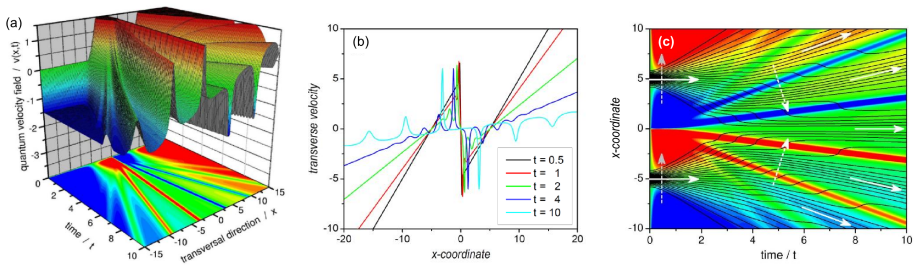
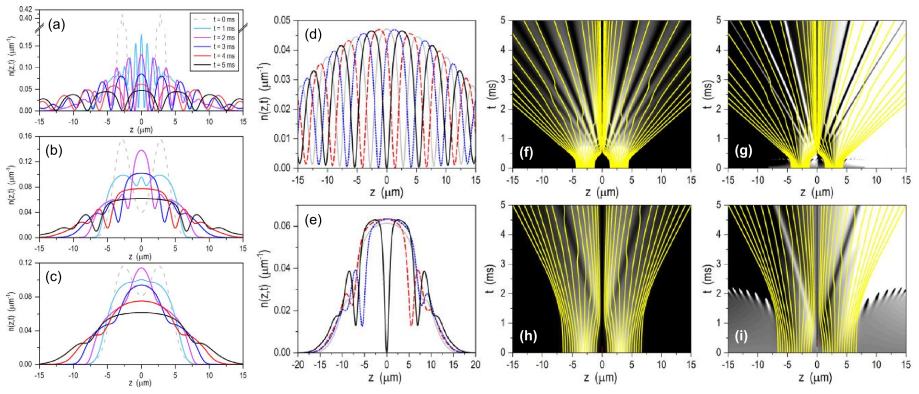
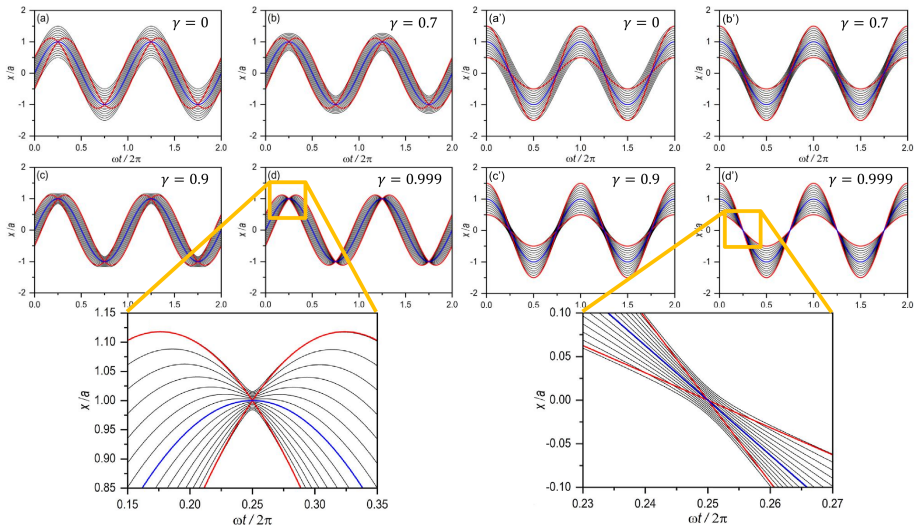
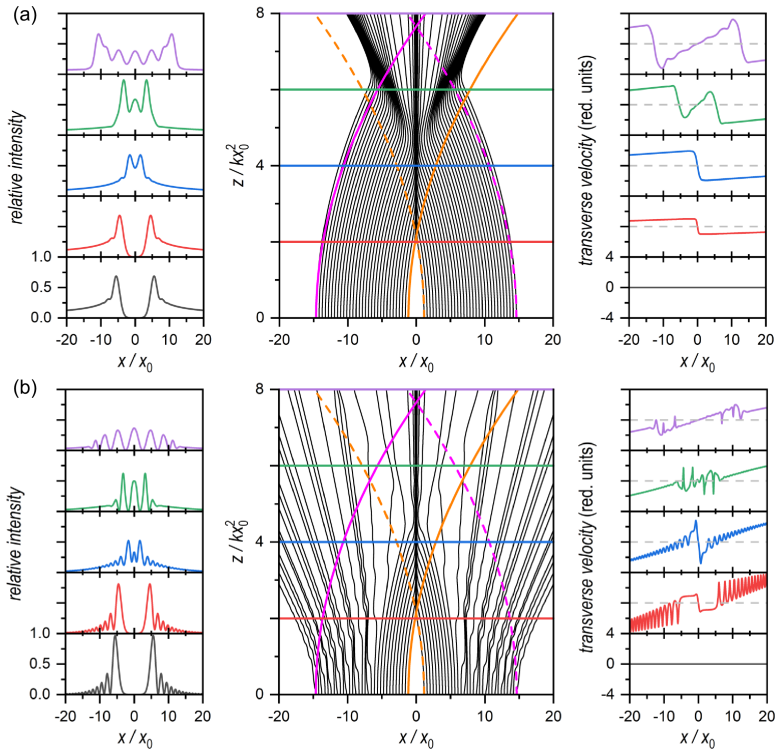
Interference is commonly regarded as the most direct manifestation of the superposition principle. This association is natural for the linear Schr\"odinger equation, where coherent alternatives combine at the level of probability amplitudes. However, the situation becomes less transparent when nonlinear couplings are present, or when the field is only partially coherent. In this work, we argue that a more robust organizing principle is provided by the local flow generated by phase variations. In this sense, phase-induced flow acts as a unifying mechanism for interference-like dynamics in nonlinear and partially coherent Schr\"odinger systems. The discussion is developed from a hydrodynamic, or Bohmian, perspective, understood here as a practical probing tool rather than as an additional ontology. Three representative situations are considered: interfering Bose--Einstein condensates described by the Gross--Pitaevskii equation, nonlinear Schr\"odinger dynamics obtained by modifying the quantum-potential contribution, and partially coherent Airy beams described through their cross-spectral density. Although these systems differ in physical origin and mathematical implementation, they share a common dynamical structure: density-related observables are shaped by velocity fields determined by phase, or ensemble-phase, information. From this viewpoint, interference-like traits, localization, self-acceleration and coherence loss can be interpreted in terms of the preservation, deformation or breaking of the symmetries displayed by the underlying flow. This provides a compact way of connecting interference, nonlinear dynamics, classicality, coherence loss, and structured-light propagation within a single trajectory-based framework.
Editorial analysis
A structured set of objections, weighed in public.
Referee Report
Summary. The manuscript argues that phase-induced flow, analyzed via a hydrodynamic/Bohmian perspective treated strictly as a practical tool, provides a unifying mechanism for interference-like dynamics across nonlinear and partially coherent Schrödinger systems. It examines three cases—interfering Bose-Einstein condensates governed by the Gross-Pitaevskii equation, nonlinear Schrödinger dynamics with a modified quantum-potential term, and partially coherent Airy beams described by their cross-spectral density—claiming that density-related observables are shaped by velocity fields determined by phase or ensemble-phase information. Interference-like features, localization, self-acceleration, and coherence loss are then interpreted through preservation, deformation, or breaking of the symmetries of this underlying flow.
Significance. If the claimed common dynamical structure is explicitly demonstrated, the work supplies a compact trajectory-based framework that links interference, nonlinear effects, classicality, and structured-light propagation without invoking linearity or full coherence. Treating the Bohmian picture as a neutral probing tool rather than an ontology is a constructive choice that focuses attention on the phase-velocity relation. The approach could prove useful for connecting phenomena that are usually treated separately, though its significance remains primarily interpretive and organizational rather than predictive.
minor comments (3)
- [Abstract] The abstract is information-dense; the central claim about shared dynamical structure would be clearer if the three examples were introduced with one-sentence descriptions of their distinct physical origins before the common structure is stated.
- [Main text (examples section)] Notation for the velocity field and ensemble-phase information should be introduced once with explicit definitions (e.g., v = ∇S/m or equivalent) and then used consistently across the three examples to avoid reader confusion when moving between the Gross-Pitaevskii, modified NLS, and cross-spectral-density cases.
- [Figures] Figure captions for any flow-line or density plots should explicitly label which symmetry (e.g., translational, rotational) is being preserved or broken in each panel.
Simulated Author's Rebuttal
We thank the referee for the positive and accurate summary of our work and for recommending minor revision. The assessment correctly identifies the interpretive and organizational character of the contribution, which matches our stated aim of using the hydrodynamic/Bohmian picture strictly as a practical tool to reveal a common phase-induced flow structure across the three systems.
Circularity Check
No significant circularity detected
full rationale
The provided abstract frames the Bohmian/hydrodynamic perspective explicitly as a practical probing tool rather than ontology, and argues that phase-induced flow unifies interference-like dynamics across the three example systems via shared velocity-field structure. No equations, fitted parameters, self-citations, or uniqueness theorems are exhibited that would reduce any claimed prediction or organizing principle to an input by construction. The derivation chain therefore remains self-contained against external benchmarks, with the central claim resting on interpretive comparison of dynamical structures rather than definitional or statistical closure.
Axiom & Free-Parameter Ledger
axioms (2)
- domain assumption The Bohmian (hydrodynamic) perspective can be used as a practical probing tool without implying additional ontology.
- domain assumption The three representative systems share a common dynamical structure determined by phase or ensemble-phase information.
Reference graph
Works this paper leans on
-
[1]
Bohm D 1952 A suggested interpretation of the quantum theory in terms of “hidden” variables. IPhys. Rev. 85166–179
1952
-
[2]
Bohm D 1952 A suggested interpretation of the quantum theory in terms of “hidden” variables. IIPhys. Rev.85180–193
1952
-
[3]
Phys.40322–326
Madelung E 1926 Quantentheorie in hydrodynamischer FormZ. Phys.40322–326
1926
-
[4]
Holland P R 1993The Quantum Theory of Motion(Cambridge: Cambridge University Press)
-
[5]
Phys.1411301
Sanz A S 2019 Bohm’s approach to quantum mechanics: Alternative theory or practical picture?Front. Phys.1411301
2019
-
[6]
Phys.: Conf
Sanz A S 2024 Symmetries and singular behaviors with Bohmian trajectoriesJ. Phys.: Conf. Ser.2883 012011
2024
-
[7]
Tonomura A, Endo J, Matsuda T, Kawasaki T and Ezawa H 1989 Demonstration of single-electron buildup of an interference patternAm. J. Phys.57117–120
1989
-
[8]
Arndt M, Nairz O, Vos-Andreae J, Keller C, van der Zouw G and Zeilinger A 1999 Wave-particle duality of C60 moleculesNature401680–682
1999
-
[9]
Arndt M and Hornberger K 2014 Testing the limits of quantum mechanical superpositionsNature Phys.10 271–277
2014
-
[10]
Andrews M R, Townsend C G, Miesner H-J, Durfee D S, Kurn D M and Ketterle W 1997 Observation of interference between two Bose condensatesScience275637–641
1997
-
[11]
Schumm T, Hofferberth S, Andersson L M, Wildermuth S, Groth S, Bar-Joseph I, Schmiedmayer J and Kr¨ uger P 2005 Matter-wave interferometry in a double well on an atom chipNature Phys.157–62
2005
-
[12]
Kocsis S, Braverman B, Ravets S, Stevens M J, Mirin R P, Shalm L K and Steinberg A M 2011 Observing the average trajectories of single photons in a two-slit interferometerScience3321170–1173
2011
-
[13]
Shapiro M and Brumer P 2003Principles of the Quantum Control of Molecular Processes(Wiley: New York)
-
[14]
Nielsen M A and Chuang I L 2000Quantum Computation and Quantum Information(Cambridge: Cambridge University Press)
-
[15]
Mandel L and Wolf E 1995Optical Coherence and Quantum Optics(Cambridge: Cambridge University Press)
-
[16]
Laser Technol.184112509
Sanz A S and Mart´ ınez-Herrero R 2025 Generalized flux trajectories: new insights into partially coherent Airy beamsOpt. Laser Technol.184112509
2025
-
[17]
Gross E P 1961 Structure of a quantized vortex in boson systemsIl Nuovo Cimento20454–477
1961
-
[18]
Pitaevskii L P 1961 Vortex lines in an imperfect Bose gasSov. Phys. JETP13451–454
1961
-
[19]
Pethick C J and Smith H 2002Bose–Einstein Condensation in Dilute Gases(Cambridge: Cambridge University Press)
-
[20]
Tounli J and Sanz A S 2024 Bohmian analysis of dark solutions in interfering Bose–Einstein condensates: the dynamical role of underlying velocity fieldsResults Phys.63107859
2024
-
[21]
Rev.1251100–1108
Schiller R 1962 Quasi-classical theory of the nonspinning electronPhys. Rev.1251100–1108
1962
-
[22]
Rev.1251109–1115
Schiller R 1962 Quasi-classical transformation theoryPhys. Rev.1251109–1115
1962
-
[23]
Rosen N 1964 The relation between classical and quantum mechanicsAm. J. Phys.32597–600
1964
-
[24]
Phys.16687–700
Rosen N 1986 Quantum particles and classical particlesFound. Phys.16687–700
1986
-
[25]
classical
Navia D and Sanz A S 2024 Exploring the nonclassical dynamics of the “classical” Schr¨ odinger equation Ann. Phys.463169637
2024
-
[26]
Sanz A S and Miret-Art´ es S 2012A Trajectory Description of Quantum Processes. I. Fundamentals(Berlin: Springer)
-
[27]
Sanz A S and Miret-Art´ es S 2008 A trajectory-based understanding of quantum interferenceJ. Phys. A: Math. Theor.41435303
2008
-
[28]
Berry M V and Balazs N L 1979 Nonspreading wave packetsAm. J. Phys.47264–267
1979
-
[29]
Lett.32979–981
Siviloglou G A and Christodoulides D N 2007 Accelerating finite energy Airy beamsOpt. Lett.32979–981
2007
-
[30]
Mart´ ınez-Herrero R and Sanz A S 2022 Partially coherent Airy beams: a cross-spectral-density approach Phys. Rev. A106053512
2022
-
[31]
Express325592–5606
Sanz A S and Mart´ ınez-Herrero R 2024 Exploring the dynamics of finite-energy Airy beams: a trajectory analysis perspectiveOpt. Express325592–5606
2024
discussion (0)
Sign in with ORCID, Apple, or X to comment. Anyone can read and Pith papers without signing in.