REVIEW 2 major objections 1 minor 140 references
Resource Letter QIE-1: Research in quantum information education
T0 review · 2 major / 1 minor · reviewed 2026-06-27 · grok-4.3
Pith's one-line read A resource letter surveys scholarship on teaching quantum information science and engineering.
desk verdict This resource letter organizes existing QISE education work into a usable guide but its value depends on whether the curation is complete enough to be reliable. read the letter →
The pith
A machine-rendered reading of the paper's core claim, the machinery that carries it, and where it could break.
The reading
What carries the argument
The Resource Letter, which functions as a curated index and summary of existing QISE education scholarship across the listed topic areas.
What would settle it
A systematic search that identifies a substantial body of relevant QISE education papers, curricula, or tools omitted from the letter.
Extended reading notes
Core claim
The authors present a structured overview of the QISE education literature that identifies studies of student reasoning, research-based and research-inspired curricula at multiple levels, validated assessments, simulation and gamification tools, and materials for societal and ethical discussions, thereby mapping the field for educators and researchers.
Load-bearing premise
The papers and resources selected for inclusion accurately and comprehensively capture the current state of QISE education research.
Editorial extensions
If this is right
- Educators can locate and adopt research-based curricula and assessments for QISE courses.
- DBER researchers can identify established results and open questions to guide new studies.
- Instructors can incorporate simulation tools, games, and ethical discussion modules into existing classes.
- The field gains a shared reference point that supports consistent use of evidence-based methods.
Reading between the lines
- Periodic updates to the letter could track growth in the field after 2025.
- The compiled resources may encourage cross-fertilization between QISE education and other STEM education research areas.
- Inclusion of societal implications sections suggests quantum education can address responsible technology development.
Signed reviews
Editorial analysis
A structured set of objections, weighed in public.
Referee Report
Summary. The paper is a Resource Letter surveying scholarship in quantum information science and engineering (QISE) education. It serves as a guide for educators adopting research-based teaching methods and for DBER practitioners entering the field. Topics covered include scoping the QISE education field, research on student reasoning, curricular materials from high school through graduate levels, research-based assessments, simulation and gamification tools, and incorporation of societal/ethical implications of quantum technologies.
Significance. If the literature curation is representative, the Resource Letter would provide a timely and practical entry point for educators and researchers, especially in the context of the 2025 UN International Year of Quantum Science and Technology. It compiles disparate resources on student reasoning, curricula, assessments, and tools into a single reference that could accelerate evidence-based QISE instruction and related DBER.
major comments (2)
- [Introduction / Scoping the field of QISE education] The manuscript does not describe the literature search strategy, databases used, search terms, or inclusion/exclusion criteria for selecting references. This is load-bearing for the central claim that the letter accurately scopes the field and serves as a reliable guide, given the abstract's emphasis on the 'rapidly-growing' nature of QISE education scholarship.
- [Topics covered (as listed in abstract)] No explicit discussion of potential gaps or rapidly emerging sub-areas (e.g., specific recent assessment instruments or gamification studies post-dating the curation) is provided to bound the risk of omissions, which directly affects the utility for DBER practitioners seeking starting points.
minor comments (1)
- The abstract lists topics but the manuscript would benefit from a short table or bulleted overview mapping each topic to key references or sections for quicker navigation by readers.
Simulated Author's Rebuttal
We thank the referee for their constructive feedback and positive evaluation of the Resource Letter. We agree that the two points raised will strengthen the manuscript's transparency and utility, and we will incorporate revisions accordingly.
read point-by-point responses
-
Referee: [Introduction / Scoping the field of QISE education] The manuscript does not describe the literature search strategy, databases used, search terms, or inclusion/exclusion criteria for selecting references. This is load-bearing for the central claim that the letter accurately scopes the field and serves as a reliable guide, given the abstract's emphasis on the 'rapidly-growing' nature of QISE education scholarship.
Authors: We agree that an explicit description of the literature curation process is important for establishing the Resource Letter as a reliable guide. In the revised manuscript, we will add a new subsection (likely in the Introduction) that details the search strategy, including the databases consulted (e.g., Google Scholar, Web of Science, arXiv, and education-specific repositories), the primary search terms employed (such as combinations of 'quantum information', 'QISE', 'education research', 'student reasoning'), the time period covered, and the inclusion/exclusion criteria used to select references. This addition will directly address the concern about scoping the rapidly growing field. revision: yes
-
Referee: [Topics covered (as listed in abstract)] No explicit discussion of potential gaps or rapidly emerging sub-areas (e.g., specific recent assessment instruments or gamification studies post-dating the curation) is provided to bound the risk of omissions, which directly affects the utility for DBER practitioners seeking starting points.
Authors: We concur that bounding the risk of omissions through discussion of gaps and emerging areas will improve the manuscript's value for DBER practitioners. In the revision, we will add a dedicated paragraph or short subsection (possibly at the end of the scoping section or in a new 'Limitations and Future Directions' note) that acknowledges the literature cutoff date, notes the potential for rapid developments in areas such as new assessment instruments and gamification tools, and points readers toward ongoing searches or recent preprints for the most current work. This will help contextualize the survey without overclaiming completeness. revision: yes
Circularity Check
No derivations or predictions; survey curation has no circularity
full rationale
This resource letter is a literature survey and guide with no equations, fitted parameters, predictive claims, or derivations of any kind. The central content is a curated overview of QISE education research topics, and its value rests on the scope and accuracy of that curation rather than any self-referential reduction. No self-citation chains, uniqueness theorems, or ansatzes are invoked to support a claimed result. The paper is self-contained against external benchmarks of literature coverage and does not reduce any output to its own inputs by construction.
Assumptions & free parameters
Cite this review
Pith. "Pith review of Resource Letter QIE-1: Research in quantum information education." pith.science (2026). https://pith.science/paper/Q45EQ7ZO
@misc{pith2026260606445,
  author       = {Pith},
  title        = {Pith review of: Resource Letter QIE-1: Research in quantum information education},
  year         = {2026},
  howpublished = {\url{https://pith.science/paper/Q45EQ7ZO}},
  note         = {Machine review of arXiv:2606.06445}
}
read the original abstract
In celebration of the 2025 UN International Year of Quantum Science and Technology, this Resource Letter surveys the rapidly-growing field of scholarship in quantum information science and engineering (QISE) education. It is primarily written as a guide for educators wishing to get started teaching QISE using research-based teaching methods, as well as for discipline-based education research (DBER) practitioners looking to get started in this field. Topics covered include scoping the field of QISE education, research into student reasoning in QISE, research-based and research-inspired curricular materials from the high school to graduate level, research-based assessments, simulation and gamification tools, and tools for incorporating discussion of the societal and ethical implications of quantum technologies into the classroom.
Figures
Reference graph
Works this paper leans on
-
[1]
quantum divide
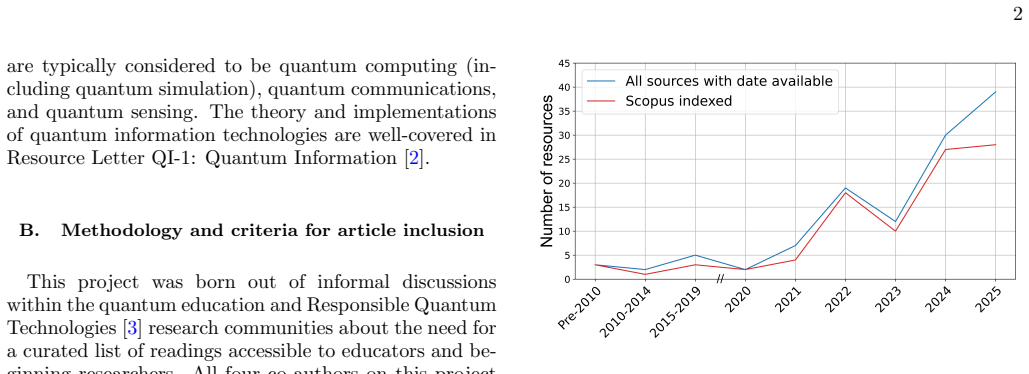
Five resources with a 2026 publication date (typically released as preprints or early access in 2025), are not shown. research tradition in Physics Education Research, and likely warrants its own Resource Letter. C. Bibliometric analysis For completeness sake, we performed bibliometric anal- ysis of our dataset to identify whether we were missing any high...
2026
-
[2]
United States quantum education landscape,
“United States quantum education landscape,” B.M. Zwicklet al.https://quantumlandscape. streamlit.app/. An intuitive and up-to-date visualization of QISE (and traditional quantum mechanics) coursework and degree programs at US universities, showcasing the distribution and breadth of these programs. (E)
-
[3]
Defining the quantum workforce landscape: A review of global quantum education initiatives,
“Defining the quantum workforce landscape: A review of global quantum education initiatives,” M. Kaur and A. Venegas-Gomez. Opt. Eng. 61(8), 081806 (2022). Notable for the study’s fo- cus on academic-industry alignment and for in- cluding nontraditional education pathways such as hackathons, conferences, and MOOCs. (E)
2022
-
[4]
Quantum technology master’s: A shortcut to the quantum industry?
“Quantum technology master’s: A shortcut to the quantum industry?” S. Goorneyet al.EPJ Quantum Technol.12, 2 (2025). A global land- scape study of QISE master’s programs, showing a marked shift over time from focus on academic to industry-focused careers and from physics to inter- disciplinary faculties. (E)
2025
-
[5]
Landscape of quantum information science and engineering education: From physics foundations to interdisciplinary frontiers,
“Landscape of quantum information science and engineering education: From physics foundations to interdisciplinary frontiers,” A.R. Pi˜ naet al. Phys. Rev. Phys. Educ. Res.21, 020131 (2025). A detailed, accessible analysis of the distribution of QISE courses and degree programs in the US, with attention to equity and opportunities to in- corporate QISE wi...
2025
-
[6]
Today’s interdisciplinary quantum information classroom: Themes from a survey of quantum in- formation science instructors,
“Today’s interdisciplinary quantum information classroom: Themes from a survey of quantum in- formation science instructors,” J.C. Meyeret al. Phys. Rev. Phys. Educ. Res.18, 010150 (2022). A mixed-methods study of interdisciplinary QISE educators’ experiences, focusing on the diversity of student and instructor backgrounds, prerequisites, curricular mater...
2022
-
[7]
Building Europe’s quantum technology education community,
“Building Europe’s quantum technology education community,” S. Goorney, E. Karydi, and J. Sher- son. EPJ Quantum Technol.12, 61 (2025). A detailed discussion of the European quantum edu- cation community, focused on an activity-theoretic analysis of 11 pilot projects. (I)
2025
-
[8]
Preparing students for the quantum information revolution: Interdisciplinary teaching, curriculum development, and advising in quantum informa- tion science and engineering,
“Preparing students for the quantum information revolution: Interdisciplinary teaching, curriculum development, and advising in quantum informa- tion science and engineering,” F. Seifollahi and C. Singh. Eur. J. Phys. (2025). A qualita- tive study featuring 7 interviews with university- level QISE instructors of diverse disciplinary back- grounds. The int...
2025
Show all 140 references
-
[9]
Building bridges in quantum information science education: Expert insights to guide framework de- velopment for interdisciplinary teaching and evo- lution of common language,
“Building bridges in quantum information science education: Expert insights to guide framework de- velopment for interdisciplinary teaching and evo- lution of common language,” L. Doyle, F. Seifol- lahi, and C. Singh. EPJ Quantum Technol.13, 2 (2026). Shares reflections from u...
2026
-
[10]
Disparities in access to US quantum information education,
“Disparities in access to US quantum information education,” J.C. Meyer, G. Passante, and B.R. Wilcox. Phys. Rev. Phys. Educ. Res.20, 010131 (2024). A quantitative study of QISE course availability at US institutions, demonstrating that coursework is heavily concentrated at el...
2024
-
[11]
Quantum Information Science and Technology Workforce Development National Strategic Plan,
“Quantum Information Science and Technology Workforce Development National Strategic Plan,” U.S. National Science & Technology Council (2022). The plan outlines a coordinated federal strategy to assess QIST workforce needs, expand access through outreach and education, and ad-...
2022
-
[12]
Quantum education in Africa: Innovative models, collaborative frameworks, and the path forward,
“Quantum education in Africa: Innovative models, collaborative frameworks, and the path forward,” F. Mazhandu and M. Mafu. Proc. 2025 IEEE Int. Conf. Quantum Comput. Eng.3, 65-69 (2025). An accessible analysis of the state of QISE education and research across the African cont...
2025
-
[13]
UK Quantum Skills Taskforce Report,
“UK Quantum Skills Taskforce Report,” UK De- partment for Science, Innovation & Technology (2025). Sets out current and future skills demands in the UK quantum sector and proposes 16 recom- mendations to align education, training pathways, technical roles, and equity goals to ...
2025
-
[14]
Insights from educators on building a more co- hesive quantum information science and engineer- ing education ecosystem,
“Insights from educators on building a more co- hesive quantum information science and engineer- ing education ecosystem,” S. El-Adawyet al. Phys. Rev. Phys. Educ. Res.21, 020144 (2025). The authors analyze interviews with educators at 15 institutions to identify common challe...
2025
-
[15]
Investigating opportunities for growth and in- creased diversity in quantum information science and engineering education in the U.S.,
“Investigating opportunities for growth and in- creased diversity in quantum information science and engineering education in the U.S.,” A.R. Pi˜ na et al.Proc. 2025 ASEE Ann. Conf. Expo., 48011 (2025). This work analyzes over 8,000 course list- ings and nearly 90 dedicated QI...
2025
-
[16]
Outcomes from a workshop on a national center for quantum education,
“Outcomes from a workshop on a national center for quantum education,” E. Barneset al.EPJ Quantum Technol.12, 40 (2025). It synthesizes outcomes from a multi-stakeholder NSF-sponsored workshop on establishing a national center for quantum education, identifying coordinated str...
2025
-
[17]
Preparing for the quantum revolution: What is the role of higher education?
“Preparing for the quantum revolution: What is the role of higher education?” M.F.J. Fox, B.M. Zwickl, and H.J. Lewandowski. Phys. Rev. Phys. Educ. Res.16, 020131 (2020). An early study 5 in which 21 U.S. companies were interviewed re- garding the skills they value in differen...
2020
-
[18]
Achieving a quantum smart workforce,
“Achieving a quantum smart workforce,” C. Aiello et al.Quantum Sci. Technol.6(3), 030501 (2021). Is a 2021 perspective article reporting on the sta- tus of 18 early efforts in university education for QISE.The authors advocate for integrating quan- tum concepts into existing S...
2021
-
[19]
Assessing the needs of the quantum industry,
“Assessing the needs of the quantum industry,” C. Hugheset al.IEEE Trans. Educ.65(4), 592-601 (2022). Investigates what kind of jobs, skills, and degrees are needed for the development of the qun- tum industry, through a survey of 57 companies. They identified that many job ro...
2022
-
[20]
Industry perspectives on projected quantum workforce needs,
“Industry perspectives on projected quantum workforce needs,” S. El-Adawyet al.Proc. 2025 Phys. Educ. Res. Conf., 148-153 (2025). An in- terview study investigating how quantum indus- try professionals in managerial positions feel about workforce needs. The authors found that ...
2025
-
[21]
Industry insights into quantum knowledge needed for the quantum information science and engi- neering workforce,
“Industry insights into quantum knowledge needed for the quantum information science and engi- neering workforce,” A.R. Pi˜ naet al.Proc. 2025 Phys. Educ. Res. Conf., 350-355 (2025). This inter- view study was undertaken with managers and em- ployees at 21 QISE companies. The ...
2025
-
[22]
Quantum Workforce Report Series,
“Quantum Workforce Report Series,” S. El-Adawy, A.R. Pi˜ na, H.J. Lewandowski, and B.M. Zwickl (2025-2026). A set of 3 whitepapers on the roles, skills, and job duties of a broad cross-section of the US quantum industry, designed to be easily acces- sible to nonexperts. (E) •R...
2025
-
[23]
The quantum technology job market: Data driven analysis of 3641 job posts,
“The quantum technology job market: Data driven analysis of 3641 job posts,” S. Goorneyet al.EPJ Quantum Technol. (2026). This is the first large- scale empirical study of the quantum job market, using data from 3,641 online job postings. The authors identify trends across geo...
2026
-
[24]
Quantum technician skills and competencies for the emerging Quantum 2.0 industry,
“Quantum technician skills and competencies for the emerging Quantum 2.0 industry,” M. Hasanovic et al.Opt. Eng.61(8), 081803 (2022). This paper argues that technician education is a missing but essential link in the quantum workforce pipeline, and identify 5 key areas for tec...
2022
-
[25]
Mapping quantum industry demands to educa- tion: A critical analysis of skills, qualifications, and modalities,
“Mapping quantum industry demands to educa- tion: A critical analysis of skills, qualifications, and modalities,” S. Devendrabrabu, S. Ganguly, and K. Hemachandran. EPJ Quantum Technol.12, 105 (2025). This article investigates job descriptions from 90 quantum jobs in detail, i...
2025
-
[26]
Requirements for future quantum workforce – a Delphi study,
“Requirements for future quantum workforce – a Delphi study,” F. Gerke 5 et al.J. Phys.: Conf. Ser.2297(GIREP Malta Webinar 2020), 012017 (2022). (E)
2020
-
[27]
Future quantum workforce: Competences, re- quirements, and forecasts,
“Future quantum workforce: Competences, re- quirements, and forecasts,” F. Greinertet al.Phys. Rev. Phys. Educ. Res.19, 010137 (2023). (E)
2023
-
[28]
Towards a quantum ready workforce: The up- dated European Competence Framework for Quan- tum Technologies,
“Towards a quantum ready workforce: The up- dated European Competence Framework for Quan- tum Technologies,” F. Greinertet al.Front. Quan- tum Sci. Technol.2, 1225733 (2023). (E)
2023
-
[29]
Advancing quantum technology workforce: Indus- try insights into qualification and training needs,
“Advancing quantum technology workforce: Indus- try insights into qualification and training needs,” F. Greinertet al.EPJ Quantum Technol.11, 82 (2024). (E)
2024
-
[30]
Extending the European Competence Framework for Quantum Technologies: New proficiency trian- gle and qualification profiles,
“Extending the European Competence Framework for Quantum Technologies: New proficiency trian- gle and qualification profiles,” F. Greinertet al. EPJ Quantum Technol.12, 1 (2025). (E) Note that the European Competence Framework has been successfully applied outside the original...
2025
-
[31]
Quantum computer engineering education in the Philippines: A readiness and recommendation analysis of the prescribed computer engineering curriculum,
“Quantum computer engineering education in the Philippines: A readiness and recommendation analysis of the prescribed computer engineering curriculum,” D.J. Domingo Lopezet al.Proc. 2025 IEEE Int. Conf. Quantum Comput. Eng.3, 71-80 (2025). Analyzes the existing undergraduate c...
2025
-
[32]
The quantum computer revolution must include women,
“The quantum computer revolution must include women,” C. Singh. Scientific American (2021 Jan 13). Argues that women report a weaker sense of belonging and self efficacy in the field, and suggests a number of strategies to help improve feelings of integration for women in QISE. (E)
2021
-
[33]
Q-Turn: Changing paradigms in quantum sci- ence,
“Q-Turn: Changing paradigms in quantum sci- ence,” A.B. Sainz. Quantum Sci. Technol.7(4), 044004 (2022). Sainz (2022) presents Q-Turn, an international workshop series that integrates quan- tum information science with social awareness and community reform. The workshops show ...
2022
-
[34]
Creating a modular, workforce-relevant under- graduate curriculum for quantum information sci- ence and engineering for all people,
“Creating a modular, workforce-relevant under- graduate curriculum for quantum information sci- ence and engineering for all people,” C.D. Porter, Z. Atiq, and E. Fletecher. Proc. 2022 Phys. Educ. Res. Conf., 365-370 (2022). Describes the QuSTEAM initiative, a large-scale coll...
2022
-
[35]
Reflections of quantum educators on strategies to diversify the Second Quantum Revolution,
“Reflections of quantum educators on strategies to diversify the Second Quantum Revolution,” A. Ghimire and C. Singh. Phys. Teach.63, 35- 39 (2025). This article explores how QISE might avoid inheriting the inequitable culture of tradi- tional physics. Educators emphasize intr...
2025
-
[36]
Leveraging equity and inclusion to demystify and diversify undergraduate quantum science educa- tion,
“Leveraging equity and inclusion to demystify and diversify undergraduate quantum science educa- tion,” M. Mafu and F. Mazhandu. Phys. Teach. 63, 90-94 (2025). Discusses the interconnected structures (social, economic, and power) which can affect diversity in and access to QIS...
2025
-
[37]
Quantum computing online workshops and hackathon for Spanish speakers: A case study,
“Quantum computing online workshops and hackathon for Spanish speakers: A case study,” A. Maldonado-Romo and L. Yeh. Proc. 2022 IEEE Int. Conf. Quantum Comput. Eng., 709-717 (2022). Reports on a Spanish-language online workshop se- ries and hackathon in Latin America, highligh...
2022
-
[38]
Leveraging dual enrollment programs to expand secondary education in quantum computation,
“Leveraging dual enrollment programs to expand secondary education in quantum computation,” D.L. Tucker. Proc. 2023 IEEE Int. Conf. Quan- tum Comput. Eng.3, 10-14 (2023). Illustrates how partnerships between universities and regional high schools can scalably expand access to ...
2023
-
[39]
Introducing quantum information and compu- tation to a broader audience with MOOCs at OpenHPI,
“Introducing quantum information and compu- tation to a broader audience with MOOCs at OpenHPI,” G. Hellstern, J. Hettel, and B. Just. EPJ Quantum Technol.11, 59 (2024). Analyzes a sequence of nine MOOCs on quantum computing offered via OpenHPI, reporting on participant de- mo...
2024
-
[40]
Quantum Entrepeneurship Lab: Training a future workforce for the quantum industry,
“Quantum Entrepeneurship Lab: Training a future workforce for the quantum industry,” A. Sander et al.Proc. 2025 IEEE Int. Conf. Quantum Comput. Eng.3, 185-193 (2025). Presents the Quantum Entrepreneurship Lab, a one-semester, project-based course at Technical University of Mu-...
2025
-
[41]
Quantum workshop for IT professionals,
“Quantum workshop for IT professionals,” B. Just, J. Hettel, and G. Hellstern. EPJ Quantum Tech- nol.13, 4 (2026). Presents the design and eval- uation of a one-day module intended to upskill existing industry professionals, and demonstrates that an approach based primarily on...
2026
-
[42]
Building a quantum engineering undergraduate program,
“Building a quantum engineering undergraduate program,” A. Asfawet al.IEEE Trans. Educ. 65(2), 220-242 (2022). A community-developed roadmap for undergraduate quantum engineering education, detailing course frameworks, degree tracks, and training opportunities to prepare both ...
2022
-
[43]
Development of an undergraduate quantum engi- neering degree,
“Development of an undergraduate quantum engi- neering degree,” A.S. Dzuraket al.IEEE Trans. Quantum Eng.3, 6500110 (2022). Describes the creation and first year of operation of one of the world’s first undergraduate degree in quantum en- gineering, offering a model for integr...
2022
-
[44]
The design and implementation of a quantum information science undergraduate program,
“The design and implementation of a quantum information science undergraduate program,” S. Blanchetteet al.arXiv:2412.01874 (2024). De- scribes the design and launch of a 3.5-year under- graduate program in quantum information science at Universit´ e de Sherbrooke, detailing c...
2024
-
[45]
The quantum technology open master: Widening access to the quantum industry,
“The quantum technology open master: Widening access to the quantum industry,” S. Goorney, M. Sarantinou, and J. Sherson. EPJ Quantum Tech- nol.11, 7 (2024). The authors conceptualize and evaluate an “Open Master” transnational educa- tion model in quantum technology, showing ...
2024
-
[46]
QCaMP: A 4-week summer camp introducing high school students to quantum information science and technology,
“QCaMP: A 4-week summer camp introducing high school students to quantum information science and technology,” M. Ivoryet al.Proc. 2025 IEEE Int. Conf. Quantum Comput. Eng.3, 29-38 (2025). Presents the design of a project-based QISE sum- mer camp for high school students, integ...
2025
-
[47]
From computing to quantum mechanics: acces- sible and hands-on quantum computing education for high school students,
“From computing to quantum mechanics: acces- sible and hands-on quantum computing education for high school students,” Q. Sunet al.EPJ Quan- tum Technol.11, 58 (2024). Narrates practical learning in QISE through the use of portable NMR quantum computers, demonstrating how hand...
2024
-
[48]
Project-based learning in introductory quantum computing courses: A case study on quantum algorithms for medical imaging,
“Project-based learning in introductory quantum computing courses: A case study on quantum algorithms for medical imaging,” N.B. Gautam, K.E. Schubert, and E.P. Blair. Proc. 2025 IEEE Int. Conf. Quantum Comput. Eng.3, 39-50 (2025). Illustrates how a project-based learning modu...
2025
-
[49]
Bridging the theory-practice gap: A university course on quantum information science and trans- fer to career-oriented physics teaching,
“Bridging the theory-practice gap: A university course on quantum information science and trans- fer to career-oriented physics teaching,” M. F¨ orster and G. Pospiech. EPJ Quantum Technol.12, 127 (2025). A novel approach to teacher train- ing, bridging an internship with trad...
2025
-
[50]
The USRA Quantum Feynman Academy: If you give a student a quantum internship,
“The USRA Quantum Feynman Academy: If you give a student a quantum internship,” Z. Gon- zalez Izquierdoet al.arXiv:2505.04641 (2025). The authors present an eight-year retrospective on the USRA Feynman Quantum Academy intern- ship program, analyzing how sustained experiential ...
2025
-
[51]
Advancing quantum information science pre- college education: The case for learning sciences collaboration,
“Advancing quantum information science pre- college education: The case for learning sciences collaboration,” R. Coelhoet al.Proc. 2025 IEEE Int. Conf. Quantum Comput. Eng.3, 11-22 (2025). A position paper arguing for the importance of co- operation between educators and the e...
2025
-
[52]
A framework for curriculum transformation in quantum information science and technology edu- cation,
“A framework for curriculum transformation in quantum information science and technology edu- cation,” S. Goorneyet al.Eur. J. Phys.45(6), 065702 (2024). A practical toolkit for development of research-inspired curricula in QISE, distilling the essential findings of decades’ w...
2024
-
[53]
Empirical insights into the effects of research- based teaching strategies in quantum education
“Empirical insights into the effects of research- based teaching strategies in quantum education.” A. Donhauseret al.Phys. Rev. Phys. Educ. Res. 20, 020601 (2024). A systematized review of the literature on research-based strategies for teaching and learning quantum concepts, ...
2024
-
[54]
Student ability to differentiate between superpo- sition and mixed states,
“Student ability to differentiate between superpo- sition and mixed states,” G. Passante, P.J. Emigh, and P.S. Shaffer. Phys. Rev. ST Phys. Educ. Res. 11, 020135 (2015). Investigates how undergraduate and graduate students understand the distinction between superposition and m...
2015
-
[55]
Investigating students’ strategies for interpreting quantum states in an upper-division quantum com- puting course,
“Investigating students’ strategies for interpreting quantum states in an upper-division quantum com- puting course,” J.C. Meyeret al.Proc. 2021 Phys. Educ. Res. Conf., 289-294 (2021). Examines how upper-division QISE students interpret quantum states, particularly distinguish...
2021
-
[56]
Investigating student interpretations of the dif- ferences between classical and quantum comput- ers: Are quantum computers just analog classi- cal computers?
“Investigating student interpretations of the dif- ferences between classical and quantum comput- ers: Are quantum computers just analog classi- cal computers?” J.C. Meyeret al.Proc. 2022 Phys. Educ. Res. Conf., 317-322 (2022). Investi- gates how upper-division and graduate-le...
2022
-
[57]
Investigating students’ strengths and difficulties in quantum computing,
“Investigating students’ strengths and difficulties in quantum computing,” T. Kushimo and B. Thacker. Proc. 2023 IEEE Int. Conf. Quantum Comput. Eng.3, 33-39 (2023). Examines undergraduate students’ strengths and difficulties in an introduc- tory quantum computing course to gu...
2023
-
[58]
Design and evaluation of a questionnaire to assess learners’ understanding of quantum measurement in different two-state contexts: The context mat- ters,
“Design and evaluation of a questionnaire to assess learners’ understanding of quantum measurement in different two-state contexts: The context mat- ters,” P. Bitzenbaueret al.Phys. Rev. Phys. Educ. Res.20, 020136 (2024). Assesses learners’ un- derstanding of quantum measureme...
2024
-
[59]
Keep it secret, keep it safe: Teaching quantum key distribution in high school,
“Keep it secret, keep it safe: Teaching quantum key distribution in high school,” E.Y. Weissmanet al. EPJ Quantum Technol.11, 64 (2024). Explores the feasibility of teaching quantum key distribution (QKD) at the high school level by testing varied teaching approaches. (I) 9
2024
-
[60]
Secondary and university students’ descriptions of quantum superposition,
“Secondary and university students’ descriptions of quantum superposition,” N.B.C. Birkeland and M.V. Bøe. Phys. Teach.63, 32-34 (2025). A comparative study of Norwegian upper secondary and university students’ descriptions of quantum superposition after engaging with digital ...
2025
-
[61]
Visualization enhances problem solving in multi- qubit systems: An eye-tracking study,
“Visualization enhances problem solving in multi- qubit systems: An eye-tracking study,” J. Bleyet al.Phys. Rev. Phys. Educ. Res.22, 010126 (2026). An investigation into how visualization supports learning in QISE, particularly for understanding Hadamard gate operations in mul...
2026
-
[62]
From research to resources: Assessing student un- derstanding and skills in quantum computing,
“From research to resources: Assessing student un- derstanding and skills in quantum computing,” B. Thackeret al.Eur. J. Phys.47, 015702 (2025). A comparative study examining students in intro- ductory quantum computing courses taught with and without research-based mini-tutor...
2025
-
[63]
Framework for understanding the patterns of stu- dent difficulties in quantum mechanics,
“Framework for understanding the patterns of stu- dent difficulties in quantum mechanics,” E. Marsh- man and C. Singh. Phys. Rev. ST Phys. Educ. Res.11, 020119 (2015). Presents a framework for analyzing student reasoning difficulties and the de- velopment of expertise in quant...
2015
-
[64]
Effect of an introductory quantum physics course using experiments with heralded photons on pre- university students’ conceptions about quantum physics,
“Effect of an introductory quantum physics course using experiments with heralded photons on pre- university students’ conceptions about quantum physics,” P. Bitzenbauer. Phys. Rev. Phys. Educ. Res.17, 020103 (2021). A quasi-controlled study demonstrating that explicit introdu...
2021
-
[65]
Mathematical sense making of quantum phenom- ena using Dirac notation: Its effect on secondary school students’ functional thinking about pho- tons,
“Mathematical sense making of quantum phenom- ena using Dirac notation: Its effect on secondary school students’ functional thinking about pho- tons,” F. Henniget al.EPJ Quantum Technol. 11, 61 (2024). Investigates whether introducing reduced Dirac notation in teaching quantum...
2024
-
[66]
Investigating student understanding of quantum entanglement,
“Investigating student understanding of quantum entanglement,” A. Kohnle and E. Deffebach. Proc. 2015 Phys. Educ. Res. Conf., 171-174 (2015). This study uses the QuVis Entanglement simulation to examine undergraduate understanding of quantum entanglement, highlighting some per...
2015
-
[67]
Spooky action at a distance? A two-phase study into learners’ views of quantum entanglement,
“Spooky action at a distance? A two-phase study into learners’ views of quantum entanglement,” M. Branget al.EPJ Quantum Technol.11, 33 (2024). This is a two-phase empirical study examining pre- service physics teachers’ and university students’ conceptions of quantum entangle...
2024
-
[68]
Investigating students’ understanding of entangle- ment,
“Investigating students’ understanding of entangle- ment,” B.M. Zwickl and H.J. Hersom. Proc. 2024 Phys. Educ. Res. Conf., 467-472 (2024). A study exploring how undergraduates conceptualize quan- tum entanglement, suggesting that reliance on clas- sical analogies in textbooks ...
2024
-
[69]
A hands-on introduction to single photons and quantum mechanics for undergraduates,
“A hands-on introduction to single photons and quantum mechanics for undergraduates,” B. Pear- son and D. Jackson. Am. J. Phys.78, 471-484 (2010). A useful primer on single-photon quantum optics experiments intended for instructors wishing to implement these experiments. (E)
2010
-
[70]
Implementation and goals of quantum optics ex- periments in undergraduate instructional labs,
“Implementation and goals of quantum optics ex- periments in undergraduate instructional labs,” V. Borish and H. Lewandowski. Phys. Rev. Phys. Educ. Res.19, 010117 (2023). An accessible intro- duction to the possible experiments, learning goals, and uses of single-photon exper...
2023
-
[71]
Seeing quantum effects in experiments,
“Seeing quantum effects in experiments,” V. Bor- ish and H. Lewandowski. Phys. Rev. Phys. Educ. Res.19, 020144 (2023). Probes what it means to “see” quantum effects from instructor and student perspectives, with implications for aligning learn- ing goals with choice and framin...
2023
-
[72]
Student reasoning about quantum mechanics while working with physical experiments,
“Student reasoning about quantum mechanics while working with physical experiments,” V. Bor- ish and H. Lewandowski. Phys. Rev. Phys. 10 Educ. Res.20, 020135 (2024). Features think- aloud interviews with two pairs of students work- ing through single-photon quantum optics expe...
2024
-
[73]
Affordances and challenges of incorporating a remote, cloud-accessible quantum experiment into undergraduate courses,
“Affordances and challenges of incorporating a remote, cloud-accessible quantum experiment into undergraduate courses,” V. Borish and H. Lewandowski. Phys. Rev. Phys. Educ. Res.21, 010133 (2025). This study, based on Infleq- tion’s Oqtant Bose-Einstein Condensate experi- ment6...
2025
-
[74]
Exploratory factor analysis of a precollege quan- tum information science and technology survey: Exploring career aspiration formation and student interest,
“Exploratory factor analysis of a precollege quan- tum information science and technology survey: Exploring career aspiration formation and student interest,” A.M. Kellyet al.EPJ Quantum Tech- nol.12, 11 (2025). Investigates how demographics and prior coursework influence prec...
2025
-
[75]
Formation of students’ interests in quantum tech- nology across STEM majors,
“Formation of students’ interests in quantum tech- nology across STEM majors,” E. Watts and B.M. Zwickl. Proc. 2025 Phys. Educ. Res. Conf., 441-446 (2025). An accessible qualitative study featuring interviews with 22 undergraduates, and identifying crosscutting themes among hi...
2025
-
[76]
Science, technology, engineering, and mathemat- ics undergraduates’ knowledge and interest in quantum careers: Barriers and opportunities to building a diverse quantum workforce,
“Science, technology, engineering, and mathemat- ics undergraduates’ knowledge and interest in quantum careers: Barriers and opportunities to building a diverse quantum workforce,” J.L. Rosen- berg, N. Holincheck, and M. Colandene. Phys. 6 Infleqtion has since shut down Oqtant...
2024
-
[77]
Education for expanding the quantum workforce: Students’ perceptions of the quantum industry in an upper-division physics capstone course,
“Education for expanding the quantum workforce: Students’ perceptions of the quantum industry in an upper-division physics capstone course,” K.A. Oliveret al.Phys. Rev. Phys. Educ. Res.21, 010129 (2025). Examines students’ perceptions of the quantum industry through a universi...
2025
-
[78]
Student attitudes toward quantum information science and technology in a high school outreach program,
“Student attitudes toward quantum information science and technology in a high school outreach program,” M. Darienzoet al.Phys. Rev. Phys. Educ. Res.20, 020126 (2024). This work uses a QIST-specific attitudes survey to assess high school students’ affective outcomes from a sum...
2024
-
[79]
Quantum science and technologies in K-12: Sup- porting teachers to integrate quantum in STEM classrooms,
“Quantum science and technologies in K-12: Sup- porting teachers to integrate quantum in STEM classrooms,” N. Holinchecket al.Educ. Sci.14(3), 219 (2024). Identifies K-12 teachers’ perceived bar- riers to integrating quantum concepts and technolo- gies into STEM classrooms. It...
2024
-
[80]
Quantum information science and technology pro- fessional learning for secondary science, technol- ogy, engineering, and mathematics teachers,
“Quantum information science and technology pro- fessional learning for secondary science, technol- ogy, engineering, and mathematics teachers,” A.M. Kellyet al.Phys. Rev. Phys. Educ. Res.20, 020154 (2024). Examines middle and high school STEM teachers’ self-efficacy, QISE kno...
2024
-
[81]
Preparing precollege students for the Second Quantum Revolution with core concepts in quan- tum information science,
“Preparing precollege students for the Second Quantum Revolution with core concepts in quan- tum information science,” C. Singh, A. Levy, and 11 J. Levy. Phys. Teach.60, 639-641 (2022). Advo- cates for integrating QIS into K–12 curricula using a compare-and-contrast approach b...
2022
-
[82]
Review of literature on quantum information sci- ence and technology programs for high school stu- dents,
“Review of literature on quantum information sci- ence and technology programs for high school stu- dents,” M. Darienzo and A.M. Kelly. Proc. 2024 IEEE International Conference on Quantum Com- puting and Engineering (QCE)3, 96-103 (2024).A comprehensive guide to the literature...
2024
-
[83]
Quantum information science and technology high school outreach: Conceptual progression for in- troducing principles and programming skills,
“Quantum information science and technology high school outreach: Conceptual progression for in- troducing principles and programming skills,” D. Schneble, T.-C. Wei, and A.M. Kelly. Am. J. Phys. 93, 88-97 (2025). Presents a replicable model for teaching high school students Q...
2025
-
[84]
Quantum readiness in Latin American high schools: Curriculum compatibility and en- abling conditions,
“Quantum readiness in Latin American high schools: Curriculum compatibility and en- abling conditions,” A.C. Alvarado Le´ onet al. arXiv:2512.16257 (2025). A detailed analysis of the relative opportunities and constraints around in- tegrating quantum technologies into existing...
2025
-
[85]
Teaching quantum computing to high-school-aged youth: A hands-on approach,
“Teaching quantum computing to high-school-aged youth: A hands-on approach,” P.P. Angaraet al. IEEE Trans. Quantum Eng.3, 3100115 (2022). Describes the design and implementation of quan- tum computing workshops for high school students, integrating unplugged learning activitie...
2022
-
[86]
Making the quantum world accessible to young learners through Quantum Picturalism: An ex- perimental study,
“Making the quantum world accessible to young learners through Quantum Picturalism: An ex- perimental study,” S. D¨ undar-Coeckeet al. arXiv:2504.01013 (2025). Investigates Quantum Picturalism (QPic), a fully diagrammatic approach to qubit quantum mechanics aimed at reducing m...
2025
-
[87]
Enhancing high school students’ understanding and attitude towards quantum mechanics through discipline-culture framework and cognitive appren- ticeship,
“Enhancing high school students’ understanding and attitude towards quantum mechanics through discipline-culture framework and cognitive appren- ticeship,” V.V. Nautiyalet al.EPJ Quantum Tech- nol.12, 104 (2025). Evaluates a fully online Quan- tum Education STEM & Research Int...
2025
-
[88]
A multidisciplinary, artistic approach to broaden- ing the accessibility of quantum science,
“A multidisciplinary, artistic approach to broaden- ing the accessibility of quantum science,” S. Chi- transhet al.Proc. 2022 IEEE Int. Conf. Quantum Comput. Eng., 701-708 (2022). Reports on a novel initiative using theatre and games to make quan- tum concepts accessible to no...
2022
-
[89]
Culturo-scientific storytelling,
“Culturo-scientific storytelling,” S. Goorneyet al. Educ. Sci.12(7), 474 (2022). Introduces a frame- work for storytelling - developing a narrative for QISE in outreach activities, they call the culturo- scientific storytelling (CSS), arguing that QISE has its own distinct cul...
2022
-
[90]
Educating to the “culture
“Educating to the “culture” of quantum technolo- gies: A survey study on concepts for public aware- ness,” Z. C. Seskir, S. R. Goorney, and M. L. Chio- falo. Eur. J. STEM Educ.9(1), 03 (2024). Investi- gates which quantum concepts educators prioritize for outreach using a disc...
2024
-
[91]
Why teach quantum on your own time: The val- ues of grassroots organisations involved in quantum technologies education and outreach,
“Why teach quantum on your own time: The val- ues of grassroots organisations involved in quantum technologies education and outreach,” U. Genenz et al.EPJ Quantum Technol.12, 44 (2025). This article examines the contribution of grassroots or- ganisations to QISE education, ch...
2025
-
[92]
Quantum at a music festival: The impact of an exhibit about quantum science and tech- nologies on festival visitors,
“Quantum at a music festival: The impact of an exhibit about quantum science and tech- nologies on festival visitors,” V. Koemanet al. arXiv:2507.13010 (2025). Evaluate a large-scale public outreach experiment on quantum technolo- gies conducted at the 2024 Lowlands music fest...
2025
-
[93]
From Cbits to Qbits: Teaching computer scien- tists quantum mechanics,
“From Cbits to Qbits: Teaching computer scien- tists quantum mechanics,” N.D. Mermin. Am. J. Phys.71, 23-30 (2003). Perhaps the first paper to propose that relatively little traditional quantum mechanics knowledge is needed to learn quantum computing. Included largely for its ...
2003
-
[94]
The challenge and opportunities of quantum liter- acy for future education and transdisciplinary prob- lem solving,
“The challenge and opportunities of quantum liter- acy for future education and transdisciplinary prob- lem solving,” L. Nitaet al.Res. Sci. Technol. Educ. 41(2), 564-580 (2021). An early discussion notable for its introduction of the concept of “quantum lit- eracy” as a goal ...
2021
-
[95]
Capturing expert mental models of quantum sens- ing using concept maps,
“Capturing expert mental models of quantum sens- ing using concept maps,” N. Pradeep and B.M. Zwickl. Proc. 2025 Phys. Educ. Res. Conf., 356- 261 (2025). This article discusses how researchers come to identify core content in quantum sensing, a domain that lacks traditional te...
2025
-
[96]
Towards a quantum technology PCK for teach- ers,
“Towards a quantum technology PCK for teach- ers,” L. Verbraekenet al.J. Phys.: Conf. Ser.2750 (GIREP 2022), 012045 (2024). Provides a series of toolkits and concept maps on why and how to teach QISE principles in secondary school educa- tion, based on the practical lived expe...
2022
-
[97]
The core of secondary level quantum education: A multi-stakeholder perspective,
“The core of secondary level quantum education: A multi-stakeholder perspective,” A. Merzelet al. EPJ Quantum Technol.11, 27 (2024). Reports on the findings of the first round of a global study of physics researchers, education researchers, and high school teachers on the key ...
2024
-
[98]
Introductory quantum information science courses at US institutions: Content coverage,
“Introductory quantum information science courses at US institutions: Content coverage,” J.C. Meyer et al.EPJ Quantum Technol.11, 16 (2024). A de- tailed analysis of the content covered in university- level introductory QISE courses broken down by topic, identifying a number o...
2024
-
[99]
Investigating the use of multiple representations in university courses on quantum technologies,
“Investigating the use of multiple representations in university courses on quantum technologies,” E. Rexigelet al.EPJ Quantum Technol.12, 22 (2025). Analyzes the symbolic and graphical rep- resentations used by 25 instructors to represent qubit states, finding that apart from...
2025
-
[100]
Exploring the mechanisms of qubit representa- tions and introducing a new category system for vi- sual representations: Results from expert ratings,
“Exploring the mechanisms of qubit representa- tions and introducing a new category system for vi- sual representations: Results from expert ratings,” L. Qerimiet al.EPJ Quantum Technol.12, 45 (2025). Investigates the relative affordances and drawbacks of various representatio...
2025
-
[101]
Q is for Quantum: Quantum mechanics for those who know only basic arithmetic,
“Q is for Quantum: Quantum mechanics for those who know only basic arithmetic,” T. Rudolph (2017). An accessible introduction to basic quan- tum computing with virtually no math prerequi- sites. Useful particularly for teaching quantum lit- eracy to high school and non-science...
2017
-
[102]
Introduction to Classical and Quantum Comput- ing,
“Introduction to Classical and Quantum Comput- ing,” T. G. Wong. (2021). Introduces a freely accessible textbook bridging classical computation 13 and the mathematical foundations of quantum al- gorithms, designed for undergraduates and self- learners. (E)
2021
-
[103]
Quantum in Pictures: A New Way to Understand the Quantum World,
“Quantum in Pictures: A New Way to Understand the Quantum World,” B. Coecke and S. Gogioso. Cambridge Quantum (2023). Offers a visually in- tuitive, low-mathematics introduction to quantum theory by combining imagery and conceptual nar- ration to broaden accessibility for newc...
2023
-
[104]
Quantum Computer Science: An Introduction,
“Quantum Computer Science: An Introduction,” N. David Mermin. Cambridge University Press (2007). Provides a clear, minimal-mathematics in- troduction to quantum computation for computer scientists and mathematicians, treating key algo- rithms, error correction, and foundations...
2007
-
[105]
Quantum Computation and Quantum Informa- tion,
“Quantum Computation and Quantum Informa- tion,” M. A. Nielsen and I. L. Chuang. Cam- bridge University Press (10th Anniversary Edition, 2010). A foundational and comprehensive reference that combines rigorous treatment of quantum al- gorithms, error correction, and informatio...
2010
-
[106]
Quantum Programming in Depth: Solving Prob- lems with Q# and Qiskit,
“Quantum Programming in Depth: Solving Prob- lems with Q# and Qiskit,” M. Mykhailova. Man- ning, 2025. Advances practical quantum software development by guiding readers through algorithm implementation, testing, and performance evalua- tion with Q# and Qiskit. (A) B. Research...
2025
-
[107]
Designing and implementing materials on quan- tum computing for secondary school students: The case of teleportation,
“Designing and implementing materials on quan- tum computing for secondary school students: The case of teleportation,” S. Satanassi, E. Ercolessi, and O. Levrini. Phys. Rev. Phys. Educ. Res. 18, 010122 (2022). This article, one of several by the same authors, introduces the d...
2022
-
[108]
Toward personalizing quantum computing educa- tion: An evolutionary LLM-powered approach,
“Toward personalizing quantum computing educa- tion: An evolutionary LLM-powered approach,” I. Elhaimeur and N. Chrisochoides Proc. 2025 IEEE Int. Conf. Quantum Comput. Eng.3, 174- 184 (2025). An approach for the use of AI models to develop personalized quantum computing lesso...
2025
-
[109]
Quantum games and interactive tools for quantum technologies outreach and education,
“Quantum games and interactive tools for quantum technologies outreach and education,” Z.C. Seskir et al.Opt. Eng.61(8), 081809 (2022). Sum- marises the state of the art in interactive tools and resources for quantum outreach, including games, simulations, and explorable expla...
2022
-
[110]
Games for quantum physics education,
“Games for quantum physics education,” M.L. Chiofaloet al.J. Phys.: Conf. Ser.2727(3rd World Conf. Phys. Educ. 2021), 012010 (2024). This article discusses the significance of games for quantum education, in particular how they help to address the challenge of creative abstrac...
2021
-
[111]
Defining quantum games,
“Defining quantum games,” L. Piispanenet al. EPJ Quantum Technol.12, 7 (2025). Piispanen et al. (2025) take an analytical approach to defin- ing quantum games, by surveying games collected over several years. They identify several common dimensions and propose a definition for...
2025
-
[112]
Ethics education in the quantum information sci- ence classroom: Exploring attitudes, barriers, and opportunities,
“Ethics education in the quantum information sci- ence classroom: Exploring attitudes, barriers, and opportunities,” J.C. Meyer, N. Finkelstein, and B.R. Wilcox. Proc. 2022 ASEE Ann. Conf. Expo., 36517 (2022). Reports findings from QISE in- structor interviews showing interest...
2022
-
[113]
A holistic approach to quantum ethics education,
“A holistic approach to quantum ethics education,” J.´E. Arrow, S.E. Marsh, and J.C. Meyer. Proc. 2023 IEEE Int. Conf. Quantum Comput. Eng.3, 119-128 (2023). A detailed primer on quantum ethics education, covering specific ethical issues pertaining to quantum technologies and ...
2023
-
[114]
Talking about responsible quantum: ‘Awareness is the absolute minimum ... that we need to do,
“Talking about responsible quantum: ‘Awareness is the absolute minimum ... that we need to do,”’ T. Roberson. NanoEthics17, 2 (2023). A stake- holder interview study on the importance of aware- ness and discussion in ensuring ethical and respon- sible development of quantum te...
2023
-
[115]
The role of community building and education as key pillar of institutionalizing responsible quan- tum,
“The role of community building and education as key pillar of institutionalizing responsible quan- tum,” S. Vishwakarmaet al.Proc. 2024 IEEE Int. Conf. Quantum Comput. Eng.3, 86-91 (2024). A position paper from IBM on the role of educational initiatives in fostering equitable...
2024
-
[116]
Building student understanding of quantum infor- mation science and engineering through projects on applications to medical technologies,
“Building student understanding of quantum infor- mation science and engineering through projects on applications to medical technologies,” J.L. Rosenberg and N. Holincheck. Proc. 2025 IEEE 8 Note that while the educational design principles discussed in the paper are sound, s...
2025
-
[117]
Second quantum revolution: The progressive de- sign of an approach to value its cultural and con- ceptual scope,
“Second quantum revolution: The progressive de- sign of an approach to value its cultural and con- ceptual scope,” S. Satanassi and O. Levrini. Phys. Rev. Phys. Educ. Res.21, 010112 (2025). De- tails the development and refinement of a research- based curriculum blending funda...
2025
-
[118]
Is everything quantum ‘spooky and weird’? An exploration of popular communication about quan- tum science and technology in TEDx talks,
“Is everything quantum ‘spooky and weird’? An exploration of popular communication about quan- tum science and technology in TEDx talks,” A.L. Meinsmaet al.Quantum Sci. Technol.8, 035004 (2023). The authors conduct a content analysis of 501 TEDx talks to show that “spooky” fra...
2023
-
[119]
How media hype affects our physics teaching: A case study on quantum computing,
“How media hype affects our physics teaching: A case study on quantum computing,” J.C. Meyeret al. Phys. Teach.61(5), 339-342 (2023). Examines how sensationalized media portrayals of quantum science influence student expectations and miscon- ceptions, and proposes instructiona...
2023
-
[120]
Quantum Computing in the NISQ era and be- yond,
“Quantum Computing in the NISQ era and be- yond,” J. Preskill. Quantum2, 79 (2018). Pro- vides a foundational perspective on the NISQ era, arguing that near-term quantum devices with 50–100 qubits will enable explorations of many- body physics despite noise constraints, and em...
2018
-
[121]
Strategies educators can use to counter misinfor- mation related to the quantum information revo- lution,
“Strategies educators can use to counter misinfor- mation related to the quantum information revo- lution,” J.S. Kashyap and C. Singh. Phys. Educ. 60, 035024 (2025). Proposes concrete instructional 16 strategies for confronting misinformation and mis- conceptions about quantum...
2025
-
[122]
Like a coin spinning in the air: the effect of (non-)metaphorical explanations on comprehen- sion and attitudes towards quantum technology,
“Like a coin spinning in the air: the effect of (non-)metaphorical explanations on comprehen- sion and attitudes towards quantum technology,” A.L. Meinsma, W. G. Reijnierse, and J. Cramer. Metaphor Soc. World (2026). Experimentally com- pares metaphorical, literal, and no expl...
2026
-
[123]
quarksinteractive.com/quantum- odyssey
Quantum Odyssey (educational game), Quarks Interactive. quarksinteractive.com/quantum- odyssey. L. Nita, N. Chancellor, L. Mazzoli Smith, H. Cramman, and G. Dost. arXiv:2106.07077 (2021) An educational puzzle game that conveys quantum computing logic through visual, interac- t...
2021
-
[124]
qubitbyqubit.org
Qubit by Qubit. qubitbyqubit.org. Offers K-16 and workforce quantum education programs, in- cluding year-long high school courses, internships, workshops, and policy advocacy, with a strong fo- cus on accessibility, equity, and real-world training; by 2023 it had engaged over ...
2023
-
[125]
QWorld (Association) qworld.net. A global non- profit network that coordinates open quantum tu- torials, workshops, internships, and local groups with an emphasis on expanding access, grassroots participation, and capacity building. Their re- sources are freely available on: g...
-
[126]
Quantum computing with Qiskit,
“Quantum computing with Qiskit,” A. Javadi- Abhariet al.arXiv:2405.08810 (2024). Pro- vides a deep overview of the Qiskit software de- velopment kit—covering its design decisions, ar- chitecture, core components, and ecosystem—and demonstrates a complete workflow highlighting ...
2024 arXiv
-
[127]
The Virtual Quantum Optics Laboratory (VQOL) B. R. La Couret al.Proc. 2022 IEEE Int. Conf. Quantum Computing and Engineering, 677–687 (2022). VQOL is a web-based quantum optics sim- ulation environment enabling design and execution of realistic experiments with optical compone...
2022
-
[128]
U. N. G. Assembly, A/RES/78/287: International Year of Quantum Science and Technology, 2025 (2024, 19 June)
2025
-
[129]
Strauch, Resource Letter QI-1: Quantum information, Am
F. Strauch, Resource Letter QI-1: Quantum information, Am. J. Phys.84, 495 (2016)
2016
-
[130]
Schmidtet al., Current and future directions for re- sponsible quantum technologies: A ResQT community perspective (2025), 2509.19815
A. Schmidtet al., Current and future directions for re- sponsible quantum technologies: A ResQT community perspective (2025), 2509.19815
2025
-
[131]
J. C. Meyer,New Paradigms in Quantum Education for the Second Quantum Revolution, Ph.D. thesis, University of Colorado at Boulder, United States – Colorado (2025)
2025
-
[132]
N. J. van Eck and L. Waltman, Software survey: Vosviewer, a computer program for bibliometric map- ping, Scientometrics84, 523 (2010), epub 2009 Dec 31. 9 Published as a separate volume within the proceedings of the IEEE International Conference on Quantum Computing and En- gi...
2010
-
[133]
Gschwendtner, Y
M. Gschwendtner, Y. Bormuth, H. Soller, A. Stein, and R. Walsworth, Quantum sensing can already make a dif- ference. but where?, J. Innov. Manag.12, 10.24840/2183- 0606 012.001 L001 (2024)
2024 doi
-
[134]
Ten Holter, P
C. Ten Holter, P. Inglesant, R. Srivastava, and M. Jirotka, Bridging the quantum divides: A chance to repair classic(al) mistakes?, Quantum Sci. Technol.7, 044006 (2022)
2022
-
[135]
Gercek and Z
A. Gercek and Z. Seskir, Navigating the quantum divide(s), IEEE Eng. Manag. Rev. 10.1109/EMR.2025.3547927 (2025)
2025 doi
-
[136]
J. C. Meyer, G. Passante, S. J. Pollock, and B. R. Wilcox, Today’s interdisciplinary quantum information classroom: Themes from a survey of quantum informa- tion science instructors, Phys. Rev. Phys. Educ. Res.18, 010150 (2022)
2022
-
[137]
C. D. Aiello, D. D. Awschalom, H. Bernien, T. Brower, K. R. Brown, T. A. Brun, J. R. Caram, E. Chitambar, R. Di Felice, K. M. Edmonds, M. F. J. Fox, S. Haas, A. W. Holleitner, E. R. Hudson, J. H. Hunt, R. Joynt, S. Koziol, M. Larsen, H. J. Lewandowski, D. T. Mc- Clure, J. Pals...
2021
-
[138]
Corsiglia,Designing Online Activities for Teach- ing Quantum Mechanics: A Research-Based Approach, Ph.D
G. Corsiglia,Designing Online Activities for Teach- ing Quantum Mechanics: A Research-Based Approach, Ph.D. thesis, U Colorado Boulder (2023)
2023
-
[139]
Madsen, S
A. Madsen, S. McKagan, and E. Sayre, Resource Let- ter RBAI-1: Research-based assessment instruments in physics and astronomy, Am. J. Phys.85, 245 (2017)
2017
-
[140]
Kanim and X
S. Kanim and X. Cid, Demographics of physics education research, Phys. Rev. Phys. Educ. Res.16, 020106 (2020)
2020
Reviewed June 27, 2026 · model on record in the stance chip above.
Discussion (0). Continue with ORCID to comment.