Revivals of Bell nonlocality require Schr\"odinger and Heisenberg non-Markovianity
Pith reviewed 2026-07-01 02:09 UTC · model grok-4.3
The pith
Bell nonlocality revivals require non-Markovian dynamics in both Schrödinger and Heisenberg pictures.
A machine-rendered reading of the paper's core claim, the machinery that carries it, and where it could break.
Core claim
If memory effects allow revivals in time of Bell nonlocality, the dynamics must be non-Markovian in both the Schrödinger and Heisenberg pictures. The authors demonstrate this necessity through analysis of the conditions for nonlocality revival and apply it to a device-independent quantum key distribution task where nonlocality is required.
What carries the argument
The dual non-Markovianity requirement: memory effects must qualify as non-Markovian under both the Schrödinger and Heisenberg characterizations for Bell nonlocality to revive.
If this is right
- Nonlocality cannot revive if the dynamics is Markovian in at least one picture.
- Device-independent quantum key distribution can benefit from memory-induced nonlocality revivals only when both pictures register non-Markovianity.
- The differing characterizations of memory effects between the two pictures directly control whether nonlocality persists or returns.
Where Pith is reading between the lines
- Analyses that track non-Markovianity in only one picture may overlook cases where nonlocality revives or fails to revive.
- Practical quantum communication setups may need simultaneous checks of both pictures to ensure memory effects can sustain nonlocality.
- The result ties preservation of Bell nonlocality to a fuller description of open-system evolution that accounts for both pictures.
Load-bearing premise
Non-Markovianity can be defined independently in the Schrödinger and Heisenberg pictures so that it appears in one without appearing in the other.
What would settle it
A concrete dynamical process in which Bell nonlocality revives over time while the evolution remains Markovian according to either the Schrödinger or the Heisenberg definition.
Figures
read the original abstract
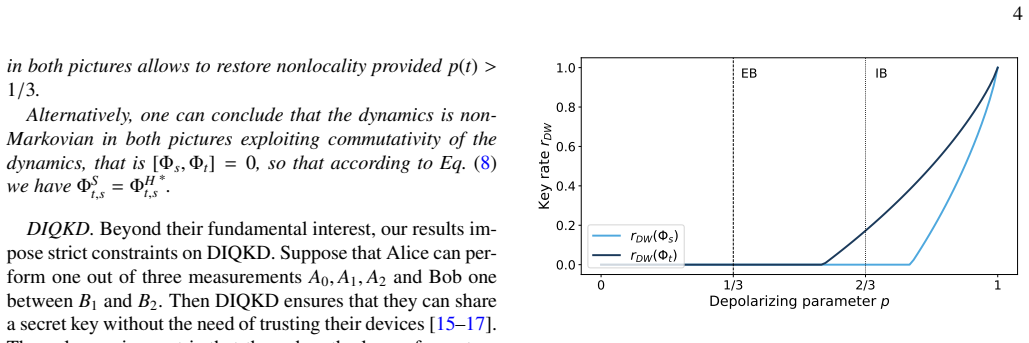
Bell nonlocality is a key resource in quantum information, demonstrating the nonclassicality of quantum theory. Noise, however, {is in general detrimental to} nonlocality, and can cause the loss of the ability to violate any Bell inequality. Memory effects, on the other hand, can restore {this} quantumness and, as recently shown, they can be {differently characterized} in the Schr\"odinger and in the Heisenberg picture. Here, we show that if memory effects allow for revivals in time of nonlocality, then the dynamics must be non-Markovian in both pictures. We showcase our findings through a device-independent quantum key distribution task, for which Bell nonlocality is necessary.
Editorial analysis
A structured set of objections, weighed in public.
Referee Report
Summary. The paper claims that revivals of Bell nonlocality due to memory effects require the underlying dynamics to be non-Markovian in both the Schrödinger and Heisenberg pictures, because memory effects admit distinct characterizations in each picture. The result is presented as a direct implication and is illustrated via a device-independent quantum key distribution task in which Bell nonlocality is a necessary resource.
Significance. If the central implication holds, the work clarifies the picture dependence of non-Markovianity when preserving quantum resources such as Bell nonlocality, offering a necessary condition that could inform the analysis of open-system dynamics in quantum information protocols.
major comments (1)
- The abstract states the implication but the full manuscript (including definitions of Schrödinger and Heisenberg non-Markovianity, the precise statement of the revival condition, and the proof) is required to verify whether the argument reduces to the chosen definitions or contains additional assumptions on the form of the dynamical map.
Simulated Author's Rebuttal
We thank the referee for their thoughtful review and for highlighting the potential significance of the result if the central implication holds. We address the single major comment below, directing the referee to the relevant sections of the manuscript where the requested elements are provided.
read point-by-point responses
-
Referee: The abstract states the implication but the full manuscript (including definitions of Schrödinger and Heisenberg non-Markovianity, the precise statement of the revival condition, and the proof) is required to verify whether the argument reduces to the chosen definitions or contains additional assumptions on the form of the dynamical map.
Authors: The full manuscript contains all requested elements without additional assumptions beyond the standard framework of completely positive trace-preserving dynamical maps. Definitions of Schrödinger-picture non-Markovianity (based on CP-divisibility) and Heisenberg-picture non-Markovianity (based on the dual map) appear in Section II. The precise revival condition is stated as Theorem 1 in Section III: if Bell nonlocality revives at some later time, the dynamics must be non-Markovian in both pictures. The proof, which relies solely on the definitions and the properties of the Choi-Jamiolkowski isomorphism for the maps, is given in Section IV (with technical details in Appendix A). No further restrictions on the form of the dynamical map are imposed. revision: no
Circularity Check
No significant circularity identified
full rationale
The paper's core claim is a logical implication: revivals of Bell nonlocality under memory effects require non-Markovianity in both Schrödinger and Heisenberg pictures, given the premise (cited from prior work) that non-Markovianity admits distinct characterizations across pictures. No self-definitional reductions, fitted parameters renamed as predictions, or load-bearing self-citations that collapse the result to its own inputs are present. The derivation is a proof of implication from definitions and is self-contained against external benchmarks.
Axiom & Free-Parameter Ledger
axioms (1)
- domain assumption Memory effects can be characterized differently in the Schrödinger and Heisenberg pictures
Reference graph
Works this paper leans on
-
[1]
The Schr¨ odinger picture propagator readsΦ S t,s[ρ]=UρU † and is clearly CP
At time t, instead p 3(t)=1−p 4(t)=(1+δ)/2and p1(t)=p 2(s)=0. The Schr¨ odinger picture propagator readsΦ S t,s[ρ]=UρU † and is clearly CP . In order to show that the dynamics is Heisenberg non-Markovian, it suffices to find a pair of POVMs such that inequality(11)is violated. Let A= |+x⟩ ⟨+x|,|− x⟩ ⟨−x| and A′ = |+y⟩ ⟨+y|,|− y⟩ ⟨−y| , where |±x,y⟩are the...
2024
-
[2]
J. S. Bell, On the Einstein Podolsky Rosen paradox, Physics Physique Fizika1, 195 (1964)
1964
-
[3]
J. F. Clauser, M. A. Horne, A. Shimony, and R. A. Holt, Proposed Experiment to Test Local Hidden-Variable Theories, Physical Review Letters23, 880 (1969)
1969
-
[4]
J. S. Bell and A. Aspect,Speakable and Unspeakable in Quan- tum Mechanics(Cambridge University Press, 2004)
2004
-
[5]
G ¨uhne, E
O. G ¨uhne, E. Haapasalo, T. Kraft, J.-P. Pellonp¨a¨a, and R. Uola, Colloquium: Incompatible measurements in quantum informa- tion science, Reviews of Modern Physics95, 011003 (2023)
2023
-
[6]
Fine, Hidden variables, joint probability, and the bell in- equalities, Physical Review Letters48, 291 (1982)
A. Fine, Hidden variables, joint probability, and the bell in- equalities, Physical Review Letters48, 291 (1982)
1982
-
[7]
Breuer and F
H.-P. Breuer and F. Petruccione,The Theory of Open Quantum Systems(Oxford University PressOxford, 2007)
2007
-
[8]
Vacchini,Open Quantum Systems, Graduate Texts in Physics (Springer Nature Switzerland, Cham, 2024)
B. Vacchini,Open Quantum Systems, Graduate Texts in Physics (Springer Nature Switzerland, Cham, 2024)
2024
-
[9]
C. H. Bennett, H. J. Bernstein, S. Popescu, and B. Schumacher, Concentrating partial entanglement by local operations, Physi- cal Review A53, 2046 (1996)
2046
-
[10]
Horodecki, P
R. Horodecki, P. Horodecki, M. Horodecki, and K. Horodecki, Quantum entanglement, Reviews of Modern Physics81, 865 (2009), arXiv:0702225 [quant-ph]
2009
-
[11]
Noise Robustness of the Incompatibility of Quantum Measurements
T. Heinosaari, J. Kiukas, and D. Reitzner, Noise robustness of the incompatibility of quantum measurements, Physical Review A - Atomic, Molecular, and Optical Physics92, 10.1103/Phys- RevA.92.022115 (2015), arXiv:1501.04554
work page internal anchor Pith review Pith/arXiv arXiv doi:10.1103/phys- 2015
-
[12]
H. P. Breuer, E. M. Laine, J. Piilo, and B. Vacchini, Colloquium: Non-Markovian dynamics in open quantum systems, Reviews of Modern Physics88, 021002 (2016)
2016
-
[13]
F. Settimo, A. Smirne, K. Luoma, B. Vacchini, J. Piilo, and D. Chru´sci´nski, Divisibility of Dynamical Maps: Schr ¨odinger Versus Heisenberg Picture, PRX Quantum7, 010340 (2026), arXiv:2506.08103
-
[14]
Entanglement and non-Markovianity of quantum evolutions
´A. Rivas, S. F. Huelga, and M. B. Plenio, Entanglement and Non-Markovianity of Quantum Evolutions, Physical Review Letters105, 050403 (2010), arXiv:0911.4270
work page internal anchor Pith review Pith/arXiv arXiv 2010
-
[15]
A. K. Ekert, Quantum cryptography based on Bell’s theorem, Physical Review Letters67, 661 (1991)
1991
-
[16]
Ac ´ın, N
A. Ac ´ın, N. Brunner, N. Gisin, S. Massar, S. Pironio, and V . Scarani, Device-independent security of quantum cryptog- raphy against collective attacks, Physical Review Letters98, 1 (2007), arXiv:0702152 [quant-ph]
2007
-
[17]
The Security of Practical Quantum Key Distribution
V . Scarani, H. Bechmann-Pasquinucci, N. J. Cerf, M. Du ˇsek, N. L¨utkenhaus, and M. Peev, The security of practical quantum key distribution, Reviews of Modern Physics81, 1301 (2009), arXiv:0802.4155
work page internal anchor Pith review Pith/arXiv arXiv 2009
-
[18]
Fully device independent quantum key distribution
U. Vazirani and T. Vidick, Fully device-independent quan- tum key distribution, Physical Review Letters113, 1 (2014), arXiv:1210.1810
work page internal anchor Pith review Pith/arXiv arXiv 2014
-
[19]
D. P. Nadlinger, P. Drmota, B. C. Nichol, G. Araneda, D. Main, R. Srinivas, D. M. Lucas, C. J. Ballance, K. Ivanov, E. Y .-Z. Tan, P. Sekatski, R. L. Urbanke, R. Renner, N. Sangouard, and J.-D. Bancal, Experimental quantum key distribution certified by bell’s theorem, Nature607, 682 (2022)
2022
-
[20]
Liu, Y .-Z
W.-Z. Liu, Y .-Z. Zhang, Y .-Z. Zhen, M.-H. Li, Y . Liu, J. Fan, F. Xu, Q. Zhang, and J.-W. Pan, Toward a photonic demonstra- tion of device-independent quantum key distribution, Physical Review Letters129, 050502 (2022)
2022
-
[21]
Zhang, T
W. Zhang, T. van Leent, K. Redeker, R. Garthoff, R. Schwon- nek, F. Fertig, S. Eppelt, W. Rosenfeld, V . Scarani, C. C.-W. Lim, and H. Weinfurter, A device-independent quantum key distribution system for distant users, Nature607, 687 (2022)
2022
-
[22]
Settimo, K
F. Settimo, K. Luoma, J. Piilo, B. Vacchini, D. Chru ´sci´nski, and A. Smirne, Schr¨odinger and Heisenberg non-Markovianity in quantum information tasks, arXiv preprint (2026)
2026
-
[23]
M. Pl ´avala, O. G ¨uhne, and M. T. Quintino, All Incom- patible Measurements on Qubits Lead to Multiparticle Bell Nonlocality, Physical Review Letters134, 200201 (2025), arXiv:2403.10564
-
[24]
Collins and N
D. Collins and N. Gisin, A relevant two qubit Bell inequality in- equivalent to the CHSH inequality, Journal of Physics A: Math- ematical and General37, 1775 (2004), arXiv:0306129 [quant- ph]
2004
-
[25]
Heinosaari and M
T. Heinosaari and M. Ziman,The Mathematical Language of Quantum Theory: From Uncertainty to Entanglement(Cam- bridge University Press, Cambridge, 2011)
2011
-
[26]
Brunner, D
N. Brunner, D. Cavalcanti, S. Pironio, V . Scarani, and S. Wehner, Bell nonlocality, Reviews of Modern Physics86, 419 (2014)
2014
-
[27]
Non-locality breaking qubit channels
R. Pal and S. Ghosh, Non-locality breaking qubit chan- nels, Journal of Physics A: Mathematical and Theoretical48, 10.1088/1751-8113/48/15/155302 (2014), arXiv:1306.3151
work page internal anchor Pith review Pith/arXiv arXiv doi:10.1088/1751-8113/48/15/155302 2014
-
[28]
Incompatibility breaking quantum channels
T. Heinosaari, J. Kiukas, D. Reitzner, and J. Schultz, Incompat- ibility breaking quantum channels, Journal of Physics A: Math- ematical and Theoretical48, 1 (2015), arXiv:1504.05768
work page internal anchor Pith review Pith/arXiv arXiv 2015
-
[29]
B. S. Cirel’son, Quantum generalizations of Bell’s inequality, Letters in Mathematical Physics4, 93 (1980)
1980
-
[30]
M. M. Wolf, D. Perez-Garcia, and C. Fernandez, Measurements incompatible in quantum theory cannot be measured jointly in any other no-signaling theory, Physical Review Letters103, 2 (2009), arXiv:0905.2998
work page internal anchor Pith review Pith/arXiv arXiv 2009
-
[31]
R. F. Werner, Quantum states with Einstein-Podolsky-Rosen correlations admitting a hidden-variable model, Physical Re- view A40, 4277 (1989)
1989
-
[32]
Busch, Unsharp reality and joint measurements for spin ob- servables, Physical Review D33, 2253 (1986)
P. Busch, Unsharp reality and joint measurements for spin ob- servables, Physical Review D33, 2253 (1986)
1986
-
[33]
Grinko and R
D. Grinko and R. Uola, Compatibility of binary qubit measure- ments, Physical Review Letters135, 200201 (2025)
2025
-
[34]
Horodecki, P
M. Horodecki, P. W. Shor, and M. B. Ruskai, Entanglement Breaking Channels, Reviews in Mathematical Physics15, 629 (2003), arXiv:0302032 [quant-ph]
2003
-
[35]
Kumari, J
S. Kumari, J. Naikoo, S. Ghosh, and A. K. Pan, Interplay of nonlocality and incompatibility breaking qubit channels, Phys- ical Review A107, 022201 (2023). 6
2023
-
[36]
Quantum Non-Markovianity: Characterization, Quantification and Detection
´A. Rivas, S. F. Huelga, and M. B. Plenio, Quantum non- Markovianity: characterization, quantification and detec- tion, Reports on Progress in Physics77, 094001 (2014), arXiv:1405.0303
work page internal anchor Pith review Pith/arXiv arXiv 2014
-
[37]
Chru ´sci´nski, Dynamical maps beyond Markovian regime, Physics Reports992, 1 (2022)
D. Chru ´sci´nski, Dynamical maps beyond Markovian regime, Physics Reports992, 1 (2022)
2022
-
[38]
Breuer, E.-M
H.-P. Breuer, E.-M. Laine, and J. Piilo, Measure for the degree of non-markovian behavior of quantum processes in open sys- tems, Phys. Rev. Lett.103, 210401 (2009)
2009
-
[39]
Measure for the Non-Markovianity of Quantum Processes
E.-M. Laine, J. Piilo, and H.-P. Breuer, Measure for the non- Markovianity of quantum processes, Physical Review A81, 062115 (2010), arXiv:1002.2583
work page internal anchor Pith review Pith/arXiv arXiv 2010
-
[40]
F. Carollo and S. Wald, Stochastic resetting induces quantum non-Markovianity (2026), arXiv:2601.13367
-
[41]
Kossakowski, On necessary and sufficient conditions for a generator of a quantum dynamical semi-group, Bull
A. Kossakowski, On necessary and sufficient conditions for a generator of a quantum dynamical semi-group, Bull. Acad. Pol. Sci., S´er. Sci. Math. Astron. Phys.20, 1021 (1972)
1972
-
[42]
Optimal state pairs for non-Markovian quantum dynamics
S. Wimann, A. Karlsson, E. M. Laine, J. Piilo, and H.-P. Breuer, Optimal state pairs for non-Markovian quantum dy- namics, Physical Review A - Atomic, Molecular, and Optical Physics86, 1 (2012), arXiv:1209.4989
work page internal anchor Pith review Pith/arXiv arXiv 2012
-
[43]
Hill and W
S. Hill and W. K. Wootters, Entanglement of a Pair of Quantum Bits, Physical Review Letters78, 5022 (1997), arXiv:9703041 [quant-ph]
1997
-
[44]
W. K. Wootters, Entanglement of Formation of an Arbitrary State of Two Qubits, Physical Review Letters80, 2245 (1998), arXiv:0009063 [quant-ph]
1998
-
[45]
Devetak and A
I. Devetak and A. Winter, Distillation of secret key and entan- glement from quantum states, Proceedings of the Royal Society A: Mathematical, Physical and Engineering Sciences461, 207 (2005), arXiv:0306078 [quant-ph]
2005
discussion (0)
Sign in with ORCID, Apple, or X to comment. Anyone can read and Pith papers without signing in.