Existence of the C-type renormalisation two-cycle
Pith reviewed 2026-06-27 23:10 UTC · model grok-4.3
The pith
The C-type renormalisation two-cycle exists in a Banach space of analytic maps with rigorous bounds on state-space scaling constants.
A machine-rendered reading of the paper's core claim, the machinery that carries it, and where it could break.
Core claim
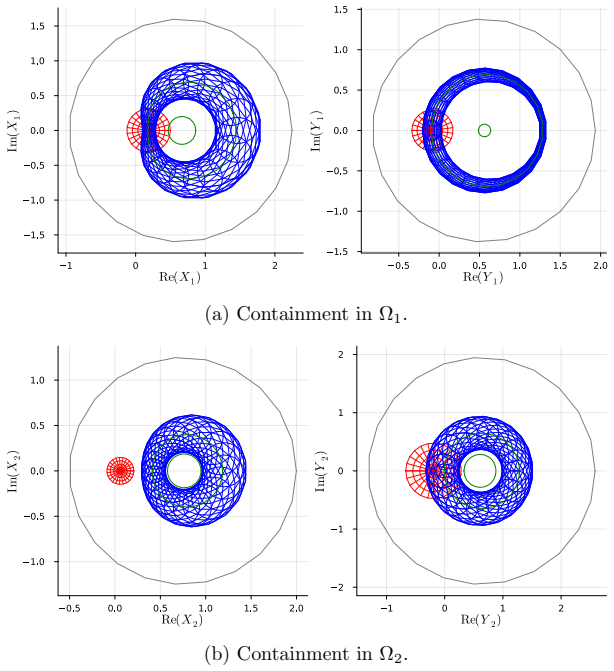
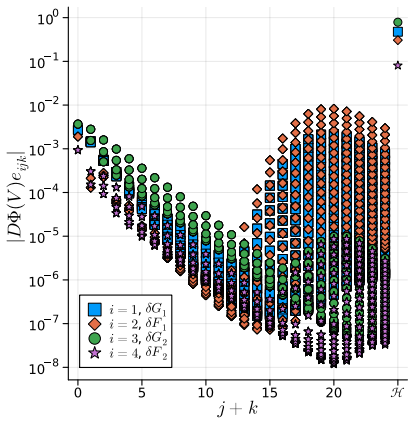
We prove the existence of the C-type renormalisation two-cycle in a Banach space of analytic maps and gain rigorous bounds on the corresponding universal state space scaling constants. This is established by verifying that a variant of Newton's method applied to the two-cycle equation is a contraction mapping on a ball around the candidate orbit.
What carries the argument
The renormalisation operator acting on a Banach space of analytic maps, together with its period-two orbit and the Newton-like contraction operator constructed around that orbit.
If this is right
- The result supplies one further step toward proving the full set of conjectures on distinct universality classes for period-doubling routes.
- It extends the analytic framework already established for unidirectionally coupled maps to the bidirectionally coupled case.
- It generalises the treatment of renormalisation from fixed points to genuine periodic orbits of the renormalisation operator.
- It supports the conjecture that the C-type class is born from the FS-type class by a period-doubling bifurcation inside the renormalisation group dynamics.
- The scaling constants obtained apply directly to concrete systems such as models of nephron blood-pressure autoregulation that exhibit C-type scaling.
Where Pith is reading between the lines
- Similar contraction-mapping arguments could be used to locate and prove the existence of higher-period orbits of the renormalisation operator that would correspond to still other universality classes.
- The explicit bounds on scaling constants furnish quantitative predictions that can be checked against numerical simulations or experimental time series from any system known to display C-type period quadrupling.
- If the renormalisation dynamics itself undergoes further bifurcations, the same Banach-space setting should allow the detection of additional cycles and the corresponding new scaling laws.
- The technique may extend to maps with other types of critical points once the appropriate Banach spaces are identified.
Load-bearing premise
A variant of Newton's method for the two-cycle equation remains a contraction mapping on some ball around the candidate point inside the chosen Banach space.
What would settle it
A verified computation that the Lipschitz constant of the Newton operator on the ball is at least one, or that no point inside the ball satisfies the two-cycle equation to machine precision.
Figures
read the original abstract
We prove the existence of the C-type renormalisation two-cycle, helping to establish the universality of the C-type route to chaos in families of non-invertible maps of the plane. Families of two-dimensional non-invertible maps, with at least two parameters and critical points of fold type, exhibit a distinct type of critical scaling, the C-type. An accumulation of parameter values leads to an infinite collection of coexisting attracting cycles of periods $4^n$ or $2\cdot 4^n$. Asymptotically, period quadrupling is accompanied by parameter-space scaling and state-space scaling governed by particular universal constants. Kuznetsov et. al. explained this phenomenon in terms of a stationary orbit of period two of the renormalisation group (RG) transformation for period-doubling. We prove the existence of the corresponding renormalisation two-cycle in a Banach space of analytic maps and gain rigorous bounds on the corresponding universal state space scaling constants. This result provides a further step in proving a series of outstanding conjectures concerning distinct universality classes for period-doubling. It extends the recent results for unidirectionally-coupled maps (the FS-type) to bidirectionally-coupled maps, and generalises the framework from fixed points to periodic orbits of the corresponding renormalisation operators. It also provides a further step in establishing the conjectured picture that the C-type universality class is born from the FS-type class via a period-doubling bifurcation in the dynamics of the RG transformation itself. The proof relies on rigorous computations to establish that a variant of Newton's method for the two-cycle is a contraction map. The C-type scaling regularity is known to occur in a number of dynamical systems of interest, perhaps most notably in biologically-plausible models of nephron blood pressure autoregulation.
Editorial analysis
A structured set of objections, weighed in public.
Referee Report
Summary. The manuscript proves the existence of the C-type renormalisation two-cycle in a Banach space of analytic maps by showing via rigorous computations that a variant of Newton's method for the two-cycle is a contraction mapping on a ball around the candidate orbit. This yields bounds on the associated universal state-space scaling constants and supports the universality of the C-type route to chaos (period quadrupling with coexisting attracting cycles of periods 4^n or 2·4^n) in families of non-invertible planar maps with fold critical points.
Significance. If the contraction-mapping bounds hold, the result is significant: it extends recent computer-assisted proofs for the FS-type class (unidirectionally coupled maps, fixed points of the RG operator) to the bidirectionally coupled C-type case and to period-two orbits of the renormalization operator. It supplies verifiable, parameter-free bounds on the scaling constants and advances the conjectured picture that the C-type class emerges from the FS-type class via a period-doubling bifurcation in the dynamics of the RG transformation itself. The computer-assisted contraction argument is a methodological strength that can be independently checked.
minor comments (2)
- The abstract and introduction should state the precise Banach space (including the norm and domain of analyticity) and the explicit form of the renormalization operator at the outset, so that the contraction-mapping claim can be followed without first consulting later technical sections.
- Add a short paragraph describing the interval-arithmetic implementation, the choice of the ball radius, and the software or library used for the rigorous bounds; this improves reproducibility without altering the central argument.
Simulated Author's Rebuttal
We thank the referee for their positive summary, significance assessment, and recommendation of minor revision. No major comments were provided in the report, so we have no specific points to address point-by-point. The manuscript stands as submitted, and we are prepared to incorporate any minor editorial changes requested by the editor.
Circularity Check
No significant circularity; existence proof is self-contained
full rationale
The paper establishes existence of the C-type renormalisation two-cycle via a computer-assisted proof that a Newton-like operator is a contraction mapping on a ball in a Banach space of analytic maps. This is a direct verification using rigorous bounds (interval arithmetic) on the operator and its derivative, with no fitted parameters renamed as predictions, no self-definitional reductions, and no load-bearing self-citations that substitute for independent verification. The derivation chain is self-contained against external benchmarks and does not reduce any claimed result to its own inputs by construction.
Axiom & Free-Parameter Ledger
axioms (1)
- domain assumption A Banach space of analytic maps exists on which the renormalization operator for period-quadrupling is well-defined and differentiable.
Reference graph
Works this paper leans on
-
[1]
Gianni Arioli and Hans Koch. The Critical Renormalization Fixed Point for Commuting Pairs of Area-Preserving Maps.Communications in Mathematical Physics, 295(2):415–429, April 2010.doi:10.1007/s00220-009-0922-1
-
[2]
Jeff Bezanson, Alan Edelman, Stefan Karpinski, and Viral B Shah. Julia: A fresh approach to numerical computing.SIAM review, 59(1):65–98, 2017. URL: https://doi.org/10.1137/141000671
-
[3]
Maxime Breden, Jorge Gonzalez, and J. D Mireles James. Validated enclosure of renormalization fixed points via Chebyshev series and the DFT, 2024. URL: https://arxiv.org/abs/2409.20457,arXiv:2409.20457
arXiv 2024
-
[4]
A. Burbanks and A. Stirnemann. Holder continuous Siegel disc boundary curves. Nonlinearity, 8(6):901, November 1995.doi:10.1088/0951-7715/8/6/002. 32
-
[5]
A. D. Burbanks, A. H. Osbaldestin, and A. Stirnemann. Rigorous Bounds on the Hausdorff Dimension of Siegel Disc Boundaries.Communications in Mathematical Physics, 199(2):417–439, December 1998.doi:10.1007/s002200050507
-
[6]
A.D. Burbanks, A.H. Osbaldestin, and A. Stirnemann. Fractal dimension of Siegel disc boundaries.The European Physical Journal B - Condensed Matter and Complex Systems, 4(3):263–265, August 1998.doi:10.1007/s100510050377
-
[7]
Andrew Burbanks and Andrew Osbaldestin. Existence of the FS-type renor- malisation fixed point for unidirectionally-coupled pairs of maps.Journal of Physics A: Mathematical and Theoretical, 56(19):195202, April 2023. Pub- lisher: IOP Publishing. URL:https://dx.doi.org/10.1088/1751-8121/acc7dd, doi:10.1088/1751-8121/acc7dd
-
[8]
Burbanks.Renormalization for Siegel Discs
Andrew D. Burbanks.Renormalization for Siegel Discs. Thesis, Loughborough University, January 1997. URL:https://hdl.handle.net/2134/27906
1997
-
[9]
Andrew D. Burbanks, Andrew H. Osbaldestin, and Judi A. Thurlby. Rigorous computer-assisted bounds on the period doubling renormal- ization fixed point and eigenfunctions in maps with critical point of degree 4.Journal of Mathematical Physics, 62(11):112701, Novem- ber 2021. URL:https://pubs.aip.org/jmp/article/62/11/112701/ 234026/Rigorous-computer-assist...
-
[10]
Dr Andrew Burbanks. andrewburbanks/burbanks-2021-04-22-code-rigorous- degree-4-jmp21-ar-00685: Release of source code originally submitted with preprint on 2021-04-22, October 2021.doi:10.5281/zenodo.5608449
-
[11]
Dr Andrew Burbanks. andrewburbanks/existence-fs: Existence of the FS-type renormalisation fixed point [Software], October 2022. URL:https://zenodo. org/records/7139006,doi:10.5281/zenodo.7139006
-
[12]
Citation pending; to be provided on journal submission., 2026
Dr Andrew Burbanks. Citation pending; to be provided on journal submission., 2026
2026
-
[13]
P. Coullet and C. Tresser. IT ´ERATIONS D’ENDOMORPHISMES ET GROUPE DE RENORMALISATION.Le Journal de Physique Colloques, 39(C5):C5–25– C5–28, August 1978.doi:10.1051/jphyscol:1978513
-
[14]
Cvitanovic.Universality in Chaos, 2nd Edition
P. Cvitanovic.Universality in Chaos, 2nd Edition. Routledge, July 2017
2017
-
[15]
American Mathematical Soc., 1984
Jean Pierre Eckmann, Hans Koch, and Peter Wittwer.A Computer-Assisted Proof of Universality for Area-Preserving Maps. American Mathematical Soc., 1984
1984
-
[16]
Springer-Verlag, Berlin/Heidelberg, 1985
Jean-Pierre Eckmann and Peter Wittwer, editors.Computer Methods and Borel Summability Applied to Feigenbaum’s Equation, volume 227 ofLecture Notes in Physics. Springer-Verlag, Berlin/Heidelberg, 1985. URL:http://link. springer.com/10.1007/BFb0044703,doi:10.1007/BFb0044703
-
[17]
Mitchell J. Feigenbaum. Quantitative universality for a class of nonlinear trans- formations.Journal of Statistical Physics, 19(1):25–52, July 1978. URL:http: //link.springer.com/10.1007/BF01020332,doi:10.1007/BF01020332
-
[18]
Mitchell J. Feigenbaum. The universal metric properties of nonlinear transfor- mations.Journal of Statistical Physics, 21(6):669–706, December 1979.doi: 10.1007/BF01107909. 33
-
[19]
Denis Gaidashev and Hans Koch. Period doubling in area-preserving maps: An associated one-dimensional problem.Ergodic Theory and Dynamical Systems, 31(4):1193–1228, August 2011.doi:10.1017/S0143385710000283
-
[20]
Golden mean Siegel disk universality and renormalization, April 2016
Denis Gaidashev and Michael Yampolsky. Golden mean Siegel disk universality and renormalization, April 2016. URL:https://arxiv.org/abs/1604.00717v4
Pith/arXiv arXiv 2016
-
[21]
Edgar Kaucher and Willard L. Miranker.Self-validating numerics for function space problems: computation with guarantees for differential and integral equa- tions. Number 9 in Notes and reports in computer science and applied mathe- matics. Acad. Pr, Orlando, Fla u.a, 1984.doi:10.1016/C2013-0-10948-8
-
[22]
RENORMALIZATION AND RIGIDITY
Konstantin Khanin. RENORMALIZATION AND RIGIDITY. InProceed- ings of the International Congress of Mathematicians (ICM 2018), pages 1973– 1993, Rio de Janeiro, Brazil, May 2019. WORLD SCIENTIFIC.doi:10.1142/ 9789813272880_0126
2018
-
[23]
HANS KOCH. Asymptotic scaling and universality for skew products with factors in sl(2,∖).Ergodic Theory and Dynamical Systems, 43(5):1594–1632, 2023.doi: 10.1017/etds.2022.22
-
[24]
Hans Koch. A renormalization group fixed point associated with the breakup of golden invariant tori.Discrete and Continuous Dynamical Systems, 11(4):881– 909, Wed Sep 01 00:00:00 UTC 2004.doi:10.3934/dcds.2004.11.881
-
[25]
Hans Koch and Peter Wittwer. A non-Gaussian renormalization group fixed point for hierarchical scalar lattice field theories.Communications in Mathematical Physics, 106(3):495–532, September 1986.doi:10.1007/BF01207260
-
[26]
Hans Koch and Peter Wittwer. A nontrivial Renormalization Group fixed point for the Dyson-Baker hierarchical model.Communications in Mathemat- ical Physics, 164(3):627–647, August 1994.doi:10.1007/BF02101493
-
[27]
U. W. Kulisch and W. L. Miranker. The Arithmetic of the Digital Computer: A New Approach.SIAM Review, 28(1):1–40, March 1986. URL:http://epubs. siam.org/doi/10.1137/1028001,doi:10.1137/1028001
-
[28]
A.p. Kuznetsov, S.p. Kuznetsov, and I.r. Sataev. Variety of types of critical behavior and multistability in period-doubling systems with unidirectional cou- pling near the onset of chaos.International Journal of Bifurcation and Chaos, 03(01):139–152, February 1993. URL:https://www.worldscientific.com/doi/ abs/10.1142/S0218127493000106,doi:10.1142/S021812...
-
[29]
A.P. Kuznetsov, S.P. Kuznetsov, and I.R. Sataev. A variety of period- doubling universality classes in multi-parameter analysis of transition to chaos.Physica D: Nonlinear Phenomena, 109(1-2):91–112, November 1997. URL:https://linkinghub.elsevier.com/retrieve/pii/S0167278997001620, doi:10.1016/S0167-2789(97)00162-0
-
[30]
S. P. Kuznetsov, A. P. Kuznetsov, and I. R. Sataev. Multiparameter Crit- ical Situations, Universality and Scaling in Two-Dimensional Period-Doubling Maps.Journal of Statistical Physics, 121(5-6):697–748, December 2005. URL:http://link.springer.com/10.1007/s10955-005-6973-6,doi:10.1007/ s10955-005-6973-6
-
[31]
S. P. Kuznetsov, A. A. Mailybaev, and I. R. Sataev. Birth of a New Class of Period-Doubling Scaling Behavior as a Result of Bifurcation in the Renor- malization Equation.Journal of Statistical Physics, 130(3):599–616, Febru- 34 ary 2008. URL:http://link.springer.com/10.1007/s10955-007-9442-6,doi: 10.1007/s10955-007-9442-6
-
[32]
S. P. Kuznetsov and I. R. Sataev. Period-doubling for two-dimensional non- invertible maps: Renormalization group analysis and quantitative universality. Physica D: Nonlinear Phenomena, 101(3):249–269, March 1997. URL:https:// www.sciencedirect.com/science/article/pii/S0167278996002370,doi:10. 1016/S0167-2789(96)00237-0
1997
-
[33]
Sergey Kuznetsov and Igor Sataev. Universality and scaling for the breakup of phase synchronization at the onset of chaos in a periodically driven R¨ ossler oscilla- tor.Physical Review E, 64(4):046214, September 2001. URL:https://link.aps. org/doi/10.1103/PhysRevE.64.046214,doi:10.1103/PhysRevE.64.046214
-
[34]
S. P. Kuznetzov and I. R. Sataev. New types of critical dynam- ics for two-dimensional maps.Physics Letters A, 162(3):236–242, Febru- ary 1992. URL:https://www.sciencedirect.com/science/article/pii/ 037596019290440W,doi:10.1016/0375-9601(92)90440-W
-
[35]
Oscar E. Lanford. Computer-assisted proofs in analysis.Physica A: Statistical Mechanics and its Applications, 124(1-3):465–470, March 1984. URL:https: //linkinghub.elsevier.com/retrieve/pii/0378437184902620,doi:10.1016/ 0378-4371(84)90262-0
arXiv 1984
-
[36]
Laugesen, Erik Mosekilde, and Niels-Henrik Holstein-Rathlou
Jakob L. Laugesen, Erik Mosekilde, and Niels-Henrik Holstein-Rathlou. C-type period-doubling transition in nephron autoregulation.Interface Focus, 1(1):132– 142, February 2011.doi:10.1098/rsfs.2010.0004
-
[37]
Technical University of Denmark, Kgs
Jakob Lund Laugesen.Modelling Nephron Autoregulation and Synchronization in Coupled Nephron Systems. Technical University of Denmark, Kgs. Lyngby, Denmark, 2011. URL:https://api.semanticscholar.org/CorpusID:86628459
2011
-
[38]
WORLD SCIENTIFIC, August 1993.doi:10
R S MacKay.Renormalisation in Area-Preserving Maps, volume 6 ofAdvanced Series in Nonlinear Dynamics. WORLD SCIENTIFIC, August 1993.doi:10. 1142/2001
1993
-
[39]
phd, University of Warwick, September 1985
Benjamin David Mestel.A computer assisted proof of universality for cubic critical maps of the circle with Golden Mean rotation number. phd, University of Warwick, September 1985. URL:http://webcat.warwick.ac.uk/record=b1445855 ~S1
1985
-
[40]
Moore.Interval analysis
R.E. Moore.Interval analysis. Prentice-Hall series in automatic computation. Prentice-Hall, 1966. tex.lccn: lc66022090
1966
-
[41]
Walter Rudin.Function theory in polydiscs. W.A. Benjamin, New York, 1969. OCLC: 3200
1969
-
[42]
Existence of the Siegel disc renormalization fixed point.Nonlin- earity, 7(3):959–974, May 1994
A Stirnemann. Existence of the Siegel disc renormalization fixed point.Nonlin- earity, 7(3):959–974, May 1994. URL:https://iopscience.iop.org/article/ 10.1088/0951-7715/7/3/011,doi:10.1088/0951-7715/7/3/011
-
[43]
Andreas Stirnemann. Renormalization for golden circles.Communications in Mathematical Physics, 152(2):369–431, March 1993. URL:http://link. springer.com/10.1007/BF02098303,doi:10.1007/BF02098303. 35
discussion (0)
Sign in with ORCID, Apple, or X to comment. Anyone can read and Pith papers without signing in.