REVIEW 5 major objections 5 minor 35 references
A scale invariant extension of the Georgi Machacek model
T0 review · 5 major / 5 minor · reviewed 2026-08-16 · deepseek-v4-flash
Pith's one-line read A classically scale-invariant Georgi-Machacek model with a singlet generates the electroweak scale radiatively, preserves custodial symmetry, and predicts a scalon below about 200 GeV.
desk verdict Novel scale-invariant GM+singlet model, but the printed mass matrix and the Higgs chi-square analysis do not support the claimed viable regions. read the letter →
The pith
A machine-rendered reading of the paper's core claim, the machinery that carries it, and where it could break.
The reading
What carries the argument
The load-bearing object is the Gildener-Weinberg flat-direction construction applied to a scale-invariant potential. The tree-level potential is reduced to a radial field $\varphi$ and unit direction components $N_h,N_\delta,N_s$; the minimization conditions together with $V_0=0$ define a flat direction when $\det A=0$, and dimensional transmutation is invoked to locate the scale $\mu_{\mathrm{GW}}$ at which that condition is met. The one-loop effective potential then supplies the scalon mass $$$M_s^{2}$=\frac{1}{8\pi v_\$varphi^{2}$}\left(5M_{H_5}^4+3M_{H_3}^4+$M_h^{4}$+$M_H^{4}$+$6M_W^{4}$+$3M_Z^{4}$-$12M_t^{4}$\right),$$ and the CP-even mass matrix in the $(S,\phi_R,H_1^0)$ basis, rotated by angles $\alpha,\beta,\gamma$, decides which linear combination is the 125 GeV Higgs. The positivity requirement on this formula is what forces the new scalar states to be heavy enough to appear in the scan's viable bands.
What would settle it
Take a claimed viable point from the scan, reconstruct the quartic couplings from the mass and minimization equations, and check that the flat-direction existence condition is satisfied; if a point that passes all published constraints fails that check, the advertised regions are not realizable. Experimentally, discovering a scalon with mass above about 200 GeV would fall outside the paper's claimed viable region.
Extended reading notes
Core claim
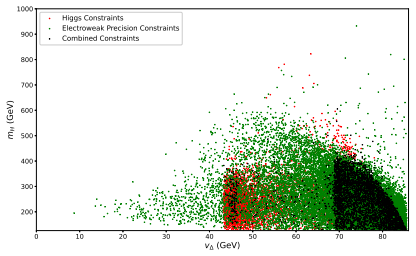
The central claim is that a classically scale-invariant extension of the Georgi-Machacek model --- one doublet, two triplets, and one gauge singlet with only quartic couplings --- can break electroweak symmetry radiatively. Along a flat direction of the tree-level potential, parameterized by $\varphi$ and a unit direction $(n_s,n_h,\sqrt{3}n_\delta)$, the one-loop effective potential $V_1(\varphi)=A\varphi^4+B\varphi^4\ln(\varphi^2/\mu_{\mathrm{GW}}^2)$ lifts the vacuum degeneracy and fixes $\langle\varphi\rangle=v_\varphi$ through $\ln(v_\varphi/\mu_{\mathrm{GW}})=-1/4-A/(2B)$. The spectrum retains the $H_5$ quintet and $H_3$ triplet states, and the CP-even neutral sector contains three singlets: one identified with the observed 125 GeV Higgs, one heavier scalar $H$, and the pseudo-Goldstone scalon, which acquires mass only at one loop. After imposing vacuum stability, unitarity, electroweak precision, and Higgs data, the paper finds viable parameter regions with $m_s\lesssim200$ GeV and $m_H\lesssim600$ GeV, with $v_\Delta\gtrsim45$ GeV favored.
Load-bearing premise
The load-bearing premise is that every point in the paper's six-parameter scan can be realized by quartic couplings for which the tree-level potential has a flat direction; the paper does not show the explicit mapping from the scanned masses and angles back to those couplings.
Editorial extensions
If this is right
- The electroweak scale is not an input: radiative corrections select $v_\varphi$, so the model has no fundamental scalar mass parameter to be destabilized by quantum corrections.
- The model predicts a light pseudo-Goldstone scalon, typically below 200 GeV, and a heavier CP-even scalar $H$ under about 600 GeV, with a triplet VEV above about 45 GeV; these are concrete search targets.
- Custodial symmetry is preserved with $\rho\approx1$ at tree level, and the $S$ parameter plus the coupling modifiers $\kappa_V,\kappa_f$ provide electroweak precision and Higgs-data tests of the scheme.
- If the invisible decay $h\to ss$ is kinematically open, the Higgs total width and signal strengths shift relative to the Standard Model, giving another observable signature.
Reading between the lines
- Beyond the paper: a decisive cross-check is to invert the six scanned parameters back to the eight quartic couplings and verify that every advertised viable point satisfies the flat-direction existence condition; the paper leaves that mapping implicit.
- Beyond the paper: the mechanism should transplant to other custodial triplet constructions, since the defining ingredients are a quartic-only potential and an RG-selected flat direction rather than the specifics of this field content.
- Beyond the paper: if the scalon is as light as claimed, precision probes of $hh$ production or of transitions such as $H\to hh$ may be more sensitive than the oblique parameters used here, because the light state's couplings are set by the same mixing angles that control the modified Higgs couplings.
Signed reviews
Editorial analysis
A structured set of objections, weighed in public.
Referee Report
Summary. This paper constructs a classically scale-invariant extension of the Georgi-Machacek model by adding a real gauge singlet, using the Gildener-Weinberg formalism to generate the electroweak scale radiatively. The scalar sector is analyzed, theoretical constraints from bounded-from-below and unitarity are imposed, and a numerical scan is performed under electroweak precision (S parameter) and Higgs signal-strength constraints. The authors claim viable regions with scalon mass below about 200 GeV and heavy scalar below about 600 GeV.
Significance. The idea of combining classical scale invariance with a custodial-symmetric triplet sector is interesting, and the paper is self-contained in proposing a specific scalar potential and deriving many constraint equations. However, the central numerical claims rely on a mass matrix that is not derived from the stated potential and on a statistical acceptance criterion that cannot certify compatibility with Higgs data. As it stands, the paper does not establish that the model has viable parameter regions; the flaws are at the level of the core derivation rather than presentation.
major comments (5)
- [2.3, Eq. (2.11)] The mass matrix in Eq. (2.11) cannot be the Hessian of the tree-level potential (2.5). The term 3λ8 s^2 δ^2 in (2.5) must produce an S–H_1^0 mixing entry proportional to λ8 n_s n_δ, yet the printed (1,3) entry is 4√3 n_s n_δ with no coupling. Likewise, the h^2δ^2 term in (2.5) carries the combination 3(λ4+λ5/2), whereas the (2,3) entry of (2.11) contains 4λ2+2λ5. No field redefinition or flat-direction identity is given that would eliminate these couplings. Since Eq. (2.11) feeds the eigenvalues (2.17), the rotation (2.12)–(2.16), the coupling modifiers (3.21)–(3.22), the scalon formula (2.24), and the entire scan of Section 4, the numerical results derived from it are not supported.
- [Section 4, parameter count and scan] The scan samples (m_H3, m_H5, m_H, sβ, vΔ, vφ) independently but never demonstrates that these points correspond to solutions of the flat-direction conditions (2.8)–(2.9). The existence of a flat direction requires det A = 0, an additional condition beyond the parameter count in the text. Moreover, the paper does not provide the mapping from the scanned mass and mixing parameters back to the quartic couplings λ1...λ8, so a reader cannot check whether the potential (2.2) with those couplings is stable and unitarity-bounded. As a result, the points plotted in Figs. 1 and 2 are not shown to be points of the scale-invariant model.
- [Section 4, Higgs signal-strength fit] The reported best-fit value χ2_fit,µ = 119.33 for five signal-strength measurements is enormous for a fit with three free parameters (χ2/dof ≈ 24). The acceptance criterion |χ² − χ²_fit| < 7.815 then admits only points with χ² between approximately 111.5 and 127.1, all of which are strongly excluded by the data. The black dots in Figs. 1–2 are therefore not 'compatible with all constraints'; the model as implemented cannot reproduce the measured Higgs rates. This invalidates the central phenomenological claim of viable regions.
- [Section 3.3, Eqs. (3.19)–(3.20)] The text acknowledges that the T parameter is quadratically divergent in the GM framework and that this undermines naturalness, but then sets T = 0 and constrains only S. This is an assumption, not a derivation; custodial symmetry at tree level does not protect T at one loop. Since one of the paper's goals is to address the hierarchy problem without fine-tuning, the neglect of T significantly weakens the electroweak precision test, and the quoted 95% region is not a full electroweak precision fit.
- [2.4, Eq. (2.25)] There is a factor-of-π error in the scalon mass formula. From the one-loop coefficient B in Eq. (2.20), B = 1/(64π² v_φ⁴) [Tr M_S⁴ + 3 Tr M_V⁴ − 4 Tr M_F⁴], and the second derivative of V_1 in Eq. (2.23) at φ = v_φ is 8B v_φ². This yields m_s² = 1/(8π² v_φ²)[...], not 1/(8π v_φ²)[...] as printed in Eq. (2.25). The quoted scalon masses below 200 GeV are therefore not computed with the stated formula.
minor comments (5)
- [Section 4] The relation "v2 = vh^2 + 8v∆ = 246 GeV" is dimensionally inconsistent; it should read v² = v_h² + 8 v_Δ² = (246 GeV)².
- [2.3, Eq. (2.17)] The notation "cos2β" and "sin2β" is ambiguous: if it denotes cos²β or sin²β, these should be written explicitly, and if it denotes cos(2β) or sin(2β), the formulas should be checked for consistency.
- [Abstract] The phrase "three CP-even singlets" is misleading because the three neutral CP-even mass eigenstates are mixtures of the singlet S, the doublet neutral, and the triplet neutral, not all custodial singlets; rewording would improve clarity.
- [Figures 1 and 2 captions] The captions contain typographical errors such as "Const aints", "Elect oweak P ecision", and "Compat ibility", which should be corrected.
- [Reference [35]] The author list "G. Group" appears to be a garbled placeholder; if this refers to the Gfitter Group, the citation should be corrected.
Circularity Check
No circularity: the model's central quantities are computed from the potential and scan, not fitted from the quantities they are said to predict.
full rationale
Walking the claimed derivation chain, the tree-level potential (2.2) is the input, the flat-direction conditions (2.8)-(2.9) are imposed, and the CP-even mass matrix (2.11) together with the one-loop Gildener-Weinberg potential (2.18)-(2.23) yields the tree-level spectrum and the radiatively generated scalon mass (2.24)-(2.25). The scalon mass is not fitted to the statement ms < 200 GeV; it is computed from the boson/fermion mass spectrum via the trace formula, and the quoted viable regions are outputs of a parameter scan subject to independent experimental constraints (the S parameter and Higgs signal strengths). The identification h1 = 125 GeV is an input/assignment rather than a predicted value, so it does not make the derived masses circular. No load-bearing step invokes a self-citation or an ansatz smuggled in through citation; the cited unitarity and vacuum-stability conditions are external constraints. Even if the numerical scan omits an explicit check of det A = 0 or the printed mass matrix (2.11) has algebraic inconsistencies, those are correctness issues for independent scrutiny rather than a circular reduction of an output to an input.
Assumptions & free parameters
free parameters (6)
- m_H3 (triplet mass) =
0-1000 GeV
- m_H5 (quintet mass) =
0-1000 GeV
- m_H (heavy singlet mass) =
0-3000 GeV
- s_beta (mixing sine) =
[-1, 1]
- v_Delta (triplet VEV) =
0-86.97 GeV
- v_phi (overall VEV scale) =
0-5000 GeV
assumptions (5)
- domain assumption The tree-level potential has a Gildener-Weinberg flat direction where V0=0 and the gradient vanishes (det A = 0 at some scale mu_GW).
- domain assumption The neutral VEV alignment preserves custodial symmetry with equal VEVs for the real and complex triplets.
- standard math The one-loop effective potential along the flat direction has the Gildener-Weinberg form V1 = A phi^4 + B phi^4 ln(phi^2/mu_GW^2), and the scalon mass is given by the standard trace formula (2.25).
- ad hoc to paper The T parameter and U parameter can be neglected; only the S parameter is constrained.
- domain assumption The scanned parameter points satisfy the flat-direction conditions (2.8)-(2.9).
invented entities (2)
-
Real gauge-singlet scalar S
independent evidence
-
Scalon (pseudo-Goldstone boson)
independent evidence
Cite this review
Pith. "Pith review of A scale invariant extension of the Georgi Machacek model." pith.science (2026). https://pith.science/paper/Q4XKHATS
@misc{pith2026250419187,
  author       = {Pith},
  title        = {Pith review of: A scale invariant extension of the Georgi Machacek model},
  year         = {2026},
  howpublished = {\url{https://pith.science/paper/Q4XKHATS}},
  note         = {Machine review of arXiv:2504.19187}
}
abstract
We propose a classically scale-invariant extension of the Georgi--Machacek model by augmenting its custodial \(SU(2)_L \times SU(2)_R\)-symmetric Higgs sector -- originally composed of a doublet and two triplets -- with a gauge-singlet scalar. Employing the Gildener--Weinberg formalism, we demonstrate that radiative symmetry breaking via the Coleman--Weinberg mechanism dynamically generates the electroweak scale along a flat direction. The scalar spectrum retains the quintet (\(H_5\)) and triplet (\(H_3\)) states of the original model while introducing three CP-even singlets: a pseudo-Goldstone boson (the \emph{scalon}), which acquires mass at one loop, and two additional massive scalars. One of these massive states corresponds to the observed \(125\,\mathrm{GeV}\) Higgs boson. We rigorously derive theoretical constraints from vacuum stability and perturbative unitarity, and we incorporate experimental bounds from electroweak precision tests (notably the \(S\) parameter) and Higgs signal strength measurements. Our parameter space analysis identifies viable regions where the scalon mass is below approximately \(200\,\mathrm{GeV}\) and the heavier scalar remains under \(600\,\mathrm{GeV}\). This framework addresses the hierarchy problem without fine-tuning, preserves custodial symmetry (with \(\rho \approx 1\) at tree level), and predicts testable deviations in Higgs couplings. Together with the extended scalar sector, these signatures provide promising avenues for direct investigation at collider experiments.
Figures

Reference graph
Works this paper leans on
-
[1]
G. Aad, T. Abajyan, B. Abbott, J. Abdallah, S. A. Khalek, A. A. Abdelalim, R. Aben, B. Abi, M. Abolins, O. AbouZeid, et al. , “Observation of a New Particle in the Search for the Standard Model Higgs Boson with the ATLAS Detector at the LHC,” Phys. Lett. B 716 (2012) 1–29, arXiv:1207.7214
arXiv 2012
-
[2]
Observation of a New Boson at a Mass of 125 GeV with the CMS Experiment at the LHC,
S. Chatrchyan, V. Khachatryan, A. M. Sirunyan, A. Tumasyan, W. Adam, E. Aguilo, T. Bergauer, M. Dragicevic, J. Er¨ o, C. Fabjan,et al. , “Observation of a New Boson at a Mass of 125 GeV with the CMS Experiment at the LHC,” Phys. Lett. B 716 (2012) 30–61, arXiv:1207.7235
arXiv 2012
-
[3]
Dynamics of Spontaneous Symmetry Breaking in the Weinberg-Salam Theory,
L. Susskind, “Dynamics of Spontaneous Symmetry Breaking in the Weinberg-Salam Theory,” Phys. Rev. D 20 (1979) 2619
work page 1979
-
[4]
S. P. Martin, “A Supersymmetry primer,” Adv. Ser. Direct. High Energy Phys. 18 (1998) 1–98, arXiv:hep-ph/9709356
arXiv 1998
-
[5]
On Naturalness in the Standard Model,
W. A. Bardeen, “On Naturalness in the Standard Model,” tech. rep., SCAN-9602063, 1995
work page 1995
-
[6]
Conformal Symmetry and the Standard Model,
K. A. Meissner and H. Nicolai, “Conformal Symmetry and the Standard Model,” Phys. Lett. B 648 (2007) 312–317, arXiv:hep-th/0612165
arXiv 2007
-
[7]
Effective Action, Conformal Anomaly and the Issue of Quadratic Divergences,
K. A. Meissner and H. Nicolai, “Effective Action, Conformal Anomaly and the Issue of Quadratic Divergences,” Phys. Lett. B 660 (2008) 260–266, arXiv:0710.2840
arXiv 2008
-
[8]
Conformal invariance from non-conformal gravity
K. A. Meissner and H. Nicolai, “Conformal Invariance from Nonconformal Gravity,” Phys. Rev. D 80 (2009) 086005, arXiv:0907.3298
work page Pith review arXiv 2009
Show all 35 references
-
[9]
Radiative Corrections as the Origin of Spontaneous Symmetry Breaking,
S. R. Coleman and E. J. Weinberg, “Radiative Corrections as the Origin of Spontaneous Symmetry Breaking,” Phys. Rev. D 7 (1973) 1888–1910
1973
-
[10]
Implications of Triviality for the Standard Model,
M. Lindner, “Implications of Triviality for the Standard Model,” Z. Phys. C 31 (1986) 295–300
1986
-
[11]
Precise Vacuum Stability Bound in the Standard Model,
M. Sher, “Precise Vacuum Stability Bound in the Standard Model,” Phys. Lett. B 317 (1993) 159–163. 19
1993
-
[12]
Electroweak Higgs as a Pseudo-Goldstone Boson of Broken Scale Invariance,
R. Foot, A. Kobakhidze, and R. R. Volkas, “Electroweak Higgs as a Pseudo-Goldstone Boson of Broken Scale Invariance,” Phys. Lett. B 655 (2007) 156–161, arXiv:0704.1165
2007 arXiv
-
[13]
Novel Effects in Electroweak Breaking from a Hidden Sector,
J. R. Espinosa and M. Quiros, “Novel Effects in Electroweak Breaking from a Hidden Sector,” Phys. Rev. D 76 (2007) 076004, arXiv:hep-ph/0701145
2007 arXiv
-
[14]
Solution to the Hierarchy Problem from an Almost Decoupled Hidden Sector within a Classically Scale Invariant Theory,
R. Foot, A. Kobakhidze, K. L. McDonald, and R. R. Volkas, “Solution to the Hierarchy Problem from an Almost Decoupled Hidden Sector within a Classically Scale Invariant Theory,” Phys. Rev. D 77 (2008) 035006, arXiv:0801.0872
2008 arXiv
-
[15]
Classically Conformal B–L Extended Standard Model,
S. Iso, N. Okada, and Y. Orikasa, “Classically Conformal B–L Extended Standard Model,” Phys. Lett. B 676 (2009) 81–87, arXiv:0902.4050
2009 arXiv
-
[16]
Stable Mass Hierarchies and Dark Matter from Hidden Sectors in the Scale-Invariant Standard Model,
R. Foot, A. Kobakhidze, and R. R. Volkas, “Stable Mass Hierarchies and Dark Matter from Hidden Sectors in the Scale-Invariant Standard Model,” Phys. Rev. D 82 (2010) 035005, arXiv:1004.2612
2010 arXiv
-
[17]
The Minimal Scale Invariant Extension of the Standard Model,
L. Alexander-Nunneley and A. Pilaftsis, “The Minimal Scale Invariant Extension of the Standard Model,” JHEP 2010 (2010) 021, arXiv:1004.0178
2010 arXiv
-
[18]
Natural Electroweak Symmetry Breaking from Scale Invariant Higgs Mechanism,
A. Farzinnia, H.-J. He, and J. Ren, “Natural Electroweak Symmetry Breaking from Scale Invariant Higgs Mechanism,” Phys. Lett. B 727 (2013) 141–150, arXiv:1301.1011
2013 arXiv
-
[19]
Physical Naturalness and Dynamical Breaking of Classical Scale Invariance,
M. Heikinheimo, A. Racioppi, C. Spethmann, M. Raidal, and K. Tuominen, “Physical Naturalness and Dynamical Breaking of Classical Scale Invariance,” Mod. Phys. Lett. A 29 (2014) 1450077, arXiv:1401.1465
2014 arXiv
-
[20]
Dark Matter and Neutrino Masses from a Scale-Invariant Multi-Higgs Portal,
A. Karam and K. Tamvakis, “Dark Matter and Neutrino Masses from a Scale-Invariant Multi-Higgs Portal,” Phys. Rev. D 92 (2015) 075010, arXiv:1506.02656
2015 arXiv
-
[21]
Doubly Charged Higgs Bosons,
H. Georgi and M. Machacek, “Doubly Charged Higgs Bosons,” Nucl. Phys. B 262 (1985) 463–477
1985
-
[22]
Higgs Boson Triplets with MW =MZ cosθw,
M. S. Chanowitz and M. Golden, “Higgs Boson Triplets with MW =MZ cosθw,” Phys. Lett. B 165 no. 1-3, (1985) 105–108
1985
-
[23]
What if the Higgs Couplings to W and Z Bosons are Larger than in the Standard Model?,
A. Falkowski, S. Rychkov, and A. Urbano, “What if the Higgs Couplings to W and Z Bosons are Larger than in the Standard Model?,” JHEP 2012 (2012) 073, arXiv:1202.1532
2012 arXiv
-
[24]
Neutrino Masses, Mixings, and Oscillations in SU(2) × U(1) Models of Electroweak Interactions,
T. Cheng and L.-F. Li, “Neutrino Masses, Mixings, and Oscillations in SU(2) × U(1) Models of Electroweak Interactions,” Phys. Rev. D 22 no. 11, (1980) 2860
1980
-
[25]
Neutrino Masses in SU(2) ⊗ U(1) Theories,
J. Schechter and J. W. Valle, “Neutrino Masses in SU(2) ⊗ U(1) Theories,” Phys. Rev. D 22 no. 9, (1980) 2227
1980
-
[26]
Neutrino Masses and Mixings in Gauge Models with Spontaneous Parity Violation,
R. N. Mohapatra and G. Senjanovi´ c, “Neutrino Masses and Mixings in Gauge Models with Spontaneous Parity Violation,” Phys. Rev. D 23 no. 1, (1981) 165
1981
-
[27]
Symmetry Breaking and Scalar Bosons,
E. Gildener and S. Weinberg, “Symmetry Breaking and Scalar Bosons,” Phys. Rev. D 13 no. 12, (1976) 3333
1976
-
[28]
Higgs Potential in the Type II Seesaw Model,
A. Arhrib, R. Benbrik, M. Chabab, G. Moultaka, M. Peyranere, L. Rahili, and J. Ramadan, “Higgs Potential in the Type II Seesaw Model,” Phys. Rev. D 84 (2011) 095005, arXiv:1106.4654
2011 arXiv
-
[29]
The Decoupling Limit in the Georgi-Machacek Model,
K. Hartling, K. Kumar, and H. E. Logan, “The Decoupling Limit in the Georgi-Machacek Model,” Phys. Rev. D 90 (2014) 015007, arXiv:1312.3321
2014 arXiv
-
[30]
Real Singlet Scalar Dark Matter Extension of the Georgi-Machacek Model,
R. Campbell, S. Godfrey, H. E. Logan, and A. Poulin, “Real Singlet Scalar Dark Matter Extension of the Georgi-Machacek Model,” Phys. Rev. D 95 (2017) 016005, arXiv:1610.09374
2017 arXiv
-
[31]
Naturalness Problems for ρ = 1 and Other Large 20 One-Loop Effects for a Standard-Model Higgs Sector Containing Triplet Fields,
J. Gunion, R. Vega, and J. Wudka, “Naturalness Problems for ρ = 1 and Other Large 20 One-Loop Effects for a Standard-Model Higgs Sector Containing Triplet Fields,” Phys. Rev. D 43 (1991) 2322
1991
-
[32]
Triplet Higgs Boson Collider Phenomenology after the LHC,
C. Englert, E. Re, and M. Spannowsky, “Triplet Higgs Boson Collider Phenomenology after the LHC,” Phys. Rev. D 87 (2013) 095014, arXiv:1304.7337
2013 arXiv
-
[33]
The Oblique Parameters in Multi-Higgs-Doublet Models,
W. Grimus, L. Lavoura, O. Ogreid, and P. Osland, “The Oblique Parameters in Multi-Higgs-Doublet Models,” Nucl. Phys. B 801 (2008) 81–96, arXiv:0802.4353
2008 arXiv
-
[34]
Review of Particle Physics,
P. D. Group, R. Workman, V. Burkert, V. Crede, E. Klempt, U. Thoma, L. Tiator, K. Agashe, G. Aielli, B. Allanach, et al. , “Review of Particle Physics,” PTEP 2022 (2022) 083C01, arXiv:2206.15301
2022 arXiv
-
[35]
The global electroweak fit at NNLO and prospects for the LHC and ILC,
G. Group, M. Baak, J. C´ uth, J. Haller, A. Hoecker, R. Kogler, K. M¨ onig, M. Schott, and J. Stelzer, “The global electroweak fit at NNLO and prospects for the LHC and ILC,” Eur. Phys. J. C 74 (2014) 1–14, arXiv:1407.3792. 21
2014 arXiv
Reviewed August 16, 2026 · model on record in the stance chip above.
Discussion (0). Continue with ORCID to comment.