Fluctuation-guided adaptive random compiler for Hamiltonian simulation
Pith reviewed 2026-05-18 17:30 UTC · model grok-4.3
pith:Q5OKIA2T Add to your LaTeX paper
What is a Pith Number?\usepackage{pith}
\pithnumber{Q5OKIA2T}
Prints a linked pith:Q5OKIA2T badge after your title and writes the identifier into PDF metadata. Compiles on arXiv with no extra files. Learn more
The pith
An adaptive random compiler updates sampling probabilities using Hamiltonian term fluctuations to raise simulation fidelity.
A machine-rendered reading of the paper's core claim, the machinery that carries it, and where it could break.
Core claim
The central claim is that a fluctuation-guided adaptive algorithm, which dynamically updates the sampling probabilities of Hamiltonian terms according to their observed fluctuations, yields higher simulation fidelity than fixed-distribution randomized compilation. The protocol rests on the observation that terms with greater sensitivity to state evolution should be sampled more often. Measurement overhead for the fluctuations is presented as affordable in practice and further reducible via classical shadows, with supporting evidence from numerical simulations on discrete-variable, continuous-variable, and hybrid-variable systems.
What carries the argument
The fluctuation-guided adaptive sampling rule that reweights Hamiltonian terms by their measured state-dependent fluctuations.
If this is right
- Randomized compilation can be made more accurate for the same circuit depth by adapting to term fluctuations.
- The same adaptive idea applies across discrete, continuous, and hybrid quantum variables.
- Classical shadows suffice to keep the extra measurement cost low.
- The approach preserves the error-suppression advantage of stochastic methods while improving their accuracy.
Where Pith is reading between the lines
- Similar fluctuation-based adaptation might improve other randomized quantum protocols that rely on term sampling.
- The method could reduce the resources needed for long-time Hamiltonian simulation in quantum algorithms for chemistry or materials.
- Scaling studies on larger systems would test whether the adaptation overhead remains sub-dominant.
Load-bearing premise
The cost of measuring fluctuations to update the sampling probabilities stays small enough that it does not cancel the fidelity gains.
What would settle it
A direct comparison on a concrete system in which the total error including fluctuation-measurement overhead exceeds the error of the fixed-probability baseline.
Figures


read the original abstract
Stochastic methods offer an effective way to suppress coherent errors in quantum simulation. In particular, the randomized compilation protocol may reduce circuit depth by randomly sampling Hamiltonian terms rather than following the deterministic Trotter-Suzuki sequence. However, its fixed sampling distribution does not adapt to the dynamics of the system, limiting its accuracy. In this work, we propose a fluctuation-guided adaptive algorithm that adaptively updates sampling probabilities based on fluctuations of Hamiltonian terms to achieve higher simulation fidelity. Remarkably, the protocol renders an intuitive physical understanding: Hamiltonian terms with greater sensitivity to the state evolution should be prioritized during sampling. The overload of measuring fluctuations necessary for updating the sampling probability is affordable, and can be further largely reduced by classical shadows. We demonstrate the effectiveness of the method with numeral simulations across discrete-variable, continuous-variable and hybrid-variable systems.
Editorial analysis
A structured set of objections, weighed in public.
Referee Report
Summary. The paper proposes a fluctuation-guided adaptive random compiler for Hamiltonian simulation. Sampling probabilities for randomized compilation are updated adaptively according to measured fluctuations of individual Hamiltonian terms, with the goal of achieving higher simulation fidelity than fixed-probability sampling. The measurement overhead required for fluctuation estimation is claimed to be affordable in practice and largely reducible via classical shadows; effectiveness is demonstrated through numerical simulations on discrete-variable, continuous-variable, and hybrid-variable systems.
Significance. If the reported fidelity gains survive a full accounting of the extra quantum measurements needed for adaptation, the method would supply a physically motivated, low-parameter way to improve stochastic Hamiltonian simulation by prioritizing terms with larger state-dependent fluctuations.
major comments (2)
- [Numerical Simulations] Numerical Simulations section: fidelity comparisons between the adaptive and fixed-probability compilers are shown, but the total quantum resource cost (shots or circuits) that includes the classical-shadow tomography overhead for fluctuation estimation at each adaptation step is not tabulated or plotted. Without this accounting it is impossible to confirm that the overhead remains sub-dominant to the fidelity improvement, which is load-bearing for the central claim.
- [Method] The adaptation rule is defined directly from externally measured fluctuations, yet the manuscript does not provide an explicit bound or scaling argument showing that the number of adaptation steps (and therefore the cumulative shadow overhead) can be kept low enough across the simulated system sizes and evolution times.
minor comments (2)
- [Abstract] Abstract: 'numeral simulations' should read 'numerical simulations'.
- [Abstract] Abstract: 'The overload of measuring fluctuations' should read 'The overhead of measuring fluctuations'.
Simulated Author's Rebuttal
We thank the referee for the constructive feedback. We have revised the manuscript to address the concerns about resource accounting and adaptation scaling, strengthening the presentation of our results.
read point-by-point responses
-
Referee: [Numerical Simulations] Numerical Simulations section: fidelity comparisons between the adaptive and fixed-probability compilers are shown, but the total quantum resource cost (shots or circuits) that includes the classical-shadow tomography overhead for fluctuation estimation at each adaptation step is not tabulated or plotted. Without this accounting it is impossible to confirm that the overhead remains sub-dominant to the fidelity improvement, which is load-bearing for the central claim.
Authors: We agree that a full accounting of total quantum resources is necessary to validate the practicality of the method. In the revised manuscript we have added new tables and figures in the Numerical Simulations section that explicitly tabulate and plot the cumulative number of shots and circuits, including the classical-shadow tomography overhead incurred at each adaptation step. These results show that the overhead remains sub-dominant to the observed fidelity gains across the simulated systems. revision: yes
-
Referee: [Method] The adaptation rule is defined directly from externally measured fluctuations, yet the manuscript does not provide an explicit bound or scaling argument showing that the number of adaptation steps (and therefore the cumulative shadow overhead) can be kept low enough across the simulated system sizes and evolution times.
Authors: We acknowledge the request for an explicit bound. While the manuscript is primarily empirical, we have expanded the Method section with a heuristic scaling discussion: fluctuation magnitudes stabilize as the state evolves under the Hamiltonian, so the number of meaningful adaptation steps saturates rapidly and remains modest for fixed evolution times. Our numerical data across discrete-, continuous-, and hybrid-variable systems confirm that adaptation steps do not grow unfavorably with system size. A rigorous theoretical bound is left for future work. revision: partial
Circularity Check
No significant circularity in derivation chain
full rationale
The paper introduces an adaptive sampling rule that updates probabilities directly from externally measured fluctuations of Hamiltonian terms, motivated by physical intuition about state sensitivity. This rule is not equivalent to the target fidelity by construction, nor does it reduce to a fitted internal parameter or self-referential equation. Numerical demonstrations compare fidelities across DV/CV/hybrid systems without the improvement being forced by the definition of the method itself. Measurement overhead via classical shadows is presented as a practical consideration rather than a load-bearing self-citation or ansatz that circularly justifies the central claim. The derivation remains self-contained against external benchmarks.
Axiom & Free-Parameter Ledger
axioms (2)
- standard math Quantum state evolution is governed by the Schrödinger equation with the given Hamiltonian
- domain assumption Fluctuations of Hamiltonian terms can be measured without fundamentally altering the simulation dynamics
Reference graph
Works this paper leans on
-
[1]
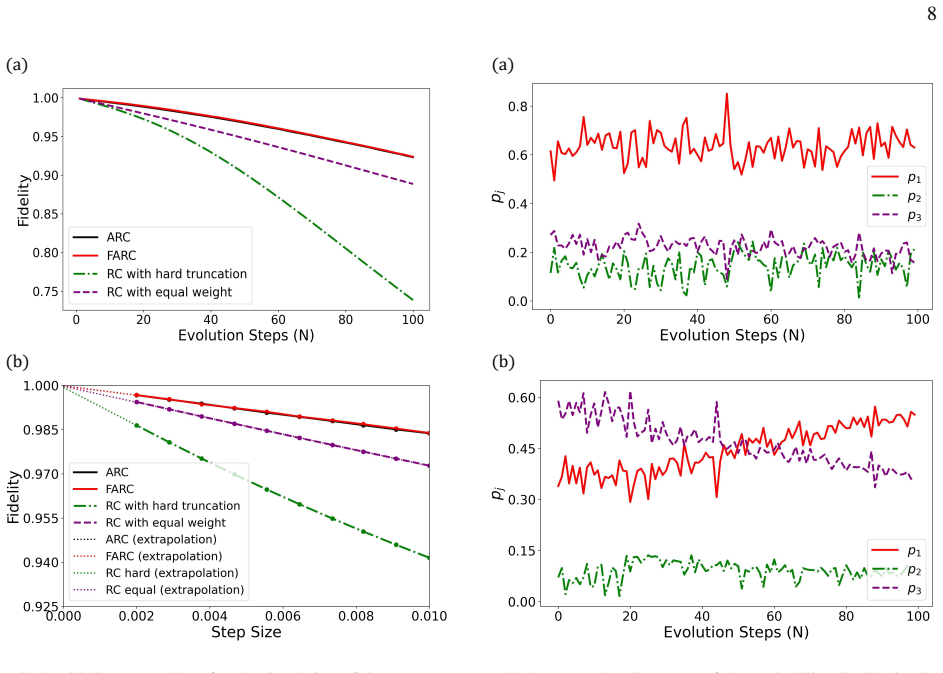
g= 0.2, with the initial state(|2,0⟩+|5,0⟩)/ √ 2, and a Fock space truncation dimension ofD= 50
Sampling probabilitiesp 1,p 2 andp 3 corresponding to the three Hamilto- nian terms are shown as red solid, green dot-dashed, and purple dashed lines, respectively. g= 0.2, with the initial state(|2,0⟩+|5,0⟩)/ √ 2, and a Fock space truncation dimension ofD= 50. The re- sults are obtained by averaging over10000samples. As shown in Fig. 4, in comparison wit...
-
[2]
J. J. Wallman and J. Emerson, Noise tailoring for scalable quantum computation via randomized compiling, Phys. Rev. A94, 052325 (2016)
work page 2016
- [3]
-
[4]
M. Urbanek, B. Nachman, V . R. Pascuzzi, A. He, C. W. Bauer, and W. A. de Jong, Mitigating depolarizing noise on quantum computers with noise-estimation circuits, Phys. Rev. Lett.127, 270502 (2021)
work page 2021
-
[5]
A. Jain, P. Iyer, S. D. Bartlett, and J. Emerson, Im- proved quantum error correction with randomized com- piling, Phys. Rev. Res.5, 033049 (2023)
work page 2023
-
[6]
Y . Gu, Y . Ma, N. Forcellini, and D. E. Liu, Noise-resilient phase estimation with randomized compiling, Phys. Rev. Lett.130, 250601 (2023)
work page 2023
-
[7]
Campbell, Random compiler for fast hamiltonian sim- ulation, Phys
E. Campbell, Random compiler for fast hamiltonian sim- ulation, Phys. Rev. Lett.123, 070503 (2019)
work page 2019
- [8]
-
[9]
C.-F. Chen, H.-Y . Huang, R. Kueng, and J. A. Tropp, Con- centration for random product formulas, PRX Quantum2, 040305 (2021)
work page 2021
- [10]
- [11]
-
[12]
R. P. Feynman, Simulating physics with computers, Int. J. Theor. Phys.21, 467 (1982)
work page 1982
-
[13]
I. M. Georgescu, S. Ashhab, and F. Nori, Quantum simu- lation, Rev. Mod. Phys.86, 153 (2014)
work page 2014
-
[14]
J. I. Cirac and P. Zoller, Goals and opportunities in quan- tum simulation, Nat. Phys.8, 264 (2012)
work page 2012
-
[15]
Deutsch, Quantum theory, the church–turing principle and the universal quantum computer, Proc
D. Deutsch, Quantum theory, the church–turing principle and the universal quantum computer, Proc. R. Soc. Lon- don. Ser. A400, 97 (1985)
work page 1985
-
[16]
Lloyd, Universal quantum simulators, Science273, 1073 (1996)
S. Lloyd, Universal quantum simulators, Science273, 1073 (1996)
work page 1996
-
[17]
A. Aspuru-Guzik, A. D. Dutoi, P. J. Love, and M. Head- Gordon, Simulated quantum computation of molecular energies, Science309, 1704 (2005)
work page 2005
-
[18]
R. Babbush, P. J. Love, and A. Aspuru-Guzik, Adiabatic quantum simulation of quantum chemistry, Sci. Rep.4, 6603 (2014)
work page 2014
- [19]
-
[20]
J. Arg ¨uello-Luengo, A. Gonz´alez-Tudela, T. Shi, P. Zoller, and J. I. Cirac, Analogue quantum chemistry simulation, Nature574, 215 (2019)
work page 2019
-
[21]
Y . Li, J. Hu, X.-M. Zhang, Z. Song, and M.-H. Yung, Vari- ational quantum simulation for quantum chemistry, Adv. Theor. Simul.2, 1800182 (2019)
work page 2019
-
[22]
G. D’Ariano, C. Macchiavello, and M. Sacchi, On the general problem of quantum phase estimation, Phys. Lett. A248, 103 (1998)
work page 1998
- [23]
-
[24]
S. Paesani, A. A. Gentile, R. Santagati, J. Wang, N. Wiebe, D. P. Tew, J. L. O’Brien, and M. G. Thompson, Experimental bayesian quantum phase estimation on a sil- icon photonic chip, Phys. Rev. Lett.118, 100503 (2017)
work page 2017
-
[25]
L.-Z. Liu, Y .-Z. Zhang, Z.-D. Li, R. Zhang, X.-F. Yin, Y .- Y . Fei, L. Li, N.-L. Liu, F. Xu, Y .-A. Chen,et al., Dis- tributed quantum phase estimation with entangled pho- tons, Nat. Photonics15, 137 (2021)
work page 2021
-
[26]
J. G. Smith, C. H. W. Barnes, and D. R. M. Arvidsson- Shukur, Adaptive bayesian quantum algorithm for phase estimation, Phys. Rev. A109, 042412 (2024)
work page 2024
-
[27]
R. Barends, A. Shabani, L. Lamata, J. Kelly, A. Mezza- capo, U. L. Heras, R. Babbush, A. G. Fowler, B. Camp- bell, Y . Chen,et al., Digitized adiabatic quantum com- puting with a superconducting circuit, Nature534, 222 (2016)
work page 2016
-
[28]
X. Cui, Y . Shi, and J.-C. Yang, Circuit-based digital adia- batic quantum simulation and pseudoquantum simulation as new approaches to lattice gauge theory, J. High Energy Phys.2020(8), 1
work page 2020
-
[29]
N. N. Hegade, K. Paul, Y . Ding, M. Sanz, F. Albarr ´an- Arriagada, E. Solano, and X. Chen, Shortcuts to adiabatic- ity in digitized adiabatic quantum computing, Phys. Rev. Appl.15, 024038 (2021)
work page 2021
-
[30]
J. L. O’Brien, Optical quantum computing, Science318, 1567 (2007)
work page 2007
-
[31]
Preskill, Quantum Computing in the NISQ era and be- yond, Quantum2, 79 (2018)
J. Preskill, Quantum Computing in the NISQ era and be- yond, Quantum2, 79 (2018)
work page 2018
-
[32]
L. Gyongyosi and S. Imre, A survey on quantum comput- ing technology, Comput. Sci. Rev.31, 51 (2019)
work page 2019
-
[33]
C. D. Bruzewicz, J. Chiaverini, R. McConnell, and J. M. Sage, Trapped-ion quantum computing: Progress and challenges, Appl. Phys. Rev.6(2019)
work page 2019
-
[34]
M. Kjaergaard, M. E. Schwartz, J. Braum ¨uller, P. Krantz, J. I.-J. Wang, S. Gustavsson, and W. D. Oliver, Supercon- ducting qubits: Current state of play, Annu. Rev. Condens. Matter Phys.11, 369 (2020)
work page 2020
-
[35]
H. F. Trotter, On the product of semi-groups of operators, Proc. Am. Math. Soc.10, 545 (1959)
work page 1959
-
[36]
M. Suzuki, Generalized trotter’s formula and systematic approximants of exponential operators and inner deriva- tions with applications to many-body problems, Commun. Math. Phys.51, 183 (1976)
work page 1976
-
[37]
H. Zhao, M. Bukov, M. Heyl, and R. Moessner, Making trotterization adaptive and energy-self-correcting for nisq devices and beyond, PRX Quantum4, 030319 (2023)
work page 2023
-
[38]
Q. Zhao, Y . Zhou, and A. M. Childs, Entanglement accel- erates quantum simulation, Nat. Phys. , 1 (2025)
work page 2025
-
[39]
M. C. Tran, S.-K. Chu, Y . Su, A. M. Childs, and A. V . Gor- shkov, Destructive error interference in product-formula lattice simulation, Phys. Rev. Lett.124, 220502 (2020)
work page 2020
-
[40]
J. D. Whitfield, J. Biamonte, and A. Aspuru-Guzik, Simu- lation of electronic structure hamiltonians using quantum computers, Mol. Phys.109, 735 (2011)
work page 2011
-
[41]
I. D. Kivlichan, J. McClean, N. Wiebe, C. Gidney, A. Aspuru-Guzik, G. K.-L. Chan, and R. Babbush, Quan- tum simulation of electronic structure with linear depth and connectivity, Phys. Rev. Lett.120, 110501 (2018)
work page 2018
-
[42]
A. Tranter, P. J. Love, F. Mintert, N. Wiebe, and P. V . Coveney, Ordering of trotterization: Impact on errors in quantum simulation of electronic structure, Entropy21, 1218 (2019)
work page 2019
-
[43]
Y . Shee, P.-K. Tsai, C.-L. Hong, H.-C. Cheng, and H.-S. Goan, Qubit-efficient encoding scheme for quantum sim- ulations of electronic structure, Phys. Rev. Res.4, 023154 (2022)
work page 2022
-
[44]
Y .-Z. Fan, Y .-X. Wu, and D.-B. Zhang, Adaptive ran- dom compiler for hamiltonian simulation, (2025), arXiv:2506.15466
-
[45]
V . Giovannetti, S. Lloyd, and L. Maccone, Quantum metrology, Phys. Rev. Lett.96, 010401 (2006)
work page 2006
-
[46]
V . Giovannetti, S. Lloyd, and L. Maccone, Advances in quantum metrology, Nat. Photonics5, 222 (2011)
work page 2011
-
[47]
V . Giovannetti, S. Lloyd, and L. Maccone, Quantum mea- surement bounds beyond the uncertainty relations, Phys. Rev. Lett.108, 260405 (2012)
work page 2012
- [48]
-
[49]
C. W. Helstrom, Quantum detection and estimation the- ory, J. Stat. Phys.1, 231 (1969)
work page 1969
-
[50]
V . Giovannetti, S. Lloyd, and L. Maccone, Quantum- enhanced measurements: beating the standard quantum limit, Science306, 1330 (2004)
work page 2004
-
[51]
S. L. Braunstein and C. M. Caves, Statistical distance and the geometry of quantum states, Phys. Rev. Lett.72, 3439 (1994)
work page 1994
-
[52]
M. G. Paris, Quantum estimation for quantum technology, Int. J. Quantum Inf.7, 125 (2009)
work page 2009
- [53]
-
[54]
S. P. Boyd and L. Vandenberghe,Convex optimization (Cambridge university press, 2004)
work page 2004
-
[55]
Luo, Quantum fisher information and uncertainty rela- tions, Lett
S. Luo, Quantum fisher information and uncertainty rela- tions, Lett. Math. Phys.53, 243 (2000)
work page 2000
- [56]
- [57]
-
[58]
S. Gandhari, V . V . Albert, T. Gerrits, J. M. Taylor, and M. J. Gullans, Precision bounds on continuous-variable state tomography using classical shadows, PRX Quantum 5, 010346 (2024)
work page 2024
-
[59]
QuTiP 5: The Quantum Toolbox in Python
N. Lambert, E. Gigu `ere, P. Menczel, B. Li, P. Hopf, G. Su´arez, M. Gali, J. Lishman, R. Gadhvi, R. Agarwal, et al., Qutip 5: The quantum toolbox in python, (2024), arXiv:2412.04705
work page internal anchor Pith review Pith/arXiv arXiv 2024
-
[60]
J. Johansson, P. Nation, and F. Nori, Qutip 2: A python framework for the dynamics of open quantum systems, Comput. Phys. Commun.184, 1234 (2013)
work page 2013
-
[61]
J. Johansson, P. Nation, and F. Nori, Qutip: An open- source python framework for the dynamics of open quan- tum systems, Comput. Phys. Commun.183, 1760 (2012)
work page 2012
-
[62]
K. Marshall, R. Pooser, G. Siopsis, and C. Weedbrook, Quantum simulation of quantum field theory using con- tinuous variables, Phys. Rev. A92, 063825 (2015)
work page 2015
-
[63]
S. Abel, M. Spannowsky, and S. Williams, Simulating quantum field theories on continuous-variable quantum 11 computers, Phys. Rev. A110, 012607 (2024)
work page 2024
- [64]
-
[65]
D.-B. Zhang, S.-L. Zhu, and Z. D. Wang, Protocol for im- plementing quantum nonparametric learning with trapped ions, Phys. Rev. Lett.124, 010506 (2020)
work page 2020
-
[66]
D.-B. Zhang, G.-Q. Zhang, Z.-Y . Xue, S.-L. Zhu, and Z. D. Wang, Continuous-variable assisted thermal quan- tum simulation, Phys. Rev. Lett.127, 020502 (2021)
work page 2021
-
[67]
U. L. Andersen, J. S. Neergaard-Nielsen, P. van Loock, and A. Furusawa, Hybrid discrete- and continuous- variable quantum information, Nat. Phys.11, 713–719 (2015)
work page 2015
-
[68]
M. Sabatini, T. Bertapelle, P. Villoresi, G. Vallone, and M. Avesani, Hybrid encoder for discrete and continuous variable qkd, Adv. Quantum Technol. , 2400522 (2024)
work page 2024
-
[69]
J. Lepp ¨akangas, P. Stadler, D. Golubev, R. Reiner, J.- M. Reiner, S. Zanker, N. Wurz, M. Renger, J. Ver- jauw, D. Gusenkova,et al., Quantum algorithms for simulating systems coupled to bosonic modes using a hybrid resonator-qubit quantum computer, (2025), arXiv:2503.11507
discussion (0)
Sign in with ORCID, Apple, or X to comment. Anyone can read and Pith papers without signing in.