REVIEW 3 major objections 4 minor 108 references
Probing the $\Lambda_{b}\to \Lambda_{c}^{*}\tau \bar{\nu}_{\tau}$ decays with leptoquarks
T0 review · 3 major / 4 minor · reviewed 2026-08-15 · deepseek-v4-flash
Pith's one-line read The lepton-flavor-universality ratio $R_{\Lambda_c^*}$ in $\Lambda_b\to\Lambda_c^*(2595,2625)\tau\bar{\nu}_\tau$ decays is particularly sensitive to U1 and S1 leptoquarks, showing a clear departure from the standard-model prediction in…
desk verdict Solid but incremental LQ analysis of Λ_b→Λ_c* τν decays; the claimed R_Λ_c* sensitivity is plausible but not quantified, so the paper needs a significance calculation before the headline claim is credible. read the letter →
The pith
A machine-rendered reading of the paper's core claim, the machinery that carries it, and where it could break.
The reading
What carries the argument
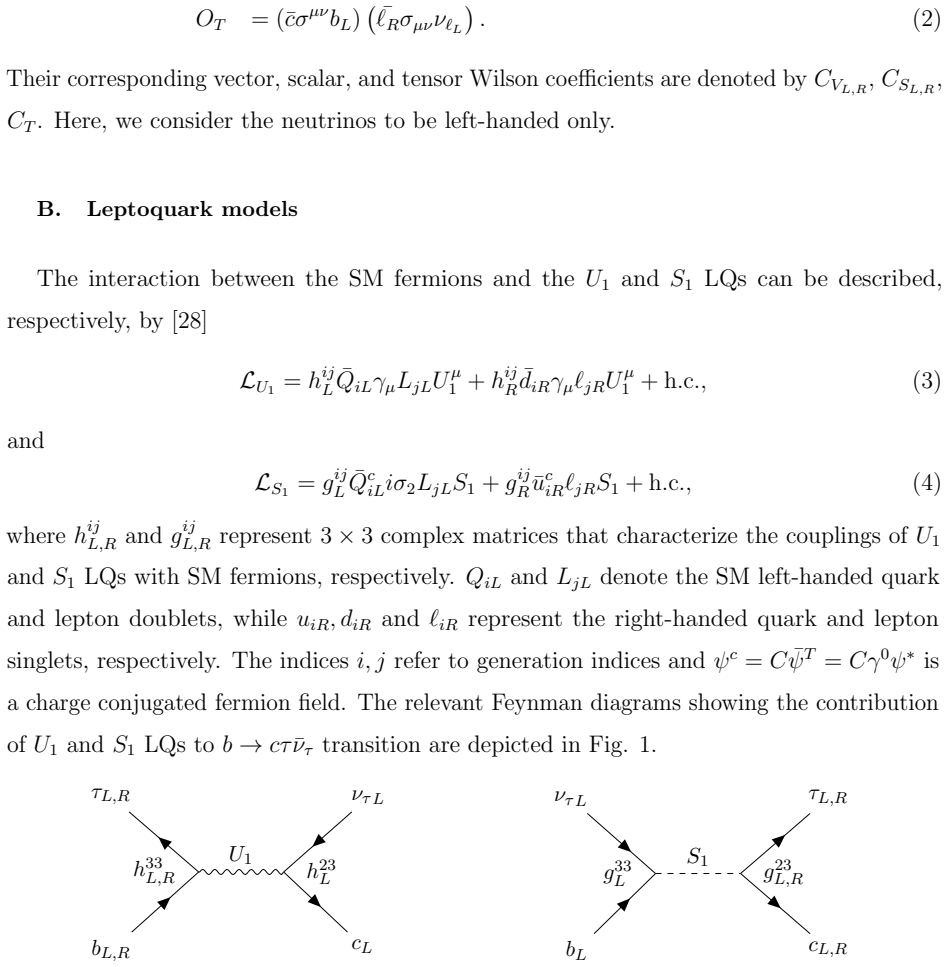
The machinery is the helicity-amplitude decomposition of the $1/2^+\to 1/2^-$ and $1/2^+\to 3/2^-$ transitions for vector, axial-vector, scalar, pseudoscalar, and tensor operators, with Wilson coefficients obtained from the U1 and S1 leptoquark Lagrangians through Fierz transformations and evolved to the $m_b$ scale. The hadronic input is the set of lattice QCD form factors and covariance matrices for $\Lambda_b\to\Lambda_c^*(2595,2625)$; the analytical work is the explicit construction of the helicity amplitudes, the differential decay rate, and the $q^2$-dependent observables. The controlling mechanism is the factor $|1+C_{V_L}|^2$, which dominates the rate, cancels in normalized angular distributions, and leaves $R_{\Lambda_c^*}$ as the clear new-physics probe.
What would settle it
Measure $R_{\Lambda_c^*}$ for $\Lambda_c^*(2595)$ and $\Lambda_c^*(2625)$ in narrow $q^2$ bins near zero recoil in a high-statistics experiment; if the measured ratios track the standard-model prediction bin by bin while $R_D$ and $R_{D^*}$ remain elevated, the leptoquark interpretation of the claimed shift would be excluded.
Extended reading notes
Core claim
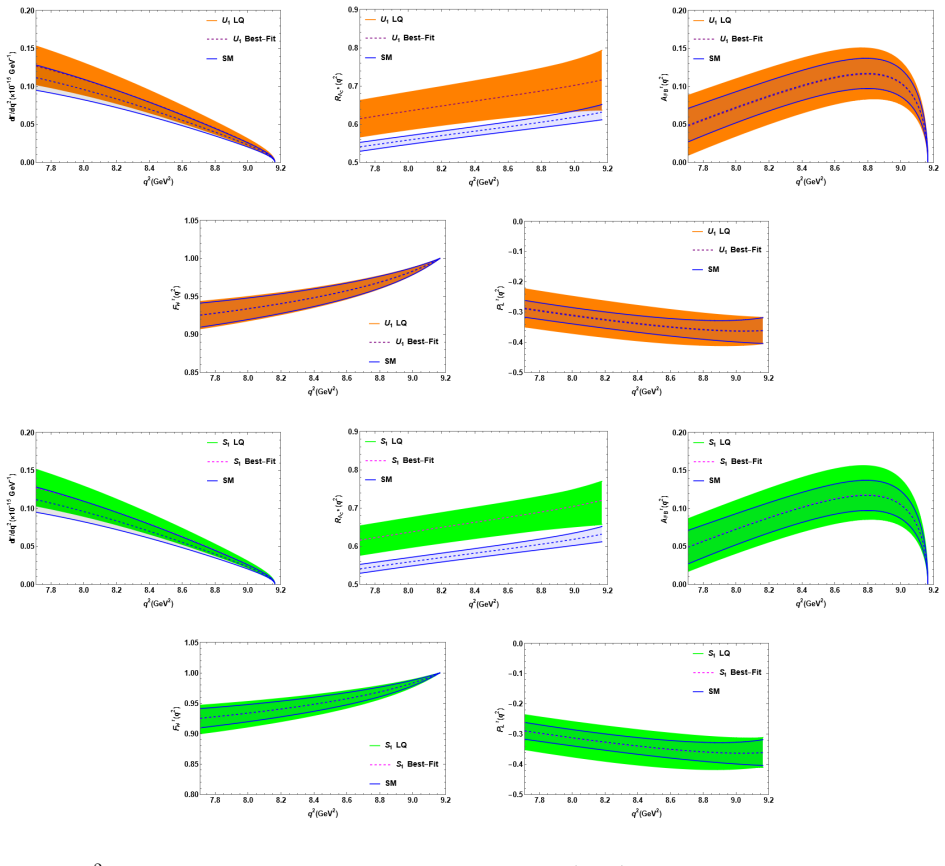
The paper claims that for both final states, the ratio $R_{\Lambda_c^*}=\mathcal{B}(\Lambda_b\to\Lambda_c^*\tau\bar{\nu}_\tau)/\mathcal{B}(\Lambda_b\to\Lambda_c^*\ell\bar{\nu}_\ell)$ receives visible upward shifts when a U1 vector or S1 scalar leptoquark at a benchmark mass of 2 TeV is added to the standard model, after fitting the leptoquark couplings to $R_{D^{(*)}}$, $R_{J/\psi}$, $F_L^{D^*}$, $P_\tau^{D^*}$, and the $B_c\to\tau\nu$ bound. The deviations appear because vector new physics enters the decay rate through $|1+C_{V_L}|^2$ and survives in the ratio, while scalar and tensor contributions are suppressed near zero recoil by $m_\tau^2/q^2$. The same structure makes the forward-backward asymmetry, the flat term, and the longitudinal $\tau$ polarization nearly insensitive to the leptoquarks, singling out the LFU ratio as the observable to measure.
Load-bearing premise
The lattice QCD form factors for the two excited charmed baryons, including their covariance matrices, correctly describe all hadronic matrix elements in the high-$q^2$ region where the analysis is restricted; if those form factors are inaccurate, the predicted deviations in $R_{\Lambda_c^*}$ could disappear.
Editorial extensions
If this is right
- A measurement of $R_{\Lambda_c^*}$ in either excited charmed channel supplies a new lepton-flavor-universality test in the tauonic $b\to c$ sector, complementing the mesonic ratios $R_D$ and $R_{D^*}$.
- The LFU ratio is the discriminating observable: the forward-backward asymmetry, flat term, and $\tau$ polarization overlap with the standard-model predictions, so those observables cannot serve as clean new-physics signals here.
- Both U1 and S1 leptoquark scenarios produce similar $R_{\Lambda_c^*}$ predictions in the studied kinematic region, so observing a deviation would indicate leptoquark-like new physics but would not by itself identify which leptoquark is responsible.
- Complex leptoquark couplings leave the predicted observables essentially unchanged near zero recoil, making the conclusions insensitive to unknown CP-violating phases in the fitted couplings.
- The high-$q^2$ region, where the lattice form factors are most reliable, is where the claimed deviation is most visible; measurements binned there would be the most informative.
Reading between the lines
- If the predicted deviation is confirmed, it would show that vector new physics in $b\to c\tau\nu$ is not an artifact of mesonic form-factor modeling, because baryonic and mesonic transitions carry different hadronic uncertainties.
- Because scalar and tensor effects are suppressed by $m_\tau^2/q^2$ near zero recoil, comparing a high-$q^2$ measurement of $R_{\Lambda_c^*}$ with one extended to lower $q^2$ could in principle separate the vector Wilson coefficient $C_{V_L}$ from scalar operators.
- The excited baryons decay through $\Lambda_c\pi\pi$ final states, so a high-luminosity analysis built around that decay chain could turn $R_{\Lambda_c^*}$ into a practical observable even though the individual branching fractions are small.
- The near-degeneracy of the U1 and S1 predictions suggests that an additional observable, such as the $\tau$ polarization combined with $R_{\Lambda_c^*}$, would be needed to break the degeneracy between scalar and vector leptoquark explanations.
Signed reviews
Editorial analysis
A structured set of objections, weighed in public.
Referee Report
Summary. The manuscript studies the semileptonic decays Λ_b → Λ_c*(2595,2625) τ^- ν̄_τ in the Standard Model and in two leptoquark scenarios, the vector U_1 and the scalar S_1. The authors derive the effective Hamiltonian, match the U_1 and S_1 Wilson coefficients to b→cτν, give explicit helicity amplitudes for the 1/2^+ → 1/2^- and 1/2^+ → 3/2^- transitions, and construct the q^2-dependent observables: differential decay rate, LFU ratio R_Λ_c*, forward-backward asymmetry, flat term, and τ longitudinal polarization. Using lattice QCD form factors from Refs. [82,83], they fit the LQ couplings to the current R_D, R_D*, R_J/ψ, F_L^{D*}, P_τ^{D*} data and the B_c→τν bound, and then show q^2 spectra of the Λ_b → Λ_c* observables. The headline finding is that R_Λ_c* is particularly sensitive to the U_1 and S_1 leptoquarks, exhibiting a 'distinguished divergence' from the SM prediction.
Significance. If the sensitivity claim is quantitatively established, the paper would be a useful model-dependent addition to the phenomenology of semileptonic Λ_b decays. The helicity formalism is standard and the explicit expressions for the 1/2^+ → 1/2^- and 1/2^+ → 3/2^- amplitudes with all four-fermion structures are a useful reference. A clear strength is that the LQ couplings are fitted to mesonic observables only, so the Λ_b → Λ_c* predictions are independent consequences of the model rather than a refit of the target modes. The use of the lattice covariance matrices is also to be credited. However, the central claim is currently supported only by visual separation of bands in Figs. 3 and 4: no numerical R_Λ_c* values, uncertainties, or significance estimates are provided, and the entire analysis rests on a single lattice form-factor set that the manuscript itself notes is in tension with HQET-based extractions. These shortcomings prevent the paper from demonstrating the headline sensitivity at the quantitative level required for a journal publication.
major comments (3)
- [Sec. III, Figs. 3 and 4, and Sec. IV] The central claim that R_Λ_c* shows a 'distinguished divergence' is inferred from the visual separation of the SM and LQ bands, but the paper provides no numeric predictions, no binned R_Λ_c* values, and no significance estimate. With the best-fit vector coefficient C_VL ≈ 0.065, the dominant effect is roughly a multiplicative |1+C_VL|^2 ≈ 1.13 enhancement, and whether this is distinguishable from the SM depends on the full form-factor covariance and on the 1σ spread of the fitted couplings from Fig. 2, which are not propagated into the displayed bands. I request a quantitative statement, for example a table of binned R_Λ_c* values with form-factor and fit uncertainties, and the SM-vs-LQ separation expressed in units of σ.
- [Secs. II.D and III] The numerical analysis uses exclusively the lattice QCD form factors of Refs. [82,83]. The manuscript itself cites Refs. [91,92], which report tensions between these lattice results and HQET-based determinations of the same form factors. Since the claimed NP shift in R_Λ_c* is only of order 10%, an alternative form-factor input could change the size, the sign, or the q^2 location of the deviation. A cross-check with HQET-based form factors, or at least a quantitative study of the sensitivity of the predicted R_Λ_c* deviation to the form-factor parameterization, is needed before the headline claim is robust.
- [Table I] There is an internal inconsistency in Table I: the rows after h(3/2^-)_+ are labeled h(1/2^-)_⊥ = 1.23(15) and h(1/2^-)_⊥' = -0.02133(95), but the same values appear to belong to the 3/2^- transition (h(3/2^-)_⊥ and h(3/2^-)_⊥'), while the 1/2^- h_⊥ entry was already listed above as 0.91(23). Because the mislabeled quantities enter the F_V4, F_A4 and tensor helicity amplitudes used for Λ_c(2625), this affects the numerical results for the 3/2^- channel. The table labels should be corrected and the numerics rechecked.
minor comments (4)
- [Abstract and Sec. III] The abstract states that the distinguished divergence appears in the high-q^2 region, but Sec. III reports that R_Λ_c*(2595) deviates near the lower end of the q^2 spectrum while R_Λ_c*(2625) deviates at higher q^2; these statements should be reconciled.
- [Sec. IV] The sentence 'we used a 1σ bound from the current experimental data of R_D(∗), R_J/ψ, F_L^{D*}, P_τ^{D*}' is imprecise: the analysis uses a χ^2 fit with the full experimental covariance, not a simple 1σ bound. The wording should be corrected.
- [Eq. (35) and Table V] The definition of dO_i in Eq. (35) gives the discrepancy from experiment in units of σ_exp, but the entries in Table V are hard to read and the sign convention (positive/negative superscripts) is not explained. Please clarify the presentation.
- [Sec. IV] There are minor language issues, including 'the the U_1 and S_1 leptoquark frameworks' and 'provide complimentary probe'; these should be fixed in a final proofread.
Circularity Check
No significant circularity: the leptoquark couplings are fitted to external mesonic b->c tau nu data, and the Lambda_b -> Lambda_c* observables are genuine out-of-sample predictions.
full rationale
The derivation chain is self-contained against the paper's own target: the U1 and S1 Wilson coefficients are obtained from the leptoquark Lagrangians (Eqs. 5-9), then constrained by a chi-square fit to R_D, R_D*, R_J/psi, F_L^D*, P_tau^D*, and the B_c -> tau nu upper bound, using experimental values and the external global fit of Ref. [10]. The predicted quantity R_Lambda_c* for Lambda_b -> Lambda_c*(2595,2625) tau nu does not appear anywhere in the fit function of Eq. (33) or in the observables of Table III, so it is not a refit or a renamed input. The hadronic input, the lattice QCD form factors of Refs. [82,83], is external to the authors and is used for both SM and leptoquark predictions, with the target observables entering only after the couplings are fixed. There is no self-citation chain supporting the central claim, no parameter defined in terms of R_Lambda_c*, and no fitted quantity relabeled as a prediction. The skeptic's concern that the claimed deviation lacks a quantitative significance test against form-factor and coupling uncertainties is a correctness or robustness issue, not a circularity issue, and therefore does not raise the circularity score.
Assumptions & free parameters
free parameters (5)
- U1 coupling combination (h23_L h33*_L) =
0.3473
- U1 coupling combination (h23_L h33*_R) =
-0.0116
- S1 coupling combination (g33_L g23*_L) =
0.7517
- S1 coupling combination (g33_L g23*_R) =
0.0424
- Leptoquark mass benchmark M_LQ =
2 TeV
assumptions (6)
- domain assumption The effective Hamiltonian for b->c ell nu_ell is the SM (V-A) plus NP operators with left-handed neutrinos only.
- domain assumption The single U1 and S1 leptoquark models and their Wilson coefficients are as given in [28].
- domain assumption The RGE evolution of Wilson coefficients from 2 TeV to mb scale is taken from [10].
- domain assumption The lattice QCD form factors and their covariance matrices from [82,83] are valid in the high-q^2 region.
- domain assumption The form factor parametrizations in Eqs. (10)-(15) as given in [95] are correct.
- domain assumption The excited Lambda_c*(2595,2625) states can be treated as stable (narrow width).
Cite this review
Pith. "Pith review of Probing the $\Lambda_{b}\to \Lambda_{c}^{*}\tau \bar{\nu}_{\tau}$ decays with leptoquarks." pith.science (2026). https://pith.science/paper/Q6ZDHVGU
@misc{pith2026250513323,
  author       = {Pith},
  title        = {Pith review of: Probing the $\Lambda_b\to \Lambda_c^*\tau \bar\nu_\tau$ decays with leptoquarks},
  year         = {2026},
  howpublished = {\url{https://pith.science/paper/Q6ZDHVGU}},
  note         = {Machine review of arXiv:2505.13323}
}
abstract
The extension of the standard model to include a single scalar or vector leptoquark has been shown to account for the observed deviations in the lepton flavor universality ratios in the $b \to c \ell \nu_{\ell}$ and $b \to s \ell \ell$ transitions. Exploring new physics in the $b \to c \tau \nu_{\tau}$ decays, in this work we analyze the baryonic decay channels $\Lambda_b \to \Lambda_{c}^{*}(2595,2625) \tau^- \bar{\nu}_\tau$ beyond the standard model. Specifically, we investigate the role of leptoquarks in these decays, focusing on the $U_1$ vector leptoquark and the $S_1$ scalar leptoquark. Employing recent lattice QCD results for the $\Lambda_b \to \Lambda_{c}^{*}$ form factors, the helicity amplitudes for all possible four-fermion interactions are worked out explicitly and presented here. Utilizing the current $b \to c \ell \nu_{\ell}$ experimental data, we impose constraints on the leptoquark couplings and test new physics sensitivity of various observables for the decay processes under consideration. Our analysis demonstrates the significance of testing the lepton flavor universality ratio $R_{\Lambda_{c}^{*}}$ as it is observed to be particularly sensitive to these leptoquarks.
Figures

Figures from the paper (1 more)

Reference graph
Works this paper leans on
-
[95]
M. Papucci and D. J. Robinson, Form factor counting and HQET matching for new physics in Λb→ Λ∗ cℓν, Phys. Rev. D 105, 016027 (2022), arXiv:2105.09330 [hep-ph]
arXiv 2022
-
[1]
(18) Other helicity amplitudes can be obtained from the relations HV,A −λ2,−λW =∓HV,A λ2,λW and HS,P −λ2,−λW =∓HS,P λ2,λW
1/2+→ 1/2− For the 1/2+→ 1/2− transition, we find the relevant helicity amplitudes as HV,A 1/2,t = −f ( 1 2 −)V,A 0 (1 +CVL±CVR) √Q∓p q2 (M1±M2), HV,A 1/2,0 = −f ( 1 2 −)V,A + (1 +CVL±CVR) √Q±p q2 (M1∓M2), HV,A 1/2,1 = f ( 1 2 −)V,A ⊥ (1 +CVL±CVR) p 2Q± , HS,P 1/2,0 = ∓f ( 1 2 −)V,A 0 (CSL±CSR) √Q∓ (mb∓mc)(M1±M2). (18) Other helicity amplitudes can be obt...
-
[2]
(12) In the above, σµν = i 2(γµγν−γνγµ)
+iT4σµν i uB1(p1,s 1). (12) In the above, σµν = i 2(γµγν−γνγµ). The form factors Gi.Fi,Ti defined in Eqs. (10)-(12) are related to the helicity form factors computed in the LQCD framework [82] as G1 = −f ( 1 2 −) ⊥ , G2 = M1 h f ( 1 2 −) 0 M1 +M2 q2 +f ( 1 2 −) + M1−M2 Q− 1− M 2 1−M 2 2 q2 +f ( 1 2 −) ⊥ 2M2 Q− i , G3 = M2 h −f ( 1 2 −) 0 M1 +M2 q2 +f ( 1 ...
-
[3]
(14) In the above, ¯uλ B∗ 2 denotes the Rarita-Schwinger spinor of Λ∗ c(3/2−) baryon
+iFT 4 M1 p1λσµν−FT 5 (gλ µγν−gλ νγµ) −FT 6 M1 (gλ µpν 1−gλ νpµ 1)− FT 7 M1 (gλ µpν 2−gλ νpµ 2) i uB1(p1,s 1), ⟨B∗ 2|¯ciσµνγ5b|B1⟩ = ¯uλ B∗ 2 (p2,s 2)γ5 h p1λ(pµ 1pν 2−pν 1pµ 2)FT 1 M 3 1 −p1λ(γµpν 1−γνpµ 1) ×M2FT 1 −M1FT 2 M 3 1 −p1λ(γµpν 2−γνpµ 2)FT 1 +FT 3 M 2 1 +ip1λσµν hFT 6 M1 − FT 1 M 3 1 (p.p′ +M1M2) +FT 2 M1 − M2 M 2 1 FT 3 + FT 4 M1 i −(gλ µγν−g...
-
[4]
h ( 3 2 −) + r Q+ 6 − ˜h ( 3 2 −) + r Q− 6 # , H(T )+1/2 +1/2,t,0 = CT
1/2+→ 3/2− For the 1/2+→ 3/2− transition, we obtain the helicity amplitudes as HV,A 1/2,t = f ( 3 2 −)V,A 0 (1 +CVL±CVR) s 2 3 Q∓ q2 (M1∓M2) 2 , HV,A 1/2,0 = f ( 3 2 −)V,A + (1 +CVL±CVR) s 2 3 Q± q2 (M1±M2) 2 , HV,A 1/2,1 = −f ( 3 2 −)V,A ⊥ (1 +CVL±CVR) r Q± 3 , HV,A 3/2,1 = ±f ( 3 2 −)V,A ⊥′ (1 +CVL±CVR) p Q±, HS,P 1/2,0 = ±f ( 3 2 −)V,A 0 (CSL±CSR) r 1 ...
2020
-
[5]
R. Aaij et al. (LHCb), Measurement of lepton universality parameters in B+→K+ℓ+ℓ− and B0→K∗0ℓ+ℓ− decays, Phys. Rev. D 108, 032002 (2023), arXiv:2212.09153 [hep-ex]
arXiv 2023
-
[6]
S. Descotes-Genon, J. Matias, M. Ramon, and J. Virto, Implications from clean observables for the binned analysis ofB→K∗µ+µ− at large recoil, JHEP 01, 048 (2013), arXiv:1207.2753 [hep-ph]
arXiv 2013
-
[7]
R. Aaij et al. (LHCb), Measurement of CP -Averaged Observables in the B0→K∗0µ+µ− Decay, Phys. Rev. Lett. 125, 011802 (2020), arXiv:2003.04831 [hep-ex]
arXiv 2020
Show all 108 references
-
[8]
Aaij et al
R. Aaij et al. (LHCb), Branching Fraction Measurements of the Rare B0 s → ϕµ+µ− and B0 s→f′ 2(1525)µ+µ−- Decays, Phys. Rev. Lett. 127, 151801 (2021), arXiv:2105.14007 [hep-ex]. 25
2021
-
[9]
Aaij et al
R. Aaij et al. (LHCb), Differential branching fractions and isospin asymmetries of B→ K(∗)µ+µ− decays, JHEP 06, 133 (2014), arXiv:1403.8044 [hep-ex]
2014 arXiv
-
[10]
HFLAV Collaboration, https://hflav-eos.web.cern.ch/hflav-eos/semi/moriond24/ html/RDsDsstar/RDRDs.html
-
[11]
Aaij et al
R. Aaij et al. (LHCb), Measurement of the ratio of branching fractions B(B+ c → J/ψτ +ντ)/B(B+ c → J/ψµ+νµ), Phys. Rev. Lett. 120, 121801 (2018), arXiv:1711.05623 [hep-ex]
2018 arXiv
-
[12]
Hayrapetyan et al
A. Hayrapetyan et al. (CMS), Test of lepton flavor universality in semileptonic B+ c meson decays in proton-proton collisions at √s = 13 TeV, Phys. Rev. D 111, L051102 (2025), arXiv:2408.00678 [hep-ex]
2025 arXiv
-
[13]
CMS Collaboration, Measurement of the ratio of the B+ c →J/ψτ +ντ and B+ c →J/ψµ+νµ branching fractions using three-prong τ lepton decays in proton-proton collisions at √s = 13 TeV, CMS-PAS-BPH-23-001, https://cds.cern.ch/record/2908224 (2024)
2024
-
[14]
Iguro, T
S. Iguro, T. Kitahara, and R. Watanabe, Global fit to b→cτν anomalies as of Spring 2024, Phys. Rev. D 110, 075005 (2024), arXiv:2405.06062 [hep-ph]
2024 arXiv
-
[15]
Harrison, C
J. Harrison, C. T. H. Davies, and A. Lytle (LATTICE-HPQCD), R(J/ψ) andB− c →J/ψℓ−¯νℓ Lepton Flavor Universality Violating Observables from Lattice QCD, Phys. Rev. Lett. 125, 222003 (2020), arXiv:2007.06956 [hep-lat]
2020 arXiv
-
[16]
Hirose et al
S. Hirose et al. (Belle), Measurement of the τ lepton polarization and R(D∗) in the decay ¯B→D∗τ−¯ντ, Phys. Rev. Lett. 118, 211801 (2017), arXiv:1612.00529 [hep-ex]
2017 arXiv
-
[17]
Hirose et al
S. Hirose et al. (Belle), Measurement of the τ lepton polarization and R(D∗) in the decay ¯B→D∗τ−¯ντ with one-prong hadronic τ decays at Belle, Phys. Rev. D 97, 012004 (2018), arXiv:1709.00129 [hep-ex]
2018 arXiv
-
[18]
Abdesselam et al
A. Abdesselam et al. (Belle), Measurement of the D∗− polarization in the decay B0→ D∗−τ +ντ, in 10th International Workshop on the CKM Unitarity Triangle (2019) arXiv:1903.03102 [hep-ex]
2019 arXiv
-
[19]
Aaij et al
R. Aaij et al. (LHCb), Measurement of the D∗ longitudinal polarization in B0→D∗−τ +ντ decays, Phys. Rev. D 110, 092007 (2024), arXiv:2311.05224 [hep-ex]
2024
-
[20]
Farhi and L
E. Farhi and L. Susskind, Technicolor, Phys. Rept. 74, 277 (1981)
1981
-
[21]
K. D. Lane and M. V. Ramana, Walking technicolor signatures at hadron colliders, Phys. Rev. D 44, 2678 (1991). 26
1991
-
[22]
Georgi and S
H. Georgi and S. L. Glashow, Unity of All Elementary Particle Forces, Phys. Rev. Lett. 32, 438 (1974)
1974
-
[23]
Fritzsch and P
H. Fritzsch and P. Minkowski, Unified Interactions of Leptons and Hadrons, Annals Phys. 93, 193 (1975)
1975
-
[24]
J. C. Pati and A. Salam, Lepton Number as the Fourth Color, Phys. Rev. D 10, 275 (1974), [Erratum: Phys.Rev.D 11, 703–703 (1975)]
1974
-
[25]
G. R. Farrar and P. Fayet, Phenomenology of the Production, Decay, and Detection of New Hadronic States Associated with Supersymmetry, Phys. Lett. B 76, 575 (1978)
1978
-
[26]
Barbier et al
R. Barbier et al. , R-parity violating supersymmetry, Phys. Rept. 420, 1 (2005), arXiv:hep- ph/0406039
2005
-
[27]
Schrempp and F
B. Schrempp and F. Schrempp, LIGHT LEPTOQUARKS, Phys. Lett. B 153, 101 (1985)
1985
-
[28]
Gripaios, Composite Leptoquarks at the LHC, JHEP 02, 045 (2010), arXiv:0910.1789 [hep-ph]
B. Gripaios, Composite Leptoquarks at the LHC, JHEP 02, 045 (2010), arXiv:0910.1789 [hep-ph]
2010 arXiv
-
[29]
Dorˇ sner, S
I. Dorˇ sner, S. Fajfer, A. Greljo, J. F. Kamenik, and N. Koˇ snik, Physics of leptoquarks in precision experiments and at particle colliders, Phys. Rept. 641, 1 (2016), arXiv:1603.04993 [hep-ph]
2016 arXiv
-
[30]
CMS Collaboration, Overview of CMS leptoquark searches, https://twiki.cern.ch/twiki/ pub/CMSPublic/SummaryPlotsEXO13TeV/barplot_QE_QMU_QTAU_QNU_2025March.pdf (2025)
2025
-
[31]
cern.ch/record/2927911 (2025)
ATLAS Collaboration, Leptoquark summary plots for scalar or vector models, http://cds. cern.ch/record/2927911 (2025)
2025
-
[32]
Sakaki, M
Y. Sakaki, M. Tanaka, A. Tayduganov, and R. Watanabe, Testing leptoquark models in ¯B→D(∗)τ ¯ν, Phys. Rev. D 88, 094012 (2013), arXiv:1309.0301 [hep-ph]
2013 arXiv
-
[33]
Hiller and M
G. Hiller and M. Schmaltz, RK and future b→ sℓℓ physics beyond the standard model opportunities, Phys. Rev. D 90, 054014 (2014), arXiv:1408.1627 [hep-ph]
2014 arXiv
-
[34]
Bauer and M
M. Bauer and M. Neubert, Minimal Leptoquark Explanation for the RD(∗) ,RK , and (g−2)µ Anomalies, Phys. Rev. Lett. 116, 141802 (2016), arXiv:1511.01900 [hep-ph]
2016 arXiv
-
[35]
Bhattacharya, A
B. Bhattacharya, A. Datta, J.-P. Gu´ evin, D. London, and R. Watanabe, Simultaneous Explana- tion of the RK and RD(∗) Puzzles: a Model Analysis, JHEP 01, 015 (2017), arXiv:1609.09078 [hep-ph]. 27
2017 arXiv
-
[36]
Dumont, K
B. Dumont, K. Nishiwaki, and R. Watanabe, LHC constraints and prospects forS1 scalar lepto- quark explaining the ¯B→D(∗)τ ¯ν anomaly, Phys. Rev. D 94, 034001 (2016), arXiv:1603.05248 [hep-ph]
2016 arXiv
-
[37]
Li, Y.-D
X.-Q. Li, Y.-D. Yang, and X. Zhang, Revisiting the one leptoquark solution to the R(D(∗)) anomalies and its phenomenological implications, JHEP 08, 054 (2016), arXiv:1605.09308 [hep-ph]
2016 arXiv
-
[38]
Beˇ cirevi´ c, S
D. Beˇ cirevi´ c, S. Fajfer, N. Koˇ snik, and O. Sumensari, Leptoquark model to explain theB- physics anomalies, RK and RD, Phys. Rev. D 94, 115021 (2016), arXiv:1608.08501 [hep-ph]
2016 arXiv
-
[39]
D. Das, C. Hati, G. Kumar, and N. Mahajan, Towards a unified explanation of RD(∗),RK and (g− 2)µ anomalies in a left-right model with leptoquarks, Phys. Rev. D 94, 055034 (2016), arXiv:1605.06313 [hep-ph]
2016 arXiv
-
[40]
Sahoo, R
S. Sahoo, R. Mohanta, and A. K. Giri, Explaining the RK and RD(∗) anomalies with vector leptoquarks, Phys. Rev. D 95, 035027 (2017), arXiv:1609.04367 [hep-ph]
2017 arXiv
-
[41]
C.-H. Chen, T. Nomura, and H. Okada, Excesses of muong−2,RD(∗), andRK in a leptoquark model, Phys. Lett. B 774, 456 (2017), arXiv:1703.03251 [hep-ph]
2017 arXiv
-
[42]
Crivellin, D
A. Crivellin, D. M¨ uller, and T. Ota, Simultaneous explanation ofR(D(∗)) and b→sµ+µ−: the last scalar leptoquarks standing, JHEP 09, 040 (2017), arXiv:1703.09226 [hep-ph]
2017 arXiv
-
[43]
Angelescu, D
A. Angelescu, D. Beˇ cirevi´ c, D. A. Faroughy, and O. Sumensari, Closing the window on single leptoquark solutions to the B-physics anomalies, JHEP 10, 183 (2018), arXiv:1808.08179 [hep-ph]
2018 arXiv
-
[44]
Jung and D
M. Jung and D. M. Straub, Constraining new physics in b→cℓν transitions, JHEP 01, 009 (2019), arXiv:1801.01112 [hep-ph]
2019 arXiv
-
[45]
Iguro, T
S. Iguro, T. Kitahara, Y. Omura, R. Watanabe, and K. Yamamoto, D∗ polarization vs. RD(∗) anomalies in the leptoquark models, JHEP 02, 194 (2019), arXiv:1811.08899 [hep-ph]
2019 arXiv
-
[46]
Popov, M
O. Popov, M. A. Schmidt, and G. White, R2 as a single leptoquark solution to RD(∗) and RK(∗), Phys. Rev. D 100, 035028 (2019), arXiv:1905.06339 [hep-ph]
2019 arXiv
-
[47]
Crivellin, D
A. Crivellin, D. M¨ uller, and F. Saturnino, Flavor Phenomenology of the Leptoquark Singlet- Triplet Model, JHEP 06, 020 (2020), arXiv:1912.04224 [hep-ph]
2020 arXiv
-
[48]
Aydemir, T
U. Aydemir, T. Mandal, and S. Mitra, Addressing the RD(∗) anomalies with an S1 leptoquark from SO(10) grand unification, Phys. Rev. D 101, 015011 (2020), arXiv:1902.08108 [hep-ph]. 28
2020 arXiv
-
[49]
Iguro, M
S. Iguro, M. Takeuchi, and R. Watanabe, Testing leptoquark/EFT in ¯B→ D(∗)l¯ν at the LHC, Eur. Phys. J. C 81, 406 (2021), arXiv:2011.02486 [hep-ph]
2021 arXiv
-
[50]
Cheung, Z.-R
K. Cheung, Z.-R. Huang, H.-D. Li, C.-D. L¨ u, Y.-N. Mao, and R.-Y. Tang, Revisit to the b→ cτν transition: In and beyond the SM, Nucl. Phys. B 965, 115354 (2021), arXiv:2002.07272 [hep-ph]
2021 arXiv
-
[51]
Angelescu, D
A. Angelescu, D. Beˇ cirevi´ c, D. A. Faroughy, F. Jaffredo, and O. Sumensari, Single leptoquark solutions to the B-physics anomalies, Phys. Rev. D 104, 055017 (2021), arXiv:2103.12504 [hep-ph]
2021 arXiv
-
[52]
A. K. Alok, J. Kumar, D. Kumar, and R. Sharma, Lepton flavor non-universality in the B-sector: a global analyses of various new physics models, Eur. Phys. J. C 79, 707 (2019), arXiv:1704.07347 [hep-ph]
2019 arXiv
-
[53]
A. K. Alok, B. Bhattacharya, D. Kumar, J. Kumar, D. London, and S. U. Sankar, New physics in b→sµ+µ−: Distinguishing models through CP-violating effects, Phys. Rev. D 96, 015034 (2017), arXiv:1703.09247 [hep-ph]
2017 arXiv
-
[54]
Albajar et al
C. Albajar et al. (UA1), First observation of the beauty baryon Λ b in the decay channel Λb→J/ψΛ at the CERN proton - anti-proton collider, Phys. Lett. B 273, 540 (1991)
1991
-
[55]
M. A. Ivanov, V. E. Lyubovitskij, J. G. Korner, and P. Kroll, Heavy baryon transitions in a relativistic three quark model, Phys. Rev. D 56, 348 (1997), arXiv:hep-ph/9612463
1997 arXiv
-
[56]
R. L. Singleton, Semileptonic baryon decays with a heavy quark, Phys. Rev. D 43, 2939 (1991)
1991
-
[57]
Cheng and B
H.-Y. Cheng and B. Tseng, 1/M corrections to baryonic form-factors in the quark model, Phys. Rev. D 53, 1457 (1996), [Erratum: Phys.Rev.D 55, 1697 (1997)], arXiv:hep-ph/9502391
1996 arXiv
-
[58]
Cardarelli and S
F. Cardarelli and S. Simula, Analysis of the Λb→ Λc+l¯νl decay within a light front constituent quark model, Phys. Rev. D 60, 074018 (1999), arXiv:hep-ph/9810414
1999 arXiv
-
[59]
Detmold, C
W. Detmold, C. Lehner, and S. Meinel, Λ b→ pℓ−¯νℓ and Λb→ Λcℓ−¯νℓ form factors from lattice QCD with relativistic heavy quarks, Phys. Rev. D 92, 034503 (2015), arXiv:1503.01421 [hep-lat]
2015 arXiv
-
[60]
Gutsche, M
T. Gutsche, M. A. Ivanov, J. G. K¨ orner, V. E. Lyubovitskij, P. Santorelli, and N. Habyl, Semileptonic decay Λb→ Λc +τ− + ¯ντ in the covariant confined quark model, Phys. Rev. D 91, 074001 (2015), [Erratum: Phys.Rev.D 91, 119907 (2015)], arXiv:1502.04864 [hep-ph]. 29
2015 arXiv
-
[61]
R. N. Faustov and V. O. Galkin, Semileptonic decays of Λ b baryons in the relativistic quark model, Phys. Rev. D 94, 073008 (2016), arXiv:1609.00199 [hep-ph]
2016 arXiv
-
[62]
Zhao, R.-H
Z.-X. Zhao, R.-H. Li, Y.-L. Shen, Y.-J. Shi, and Y.-S. Yang, The semi-leptonic form factors of Λb→ Λc and Ξb→ Ξc in QCD sum rules, Eur. Phys. J. C 80, 1181 (2020), arXiv:2010.07150 [hep-ph]
2020 arXiv
-
[63]
Y.-S. Li, X. Liu, and F.-S. Yu, Revisiting semileptonic decays of Λ b(c) supported by baryon spectroscopy, Phys. Rev. D 104, 013005 (2021), arXiv:2104.04962 [hep-ph]
2021 arXiv
-
[64]
Duan, Y.-L
H.-H. Duan, Y.-L. Liu, and M.-Q. Huang, Light-cone sum rule analysis of semileptonic decays Λ0 b→Λ+ cℓ−νℓ, Eur. Phys. J. C 82, 951 (2022), arXiv:2204.00409 [hep-ph]
2022 arXiv
-
[65]
Zhang, X.-N
J. Zhang, X.-N. Jin, C.-W. Liu, and C.-Q. Geng, Heavy quark symmetry of Λ 0 b decays in quark models, Phys. Rev. D 107, 033004 (2023), arXiv:2210.16825 [hep-ph]
2023 arXiv
-
[66]
Dutta, Λb→ (Λc, p)τν decays within standard model and beyond, Phys
R. Dutta, Λb→ (Λc, p)τν decays within standard model and beyond, Phys. Rev. D 93, 054003 (2016), arXiv:1512.04034 [hep-ph]
2016 arXiv
-
[67]
Shivashankara, W
S. Shivashankara, W. Wu, and A. Datta, Λb→ Λcτ ¯ντ Decay in the Standard Model and with New Physics, Phys. Rev. D 91, 115003 (2015), [Erratum: Phys.Rev.D 109, 119904 (2024)], arXiv:1502.07230 [hep-ph]
2015 arXiv
-
[68]
Li, Y.-D
X.-Q. Li, Y.-D. Yang, and X. Zhang, Λb→ Λcτντ decay in scalar and vector leptoquark scenarios, JHEP 02, 068 (2017), arXiv:1611.01635 [hep-ph]
2017 arXiv
-
[69]
Datta, S
A. Datta, S. Kamali, S. Meinel, and A. Rashed, Phenomenology of Λ b→ Λcτντ using lattice QCD calculations, JHEP 08, 131 (2017), arXiv:1702.02243 [hep-ph]
2017 arXiv
-
[70]
A. Ray, S. Sahoo, and R. Mohanta, Probing new physics in semileptonic Λ b decays, Phys. Rev. D 99, 015015 (2019), arXiv:1812.08314 [hep-ph]
2019 arXiv
-
[71]
F. U. Bernlochner, Z. Ligeti, D. J. Robinson, and W. L. Sutcliffe, Precise predictions for Λb→ Λc semileptonic decays, Phys. Rev. D 99, 055008 (2019), arXiv:1812.07593 [hep-ph]
2019 arXiv
-
[72]
B¨ oer, A
P. B¨ oer, A. Kokulu, J.-N. Toelstede, and D. van Dyk, Angular Analysis of Λb→ Λc(→ Λπ)ℓ¯ν, JHEP 12, 082 (2019), arXiv:1907.12554 [hep-ph]
2019 arXiv
-
[73]
Fedele, M
M. Fedele, M. Blanke, A. Crivellin, S. Iguro, T. Kitahara, U. Nierste, and R. Watanabe, Impact of Λb→ Λcτν measurement on new physics in b→cℓν transitions, Phys. Rev. D 107, 055005 (2023), arXiv:2211.14172 [hep-ph]
2023 arXiv
-
[74]
Karmakar, S
S. Karmakar, S. Chattopadhyay, and A. Dighe, Identifying physics beyond SMEFT in the angular distribution of Λ b→ Λc(→ Λπ)τ ¯ντ decay, Phys. Rev. D 110, 015010 (2024), 30 arXiv:2305.16007 [hep-ph]
2024 arXiv
-
[75]
Nandi, S
S. Nandi, S. Sahoo, and R. Sain, An imperative study of the angular observables in Λ b→ Λ+ c (→ Λπ+)ℓ−νℓ decay and probing the footprint of new physics, JHEP 11, 053 (2024), arXiv:2403.12155 [hep-ph]
2024 arXiv
-
[76]
Georgi, B
H. Georgi, B. Grinstein, and M. B. Wise, Λ b semileptonic decay form-factors for mc̸=∞, Phys. Lett. B 252, 456 (1990)
1990
-
[77]
Abdallah et al
J. Abdallah et al. (DELPHI), Measurement of the Λ 0 b decay form-factor, Phys. Lett. B 585, 63 (2004), arXiv:hep-ex/0403040
2004 arXiv
-
[78]
Aaij et al
R. Aaij et al. (LHCb), Observation of the decay Λ 0 b→ Λ+ cτ−ντ, Phys. Rev. Lett. 128, 191803 (2022), arXiv:2201.03497 [hep-ex]
2022
-
[79]
Aaij et al
R. Aaij et al. (LHCb), Measurement of the shape of the Λ 0 b→ Λ+ cµ−νµ differential decay rate, Phys. Rev. D 96, 112005 (2017), arXiv:1709.01920 [hep-ex]
2017 arXiv
-
[80]
F. U. Bernlochner, Z. Ligeti, D. J. Robinson, and W. L. Sutcliffe, New predictions for Λb→ Λc semileptonic decays and tests of heavy quark symmetry, Phys. Rev. Lett. 121, 202001 (2018), arXiv:1808.09464 [hep-ph]
2018 arXiv
-
[81]
Aaltonen et al
T. Aaltonen et al. (CDF), First Measurement of the Ratio of Branching Fractions B(Λ0 b→ Λ+ cµ−¯νµ/B(Λ0 b→ Λ+ cπ−), Phys. Rev. D 79, 032001 (2009), arXiv:0810.3213 [hep-ex]
2009 arXiv
-
[82]
Navas et al
S. Navas et al. (Particle Data Group), Review of particle physics, Phys. Rev. D 110, 030001 (2024)
2024
-
[83]
F. U. Bernlochner, M. F. Sevilla, D. J. Robinson, and G. Wormser, Semitauonic b-hadron decays: A lepton flavor universality laboratory, Rev. Mod. Phys. 94, 015003 (2022), arXiv:2101.08326 [hep-ex]
2022 arXiv
-
[84]
Pervin, W
M. Pervin, W. Roberts, and S. Capstick, Semileptonic decays of heavy lambda baryons in a quark model, Phys. Rev. C 72, 035201 (2005), arXiv:nucl-th/0503030
2005 arXiv
-
[85]
Gutsche, M
T. Gutsche, M. A. Ivanov, J. G. K¨ orner, V. E. Lyubovitskij, P. Santorelli, and C.-T. Tran, Analyzing lepton flavor universality in the decays Λ b→ Λ(∗) c ( 1 2 ±, 3 2 −) +ℓ ¯νℓ, Phys. Rev. D 98, 053003 (2018), arXiv:1807.11300 [hep-ph]
2018 arXiv
-
[86]
Meinel and G
S. Meinel and G. Rendon, Λ b→ Λ∗ c(2595, 2625)ℓ−¯νform factors from lattice QCD, Phys. Rev. D 103, 094516 (2021), arXiv:2103.08775 [hep-lat]
2021 arXiv
-
[87]
Meinel and G
S. Meinel and G. Rendon, Λ c→ Λ∗(1520) form factors from lattice QCD and improved analysis of the Λ b→ Λ∗(1520) and Λb→ Λ∗ c(2595, 2625) form factors, Phys. Rev. D 105, 31 054511 (2022), arXiv:2107.13140 [hep-lat]
2022 arXiv
-
[88]
Duan, Y.-L
H.-H. Duan, Y.-L. Liu, Q. Chang, and M.-Q. Huang, Form factors of Λ0 b→Λc(2595)+ within light-cone QCD sum rules, Eur. Phys. J. C 84, 1308 (2024), arXiv:2406.00353 [hep-ph]
2024 arXiv
-
[89]
Beˇ cirevi´ c, A
D. Beˇ cirevi´ c, A. Le Yaouanc, V. Mor´ enas, and L. Oliver, Heavy baryon wave functions, Bakamjian-Thomas approach to form factors, and observables in Λb→ Λc 1 2 ± ℓν transitions, Phys. Rev. D 102, 094023 (2020), arXiv:2006.07130 [hep-ph]
2020 arXiv
-
[90]
Li and X
Y.-S. Li and X. Liu, Investigating the transition form factors of Λ b→ Λc(2625) and Ξb→ Ξc(2815) and the corresponding weak decays with support from baryon spectroscopy, Phys. Rev. D 107, 033005 (2023), arXiv:2212.00300 [hep-ph]
2023 arXiv
-
[91]
T. M. Aliev, S. Bilmis, and M. Savci, The study of weak decays induced by1 2 +→ 3 2 − transition in light-cone sum rules, Phys. Lett. B 847, 138287 (2023), arXiv:2303.07505 [hep-ph]
2023 arXiv
-
[92]
Roberts, Semileptonic decays of heavy Λ’s into excited baryons, Nucl
W. Roberts, Semileptonic decays of heavy Λ’s into excited baryons, Nucl. Phys. B 389, 549 (1993)
1993
-
[93]
A. K. Leibovich and I. W. Stewart, Semileptonic Λ b decay to excited Λc baryons at order ΛQCD/mQ, Phys. Rev. D 57, 5620 (1998), arXiv:hep-ph/9711257
1998 arXiv
-
[94]
B¨ oer, M
P. B¨ oer, M. Bordone, E. Graverini, P. Owen, M. Rotondo, and D. Van Dyk, Testing lepton flavour universality in semileptonic Λb→ Λ∗ c decays, JHEP 06, 155 (2018), arXiv:1801.08367 [hep-ph]
2018 arXiv
-
[96]
Di Risi, D
V. Di Risi, D. Iacobacci, and F. Sannino, Λ b→ Λ∗ c at 1/m2 c heavy quark mass order, Phys. Rev. D 109, 036021 (2024), arXiv:2309.03553 [hep-ph]
2024 arXiv
-
[97]
Nieves, R
J. Nieves, R. Pavao, and S. Sakai, Λ b decays into Λ∗ cℓ¯νℓ and Λ∗ cπ− [Λ∗ c = Λc(2595) and Λc(2625)] and heavy quark spin symmetry, Eur. Phys. J. C 79, 417 (2019), arXiv:1903.11911 [hep-ph]
2019 arXiv
-
[98]
M.-L. Du, E. Hern´ andez, and J. Nieves, Is the Λc(2625)+ the heavy quark spin symmetry partner of the Λc(2595)+ ?, Phys. Rev. D 106, 114020 (2022), arXiv:2207.02109 [hep-ph]
2022 arXiv
-
[99]
M.-L. Du, N. Penalva, E. Hern´ andez, and J. Nieves, New physics effects on Λ b→ Λ∗ cτ ¯ντ decays, Phys. Rev. D 106, 055039 (2022), arXiv:2207.10529 [hep-ph]
2022 arXiv
-
[100]
Penalva, E
N. Penalva, E. Hern´ andez, and J. Nieves, The role of right-handed neutrinos in b → cτ(πντ,ρντ,µ ¯νµντ)¯ντ from visible final-state kinematics, JHEP 10, 122, arXiv:2107.13406 32 [hep-ph]
-
[101]
Murgui, A
C. Murgui, A. Pe˜ nuelas, M. Jung, and A. Pich, Global fit to b→cτν transitions, JHEP 09, 103 (2019), arXiv:1904.09311 [hep-ph]
2019 arXiv
-
[102]
A. M. Sirunyan et al. (CMS), Constraints on models of scalar and vector leptoquarks decaying to a quark and a neutrino at√s = 13 TeV, Phys. Rev. D 98, 032005 (2018), arXiv:1805.10228 [hep-ex]
2018 arXiv
-
[103]
A. M. Sirunyan et al. (CMS), Search for heavy neutrinos and third-generation leptoquarks in hadronic states of two τ leptons and two jets in proton-proton collisions at √s = 13 TeV, JHEP 03, 170 (2019), arXiv:1811.00806 [hep-ex]
2019 arXiv
-
[104]
Tumasyan et al
A. Tumasyan et al. (CMS), Inclusive nonresonant multilepton probes of new phenomena at √s=13 TeV, Phys. Rev. D 105, 112007 (2022), arXiv:2202.08676 [hep-ex]
2022 arXiv
-
[105]
Aad et al
G. Aad et al. (ATLAS), Search for excited τ-leptons and leptoquarks in the final state with τ-leptons and jets in pp collisions at √s = 13 TeV with the ATLAS detector, JHEP 06, 199 (2023), arXiv:2303.09444 [hep-ex]
2023 arXiv
-
[106]
Iguro and R
S. Iguro and R. Watanabe, Bayesian fit analysis to full distribution data of ¯B→ D(∗)ℓ¯ν : |Vcb| determination and new physics constraints, JHEP 08 (08), 006 (2020), arXiv:2004.10208 [hep-ph]
2020 arXiv
-
[107]
Alonso, B
R. Alonso, B. Grinstein, and J. Martin Camalich, Lifetime of B− c Constrains Explanations for Anomalies in B→D(∗)τν , Phys. Rev. Lett. 118, 081802 (2017), arXiv:1611.06676 [hep-ph]
2017 arXiv
-
[108]
Blanke, A
M. Blanke, A. Crivellin, S. de Boer, T. Kitahara, M. Moscati, U. Nierste, and I. Niˇ sandˇ zi´ c, Impact of polarization observables and Bc→τν on new physics explanations of the b→cτν anomaly, Phys. Rev. D 99, 075006 (2019), arXiv:1811.09603 [hep-ph]. 33
2019 arXiv
Reviewed August 15, 2026 · model on record in the stance chip above.
Discussion (0). Continue with ORCID to comment.