Fundamental Performance Limits of Non-Coherent ISAC: A Data-Aided Sensing Perspective
Pith reviewed 2026-05-19 18:37 UTC · model grok-4.3
The pith
Data-aided sensing in non-coherent ISAC systems delivers a strict 3 dB effective SNR improvement at low SNR and faster distortion scaling at high SNR than pilot sensing.
A machine-rendered reading of the paper's core claim, the machinery that carries it, and where it could break.
Core claim
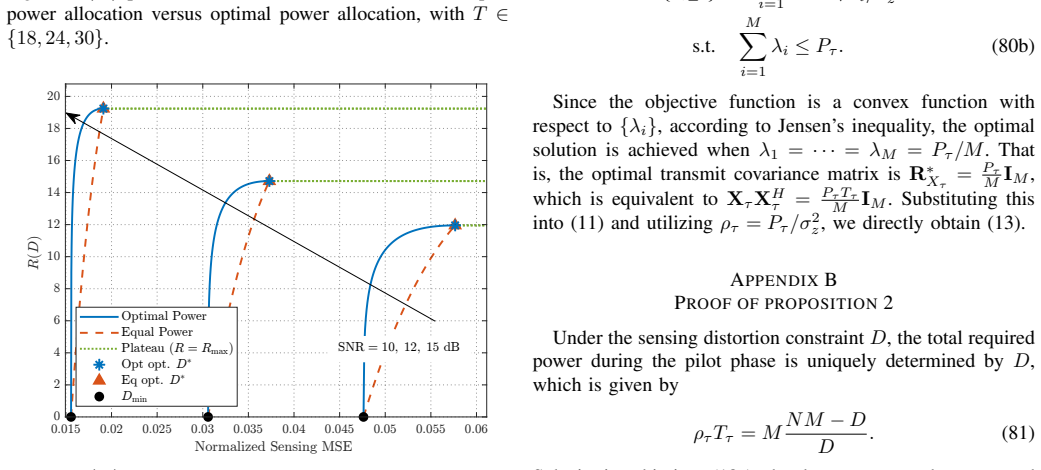
In a non-coherent bistatic MIMO ISAC system with unknown CSI at co-located receivers over block-fading channels, the data-aided sensing scheme yields superior communication rate-sensing distortion tradeoffs relative to pilot sensing; random matrix theory produces a closed-form asymptotic sensing distortion expression that explicitly demonstrates a strict 3 dB effective SNR improvement in the low-SNR regime and a strictly faster scaling rate in the high-SNR limit.
What carries the argument
The data-aided sensing scheme, which reuses communication data symbols for sensing, together with its asymptotic distortion analysis obtained via random matrix theory.
If this is right
- The rate-distortion tradeoff for data-aided sensing strictly dominates that of pilot sensing under the stated conditions.
- Sensing distortion admits a closed-form asymptotic expression derived from random matrix theory.
- A 3 dB effective SNR gain holds in the low-SNR regime for the data-aided scheme.
- Distortion scaling with SNR is strictly faster for data-aided sensing than for pilot sensing in the high-SNR regime.
Where Pith is reading between the lines
- Systems could reduce dedicated pilot overhead by shifting sensing load onto communication data streams.
- The same data-reuse principle might apply to other estimation tasks where coherent channel knowledge is unavailable.
- Performance in time-varying or spatially separated receiver scenarios would require separate analysis to confirm whether the reported gains persist.
Load-bearing premise
The receivers are co-located, channel state information is unknown, and the channel follows a block-fading model.
What would settle it
A simulation or experiment in a co-located non-coherent MIMO setup that fails to observe approximately 3 dB lower sensing distortion at low SNR or the predicted faster scaling rate when data-aided sensing is used would falsify the asymptotic claims.
Figures


read the original abstract
In this paper, we investigate a bistatic multiple-input multiple-output (MIMO) integrated sensing and communication (ISAC) system over block-fading channels, focusing on the scenario where the sensing and communication receivers (Rxs) are co-located. Under the assumption of unknown channel state information (CSI) at the Rx, two schemes are considered: pilot sensing (PS) and data-aided sensing (DAS). The communication rate-sensing distortion functions for both schemes are characterized. For the DAS scheme, a closed-form asymptotic expression for the sensing distortion is derived by using random matrix theory (RMT). The asymptotic performance analysis explicitly quantifies the significant gains of the DAS scheme, revealing a strict $3$ dB effective SNR improvement in the low-SNR regime and a strictly faster performance scaling rate in the high-SNR limit compared to the PS scheme.
Editorial analysis
A structured set of objections, weighed in public.
Referee Report
Summary. The paper investigates fundamental performance limits of a bistatic MIMO ISAC system over block-fading channels with co-located sensing and communication receivers under unknown CSI. It compares pilot sensing (PS) and data-aided sensing (DAS) schemes by characterizing their communication rate-sensing distortion functions. For DAS, a closed-form asymptotic expression for sensing distortion is derived via random matrix theory (RMT), which is then used to quantify a strict 3 dB effective SNR improvement in the low-SNR regime and a strictly faster performance scaling rate in the high-SNR limit relative to PS.
Significance. If the RMT-based asymptotic analysis is rigorously validated, the work provides analytically tractable expressions that quantify concrete gains of data-aided sensing in non-coherent ISAC, offering useful design guidelines for large MIMO systems. The explicit regime-specific comparisons (low-SNR SNR gain and high-SNR scaling) strengthen the contribution beyond purely numerical studies.
major comments (2)
- [Asymptotic Analysis] Asymptotic Analysis (around the RMT derivation for DAS distortion): The closed-form expression and the claimed 3 dB low-SNR gain must be shown to hold under the specific scaling regime of the large-system limit (e.g., antennas or observations tending to infinity while SNR is fixed or scaled). The interaction between noise dominance in low SNR and the RMT assumptions is not explicitly verified, raising the possibility that the quantified gain is an artifact of the limit rather than a fundamental property.
- [Performance Analysis] Performance Analysis and Numerical Validation sections: The strictly faster high-SNR scaling rate for DAS versus PS is asserted from the asymptotic expression, but without accompanying finite-dimensional simulations, error-bar analysis, or direct checks against the large-system assumptions in the respective SNR regimes, the support for the central claim remains incomplete.
minor comments (2)
- [Abstract] Abstract: the wording 'strict 3 dB effective SNR improvement' would be clearer as 'strictly 3 dB' to avoid ambiguity in the gain description.
- [System Model] Notation consistency: ensure uniform use of symbols for the number of transmit/receive antennas and block length across system model, PS, and DAS sections.
Simulated Author's Rebuttal
We thank the referee for the constructive feedback on our manuscript. We address each major comment below with clarifications on the asymptotic regime and agree to strengthen the numerical validation.
read point-by-point responses
-
Referee: [Asymptotic Analysis] Asymptotic Analysis (around the RMT derivation for DAS distortion): The closed-form expression and the claimed 3 dB low-SNR gain must be shown to hold under the specific scaling regime of the large-system limit (e.g., antennas or observations tending to infinity while SNR is fixed or scaled). The interaction between noise dominance in low SNR and the RMT assumptions is not explicitly verified, raising the possibility that the quantified gain is an artifact of the limit rather than a fundamental property.
Authors: We appreciate the referee's observation. The RMT analysis for the DAS sensing distortion is derived in the standard large-system limit in which the number of antennas and observations tend to infinity while the SNR remains fixed (or is scaled in a controlled manner). The low-SNR regime is subsequently obtained by letting the SNR tend to zero after the large-system limit has been taken. The strict 3 dB effective SNR gain arises because DAS effectively doubles the number of sensing observations by treating the unknown data symbols as additional pilots; this factor-of-two improvement is preserved in the asymptotic expression. We acknowledge that an explicit discussion of the interplay between noise dominance and the RMT assumptions would improve clarity. In the revised manuscript we will insert a dedicated remark (or short subsection) that states the precise scaling regime, recalls the conditions under which the RMT results remain valid when noise is dominant, and briefly verifies that the 3 dB gain is not an artifact of the limit. revision: yes
-
Referee: [Performance Analysis] Performance Analysis and Numerical Validation sections: The strictly faster high-SNR scaling rate for DAS versus PS is asserted from the asymptotic expression, but without accompanying finite-dimensional simulations, error-bar analysis, or direct checks against the large-system assumptions in the respective SNR regimes, the support for the central claim remains incomplete.
Authors: We thank the referee for this remark. The strictly faster high-SNR scaling rate follows directly from the closed-form asymptotic distortion expression, which exhibits a higher-order decay for DAS than for PS. The manuscript already contains Monte-Carlo simulations that compare the asymptotic predictions with finite-dimensional realizations for representative system sizes. Nevertheless, we agree that additional finite-system results with error bars and explicit checks of the large-system assumptions in the high-SNR regime would provide stronger empirical support. In the revision we will augment the Numerical Validation section with new simulation figures that include error bars, display convergence behavior across a range of finite dimensions, and discuss agreement with the asymptotic scaling in both low- and high-SNR regimes. revision: yes
Circularity Check
No circularity: asymptotic sensing distortion derived via standard external RMT results
full rationale
The paper derives a closed-form asymptotic expression for DAS sensing distortion using random matrix theory applied to the non-coherent block-fading MIMO ISAC model. This is an external mathematical tool (standard RMT limits for large antenna/ observation regimes) rather than a self-citation chain, fitted parameter renamed as prediction, or self-definitional reduction. The claimed 3 dB SNR gain and scaling rate emerge from the RMT analysis of the data-aided scheme versus pilot sensing; they are not forced by construction from the inputs or prior author work. The derivation remains self-contained against external benchmarks, with no load-bearing step that reduces to a definition or fit internal to the paper.
Axiom & Free-Parameter Ledger
axioms (2)
- domain assumption Block-fading channels with unknown CSI at the co-located receivers
- standard math Random matrix theory applies to obtain closed-form asymptotic sensing distortion
Lean theorems connected to this paper
-
IndisputableMonolith/Cost/FunctionalEquation.leanwashburn_uniqueness_aczel unclear?
unclearRelation between the paper passage and the cited Recognition theorem.
For the DAS scheme, a closed-form asymptotic expression for the sensing distortion is derived by using random matrix theory (RMT). ... strict 3 dB effective SNR improvement in the low-SNR regime
What do these tags mean?
- matches
- The paper's claim is directly supported by a theorem in the formal canon.
- supports
- The theorem supports part of the paper's argument, but the paper may add assumptions or extra steps.
- extends
- The paper goes beyond the formal theorem; the theorem is a base layer rather than the whole result.
- uses
- The paper appears to rely on the theorem as machinery.
- contradicts
- The paper's claim conflicts with a theorem or certificate in the canon.
- unclear
- Pith found a possible connection, but the passage is too broad, indirect, or ambiguous to say the theorem truly supports the claim.
Reference graph
Works this paper leans on
-
[1]
Integrated sensing and communications: Toward dual-functional wireless networks for 6G and beyond,
F. Liu, Y . Cui, C. Masouros, J. Xu, T. X. Han, Y . C. Eldar, and S. Buzzi, “Integrated sensing and communications: Toward dual-functional wireless networks for 6G and beyond,”IEEE J. Sel. Areas Commun., vol. 40, no. 6, pp. 1728–1767, June 2022
work page 2022
-
[2]
A survey on fundamental limits of integrated sensing and communication,
A. Liu, Z. Huang, M. Li, Y . Wan, W. Li, T. X. Han, C. Liu, R. Du, D. K. P. Tan, J. Lu, Y . Shen, F. Colone, and K. Chetty, “A survey on fundamental limits of integrated sensing and communication,”IEEE Commun. Surveys Tuts., vol. 24, no. 2, pp. 994–1034, Second Quarter 2022
work page 2022
-
[3]
Twelve scientific challenges for 6G: Rethinking the foundations of communications theory,
M. Chafii, L. Bariah, S. Muhaidat, and M. Debbah, “Twelve scientific challenges for 6G: Rethinking the foundations of communications theory,” IEEE Commun. Surveys Tuts., vol. 25, no. 2, pp. 868–904, Second Quarter 2023
work page 2023
-
[4]
A vision of 6G wireless systems: Applications, trends, technologies, and open research problems,
W. Saad, M. Bennis, and M. Chen, “A vision of 6G wireless systems: Applications, trends, technologies, and open research problems,”IEEE Network, vol. 34, no. 3, pp. 134–142, May/June 2020
work page 2020
-
[5]
C. Sturm and W. Wiesbeck, “Waveform design and signal processing aspects for fusion of wireless communications and radar sensing,”Proc. IEEE, vol. 99, no. 7, pp. 1236–1259, July 2011
work page 2011
-
[6]
Integrating low complexity and flexible sensing into communication systems,
K. Wu, J. A. Zhang, X. Huang, and Y . J. Guo, “Integrating low complexity and flexible sensing into communication systems,”IEEE J. Sel. Areas Commun., vol. 40, no. 6, pp. 1873–1889, June 2022
work page 2022
-
[7]
Joint communications and sensing employing optimized MIMO-OFDM signals,
K. Wu, J. A. Zhang, Z. Ni, X. Huang, Y . J. Guo, and S. Chen, “Joint communications and sensing employing optimized MIMO-OFDM signals,”IEEE Internet Things J., vol. 11, no. 6, pp. 10368–10383, Mar. 2024
work page 2024
-
[8]
Integrated sensing and communication: Joint pilot and transmission design,
M. Hua, Q. Wu, W. Chen, A. Jamalipour, C. Wu, and O. A. Dobre, “Integrated sensing and communication: Joint pilot and transmission design,”IEEE Trans. Wireless Commun., vol. 23, no. 11, pp. 16017– 16032, Nov. 2024
work page 2024
-
[9]
A. Hassanien, M. G. Amin, Y . D. Zhang, and F. Ahmad, “Dual-function radar-communications: Information embedding using sidelobe control and waveform diversity,”IEEE Trans. Signal Process., vol. 64, no. 8, pp. 2168–2181, Apr. 2016
work page 2016
-
[10]
MAJoRCom: A dual-function radar communication system using index modulation,
T. Huang, N. Shlezinger, X. Xu, Y . Liu, and Y . C. Eldar, “MAJoRCom: A dual-function radar communication system using index modulation,” IEEE Trans. Signal Process., vol. 68, pp. 3423–3438, 2020
work page 2020
-
[11]
An experimental study of radar-centric transmission for integrated sensing and communications,
M. Temiz, C. Horne, N. J. Peters, M. A. Ritchie, and C. Masouros, “An experimental study of radar-centric transmission for integrated sensing and communications,”IEEE Trans. Microw. Theory Technol., vol. 71, no. 7, pp. 3203–3216, July 2023
work page 2023
-
[12]
X. Liu, T. Huang, and Y . Liu, “Transmit design for joint MIMO radar and multiuser communications with transmit covariance constraint,”IEEE J. Sel. Areas Commun., vol. 40, no. 6, pp. 1932–1950, June 2022
work page 1932
-
[13]
Joint transmit beamforming for multiuser MIMO communications and MIMO radar,
X. Liu, T. Huang, N. Shlezinger, Y . Liu, J. Zhou, and Y . C. Eldar, “Joint transmit beamforming for multiuser MIMO communications and MIMO radar,”IEEE Trans. Signal Process., vol. 68, pp. 3929–3944, 2020
work page 2020
-
[14]
Z. Ren, Y . Peng, X. Song, Y . Fang, L. Qiu, L. Liu, D. W. K. Ng, and J. Xu, “Fundamental CRB-rate tradeoff in multi-antenna ISAC systems with information multicasting and multi-target sensing,”IEEE Trans. Wireless Commun., vol. 23, no. 4, pp. 3870–3885, Apr. 2024
work page 2024
-
[15]
MIMO integrated sensing and com- munication: CRB-rate tradeoff,
H. Hua, T. X. Han, and J. Xu, “MIMO integrated sensing and com- munication: CRB-rate tradeoff,”IEEE Trans. Wireless Commun., vol. 23, no. 4, pp. 2839–2854, Apr. 2024
work page 2024
-
[16]
Sensing with communication signals: From information theory to signal processing,
F. Liu, Y .-F. Liu, Y . Cui, C. Masouros, J. Xu, T. X. Han, S. Buzzi, Y . C. Eldar, and S. Jin, “Sensing with communication signals: From information theory to signal processing,”IEEE J. Sel. Areas Commun., vol. 44, pp. 1–30, 2026
work page 2026
-
[17]
Rethinking signaling design for ISAC: From pilot-based to payload-based sensing,
Y . Li, Y . Zhang, C. Masouros, S. Pollin, and F. Liu, “Rethinking signaling design for ISAC: From pilot-based to payload-based sensing,” IEEE Commun. Stand. Mag., pp. 1–9, 2025
work page 2025
-
[18]
MSE-based training and transmission optimization for MIMO ISAC systems,
Z. He, H. Shen, W. Xu, Y . C. Eldar, and X. You, “MSE-based training and transmission optimization for MIMO ISAC systems,”IEEE Trans. Signal Process., vol. 72, pp. 3104–3121, 2024
work page 2024
-
[19]
Exploiting both pilots and data pay- loads for integrated sensing and communications,
C. Xu, X. Yu, F. Liu, and S. Jin, “Exploiting both pilots and data pay- loads for integrated sensing and communications,”IEEE Trans. Wireless Commun., vol. 25, pp. 5573–5586, 2026
work page 2026
-
[20]
L. Xie, H. He, J. Tong, F. Liu, and S. Song, “Sensing mutual information for communication signal with deterministic pilots and random data payloads,”arXiv preprint arXiv:2601.11149, Jan. 2026
-
[21]
Bistatic target detection by exploiting both deterministic pilots and unknown random data payloads,
L. Xie, F. Liu, S. Song, and S. Jin, “Bistatic target detection by exploiting both deterministic pilots and unknown random data payloads,”arXiv preprint arXiv:2508.18728, Aug. 2025
-
[22]
Sensing for free: Learn to localize more sources than antennas without pilots,
W. Yu, K. B. Letaief, and L. Zheng, “Sensing for free: Learn to localize more sources than antennas without pilots,”IEEE J. Sel. Areas Commun., vol. 44, pp. 3285–3301, 2026
work page 2026
-
[23]
How much training is needed in multiple-antenna wireless links?
B. Hassibi and B. M. Hochwald, “How much training is needed in multiple-antenna wireless links?”IEEE Trans. Inf. Theory, vol. 49, no. 4, pp. 951–963, Apr. 2003
work page 2003
-
[24]
On the fundamental tradeoff of integrated sensing and communications under Gaussian channels,
Y . Xiong, F. Liu, Y . Cui, W. Yuan, T. X. Han, and G. Caire, “On the fundamental tradeoff of integrated sensing and communications under Gaussian channels,”IEEE Trans. Inf. Theory, vol. 69, no. 9, pp. 5723– 5751, Sept. 2023
work page 2023
-
[25]
A. M. Tulino and S. Verd ´u,Random Matrix Theory and Wireless Communications. Hanover, MA, USA: Now Publishers, 2004
work page 2004
-
[26]
Random-matrix theories in quantum physics: Common concepts,
T. Guhr, A. M ¨uller-Groeling, and H. A. Weidenm ¨uller, “Random-matrix theories in quantum physics: Common concepts,”Phys. Rep., vol. 299, no. 4-6, pp. 189–425, June 1998
work page 1998
-
[27]
High dimensional statistical inference and random matrices,
I. M. Johnstone, “High dimensional statistical inference and random matrices,”arXiv preprint arXiv:0611589, Nov. 2006
work page 2006
-
[28]
Linear multiuser receivers: Effective interference, effective bandwidth and user capacity,
D. Tse and S. Hanly, “Linear multiuser receivers: Effective interference, effective bandwidth and user capacity,”IEEE Trans. Inf. Theory, vol. 45, no. 2, pp. 641–657, Feb. 1999
work page 1999
discussion (0)
Sign in with ORCID, Apple, or X to comment. Anyone can read and Pith papers without signing in.