A Lorentzian Gribov no-pole condition for Yang-Mills theory
Pith reviewed 2026-06-27 17:57 UTC · model grok-4.3
The pith
A gauge configuration remains inside the first Gribov region in Minkowski space precisely when the Faddeev-Popov wave equation has no source-free solutions obeying the Feynman boundary condition.
A machine-rendered reading of the paper's core claim, the machinery that carries it, and where it could break.
Core claim
The central claim is that a gauge configuration remains inside the first Gribov region as long as the Faddeev-Popov wave equation admits no source-free solutions obeying the Feynman boundary condition. For backgrounds localized in time this condition translates to the injectivity of the negative-frequency block of the classical ghost scattering map. For stationary backgrounds it becomes a spatial bound-state or threshold-resonance problem under Fourier transformation. A Wronskian identity proves that pure frequency mixing in stable self-adjoint time-dependent channels cannot by itself produce the obstruction. Static chromomagnetic backgrounds reproduce the familiar zero-frequency horizon cro
What carries the argument
The Faddeev-Popov wave equation equipped with the Feynman boundary condition, which replaces Euclidean positivity and marks the boundary of the Gribov region by the absence of homogeneous solutions.
If this is right
- For backgrounds localized in time the condition reduces to injectivity of the negative-frequency block of the ghost scattering map.
- For stationary backgrounds the condition becomes a spatial bound-state or threshold-resonance problem.
- Pure frequency mixing in stable self-adjoint time-dependent channels is structurally protected and cannot produce the obstruction.
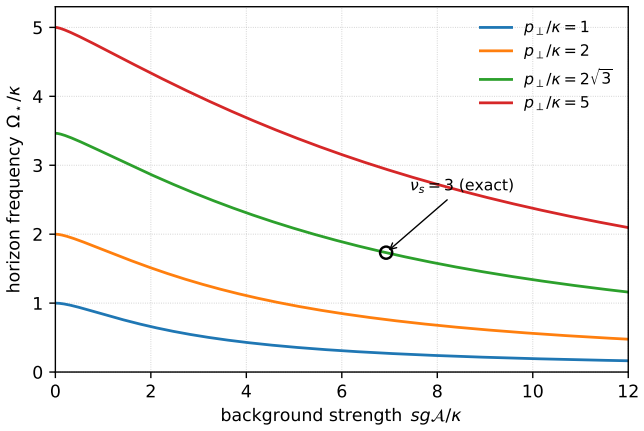
- Static chromoelectric backgrounds reach the Gribov horizon at finite non-zero frequency, unlike the zero-frequency crossing for chromomagnetic backgrounds.
- The exact restriction is a functional determinant that the naive local continuation of the Gribov-Zwanziger action does not reproduce.
Where Pith is reading between the lines
- This real-time definition could support direct calculations or simulations of the Gribov region without analytic continuation to Euclidean space.
- The contrast between electric and magnetic backgrounds points to phenomena in time-dependent Yang-Mills fields that lack Euclidean analogs.
- A local real-time action whose determinant matches the exact condition would need to incorporate non-local structure or auxiliary fields beyond the standard Gribov-Zwanziger form.
- Numerical solution of the wave equation on explicit time-dependent backgrounds could test whether the Feynman boundary condition selects the physically relevant region.
- keywords:[
Load-bearing premise
The Feynman boundary condition is the physically correct choice for defining the first Gribov region in Minkowski space.
What would settle it
Explicit construction of a source-free solution to the Faddeev-Popov wave equation that obeys the Feynman boundary condition, for a background gauge field otherwise regarded as interior to the first Gribov region, would falsify the proposed criterion.
Figures
read the original abstract
For over four decades, Gribov's no-pole condition has been almost exclusively explored in Euclidean space, where the elliptic nature of the Faddeev-Popov operator provides a clear spectral boundary. In physical Minkowski spacetime, however, this operator becomes a hyperbolic wave operator, and the Euclidean positivity criterion collapses. We show that the natural Lorentzian replacement is a real-time boundary-value problem: a gauge configuration remains inside the first Gribov region as long as the Faddeev-Popov wave equation admits no source-free solutions obeying the Feynman boundary condition. For backgrounds localized in time, this condition translates to the injectivity of the negative-frequency block of the classical ghost scattering map. For stationary backgrounds, it becomes a spatial bound-state or threshold-resonance problem under Fourier transformation. Using a Wronskian identity, we prove that pure frequency mixing in stable self-adjoint time-dependent channels is structurally protected and cannot by itself produce the obstruction. While static chromomagnetic backgrounds reproduce the familiar zero-frequency horizon crossing, static chromoelectric potentials reach the horizon at finite, non-vanishing frequency - a uniquely Lorentzian phenomenon arising because $A_0$ couples directly to the ghost time derivative. We also cast the condition in Fredholm form and show that the exact restriction is a functional determinant, which the naive local continuation of the Gribov-Zwanziger action fails to reproduce, leaving the construction of a genuine local real-time action as the central open problem.
Editorial analysis
A structured set of objections, weighed in public.
Referee Report
Summary. The manuscript proposes a Lorentzian analog of Gribov's no-pole condition for Yang-Mills theory. It defines the first Gribov region as the set of gauge configurations for which the Faddeev-Popov wave equation admits no source-free solutions obeying the Feynman boundary condition. For time-localized backgrounds this is equivalent to injectivity of the negative-frequency block of the ghost scattering map; for stationary backgrounds it reduces to a spatial bound-state or threshold-resonance problem. A Wronskian identity is used to prove structural protection against pure frequency mixing in stable channels. Static chromomagnetic backgrounds recover the familiar zero-frequency horizon crossing, while static chromoelectric potentials produce crossing at finite non-zero frequency. The condition is recast in Fredholm form as a functional determinant, which the naive local continuation of the Gribov-Zwanziger action does not reproduce.
Significance. If the central identification holds, the work supplies the first systematic real-time formulation of the Gribov region, opening a path toward Lorentzian extensions of the Gribov-Zwanziger framework relevant to heavy-ion collisions and other Minkowski-space applications. The Wronskian protection argument and the Fredholm-determinant representation are concrete technical strengths that add rigor. The distinction between chromoelectric and chromomagnetic horizon crossing is a genuinely new Lorentzian phenomenon.
major comments (2)
- [Abstract / definition of first Gribov region] Abstract and the definition of the first Gribov region: the identification of the region with the absence of source-free solutions obeying the Feynman boundary condition is introduced as the 'natural' Lorentzian replacement, yet no independent derivation or physical argument is supplied showing why the Feynman condition (rather than retarded, advanced, or other conditions at temporal infinity) is the correct choice. This premise is load-bearing for the ghost scattering map, the Wronskian protection claim, and the chromoelectric horizon-crossing result.
- [Fredholm representation section] The statement that the exact restriction is a functional determinant and that the naive local Gribov-Zwanziger continuation fails to reproduce it is asserted, but the manuscript provides no explicit computation of the determinant or direct comparison demonstrating the mismatch; without these steps the claim that a genuine local real-time action remains an open problem cannot be assessed.
minor comments (1)
- [Abstract] The abstract is information-dense; a short introductory paragraph clarifying the Euclidean-to-Lorentzian transition and the role of the boundary condition would improve readability for readers outside the immediate Gribov literature.
Simulated Author's Rebuttal
We thank the referee for the careful reading and positive assessment of the significance of our work. We respond point-by-point to the major comments below.
read point-by-point responses
-
Referee: [Abstract / definition of first Gribov region] Abstract and the definition of the first Gribov region: the identification of the region with the absence of source-free solutions obeying the Feynman boundary condition is introduced as the 'natural' Lorentzian replacement, yet no independent derivation or physical argument is supplied showing why the Feynman condition (rather than retarded, advanced, or other conditions at temporal infinity) is the correct choice. This premise is load-bearing for the ghost scattering map, the Wronskian protection claim, and the chromoelectric horizon-crossing result.
Authors: The Feynman boundary condition is the appropriate choice because it is the unique condition that reproduces the Euclidean no-pole criterion under Wick rotation and corresponds to the standard iε prescription for the ghost propagator in Minkowski QFT. This ensures the scattering map is well-defined and that the first Gribov region reduces correctly to its Euclidean counterpart. We will add an expanded discussion in the introduction deriving this choice from analytic continuation and unitarity requirements in the ghost sector. revision: yes
-
Referee: [Fredholm representation section] The statement that the exact restriction is a functional determinant and that the naive local Gribov-Zwanziger continuation fails to reproduce it is asserted, but the manuscript provides no explicit computation of the determinant or direct comparison demonstrating the mismatch; without these steps the claim that a genuine local real-time action remains an open problem cannot be assessed.
Authors: We agree that an explicit example would strengthen the assertion. In the revised manuscript we will add a concrete calculation for a static chromoelectric background, evaluating the Fredholm determinant explicitly and comparing it directly to the naive local continuation to demonstrate the mismatch. revision: yes
Circularity Check
No significant circularity; derivation relies on standard hyperbolic operator properties
full rationale
The paper defines the first Gribov region in Minkowski space via the absence of source-free solutions to the Faddeev-Popov wave equation under the Feynman boundary condition, presented as the natural Lorentzian analogue to the Euclidean positivity criterion. This choice is an explicit modeling assumption rather than a self-referential definition. Subsequent results (Wronskian protection, ghost scattering map injectivity, Fredholm determinant form) follow from classical identities for hyperbolic operators and do not reduce to the input by construction. No self-citations, fitted parameters renamed as predictions, or ansatze smuggled via prior work appear in the derivation chain. The paper is self-contained against external benchmarks of hyperbolic PDE theory.
Axiom & Free-Parameter Ledger
axioms (2)
- domain assumption The Faddeev-Popov operator in Minkowski space is a hyperbolic wave operator whose spectral properties differ from the Euclidean elliptic case.
- domain assumption Feynman boundary conditions at temporal infinity are the appropriate choice for selecting physical solutions in real-time gauge theory.
Reference graph
Works this paper leans on
-
[1]
Feynman diagrams for the Yang–Mills field,
L. D. Faddeev and V. N. Popov, “Feynman diagrams for the Yang–Mills field,” Phys. Lett. B 25, 29–30 (1967), doi:10.1016/0370-2693(67)90067-6
-
[2]
Some remarks on the Gribov ambiguity,
I. M. Singer, “Some remarks on the Gribov ambiguity,” Commun. Math. Phys.60, 7–12 (1978), doi:10.1007/BF01609471
-
[3]
Quantization of non-Abelian gauge theories,
V. N. Gribov, “Quantization of non-Abelian gauge theories,” Nucl. Phys. B139, 1–19 (1978), doi:10.1016/0550-3213(78)90175-X
-
[4]
Equivalence between Zwanziger's horizon function and Gribov's no-pole ghost form factor
A. J. Gomez, M. S. Guimaraes, R. F. Sobreiro and S. P. Sorella, “Equivalence between Zwanziger’s horizon function and Gribov’s no-pole ghost form factor,” Phys. Lett. B683, 217–221 (2010), doi:10.1016/j.physletb.2009.12.001, arXiv:0910.3596 [hep-th]
work page internal anchor Pith review Pith/arXiv arXiv doi:10.1016/j.physletb.2009.12.001 2010
-
[5]
An all-order proof of the equivalence between Gribov's no-pole and Zwanziger's horizon conditions
M. A. L. Capri, D. Dudal, M. S. Guimaraes, L. F. Palhares and S. P. Sorella, “An all-order proof of the equivalence between Gribov’s no-pole and Zwanziger’s horizon conditions,” Phys. Lett. B719, 448–453 (2013), doi:10.1016/j.physletb.2013.01.039, arXiv:1212.2419 [hep-th]
work page internal anchor Pith review Pith/arXiv arXiv doi:10.1016/j.physletb.2013.01.039 2013
-
[6]
Action from the Gribov horizon,
D. Zwanziger, “Action from the Gribov horizon,” Nucl. Phys. B321, 591–604 (1989), doi:10.1016/0550-3213(89)90263-0. 18
-
[7]
Local and renormalizable action from the Gribov horizon,
D. Zwanziger, “Local and renormalizable action from the Gribov horizon,” Nucl. Phys. B323, 513–544 (1989), doi:10.1016/0550-3213(89)90122-3
-
[8]
Renormalization in the Coulomb gauge and order parameter for confinement in QCD,
D. Zwanziger, “Renormalization in the Coulomb gauge and order parameter for confinement in QCD,” Nucl. Phys. B518, 237–272 (1998), doi:10.1016/S0550-3213(98)00031-5
-
[9]
Variational solution of the Yang-Mills Schr\"odinger equation in Coulomb gauge
C. Feuchter and H. Reinhardt, “Variational solution of the Yang–Mills Schrödinger equa- tion in Coulomb gauge,” Phys. Rev. D70, 105021 (2004), doi:10.1103/PhysRevD.70.105021, arXiv:hep-th/0408236 [hep-th]
work page internal anchor Pith review Pith/arXiv arXiv doi:10.1103/physrevd.70.105021 2004
-
[10]
Gribov horizon and i-particles: about a toy model and the construction of physical operators
L. Baulieu, D. Dudal, M. S. Guimaraes, M. Q. Huber, S. P. Sorella, N. Vandersickel and D. Zwanziger, “Gribov horizon and i-particles: about a toy model and the construction of physical operators,” Phys. Rev. D82, 025021 (2010), doi:10.1103/PhysRevD.82.025021, arXiv:0912.5153 [hep-th]
work page internal anchor Pith review Pith/arXiv arXiv doi:10.1103/physrevd.82.025021 2010
-
[11]
The Gribov problem and QCD dynamics
N. Vandersickel and D. Zwanziger, “The Gribov problem and QCD dynamics,” Phys. Rept. 520, 175–251 (2012), doi:10.1016/j.physrep.2012.07.003, arXiv:1202.1491 [hep-th]
work page internal anchor Pith review Pith/arXiv arXiv doi:10.1016/j.physrep.2012.07.003 2012
-
[12]
K.-I. Kondo, Y. Hayashi, R. Matsudo, Y. Suda and M. Watanabe, “Reflection positivity and complex analysis of the Yang–Mills theory from a viewpoint of gluon confinement,” Eur. Phys. J. C80, 84 (2020), doi:10.1140/epjc/s10052-020-7634-1, arXiv:1902.01602 [hep-th]
work page internal anchor Pith review Pith/arXiv arXiv doi:10.1140/epjc/s10052-020-7634-1 2020
-
[13]
Reed and B
M. Reed and B. Simon,Methods of Modern Mathematical Physics. III: Scattering Theory, Academic Press, New York (1979)
1979
-
[14]
D. R. Yafaev,Mathematical Scattering Theory: General Theory, Translations of Mathematical Monographs105, American Mathematical Society, Providence (1992)
1992
-
[15]
E. S. Fradkin, D. M. Gitman and S. M. Shvartsman,Quantum Electrodynamics with Unstable Vacuum, Springer Series in Nuclear and Particle Physics, Springer, Berlin (1991)
1991
-
[16]
Bemerkungen zur Quantenmechanik des anharmonischen Oszillators,
G. Pöschl and E. Teller, “Bemerkungen zur Quantenmechanik des anharmonischen Oszillators,” Z. Phys.83, 143–151 (1933), doi:10.1007/BF01331132
-
[17]
On gauge invariance and vacuum polarization,
J. S. Schwinger, “On gauge invariance and vacuum polarization,” Phys. Rev.82, 664–679 (1951), doi:10.1103/PhysRev.82.664
-
[18]
The BRST- invariant vacuum state of the Gribov–Zwanziger theory,
D. Dudal, C. P. Felix, L. F. Palhares, F. Rondeau and D. Vercauteren, “The BRST- invariant vacuum state of the Gribov–Zwanziger theory,” Eur. Phys. J. C79, 731 (2019), doi:10.1140/epjc/s10052-019-7235-0, arXiv:1901.11264 [hep-th]
-
[19]
Notes on infinite determinants of Hilbert space operators,
B. Simon, “Notes on infinite determinants of Hilbert space operators,” Adv. Math.24, 244–273 (1977), doi:10.1016/0001-8708(77)90073-1
-
[20]
A Lorentz invariant formulation of the Yang-Mills theory with gauge invariant ghost field Lagrangian
A. A. Slavnov, “A Lorentz invariant formulation of the Yang-Mills theory with gauge in- variant ghost field Lagrangian,” JHEP08, 047 (2008), doi:10.1088/1126-6708/2008/08/047, arXiv:0807.1795 [hep-th]
work page internal anchor Pith review Pith/arXiv arXiv doi:10.1088/1126-6708/2008/08/047 2008
-
[21]
F. Sauter, “Über das Verhalten eines Elektrons im homogenen elektrischen Feld nach der rela- tivistischen Theorie Diracs,” Z. Phys.69, 742–764 (1931), doi:10.1007/BF01339461
-
[22]
Onthevibrationsofpolyatomicmolecules,
N.RosenandP.M.Morse, “Onthevibrationsofpolyatomicmolecules,” Phys.Rev.42, 210–217 (1932), doi:10.1103/PhysRev.42.210. 19
discussion (0)
Sign in with ORCID, Apple, or X to comment. Anyone can read and Pith papers without signing in.