REVIEW 3 major objections 5 minor 1 cited by
Giant number-parity effect leading to spontaneous symmetry breaking in finite-size quantum spin models
T0 review · 3 major / 5 minor · reviewed 2026-08-11 · deepseek-v4-flash
Pith's one-line read Spontaneous symmetry breaking can persist in a finite spin system when the number of spins is odd and parity is conserved.
desk verdict The U(1) result—odd-size parity-protected doublet, macroscopic order from long-range order, and O(N)-ramp Heisenberg squeezing—is solid and honest; the XYZ generalization is explicitly heuristic and leans on an untested monotonicity assumption. read the letter →
The pith
A machine-rendered reading of the paper's core claim, the machinery that carries it, and where it could break.
The reading
What carries the argument
The load-bearing object is the spin-parity operator $P_x = \prod_i (2S^x_i)$, which flips the sign of the order parameter and commutes with the XYZ Hamiltonian. For odd $N$, the two fully polarized states along $x$ have opposite $P_x$ eigenvalues, so the off-diagonal Hamiltonian terms cannot mix them; the ground state remains doubly degenerate to every order in perturbation theory, and the parity eigenstates $|\pm\rangle = (|\Psi_{1/2}\rangle \pm |\Psi_{-1/2}\rangle)/\sqrt{2}$ acquire a macroscopic order parameter. The second ingredient is the Anderson tower of states, the low-lying collective excitations with energies $\approx (J_z)^2/(2I)$ and moment of inertia $I \sim O(N)$; its gap is $1/I$ for odd $N$ and $1/(2I)$ for even $N$, which explains the different dynamics. The quasi-adiabatic ramp is analyzed with rotor-plus-spin-wave theory, which treats the zero-mode rotor exactly and the spin waves around it, and with a time-dependent variational Monte Carlo wavefunction.
What would settle it
Exact diagonalization of the dipolar XYZ model with odd $N$ and $\Delta_y < 1$ at sizes beyond $3\times 5$: if the positive-parity ground state had $\langle J_x\rangle/N \to 0$ in the long-range ordered phase, the general claim would fail. Alternatively, a time-resolved measurement on an odd-sized Rydberg or dipolar array after an exponential ramp with $\tau J \approx 0.2 N$ should show a persistent $\langle J_x\rangle \approx N/4$; observing instead a decay to zero on times much shorter than exponentially long in $N$ would falsify the U(1) result.
Extended reading notes
Core claim
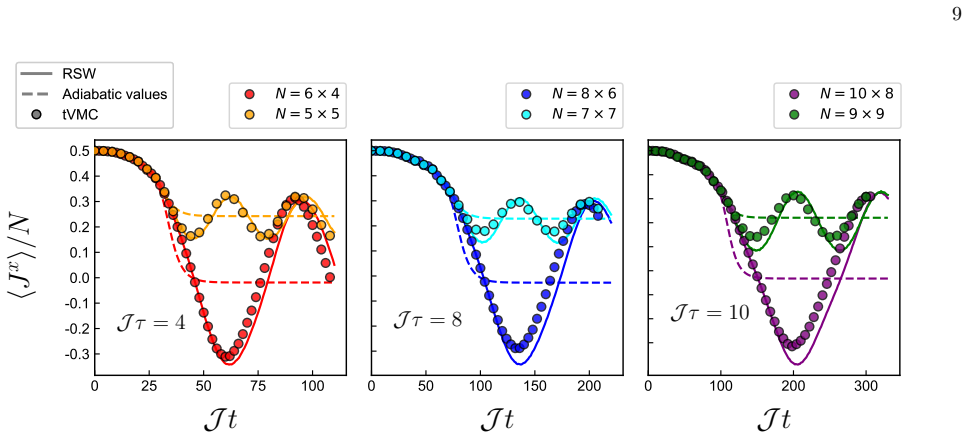
The paper's central claim is that, in a quantum spin system with long-range order and a conserved spin parity, an odd number of spins turns the usual Anderson-tower scenario — low-lying collective levels with gaps $O(1/N)$ — inside out: rather than a quasi-degenerate tower that eventually restores the symmetry, parity conservation produces an exactly degenerate pair of ground states of opposite parity, $|+\rangle$ and $|-\rangle$, and these states have macroscopic $\langle J_x\rangle \sim O(N)$. Consequently, a slowly switched-off field prepares a stationary symmetry-broken state at finite $N$. For U(1)-symmetric Hamiltonians the two ground states have $J_z = \pm 1/2$, so the parity eigenstates have $\mathrm{Var}(J_z) = 1/4$ and the spin-squeezing parameter obeys $\xi_R^2 = O(1/N)$, i.e. Heisenberg scaling. Numerical simulations of the two-dimensional dipolar and nearest-neighbor XX models show that lattices differing by one site behave radically differently: odd-sized lattices retain a finite magnetization while even-sized lattices oscillate around zero.
Load-bearing premise
The general XYZ version of the claim assumes that the ground state's distribution of the collective magnetization $J_z$ is peaked at $\pm 1/2$ with width at most $O(\sqrt{N})$, and that reducing the anisotropy parameter $\Delta_y$ steadily lowers the fluctuations of $J_x$ while raising its square; the paper supports this with a physical argument and a small exact-diagonalization check, not a derivation.
Editorial extensions
If this is right
- Odd-sized two-dimensional Rydberg or dipolar spin arrays should display a persistent macroscopic magnetization after a symmetry-breaking field is slowly turned off, with the ramp time $\tau$ only needing to scale linearly with $N$.
- Even-sized lattices in the same model will not show stationary symmetry breaking; their magnetization oscillates around zero with a frequency set by the Anderson-tower gap.
- In U(1)-symmetric systems, the same quasi-adiabatic preparation produces spin squeezing with Heisenberg scaling $\xi_R^2 \sim O(1/N)$ in a time $\tau \sim O(N)$, which is potentially useful for quantum metrology.
- The effect is robust to particle loss: losing particles simply averages the odd- and even-size behaviors, and the Heisenberg squeezing scaling persists, so experiments would not need to post-select on final atom number.
- Because the mechanism only requires long-range order and parity conservation, it applies to both power-law and nearest-neighbor interactions, as demonstrated for the two-dimensional XX model.
Reading between the lines
- The same parity mechanism should extend to half-integer spins $S > 1/2$ with odd $N$; for integer spins the parity eigenvalues of the polarized states would not differ in the same way, so the odd-even effect may disappear.
- A weak explicit breaking of parity conservation should convert the exact degeneracy into a very small quasi-degeneracy, making the finite-size symmetry-broken state effectively stationary for all practical observation times yet eventually restoring the symmetry.
- The finding that $\tau \sim N$ suffices for adiabaticity, whereas the naive adiabatic theorem suggests $\tau \sim N^2$, suggests a broader design principle: when the matrix elements of the driving field are known, state preparation protocols in other long-range ordered systems can be much faster than gap-squared criteria imply.
- A direct experimental discriminator would be to repeat the ramp on lattices of size $N$ and $N+1$: the odd lattice should keep a finite magnetization for times far beyond the even lattice's oscillation period, and the ratio of the two signals should scale with $N$.
Signed reviews
Editorial analysis
A structured set of objections, weighed in public.
Referee Report
Summary. This paper proposes that spontaneous symmetry breaking (SSB) can occur in finite-size quantum spin lattices with an odd number of sites, provided the Hamiltonian conserves the spin parity of the order parameter and the ground state has long-range order. For U(1)-symmetric XX models (dipolar and nearest-neighbor), the authors prove an exact ground-state doublet at J_z = ±1/2, establish that the parity eigenstates |±⟩ carry a macroscopic ⟨J_x⟩ ∼ O(N), and demonstrate numerically, with time-dependent variational Monte Carlo and rotor+spin-wave theory, that quasi-adiabatic ramps of a symmetry-breaking field prepare these states. They further show that the required ramp time scales as τ ∼ O(N) and that the resulting states have spin squeezing with Heisenberg scaling, ξ_R^2 ∼ 1/N. The same conclusions are claimed for the general XYZ model on the basis of a physical monotonicity argument and small exact-diagonalization checks.
Significance. The U(1) result is a clean and potentially important observation: odd N forces half-integer J_z, parity conservation protects the degeneracy, and the symmetry-broken state is an exact stationary state rather than a long-lived transient. This overturns the usual expectation that finite-size effects restore symmetry, and it has direct implications for quantum simulators and metrology. The numerical evidence is strong and comes from two independent methods, with no fitted parameters and with a parameter-free scaling law τ ∼ N. However, the advertised generality to general XYZ models is not supported at the same level as the U(1)/SU(2) case, and the central proof for that case rests on an unverified assumption. The paper would be a solid contribution if the XYZ claim were either made rigorous or explicitly restricted to a conjecture.
major comments (3)
- [Supplemental Material, Proof that ⟨Jx⟩ ∼ O(N)] The proof for the XYZ model is incomplete. The coherence terms in the second line of Eq. (4) have signs that are not known a priori, as the authors acknowledge, and the subsequent 'physical argument' that lowering Δ_y decreases Var(J_x) and increases ⟨(J_x)^2⟩ relative to the Δ_y = 1 point is an unverified monotonicity assumption. It is supported only by exact diagonalization on a single 3 × 5 lattice (Fig. 5). The first term in Eq. (4), with P(J_z = ±1/2) ∼ N^{-1/2}, contributes only O(√N), so without control of the coherence terms the claimed O(N) magnetization for general XYZ does not follow. Since the abstract and Eq. (1) present the XYZ case as part of the central claim, this is a load-bearing gap. Either a rigorous bound on the coherence terms or an explicit restriction of the result to U(1)/SU(2) symmetry is needed.
- [Supplemental Material, Proof that ⟨Jx⟩ ∼ O(N)] The assumption that the uniform J_z distribution P(J_z) is peaked around ±1/2 with width at most O(√N) is stated as 'safe' but is not proved for the XYZ model. For the U(1)/SU(2) case it is exact (J_z = ±1/2 only), but for general XYZ with Δ_z < 0, competing antiferromagnetic interactions can in principle broaden P(J_z) without violating the stated LRO condition on S^x. This assumption is essential for the first term of Eq. (4), and the small-lattice check in Fig. 5 cannot establish the asymptotic N-dependence. The authors should either prove this distributional assumption from the Hamiltonian or clearly label the XYZ extension as a conjecture.
- [Main text, 'Time scale to adiabaticity' and Supplemental Material, 'Condition of adiabaticity'] The central quantitative claim that τ ∼ O(N) is derived using the rotor+spin-wave adiabaticity criterion R(t), which is an approximate method. Although the agreement between RSW and tVMC in Fig. 2 is encouraging, the RSW matrix elements that enter Eq. (13) are not exact, and the conclusion that r_min ∼ 1/N is obtained from RSW data. The paper would be strengthened by a direct, method-independent test of the τ ∼ N scaling (for example, a systematic tVMC study at larger N), or by an explicit statement that the scaling is an RSW-based prediction that is verified only up to the system sizes accessible to tVMC.
minor comments (5)
- [Main text, after Eq. (1)] The phrase 'withI ∼ O(N )' (in the discussion of the Anderson tower) contains a typographical spacing error and should read 'with I ∼ O(N)'.
- [Supplemental Material, Eqs. (4) and (5)] The notation for J_z is inconsistent: sometimes 'J_z' is used, sometimes 'Jz'; please unify. Additionally, the expressions in the second line of Eq. (5) contain unmatched parentheses, which should be corrected for readability.
- [Main text, Fig. 3(c) caption] The caption states that the dashed line marks the minimum value of ξ_R^2 allowed by quantum states; it would be helpful to state explicitly that this is 2/(N+2) and to cite the relevant inequality from Ref. [23].
- [Main text, 'Robustness to particle loss'] The statement that particle loss 'simply leads to a reduction of the residual magnetization' is imprecise: for a system that becomes even-N, the magnetization oscillates around zero, so the time-averaged signal is not merely reduced but absent. The sentence should be clarified to distinguish instantaneous versus time-averaged behavior.
- [Supplemental Material, 'Transverse-field Ising model'] The discussion of the TFI model is useful context, but it would benefit from explicitly stating that the absence of parity conservation (rather than the exponential gap alone) is what prevents the stationary symmetry-broken state; currently this point is made implicitly.
Circularity Check
No significant circularity: the finite-size SSB claim is derived analytically from long-range order, parity conservation, and odd N, with the numerical methods mutually cross-validated; the XYZ extension rests on a stated monotonicity assumption that is a rigor gap rather than a circular reduction.
full rationale
The paper's central derivation is self-contained rather than circular. The two rigorous results are (i) doubly degenerate ground states for odd N, proved by the parity argument that the Ising-limit states |⇒> and |⇐> have opposite P^x eigenvalues for odd N and cannot be connected by parity-conserving perturbations; and (ii) <Jx> ~ O(N) in the parity eigenstates |±>, derived in the Supplemental Material from the stated inputs (long-range order, U(1)/SU(2) symmetry, Jz = ±1/2 sector) using explicit inequalities (SM Eqs. 6–11): LRO gives <(Jx)^2> ≈ aN^2, which forces Σ_J p_J J^2 ≥ a'N^2, and J ≤ N/2 then yields <Jx>_+ ≥ a'N. The Heisenberg scaling of squeezing follows exactly from the Jz = ±1/2 structure (Var(Jz) = 1/4) combined with the derived bound <Jx>_+ ≤ (N+1)/4, giving (ξ^2_R)_+ ≥ 4N/(N+1)^2; no fitted parameter is renamed as a prediction. The τ ~ O(N) ramp scaling and the squeezing dynamics are numerical outputs of rotor+spin-wave theory cross-validated against time-dependent variational Monte Carlo and exact diagonalization. The only unproven step is the generalization to the XYZ model (Δy < 1), where the paper explicitly states that the coherence-term signs are 'not known a priori' and invokes a physical monotonicity argument (Var(Jx) decreases, <(Jx)^2> increases) supported by a 3×5 exact-diagonalization check; because the conclusion <Jx> ~ O(N) is not among the premises and the base U(1) case is proven independently, this is an assumption and rigor gap rather than a circular reduction. Self-citations to the authors' prior RSW and tVMC methods are computational tools with prior benchmarks and mutual agreement here; the paper even revises its own prior adiabaticity conclusion from Ref. [24], indicating the framework has independent content.
Assumptions & free parameters
free parameters (2)
- Initial field amplitude Omega_0 =
20 J
- Onset ramp prefactor tau_0 J for odd N =
approximately 0.025
assumptions (6)
- domain assumption The ground state has long-range order, <Sx_i Sx_j> -> c != 0 at maximum distance with c independent of N.
- domain assumption The Hamiltonian conserves the spin parity P_x = product_i (2 Sx_i).
- domain assumption N is odd.
- ad hoc to paper The distribution P(J_z) is peaked around J_z = +/- 1/2 with width at most O(sqrt(N)).
- ad hoc to paper Lowering Delta_y from the XXZ limit monotonically decreases Var(Jx) and increases <(Jx)^2>.
- domain assumption RSW and tVMC variational approximations faithfully describe the low-energy, long-time ramp dynamics.
Cite this review
Pith. "Pith review of Giant number-parity effect leading to spontaneous symmetry breaking in finite-size quantum spin models." pith.science (2026). https://pith.science/paper/Q7RGWTT5
@misc{pith2026241215493,
  author       = {Pith},
  title        = {Pith review of: Giant number-parity effect leading to spontaneous symmetry breaking in finite-size quantum spin models},
  year         = {2026},
  howpublished = {\url{https://pith.science/paper/Q7RGWTT5}},
  note         = {Machine review of arXiv:2412.15493}
}
abstract
Spontaneous symmetry breaking (SSB) occurs when a many-body system governed by a symmetric Hamiltonian, and prepared in a symmetry-broken state by the application of a field coupling to its order parameter $O$, retains a finite $O$ value even after the field is switched off. SSB is generally thought to occur only in the thermodynamic limit $N\to \infty$ (for $N$ degrees of freedom). In this limit, the time to restore the symmetry once the field is turned off, either via thermal or quantum fluctuations, is expected to diverge. Here we show that SSB can also be observed in \emph{finite-size} quantum spin systems, provided that three conditions are met: 1) the ground state of the system has long-range correlations; 2) the Hamiltonian conserves the (spin) parity of the order parameter; and 3) $N$ is odd. Using a combination of analytical arguments and numerical results (based on time-dependent variational Monte Carlo and rotor+spin-wave theory), we show that SSB on finite-size systems can be achieved via a quasi-adiabatic preparation of the ground state -- which, in U(1)-symmetric systems, is shown to require a symmetry breaking field vanishing over time scales $\tau \sim O(N)$. In these systems, the symmetry-broken state exhibits spin squeezing with Heisenberg scaling.
Figures


Figures from the paper (5 more)




Forward citations
Cited by 1 Pith paper
-
Exponential onset of scalable entanglement via twist-and-turn dynamics in XY models
Twist-and-turn spin dynamics creates Heisenberg-scaled multipartite entanglement in logarithmically growing time for all-to-all and dipolar XY interactions.
Reference graph
Works this paper leans on
-
[24]
L. Pezz` e, A. Smerzi, M. K. Oberthaler, R. Schmied, and P. Treutlein, Rev. Mod. Phys. 90, 035005 (2018), URL https://link.aps.org/doi/10.1103/RevModPhys.90. 035005
-
[1]
R. Palmer, Advances in Physics 31, 669 (1982), https://doi.org/10.1080/00018738200101438, URL https://doi.org/10.1080/00018738200101438
-
[2]
H. Nishimori and G. Ortiz, Elements of Phase Transi- tions and Critical Phenomena (Oxford, 2011)
work page 2011
-
[3]
A. Beekman, L. Rademaker, and J. van Wezel, SciPost Physics Lecture Notes (2019), ISSN 2590-1990, URL http://dx.doi.org/10.21468/SciPostPhysLectNotes. 11
-
[4]
P. W. Anderson, Phys. Rev. 86, 694 (1952), URL https: //link.aps.org/doi/10.1103/PhysRev.86.694
-
[5]
P. W. Anderson, Basic Notions of Condensed Matter Physics (Benjamin, 1984)
work page 1984
-
[6]
Tasaki, Journal of Statistical Physics 174, 735–761 (2018), ISSN 1572-9613, URL http://dx.doi.org/10
H. Tasaki, Journal of Statistical Physics 174, 735–761 (2018), ISSN 1572-9613, URL http://dx.doi.org/10. 1007/s10955-018-2193-8
work page 2018
-
[7]
B. Damski and M. M. Rams, Journal of Physics A: Math- ematical and Theoretical 47, 025303 (2013), URL https: //dx.doi.org/10.1088/1751-8113/47/2/025303
Show all 30 references
-
[8]
Gross and I
C. Gross and I. Bloch, Science 357, 995 (2017), URL https://doi.org/10.1126/science.aal3837
2017 doi
-
[9]
Browaeys and T
A. Browaeys and T. Lahaye, Nat. Phys. 16, 132 (2020), URL https://doi.org/10.1038/s41567-019-0733-z
2020 doi
-
[10]
Monroe, W
C. Monroe, W. C. Campbell, L.-M. Duan, Z.-X. Gong, A. V. Gorshkov, P. W. Hess, R. Islam, K. Kim, N. M. Linke, G. Pagano, et al., Rev. Mod. Phys. 93, 025001 (2021), URL https://link.aps.org/doi/ 10.1103/RevModPhys.93.025001
2021 doi
-
[11]
Garc ´ ıa-Ripoll,Quantum Information and Quantum Optics with Superconducting Circuits (Cambridge Uni- versity Press, 2022)
J. Garc ´ ıa-Ripoll,Quantum Information and Quantum Optics with Superconducting Circuits (Cambridge Uni- versity Press, 2022)
2022
-
[12]
J. G. Bohnet, B. C. Sawyer, J. W. Britton, M. L. Wall, A. M. Rey, M. Foss-Feig, and J. J. Bollinger, Science352, 1297 (2016), URL https://doi.org/10.1126/science. aad9958
2016 doi
-
[13]
Bornet, G
G. Bornet, G. Emperauger, C. Chen, B. Ye, M. Block, M. Bintz, J. A. Boyd, D. Barredo, T. Comparin, F. Mezzacapo, et al., Nature 621, 728–733 (2023), ISSN 1476-4687, URL http://dx.doi.org/10.1038/ s41586-023-06414-9
2023
-
[14]
See Supplemental Material (SM) for details about: 1) the tower-of-states spectrum of even and odd N ; 2) the proof that parity eigenstates with odd N have a macroscopic magnetization; 3) the spin-Jastrow Ansatz used in the tVMC calculations; 4) the magnetization dynamics in th...
-
[15]
the absence of finite-size SSB in the quantum Ising model. 6
-
[16]
C. Chen, G. Bornet, M. Bintz, G. Emperauger, L. Leclerc, V. S. Liu, P. Scholl, D. Barredo, J. Hauschild, S. Chatterjee, et al., Nature 616, 691–695 (2023), ISSN 1476-4687, URL http://dx.doi.org/10.1038/ s41586-023-05859-2
2023
-
[17]
Thibaut, T
J. Thibaut, T. Roscilde, and F. Mezzacapo, Phys. Rev. B 100, 155148 (2019), URL https://link.aps.org/doi/ 10.1103/PhysRevB.100.155148
2019 doi
-
[18]
Comparin, F
T. Comparin, F. Mezzacapo, and T. Roscilde, Physical Review A 105 (2022), ISSN 2469-9934, URL http://dx. doi.org/10.1103/PhysRevA.105.022625
2022 doi
-
[19]
Roscilde, T
T. Roscilde, T. Comparin, and F. Mezzacapo, Phys. Rev. Lett. 131, 160403 (2023), URL https://link.aps.org/ doi/10.1103/PhysRevLett.131.160403
2023 doi
-
[20]
Comparin, F
T. Comparin, F. Mezzacapo, and T. Roscilde, Physical Review Letters 129 (2022), ISSN 1079-7114, URL http: //dx.doi.org/10.1103/PhysRevLett.129.150503
2022 doi
-
[21]
J. Ma, X. Wang, C. Sun, and F. Nori, Phys. Rep. 509, 89 (2011), ISSN 0370-1573, URL http://www.sciencedirect.com/science/article/ pii/S0370157311002201
2011
-
[22]
Albash and D
T. Albash and D. A. Lidar, Rev. Mod. Phys. 90, 015002 (2018), URL https://link.aps.org/doi/10. 1103/RevModPhys.90.015002
2018
-
[23]
D. J. Wineland, J. J. Bollinger, W. M. Itano, and D. J. Heinzen, Phys. Rev. A 50, 67 (1994), URL https:// link.aps.org/doi/10.1103/PhysRevA.50.67
1994 doi
-
[25]
Comparin, F
T. Comparin, F. Mezzacapo, M. Robert-de Saint- Vincent, and T. Roscilde, Phys. Rev. Lett. 129, 113201 (2022), URL https://link.aps.org/doi/10. 1103/PhysRevLett.129.113201
2022
-
[26]
Block, B
M. Block, B. Ye, B. Roberts, S. Chern, W. Wu, Z. Wang, L. Pollet, E. J. Davis, B. I. Halperin, and N. Y. Yao, Nature Physics (2024), ISSN 1745-2481, URL https:// doi.org/10.1038/s41567-024-02562-5
2024 doi
-
[27]
Becca and S
F. Becca and S. Sorella, Quantum Monte Carlo Ap- proaches for Correlated Systems (Cambridge University Press, 2017)
2017
-
[28]
Roscilde, F
T. Roscilde, F. Caleca, A. Angelone, and F. Mezzacapo, Phys. Rev. Lett. 133, 210401 (2024), URL https:// link.aps.org/doi/10.1103/PhysRevLett.133.210401
2024 doi
-
[29]
jqaHnqbxa2NAyzRZahgK3QG5Ovo=
A. Messiah, Quantum Mechanics (Dover, 2014). 7 SUPPLEMENT AL MA TERIAL Giant number-parity effect leading to sponta- neous symmetry breaking in finite-size quantum spin models TOWER-OF-ST A TE SPECTRUM FOR EVEN AND ODDN Fig. 4 shows the exact low-lying spectrum of the dipo- la...
2014
-
[30]
Nonetheless, over time scales t ∼ O(exp(−N )) the magnetization will decay because of the relative phase accumulated by the two components of the state
In this same phase, a slow, but not perfectly adiabatic ramp of the Ω field will bring the state of the system to a superposition of the ground and first excited state ≈ (|ψ0⟩ + |ψ1⟩)/ √ 2, which exhibits a macroscopic magnetization ⟨J x⟩ ∼O(N ). Nonetheless, over time scales ...
Reviewed August 11, 2026 · model on record in the stance chip above.
Discussion (0). Continue with ORCID to comment.