Generalized parton distributions of a deuteron in an AdS/QCD hard-wall model
Pith reviewed 2026-06-26 13:27 UTC · model grok-4.3
The pith
The hard-wall AdS/QCD model yields deuteron gravitational form factors whose momentum dependence matches the soft-wall model and whose mean square radius matches experiment.
A machine-rendered reading of the paper's core claim, the machinery that carries it, and where it could break.
Core claim
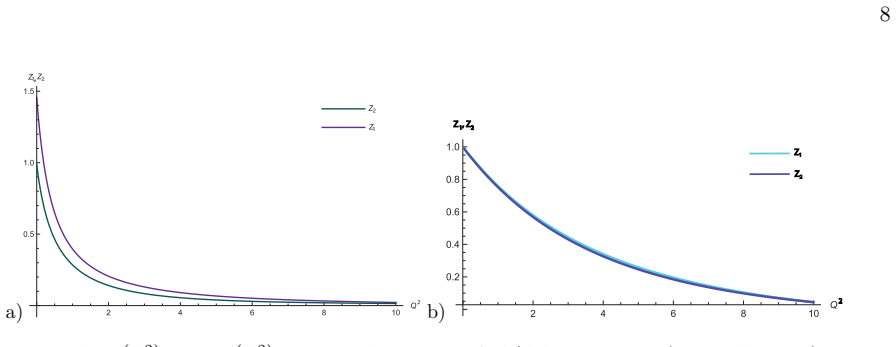
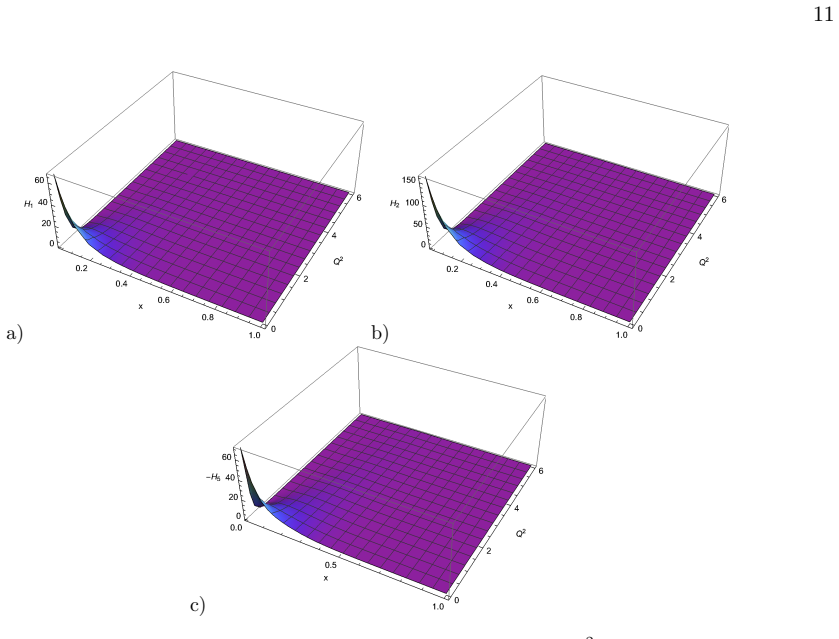
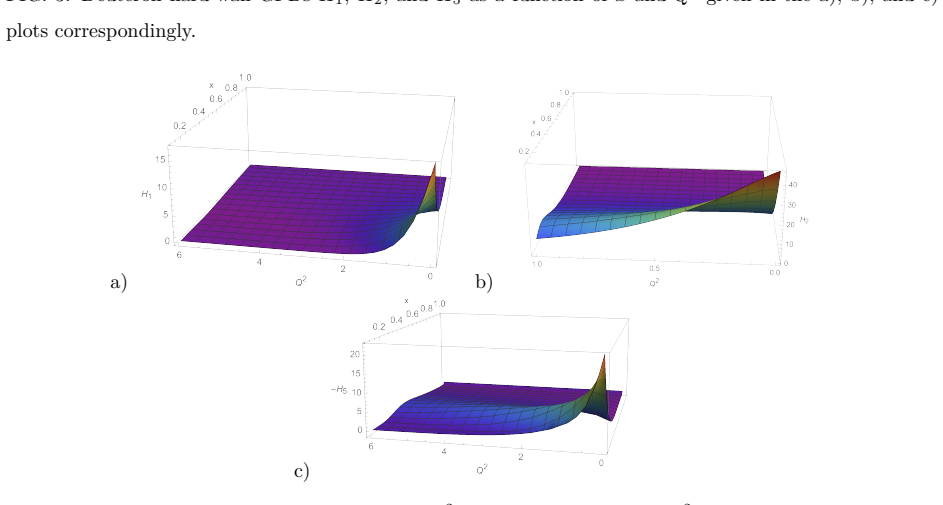
In the hard-wall AdS/QCD model the gravitational form factors of the deuteron are computed; their momentum dependence agrees with the soft-wall AdS/QCD model, the gravitational mean square radius agrees with experimental data, and the GPDs obtained from the GFFs via sum rules have shapes similar to those extracted from electromagnetic form factors calculated in the soft-wall model.
What carries the argument
The hard-wall AdS/QCD model with its infrared cutoff, applied to extract gravitational form factors and generalized parton distributions of the deuteron.
Load-bearing premise
The infrared cutoff chosen to reproduce meson or nucleon properties can be used directly for the deuteron without additional nuclear corrections or changes to the background geometry.
What would settle it
A measurement of the deuteron gravitational mean square radius that differs substantially from the value computed in the hard-wall model would falsify the agreement with experiment.
Figures
read the original abstract
We investigate the gravitational form factors (GFFs) and the generalized parton distributions (GPDs) of the deuteron within the framework of the hard-wall AdS/QCD model. The momentum dependence of the GFFs obtained here is in good agreement with the results of the soft-wall AdS/QCD model. The value of the gravitational mean square radius in this model agrees with the experimental data. GFFs provide a holographic description of the. Deuteron GPDs are obtained from GFFs via sum rules and have shapes of plots similar to those for GPDs extracted from the electromagnetic form factors (EFFs) calculated in the framework of the soft-wall AdS/QCD model.
Editorial analysis
A structured set of objections, weighed in public.
Referee Report
Summary. The manuscript computes the gravitational form factors (GFFs) and generalized parton distributions (GPDs) of the deuteron in the hard-wall AdS/QCD model. It reports that the momentum dependence of the GFFs agrees with results from the soft-wall AdS/QCD model, that the gravitational mean-square radius matches experimental data, and that the deuteron GPDs obtained from GFFs via sum rules have shapes similar to those extracted from electromagnetic form factors in the soft-wall model.
Significance. If the central numerical results hold after clarification of parameters and assumptions, the work would provide a consistent holographic description of deuteron gravitational structure and a cross-check between hard-wall and soft-wall AdS/QCD realizations. The explicit use of sum rules to obtain GPDs from GFFs is a standard and reproducible step that strengthens the presentation.
major comments (3)
- [§2] §2 (model setup): the infrared cutoff z_IR is stated to be fixed by meson or nucleon spectra, yet the manuscript applies this value unchanged to the deuteron without any discussion or estimate of nuclear-size corrections, even though the deuteron charge radius (~2 fm) greatly exceeds the nucleon scale. This choice directly underpins the reported agreement of the gravitational mean-square radius with experiment.
- [§3.2] §3.2 (GFF results) and abstract: the claim of agreement between the hard-wall GFF momentum dependence and the soft-wall model, and between the gravitational radius and experiment, is presented without tabulated numerical values, error estimates, or the explicit functional form used for the radius extraction. Without these, it is impossible to judge whether the agreement is quantitative or merely qualitative.
- [§4] §4 (GPD extraction): the GPDs are obtained from the GFFs via the standard sum-rule relations, but the manuscript does not verify that these relations remain valid inside the hard-wall geometry for a composite two-nucleon state; any circularity between the model assumptions used for both GFFs and the sum rules therefore affects the claimed similarity to soft-wall EFF-derived GPDs.
minor comments (2)
- [Abstract] The abstract refers to 'GFFs provide a holographic description of the' but the sentence is incomplete; this should be corrected for clarity.
- [Figures] Figure captions and axis labels should explicitly state the value of z_IR employed and the kinematic range shown, to allow direct comparison with the soft-wall results cited.
Simulated Author's Rebuttal
We thank the referee for the thorough review and valuable comments on our manuscript. We address each of the major comments below and will revise the manuscript to incorporate clarifications and additional details as appropriate.
read point-by-point responses
-
Referee: §2 (model setup): the infrared cutoff z_IR is stated to be fixed by meson or nucleon spectra, yet the manuscript applies this value unchanged to the deuteron without any discussion or estimate of nuclear-size corrections, even though the deuteron charge radius (~2 fm) greatly exceeds the nucleon scale. This choice directly underpins the reported agreement of the gravitational mean-square radius with experiment.
Authors: We agree that additional discussion is warranted. In the hard-wall AdS/QCD model, z_IR is fixed by the confinement scale from meson spectra, and for consistency we apply the same value to the deuteron as a bound state. However, we recognize the deuteron's larger size and will add a discussion in section 2 on the applicability and potential limitations regarding nuclear-size corrections. revision: yes
-
Referee: §3.2 (GFF results) and abstract: the claim of agreement between the hard-wall GFF momentum dependence and the soft-wall model, and between the gravitational radius and experiment, is presented without tabulated numerical values, error estimates, or the explicit functional form used for the radius extraction. Without these, it is impossible to judge whether the agreement is quantitative or merely qualitative.
Authors: We will revise section 3.2 and the abstract to include tabulated comparisons of GFFs at various Q^2 with soft-wall results, specify the extraction method for the gravitational mean square radius (from the derivative of the form factor at Q^2=0), and provide any associated uncertainties from the model. revision: yes
-
Referee: §4 (GPD extraction): the GPDs are obtained from the GFFs via the standard sum-rule relations, but the manuscript does not verify that these relations remain valid inside the hard-wall geometry for a composite two-nucleon state; any circularity between the model assumptions used for both GFFs and the sum rules therefore affects the claimed similarity to soft-wall EFF-derived GPDs.
Authors: The sum rules relating GFFs to moments of GPDs are general relations based on the operator product expansion and definitions, independent of the holographic model. They have been used in both hard-wall and soft-wall models in the literature. There is no circularity as the GFFs are computed from the model and the sum rules are applied post-computation. We will add a sentence in section 4 clarifying the model-independent nature of these relations. revision: partial
Circularity Check
No circularity: standard model application with independent comparison to data and other models
full rationale
The derivation applies the established hard-wall AdS/QCD geometry (IR cutoff fixed by meson/nucleon spectra) to deuteron wave functions, extracts GFFs, then obtains GPDs from standard sum rules. The reported agreement of the gravitational radius with experiment and with soft-wall results is an output of the calculation rather than a parameter refit or self-referential definition. No equations reduce a claimed prediction to a fitted input by construction, and no load-bearing self-citations or uniqueness theorems are invoked in the abstract or described chain. The central results remain falsifiable against external data without tautological reduction.
Axiom & Free-Parameter Ledger
free parameters (1)
- hard-wall infrared cutoff
axioms (1)
- domain assumption The AdS/QCD correspondence provides a valid effective description of deuteron gravitational observables.
Reference graph
Works this paper leans on
-
[1]
Müller, D
D. Müller, D. Robaschik, B. Geyer, F. M. Dittes, J. Horejsi, Fortsch. Phys. 42, 101 (1994), [arXiv:9812448 [hep-ph]]
1994
-
[2]
X.-D. Ji, J. Phys. G 24, 1181 (1998), [arxiv:9807358 [hep-ph]]
1998
-
[3]
X. -D. Ji, Phys. Rev. Lett. 78, 610 (1997), [arxiv:9603249 [hep-ph]]
1997
-
[4]
M. V. Polyakov, P. Schweitzer, Int. J. Mod. Phys. A 33, 1830025 (2018), [arxiv: 1805.06596[hep-ph]]
Pith/arXiv arXiv 2018
-
[5]
Belitsky, X
A.V. Belitsky, X. Ji, Phys. Lett. B 538, 289 (2002), [arxiv:0203276 [hep-ph]]
2002
-
[6]
M. V. Polyakov, Phys. Lett. B 555, 57-62 (2003), [arXiv:hep-ph/0210165]
Pith/arXiv arXiv 2003
-
[7]
N. Kumar, C. Mondal, N. Sharma, Eur. Phys. J. A 53, 237 (2017), [arXiv:1712.02110 [hep-ph]]
Pith/arXiv arXiv 2017
-
[8]
A. V. Radyushkin, ”Nonforward parton distributions”,Phys. Rev. D 56, 5524 (1997), [arxiv: 9704207[hep-ph]]
1997
-
[9]
V. Yu. Alexakhin, Yu. Alexandrov, G. D. Alexeev, A. Amoroso, B. Badełek, F. Balestra, J. Ball, G. Baum, Y. Bedfer et al. (COMPASS Collaboration), Phys. Rev. Lett. 94, 202002 (2005)
2005
-
[10]
DeGrush, A
A. DeGrush, A. Maschinot, T. Akdogan, R. Alarcon, W. Bertozzi, E. Booth, T. Botto, J.R. Calarco, B. Clasie et al. (BLAST Collaboration), Phys. Rev. Lett. 119, 182501 (2017)
2017
-
[11]
F. Bradamante (on behalf of the COMPASS Collaboration), PoS 346, 23rd International Spin Physics Symposium (2018), [arxiv: 1812.07281[hep-ex]]
Pith/arXiv arXiv 2018
-
[12]
COMPASS Collaboration, CERN-EP-2025-298, (2025) [arxiv: 2512.22311[hep-ex]]
arXiv 2025
-
[13]
ALICE Collaboration, Nature 648, 306-311 (2025), [arxiv: 2504.02393[nucl-ex]]
arXiv 2025
-
[14]
Y. Guo, F. P. Aslan, X. Ji, M. G. Santiago, Phys. Rev. Lett. 135, 261903 (2025), [arXiv:arXiv:2509.08037 [hep-ph]]
arXiv 2025
-
[15]
D. Watkins, D. Keller, ”Direct Deep Neural-network Extraction of Generalized Parton Distributions”, [arXiv:2512.21761 [hep-ph]]
-
[16]
Belitsky, D
A.V. Belitsky, D. Müller, A. Kirchner, Nucl. Phys. B 629, 323-392 (2002), [arXiv:0112108 [hep-ph]]
2002
-
[17]
Hägler, W
Ph. Hägler, W. Schroers, J. Bratt, J. W. Negele, A. V. Pochinsky, R. G. Edwards, D. G. Richards, M. Engelhardt, G. T. Fleming et al. (LHPC Collaboration), Phys. Rev. D 77, 094502 (2008)
2008
-
[18]
E. R. Berger, F. Cano, M. Diehl, B. Pire, Phys. Rev. Lett. 87, 142302 (2001), [arxiv:0106192 [hep-ph]]
2001
-
[19]
J. M. Maldacena, Adv. Theor. Math. Phys. 2, 231 (1998), [arXiv:9711200 [hep-th]]
1998
-
[20]
S. S. Gubser, I. R. Klebanov and A. M. Polyakov, Phys. Lett. B 428, 105 (1998) [arXiv:9802109[hep-th]]
1998
-
[21]
Witten, Adv
E. Witten, Adv. Theor. Math. Phys. 2, 253 (1998) [arXiv: 9802150[hep-th]]
1998
-
[22]
Boschi-Filho and N.R.F
H. Boschi-Filho and N.R.F. Braga, JHEP 0305, 009 (2003), [arXiv:0212207[hep-th]]
2003
-
[23]
Boschi-Filho and N.R.F
H. Boschi-Filho and N.R.F. Braga, Eur. Phys. J. C 32, 529 (2004) [arXiv: 0209080[hep-th]]
2004
-
[24]
Erlich, E
J. Erlich, E. Katz, D. T. Son and M. A. Stephanov, Phys. Rev. Lett. 95, 261602 (2005) [arxiv:0501128[hep-ph]]
2005
-
[25]
Z. Abidin, C. E. Carlson, Phys. Rev. D 77, 095007 (2008), [arxiv:0801.3839 [hep-ph]]
Pith/arXiv arXiv 2008
-
[26]
Z. Abidin, C. E. Carlson, Phys. Rev. D 78, 071502 (2008), [arxiv:0808.3097 [hep-ph]]. 14
Pith/arXiv arXiv 2008
-
[27]
Z. Abidin and C. E. Carlson, Phys. Rev. D, 79, 115003 (2009), [arXiv:0903.4818 [hep-ph]]
Pith/arXiv arXiv 2009
-
[28]
A. Vega, I. Schmidt, T. Gutsche, V. E. Lyubovitskij, Phys. Rev. D 83, 036001 (2011), [arXiv:hep- ph/1010.2815v3]
Pith/arXiv arXiv 2011
-
[29]
N. Sharma, Phys. Rev. D 90, 095024 (2014), [arXiv:hep-ph/1411.7486]
Pith/arXiv arXiv 2014
-
[30]
M. Allahverdiyeva, S. Mamedov, Eur. Phys. J. C 83, 5, 447 (2023), [arXiv:2302.03383 [hep-ph]]
arXiv 2023
-
[31]
T. Gutsche, V. E. Lyubovitskij, I. Schmidt, Phys. Rev. D 94, 116006, (2016), [arXiv:1607.04124 [hep- ph]]
Pith/arXiv arXiv 2016
-
[32]
T. Gutsche, V. E. Lyubovitskij, I. Schmidt, A. Vega, Phys. Rev. D, 91, 114001, (2015), [arxiv:1501.02738 [hep-ph]]
Pith/arXiv arXiv 2015
-
[33]
N. Huseynova, Sh. Mamedov, J. Samadov, Chin. Phys. C 47, 013104, (2023), [arxiv:2204.06205 [hep- ph]]
arXiv 2023
-
[34]
C. Mondal, D. Chakrabarti, X. Zhao, Eur. Phys. J. A 53, 106 (2017), [arXiv:1705.05808 [hep-ph]]
Pith/arXiv arXiv 2017
-
[35]
S. Mamedov, M. Allahverdiyeva and N. Akbarova, Eur. Phys. J. C 85, 361 (2025), [arXiv:2412.17407 [hep-ph]]
arXiv 2025
-
[36]
Sh. Mamedov, N. Akbarova, M. Allahverdiyeva, PEPAN 20, 1477–1479, (2023), [arXiv:2305.09704 [hep-ph]]
arXiv 2023
-
[37]
S.J. Brodsky, G.F. de Teramond, Phys. Rev. D 78, 025032 (2008) [arXiv:0809.4899 [hep-ph]]
Pith/arXiv arXiv 2008
- [38]
- [39]
- [40]
-
[41]
Garriga and T
J. Garriga and T. Tanaka, Phys. Rev. Lett. 84, 2778 (2000), [arXiv:9911055 [hep-th]]
2000
-
[42]
N. Maru, M. Tachibana, Eur. Phys. J. C 63,123 (2009), [arXiv:0904.3816 [hep-ph]]
Pith/arXiv arXiv 2009
-
[43]
X. Lin, W. Kou, S. Fu, R. Wang, C. Han, X. Chen, Chinese Physics C 49, 10 (2025), [arxiv:2504.10023 [hep-ph]]
arXiv 2025
-
[44]
and Braun, O
Benz, P. and Braun, O. and Butenschön, H. and Gall, D. and Idschok, U. and Kiesling, C. and Knies, G. and Müller, K. and Nellen, B. and Schiffer, R. and Schlamp, P. and Schnackers, H. J. and Spiering, P. and Stiewe, J. and Storim, F., Nucl. Phys. B 79, 10 (1974)
1974
-
[45]
Mibe et al
T. Mibe et al. (CLAS Collaboration), Phys. Rev. C 76, 052202 (2007), [arxiv:0703013 [nucl-ex]]
2007
-
[46]
W. C. Chang et al., Phys. Lett. B 658, 209 (2008), [arXiv:nucl-ex/0703034]
Pith/arXiv arXiv 2008
-
[47]
Mibe et al
T. Mibe et al. (LEPS Collaboration), Phys. Rev. Lett. 95, 182001 (2005) [arxiv:0506015 [nucl-ex]]
2005
-
[48]
A. Vega, I. Schmidt, T. Gutsche, V. E. Lyubovitskij, Phys. Rev. D 85, 096004 (2012), [arxiv:1202.4806 [hep-ph]]
Pith/arXiv arXiv 2012
-
[49]
S. J. Brodsky, G. F. de Teramond, Phys. Rev. D 77,056007 (2008), [arXiv:0707.3859 [hep-ph]]
Pith/arXiv arXiv 2008
-
[50]
http://functions.wolfram.com/03.02.07.0004.01
-
[51]
L. Bellantuono, P. Colangelo, F. Giannuzzi, Eur. Phys. J. C 74, 2830 (2014), [arXiv:1402.5308 [hep-ph]]
Pith/arXiv arXiv 2014
discussion (0)
Sign in with ORCID, Apple, or X to comment. Anyone can read and Pith papers without signing in.