REVIEW 3 major objections 5 minor 1 cited by
Medical Applications of Graph Convolutional Networks Using Electronic Health Records: A Survey
T0 review · 3 major / 5 minor · reviewed 2026-08-07 · deepseek-v4-flash
Pith's one-line read This paper claims to be the first detailed survey of graph convolutional networks applied to electronic health records, and organizes 25 studies into a taxonomy of medical fields, prediction tasks, benchmark datasets, and hybrid…
desk verdict A competent but overclaimed survey of GCN-EHR work; the 'first detailed survey' framing is contradicted by its own reference and needs fixing before it can be taken seriously. read the letter →
The pith
A machine-rendered reading of the paper's core claim, the machinery that carries it, and where it could break.
The reading
What carries the argument
The organizing instrument is a categorization schema applied uniformly to the 25 retained papers. Each study is classified along four axes: medical field (with a residual 'general medical informatics' bucket), prediction task, EHR data source (public benchmark versus real-world), and architecture (pure GCN versus hybrid, with the additional model types recorded). A formalized selection flowchart documents how the initial 56 retrieved papers were reduced to 25 by exclusion criteria, and the resulting table maps each reference to its dataset, field, and hybrid partners. This schema—not any single algorithm—is what carries the survey's argument that the field has recognizable structure.
What would settle it
A reader could run the same query on PubMed and Scopus and count the additional eligible GCN-EHR papers published before April 2024 that are absent from this review; if the count is more than a handful, the survey's comprehensiveness claim fails.
Extended reading notes
Core claim
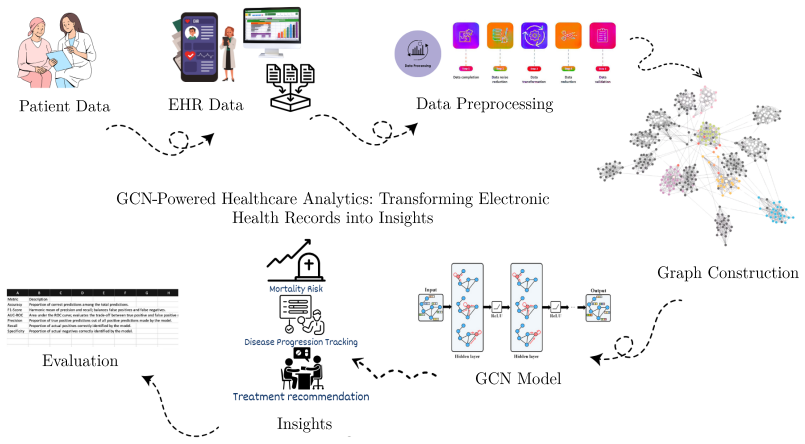
On its own terms, the paper's central contribution is descriptive: it establishes that GCNs are being applied to EHR data across a recognizable set of tasks—diagnosis prediction, ICD coding, readmission and mortality prediction, relation classification, and medication recommendation—and that the literature clusters in general medical informatics and critical care. Fifteen of the 25 surveyed papers use hybrid architectures, most often combining a GCN with a transformer-based language model or a recurrent network. The field is recent: all retrieved papers appeared after 2019, with eight already in the first four months of 2024. The authors also report that the main obstacles are the heterogeneous tabular nature of EHR data and the difficulty of obtaining real patient data, which is why eight studies relied on real-world datasets rather than public benchmarks.
Load-bearing premise
The literature search, which queried a single university library catalog plus references from one prior survey, is complete enough to support the paper's claim of being the first detailed survey of the field.
Editorial extensions
If this is right
- If this map is accurate, newcomers can identify MIMIC-III and MIMIC-IV as the default benchmarks and the hybrid GCN-plus-language-model pattern as the common recipe.
- The concentration in medical informatics and critical care suggests these are the entry domains, while other specialties appear as single studies.
- The absence of performance metrics means the survey cannot rank methods, but it defines where a more systematic comparison could be run.
- The recent surge in 2024 publications implies the taxonomy will need regular updating as more papers appear.
- The authors' stated limitations point to useful next work: classifying convolution mechanisms and graph construction choices.
Reading between the lines
- Beyond the paper's claim, the finding that 60% of systems are hybrids suggests that pure GCNs are rarely sufficient for EHR tabular heterogeneity, and that graph structure is often used as a side channel feeding a stronger sequence or language model.
- A testable extension: a systematic comparison of graph construction choices (patient similarity, temporal, hierarchical) across the same benchmark task would be the natural sequel, and the absence of such comparison is a gap the paper itself flags.
- The observation that only two MIMIC generations dominate public benchmarking raises the question of whether GCN results generalize to other EHR systems or non-ICU data; that is not answered in the survey.
- If the field's growth rate holds, the claim of being 'no papers surveying the literature in detail' will be time-limited; a follow-up review including performance metrics and graph type taxonomy would supersede this one.
Editorial analysis
A structured set of objections, weighed in public.
Referee Report
Summary. This manuscript presents a survey of Graph Convolutional Network (GCN) applications to Electronic Health Records (EHRs). The authors describe a literature selection process based on a library catalog query plus references from a prior survey, yielding 25 included papers. They then categorize these papers by medical field, prediction task, dataset, and architecture, reporting the prevalence of hybrid models and common benchmark datasets. The paper claims in the Introduction that 'there are currently no papers surveying the literature in detail,' and the Abstract explicitly labels the work a 'comprehensive survey.'
Significance. If the claimed novelty and comprehensiveness were supported, this survey would provide a convenient entry point for researchers interested in GCN-EHR applications, especially by consolidating information about medical domains, datasets (e.g., MIMIC-III/IV), and hybrid architectures. The authors are transparent about several limitations, including the absence of performance metrics, and the descriptive tables appear internally consistent with the cited papers. However, the central claims of being the first detailed survey and of comprehensive coverage are undermined by the manuscript's own citation of a prior survey and by a search strategy that cannot plausibly capture the full biomedical literature.
major comments (3)
- [Section I (Introduction)] The statement 'there are currently no papers surveying the literature in detail' is contradicted by reference [12], which is a 2024 Journal of Biomedical Informatics survey on graph neural networks for clinical risk prediction from electronic health records. The authors themselves used [12] to source additional papers, acknowledging that it covers the same body of literature. This makes the novelty claim internally inconsistent and unsupported.
- [Section II.A (Search Strategy and Sources)] The search strategy is limited to Lehigh University's ASA Library Catalog, queried in April 2024, plus five papers from reference [12]. For a biomedical informatics topic, omitting standard databases such as PubMed, Scopus, and Web of Science makes it highly unlikely that all relevant publications were retrieved. Consequently, the Abstract's claim of a 'comprehensive survey' is not justified, and the descriptive results (e.g., distributions in Fig. 3 and Fig. 4) should be interpreted as originating from a convenience sample rather than a comprehensive corpus.
- [Section II.D and Fig. 2] The PRISMA flowchart indicates that 35 papers were excluded, but the authors report exclusion reasons only for one example (blockchain/security, reference [18]) and otherwise refer to the general criteria in Section II.B. Without a full list of excluded studies and their reasons, readers cannot independently assess the reproducibility or completeness of the selection process. This lack of transparency is especially problematic given the paper's assertion that it offers a detailed and comprehensive survey.
minor comments (5)
- [Section I.B] In the sentence 'such as Graph Convolutional Networks (GCNs) Graph Attention Networks (GATs) and Graph Recurrent Networks', a comma is needed between '(GCNs)' and 'Graph Attention Networks'.
- [Section II.A] The search query string contains a mismatched quotation mark: the final term appears as 'electronic health data'.' and should be 'electronic health data"'.
- [Table 1] Abbreviations such as 'MGAE' and 'NMEDW' are not expanded in the table or the surrounding text; please define them at first use.
- [Figure 4 caption] The caption 'Distribution of the application of GCNs to various medical fields identified by the review.' would read more naturally as 'Distribution of the applications of GCNs across medical fields identified by the review.'
- [Section IV.B] The in-text reference to 'Grinsztajn et al.' is not accompanied by a year, unlike other in-text citations; please ensure consistent citation formatting.
Circularity Check
No circularity: the survey makes no quantitative predictions and derives nothing from fitted inputs or self-citation.
full rationale
This paper is a literature survey, not a derivation or empirical study. It reviews 25 external papers applying GCNs to EHR data, categorizes them by medical field, task, dataset, and architecture, and reports summary statistics such as the number of hybrid models and the most common datasets. No parameter is fitted, no quantity is predicted from an input, and no result is derived from an equation. The paper's central claims are descriptive: that this is a nascent area and that the authors provide a first detailed survey of it. The novelty claim is weakened by the existence of the prior survey cited as [12] and by the limited search strategy described in Section II.A, but that is a correctness or methodology concern, not circularity. The paper does not define its categories in terms of its conclusions, nor does it cite the authors' own prior work as a load-bearing premise. The limitations section openly states that the paper is brief and does not report performance metrics, which further confirms that no circular construction is present. Under the review criteria, a non-finding of circularity is appropriate.
Assumptions & free parameters
assumptions (3)
- domain assumption A single university library catalog query plus reference-chaining from one prior survey retrieves the relevant GCN/EHR literature.
- domain assumption Manual categorization of the 25 papers by medical field, task, and hybrid architecture is accurate and reproducible.
- domain assumption Papers not in the selected sources would not change the survey's qualitative conclusions.
Cite this review
Pith. "Pith review of Medical Applications of Graph Convolutional Networks Using Electronic Health Records: A Survey." pith.science (2026). https://pith.science/paper/QAB4PPJA
@misc{pith2026250209781,
  author       = {Pith},
  title        = {Pith review of: Medical Applications of Graph Convolutional Networks Using Electronic Health Records: A Survey},
  year         = {2026},
  howpublished = {\url{https://pith.science/paper/QAB4PPJA}},
  note         = {Machine review of arXiv:2502.09781}
}
read the original abstract
Graph Convolutional Networks (GCNs) have emerged as a promising approach to machine learning on Electronic Health Records (EHRs). By constructing a graph representation of patient data and performing convolutions on neighborhoods of nodes, GCNs can capture complex relationships and extract meaningful insights to support medical decision making. This survey provides an overview of the current research in applying GCNs to EHR data. We identify the key medical domains and prediction tasks where these models are being utilized, common benchmark datasets, and architectural patterns to provide a comprehensive survey of this field. While this is a nascent area of research, GCNs demonstrate strong potential to leverage the complex information hidden in EHRs. Challenges and opportunities for future work are also discussed.
Figures


Figures from the paper (1 more)

Forward citations
Cited by 1 Pith paper
-
MiGHT-EHR: A Multi-task Graph Transformer for Heterogeneous Temporal Electronic Health Records
A heterogeneous graph transformer with temporal attention and balanced multi-task training reports state-of-the-art average performance on four EHR prediction tasks on MIMIC-III and MIMIC-IV, but the evaluation may le...
Reference graph
Works this paper leans on
-
[12]
Graph neural networks for clinical risk pre- diction based on electronic health records: A survey,
H. Oss Boll et al., “Graph neural networks for clinical risk pre- diction based on electronic health records: A survey,” Journal of Biomedical Informatics, vol. 151, p. 104616, Mar. 2024, doi: 10.1016/j.jbi.2024.104616
-
[18]
Z. Wang, N. Luo, and P. Zhou, “GuardHealth: Blockchain empow- ered secure data management and Graph Convolutional Network enabled anomaly detection in smart healthcare,” Journal of Parallel and Distributed Computing, vol. 142, pp. 1–12, Aug. 2020, doi: 10.1016/j.jpdc.2020.03.004
-
[1]
B. Shickel, P. J. Tighe, A. Bihorac, and P. Rashidi, “Deep EHR: A Survey of Recent Advances in Deep Learning Techniques for Electronic Health Record (EHR) Analysis,” IEEE J. Biomed. Health Inform., vol. 22, no. 5, pp. 1589–1604, Sep. 2018, doi: 10.1109/JBHI.2017.2767063
arXiv 2018
-
[2]
A Comprehensive Survey on Graph Neural Networks,
Z. Wu et al., “A Comprehensive Survey on Graph Neural Networks,” IEEE Transactions on Neural Networks and Learning Systems, 2021
work page 2021
-
[3]
A new model for learning in graph domains,
M. Gori, G. Monfardini, F. Scarselli, “A new model for learning in graph domains,” IEEE International Joint Conference on Neural Networks, 2005
work page 2005
-
[4]
The Graph Neural Network Model,
F. Scarselli et al., “The Graph Neural Network Model,” IEEE Trans- actions on Neural Networks, 2009
work page 2009
-
[5]
Semi-supervised classification with graph convolutional networks,
T. N. Kipf and M. Welling, “Semi-supervised classification with graph convolutional networks,” International Conference on Learning Representations (ICLR), 2017
work page 2017
-
[6]
P. Veli ˇckovi´c et al., “Graph Attention Networks,” International Con- ference on Learning Representations (ICLR), 2018
work page 2018
Show all 45 references
-
[7]
Gated Graph Sequence Neural Networks,
Y . Li et al., “Gated Graph Sequence Neural Networks,” International Conference on Learning Representations (ICLR), 2016
2016
-
[8]
Neural Message Passing for Quantum Chemistry,
J. Gilmer et al., “Neural Message Passing for Quantum Chemistry,” International Conference on Machine Learning (ICML), 2017
2017
-
[9]
Spectral net- works and locally connected networks on graphs,
J. Bruna, W. Zaremba, A. Szlam, and Y . LeCun, “Spectral net- works and locally connected networks on graphs,” arXiv preprint arXiv:1312.6203, 2013
2013 arXiv
-
[10]
Convolutional neural networks on graphs with fast localized spectral filtering,
M. Defferrard, X. Bresson, and P. Vandergheynst, “Convolutional neural networks on graphs with fast localized spectral filtering,” Advances in Neural Information Processing Systems (NIPS), pp. 3844- 3852, 2016
2016
-
[11]
The PRISMA 2020 statement: an updated guideline for reporting systematic reviews,
M. J. Page et al., “The PRISMA 2020 statement: an updated guideline for reporting systematic reviews,” BMJ, vol. 372, p. n71, Mar. 2021, doi: 10.1136/bmj.n71
2020 doi
-
[13]
Knowledge guided diagnosis prediction via graph spatial- temporal network
“Knowledge guided diagnosis prediction via graph spatial- temporal network.” Accessed: Apr. 28, 2024. [Online]. Available: https://epubs.siam.org/doi/epdf/10.1137/1.9781611976236.3
2024 doi
-
[14]
Multi-relational EHR representation learning with infusing information of Diagnosis and Medication,
Y . Shi, Y . Guo, H. Wu, J. Li, and X. Li, “Multi-relational EHR representation learning with infusing information of Diagnosis and Medication,” in 2021 IEEE 45th Annual Computers, Software, and Applications Conference (COMPSAC), Madrid, Spain: IEEE, Jul. 2021, pp. 1617–1622. ...
2021
-
[15]
Online Disease Diagnosis with Inductive Heteroge- neous Graph Convolutional Networks,
Z. Wang et al., “Online Disease Diagnosis with Inductive Heteroge- neous Graph Convolutional Networks,” in Proceedings of the Web Conference 2021, Ljubljana Slovenia: ACM, Apr. 2021, pp. 3349–
2021
-
[16]
TAGNet: Temporal Aware Graph Con- volution Network for Clinical Information Extraction,
S. Wang and J. Liu, “TAGNet: Temporal Aware Graph Con- volution Network for Clinical Information Extraction,” in 2020 IEEE International Conference on Bioinformatics and Biomedicine (BIBM), Seoul, Korea (South): IEEE, Dec. 2020, pp. 2105–2108. doi: 10.1109/BIBM49941.2020.9313530
2020
-
[17]
The Graph-based Mutual Attentive Network for Automatic Diagnosis,
Q. Yuan, J. Chen, C. Lu, and H. Huang, “The Graph-based Mutual Attentive Network for Automatic Diagnosis,” in Proceedings of the Twenty-Ninth International Joint Conference on Artificial Intelligence, Yokohama, Japan: International Joint Conferences on Artificial In- telligenc...
2020 doi
-
[19]
MIMIC-III, a freely accessible critical care database,
A. E. W. Johnson et al., “MIMIC-III, a freely accessible critical care database,” Sci Data, vol. 3, no. 1, p. 160035, May 2016, doi: 10.1038/sdata.2016.35
2016 doi
-
[20]
MIMIC-IV , a freely accessible electronic health record dataset,
A. E. W. Johnson et al., “MIMIC-IV , a freely accessible electronic health record dataset,” Sci Data, vol. 10, no. 1, p. 1, Jan. 2023, doi: 10.1038/s41597-022-01899-x
2023 doi
-
[21]
Hyperbolic graph convolutional neural network with contrastive learning for automated ICD coding,
Y . Wu, X. Chen, X. Yao, Y . Yu, and Z. Chen, “Hyperbolic graph convolutional neural network with contrastive learning for automated ICD coding,” Computers in Biology and Medicine, vol. 168, p. 107797, Jan. 2024, doi: 10.1016/j.compbiomed.2023.107797
2024
-
[22]
Knowledge-aware representation learning for diagnosis prediction,
W. Li et al., “Knowledge-aware representation learning for diagnosis prediction,” Expert Systems, vol. 40, no. 3, p. e13175, Mar. 2023, doi: 10.1111/exsy.13175
2023 doi
-
[23]
Harmonized representation learning on dynamic EHR graphs,
D. Lee, X. Jiang, and H. Yu, “Harmonized representation learning on dynamic EHR graphs,” Journal of Biomedical Informatics, vol. 106, p. 103426, Jun. 2020, doi: 10.1016/j.jbi.2020.103426
2020
-
[24]
Classifying relations in clinical narratives using segment graph convolutional and recurrent neural networks (Seg- GCRNs),
Y . Li, R. Jin, and Y . Luo, “Classifying relations in clinical narratives using segment graph convolutional and recurrent neural networks (Seg- GCRNs),” Journal of the American Medical Informatics Association, vol. 26, no. 3, pp. 262–268, Mar. 2019, doi: 10.1093/jamia/ocy157
2019 doi
-
[25]
EHR-HGCN: An Enhanced Hybrid Approach for Text Classification Using Heteroge- neous Graph Convolutional Networks in Electronic Health Records,
G. Wang, X. Lou, F. Guo, D. Kwok, and C. Cao, “EHR-HGCN: An Enhanced Hybrid Approach for Text Classification Using Heteroge- neous Graph Convolutional Networks in Electronic Health Records,” IEEE J. Biomed. Health Inform., vol. 28, no. 3, pp. 1668–1679, Mar. 2024, doi: 10.1109...
2024
-
[26]
A weakly supervised method for named entity recognition of Chinese electronic medical records,
M. Li, C. Gao, K. Zhang, H. Zhou, and J. Ying, “A weakly supervised method for named entity recognition of Chinese electronic medical records,” Med Biol Eng Comput, vol. 61, no. 10, pp. 2733–2743, Oct. 2023, doi: 10.1007/s11517-023-02871-6
2023 doi
-
[27]
Incorporating Domain Knowledge Into Language Models by Using Graph Convolutional Net- works for Assessing Semantic Textual Similarity: Model Development and Performance Comparison,
D. Chang, E. Lin, C. Brandt, and R. A. Taylor, “Incorporating Domain Knowledge Into Language Models by Using Graph Convolutional Net- works for Assessing Semantic Textual Similarity: Model Development and Performance Comparison,” JMIR Med Inform, vol. 9, no. 11, p. e23101, Nov...
2021 doi
-
[28]
Graph-guided deep hashing networks for similar patient retrieval,
Y . Gu et al., “Graph-guided deep hashing networks for similar patient retrieval,” Computers in Biology and Medicine, vol. 169, p. 107865, Feb. 2024, doi: 10.1016/j.compbiomed.2023.107865
2024
-
[29]
Medicine Package Recommendation via Dual-Level Interaction Aware Heterogeneous Graph,
F. Zhu, X. Zhang, B. Zhang, Y . Xu, and L. Cui, “Medicine Package Recommendation via Dual-Level Interaction Aware Heterogeneous Graph,” IEEE J. Biomed. Health Inform., vol. 28, no. 4, pp. 2294– 2303, Apr. 2024, doi: 10.1109/JBHI.2024.3361552
2024
-
[30]
MedGCN: Medication recommendation and lab test imputation via graph convolutional networks,
C. Mao, L. Yao, and Y . Luo, “MedGCN: Medication recommendation and lab test imputation via graph convolutional networks,” Journal of Biomedical Informatics, vol. 127, p. 104000, Mar. 2022, doi: 10.1016/j.jbi.2022.104000
2022
-
[31]
From electronic health records to terminol- ogy base: A novel knowledge base enrichment approach,
J. Zhang et al., “From electronic health records to terminol- ogy base: A novel knowledge base enrichment approach,” Journal of Biomedical Informatics, vol. 113, p. 103628, Jan. 2021, doi: 10.1016/j.jbi.2020.103628
2021
-
[32]
A cross-modal clinical prediction system for intensive care unit patient outcome,
M. Sun, X. Yang, J. Niu, Y . Gu, C. Wang, and W. Zhang, “A cross-modal clinical prediction system for intensive care unit patient outcome,” Knowledge-Based Systems, vol. 283, p. 111160, Jan. 2024, doi: 10.1016/j.knosys.2023.111160
2024
-
[33]
Patient Electronic Health Record as Temporal Graphs for Health Monitoring,
H. Le Baher, J. Azé, S. Bringay, P. Poncelet, N. Rodriguez, and C. Dunoyer, “Patient Electronic Health Record as Temporal Graphs for Health Monitoring,” in Studies in Health Technology and Informatics, M. Hägglund, M. Blusi, S. Bonacina, L. Nilsson, I. Cort Madsen, S. Pelayo, ...
2023 doi
-
[34]
Prediction of Transfusion among In-patient Population using Temporal Pattern based Clinical Similarity Graphs,
A. Tariq, L. Su, B. Patel, and I. Banerjee, “Prediction of Transfusion among In-patient Population using Temporal Pattern based Clinical Similarity Graphs,” AMIA Annu Symp Proc, vol. 2023, pp. 679–688, Jan. 2024
2023
-
[35]
Relation Classification for Bleeding Events From Electronic Health Records Using Deep Learning Systems: An Empirical Study,
A. Mitra, B. P. S. Rawat, D. D. McManus, and H. Yu, “Relation Classification for Bleeding Events From Electronic Health Records Using Deep Learning Systems: An Empirical Study,” JMIR Medical Informatics, vol. 9, no. 7, p. e27527, Jul. 2021, doi: 10.2196/27527
2021 doi
-
[36]
Feature aggregation-based multi-relational knowledge reasoning for COPD intelligent diagnosis,
X. Yang, Y . Zhang, F. Hu, Z. Deng, and X. Zhang, “Feature aggregation-based multi-relational knowledge reasoning for COPD intelligent diagnosis,” Computers and Electrical Engineering, vol. 114, p. 109068, Mar. 2024, doi: 10.1016/j.compeleceng.2023.109068
2024
-
[37]
HR-BGCN: Pre- dicting readmission for heart failure from electronic health records,
H. Ma, D. Li, J. Zhao, W. Li, J. Fu, and C. Li, “HR-BGCN: Pre- dicting readmission for heart failure from electronic health records,” Artificial Intelligence in Medicine, vol. 150, p. 102829, Apr. 2024, doi: 10.1016/j.artmed.2024.102829
2024
-
[38]
Causal knowledge graph construction and evalua- tion for clinical decision support of diabetic nephropathy,
K. Lyu et al., “Causal knowledge graph construction and evalua- tion for clinical decision support of diabetic nephropathy,” Journal of Biomedical Informatics, vol. 139, p. 104298, Mar. 2023, doi: 10.1016/j.jbi.2023.104298
2023
-
[39]
Graph-based structural knowledge-aware network for diagnosis as- sistant,
K. Zhang, B. Hu, F. Zhou, Y . Song, X. Zhao, and X. Huang, “Graph-based structural knowledge-aware network for diagnosis as- sistant,” MBE, vol. 19, no. 10, pp. 10533–10549, 2022, doi: 10.3934/mbe.2022492
2022 doi
-
[40]
DeePaN: deep patient graph convolutional network integrating clinico-genomic evidence to stratify lung cancers for immunotherapy,
C. Fang, D. Xu, J. Su, J. R. Dry, and B. Linghu, “DeePaN: deep patient graph convolutional network integrating clinico-genomic evidence to stratify lung cancers for immunotherapy,” NPJ Digit Med, vol. 4, p. 14, Feb. 2021, doi: 10.1038/s41746-021-00381-z
2021 doi
-
[41]
Why do tree-based models still outperform deep learning on typical tabular data?,
L. Grinsztajn, E. Oyallon, and G. Varoquaux, “Why do tree-based models still outperform deep learning on typical tabular data?,” Advances in Neural Information Processing Systems, vol. 35, pp. 507–520, Dec. 2022
2022
-
[42]
Deep Neural Networks and Tabular Data: A Survey,
V . Borisov, T. Leemann, K. Seßler, J. Haug, M. Pawelczyk, and G. Kasneci, “Deep Neural Networks and Tabular Data: A Survey,” IEEE Transactions on Neural Networks and Learning Systems, pp. 1–21, 2022, doi: 10.1109/TNNLS.2022.3229161
2022
-
[43]
Converting tabular data into images for deep learning with convolutional neural networks.,
Y . Zhu, “Converting tabular data into images for deep learning with convolutional neural networks.,” Scientific Reports, vol. 11, no. 1, p. 1, 2021
2021
-
[44]
Learning the Graphical Structure of Electronic Health Records with Graph Convolutional Transformer,
E. Choi et al., “Learning the Graphical Structure of Electronic Health Records with Graph Convolutional Transformer,” Proceedings of the AAAI Conference on Artificial Intelligence, vol. 34, no. 01, Art. no. 01, Apr. 2020, doi: 10.1609/aaai.v34i01.5400
2020 doi
-
[3358]
doi: 10.1145/3442381.3449795
Reviewed August 7, 2026 · model on record in the stance chip above.
Discussion (0). Continue with ORCID to comment.