REVIEW 2 major objections 6 minor 1 cited by
VERITAS Observations of Fast Radio Bursts
T0 review · 2 major / 6 minor · reviewed 2026-08-14 · deepseek-v4-flash
Pith's one-line read Coordinated observations of the repeating fast radio burst source FRB 121102 found no gamma-ray emission within 10 milliseconds of any of 15 radio bursts.
desk verdict A clean null result with the largest contemporaneous IACT burst sample to date, but the 95% upper-limit convention behind the headline number is unexplained and should be fixed before the flux limits are quoted. read the letter →
The pith
A machine-rendered reading of the paper's core claim, the machinery that carries it, and where it could break.
The reading
What carries the argument
The load-bearing mechanism is a strict temporal coincidence search: a 10 ms window centered on each reported radio burst time, with the expected number of background gamma-rays estimated by the ring-background method. At this timescale the array is essentially background-free, since only $9\times10^{-5}$ background events are expected per window, so even a single event passing the standard soft gamma-ray selection cuts would have constituted a detection. The event selection uses boosted decision trees trained on simulated gamma rays and real cosmic-ray backgrounds, and the same machinery produces the steady-emission upper limits via standard significance skymaps.
What would settle it
A direct check of the VERITAS event database for the 15 bursts: if any event survives the same soft cuts within 10 ms of a reported burst time, the central null claim is false. Alternatively, a future repeating-FRB burst detected simultaneously by a radio telescope and VERITAS with a gamma-ray-like event in the 10 ms window would refute the conclusion that these bursts are TeV-silent at this level.
Extended reading notes
Core claim
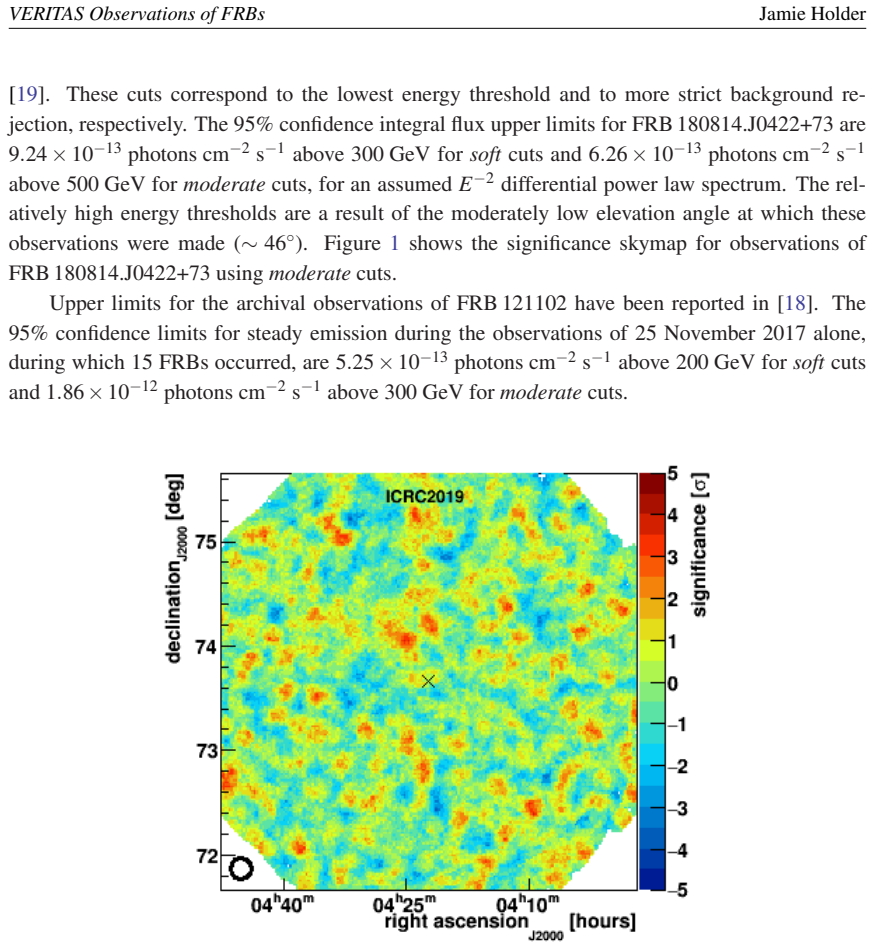
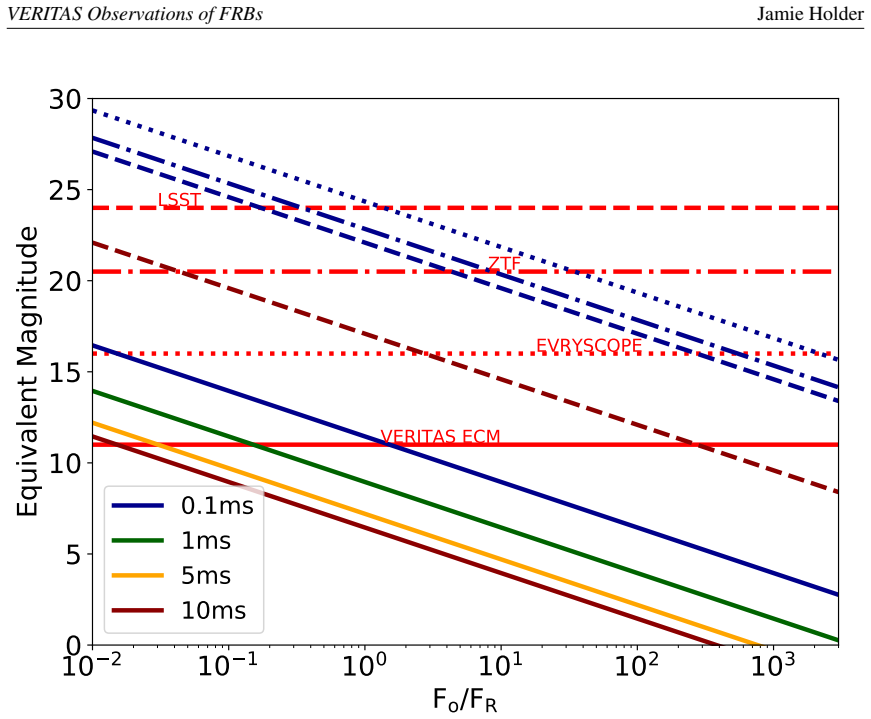
The discovery is an absence of a prompt gamma-ray signal. During 115 minutes of simultaneous VERITAS and Green Bank Telescope observations on 25 November 2017, 17 radio bursts were detected from FRB 121102; the 15 bursts with overlapping VERITAS exposures produced no gamma-ray-like events above 200 GeV within a 10 ms coincidence window, against an expected background of $9\times10^{-5}$ events per window. The per-burst 95% upper limit is $5.6\times10^{-7}$ photons cm$^{-2}$ s$^{-1}$, and the combined limit over all 15 bursts is $3.7\times10^{-8}$ photons cm$^{-2}$ s$^{-1}$, the tightest constraint from a multi-burst imaging Cherenkov campaign to date. No steady emission was detected toward FRB 121102 or FRB 180814.J0422+73, with 95% flux limits above 200-500 GeV. A partially commissioned optical channel found no sub-second flashes, with sensitivity to optical fluences ranging from about 1% of the radio fluence at 10 ms duration up to equality with the radio fluence at 0.1 ms duration.
Load-bearing premise
The limits assume that any gamma-ray counterpart arrives at the same time as the radio burst, within a strict 10-millisecond window; emission that is delayed, that lasts longer than 10 milliseconds, or that precedes the radio burst would escape the search entirely.
Editorial extensions
If this is right
- If FRB 121102 emits very-high-energy gamma rays in step with its radio bursts, each burst must carry fewer than about 3.6 detectable gamma rays above 200 GeV, implying a radio-to-gamma-ray energy ratio that rules out simple one-to-one TeV counterparts at this sensitivity.
- The combined 15-burst upper limit of $3.7\times10^{-8}$ photons cm$^{-2}$ s$^{-1}$ is the most restrictive limit yet from a multi-burst IACT campaign and demonstrates that Cherenkov arrays can monitor repeating FRB sources at millisecond timescales with negligible background.
- The null result applies only to simultaneous emission within 10 ms; precursor, delayed, or longer-duration gamma-ray emission is not constrained by this analysis and awaits the paper's planned multi-window search.
- The optical limits show that the VERITAS optical channel can constrain optical-counterpart fluence to within a factor of about 10 of the best otherwise planned surveys, making IACTs competitive for sub-second optical photometry of FRBs.
Reading between the lines
- The data can be re-analyzed with wider coincidence windows, such as 50 ms to 1 s, without new observations, since the paper already holds the event lists; such an analysis would test models in which the gamma-ray emission is delayed by propagation or by a post-burst flare.
- If the forthcoming CHIME-VERITAS campaign catches a non-repeating FRB in the overlapping field of view, the same background-free method would apply to a much larger burst population, and a single coincident detection would be far more informative than the stacked limit.
- The per-burst upper limit of 3.56 events at 95% confidence could in principle be converted into a constraint on the gamma-ray luminosity per burst under an assumed distance and spectrum, an extension the paper leaves implicit.
Signed reviews
Editorial analysis
A structured set of objections, weighed in public.
Referee Report
Summary. The paper reports VERITAS observations of the repeating FRB sources FRB 121102 and FRB 180814.J0422+73, searching for gamma-ray and optical counterparts. The central result is that no gamma-ray-like events passed selection cuts in any of the 15 FRB 121102 bursts that occurred during contemporaneous GBT observations, with an estimated background of only 9e-5 events per 10 ms window. From this null result the authors quote a 95% confidence upper limit of 3.56 events per burst, corresponding to an integral flux limit of 5.6e-7 photons cm^-2 s^-1 above 200 GeV, and a combined 15-burst limit of 3.7e-8 photons cm^-2 s^-1. The paper also gives steady-emission upper limits for both sources and reports a preliminary optical photometry search with no detected candidates. The authors explicitly note that this analysis covers only strictly contemporaneous emission in a fixed 10 ms window and that searches over multiple time windows, delayed emission, and precursor emission are deferred to a future publication.
Significance. If the result stands, this is a useful null measurement from a multi-burst IACT campaign: with negligible expected background, the non-detection of gamma-ray events in 15 radio-burst windows provides the tightest per-burst and combined integral flux upper limits for FRB 121102 above 200 GeV reported by an IACT. The observational null is robust and the paper's description of the background estimate and event selection is clear. The main quantitative claim, however, depends on the unexplained use of 3.56 events as the 95% upper limit for zero observed events, which is not the standard classical or Feldman-Cousins value. Since the 3.56 factor enters directly into the headline flux limits, the numerical result is not reproducible as written and needs correction or a derivation.
major comments (2)
- [§4.1, Gamma-ray search] The 95% confidence upper limit of 3.56 events per burst for zero observed events is stated without derivation. For a Poisson process with zero observed events and negligible background, the standard classical 95% upper limit is 2.996 events (e^-2.996 = 0.05), and the Feldman-Cousins interval also gives approximately 3.00 events; 3.56 corresponds to roughly a 97% confidence level. Because this number enters linearly into the per-burst flux limit of 5.6e-7 photons cm^-2 s^-1 and into the combined limit, the paper's principal quantitative result is not independently reproducible. Please either derive the 3.56 value explicitly, justify it as a deliberate choice (for example, a confidence level higher than 95%), or replace it with the standard 95% value.
- [§4.1, Gamma-ray search] The combined 15-burst upper limit of 3.7e-8 photons cm^-2 s^-1 appears to be obtained simply by dividing the per-burst limit by 15, which implicitly assumes that the same 3.56-event upper limit applies to the combined 150 ms exposure. A more direct calculation would apply a single 95% upper limit (about 3.00 events) to the combined exposure, which would give a limit of approximately 3.1e-8 photons cm^-2 s^-1 for the same effective area, about 20% lower than the quoted value. Please clarify whether the quoted combined limit is intended as a joint 95% confidence limit and, if so, state the statistical combination procedure explicitly.
minor comments (6)
- [§4.1, Gamma-ray search] The sentence 'no gamma-ray like events passed the cuts' should read 'no gamma-ray-like events passed the cuts'.
- [Abstract and §4.1] The abstract states that two FRBs repeat and that VERITAS results are presented, but it does not mention that the burst-search null result applies only to a 10 ms simultaneous window; this limitation is acknowledged later in §4.1 and should be reflected in the abstract if it summarizes the burst-search result.
- [Figure 2 caption] The caption uses 'ZFT' for the Zwicky Transient Factory and 'Large Synoptic Sky Telescope'; both should be corrected to 'ZTF' and 'Large Synoptic Survey Telescope' (now Rubin Observatory/LSST).
- [Figure 2 caption] The abbreviation 'ECM' is used in the figure ('VERITAS ECM') without definition; please define it in the caption.
- [§4.2, Optical search] The phrase 'at signal/noise of > 10' would read more clearly as 'at a signal-to-noise ratio greater than 10'.
- [§5, Discussion] The phrase 'fewer than 100 bursts detections' should be 'fewer than 100 burst detections'.
Circularity Check
No circularity: the paper reports a direct observational null result; no fitted parameter or self-citation is renamed as a prediction.
full rationale
The central claim is an observational upper limit based on a counting experiment: 'no gamma-ray like events passed the cuts for any of the 15 bursts with contemporaneous observations' (Section 4.1), with background estimated as 9e-5 events per 10 ms window using the standard ring-background method. The derivation chain is a direct Poisson-style limit conversion, not a fitted model that is then repackaged as a prediction. The only external quantitative input is the per-burst 95% upper limit of 3.56 events, taken 'Following [12]' — a MAGIC Collaboration paper, not a self-citation. Even if that statistical convention is unexplained or arguably non-standard, it is an imported external convention, not an input that is equivalent to the output by construction. Self-citations to VERITAS standard analysis tools ([15], [16]) and to a prior VERITAS FRB paper ([18]) are standard instrument/methodology references, not load-bearing claims of uniqueness or derivation. The paper explicitly limits its scope to strictly contemporaneous emission: 'Here we present the simplest analysis only — a search for strictly contemporaneous gamma-ray and radio emission,' and explicitly defers multi-window, precursor, and delayed searches to a future publication. This is a stated limitation, not a circular step. No equation in the paper reduces to another equation by definition, and no fitted parameter is relabeled as a prediction. The qualitative and quantitative results stand independently of any self-referential chain.
Assumptions & free parameters
free parameters (1)
- Gamma-ray coincidence window =
10 ms
assumptions (3)
- domain assumption The flux upper limits assume an E^-2 differential power law spectrum for gamma-ray emission.
- domain assumption The GBT/GUPPI single-pulse search correctly identifies and times the 15 bursts as originating from FRB 121102.
- domain assumption The standard VERITAS gamma-ray selection cuts and ring-background method correctly estimate the tiny expected background in a 10 ms window.
Cite this review
Pith. "Pith review of VERITAS Observations of Fast Radio Bursts." pith.science (2026). https://pith.science/paper/QAEF7YQP
@misc{pith2026190806471,
  author       = {Pith},
  title        = {Pith review of: VERITAS Observations of Fast Radio Bursts},
  year         = {2026},
  howpublished = {\url{https://pith.science/paper/QAEF7YQP}},
  note         = {Machine review of arXiv:1908.06471}
}
read the original abstract
Fast radio bursts (FRBs) are bright, unresolved, millisecond-duration flashes of radio emission originating from outside of the Milky Way. The source of these mysterious outbursts is unknown, but their high luminosity, high dispersion measure and short duration requires an extreme, high-energy, astrophysical process. The majority of FRBs have been discovered as single events which would require a chance coincidence for contemporaneous multiwavelength observations. However, two have been observed to repeat: FRB 121102 and the recently detected FRB 180814.J0422+73. These repeating FRBs have allowed for targeted observations by a number of different instruments, including VERITAS. We present the VERITAS FRB observing program and the results of these observations.
Figures
Forward citations
Cited by 1 Pith paper
-
H.E.S.S. programme searching for VHE gamma rays associated with FRBs
H.E.S.S. found no very high energy gamma-ray counterpart to targeted fast radio bursts, setting 99% confidence upper limits on their luminosity of 10^44 to 10^48 erg/s.
Reference graph
Works this paper leans on
-
[1]
R., et al., A Bright Millisecond Radio Burst of Extragalactic Origin, Science, 318, 777,
Lorimer, D. R., et al., A Bright Millisecond Radio Burst of Extragalactic Origin, Science, 318, 777,
-
[2]
Petroff, E., Hessels, J. W. T., and Lorimer, D. R., Fast radio bursts, Astronomy and Astrophysics Review, 27, 4, 2019. arXiv:1904.07947
arXiv 2019
-
[3]
J. M. Cordes and S. Chatterjee, Fast Radio Bursts: An Extragalactic Enigma, Ann. Rev. A & A, in press, 2019. arXiv:1906.05878
arXiv 2019
-
[4]
G., Scholz, P., et al, A repeating fast radio burst, Nature, 531, 202, 2016
Spitler, L. G., Scholz, P., et al, A repeating fast radio burst, Nature, 531, 202, 2016. arXiv:1603.00581
arXiv 2016
-
[5]
CHIME/FRB Collaboration, et al., A second source of repeating fast radio bursts, Nature, 566, 235,
-
[6]
Michilli, D., et al., An extreme magneto-ionic environment associated with the fast radio burst source FRB 121102, Nature, 553, 182, 2018. arXiv:1801.03965
arXiv 2018
-
[7]
Cunningham, V ., et al., A Search for High-Energy Counterparts to Fast Radio Bursts, arXiv e-prints, arXiv:1905.06818, 2019
arXiv 1905
-
[8]
Second Repeating FRB 180814.J0422+73: Ten-year Fermi-LAT Upper limits and Implications
Yang, Yu-Han, Zhang, Bin-Bin, and Zhang, Bing, Second Repeating FRB 180814.J0422+73: Ten-year Fermi-LAT Upper Limits and Implications, The Astrophysical Journal, 875, L19, 2019. arXiv:1903.07329
work page Pith review arXiv 2019
Show all 25 references
-
[9]
U., et al., A Search for Brief Optical Flashes Associated with the SETI Target KIC 8462852, ApJ, 818, L33, 2016
Abeysekara, A. U., et al., A Search for Brief Optical Flashes Associated with the SETI Target KIC 8462852, ApJ, 818, L33, 2016. arXiv:1602.00987
2016 arXiv
-
[10]
Benbow, W., et al., Direct measurement of stellar angular diameters by the VERITAS Cherenkov telescopes, Nature Astronomy, 249, 2019
2019
-
[11]
H. E. S. S. Collaboration, First limits on the very-high energy gamma-ray afterglow emission of a fast radio burst. H.E.S.S. observations of FRB 150418, A&A, 597, A115, 2017. arXiv:1611.09209
2017 arXiv
-
[12]
arXiv:1809.00663
MAGIC Collaboration, Constraining very-high-energy and optical emission from FRB 121102 with the MAGIC telescopes, MNRAS, 481, 2479, 2018. arXiv:1809.00663
2018
-
[13]
Phys., 25, 391, 2006
Holder, J., et al., The first VERITAS telescope, Astropart. Phys., 25, 391, 2006. arXiv:astro-ph/0604119
2006 arXiv
-
[14]
and the VERITAS Collaboration, Performance of the VERITAS experiment, 34th International Cosmic Ray Conference (ICRC2015), 34, 771, 2015
Park, N. and the VERITAS Collaboration, Performance of the VERITAS experiment, 34th International Cosmic Ray Conference (ICRC2015), 34, 771, 2015. arXiv:1508.07070 6 VERITAS Observations of FRBs Jamie Holder
2015 arXiv
-
[15]
and Holder, J., Eventdisplay: An Analysis and Reconstruction Package for Ground-based Gamma-ray Astronomy, International Cosmic Ray Conference, 301, 747, 2017
Maier, G. and Holder, J., Eventdisplay: An Analysis and Reconstruction Package for Ground-based Gamma-ray Astronomy, International Cosmic Ray Conference, 301, 747, 2017. arXiv:1708.04048
2017 arXiv
-
[16]
K., The VERITAS standard data analysis, International Cosmic Ray Conference, 3, 1325,
Daniel, M. K., The VERITAS standard data analysis, International Cosmic Ray Conference, 3, 1325,
-
[17]
K., for the VERITAS Collaboration
Hassan, T., Daniel, M. K., for the VERITAS Collaboration. Proving the outstanding capabilities of Imaging Atmospheric Cherenkov Telescopes in high time resolution optical astronomy. These proceedings
-
[18]
for the VERITAS Collaboration, Observing FRB 121102 with VERITAS; Searching for Associated TeV Emission, 35th International Cosmic Ray Conference (ICRC2017), 301, 621, 2017
Bird, R. for the VERITAS Collaboration, Observing FRB 121102 with VERITAS; Searching for Associated TeV Emission, 35th International Cosmic Ray Conference (ICRC2017), 301, 621, 2017. arXiv:1708.04717
2017 arXiv
-
[19]
arXiv:1701.06928
Krause, M., Pueschel, E., and Maier, G., Improved gamma/hadron separation for the detection of faint gamma-ray sources using boosted decision trees, Astroparticle Physics, 89, 1, 2017. arXiv:1701.06928
2017 arXiv
-
[20]
& Lorimer, D
Lyutikov, M. & Lorimer, D. R How Else Can We Detect Fast Radio Bursts?, The Astrophysical Journal Letters, 824, 18 (2016). arXiv:1605.01468
2016 arXiv
-
[21]
arXiv:astro-ph/0610959
Berge, D., Funk, S., and Hinton, J., Background modelling in very-high-energy θ s-ray astronomy, Astronomy and Astrophysics, 466, 1219, 2007. arXiv:astro-ph/0610959
2007 arXiv
-
[22]
Ravi, V ., et al., A fast radio burst localised to a massive galaxy, arXiv:1907.01542
1907 arXiv
-
[23]
array of Cherenkov telescopes, 33rd International Cosmic Ray Conference, 2013, arXiv:1307.4898
Glicenstein, J-F., et al., Limits on Primordial Black Hole evaporation with the H.E.S.S. array of Cherenkov telescopes, 33rd International Cosmic Ray Conference, 2013, arXiv:1307.4898
2013 arXiv
-
[24]
and the VERITAS Collaboration, Search for Primordial Black Hole Evaporation with VERITAS, 35th International Cosmic Ray Conference, 301, 691, 2017
Archambault, S. and the VERITAS Collaboration, Search for Primordial Black Hole Evaporation with VERITAS, 35th International Cosmic Ray Conference, 301, 691, 2017. arXiv:1709.00307
2017 arXiv
-
[25]
CHIME/FRB Collaboration, The CHIME Fast Radio Burst Project: System Overview, ApJ, 863, 48,
Reviewed August 14, 2026 · model on record in the stance chip above.
Discussion (0). Continue with ORCID to comment.