REVIEW 6 minor 47 references
Radiation reaction in the classical relativistic St{\o}rmer problem
T0 review · 0 major / 6 minor · reviewed 2026-08-15 · deepseek-v4-flash
Pith's one-line read Adding radiation reaction to the relativistic Størmer problem yields exact, averaged, and local laws for charged-particle drift in a dipole field.
desk verdict A scrupulously scoped analytical extension of the relativistic Størmer problem with Landau–Lifshitz radiation reaction; worth refereeing, with one request to check the omitted field-gradient term in the planar numerics. read the letter →
The pith
A machine-rendered reading of the paper's core claim, the machinery that carries it, and where it could break.
The reading
What carries the argument
The machinery is the dimensionless Landau–Lifshitz self-force written as three pieces: a workless field-gradient term, a quadratic drag term that removes perpendicular momentum, and a relativistic damping term along the velocity, with the single coupling parameter $\eta$ measuring radiation-reaction strength against the Størmer timescale. The reduced drag-only model keeps the two quadratic-field pieces and discards the field-gradient term, preserving the exact instantaneous energy-loss law while omitting directional deflections; this model produces the equatorial drift laws, the averaged transport system, and the closed-form circular-branch solution. The instantaneous circular branch of the conservative problem, with $\gamma^2 = 1 + \gamma_0/R^4$ and $K=2/R$, is the locus where the reduced and complete self-forces coincide and where the secular equations become exactly integrable. Finally, linearization about that branch in three dimensions turns the vertical coordinate into a damped harmonic oscillator, $\ddot{\zeta}+\frac{3\eta}{\gamma R_c^6}\dot{\zeta}+\frac{3}{\gamma^2R_c^6}\zeta=0$, whose leading damping comes from the field-gradient term, so the same machinery that is safely dropped in the equatorial drag model is the source of transverse planarization.
What would settle it
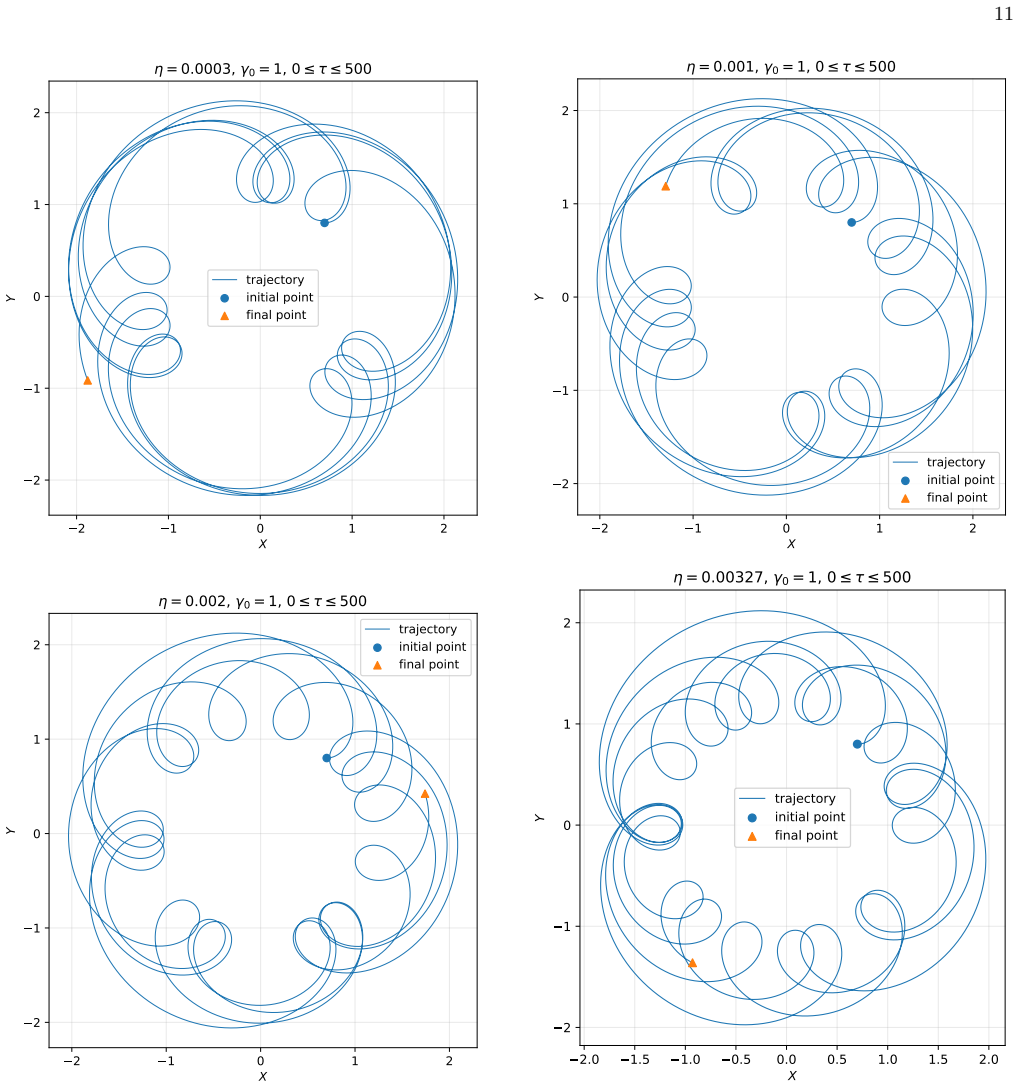
A numerical integration of the complete Landau–Lifshitz equations, keeping the field-gradient term, for the paper's equatorial initial data $X(0)=0.7$, $Y(0)=0.8$, $V_X(0)=0.16$, $V_Y(0)=0$ with $\gamma_0=1$, compared against the reduced-model trajectories shown in the paper; substantial divergence of the trajectories or of $\gamma(\tau)$ on the orbital timescale would show that the planar transport results are not valid for those parameters.
Extended reading notes
Core claim
The central claim is that radiation reaction in the relativistic dipole problem has a controlled analytical structure: most of the dissipative dynamics is captured by a reduced drag-only force that preserves the exact energy-loss law $d\gamma/d\tau=-\eta(\gamma^2-1)/R^6$, while the remaining workless field-gradient term controls local transverse damping. For planar motion the paper derives exact drift equations for $\gamma$ and the canonical angular momentum $K$, averages them over regular radial librations, and shows that the radial action is not conserved by the dissipative flow. When the motion is restricted to the instantaneous circular branch, where the circular speed satisfies $V=1/(\gamma R^2)$, the secular radial evolution is integrable in closed form, $F(R)=\frac{1}{3}(R^4+\gamma_0)^{3/2}-\gamma_0(R^4+\gamma_0)^{1/2}$, with the nonrelativistic late-time scaling $R\propto\tau^{1/6}$. This solution is a conditional benchmark: the circular branch is radially unstable, so generic nearby orbits do not remain on it. For small vertical perturbations of the circular branch, the complete Landau–Lifshitz force yields a damped oscillator with amplitude damping rate $\Gamma_\perp = 3\eta/(2\gamma R_c^6)$, establishing local planarization but not global attraction to the equatorial plane.
Load-bearing premise
The planar analytical and numerical results stand on the reduced drag-only model, which drops the workless field-gradient part of the Landau–Lifshitz force; if that term is not negligible for the initial conditions or averaged orbits in question, the reduced-model transport equations and figures do not represent the complete dynamics.
Editorial extensions
If this is right
- The closed-form circular-branch evolution gives an exact benchmark for testing numerical integrators of the full Landau–Lifshitz equations in dipole fields.
- The averaged planar transport equations reduce long-term radiative evolution to a coupled two-dimensional drift in $(\gamma,K)$, enabling kinetic descriptions without resolving individual orbits.
- Since the radial action is not conserved under dissipation, predictions of terminal circularization or a universal inward or outward migration in this system are not supported; transport must be computed from the coupled drift.
- In three dimensions, the complete self-force locally damps vertical perturbations at a rate that scales as $R_c^6/\eta$, so near the circular branch the motion is planarized on a well-defined local timescale.
- The distinction between complete and reduced models warns that eccentric equatorial or three-dimensional trajectories require the field-gradient term, so reduced-model results should not be extrapolated beyond the stated validity condition.
Reading between the lines
- Beyond the paper: a direct integration of the complete Landau–Lifshitz equations for the paper's initial data would test how quickly the reduced-model rosettes diverge from the full dynamics; the paper's own smallness bound suggests divergence is already relevant for the shown initial conditions.
- Beyond the paper: the vertical-damping rate implies that planarization is fastest in the strong-field inner region, so a kinetic simulation might reveal a radiative-capture bottleneck that concentrates particles near the equatorial plane before they escape.
- Beyond the paper: the same dimensional analysis may extend to rotating dipoles or to fields with an electric component, where the workless field-gradient term can redistribute mechanical energy among degrees of freedom while the quadratic terms fix the total energy loss.
Signed reviews
Editorial analysis
A structured set of objections, weighed in public.
Referee Report
Summary. The paper extends the classical relativistic Størmer problem by adding the Landau–Lifshitz radiation-reaction force to the static magnetic dipole dynamics. It derives the complete dimensionless LL equations and introduces a reduced drag-only model that preserves the exact energy-loss law while omitting the field-gradient term. For planar motion, the reduced system yields exact instantaneous evolution laws for the Lorentz factor and canonical angular momentum, averaged transport equations for regular bound librations, and a closed-form solution when motion is constrained to the instantaneous circular branch, with late-time scaling R ∝ τ^{1/6}. Numerical integrations of the reduced planar model illustrate nonuniform rosette deformation, while a linear stability analysis of the complete LL equations gives local exponential damping of vertical perturbations at rate Γ⊥ = 3η/(2γR_c^6). The paper carefully distinguishes exact identities, conditional results, reduced-model results, and local results, and it repeatedly states the domain of applicability of each.
Significance. If correct, the paper provides the first controlled analytical hierarchy for radiation-reaction-driven transport in a static dipole field: an exact energy-loss identity, exact drift laws for the reduced planar model, a closed-form conditional circular-branch solution, and a local transverse-damping rate from the complete LL force. The derivations are self-contained, involve no fitted parameters, and the main claims are checked against explicit algebra and exact conservation identities. The paper is unusually honest about scope: the circular branch is unstable, the planar averaged transport and figures are solutions of the reduced model rather than the complete LL equations, and global planarization or a universal attractor is explicitly not claimed. The sceptic's concern about the reduced model is therefore acknowledged and contained; it does not affect the circular-branch or vertical-stability results. This is a useful benchmark contribution for numerical and kinetic studies of radiative phase-space transport in strongly inhomogeneous magnetic fields.
minor comments (6)
- [References] Reference [38] is incomplete: the second author appears as "F. S. N." with no surname, and the title contains a dangling comma; please complete the bibliographic entry.
- [Section III.E, Fig. 1] For the initial data in Eq. (76), the ratio in Eq. (46) is initially |A_grad|/|A_drag| ≈ 0.35, which lies outside the local control condition Eq. (48). The figures are properly labeled as reduced-model solutions, but a sentence in the caption quantifying this condition would make the illustrative status of the trajectories clearer.
- [Section III.D, Eq. (62)] The averaging step is invoked with the statement that the fractional dissipative change per period is small, but no explicit smallness parameter is given; adding a condition such as η ⟨γ/R^6⟩ T_orb ≪ 1 would make the timescale separation precise.
- [Sections IV.A and IV.C, Eqs. (88) and (96)] The ratio τ_damp/τ_exp = γ²/3 and the surrounding text appear twice verbatim; please consolidate the duplicated passage.
- [Section III, opening paragraph] There is a typographical inconsistency in "In the following We investigate" where "We" is capitalized mid-sentence; please correct.
- [References [19], [20]] The author formatting "I˜narrea M. et al." is nonstandard; please use the conventional name ordering and spell out the initials.
Circularity Check
No significant circularity: the analytical results are derived from stated equations without fitted inputs; the only author self-citation is background and not load-bearing.
full rationale
The paper's derivation chain is self-contained. The complete dimensionless Landau-Lifshitz system in Eqs. (24)-(26) is obtained by direct substitution from the standard LL formula, and the reduced drag-only model is explicitly constructed by omitting the field-gradient term, which is orthogonal to the velocity; the exact energy-loss law is therefore preserved by construction rather than being assumed as an input. The planar drift laws, Eqs. (60)-(61), follow algebraically from the reduced equatorial momentum equation and the definition of the canonical angular momentum, and the circular-branch integration, Eqs. (49)-(53), uses the independently derived branch relation gamma^2 = 1 + gamma0/R^4 together with the derived branch energy-loss law; nothing is fitted or renamed as a prediction. The averaged transport equations are explicitly presented as conservative-orbit averages of those exact drift laws, with the paper stating that the radial action is not conserved and that no universal terminal state is assumed. The numerical planar figures are explicitly labeled as solutions of the reduced drag-only model, and the paper itself identifies the validity condition, Eq. (48), and the radial instability that can invalidate it; this is a scoped modeling limitation, not circular reasoning. The three-dimensional vertical-damping result, Eqs. (80)-(86), linearizes the complete LL force around the circular branch and retains the field-gradient term that is absent from the reduced model, with the order-eta cancellation derived from the branch energy-loss law. The only author self-citation, Ref. [38], is used for background statements about the complexity of the conservative CRSP and does not supply any target result. No self-definitional identification, fitted input masquerading as a prediction, or imported uniqueness theorem appears anywhere in the argument.
Assumptions & free parameters
free parameters (2)
- γ0 =
1 in numerics
- η =
3e-4, 1e-3, 2e-3, 3.27e-3 in numerics
assumptions (4)
- domain assumption The Landau-Lifshitz equation is the correct classical equation of motion for a radiating point charge to first order in the radiation-reaction time τ0.
- domain assumption Radiation reaction is weak (η ≪ 1), so the perturbative separation between fast orbital motion and slow dissipative transport holds.
- ad hoc to paper The reduced drag-only model (omitting the field-gradient term) preserves the relevant physics for planar motion away from the circular branch.
- standard math Standard results of conservative CRSP: Lorentz factor and canonical angular momentum are conserved; circular equatorial orbits satisfy ω=1/(γR^3).
Cite this review
Pith. "Pith review of Radiation reaction in the classical relativistic St{\o}rmer problem." pith.science (2026). https://pith.science/paper/QAIQSFZL
@misc{pith2026260803310,
  author       = {Pith},
  title        = {Pith review of: Radiation reaction in the classical relativistic St\ormer problem},
  year         = {2026},
  howpublished = {\url{https://pith.science/paper/QAIQSFZL}},
  note         = {Machine review of arXiv:2608.03310}
}
read the original abstract
We extend the classical relativistic St{\o}rmer problem by incorporating radiation reaction through the Landau--Lifshitz formulation, thereby providing a self-consistent description of dissipative charged-particle motion in a static dipole magnetic field. We derive the complete dimensionless equations and distinguish them from a reduced drag-only model that preserves the exact energy-loss law while omitting directional effects associated with magnetic field gradients. For planar motion, the reduced system yields exact instantaneous evolution laws for the particle energy and canonical angular momentum, together with averaged transport equations for regular bound librations. When the motion is constrained to the instantaneous circular branch, the secular evolution can be integrated in closed form and approaches a simple large-radius power law. This analytical solution provides a useful benchmark, although the circular branch is radially unstable and therefore does not describe generic nearby trajectories. Numerical integrations further illustrate the nonuniform dissipative deformation of planar rosette-like orbits. In three dimensions, the complete Landau--Lifshitz force produces local exponential damping of small vertical perturbations, with the leading contribution arising from the field-gradient term absent from the reduced model. These exact, averaged, conditional, and local results establish a controlled analytical framework for studying radiation-driven phase-space transport in strongly inhomogeneous magnetic fields and provide a foundation for future global simulations, kinetic descriptions, and calculations of the associated electromagnetic emission.
Figures

Reference graph
Works this paper leans on
-
[38]
L. D. Landau and E. M. Lifshitz,The Classical Theory of Fields, Pergamon Press, Oxford, 1994
1994
-
[1]
Størmer, Arch
C. Størmer, Arch. Sci. Phys. Nat.24, 5 (1907)
1907
-
[2]
Størmer, Arch
C. Størmer, Arch. Sci. Phys. Nat.24, 113 (1907)
1907
-
[3]
The result does not imply that the equatorial plane is a global attractor
This comparison is local and assumes thatR c andγvary only slightly during one ver- tical oscillation. The result does not imply that the equatorial plane is a global attractor. The circular branch is radially unstable on the orbital timescale, whereas both transverse damp- ing and branch migration occur on the slower radiation- reaction timescale. A traj...
2025
-
[4]
Størmer, Arch
C. Størmer, Arch. Sci. Phys. Nat.24, 221 (1907)
1907
-
[5]
Størmer, Astrophys
C. Størmer, Astrophys. J.38, 311 (1913)
1913
-
[6]
Størmer, Geofys
C. Størmer, Geofys. Publ.1, 269 (1921)
1921
-
[7]
Størmer, Terr
C. Størmer, Terr. Magn. Atmos. Electr.22, 97 (1917)
1917
Show all 47 references
-
[8]
Størmer, Astrophys
C. Størmer, Astrophys. Norv.1, 1 (1934)
1934
-
[9]
Størmer,The Polar Aurora(Clarendon Press, Oxford, 1955)
C. Størmer,The Polar Aurora(Clarendon Press, Oxford, 1955)
1955
-
[10]
Dragt, Rev
A. Dragt, Rev. Geophys.3, 255 (1965)
1965
-
[11]
Dragt and J
A. Dragt and J. M. Finn, J. Geophys. Res.81, 2327 (1976)
1976
-
[12]
Walt,Introduction to Geomagnetically Trapped Radi- ation, Cambridge Atmospheric and Space Science Series, Cambridge University Press, 1994
M. Walt,Introduction to Geomagnetically Trapped Radi- ation, Cambridge Atmospheric and Space Science Series, Cambridge University Press, 1994
1994
-
[13]
M. A. Almeida, I. C. Moreira, and H. Yoshida, J. Phys. A Math. Gen.25, L227 (1992)
1992
-
[14]
Dil˜ ao and R
R. Dil˜ ao and R. Alves-Pires , Chaos in the St¨ ormer Problem. In: Staicu, V. (eds) Differential Equations, Chaos and Variational Problems. Progress in Nonlinear Differential Equations and Their Applications, vol 75. Birkh¨ auser, Basel, pp 175-194 (2007)
2007
-
[15]
Y. Y. Shprits et al., Nature Physics9, 699 (2013)
2013
-
[16]
J. H. Zhang, L. Y. Li, Y. W. Yao, K. X. Cheng, and L. Yang, Journal of High Energy Astrophysics52, 100568 (2026)
2026
-
[17]
Schuster and K
R. Schuster and K. O. Thielheim, J. Phys. A: Math. Gen. 20, 55111987
-
[18]
J. E. Howard, M. Hor´ anyi, and G. R. Stewart, Phys. Rev. Lett.83, 3993 (1999)
1999
-
[19]
H. R. Dullin, M. Hor´ anyi, J. E. Howard, Physica D171, 178 (2002)
2002
-
[20]
et al., Physica D197, 242 (2004)
I˜ narrea M. et al., Physica D197, 242 (2004)
2004
-
[21]
et al., Chaos, Solitons and Fractals42, 155 (2009)
I˜ narrea M. et al., Chaos, Solitons and Fractals42, 155 (2009)
2009
-
[22]
V. Epp, M. A. Masterova, Astrophysics and Space Sci- ence353, 473 (2014)
2014
-
[23]
V. Epp, O. N. Pervukhina, Monthly Notices of the Royal Astronomical Society474, 5330 (2018)
2018
-
[24]
V. V. Markellos and A. A. Halioulias, Astrophysics and Space Science51, 177 (1977)
1977
-
[25]
V. V. Markellos and C. Zagouras, Astronomy and Astro- physics61, 505 (1977)
1977
-
[26]
M. K. ¨Ozt¨ urk, American Journal of Physics80, 420 (2012)
2012
-
[27]
E. Pina, E. Cort´ es, European Journal of Physics37, 065009 (2016)
2016
-
[28]
E. K. Kolesnikov, Geomagnetism and Aeronomy57, 137 (2017)
2017
-
[29]
Leghmouche, N
A. Leghmouche, N. Mebarki, A. Benslama, New Astron- omy98, 101931 (2023)
2023
-
[30]
Ershkov, E
S. Ershkov, E. Prosviryakov, D. Leshchenko, N. Burma- 16 sheva, Mathematical Methods in the Applied Sciences 46, 19364 (2023)
2023
-
[31]
Asadi-Zeydabadi, C
M. Asadi-Zeydabadi, C. S. Zaidins, Results in Physics 12, 2213 (2019)
2019
-
[32]
S. V. Ershkov, J. Appl. Comput. Mech.12, 31 (2026)
2026
-
[33]
Harko and G
T. Harko and G. R. Mocanu, Annalen der Physik537, e00415 (2025)
2025
-
[34]
D. B. Papadopoulos, I. Contopoulos, K. D. Kokkotas, N. Stergioulas, General Relativity and Gravitation47, 49 (2015)
2015
-
[35]
T. M. Burinskaya, M. M. Shevelev, Plasma Physics Re- ports42, 929 (2016)
2016
-
[36]
T. M. Burinskaya, M. M. Shevelev, Plasma Physics Re- ports43, 910 (2017)
2017
-
[37]
J. D. Jackson,Classical Electrodynamics, Wiley, Hobo- ken, NJ, 1999
1999
-
[39]
Harko and F
T. Harko and F. S. N. , Exact solutions, trajectories and radiation patterns in the classical relativistic St¨ ormer problem, [arXiv:2605.04790 [astro-ph.HE]]
-
[40]
K. S. Thorne, Astrophys. J. Suppl. Ser.8, 1 (1963)
1963
-
[41]
Di Piazza, C
A. Di Piazza, C. Muller, K. Z. Hatsagortsyan and C. H. Keitel, Rev. Mod. Phys.84, 1177 (2012). [arXiv:1111.3886 [hep-ph]]
2012 arXiv
-
[42]
M. V. Barkov and M. Lyutikov, [arXiv:2506.20515 [astro- ph.HE]]
-
[43]
J´ erˆ ome, Astron
P. J´ erˆ ome, Astron. Astrophys.666, A5 (2022). [arXiv:2207.00624 [astro-ph.HE]]
2022 arXiv
-
[44]
Tomczak and J
I. Tomczak and J. P´ etri, Astron. Astrophys.676, A128 (2023). [arXiv:2306.11482 [astro-ph.HE]]
2023 arXiv
-
[45]
Stuchl´ ık, J
Z. Stuchl´ ık, J. Vrba, M. Koloˇ s and A. Tursunov, JHEAp 44, 500 (2024). [arXiv:2412.04996 [astro-ph.HE]]
2024 arXiv
-
[46]
Cerutti, A
B. Cerutti, A. A. Philippov and A. Spitkovsky, Mon. Not. Roy. Astron. Soc.4572401 (2016). [arXiv:1511.01785 [astro-ph.HE]]
2016 arXiv
-
[47]
A. A. Philippov and A. Spitkovsky, Astrophys. J. Lett. 785, L33 (2014). [arXiv:1312.4970 [astro-ph.HE]]
2014 arXiv
Reviewed August 15, 2026 · model on record in the stance chip above.
Discussion (0). Continue with ORCID to comment.