REVIEW 4 major objections 5 minor 19 references
Surface currents in Hall devices
T0 review · 4 major / 5 minor · reviewed 2026-08-14 · deepseek-v4-flash
Pith's one-line read For a Hall device, the stationary current pattern is the global minimizer of Joule heating, and it carries longitudinal surface currents near the edges.
desk verdict A clean variational derivation with a testable surface-current prediction, but the least-dissipation postulate and the stability argument need tightening before the strong claim is solid. read the letter →
The pith
A machine-rendered reading of the paper's core claim, the machinery that carries it, and where it could break.
The reading
What carries the argument
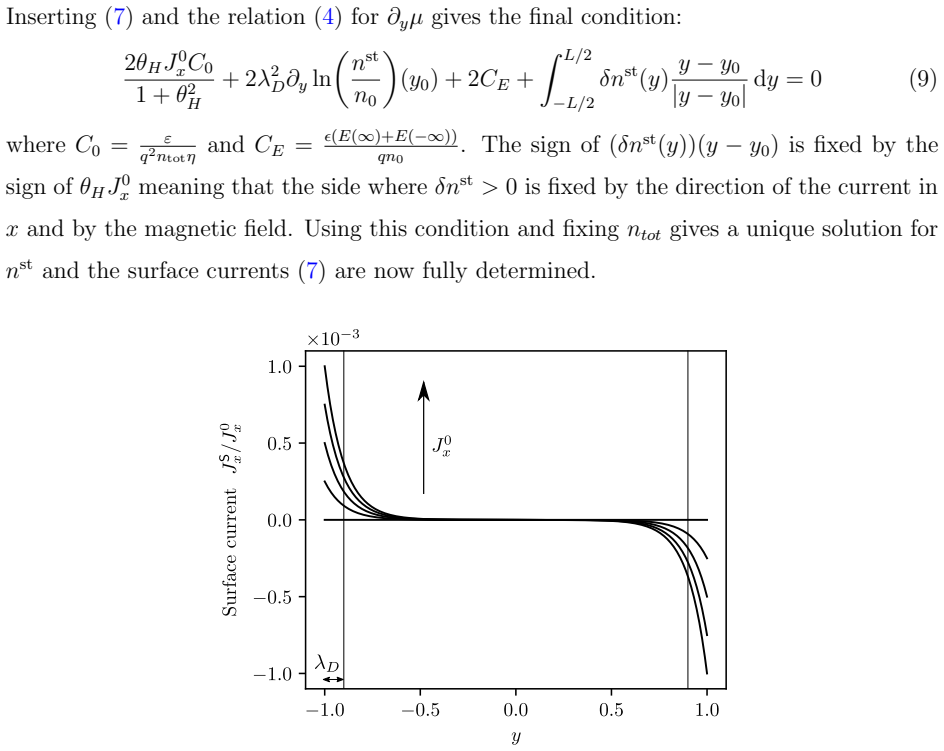
The load-bearing object is the Joule-heating functional $P_J=\int_D qn\eta\|\nabla\mu\|^2\,dx\,dy$, minimized with Lagrange multipliers that enforce the galvanostatic condition and Poisson's screening equation. The decisive step is rewriting the dissipation as an unambiguously positive part plus a deviation from $J_x=J_x^0 n/n_{tot}$, $J_y=0$, which makes the minimum state immediate. The Debye-Fermi length $\lambda_D=\sqrt{kT\epsilon/(q^2n_0)}$ sets the boundary-layer scale, and Poisson's equation $\lambda_D^2\,\partial_y^2\ln(1+\delta n/n_0)=\delta n/n_0$ together with global neutrality and a Gauss-law integral condition (Eq. 9) fixes the charge accumulation and therefore the surface currents.
What would settle it
Measure the full current density across the width of a clean Hall bar as a function of injected current at fixed magnetic field: scanning magnetometry can map local currents without contacting the sample. The heat-minimizing state predicts zero bulk transverse current and edge currents proportional to the square of the injected current when $C_E=0$; finding a bulk transverse current outside the boundary layer, or an edge current linear in applied current, would show that dissipation minimization is not the selection principle at work.
Extended reading notes
Core claim
The central claim is that the stationary state of a Hall conductor is the global minimizer of Joule dissipation, obtained by varying the dissipation functional under galvanostatic and screening constraints. The minimum is reached for $J_x^{st}(y)=J_x^0\,n(y)/n_{tot}$ and $J_y^{st}=0$, which makes the electrochemical potential harmonic ($\nabla^2\mu^{st}=0$) and sets the longitudinal surface current $J_x^{S}=J_x^0\,\delta n/n_0$. The charge accumulation profile follows from Poisson's equation with global neutrality and a Gauss-law boundary condition; in the linear regime the surface current is given by Eq. (10), confined over the Debye-Fermi length $\lambda_D$, and when $C_E=0$ proportional to the square of the injected current $J_x^0$. The usual Hall voltage is recovered in the small-Hall-angle limit, and the dynamical equations are shown to converge to this minimum.
Load-bearing premise
The load-bearing assumption is that a real Hall device actually reaches the global state of least Joule heating; if contacts, edges, or nonlinear effects select some other stationary current pattern, the predicted zero transverse current and edge currents do not hold.
Editorial extensions
If this is right
- A stable Hall voltage does not require insulating edges: the generator continuously renews the edge charges even when a voltmeter leaks current laterally.
- Hall devices carry measurable longitudinal surface currents, flowing in opposite directions on the two edges, superimposed on the bulk current.
- In the clean case $C_E=0$, the surface current scales as $(J_x^0)^2$, an experimental signature that distinguishes the edge current from ordinary linear conduction.
- When screening is very strong, the edge current collapses to Dirac-like sheet currents at the boundary, and the textbook Hall voltage $V_H=\theta_H L J_x^0/(q n_0 \eta)$ is recovered.
- The stationary state is characterized by a harmonic electrochemical potential, with the charge density constant in the bulk and varying only in boundary layers.
Reading between the lines
- Beyond the paper, the same principle could be used to determine stationary states in other open-boundary transport problems, such as thermoelectric or spin-dependent geometries, where local stationarity does not fix the edge conditions, since the derivation relies only on Ohm's law, Poisson's equation, and the dissipation minimum.
- A concrete experimental extension is to image the current density with scanning magnetometry or nitrogen-vacancy microscopy: the heat-minimizing state predicts edge currents that grow quadratically with bias and change sign with field, so observing a linear or static edge signal would suggest a different selection mechanism.
- If edge currents are present, they should contribute to the device's magnetoresistance and noise in a way that changes with Hall angle, because the two opposite edge currents interact differently with bulk transport as the magnetic field increases.
Signed reviews
Editorial analysis
A structured set of objections, weighed in public.
Referee Report
Summary. The paper proposes a variational description of stationary states in Hall devices, based on the Kirchhoff-Helmholtz principle of least heat dissipation. Minimizing Joule heating under the galvanostatic constraint and the electrostatic screening equation, the authors derive that the minimum-dissipation state has zero transverse current, J_y^st = 0, and a longitudinal current proportional to the local carrier density, J_x^st = J_x^0 n/n_tot (Eq. 7). This state yields a harmonic electrochemical potential and a charge accumulation governed by a nonlinear Poisson equation (Eq. 8). Linearizing for small density modulations gives a surface current J_x^S(y) proportional to the square of the injected current when the environment constant C_E is zero (Eq. 10), and the classical Hall voltage is recovered in the small-Hall-angle limit. The paper also includes a short stability discussion.
Significance. If the variational principle is accepted and the reachability of the minimum-dissipation state is established, the paper provides a global, closed-form characterization of Hall-device stationary states and a falsifiable prediction of a nonlinear surface current. The derivation of Eq. (7) via an inequality is self-contained and does not rely on adjustable parameters. The recovery of the standard Hall voltage provides a useful consistency benchmark. However, the physical selection of the minimum-dissipation state remains an assumption, and the stability proof is incomplete; these issues limit the current strength of the central claim.
major comments (4)
- [Stability analysis (Eqs. 11-12)] The stability argument is conditional and does not establish convergence. Equations (11) and (12) only state that if some perturbations tend to zero, then others do; no independent decay mechanism or Lyapunov functional is given, so the claim that the system relaxes to the minimum-dissipation state is not proven. Since this is the bridge between the variational minimum and the physical steady state, it is a load-bearing gap.
- [Eq. (9) and linearization] The term 2 λ_D^2 ∂_y ln(n_st/n0) in Eq. (9) is missing a factor n0. Deriving E_y from ∂_y μ and Gauss's law gives 2 n0 λ_D^2 ∂_y ln(n/n0), with the environment term also carrying the appropriate n0 factor. As written, Eq. (9) is dimensionally inconsistent, and the linearized solution (10) for CE != 0 changes. The CE=0 quadratic scaling is not affected, but the formula should be corrected and re-derived.
- [Supplemental material / Eq. (6)] The derivation of the Euler-Lagrange equation (6) is deferred to reference [18], but no supplemental material is included with the arXiv submission. Equation (6) is used to verify that Eq. (7) is a stationary point and in the stability equation (12); without the derivation, this step cannot be checked by the reader. Please provide the missing derivation.
- [Variational principle (Section 2, Eq. 5)] The Kirchhoff-Helmholtz principle is assumed as the selection criterion for the stationary state. The paper does not derive this principle from the time-dependent transport equations, and the stability section (see above) does not supply a reachability proof. A concrete test of the quadratic surface-current prediction (Eq. 10) would help validate the principle, but as it stands the identification of the physical steady state with the global minimizer is an unproven assumption.
minor comments (5)
- [Acknowledgements] The word 'ACKNOWLEGEMENT' is misspelled and should be 'ACKNOWLEDGEMENT'.
- [After Eq. (10), Dirac limit] The limiting expression for J_x^S is missing a factor of 2: (1/λ_D) sinh(y/λ_D)/cosh(L/2λ_D) tends to 2δ(y-L/2)-2δ(y+L/2), not δ_- - δ_+ as written.
- [After Eq. (10), surface charge Q_s] The expression Q_s = qC0J_x^0 θH/n0^2 is inconsistent with the Hall voltage V_H = Q_s L/ε = θH L J_x^0/(q n0 η) quoted immediately after; consistency requires Q_s = q C0 J_x^0 θH.
- [Stability section] The variable n_+ = n - n_st is defined in the stability section but never used; it should be removed or actually employed in the argument.
- [Introduction, Eq. (1)] Reference [16] notes that the expression for μ is an approximation for δn/n0 << 1; since the paper later linearizes under this condition, the approximation should be stated more prominently near Eq. (1).
Circularity Check
Partially circular: the minimum-dissipation premise is self-cited from the same group and the stability proof is a closed conditional loop; the algebraic core from that premise remains internally valid.
-
self citation load bearing
[Introduction / variational framework, paragraph before Eq. (5)]
"The goal of the present work is to reconsider the stationary states of the Hall effect in a variational framework – namely the Kirchhoff-Helmholtz principle of least heat dissipation [10–12] – in order to characterize the system globally, including the edges and beyond."
The load-bearing premise that the actual stationary current pattern is the global minimizer of Joule heating is attributed to refs. [10–12], all co-authored by Wegrowe/Rubi, the present group. No independent derivation or external validation is given for this principle. Equation (7) is then obtained by minimizing the very functional this premise postulates: the conclusion that the steady state is the minimum-dissipation state is thus imported from the authors' prior work rather than independently established. The subsequent algebra is valid, but the foundational choice is supported only by the self-citation chain.
-
other
[Stability argument, Eqs. (11)–(12), final section before the Conclusion]
"This equation shows that if both f(y) and ϵy tend to 0 then ϵx tends to a constant. ... Finally, Eq. (6) now reads: ... (12), which shows that if both f(y) and ϵx tend to 0 then ϵy tends to 0."
The claimed proof that the system relaxes to Eq. (7) is a closed loop: Eq. (11) gives f(y)→0 if ϵy and ϵx tend to 0, while Eq. (12) gives ϵy→0 if f(y) and ϵx tend to 0. No independent decay of any perturbation is established: there is no norm, Lyapunov functional, or convergence argument. Thus the stability conclusion assumes the convergence it is supposed to prove, and the argument does not rule out other stationary states selected by the dynamics.
full rationale
The variational minimization itself is not a fitted-input-called-prediction: Eq. (7) follows algebraically from completing a square in the dissipation functional under the stated global constraints, and the recovery of the usual Hall voltage is an external benchmark rather than a re-fit. The surface current expression Eq. (10) is an analytic consequence of the linearized equations, not a fitted curve. However, the foundational principle of the whole derivation, the Kirchhoff-Helmholtz least-dissipation principle, is introduced only by citation to refs. [10–12], all from the same group; the paper does not independently derive or experimentally justify that a real Hall device selects the global minimum of Joule heating. In addition, the stability argument in Eqs. (11)–(12) is a closed conditional loop: each perturbation's decay is conditioned on the decay of the others, with no independent relaxation mechanism, so the assertion that the solution is stable is not actually demonstrated. These two issues make the paper partially self-supporting at the level of its foundational premise and its stability claim, but the algebraic core from the stated principle to Eqs. (7), (8), and (10) is internally valid. A separate algebraic concern in Eq. (9) (a possible missing n0 factor) is a correctness issue rather than a circularity issue and does not affect this assessment.
Assumptions & free parameters
assumptions (6)
- domain assumption The Kirchhoff-Helmholtz principle of least heat dissipation defines the stationary state of a Hall device.
- domain assumption Local equilibrium holds and the electrochemical potential is mu = (kT/q) ln(n/n0) + V.
- domain assumption Onsager relations give the mobility tensor with Hall angle theta_H.
- standard math Poisson's equation and the screening equation (2) hold.
- domain assumption Global constraints: total carrier density n_tot = n0 and fixed total longitudinal current J0_x.
- domain assumption The boundary condition (9) from Gauss's law with E(+-infinity) as constants, and in vacuum E(+-infinity) = 0.
Cite this review
Pith. "Pith review of Surface currents in Hall devices." pith.science (2026). https://pith.science/paper/QAPBQEFF
@misc{pith2026190806282,
  author       = {Pith},
  title        = {Pith review of: Surface currents in Hall devices},
  year         = {2026},
  howpublished = {\url{https://pith.science/paper/QAPBQEFF}},
  note         = {Machine review of arXiv:1908.06282}
}
read the original abstract
A variational approach is used in order to study the stationary states of Hall devices. Charge accumulation, electric potentials and electric currents are investigated on the basis of the Kirchhoff-Helmholtz principle of least heat dissipation. A simple expression for the state of minimum power dissipated -- that corresponds to zero transverse current and harmonic chemical potential -- is derived. It is shown that a longitudinal surface current proportional to the charge accumulation is flowing near the edges of the device. Charge accumulation and surface currents define a boundary layer over a distance of the order of the Debye-Fermi length.
Figures

Reference graph
Works this paper leans on
-
[18]
Onsager Reciprocal relations in irreversible processes II, Phys
L. Onsager Reciprocal relations in irreversible processes II, Phys. Rev. 38, 2265 (1931)
work page 1931
-
[1]
Inserting the solution (7) into the relations (3,4), we deduce ∂xµst = −J 0 x qntotη(1+θ2 H ) and ∂yµst = θHJ 0 x qntotη(1+θ2 H ). These two terms are constant so that the electochemical potential of the stationary state is harmonic: ∇2µst = 0. The corresponding current (7) is defined as a function of the charge density n. The solution is hence given by Po...
-
[2]
E. H. Hall On a new action of the magnet on electric currents , Am. J. Math. 2, 287 (1879)
-
[3]
N. W. Ashcroft and N. D. Mermin, Solid State Physics , Holt-Saunders, Philadelphia, 1976
work page 1976
-
[4]
A. C. Smith, J. Janak, and R. B. Adler, Electronic Conduction in Solids , Physical and Quan- tum Electronics Series McGraw-Hill, New York, 1967
work page 1967
-
[5]
Kittel, introduction to solid state physics , Ed
Ch. Kittel, introduction to solid state physics , Ed. Wiley, Eighth Edition, Chapter 6 p153, 2008
work page 2008
-
[6]
Popovic, Hall Effect Devices , IoP Publishing, Bristol and Philadelphia 2004
R.S. Popovic, Hall Effect Devices , IoP Publishing, Bristol and Philadelphia 2004
work page 2004
-
[7]
S. M. Sze, Kwork K. Ng, Physics of Semiconductor Devices , Wiley-Interscience, John Wiley & Sons, inc., publication, thurd Ed. 2007
work page 2007
Show all 19 references
-
[8]
M. J. Moelter, J. Evans, G. Elliott, and M. Jackson, Electric potential in the classical Hall effect: An unusual boundary-value problem , Am. J. Phys. 66, 668 (1998); https://doi.org/: 10.11191/1.18931
1998 doi
-
[9]
Homentcovschi and R
D. Homentcovschi and R. Bercia, Analytical solution for the electric field in Hall plates , Z. Angew. Math. Phys. 69:97 (2018) https://doi.org/10.1007/s00033-018-0989-7
2018 doi
-
[10]
Fernandes, H
C. Fernandes, H. E. Ruda, and A. Shik, Hall effect in nanowires , J. Appl. Phys. 115, 234304 (2014)
2014
-
[11]
Benda, E
R. Benda, E. Olive, M. J. Rub` ı and J.-E. WegroweTowards Joule heating optimization in Hall devices, Phys. Rev. B 98 085417 (2018)
2018
-
[12]
Wegrowe, R
J.-E. Wegrowe, R. V. Benda, and J. M. Rub` ı., Conditions for the generation of spin current in spin-Hall devices , Europhys. Lett 18 67005 (2017)
2017
-
[13]
Wegrowe, P.-M
J.-E. Wegrowe, P.-M. Dejardin, Variational approach to the stationary spin-Hall effect , Euro- phys. Lett 124, 17003 (2018)
2018
-
[14]
Non-equilibrium Thermodynamics; North-Holland: Amsterdam, The Netherlands, 1962
See the sections relaxation phenomena and internal degrees of freedom in Chapter 10 of De Groot, S.R.; Mazur, P. Non-equilibrium Thermodynamics; North-Holland: Amsterdam, The Netherlands, 1962. 8
1962
-
[15]
Reguera, J
D. Reguera, J. M. G. Vilar, and J. M. Rub` ı.Mesoscopic Dynamics of Thermodynamic Systems, J. Phys. Chem. B 109 (2005)
2005
-
[16]
Mazur, Fluctuations and non-equilibrium thermodynamics , Physica A 261 (1998) 451
P. Mazur, Fluctuations and non-equilibrium thermodynamics , Physica A 261 (1998) 451
1998
-
[17]
How- ever, in the case of degenerated metal, the expression is an approximation for δn/n0≪ 1
The expression is valid for non-degenerated semiconductor (Maxwellian distribution). How- ever, in the case of degenerated metal, the expression is an approximation for δn/n0≪ 1
-
[19]
M. Creff, F. Faisant, J. M. Rub` ı, and J.-E. Wegrowe, Supplemental material 9
Reviewed August 14, 2026 · model on record in the stance chip above.
Discussion (0). Continue with ORCID to comment.