REVIEW 3 major objections 5 minor 60 references
Symmetry-constrained Rectification Network for Scene Text Recognition
T0 review · 3 major / 5 minor · reviewed 2026-08-14 · deepseek-v4-flash
Pith's one-line read A symmetry-constrained rectification network predicts a text line's center, scale, and orientation, generates mirror-symmetric control points, and warps irregular scene text to a regular form, reporting top accuracy on curved benchmarks.
desk verdict Solid, well-controlled paper on geometry-based rectification for scene text recognition; the gains are real but the abstract oversells them and the terminal-character failure mode is a contained limitation. read the letter →
The pith
A machine-rendered reading of the paper's core claim, the machinery that carries it, and where it could break.
The reading
What carries the argument
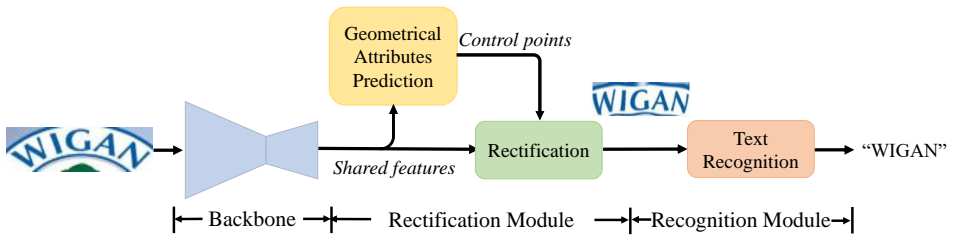
The central object is the text center line (TCL) with per-point geometric attributes $\mathrm{geo}_i = (c_i; s_i; \phi_i; \theta_i)$, where $c_i$ is a center point, $s_i$ is half the character height, $\phi_i$ is the character orientation, and $\theta_i$ is the text orientation tangent. Control points are generated by taking each of $k$ evenly spaced samples $\bar{c}_i$ and placing two points at distance $s_i$ along the character-orientation direction: $p_{2i-1} = \bar{c}_i + (s_i \cos\phi_i, -s_i \sin\phi_i)$ and $p_{2i} = \bar{c}_i - (s_i \cos\phi_i, -s_i \sin\phi_i)$, so the paired points are mirror-symmetric about the center line by construction. These points are then used as fiducials for a thin-plate-spline transformation that warps the shared feature maps to a canonical horizontal strip before an attention-based sequence decoder reads them. The character orientation $\phi$ is the distinctive addition: it lets the warp follow slanted or sheared characters rather than the normal to the center line.
What would settle it
Take a set of curved words whose end characters are nearly horizontal and close to the image border, measure the distance between ScRN's predicted control points and the true text edges, and compare recognition accuracy to the no-rectification baseline on that subset; if the control-point error is no smaller than the STN baseline's and the accuracy gain disappears, the central claim that symmetry-constrained center-line attributes improve rectification is false in the regime the paper identifies as its limitation.
Extended reading notes
Core claim
The central claim is that representing a text instance by its center line plus local geometrical attributes—scale, text orientation, and character orientation—and using those attributes to generate paired, mirror-symmetric control points for a thin-plate-spline warp yields better rectification than weakly supervised spatial-transformer networks that predict outline control points directly. Because the control points are constructed as equidistant samples along the predicted center line, offset by the predicted scale along the predicted character orientation, the upper and lower points are symmetric by construction. The paper reports that this symmetric construction, trained with explicit geometry supervision on synthetic data, outperforms its own STN-based baselines on IC15, SVTP, and CUTE80 by 0.5 to 1.7 percentage points and matches or exceeds them on regular-text benchmarks, with an additional 1 millisecond per image at inference.
Load-bearing premise
The whole method assumes that a word's shape is faithfully captured by a center line through character-box centers, with scale and orientation values linearly interpolated between centers; when terminal characters are nearly horizontal and touch the image border, this assumption breaks and the paper's own failure analysis shows misaligned control points.
Editorial extensions
If this is right
- The rectification module itself, not the extra geometry loss, drives the gains: a multi-loss baseline without rectification matches the base recognizer, while the full ScRN improves irregular-text accuracy.
- The added cost is small: prediction uses two convolutional layers and inference rises from 12 ms to 13 ms per image, so the module can be added to existing recognizers almost for free.
- The character-orientation attribute is necessary: replacing it with the center-line normal degrades rectification visibly, so the paper's representation is load-bearing rather than cosmetic.
- Because geometry supervision comes from SynthText character boxes, word-level-only corpora such as Synth90k can still be added for recognition training without needing extra geometry labels.
- On irregular-text datasets the reported gains over the STN baseline are 0.5 points on IC15, 1.4 points on SVTP, and 1.7 points on CUTE80, and the gains over the weakly supervised STN with extra supervision are consistent but smaller.
Reading between the lines
- A natural extension the authors leave implicit is to unify detection and recognition through the same center-line representation, allowing end-to-end recognition of arbitrary-shaped words without separate cropping.
- A testable prediction is that rectification quality should degrade as the predicted center line is corrupted; injecting controlled noise into $\phi$ and $s$ would isolate how much of the gain is due to the symmetry constraint and how much to the geometry itself.
- The acknowledged endpoint failure suggests a concrete fix: extend the representation at the line ends, for example with per-character quadrilaterals, to remove linear-interpolation error where terminal characters are nearly horizontal.
- An unstated consequence of the shared-feature design is that rectifying feature maps rather than the input image is what keeps the module cheap; applying ScRN to full-resolution images would let existing recognizers benefit at roughly twice the compute.
Signed reviews
Editorial analysis
A structured set of objections, weighed in public.
Referee Report
Summary. The paper proposes a Symmetry-constrained Rectification Network (ScRN) for scene text recognition. ScRN predicts per-pixel text center lines, scale, text orientation, and character orientation from shared FPN features, generates 2k Thin-Plate-Spline control points symmetrically around the center line via Eq. (2), and rectifies the shared feature maps before an attention-based recognizer. The model is trained end-to-end with a geometry loss and a recognition loss on SynthText and Synth90k, and evaluated on seven standard benchmarks. The central claims are that ScRN achieves state-of-the-art accuracy on regular and irregular text, outperforming existing methods by a large margin on ICDAR 2015, SVT-Perspective, and CUTE80, while adding negligible computation through a two-convolution-layer rectification module.
Significance. If the reported results are reproducible, ScRN is a useful and practical contribution: it gives an interpretable, symmetry-constrained alternative to STN-based rectification, with controlled experiments that correctly isolate the rectification module from the additional geometry loss. The paper's controlled comparisons in Tables 2 and 3 are a genuine strength and rule out the common confound that the gains come only from the extra loss. The computational overhead is small (about 1 ms per image), and the visualizations in Figs. 6 and 7 support the claimed qualitative behavior. However, the significance is currently limited by three issues: the controlled gains over a same-backbone supervised STN baseline are modest (0.2-1.7 points), the results appear to be single-run with no error bars or released code, and the method's acknowledged endpoint failure in Sec. 4.6 is not quantified despite being directly relevant to the headline irregular-text claim.
major comments (3)
- [Sec. 3.1.3, Eq. (2), and Sec. 4.6] The failure mode reported in Sec. 4.6 is a direct consequence of the control-point parameterization in Eq. (2). When a terminal character's orientation phi_i is nearly horizontal, the two control points p_{2i-1} and p_{2i} lie almost on the center line rather than on opposite text borders, so the TPS envelope is locally unconstrained at the word boundary. Because the abstract's headline result is the large margin on the irregular benchmarks, where curved text often has near-horizontal terminal characters close to image borders, this acknowledged limitation needs quantitative treatment. Please report the frequency of such cases on IC15, SVTP, and CUTE80, show example-level rectification quality at word endpoints, and state whether a simple post-processing constraint (e.g., clamping phi near the borders) would remove the failure.
- [Sec. 4.5/Table 4 vs Sec. 4.4/Table 3] The 'large margin' claim over ASTER on IC15, SVTP, and CUTE80 in the abstract and Sec. 4.5 is based on cross-method comparison with different training data and system components. In the controlled same-backbone, same-training comparison of Table 3, ScRN exceeds the STN_supervision baseline by only 0.2, 1.1, and 1.0 points on IC15, SVTP, and CUTE80, respectively. The paper should either calibrate the abstract and conclusion to the controlled comparison or provide evidence that the Table 4 differences are attributable to the rectification module rather than to other differences between the systems.
- [Sec. 4.2/4.4] All results appear to be from a single run and no code is provided. Since the controlled gains in Table 3 are as small as 0.2-1.7 points, the paper should report the number of runs and variance (or bootstrap confidence intervals) for at least the main comparisons in Tables 2 and 3, and should release the code or a sufficiently detailed protocol to make the experiments reproducible.
minor comments (5)
- [Sec. 3.1.2, Eq. (1)] Equation (1) normalizes cos(phi) and sin(phi), but the text says cos(theta) and sin(theta) are normalized in the same way without giving the analogous equation; please add it for completeness.
- [Table 4] The column headers of Table 4 ('50 1k 0 50 0 50 Full 0 0 0 0 0') are hard to parse; spell out the evaluation protocol for each dataset, including which columns correspond to lexicon-free recognition.
- [Sec. 4.4] The STN baseline and STN supervision are said to share the same backbone and recognition module, but the STN architecture details (number of layers, control-point count, training details) are not fully specified beyond 'similar with ASTER'; include enough details to reproduce the ablation.
- [Sec. 3.3.1] Equation (4) defines Lgeo only for SynthText; clarify that Synth90k examples contribute only the recognition loss in both training stages, and how the two-stage protocol treats un-annotated geometry in the second stage.
- [Sec. 4.6] The phrase 'labor-free and time-efficient' is misleading because character-level annotations are still required; rephrase to emphasize that the annotations are obtained automatically from the synthesizing engine rather than by manual labeling.
Circularity Check
No significant circularity: the SOTA claim is an empirical benchmark result, and the rectification geometry is defined and trained independently of those benchmarks.
full rationale
The paper's central claim is empirical recognition accuracy on standard external benchmarks (IIIT5K, SVT, IC03, IC13, IC15, SVTP, CUTE80). The rectification module predicts center line, scale, and orientation attributes from a two-convolution-layer network supervised by ground-truth geometric attributes on SynthText (Sec. 3.3, Eq. 5), then generates TPS control points via Eq. (2). None of the benchmark accuracies are used to define, fit, or post-hoc select the geometric predictor; the recognition loss (Eq. 3) and geometry loss (Eq. 5) are conventional supervised losses. The center-line/scale/orientation representation is explicitly adopted from prior work (TextSnake, [33]) and compared against ASTER ([46]), with which some authors overlap, but the paper itself defines the representation in Sec. 3.1.1 and the control-point generation in Sec. 3.1.3, and the cited works have independent empirical content and are not invoked as a uniqueness theorem or to forbid alternatives. The acknowledged limitation in Sec. 4.6, where terminal characters that are nearly horizontal and close to image borders cause imperfect rectification, is an empirical failure mode, not a circular reduction. No equation or fitted parameter in the derivation chain is equivalent by construction to the claimed prediction, so there is no circularity to report.
Assumptions & free parameters
free parameters (3)
- Loss weights lambda_1 through lambda_6 =
1 (all)
- Number of sampled control points k =
10
- TCL expansion radius =
1 pixel
assumptions (5)
- domain assumption A text instance can be represented by a center line built from character-box centers, with per-pixel scale, character orientation, and text orientation linearly interpolated between centers.
- domain assumption Geometric attributes predicted by a two-convolution-layer network trained only on SynthText generalize to real-world irregular text.
- domain assumption Character orientation is a necessary attribute in addition to text orientation for accurate rectification.
- domain assumption Thin-plate spline warping with a fixed set of symmetric control points (k=10) can map irregular text feature maps to a canonical horizontal form.
- standard math Thin-plate spline interpolation is differentiable and suitable for end-to-end training.
Cite this review
Pith. "Pith review of Symmetry-constrained Rectification Network for Scene Text Recognition." pith.science (2026). https://pith.science/paper/QASDWTQY
@misc{pith2026190801957,
  author       = {Pith},
  title        = {Pith review of: Symmetry-constrained Rectification Network for Scene Text Recognition},
  year         = {2026},
  howpublished = {\url{https://pith.science/paper/QASDWTQY}},
  note         = {Machine review of arXiv:1908.01957}
}
read the original abstract
Reading text in the wild is a very challenging task due to the diversity of text instances and the complexity of natural scenes. Recently, the community has paid increasing attention to the problem of recognizing text instances with irregular shapes. One intuitive and effective way to handle this problem is to rectify irregular text to a canonical form before recognition. However, these methods might struggle when dealing with highly curved or distorted text instances. To tackle this issue, we propose in this paper a Symmetry-constrained Rectification Network (ScRN) based on local attributes of text instances, such as center line, scale and orientation. Such constraints with an accurate description of text shape enable ScRN to generate better rectification results than existing methods and thus lead to higher recognition accuracy. Our method achieves state-of-the-art performance on text with both regular and irregular shapes. Specifically, the system outperforms existing algorithms by a large margin on datasets that contain quite a proportion of irregular text instances, e.g., ICDAR 2015, SVT-Perspective and CUTE80.
Figures


Figures from the paper (4 more)


Reference graph
Works this paper leans on
-
[1]
J. Almaz ´an, A. Gordo, A. Forn ´es, and E. Valveny. Word spotting and recognition with embedded attributes. TPAMI, 36(12):2552–2566, 2014. 8
work page 2014
-
[2]
D. Bahdanau, K. Cho, and Y . Bengio. Neural machine translation by jointly learning to align and translate. CoRR, abs/1409.0473, 2014. 4
arXiv 2014
-
[3]
F. Bai, Z. Cheng, Y . Niu, S. Pu, and S. Zhou. Edit probability for scene text recognition. In CVPR, 2018. 2, 8
work page 2018
-
[4]
X. Bai, C. Yao, and W. Liu. Strokelets: A learned multi-scale mid-level representation for scene text recognition. IEEE Transactions on Image Processing, 25(6):2789–2802, 2016. 2
work page 2016
-
[5]
A. Bissacco, M. Cummins, Y . Netzer, and H. Neven. Pho- toocr: Reading text in uncontrolled conditions. In ICCV, pages 785–792, 2013. 8
work page 2013
-
[6]
F. L. Bookstein. Principal warps: Thin-plate splines and the decomposition of deformations. TPAMI, 11(6):567–585,
- [7]
- [8]
Show all 60 references
-
[9]
K. Cho, B. van Merrienboer, C ¸ . G ¨ulc ¸ehre, D. Bahdanau, F. Bougares, H. Schwenk, and Y . Bengio. Learning phrase representations using RNN encoder-decoder for statistical machine translation. In Proceedings of the 2014 Confer- ence on Empirical Methods in Natural Language...
2014
-
[10]
Epshtein, E
B. Epshtein, E. Ofek, and Y . Wexler. Detecting text in natural scenes with stroke width transform. In CVPR, pages 2963– 2970, 2010. 2
2010
-
[11]
Girshick
R. Girshick. Fast r-cnn. In ICCV, December 2015. 5
2015
-
[12]
A. Gordo. Supervised mid-level features for word image rep- resentation. In CVPR, pages 2956–2964, 2015. 8
2015
-
[13]
Graves, S
A. Graves, S. Fern ´andez, F. J. Gomez, and J. Schmidhu- ber. Connectionist temporal classification: labelling unseg- mented sequence data with recurrent neural networks. In ICML, pages 369–376, 2006. 2
2006
-
[14]
Graves, M
A. Graves, M. Liwicki, S. Fern ´andez, R. Bertolami, H. Bunke, and J. Schmidhuber. A novel connectionist sys- tem for unconstrained handwriting recognition. TPAMI, 31(5):855–868, 2009. 4
2009
-
[15]
Gupta, A
A. Gupta, A. Vedaldi, and A. Zisserman. Synthetic data for text localisation in natural images. In CVPR, pages 2315– 2324, 2016. 5, 8
2016
-
[16]
K. He, X. Zhang, S. Ren, and J. Sun. Deep residual learning for image recognition. In CVPR, pages 770–778, 2016. 2
2016
-
[17]
P. He, W. Huang, Y . Qiao, C. C. Loy, and X. Tang. Reading scene text in deep convolutional sequences. In AAAI, vol- ume 16, pages 3501–3508, 2016. 2
2016
-
[18]
Jaderberg, K
M. Jaderberg, K. Simonyan, A. Vedaldi, and A. Zisserman. Synthetic data and artificial neural networks for natural scene text recognition. CoRR, abs/1406.2227, 2014. 5
2014 arXiv
-
[19]
Jaderberg, K
M. Jaderberg, K. Simonyan, A. Vedaldi, and A. Zisserman. Deep structured output learning for unconstrained text recog- nition. In ICLR, 2015. 8
2015
-
[20]
Jaderberg, K
M. Jaderberg, K. Simonyan, A. Vedaldi, and A. Zisserman. Reading text in the wild with convolutional neural networks. IJCV, 116(1):1–20, 2016. 2, 8
2016
-
[21]
Jaderberg, K
M. Jaderberg, K. Simonyan, A. Zisserman, et al. Spatial transformer networks. In NIPS, pages 2017–2025, 2015. 1, 2
2017
-
[22]
Jaderberg, A
M. Jaderberg, A. Vedaldi, and A. Zisserman. Deep features for text spotting. In ECCV, pages 512–528, 2014. 8
2014
-
[23]
Karatzas, L
D. Karatzas, L. Gomez-Bigorda, A. Nicolaou, S. K. Ghosh, A. D. Bagdanov, M. Iwamura, J. Matas, L. Neumann, V . R. Chandrasekhar, S. Lu, F. Shafait, S. Uchida, and E. Valveny. ICDAR 2015 competition on robust reading. In Proc. IC- DAR, pages 1156–1160, 2015. 5
2015
-
[24]
Karatzas, F
D. Karatzas, F. Shafait, S. Uchida, M. Iwamura, L. G. i Big- orda, S. R. Mestre, J. Mas, D. F. Mota, J. A. Almazan, and L. P. de las Heras. Icdar 2013 robust reading competition. In ICDAR, pages 1484–1493, 2013. 5
2013
-
[25]
Lee and S
C.-Y . Lee and S. Osindero. Recursive recurrent nets with attention modeling for ocr in the wild. InCVPR, pages 2231– 2239, 2016. 2, 8
2016
-
[26]
G. Li, S. Xu, X. Liu, L. Li, and C. Wang. Jersey num- ber recognition with semi-supervised spatial transformer net- work. In CVPR Workshops, pages 1783–1790, 2018. 2, 7
2018
-
[27]
M. Liao, J. Zhang, Z. Wan, F. Xie, J. Liang, P. Lyu, C. Yao, and X. Bai. Scene text recognition from two-dimensional perspective. In AAAI, 2019. 8
2019
-
[28]
T. Lin, P. Doll ´ar, R. B. Girshick, K. He, B. Hariharan, and S. J. Belongie. Feature pyramid networks for object detec- tion. In CVPR, pages 936–944, 2017. 2
2017
-
[29]
W. Liu, C. Chen, and K. K. Wong. Char-net: A character- aware neural network for distorted scene text recognition. In AAAI, pages 7154–7161, 2018. 2, 8
2018
-
[30]
Y . Liu, Z. Wang, H. Jin, and I. J. Wassell. Synthetically supervised feature learning for scene text recognition. In ECCV, pages 449–465, 2018. 2, 8
2018
-
[31]
Z. Liu, Y . Li, F. Ren, W. L. Goh, and H. Yu. Squeezedtext: A real-time scene text recognition by binary convolutional encoder-decoder network. In AAAI, pages 7194–7201, 2018. 8
2018
-
[32]
S. Long, X. He, and C. Yao. Scene text detection and recognition: The deep learning era. arXiv preprint arXiv:1811.04256, 2018. 1, 2
2018 arXiv
-
[33]
S. Long, J. Ruan, W. Zhang, X. He, W. Wu, and C. Yao. Textsnake: A flexible representation for detecting text of ar- bitrary shapes. In ECCV, pages 19–35. Springer, 2018. 3
2018
-
[34]
S. M. Lucas, A. Panaretos, L. Sosa, A. Tang, S. Wong, and R. Young. Icdar 2003 robust reading competitions. In IC- DAR, page 682. IEEE, 2003. 5
2003
-
[35]
P. Lyu, M. Liao, C. Yao, W. Wu, and X. Bai. Mask textspot- ter: An end-to-end trainable neural network for spotting text with arbitrary shapes. In Proceedings of the European Con- ference on Computer Vision (ECCV), pages 67–83, 2018. 1
2018
-
[36]
P. Lyu, C. Yao, W. Wu, S. Yan, and X. Bai. Multi-oriented scene text detection via corner localization and region seg- mentation. In Proceedings of the IEEE Conference on Com- puter Vision and Pattern Recognition , pages 7553–7563,
-
[37]
Mishra, K
A. Mishra, K. Alahari, and C. Jawahar. Scene text recogni- tion using higher order language priors. In BMVC. BMV A,
-
[38]
Mishra, K
A. Mishra, K. Alahari, and C. Jawahar. Top-down and bottom-up cues for scene text recognition. In CVPR. IEEE,
-
[39]
Novikova, O
T. Novikova, O. Barinova, P. Kohli, and V . S. Lempitsky. Large-lexicon attribute-consistent text recognition in natural images. In ECCV, pages 752–765, 2012. 2
2012
-
[40]
Quy Phan, P
T. Quy Phan, P. Shivakumara, S. Tian, and C. Lim Tan. Rec- ognizing text with perspective distortion in natural scenes. In ICCV, pages 569–576, 2013. 2, 5
2013
-
[41]
Risnumawan, P
A. Risnumawan, P. Shivakumara, C. S. Chan, and C. L. Tan. A robust arbitrary text detection system for natural scene im- ages. Expert Syst. Appl., 41(18):8027–8048, 2014. 5
2014
-
[42]
J. A. Rodr ´ıguez-Serrano, A. Gordo, and F. Perronnin. Label embedding: A frugal baseline for text recognition. IJCV, 113(3):193–207, 2015. 8
2015
-
[43]
X. Rong, C. Yi, and Y . Tian. Recognizing text-based traffic guide panels with cascaded localization network. In ECCV Workshops, pages 109–121, 2016. 1
2016
-
[44]
B. Shi, X. Bai, and C. Yao. An end-to-end trainable neural network for image-based sequence recognition and its appli- cation to scene text recognition. TPAMI, 39(11):2298–2304,
-
[45]
B. Shi, X. Wang, P. Lyu, C. Yao, and X. Bai. Robust scene text recognition with automatic rectification. InCVPR, pages 4168–4176, 2016. 1, 2, 8
2016
-
[46]
B. Shi, M. Yang, X. Wang, P. Lyu, C. Yao, and X. Bai. Aster: an attentional scene text recognizer with flexible rectifica- tion. TPAMI, 2018. 1, 2, 8
2018
-
[47]
Su and S
B. Su and S. Lu. Accurate scene text recognition based on recurrent neural network. In ACCV, pages 35–48, 2014. 8
2014
-
[48]
Su and S
B. Su and S. Lu. Accurate recognition of words in scenes without character segmentation using recurrent neural net- work. Pattern Recognition, 63:397–405, 2017. 2
2017
-
[49]
K. Wang, B. Babenko, and S. J. Belongie. End-to-end scene text recognition. In ICCV, pages 1457–1464, 2011. 2, 5, 8
2011
-
[50]
Wang and S
K. Wang and S. Belongie. Word spotting in the wild. In ECCV, pages 591–604, 2010. 2
2010
-
[51]
T. Wang, D. J. Wu, A. Coates, and A. Y . Ng. End-to-end text recognition with convolutional neural networks. In ICPR, pages 3304–3308, 2012. 2, 8
2012
-
[52]
X. Yang, D. He, Z. Zhou, D. Kifer, and C. L. Giles. Learning to read irregular text with attention mechanisms. In IJCAI, pages 3280–3286, 2017. 2, 8
2017
-
[53]
C. Yao, X. Bai, and W. Liu. A unified framework for multi- oriented text detection and recognition. IEEE Transactions on Image Processing, 23(11):4737–4749, 2014. 1
2014
-
[54]
C. Yao, X. Bai, W. Liu, Y . Ma, and Z. Tu. Detecting texts of arbitrary orientations in natural images. In 2012 IEEE Con- ference on Computer Vision and Pattern Recognition, pages 1083–1090. IEEE, 2012. 1
2012
-
[55]
C. Yao, X. Bai, B. Shi, and W. Liu. Strokelets: A learned multi-scale representation for scene text recognition. In CVPR, pages 4042–4049, 2014. 2, 8
2014
-
[56]
M. D. Zeiler. ADADELTA: an adaptive learning rate method. CoRR, abs/1212.5701, 2012. 6
2012 arXiv
-
[57]
F. Zhan, S. Lu, and C. Xue. Verisimilar image synthesis for accurate detection and recognition of texts in scenes. In ECCV, pages 257–273. Springer, 2018. 2
2018
-
[58]
Zhang, W
Z. Zhang, W. Shen, C. Yao, and X. Bai. Symmetry-based text line detection in natural scenes. In CVPR, pages 2558–2567,
-
[59]
X. Zhou, C. Yao, H. Wen, Y . Wang, S. Zhou, W. He, and J. Liang. East: an efficient and accurate scene text detector. In Proceedings of the IEEE conference on Computer Vision and Pattern Recognition, pages 5551–5560, 2017. 1
2017
-
[60]
Y . Zhu, C. Yao, and X. Bai. Scene text detection and recog- nition: Recent advances and future trends. Frontiers of Com- puter Science, 10(1):19–36, 2016. 1
2016
Reviewed August 14, 2026 · model on record in the stance chip above.
Discussion (0). Continue with ORCID to comment.