Probabilistic Storage and Retrieval of Quantum Superchannels for "Retrospective'' Intervention
Pith reviewed 2026-06-26 10:44 UTC · model grok-4.3
The pith
Staircase backstitch protocol achieves unit success probability asymptotically for storing and retrieving definite-causal unitary superchannels.
A machine-rendered reading of the paper's core claim, the machinery that carries it, and where it could break.
Core claim
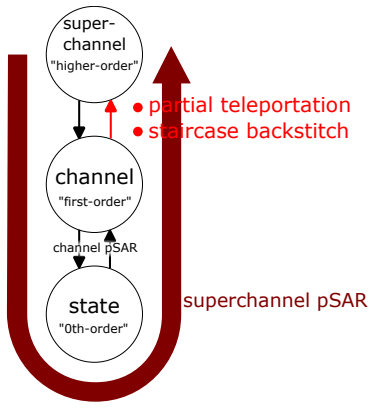
The staircase backstitch protocol for the probabilistic storage-and-retrieval of definite-causal unitary superchannels achieves unit success probability asymptotically as the number of storage queries increases, while partial teleportation is optimal for a small number of queries, and a universal inversion protocol exists for unitary superchannels.
What carries the argument
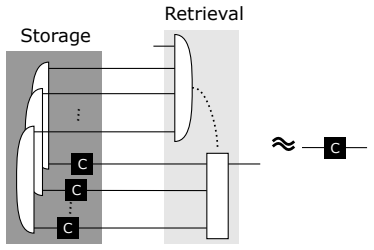
Staircase backstitch protocol that encodes and decodes definite-causal unitary superchannels to activate retrospective intervention.
Load-bearing premise
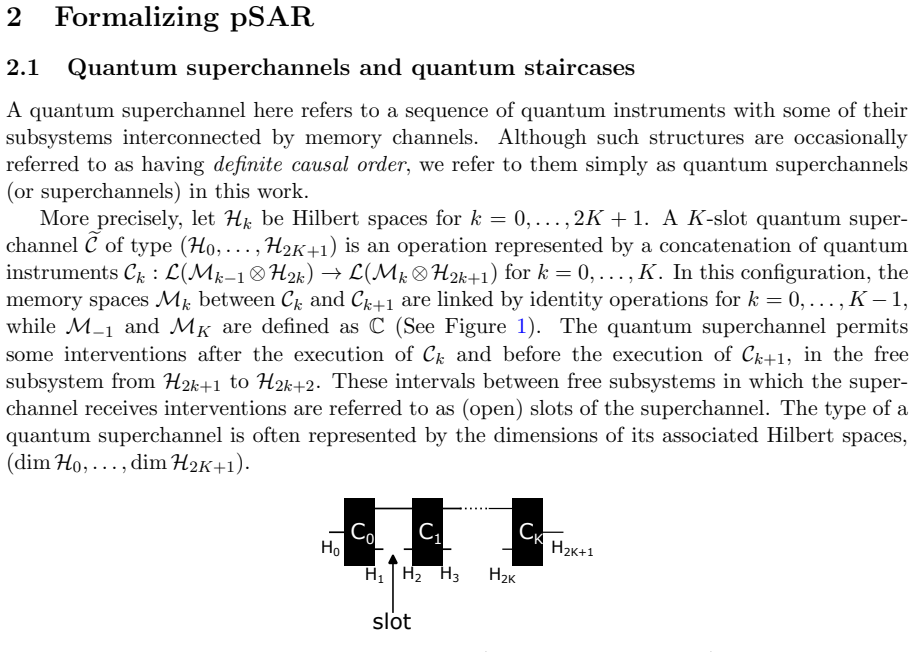
The superchannels considered are definite-causal unitary superchannels that can be physically modeled by sequences of unitary channels with open slots for intervention.
What would settle it
An experiment that applies the staircase backstitch protocol to a fixed definite-causal unitary superchannel and finds that success probability stays bounded away from 1 no matter how many queries are used.
Figures
read the original abstract
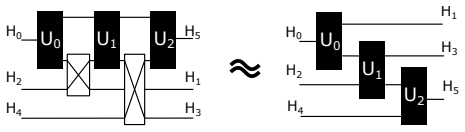
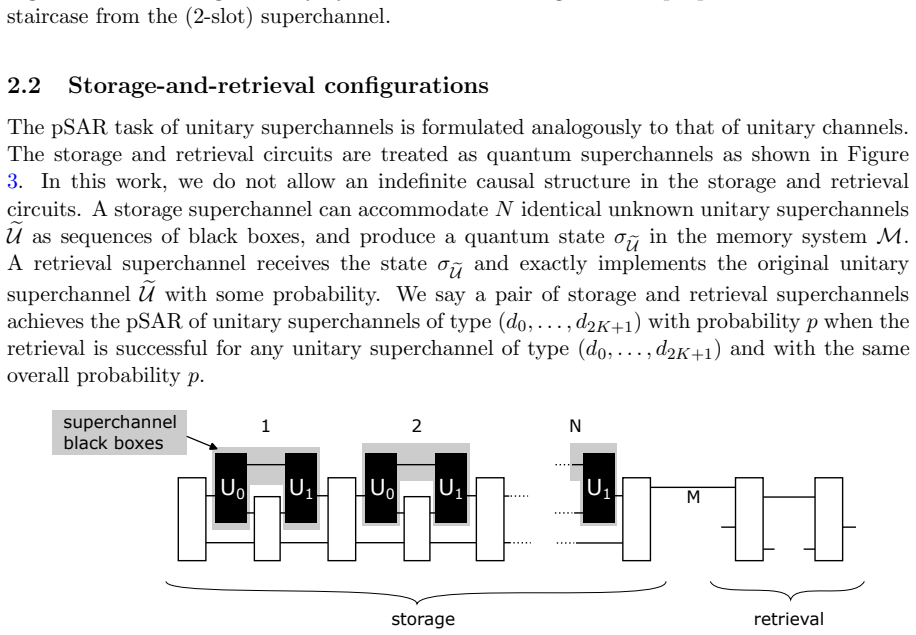
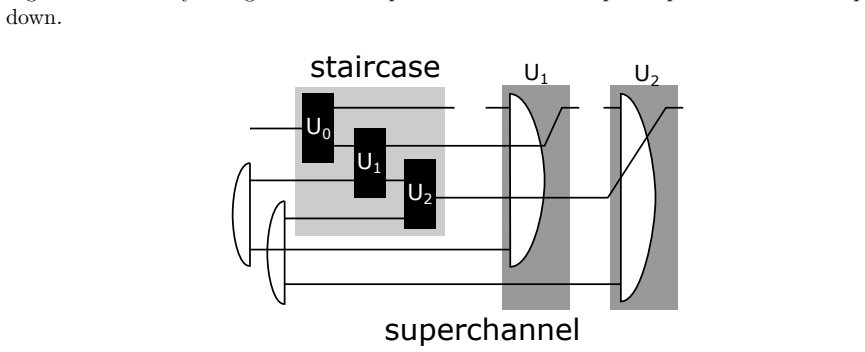
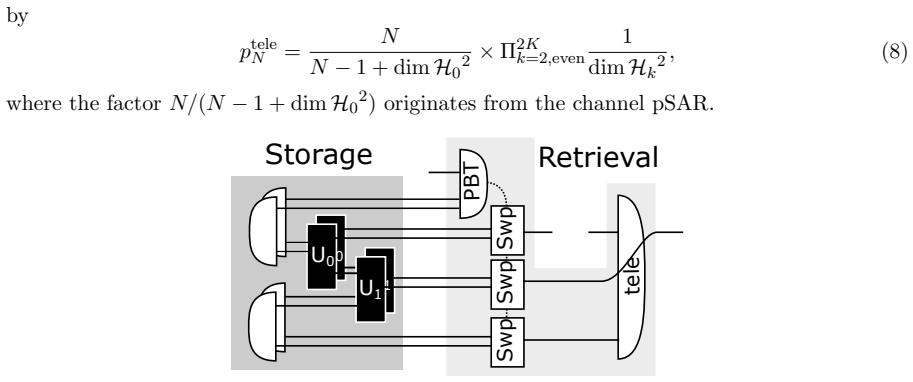
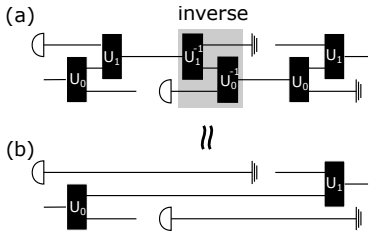
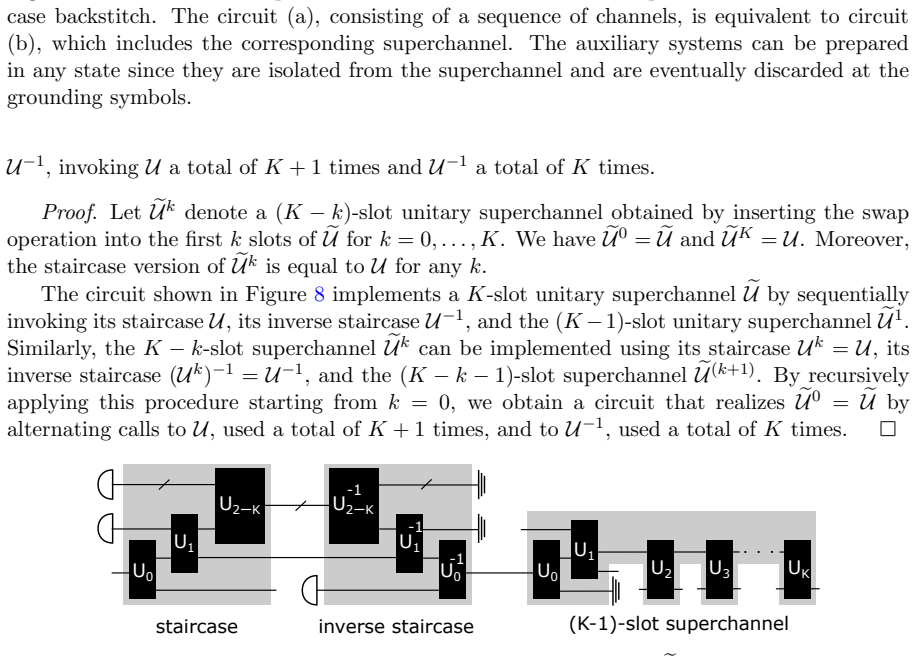
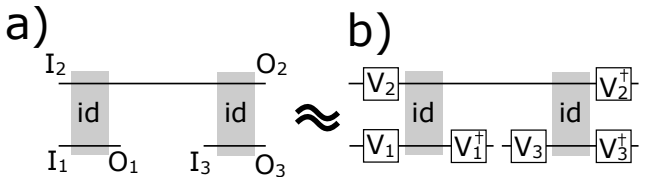
Storing an unknown quantum computation in a quantum state and retrieving it at a desired later time is a challenging task, hindered by the no-programming theorem of quantum computations. In the previous studies on the task of probabilistic storage-and-retrieval (pSAR) of quantum channels, the maximum probability of exactly retrieving a single unknown unitary channel from a quantum state in which the unknown unitary has been encoded via multiple calls to the unknown unitary channel is derived. In this work, we consider a higher-order version of pSAR, the probabilistic storage-and-retrieval of definite-causal unitary superchannels, which are physically modeled by sequences of unitary channels with open slots where arbitrary channels can be inserted between the unitary channels for intervention. This task requires activating the ``retrospective'' intervention functionality on the superchannel, beyond its normal intervention functionality. We propose two protocols: partial teleportation, which is optimal for a small number of storage queries, and staircase backstitch, which achieves unit success probability asymptotically as the number of queries increases. We also derive a universal inversion protocol for unitary superchannels.
Editorial analysis
A structured set of objections, weighed in public.
Referee Report
Summary. The manuscript extends probabilistic storage-and-retrieval (pSAR) from quantum channels to definite-causal unitary superchannels, modeled as finite sequences of unitaries with open intervention slots. It introduces the partial teleportation protocol (claimed optimal for small query counts) and the staircase backstitch protocol (claimed to reach unit success probability asymptotically with increasing queries), plus a universal inversion protocol for such superchannels.
Significance. If the derivations hold, the work provides a concrete higher-order generalization of pSAR with protocols achieving strong performance, including asymptotic perfection via the staircase backstitch construction. The use of standard quantum-information primitives without ad-hoc parameters is a strength, as is the explicit distinction between normal and retrospective intervention functionality.
minor comments (3)
- [Abstract] Abstract: the claim that partial teleportation is 'optimal for a small number of storage queries' would benefit from a parenthetical reference to the specific figure or theorem establishing the optimality bound.
- [§3 or §4] The manuscript should clarify in §3 or §4 whether the asymptotic unit probability of the staircase backstitch protocol is accompanied by an explicit convergence rate or finite-query error bound; the current sketch leaves this implicit.
- [Introduction] Notation: the distinction between 'normal intervention' and 'retrospective intervention' is introduced in the abstract but would be clearer if accompanied by a short diagram or equation set in the introduction.
Simulated Author's Rebuttal
We thank the referee for their positive summary of our work on probabilistic storage-and-retrieval of definite-causal unitary superchannels and for recommending minor revision. The referee's description accurately reflects the manuscript's contributions, including the partial teleportation and staircase backstitch protocols as well as the universal inversion protocol.
Circularity Check
No significant circularity identified
full rationale
The provided abstract and context describe constructive protocols (partial teleportation, staircase backstitch) built from standard quantum information primitives for pSAR of definite-causal unitary superchannels. No equations, fitted parameters, self-definitional reductions, or load-bearing self-citations are visible that would make any claimed result equivalent to its inputs by construction. The asymptotic unit success probability is presented as a derived protocol property rather than a tautology. This matches the default expectation for non-circular papers.
Axiom & Free-Parameter Ledger
axioms (2)
- standard math No-programming theorem prevents deterministic exact retrieval of unknown quantum computations
- domain assumption Definite-causal unitary superchannels admit a physical model as sequences of unitary channels with open intervention slots
Reference graph
Works this paper leans on
-
[1]
M. A. Nielsen and Isaac L. Chuang. Programmable quantum gate arrays.Phys. Rev. Lett., 79:321–324, Jul 1997
1997
-
[2]
Vidal, L
G. Vidal, L. Masanes, and J. I. Cirac. Storing Quantum Dynamics in Quantum States: A Stochastic Programmable Gate.Phys. Rev. Lett., 88(4):047905, January 2002
2002
-
[3]
Realization of positive-operator-valued measures using measurement-assisted programmable quantum processors.Phys
M´ ario Ziman and Vladim´ ır Buˇ zek. Realization of positive-operator-valued measures using measurement-assisted programmable quantum processors.Phys. Rev. A, 72(2):022343, August 2005
2005
-
[4]
Bergou and Mark Hillery
J´ anos A. Bergou and Mark Hillery. Universal Programmable Quantum State Discriminator that is Optimal for Unambiguously Distinguishing between Unknown States.Phys. Rev. Lett., 94(16):160501, April 2005
2005
-
[5]
Efficient Universal Programmable Quantum Measurements.Phys
Giacomo Mauro D’Ariano and Paolo Perinotti. Efficient Universal Programmable Quantum Measurements.Phys. Rev. Lett., 94(9):090401, March 2005
2005
-
[6]
Approximate programmable quantum processors.Phys
Mark Hillery, M´ ario Ziman, and Vladim´ ır Buˇ zek. Approximate programmable quantum processors.Phys. Rev. A, 73(2):022345, February 2006
2006
-
[7]
P´ erez-Garc´ ıa
D. P´ erez-Garc´ ıa. Optimality of programmable quantum measurements.Phys. Rev. A, 73(5):052315, May 2006
2006
-
[8]
Asymptotic teleportation scheme as a universal programmable quantum processor.Phys
Satoshi Ishizaka and Tohya Hiroshima. Asymptotic teleportation scheme as a universal programmable quantum processor.Phys. Rev. Lett., 101(24):240501, 2008
2008
-
[9]
Kubicki, Carlos Palazuelos, and David P´ erez-Garc´ ıa
Aleksander M. Kubicki, Carlos Palazuelos, and David P´ erez-Garc´ ıa. Resource Quantifica- tion for the No-Programing Theorem.Phys. Rev. Lett., 122(8):080505, February 2019
2019
-
[10]
Optimal Universal Programming of Unitary Gates.Phys
Yuxiang Yang, Renato Renner, and Giulio Chiribella. Optimal Universal Programming of Unitary Gates.Phys. Rev. Lett., 125(21):210501, November 2020
2020
-
[11]
Programmability of covari- ant quantum channels.Quantum, 5:488, June 2021
Martina Gschwendtner, Andreas Bluhm, and Andreas Winter. Programmability of covari- ant quantum channels.Quantum, 5:488, June 2021
2021
-
[12]
Infinite-Dimensional Programmable Quantum Processors.PRX Quantum, 2(3):030308, July 2021
Martina Gschwendtner and Andreas Winter. Infinite-Dimensional Programmable Quantum Processors.PRX Quantum, 2(3):030308, July 2021. 17
2021
-
[13]
Optimal quantum learning of a unitary transformation.Phys
Alessandro Bisio, Giulio Chiribella, Giacomo Mauro D’Ariano, Stefano Facchini, and Paolo Perinotti. Optimal quantum learning of a unitary transformation.Phys. Rev. A, 81:032324, Mar 2010
2010
-
[14]
Optimal probabilistic storage and retrieval of unitary channels.Phys
Michal Sedl´ ak, Alessandro Bisio, and M´ ario Ziman. Optimal probabilistic storage and retrieval of unitary channels.Phys. Rev. Lett., 122:170502, May 2019
2019
-
[15]
Bennett, Gilles Brassard, Claude Cr´ epeau, Richard Jozsa, Asher Peres, and William K
Charles H. Bennett, Gilles Brassard, Claude Cr´ epeau, Richard Jozsa, Asher Peres, and William K. Wootters. Teleporting an unknown quantum state via dual classical and einstein-podolsky-rosen channels.Phys. Rev. Lett., 70:1895–1899, Mar 1993
1993
-
[16]
Daniel Gottesman and Isaac L. Chuang. Demonstrating the viability of universal quantum computation using teleportation and single-qubit operations.Nature, 402(6760):390–393, November 1999
1999
-
[17]
Quantum teleportation scheme by selecting one of multiple output ports.Phys
Satoshi Ishizaka and Tohya Hiroshima. Quantum teleportation scheme by selecting one of multiple output ports.Phys. Rev. A, 79(4):042306, 2009
2009
-
[18]
Port-based teleportation in arbitrary dimension.Sci
Micha l Studzi´ nski, Sergii Strelchuk, Marek Mozrzymas, and Micha l Horodecki. Port-based teleportation in arbitrary dimension.Sci. Rep., 7(1):10871, 2017
2017
-
[19]
Optimal port-based teleportation.New J
Marek Mozrzymas, Micha l Studzi´ nski, Sergii Strelchuk, and Micha l Horodecki. Optimal port-based teleportation.New J. Phys., 20(5):053006, 2018
2018
-
[20]
Probabilistic storage and retrieval of qubit phase gates
Michal Sedl´ ak and M´ ario Ziman. Probabilistic storage and retrieval of qubit phase gates. Phys. Rev. A, 102(3):032618, 2020
2020
-
[21]
Storage and retrieval of two unknown unitary channels
Michal Sedl´ ak, Robert St´ arek, Nikola Horov´ a, Michal Miˇ cuda, Jaromir Fiur´ aˇ sek, and Alessandro Bisio. Storage and retrieval of two unknown unitary channels. arXiv:2410.23376 [quant-ph], 2024
arXiv 2024
-
[22]
Quantum circuit architecture
Giulio Chiribella, G Mauro D’Ariano, and Paolo Perinotti. Quantum circuit architecture. Phys. Rev. Lett., 101(6):060401, 2008
2008
-
[23]
Transforming quantum opera- tions: Quantum supermaps.Europhys
Giulio Chiribella, G Mauro D’Ariano, and Paolo Perinotti. Transforming quantum opera- tions: Quantum supermaps.Europhys. Lett., 83(3):30004, 2008
2008
-
[24]
Theoretical framework for quantum networks.Phys
Giulio Chiribella, Giacomo Mauro D’Ariano, and Paolo Perinotti. Theoretical framework for quantum networks.Phys. Rev. A, 80(2):022339, 2009
2009
-
[25]
Higher- Order Quantum Operations
Philip Taranto, Simon Milz, Mio Murao, Marco T´ ulio Quintino, and Kavan Modi. Higher- Order Quantum Operations. arXiv:2503.09693 [quant-ph], March 2025
arXiv 2025
-
[26]
Reversing unknown quantum transformations: Universal quantum circuit for inverting general unitary operations.Phys
Marco T´ ulio Quintino, Qingxiuxiong Dong, Atsushi Shimbo, Akihito Soeda, and Mio Mu- rao. Reversing unknown quantum transformations: Universal quantum circuit for inverting general unitary operations.Phys. Rev. Lett., 123(21):210502, 2019
2019
-
[27]
Reversing unknown qubit-unitary oper- ation, deterministically and exactly.Phys
Satoshi Yoshida, Akihito Soeda, and Mio Murao. Reversing unknown qubit-unitary oper- ation, deterministically and exactly.Phys. Rev. Lett., 131(12):120602, 2023
2023
-
[28]
Quantum Algorithm for Reversing Unknown Unitary Evolutions
Yu-Ao Chen, Yin Mo, Yingjian Liu, Lei Zhang, and Xin Wang. Quantum Algorithm for Reversing Unknown Unitary Evolutions. arXiv:2403.04704 [quant-ph], April 2025
arXiv 2025
-
[29]
Universal adjointation of isometry oper- ations using conversion of quantum supermaps.Quantum, 9:1750, May 2025
Satoshi Yoshida, Akihito Soeda, and Mio Murao. Universal adjointation of isometry oper- ations using conversion of quantum supermaps.Quantum, 9:1750, May 2025. 18
2025
-
[30]
Complex conjugation supermap of unitary quantum maps and its universal implementation protocol.Phys
Jisho Miyazaki, Akihito Soeda, and Mio Murao. Complex conjugation supermap of unitary quantum maps and its universal implementation protocol.Phys. Rev. Res., 1:013007, Aug 2019
2019
-
[31]
Optimal universal quantum circuits for unitary complex conjuga- tion.IEEE Trans
Daniel Ebler, Micha l Horodecki, Marcin Marciniak, Tomasz M lynik, Marco T´ ulio Quintino, and Micha l Studzi´ nski. Optimal universal quantum circuits for unitary complex conjuga- tion.IEEE Trans. Inform. Theory, 69(8):5069–5082, 2023
2023
-
[32]
Dmitry Grinko, Adam Burchardt, and Maris Ozols. Gelfand-tsetlin basis for partially transposed permutations, with applications to quantum information. arXiv:2310.02252 [quant-ph], 2023
arXiv 2023
-
[33]
Linear programming with unitary-equivariant constraints
Dmitry Grinko and Maris Ozols. Linear programming with unitary-equivariant constraints. Comm. Math. Phys., 405(12), November 2024
2024
-
[34]
Sequential quantum pro- cesses with group symmetries
Dmitry Grinko, Satoshi Yoshida, Mio Murao, and Maris Ozols. Sequential quantum pro- cesses with group symmetries. arXiv:2510.07100 [quant-ph], 2025
Pith/arXiv arXiv 2025
-
[35]
Optimal networks for quantum metrology: semidefinite programs and product rules.New Journal of Physics, 14(12):125008, dec 2012
Giulio Chiribella. Optimal networks for quantum metrology: semidefinite programs and product rules.New Journal of Physics, 14(12):125008, dec 2012
2012
-
[36]
Quantum correlations with no causal order.Nat
Ognyan Oreshkov, Fabio Costa, and ˇCaslav Brukner. Quantum correlations with no causal order.Nat. Commun., 3(1):1092, 2012
2012
-
[37]
A purification pos- tulate for quantum mechanics with indefinite causal order.Quantum, 1:10, 2017
Mateus Ara´ ujo, Adrien Feix, Miguel Navascu´ es, andˇCaslav Brukner. A purification pos- tulate for quantum mechanics with indefinite causal order.Quantum, 1:10, 2017
2017
-
[38]
Quantum computations without definite causal structure.Phys
Giulio Chiribella, Giacomo Mauro D’Ariano, Paolo Perinotti, and Benoit Valiron. Quantum computations without definite causal structure.Phys. Rev. A, 88(2):022318, 2013
2013
-
[39]
if” direction) since the “only if
Arun Ram and Hans Wenzl. Matrix units for centralizer algebras.J. Algebra, 145(2):378– 395, 1992. A Probabilistic port-based teleportation for channel pSAR We incorporate probabilistic PBT [8, 17–19] as a subroutine for superchannel pSAR. We re- view its application to channel pSAR, specifically focusing on the variant that utilizes multiple maximally ent...
1992
discussion (0)
Sign in with ORCID, Apple, or X to comment. Anyone can read and Pith papers without signing in.