REVIEW 4 major objections 5 minor 1 cited by
Boosting Domain Generalized and Adaptive Detection with Diffusion Models: Fitness, Generalization, and Transferability
T0 review · 4 major / 5 minor · reviewed 2026-08-06 · deepseek-v4-flash
Pith's one-line read A single-step diffusion detector with an object-centered branch and a consistency loss beats its multi-step predecessor on five domain-generalization benchmarks at 75% lower cost, and can guide a standard detector across domain shifts.
desk verdict A solid efficiency-focused extension of the DDT/GDD line that deserves review, but target-domain hyperparameter tuning and missing error bars make the 'beats GDD everywhere' claim less secure than the tables suggest. read the letter →
The pith
A machine-rendered reading of the paper's core claim, the machinery that carries it, and where it could break.
The reading
What carries the argument
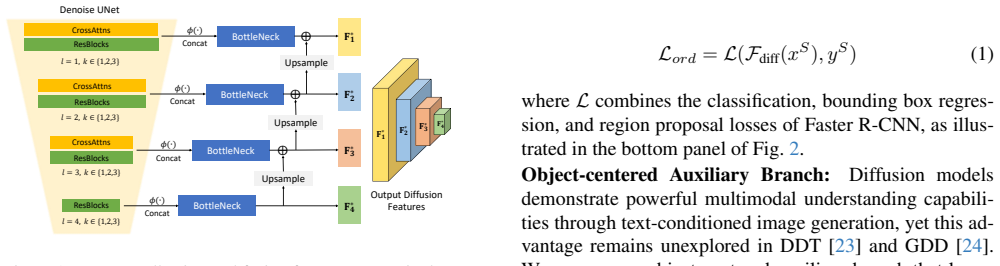
The load-bearing machinery is a dual-branch diffusion detector built on the frozen UNet of a pretrained latent-diffusion model. From one noisy sample, the method extracts twelve ResNet-block feature groups and nine cross-attention feature groups, concatenates groups of the same scale, projects them through bottlenecks, and sums upsampled higher-level features into lower-level ones to form a feature pyramid compatible with standard detection heads. The auxiliary branch feeds box-masked images plus class prompts into the text-conditioned cross-attention, and the consistency loss aligns the two branches with feature MSE, bounding-box L1, and a temperature-softened classification KL divergence. The same object-level and feature-level alignments are reused as a distillation objective to guide a standard detector, with pseudo-labels used in the adaptation setting.
What would settle it
Audit the overlap between the frozen diffusion model's training corpus and the COCO, VOC, Cityscapes, BDD100K, Foggy-Cityscapes, Clipart, Comic, Watercolor, weather, and corruption evaluation sets; if any non-negligible overlap exists, rerun the COCO generalization benchmark on a disjoint target set and add a backbone pretrained at comparable scale to see whether the reported gap survives.
Extended reading notes
Core claim
The central discovery is that a frozen diffusion UNet, read once rather than denoised many times, still contains enough hierarchical and cross-modal information to serve as a detection backbone. The paper shows this by collecting twelve ResNet-block and nine cross-attention feature groups from a single noisy sample, fusing them by same-scale concatenation and skip connections, and pairing the resulting ordinary branch with an object-centered auxiliary branch that sees box-masked images and class prompts. A consistency loss transfers the auxiliary branch's object-focused, domain-invariant representation back into the ordinary branch, which is the branch used at inference, and the same alignment is then distilled into a standard detector. The paper's claim is that this package produces improved results on five domain-generalization benchmarks and three domain-adaptation benchmarks, at roughly 164 ms per image compared with 679 ms for the multi-step baseline.
Load-bearing premise
The load-bearing premise for the COCO generalization results is that the frozen diffusion model's pretraining has not already seen the evaluation datasets, and that comparing it with detectors trained from scratch or from much lighter pretraining measures the proposed components rather than pretraining scale.
Editorial extensions
If this is right
- Deploying the diffusion detector at inference time costs about one quarter of the multi-step predecessor's compute (164 ms versus 679 ms per image) while improving mAP on all five domain-generalization benchmarks, so single-step feature extraction is a viable substitute for multi-step denoising.
- Because the auxiliary branch is used only during training, discarding it at inference costs nothing: the consistency loss has already pushed the object-centered, domain-invariant representation into the ordinary branch, making the generalization gain free at test time.
- The same diffusion detector can serve as a teacher to a standard Faster R-CNN, and the guidance works in both protocols: source-only alignment for domain generalization and pseudo-label alignment on unlabeled target data for domain adaptation.
- The COCO benchmark results imply the approach is most valuable where current detectors struggle most: large domain shifts such as real-to-artistic or day-to-night-rainy conditions, and low-data regimes such as 1% COCO.
- The authors verify the recipe with two frozen versions of the pretrained latent-diffusion weights and three different detection heads, so they present the framework as applicable beyond the exact configuration tested.
Reading between the lines
- Editorial inference: the largest unresolved confound is pretraining scale; if the frozen diffusion weights have seen images close to the test domains, an overlap audit would shrink part of the measured advantage in the COCO benchmark, so the method's true generalization value is best measured on disjoint data.
- Editorial inference: the object-centered auxiliary branch is a general recipe, since masking the input to object regions and adding class-conditioned prompts suppresses background and style signal; it should transfer to other perception tasks such as segmentation or keypoint detection under domain shift.
- Editorial inference: the paper's own failure analysis suggests that source-only distillation saturates for extreme style gaps, so a testable extension is to add target-style augmentation or an adaptive prompt when moving from real images to artistic domains.
- Editorial inference: the efficiency comparison was run on one GPU configuration; with hardware-specific acceleration or a distilled student, absolute latency would change, but the 75% relative reduction is what the paper demonstrates, not a guarantee across all hardware.
Editorial analysis
A structured set of objections, weighed in public.
Referee Report
Summary. The paper proposes a diffusion-based object detector for domain generalization (DG) and domain adaptation (DA). It extracts features from a single-step diffusion process (reducing inference time by about 75% relative to the prior GDD), fuses them into a pyramid with skip connections, adds an object-centered auxiliary branch that conditions on box-masked images and class prompts, and aligns the two branches with feature- and output-level consistency losses. The resulting 'diffusion detector' is then used as a teacher to guide a Faster R-CNN student through feature- and object-level alignment on source (DG) or unlabeled target (DA) domains. Experiments are reported on five DG benchmarks (BDD100K, FoggyCityscapes, Real-to-Artistic, Diverse Weather, Cityscapes-C), three DA benchmarks, and a newly proposed COCO generalization benchmark; the headline claims are consistent gains over GDD/DDT and a 75% inference-time reduction.
Significance. The engineering contributions are real and valuable: replacing multi-step denoising with single-step feature extraction plus a fused pyramid is a sensible way to cut inference cost, the object-centered auxiliary branch is an interesting way to exploit text-conditioned diffusion features for detection, and the unified DG/DA transfer framework is a useful recipe. The evaluation design also has strengths: five DG and three DA benchmarks, a dedicated corruption benchmark (Cityscapes-C), component ablations, a frank failure-case discussion in Section 4.4, and an explicit limitations section. If the quantitative claims survive the methodological fixes below, this would be a solid contribution to practical diffusion-based detection. At present, however, the empirical evidence does not fully secure the central claims: the DG hyperparameters are selected using target-domain performance, no repeated-seed statistics are given, and the headline gain numbers in the abstract and Section 4.3 disagree with the tables. The COCO generalization experiment also compares against backbones trained with far less data, making the 'significant advantages' claim difficult to interpret.
major comments (4)
- [Section 5.1, Table 8 and Tables 1-5] The consistency-loss weights gamma and lambda are selected by scanning values and computing target-domain accuracy on FoggyCityscapes, BDD100K, and Clipart (Table 8); the chosen values gamma=lambda=1.0 are then used for the headline DG results in Tables 1-5. This is target-domain model selection, which is not a valid domain-generalization protocol because the selected hyperparameters carry information about the test domains. Please fix the weights a priori using a source-only validation split, or report the full sensitivity surface and argue that the superiority over GDD holds for any reasonable weight choice; as written, the protocol leaves open the possibility that some of the reported gains are due to this selection.
- [All experimental tables] No repeated-seed or error-bar information is provided anywhere, even though several decisive margins are small: +0.6 mAP on FoggyCityscapes (Table 2), -0.3 on Clipart for the guided detector (Table 3), and +0.4 on BDD100K for the guided detector (Table 1). Please report mean +/- standard deviation over at least three seeds (or a seed/permutation analysis) for at least the head-to-head comparisons with GDD and DDT, and confirm that the sign of every claimed improvement is stable; otherwise the statement that the method 'outperforms GDD/DDT' is not statistically supported.
- [Abstract, Section 4.3, Conclusion] The headline gain vectors do not match the tables. The abstract reports {2.7, 0.6, 3.8, 4.8, 3.3}% DG gains, but Tables 1-3 give +2.7, +0.6, +5.8, +3.3, +1.3 for BDD, Foggy, Clipart, Comic, and Watercolor, and Figure 3 displays the same values. Section 4.3.2 reports {0.4, 1.6, 0.8, 1.8, 1.8} for the guided detector, whereas Table 3 shows -0.3/+0.3/+2.4 for Clipart/Comic/Watercolor and Table 4 shows a 1.6-point average for Diverse Weather. The abstract's DA vector {7.9, 6.6, 1.7} does not match Table 3, where gains against DDT-R101 are +2.6/+0.3/+4.3. Consequently the claimed averages of 3.0%, 1.3%, and 5.4% cannot be verified from the tables. Please correct all reported numbers to the exact table values and state the precise comparison baseline (GDD-SD1.5 vs GDD-R101, DDT-R101, etc.) used for each gain.
- [Table 6, Sections 3.2 and 4.2] The COCO generalization comparison mixes pretraining scales: the proposed method uses frozen Stable Diffusion weights trained on web-scale data, while the baselines (ResNet, ConvNeXt, Swin, ViT, GLIP) are pretrained on ImageNet-scale or comparable data. No same-scale baseline is provided, and there is no audit of overlap between Stable Diffusion pretraining data and COCO, VOC, Cityscapes, or the artistic datasets. Thus part of the large gains in Table 6 (e.g., 70.4 vs 53.9 on VOC at 1% COCO) may reflect pretraining data scale rather than the proposed components. Please add a same-scale-pretraining baseline (e.g., a diffusion-backbone detector with a comparable pretraining set) and/or provide an overlap analysis, or substantially moderate the claim that the advantages are due to the proposed approach.
minor comments (5)
- [Table 6] The table does not state the evaluation metric; 'COCO Val' suggests COCO-style AP (IoU .5:.95) while all other tables report AP50. Please specify the metric explicitly in the header or caption.
- [Section 3.7, Eq. (13)] The unified transfer framework is summarized by Eq. (13), but L_fea and L_obj are not defined in the paper; the text only says that the authors follow DDT/GDD settings. Provide the actual definitions or precise equation references from those papers, otherwise the novelty and reproducibility of the transfer component cannot be assessed.
- [Table 7] The GDD inference time is listed as both 789 ms and 679 ms depending on the source, and the 75% reduction claim uses the 679 ms figure. Please specify the exact evaluation protocol (GPU model, input scale, batch size) for both timings and, ideally, measure GDD under the same protocol as the 164 ms reported for the proposed detector.
- [Section 5.1] The single-step diffusion timestep t is a free parameter that is not reported. Please state the value used and, preferably, show sensitivity to t (for example, t=1 versus t=2).
- [Section 3.6, Eqs. (8)-(12)] The feature decomposition Phi(x) = alpha * Phi_inv(x) + Phi_spe(x) and the claim that the consistency loss reduces d_H(D_S, D_T) are presented as established facts, but no derivation or supporting evidence is given. Please label this paragraph as motivation or provide a formal argument.
Circularity Check
No derivation-level circularity found; the central DG/DA comparisons are empirical and externally benchmarked, so the paper's main claims do not reduce to their inputs. The main caveats are target-domain hyperparameter selection in Table 8 and single-run results, which are correctness risks rather than circular derivation steps.
full rationale
The paper's central claims are empirical mAP comparisons on standard DG/DA benchmarks against many baselines, including the authors' own GDD and DDT. These numbers are measured outcomes, not quantities derived from the method's definitions or from its fitted parameters. No equation in the paper defines a predicted result as a function of the fitted weights in a way that would make the result true by construction. The consistency loss in Eqs. (6)-(7) is a training regularizer, and the generalization bound in Eq. (10) is a standard bound invoked as motivation, not a derivation of the reported improvements. The COCO generalization benchmark uses frozen Stable Diffusion weights without auditing pretraining overlap with the evaluation datasets; this is an external-validity confound but not circularity. The paper relies heavily on the authors' own prior work GDD and DDT as baselines, teachers, and settings, but the comparisons are direct and the improvements are externally measurable, so the self-citations are not load-bearing in a circular sense. The most notable methodological flaw is in Table 8, where the consistency-loss weights gamma and lambda are selected by scanning target-domain mAP on FoggyCityscapes, BDD100K, and Clipart, and the chosen values (gamma=lambda=1.0) are then used in the headline tables that report results on those same target domains. This is target-domain model selection and threatens the validity of the small DG margins, but it is an evaluation-protocol issue rather than a self-definitional or by-construction reduction, so it does not warrant a high circularity score. The paper's own Limitations section acknowledges limited transfer gains in real-to-artistic DG and the absence of engineering acceleration, which further supports that the findings are stated as empirical observations rather than forced derivations.
Assumptions & free parameters
free parameters (3)
- loss weight gamma (object alignment in Eq. 6) =
1.0 (chosen in Table 8)
- loss weight lambda (consistency in Eq. 7) =
1.0 (chosen in Table 8)
- single-step diffusion timestep t =
not reported
assumptions (4)
- domain assumption Frozen Stable Diffusion UNet features are domain-invariant enough to transfer across the tested detection domains.
- ad hoc to paper The feature decomposition Phi(x) = alpha * Phi_inv(x) + Phi_spe(x) with a scalar alpha (Eq. 8) is a valid model of domain-invariant and domain-specific features.
- domain assumption The domain adaptation generalization bound RT(h) <= RS(h) + d_H(DS, DT) + delta (Eq. 10) applies here, and the consistency loss reduces d_H.
- domain assumption The 11 datasets in the COCO generalization benchmark share a meaningful category and evaluation alignment with COCO classes.
Cite this review
Pith. "Pith review of Boosting Domain Generalized and Adaptive Detection with Diffusion Models: Fitness, Generalization, and Transferability." pith.science (2026). https://pith.science/paper/QBGSA4HQ
@misc{pith2026250621042,
  author       = {Pith},
  title        = {Pith review of: Boosting Domain Generalized and Adaptive Detection with Diffusion Models: Fitness, Generalization, and Transferability},
  year         = {2026},
  howpublished = {\url{https://pith.science/paper/QBGSA4HQ}},
  note         = {Machine review of arXiv:2506.21042}
}
read the original abstract
Detectors often suffer from performance drop due to domain gap between training and testing data. Recent methods explore diffusion models applied to domain generalization (DG) and adaptation (DA) tasks, but still struggle with large inference costs and have not yet fully leveraged the capabilities of diffusion models. We propose to tackle these problems by extracting intermediate features from a single-step diffusion process, improving feature collection and fusion to reduce inference time by 75% while enhancing performance on source domains (i.e., Fitness). Then, we construct an object-centered auxiliary branch by applying box-masked images with class prompts to extract robust and domain-invariant features that focus on object. We also apply consistency loss to align the auxiliary and ordinary branch, balancing fitness and generalization while preventing overfitting and improving performance on target domains (i.e., Generalization). Furthermore, within a unified framework, standard detectors are guided by diffusion detectors through feature-level and object-level alignment on source domains (for DG) and unlabeled target domains (for DA), thereby improving cross-domain detection performance (i.e., Transferability). Our method achieves competitive results on 3 DA benchmarks and 5 DG benchmarks. Additionally, experiments on COCO generalization benchmark demonstrate that our method maintains significant advantages and show remarkable efficiency in large domain shifts and low-data scenarios. Our work shows the superiority of applying diffusion models to domain generalized and adaptive detection tasks and offers valuable insights for visual perception tasks across diverse domains. The code is available at \href{https://github.com/heboyong/Fitness-Generalization-Transferability}.
Figures


Forward citations
Cited by 1 Pith paper
-
Single-Domain Generalized Object Detection by Balancing Domain Diversity and Invariance
A diversity-plus-invariance training objective for single-domain generalized object detection, evaluated on weather and artistic domain shifts.
Reference graph
Works this paper leans on
-
[1]
Metareg: Towards domain generalization using meta- regularization
Yogesh Balaji, Swami Sankaranarayanan, and Rama Chel- lappa. Metareg: Towards domain generalization using meta- regularization. Advances in neural information processing systems, 31, 2018. 2
2018
-
[2]
Label-efficient se- mantic segmentation with diffusion models
Dmitry Baranchuk, Andrey V oynov, Ivan Rubachev, Valentin Khrulkov, and Artem Babenko. Label-efficient se- mantic segmentation with diffusion models. In International Conference on Learning Representations, 2022. 2
2022
-
[3]
Contrastive mean teacher for domain adaptive ob- ject detectors
Shengcao Cao, Dhiraj Joshi, Liang-Yan Gui, and Yu-Xiong Wang. Contrastive mean teacher for domain adaptive ob- ject detectors. In Proceedings of the IEEE/CVF Conference on Computer Vision and Pattern Recognition, pages 23839– 23848, 2023. 1, 2, 6
2023
-
[4]
Harmonizing transferability and discrim- inability for adapting object detectors
Chaoqi Chen, Zebiao Zheng, Xinghao Ding, Yue Huang, and Qi Dou. Harmonizing transferability and discrim- inability for adapting object detectors. In Proceedings of the IEEE/CVF conference on computer vision and pattern recognition, pages 8869–8878, 2020. 1, 2
2020
-
[5]
Dual bipartite graph learning: A general approach for domain adaptive object detection
Chaoqi Chen, Jiongcheng Li, Zebiao Zheng, Yue Huang, Xinghao Ding, and Yizhou Yu. Dual bipartite graph learning: A general approach for domain adaptive object detection. In Proceedings of the IEEE/CVF International Conference on Computer Vision, pages 2703–2712, 2021. 6
2021
-
[6]
Mmdetection: Open mmlab detection tool- box and benchmark
Kai Chen, Jiaqi Wang, Jiangmiao Pang, Yuhang Cao, Yu Xiong, Xiaoxiao Li, Shuyang Sun, Wansen Feng, Ziwei Liu, Jiarui Xu, et al. Mmdetection: Open mmlab detection tool- box and benchmark. arXiv preprint arXiv:1906.07155, 2019. 5
arXiv 1906
-
[7]
Geodiffusion: Text- prompted geometric control for object detection data gen- eration
Kai Chen, Enze Xie, Zhe Chen, Yibo Wang, Lanqing Hong, Zhenguo Li, and Dit-Yan Yeung. Geodiffusion: Text- prompted geometric control for object detection data gen- eration. In ICLR, 2024. 8
2024
-
[8]
Learning domain adaptive object detection with probabilistic teacher
Meilin Chen, Weijie Chen, Shicai Yang, Jie Song, Xin- chao Wang, Lei Zhang, Yunfeng Yan, Donglian Qi, Yuet- ing Zhuang, Di Xie, et al. Learning domain adaptive object detection with probabilistic teacher. InInternational Confer- ence on Machine Learning, pages 3040–3055. PMLR, 2022. 6
2022
Show all 90 references
-
[9]
Domain adaptive faster r-cnn for object de- tection in the wild
Yuhua Chen, Wen Li, Christos Sakaridis, Dengxin Dai, and Luc Van Gool. Domain adaptive faster r-cnn for object de- tection in the wild. InProceedings of the IEEE conference on computer vision and pattern recognition, pages 3339–3348,
-
[10]
Scale-aware domain adap- tive faster r-cnn
Yuhua Chen, Haoran Wang, Wen Li, Christos Sakaridis, Dengxin Dai, and Luc Van Gool. Scale-aware domain adap- tive faster r-cnn. International Journal of Computer Vision, 129(7):2223–2243, 2021. 6
2021
-
[11]
The cityscapes dataset for semantic urban scene understanding
Marius Cordts, Mohamed Omran, Sebastian Ramos, Timo Rehfeld, Markus Enzweiler, Rodrigo Benenson, Uwe Franke, Stefan Roth, and Bernt Schiele. The cityscapes dataset for semantic urban scene understanding. In Proceed- ings of the IEEE conference on computer vision and pattern re...
2016
-
[12]
Randaugment: Practical automated data augmen- tation with a reduced search space
Ekin D Cubuk, Barret Zoph, Jonathon Shlens, and Quoc V Le. Randaugment: Practical automated data augmen- tation with a reduced search space. In Proceedings of the IEEE/CVF conference on computer vision and pattern recognition workshops, pages 702–703, 2020. 2
2020
-
[13]
Improving single domain-generalized object detection: A focus on diversification and alignment
Muhammad Sohail Danish, Muhammad Haris Khan, Muhammad Akhtar Munir, M Saquib Sarfraz, and Mohsen Ali. Improving single domain-generalized object detection: A focus on diversification and alignment. In Proceedings of the IEEE/CVF Conference on Computer Vision and Pattern Recogn...
2024
-
[14]
Un- biased mean teacher for cross-domain object detection
Jinhong Deng, Wen Li, Yuhua Chen, and Lixin Duan. Un- biased mean teacher for cross-domain object detection. In Proceedings of the IEEE/CVF Conference on Computer Vi- sion and Pattern Recognition, pages 4091–4101, 2021. 6
2021
-
[15]
Harmo- nious teacher for cross-domain object detection
Jinhong Deng, Dongli Xu, Wen Li, and Lixin Duan. Harmo- nious teacher for cross-domain object detection. In Proceed- ings of the IEEE/CVF Conference on Computer Vision and Pattern Recognition, pages 23829–23838, 2023. 2, 6
2023
-
[16]
An image is worth 16x16 words: Trans- formers for image recognition at scale
Alexey Dosovitskiy, Lucas Beyer, Alexander Kolesnikov, Dirk Weissenborn, Xiaohua Zhai, Thomas Unterthiner, Mostafa Dehghani, Matthias Minderer, Georg Heigold, Syl- vain Gelly, et al. An image is worth 16x16 words: Trans- formers for image recognition at scale. arXiv preprint a...
2010 arXiv
-
[17]
Learning to learn with variational information bottleneck for domain general- ization
Yingjun Du, Jun Xu, Huan Xiong, Qiang Qiu, Xiantong Zhen, Cees GM Snoek, and Ling Shao. Learning to learn with variational information bottleneck for domain general- ization. In Computer Vision–ECCV 2020: 16th European Conference, Glasgow, UK, August 23–28, 2020, Proceed- ings...
2020
-
[18]
Davimnet: Ssms-based do- main adaptive object detection
A Enes Doruk and Hasan F Ates. Davimnet: Ssms-based do- main adaptive object detection. arXiv e-prints, pages arXiv– 2502, 2025. 6
2025
-
[19]
Scaling recti- fied flow transformers for high-resolution image synthesis
Patrick Esser, Sumith Kulal, Andreas Blattmann, Rahim Entezari, Jonas M ¨uller, Harry Saini, Yam Levi, Dominik Lorenz, Axel Sauer, Frederic Boesel, et al. Scaling recti- fied flow transformers for high-resolution image synthesis. In Forty-first International Conference on Mach...
2024
-
[20]
The pascal visual object classes (voc) challenge
Mark Everingham, Luc Van Gool, Christopher KI Williams, John Winn, and Andrew Zisserman. The pascal visual object classes (voc) challenge. International journal of computer vision, 88:303–338, 2010. 5
2010
-
[21]
Generative adversarial networks
Ian Goodfellow, Jean Pouget-Abadie, Mehdi Mirza, Bing Xu, David Warde-Farley, Sherjil Ozair, Aaron Courville, and Yoshua Bengio. Generative adversarial networks. Commu- nications of the ACM, 63(11):139–144, 2020. 1, 2
2020
-
[22]
Dsca: A dual semantic correlation align- ment method for domain adaptation object detection.Pattern Recognition, 150:110329, 2024
Yinsai Guo, Hang Yu, Shaorong Xie, Liyan Ma, Xinzhi Cao, and Xiangfeng Luo. Dsca: A dual semantic correlation align- ment method for domain adaptation object detection.Pattern Recognition, 150:110329, 2024. 6
2024
-
[23]
Dif- fusion domain teacher: Diffusion guided domain adaptive object detector
Boyong He, Yuxiang Ji, Zhuoyue Tan, and Liaoni Wu. Dif- fusion domain teacher: Diffusion guided domain adaptive object detector. In ACM Multimedia 2024, 2024. 1, 2, 3, 5, 6, 7, 8
2024
-
[24]
Generalized diffusion detector: Mining robust features from diffusion models for domain-generalized de- tection
Boyong He, Yuxiang Ji, Qianwen Ye, Zhuoyue Tan, and Liaoni Wu. Generalized diffusion detector: Mining robust features from diffusion models for domain-generalized de- tection. In Proceedings of the Computer Vision and Pattern 9 Recognition Conference (CVPR), pages 9921–9932, 2...
2025
-
[25]
Deep residual learning for image recognition
Kaiming He, Xiangyu Zhang, Shaoqing Ren, and Jian Sun. Deep residual learning for image recognition. In Proceed- ings of the IEEE conference on computer vision and pattern recognition, pages 770–778, 2016. 3, 5, 7
2016
-
[26]
Cross domain object detection by target-perceived dual branch distillation
Mengzhe He, Yali Wang, Jiaxi Wu, Yiru Wang, Hanqing Li, Bo Li, Weihao Gan, Wei Wu, and Yu Qiao. Cross domain object detection by target-perceived dual branch distillation. In Proceedings of the IEEE/CVF Conference on Computer Vision and Pattern Recognition, pages 9570–9580, 2022. 6
2022
-
[27]
Single-domain generalized ob- ject detection by balancing domain diversity and invariance
Zhenwei He and Hongsu Ni. Single-domain generalized ob- ject detection by balancing domain diversity and invariance. arXiv preprint arXiv:2502.03835, 2025. 6
2025 arXiv
-
[28]
Denoising dif- fusion probabilistic models
Jonathan Ho, Ajay Jain, and Pieter Abbeel. Denoising dif- fusion probabilistic models. Advances in neural information processing systems, 33:6840–6851, 2020. 1
2020
-
[29]
Denoising dif- fusion probabilistic models
Jonathan Ho, Ajay Jain, and Pieter Abbeel. Denoising dif- fusion probabilistic models. Advances in neural information processing systems, 33:6840–6851, 2020. 2
2020
-
[30]
Stylemix: Sep- arating content and style for enhanced data augmentation
Minui Hong, Jinwoo Choi, and Gunhee Kim. Stylemix: Sep- arating content and style for enhanced data augmentation. In Proceedings of the IEEE/CVF conference on computer vi- sion and pattern recognition, pages 14862–14870, 2021. 1, 2
2021
-
[31]
Mic: Masked image consistency for context- enhanced domain adaptation
Lukas Hoyer, Dengxin Dai, Haoran Wang, and Luc Van Gool. Mic: Masked image consistency for context- enhanced domain adaptation. In Proceedings of the IEEE/CVF conference on computer vision and pattern recognition, pages 11721–11732, 2023. 6
2023
-
[32]
Every pixel matters: Center-aware feature alignment for domain adaptive object detector
Cheng-Chun Hsu, Yi-Hsuan Tsai, Yen-Yu Lin, and Ming- Hsuan Yang. Every pixel matters: Center-aware feature alignment for domain adaptive object detector. In Computer Vision–ECCV 2020: 16th European Conference, Glasgow, UK, August 23–28, 2020, Proceedings, Part IX 16 , pages 73...
2020
-
[33]
Fsdr: Frequency space domain randomization for domain generalization
Jiaxing Huang, Dayan Guan, Aoran Xiao, and Shijian Lu. Fsdr: Frequency space domain randomization for domain generalization. In Proceedings of the IEEE/CVF conference on computer vision and pattern recognition , pages 6891– 6902, 2021. 6
2021
-
[34]
Cross-domain weakly-supervised object de- tection through progressive domain adaptation
Naoto Inoue, Ryosuke Furuta, Toshihiko Yamasaki, and Kiy- oharu Aizawa. Cross-domain weakly-supervised object de- tection through progressive domain adaptation. In Proceed- ings of the IEEE conference on computer vision and pattern recognition, pages 5001–5009, 2018. 5, 7
2018
-
[35]
Decoupled adaptation for cross-domain object detec- tion
Junguang Jiang, Baixu Chen, Jianmin Wang, and Mingsheng Long. Decoupled adaptation for cross-domain object detec- tion. In International Conference on Learning Representa- tions, 2021. 6
2021
-
[36]
Cat: Exploiting inter-class dynamics for domain adaptive object detection
Mikhail Kennerley, Jian-Gang Wang, Bharadwaj Veeravalli, and Robby T Tan. Cat: Exploiting inter-class dynamics for domain adaptive object detection. In Proceedings of the IEEE/CVF Conference on Computer Vision and Pattern Recognition, pages 16541–16550, 2024. 6
2024
-
[37]
Object-aware domain generalization for object detection
Wooju Lee, Dasol Hong, Hyungtae Lim, and Hyun Myung. Object-aware domain generalization for object detection. In Proceedings of the AAAI Conference on Artificial Intelli- gence, pages 2947–2955, 2024. 1, 2, 5, 6, 7
2024
-
[38]
Prompt-driven dynamic object-centric learning for single do- main generalization
Deng Li, Aming Wu, Yaowei Wang, and Yahong Han. Prompt-driven dynamic object-centric learning for single do- main generalization. In Proceedings of the IEEE/CVF Con- ference on Computer Vision and Pattern Recognition, pages 17606–17615, 2024. 6
2024
-
[39]
Domain generalization with adversarial feature learning
Haoliang Li, Sinno Jialin Pan, Shiqi Wang, and Alex C Kot. Domain generalization with adversarial feature learning. In Proceedings of the IEEE conference on computer vision and pattern recognition, pages 5400–5409, 2018. 1, 2
2018
-
[40]
Grounded language-image pre-training
Liunian Harold Li, Pengchuan Zhang, Haotian Zhang, Jian- wei Yang, Chunyuan Li, Yiwu Zhong, Lijuan Wang, Lu Yuan, Lei Zhang, Jenq-Neng Hwang, et al. Grounded language-image pre-training. In Proceedings of the IEEE/CVF Conference on Computer Vision and Pattern Recognition, page...
2022
-
[41]
Source-free object detection by learning to overlook domain style
Shuaifeng Li, Mao Ye, Xiatian Zhu, Lihua Zhou, and Lin Xiong. Source-free object detection by learning to overlook domain style. In Proceedings of the IEEE/CVF Conference on Computer Vision and Pattern Recognition , pages 8014– 8023, 2022. 1, 6
2022
-
[42]
Sigma: Semantic- complete graph matching for domain adaptive object detec- tion
Wuyang Li, Xinyu Liu, and Yixuan Yuan. Sigma: Semantic- complete graph matching for domain adaptive object detec- tion. In Proceedings of the IEEE/CVF Conference on Com- puter Vision and Pattern Recognition , pages 5291–5300,
-
[43]
Sigma++: Im- proved semantic-complete graph matching for domain adap- tive object detection
Wuyang Li, Xinyu Liu, and Yixuan Yuan. Sigma++: Im- proved semantic-complete graph matching for domain adap- tive object detection. IEEE Transactions on Pattern Analysis and Machine Intelligence, 2023. 6
2023
-
[44]
Cross-domain adaptive teacher for object detection
Yu-Jhe Li, Xiaoliang Dai, Chih-Yao Ma, Yen-Cheng Liu, Kan Chen, Bichen Wu, Zijian He, Kris Kitani, and Peter Va- jda. Cross-domain adaptive teacher for object detection. In Proceedings of the IEEE/CVF Conference on Computer Vi- sion and Pattern Recognition, pages 7581–7590, 20...
2022
-
[45]
Domain-invariant disentan- gled network for generalizable object detection
Chuang Lin, Zehuan Yuan, Sicheng Zhao, Peize Sun, Changhu Wang, and Jianfei Cai. Domain-invariant disentan- gled network for generalizable object detection. In Proceed- ings of the IEEE/CVF international conference on computer vision, pages 8771–8780, 2021. 6
2021
-
[46]
Microsoft coco: Common objects in context
Tsung-Yi Lin, Michael Maire, Serge Belongie, James Hays, Pietro Perona, Deva Ramanan, Piotr Doll´ar, and C Lawrence Zitnick. Microsoft coco: Common objects in context. In Computer Vision–ECCV 2014: 13th European Conference, Zurich, Switzerland, September 6-12, 2014, Proceeding...
2014
-
[47]
Cigar: Cross-modality graph reasoning for domain adaptive object detection
Yabo Liu, Jinghua Wang, Chao Huang, Yaowei Wang, and Yong Xu. Cigar: Cross-modality graph reasoning for domain adaptive object detection. In Proceedings of the IEEE/CVF Conference on Computer Vision and Pattern Recognition , pages 23776–23786, 2023. 6
2023
-
[48]
Unbiased faster r-cnn for single- source domain generalized object detection
Yajing Liu, Shijun Zhou, Xiyao Liu, Chunhui Hao, Baojie Fan, and Jiandong Tian. Unbiased faster r-cnn for single- source domain generalized object detection. In Proceedings of the IEEE/CVF Conference on Computer Vision and Pat- tern Recognition, pages 28838–28847, 2024. 2, 6 10
2024
-
[49]
Swin transformer: Hierarchical vision transformer using shifted windows
Ze Liu, Yutong Lin, Yue Cao, Han Hu, Yixuan Wei, Zheng Zhang, Stephen Lin, and Baining Guo. Swin transformer: Hierarchical vision transformer using shifted windows. In Proceedings of the IEEE/CVF international conference on computer vision, pages 10012–10022, 2021. 2, 7
2021
-
[50]
A convnet for the 2020s
Zhuang Liu, Hanzi Mao, Chao-Yuan Wu, Christoph Feicht- enhofer, Trevor Darrell, and Saining Xie. A convnet for the 2020s. In Proceedings of the IEEE/CVF conference on com- puter vision and pattern recognition , pages 11976–11986,
-
[51]
Diffusion hyperfeatures: Searching through time and space for semantic correspondence
Grace Luo, Lisa Dunlap, Dong Huk Park, Aleksander Holyn- ski, and Trevor Darrell. Diffusion hyperfeatures: Searching through time and space for semantic correspondence. Ad- vances in Neural Information Processing Systems, 36, 2024. 2
2024
-
[52]
Benchmarking ro- bustness in object detection: Autonomous driving when win- ter is coming
Claudio Michaelis, Benjamin Mitzkus, Robert Geirhos, Evgenia Rusak, Oliver Bringmann, Alexander S Ecker, Matthias Bethge, and Wieland Brendel. Benchmarking ro- bustness in object detection: Autonomous driving when win- ter is coming. arXiv preprint arXiv:1907.07484, 2019. 5
1907 arXiv
-
[53]
Zero-shot text-to-image generation
Aditya Ramesh, Mikhail Pavlov, Gabriel Goh, Scott Gray, Chelsea V oss, Alec Radford, Mark Chen, and Ilya Sutskever. Zero-shot text-to-image generation. In International confer- ence on machine learning, pages 8821–8831. Pmlr, 2021. 2
2021
-
[54]
Srcd: Semantic reasoning with com- pound domains for single-domain generalized object detec- tion
Zhijie Rao, Jingcai Guo, Luyao Tang, Yue Huang, Xinghao Ding, and Song Guo. Srcd: Semantic reasoning with com- pound domains for single-domain generalized object detec- tion. IEEE Transactions on Neural Networks and Learning Systems, 2024. 6
2024
-
[55]
Yolov3: An incremental improvement
Joseph Redmon and Ali Farhadi. Yolov3: An incremental improvement. arXiv preprint arXiv:1804.02767, 2018. 1
2018 arXiv
-
[56]
Faster r-cnn: Towards real-time object detection with region proposal networks
Shaoqing Ren, Kaiming He, Ross Girshick, and Jian Sun. Faster r-cnn: Towards real-time object detection with region proposal networks. Advances in neural information process- ing systems, 28, 2015. 1, 2, 5
2015
-
[57]
High-resolution image synthesis with latent diffusion models
Robin Rombach, Andreas Blattmann, Dominik Lorenz, Patrick Esser, and Bj ¨orn Ommer. High-resolution image synthesis with latent diffusion models. In Proceedings of the IEEE/CVF conference on computer vision and pattern recognition, pages 10684–10695, 2022. 2
2022
-
[58]
Photorealistic text-to-image diffusion models with deep language understanding
Chitwan Saharia, William Chan, Saurabh Saxena, Lala Li, Jay Whang, Emily L Denton, Kamyar Ghasemipour, Raphael Gontijo Lopes, Burcu Karagol Ayan, Tim Salimans, et al. Photorealistic text-to-image diffusion models with deep language understanding. Advances in neural information...
2022
-
[59]
Strong-weak distribution alignment for adaptive ob- ject detection
Kuniaki Saito, Yoshitaka Ushiku, Tatsuya Harada, and Kate Saenko. Strong-weak distribution alignment for adaptive ob- ject detection. In Proceedings of the IEEE/CVF conference on computer vision and pattern recognition , pages 6956– 6965, 2019. 1, 2, 5, 6
2019
-
[60]
Seman- tic foggy scene understanding with synthetic data
Christos Sakaridis, Dengxin Dai, and Luc Van Gool. Seman- tic foggy scene understanding with synthetic data. Interna- tional Journal of Computer Vision, 126:973–992, 2018. 5
2018
-
[61]
Denoising diffusion implicit models
Jiaming Song, Chenlin Meng, and Stefano Ermon. Denoising diffusion implicit models. arXiv preprint arXiv:2010.02502, 2020. 1, 2
2010 arXiv
-
[62]
Fsce: Few-shot object detection via contrastive pro- posal encoding
Bo Sun, Banghuai Li, Shengcai Cai, Ye Yuan, and Chi Zhang. Fsce: Few-shot object detection via contrastive pro- posal encoding. In Proceedings of the IEEE/CVF conference on computer vision and pattern recognition , pages 7352– 7362, 2021. 7
2021
-
[63]
Emergent correspondence from image diffusion
Luming Tang, Menglin Jia, Qianqian Wang, Cheng Perng Phoo, and Bharath Hariharan. Emergent correspondence from image diffusion. Advances in Neural Information Pro- cessing Systems, 36:1363–1389, 2023. 2
2023
-
[64]
Fcos: A simple and strong anchor-free object detector
Zhi Tian, Chunhua Shen, Hao Chen, and Tong He. Fcos: A simple and strong anchor-free object detector. IEEE Trans- actions on Pattern Analysis and Machine Intelligence, 44(4): 1922–1933, 2020. 1, 7
1922
-
[65]
Clip the gap: A single domain generalization approach for object detection
Vidit Vidit, Martin Engilberge, and Mathieu Salzmann. Clip the gap: A single domain generalization approach for object detection. In CVPR, pages 3219–3229, 2023. 6
2023
-
[66]
Generalizing to unseen domains: A survey on do- main generalization
Jindong Wang, Cuiling Lan, Chang Liu, Yidong Ouyang, Tao Qin, Wang Lu, Yiqiang Chen, Wenjun Zeng, and S Yu Philip. Generalizing to unseen domains: A survey on do- main generalization. IEEE transactions on knowledge and data engineering, 35(8):8052–8072, 2022. 1
2022
-
[67]
Crosskd: Cross-head knowledge distillation for object detection
Jiabao Wang, Yuming Chen, Zhaohui Zheng, Xiang Li, Ming-Ming Cheng, and Qibin Hou. Crosskd: Cross-head knowledge distillation for object detection. In Proceedings of the IEEE/CVF Conference on Computer Vision and Pat- tern Recognition, pages 16520–16530, 2024. 4
2024
-
[68]
Instancediffusion: Instance- level control for image generation
Xudong Wang, Trevor Darrell, Sai Saketh Rambhatla, Ro- hit Girdhar, and Ishan Misra. Instancediffusion: Instance- level control for image generation. In Proceedings of the IEEE/CVF Conference on Computer Vision and Pattern Recognition, pages 6232–6242, 2024. 8
2024
-
[69]
Detdiffusion: Synergizing gen- erative and perceptive models for enhanced data generation and perception
Yibo Wang, Ruiyuan Gao, Kai Chen, Kaiqiang Zhou, Yingjie Cai, Lanqing Hong, Zhenguo Li, Lihui Jiang, Dit- Yan Yeung, Qiang Xu, et al. Detdiffusion: Synergizing gen- erative and perceptive models for enhanced data generation and perception. In Proceedings of the IEEE/CVF Confer...
2024
-
[70]
Mean teacher detr with masked feature alignment: a robust domain adaptive detection trans- former framework
Weixi Weng and Chun Yuan. Mean teacher detr with masked feature alignment: a robust domain adaptive detection trans- former framework. In Proceedings of the AAAI Conference on Artificial Intelligence, pages 5912–5920, 2024. 6
2024
-
[71]
Single-domain generalized ob- ject detection in urban scene via cyclic-disentangled self- distillation
Aming Wu and Cheng Deng. Single-domain generalized ob- ject detection in urban scene via cyclic-disentangled self- distillation. In Proceedings of the IEEE/CVF Conference on computer vision and pattern recognition, pages 847–856,
-
[72]
G-nas: Generalizable neu- ral architecture search for single domain generalization ob- ject detection
Fan Wu, Jinling Gao, Lanqing Hong, Xinbing Wang, Chenghu Zhou, and Nanyang Ye. G-nas: Generalizable neu- ral architecture search for single domain generalization ob- ject detection. In Proceedings of the AAAI Conference on Artificial Intelligence, pages 5958–5966, 2024. 2, 6
2024
-
[73]
Exploring categorical regularization for domain adap- tive object detection
Chang-Dong Xu, Xing-Ran Zhao, Xin Jin, and Xiu-Shen Wei. Exploring categorical regularization for domain adap- tive object detection. In Proceedings of the IEEE/CVF Con- ference on Computer Vision and Pattern Recognition, pages 11724–11733, 2020. 2 11
2020
-
[74]
Open-vocabulary panop- tic segmentation with text-to-image diffusion models
Jiarui Xu, Sifei Liu, Arash Vahdat, Wonmin Byeon, Xiao- long Wang, and Shalini De Mello. Open-vocabulary panop- tic segmentation with text-to-image diffusion models. In Proceedings of the IEEE/CVF Conference on Computer Vi- sion and Pattern Recognition, pages 2955–2966, 2023. 2
2023
-
[75]
Multi-view adversarial discriminator: Mine the non-causal factors for object detection in unseen domains
Mingjun Xu, Lingyun Qin, Weijie Chen, Shiliang Pu, and Lei Zhang. Multi-view adversarial discriminator: Mine the non-causal factors for object detection in unseen domains. In Proceedings of the IEEE/CVF Conference on computer vision and pattern recognition, pages 8103–8112, 2023. 6
2023
-
[76]
A fourier-based framework for domain generaliza- tion
Qinwei Xu, Ruipeng Zhang, Ya Zhang, Yanfeng Wang, and Qi Tian. A fourier-based framework for domain generaliza- tion. In Proceedings of the IEEE/CVF conference on com- puter vision and pattern recognition , pages 14383–14392,
-
[77]
Physaug: A physical-guided and frequency-based data augmentation for single-domain gen- eralized object detection
Xiaoran Xu, Jiangang Yang, Wenhui Shi, Siyuan Ding, Luqing Luo, and Jian Liu. Physaug: A physical-guided and frequency-based data augmentation for single-domain gen- eralized object detection. arXiv preprint arXiv:2412.11807,
-
[78]
Fda: Fourier domain adaptation for semantic segmentation
Yanchao Yang and Stefano Soatto. Fda: Fourier domain adaptation for semantic segmentation. In Proceedings of the IEEE/CVF conference on computer vision and pattern recognition, pages 4085–4095, 2020. 5
2020
-
[79]
Bdd100k: A diverse driving dataset for heterogeneous multitask learning
Fisher Yu, Haofeng Chen, Xin Wang, Wenqi Xian, Yingying Chen, Fangchen Liu, Vashisht Madhavan, and Trevor Dar- rell. Bdd100k: A diverse driving dataset for heterogeneous multitask learning. In Proceedings of the IEEE/CVF con- ference on computer vision and pattern recognition ...
2020
-
[80]
Mttrans: Cross- domain object detection with mean teacher transformer
Jinze Yu, Jiaming Liu, Xiaobao Wei, Haoyi Zhou, Yohei Nakata, Denis Gudovskiy, Tomoyuki Okuno, Jianxin Li, Kurt Keutzer, and Shanghang Zhang. Mttrans: Cross- domain object detection with mean teacher transformer. In European Conference on Computer Vision, pages 629–645. Spring...
2022
-
[81]
Dino: Detr with improved denoising anchor boxes for end-to-end object de- tection
Hao Zhang, Feng Li, Shilong Liu, Lei Zhang, Hang Su, Jun Zhu, Lionel Ni, and Heung-Yeung Shum. Dino: Detr with improved denoising anchor boxes for end-to-end object de- tection. In The Eleventh International Conference on Learn- ing Representations, 2023. 1, 7
2023
-
[82]
Robust domain adaptive object detection with unified multi-granularity alignment
Libo Zhang, Wenzhang Zhou, Heng Fan, Tiejian Luo, and Haibin Ling. Robust domain adaptive object detection with unified multi-granularity alignment. IEEE Transactions on Pattern Analysis and Machine Intelligence, 2024. 6
2024
-
[83]
Task-specific inconsistency alignment for domain adaptive object detection
Liang Zhao and Limin Wang. Task-specific inconsistency alignment for domain adaptive object detection. In Proceed- ings of the IEEE/CVF Conference on Computer Vision and Pattern Recognition, pages 14217–14226, 2022. 6
2022
-
[84]
Style-hallucinated dual consistency learning for domain generalized semantic segmentation
Yuyang Zhao, Zhun Zhong, Na Zhao, Nicu Sebe, and Gim Hee Lee. Style-hallucinated dual consistency learning for domain generalized semantic segmentation. In European conference on computer vision , pages 535–552. Springer,
-
[85]
Domain generalization with mixstyle
Kaiyang Zhou, Yongxin Yang, Yu Qiao, and Tao Xi- ang. Domain generalization with mixstyle. arXiv preprint arXiv:2104.02008, 2021. 1, 2
2021 arXiv
-
[86]
Domain generalization: A survey
Kaiyang Zhou, Ziwei Liu, Yu Qiao, Tao Xiang, and Chen Change Loy. Domain generalization: A survey. IEEE Transactions on Pattern Analysis and Machine Intelligence, 45(4):4396–4415, 2022. 1
2022
-
[87]
Multi-granularity alignment domain adaptation for object detection
Wenzhang Zhou, Dawei Du, Libo Zhang, Tiejian Luo, and Yanjun Wu. Multi-granularity alignment domain adaptation for object detection. In Proceedings of the IEEE/CVF Con- ference on Computer Vision and Pattern Recognition, pages 9581–9590, 2022. 2
2022
-
[88]
Unsupervised domain adaptive detection with network sta- bility analysis
Wenzhang Zhou, Heng Fan, Tiejian Luo, and Libo Zhang. Unsupervised domain adaptive detection with network sta- bility analysis. In Proceedings of the IEEE/CVF Interna- tional Conference on Computer Vision , pages 6986–6995,
-
[89]
Unpaired image-to-image translation using cycle- consistent adversarial networks
Jun-Yan Zhu, Taesung Park, Phillip Isola, and Alexei A Efros. Unpaired image-to-image translation using cycle- consistent adversarial networks. In Proceedings of the IEEE international conference on computer vision , pages 2223– 2232, 2017. 1, 2
2017
-
[90]
Localized adversarial domain generalization
Wei Zhu, Le Lu, Jing Xiao, Mei Han, Jiebo Luo, and Adam P Harrison. Localized adversarial domain generalization. In Proceedings of the IEEE/CVF Conference on Computer Vi- sion and Pattern Recognition , pages 7108–7118, 2022. 1, 2 12
2022
Reviewed August 6, 2026 · model on record in the stance chip above.
Discussion (0). Continue with ORCID to comment.