Probes of chaos over the Clifford group and approach to Haar values
Pith reviewed 2026-05-13 23:33 UTC · model grok-4.3
The pith
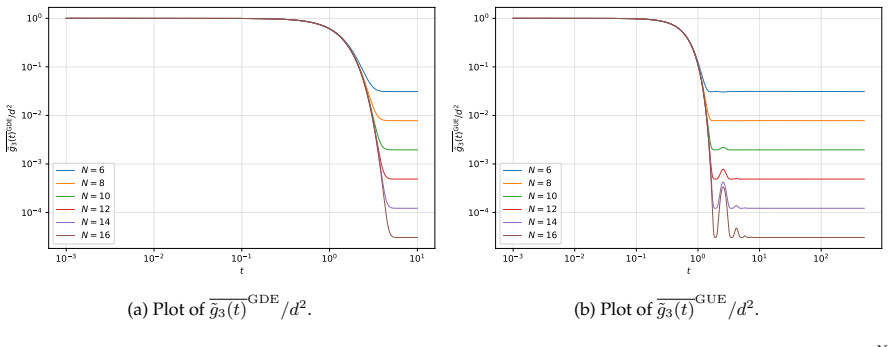
Expectation values of chaos probes match Haar distribution moments for GUE and T-doped circuits but deviate for GDE.
A machine-rendered reading of the paper's core claim, the machinery that carries it, and where it could break.
Core claim
Using isospectral twirling on fixed spectra with random eigenvectors, the expectation values of the probes adhere to moments of the Haar distribution for chaotic behavior modeled by the Gaussian Unitary Ensemble and T-doped circuits, while deviating for the non-chaotic Gaussian Diagonal Ensemble and showing specific behavior on the Toric Code Hamiltonian.
What carries the argument
Isospectral twirling, which fixes the Hamiltonian spectrum and selects eigenvectors randomly, applied across T-doped circuits and random-matrix ensembles.
If this is right
- The probes distinguish chaotic from non-chaotic regimes by whether their averages match Haar moments.
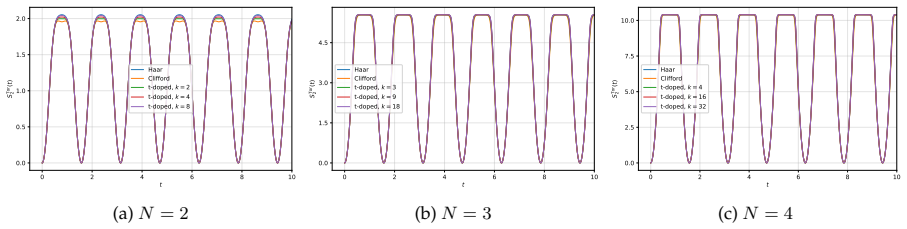
- T-doped circuits provide a tunable family of states interpolating between Clifford and fully random bases.
- Gaussian Diagonal Ensemble spectra yield systematically different probe values from Gaussian Unitary Ensemble spectra.
- The Toric Code supplies a concrete, non-random benchmark for probe behavior outside the two ensembles.
Where Pith is reading between the lines
- The same twirling procedure could be applied to experimental Hamiltonians to test whether observed probe values indicate chaos without requiring full eigenstate tomography.
- Varying the doping level in T-doped circuits might map a quantitative threshold where probes cross from non-Haar to Haar statistics.
- If the modeling is accurate, spectral statistics alone with randomized eigenvectors suffice to reproduce the probe signatures of chaos without simulating full time evolution.
Load-bearing premise
Randomly chosen eigenvectors from a fixed spectrum accurately capture the statistical signatures of chaotic dynamics in actual quantum systems.
What would settle it
Numerical or experimental computation of the same probe expectation values in a many-body system whose eigenstates are known to be fully chaotic and comparison against the reported GUE and Haar averages.
Figures






read the original abstract
Chaotic behavior of quantum systems can be characterized by the adherence of the expectation values of given probes to moments of the Haar distribution. In this work, we analyze the behavior of several probes of chaos using a technique known as Isospectral Twirling [1]. This consists in fixing the spectrum of the Hamiltonian and picking its eigenvectors at random. Here, we study the transition from stabilizer bases to random bases according to the Haar measure by T-doped random quantum circuits. We then compute the average value of the probes over ensembles of random spectra from Random Matrix Theory, the Gaussian Diagonal Ensemble and the Gaussian Unitary Ensemble, associated with non-chaotic and chaotic behavior respectively. We also study the behavior of such probes over the Toric Code Hamiltonian.
Editorial analysis
A structured set of objections, weighed in public.
Referee Report
Summary. The manuscript claims that probes of quantum chaos adhere to the moments of the Haar distribution when applied to T-doped Clifford circuits approaching Haar-random bases and to isospectral twirling over GUE spectra (modeling chaotic behavior), while deviating for GDE spectra (modeling non-chaotic behavior) and exhibiting specific behavior for the Toric Code Hamiltonian.
Significance. If the results hold, the work provides a controlled numerical approach to benchmarking chaos indicators via isospectral twirling and T-doped circuits, which could help distinguish ergodic from non-ergodic regimes in quantum many-body systems and circuits. The use of standard RMT ensembles as external benchmarks is a clear strength, as is the concrete model for the stabilizer-to-Haar transition.
major comments (1)
- [Sections defining the ensembles and isospectral twirling procedure] The central claim that GDE and GUE under isospectral twirling distinguish non-chaotic from chaotic regimes (and that deviations from Haar moments signal non-chaos) is load-bearing. This modeling choice fixes the spectrum while drawing eigenvectors from the Haar measure, decoupling them; however, physical non-chaotic Hamiltonians typically exhibit correlated, non-random eigenvectors (e.g., due to integrability or localization), so the observed GDE deviations may be an artifact of the artificial construction rather than a robust signature. The manuscript should include direct comparisons with actual integrable or localized Hamiltonians to test this.
minor comments (1)
- [Abstract] The abstract refers to 'several probes of chaos' and 'the average value of the probes' without defining the probes or reporting any numerical values, error bars, or specific adherence metrics, which hinders immediate assessment of the results.
Simulated Author's Rebuttal
We thank the referee for their positive evaluation of the significance of our work and for the constructive major comment. We address the point in detail below and outline the revisions we will make to strengthen the manuscript.
read point-by-point responses
-
Referee: [Sections defining the ensembles and isospectral twirling procedure] The central claim that GDE and GUE under isospectral twirling distinguish non-chaotic from chaotic regimes (and that deviations from Haar moments signal non-chaos) is load-bearing. This modeling choice fixes the spectrum while drawing eigenvectors from the Haar measure, decoupling them; however, physical non-chaotic Hamiltonians typically exhibit correlated, non-random eigenvectors (e.g., due to integrability or localization), so the observed GDE deviations may be an artifact of the artificial construction rather than a robust signature. The manuscript should include direct comparisons with actual integrable or localized Hamiltonians to test this.
Authors: We appreciate the referee's careful analysis of the isospectral twirling construction and its implications for distinguishing chaotic and non-chaotic regimes. The procedure is designed precisely to isolate the role of the spectrum by sampling eigenvectors from the Haar measure, allowing a controlled comparison between ensembles whose only difference is the level statistics (Poissonian for GDE versus Wigner-Dyson for GUE). The fact that probes reach Haar moments under GUE but deviate under GDE indicates that spectral statistics alone are sufficient to drive the distinction in this controlled setting. We acknowledge that physical non-chaotic Hamiltonians generally possess correlated eigenvectors, which the GDE does not capture. To address this directly, we will revise the manuscript to include an explicit comparison of the probe values obtained for the Toric Code Hamiltonian (a concrete integrable model with structured, non-random eigenvectors) against the corresponding GDE results. This addition will clarify the extent to which the GDE deviations are representative of physical non-chaotic behavior and will be presented in a new subsection discussing the limitations and strengths of the ensemble modeling. We believe these changes will reinforce rather than weaken the central claims. revision: yes
Circularity Check
No significant circularity; external RMT benchmarks and standard approximations used
full rationale
The paper computes probe expectation values directly on isospectral-twirled Hamiltonians whose spectra are drawn from the standard GDE and GUE ensembles of random-matrix theory (treated as independent external models for non-chaotic vs. chaotic regimes) and whose eigenvectors are chosen Haar-randomly. The T-doped circuit analysis invokes the known approximation of the Clifford+T group to the Haar measure, without any fitting of parameters to the probes themselves or redefinition of the target Haar moments. The Toric Code is examined as a concrete Hamiltonian instance. No equation reduces a claimed prediction to a fitted input by construction, and the single citation to the isospectral-twirling technique supplies a computational method rather than a load-bearing uniqueness theorem or ansatz that would force the central result. The derivation therefore remains self-contained against external benchmarks.
Axiom & Free-Parameter Ledger
axioms (2)
- domain assumption Random matrix ensembles (GDE, GUE) correctly capture non-chaotic and chaotic spectral statistics of quantum Hamiltonians
- domain assumption Isospectral twirling with Haar-random eigenvectors models the approach to chaotic dynamics
discussion (0)
Sign in with ORCID, Apple, or X to comment. Anyone can read and Pith papers without signing in.