REVIEW 1 major objections 72 references
How rare are Markovian quantum dynamics?
T0 review · 1 major / 0 minor · reviewed 2026-06-25 · grok-4.3
Pith's one-line read Almost all two-step qubit dynamics are non-Markovian, with only a small finite fraction being Markovian.
desk verdict Numerical sampling of two-step qubit maps finds Markovian cases form a small fraction under several witnesses, but the result tracks whatever ensemble was used to generate the maps. read the letter →
The pith
A machine-rendered reading of the paper's core claim, the machinery that carries it, and where it could break.
The reading
What carries the argument
Random generation of two-step qubit dynamics together with witnesses and measures of non-Markovianity applied to the resulting maps.
What would settle it
A different random-generation method or a substantially larger sample that yields a markedly higher or lower fraction of Markovian maps would falsify the reported rarity.
Extended reading notes
Core claim
By investigating randomly generated two-step qubit dynamics with respect to different concepts and witnesses of non-Markovianity, we observe that almost all dynamics are non-Markovian, and only a small (yet finite) fraction is Markovian. Furthermore, we study how this proportion changes when considering certain subclasses such as lower rank or mixed-unitary dynamics. Importantly, our results shed light on the relative ratios of -- and interrelations between -- the sets of dynamics that are non-Markovian with respect to different criteria. Finally, we investigate the fraction of dynamics in which the memory effects are necessarily of quantum nature and establish a connection between two recen
Load-bearing premise
The procedure used to generate random two-step qubit dynamics produces a representative sample of the space of all possible dynamics with respect to the chosen witnesses and measures of non-Markovianity.
Editorial extensions
If this is right
- The relative sizes of the sets of dynamics that are non-Markovian according to distinct criteria are fixed by the sampling results.
- A nonzero fraction of non-Markovian dynamics must involve quantum memory effects rather than classical ones.
- Markovian approximations remain valid only for restricted subclasses whose measure is smaller than the full set.
- Interrelations among non-Markovianity concepts become quantifiable through the observed overlaps in the sampled ensemble.
Reading between the lines
- Modeling protocols for open quantum systems would default to non-Markovian descriptions unless additional structure is imposed.
- Numerical studies of continuous-time or higher-dimensional dynamics could test whether the same rarity pattern appears beyond the two-step qubit setting.
- The connection between different quantum-memory witnesses suggests a hierarchy that future classification schemes could exploit.
Signed reviews
Editorial analysis
A structured set of objections, weighed in public.
Referee Report
Summary. The paper claims that Markovian dynamics are rare among all possible open quantum dynamics. By Monte Carlo sampling of randomly generated two-step qubit CPTP maps and testing them against multiple non-Markovianity witnesses, the authors report that only a small yet finite fraction of the sampled maps are Markovian while almost all exhibit memory effects. The work further examines how this fraction changes for lower-rank and mixed-unitary subclasses, quantifies the relative sizes and overlaps of sets defined by different non-Markovianity criteria, and studies the subset in which memory effects are necessarily quantum, establishing a link between two recent characterizations of quantum memory.
Significance. If the sampling procedure induces a representative measure on the space of two-step dynamics, the numerical result would indicate that Markovian descriptions are atypical rather than generic, with direct consequences for the modeling of decoherence and the applicability of Markovian master equations. The comparative analysis of different witnesses and the connection drawn between quantum-memory concepts add value beyond the headline fraction. The significance is nevertheless conditional on the ensemble used to generate the random maps.
major comments (1)
- [Numerical sampling / Methods] The procedure used to generate the ensemble of random two-step qubit dynamics is not described with sufficient detail (distribution over Kraus operators or Choi matrices, handling of CPTP constraints, sampling algorithm, and statistical error control) to determine whether the reported Markovian fraction is an artifact of the chosen measure rather than a property of the space itself. This directly affects the central claim that 'almost all dynamics are non-Markovian'.
Simulated Author's Rebuttal
We thank the referee for the detailed reading and constructive criticism. We address the sole major comment below and will revise the manuscript to incorporate the requested methodological details.
read point-by-point responses
-
Referee: [Numerical sampling / Methods] The procedure used to generate the ensemble of random two-step qubit dynamics is not described with sufficient detail (distribution over Kraus operators or Choi matrices, handling of CPTP constraints, sampling algorithm, and statistical error control) to determine whether the reported Markovian fraction is an artifact of the chosen measure rather than a property of the space itself. This directly affects the central claim that 'almost all dynamics are non-Markovian'.
Authors: We agree that the current description of the sampling procedure lacks sufficient detail for reproducibility and for readers to evaluate the underlying measure. In the revised manuscript we will expand the relevant section to specify: the precise distribution (uniform sampling with respect to the Hilbert-Schmidt volume on the convex set of two-step CPTP maps, realized via random Choi matrices projected onto the CPTP cone), the algorithm (generation of random Kraus operators followed by normalization and enforcement of trace preservation and complete positivity), and statistical controls (sample size, convergence checks, and bootstrap-derived error bars on the reported fractions). We will also explicitly state that all claims are with respect to this ensemble and discuss its relation to other natural measures on the space of quantum channels. These additions will directly address the concern without changing the numerical findings or the overall conclusion. revision: yes
Circularity Check
No circularity: prevalence estimates arise from direct Monte Carlo sampling.
full rationale
The paper computes fractions of Markovian vs. non-Markovian dynamics by generating random two-step qubit maps and applying witnesses directly to the samples. No derivation reduces a claimed result to a fitted parameter, self-definition, or self-citation chain; the output is the empirical count under the chosen ensemble. The representativeness of the sampling measure is an external modeling assumption rather than an internal logical reduction. No steps match the enumerated circularity patterns.
Assumptions & free parameters
Cite this review
Pith. "Pith review of How rare are Markovian quantum dynamics?." pith.science (2026). https://pith.science/paper/QBXBW3VE
@misc{pith2026260624511,
  author       = {Pith},
  title        = {Pith review of: How rare are Markovian quantum dynamics?},
  year         = {2026},
  howpublished = {\url{https://pith.science/paper/QBXBW3VE}},
  note         = {Machine review of arXiv:2606.24511}
}
read the original abstract
A profound understanding of decoherence and dissipation in quantum dynamics is crucial for the realistic modeling of the evolution of quantum systems. In open quantum dynamics one distinguishes between a memoryless, so-called Markovian evolution and dynamics incorporating memory effects, termed non-Markovian. In this work we study how prevalent memory effects are in the set of all such dynamics. We thus investigate how often a Markovian description is applicable. This question is approached by investigating randomly generated two-step qubit dynamics with respect to different concepts and witnesses of non-Markovianity. We observe that almost all dynamics are non-Markovian, and only a small (yet finite) fraction is Markovian. Furthermore, we study how this proportion changes when considering certain subclasses such as lower rank or mixed-unitary dynamics. Importantly, our results shed light on the relative ratios of -- and interrelations between -- the sets of dynamics that are non-Markovian with respect to different criteria. Finally, we investigate the fraction of dynamics in which the memory effects are necessarily of quantum nature and establish a connection between two recently developed concepts that characterize the quantumness of memory in non-Markovian dynamics.
Figures
Figures from the paper (3 more)
Reference graph
Works this paper leans on
-
[1]
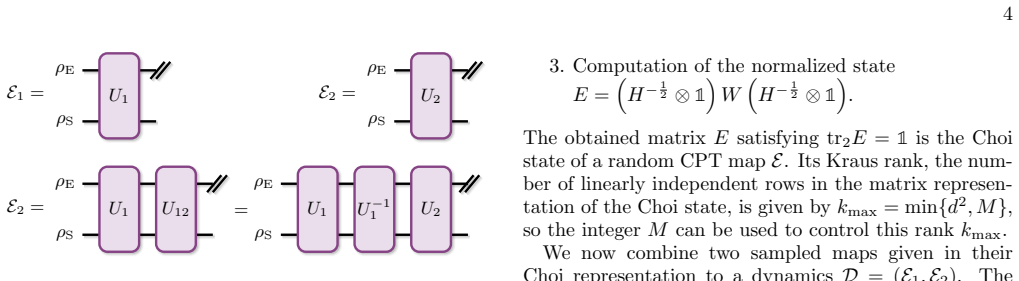
Generation of a random Wishart matrixW=GG † of parameters (d 2, M), whereGis ad 2 ×Mran- dom Ginibre matrix,Mis an integer andddenotes the dimension of the Hilbert space of the quantum system
-
[2]
Tracing out the first half ofWdefinesH= tr 1W, which is, by construction, positive semidefinite
-
[3]
The obtained matrixEsatisfying tr 2E=1is the Choi state of a random CPT mapE
Computation of the normalized state E= H − 1 2 ⊗1 W H − 1 2 ⊗1 . The obtained matrixEsatisfying tr 2E=1is the Choi state of a random CPT mapE. Its Kraus rank, the num- ber of linearly independent rows in the matrix represen- tation of the Choi state, is given byk max = min{d2, M}, so the integerMcan be used to control this rankk max. We now combine two sa...
-
[4]
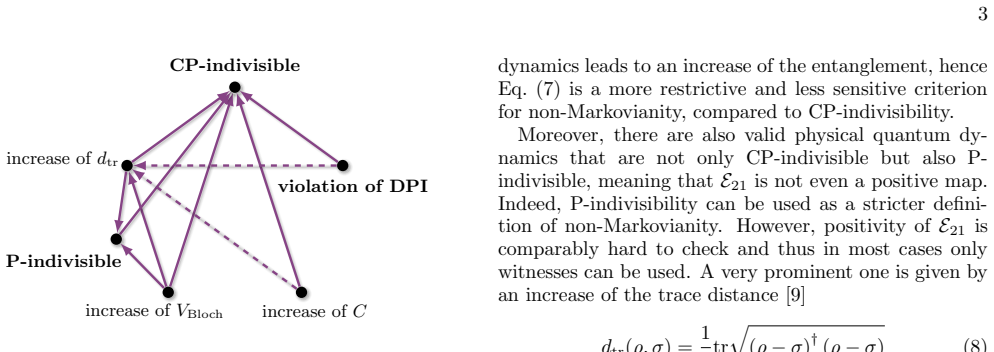
definition of CP-indivisibility [10]
-
[5]
increase of an entanglement monotone [10] •Non-Markovianity defined by P-indivisibility
-
[6]
increase of the trace distance [9]
-
[7]
increase of the Bloch volume [20] •Non-Markovianity defined in terms of correlation dynamics (mutual information)
-
[8]
The fractions of dynamics showing non-Markovianity according to each of those witnesses are shown in Fig
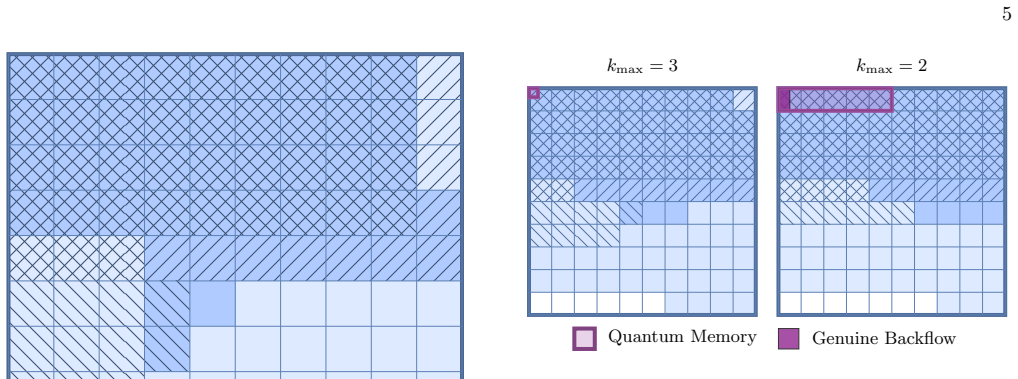
violation of a data processing inequality [19] The first and fifth witness are equivalent to the accord- ing definitions of non-Markovianity, the other three wit- nesses are only sufficient but do not necessarily detect non-Markovianity of that type for a dynamicsD. The fractions of dynamics showing non-Markovianity according to each of those witnesses ar...
Show all 72 references
-
[9]
backflow oftruly quantuminformation
Concepts verifying the quantumness of memory effects Assume again that we are given a dynamicsD= (E1,E 2) such that we can compute their corresponding Choi statesE 1 andE 2. One witness for the quantum- ness of the memory effects can be understood in the same spirit as the ent...
-
[10]
Unfortunately, the quantities appearing in crite- rion Eq
and its dual quantity, the concurrence of assistance [49]. Unfortunately, the quantities appearing in crite- rion Eq. (13) cannot be obtained in a straightforward way since the squashed entanglement is computationally hard, even for qubits [50]. In order to make a statement ab...
-
[11]
(12) is too low to be visible in the graphical depiction in Fig
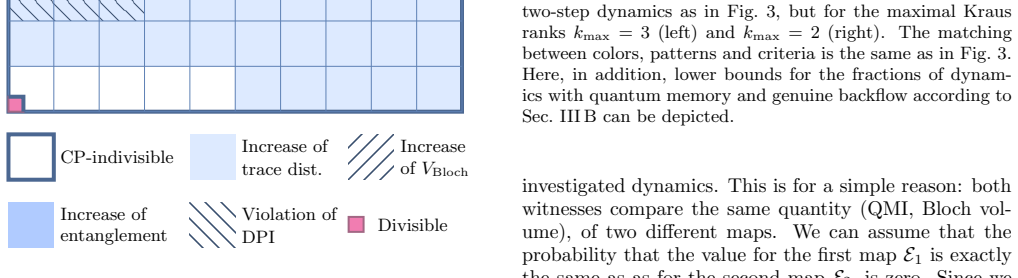
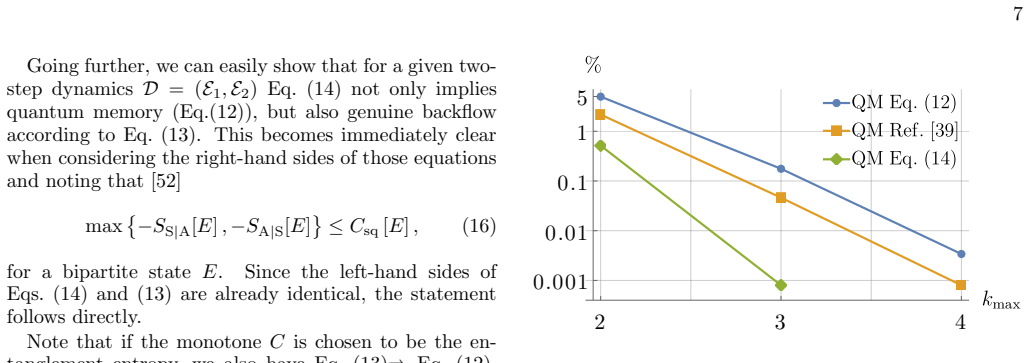
Sampling Quantum Memory The absolute number of dynamics showing quantum memory according to Eq. (12) is too low to be visible in the graphical depiction in Fig. 3. However, once we con- sider lower maximal Kraus ranks, this changes, see Fig. 4. A more detailed depiction for th...
-
[12]
Gorini, A
V. Gorini, A. Kossakowski, and E. C. G. Sudarshan, Completely positive dynamical semigroups of n-level sys- tems, J. Math. Phys.17, 821 (1976)
1976
-
[13]
Lindblad, On the generators of quantum dynamical semigroups, Commun
G. Lindblad, On the generators of quantum dynamical semigroups, Commun. Math. Phys.48, 119 (1976)
1976
-
[14]
Vacchini, A
B. Vacchini, A. Smirne, E.-M. Laine, J. Piilo, and H.-P. Breuer, Markovianity and non-Markovianity in quantum 9 and classical systems, New J. Phys.13, 093004 (2011)
2011
-
[15]
S. Milz, D. Egloff, P. Taranto, T. Theurer, M. B. Plenio, A. Smirne, and S. F. Huelga, When is a non-Markovian quantum process classical?, Phys. Rev. X10, 041049 (2020)
2020
-
[16]
B¨ acker, K
C. B¨ acker, K. Beyer, and W. T. Strunz, Local disclosure of quantum memory in non-Markovian dynamics, Phys. Rev. Lett.132, 060402 (2024)
2024
-
[17]
Giarmatzi and F
C. Giarmatzi and F. Costa, Witnessing quantum memory in non-Markovian processes, Quantum5, 440 (2021)
2021
-
[18]
Taranto, M
P. Taranto, M. T. Quintino, M. Murao, and S. Milz, Characterising the hierarchy of multi-time quantum pro- cesses with classical memory, Quantum8, 1328 (2024)
2024
-
[19]
Buscemi, R
F. Buscemi, R. Gangwar, K. Goswami, H. Badhani, T. Pandit, B. Mohan, S. Das, and M. N. Bera, Causal and noncausal revivals of information: A new regime of non-Markovianity in quantum stochastic processes, PRX Quantum6, 020316 (2025)
2025
-
[20]
Breuer, E.-M
H.-P. Breuer, E.-M. Laine, and J. Piilo, Measure for the degree of non-Markovian behavior of quantum processes in open systems, Phys. Rev. Lett.103, 210401 (2009)
2009
-
[21]
Rivas, S
´A. Rivas, S. F. Huelga, and M. B. Plenio, Entanglement and non-Markovianity of quantum evolutions, Phys. Rev. Lett.105, 050403 (2010)
2010
-
[22]
M. J. W. Hall, J. D. Cresser, L. Li, and E. Andersson, Canonical form of master equations and characterization of non-Markovianity, Phys. Rev. A89, 042120 (2014)
2014
-
[23]
L. Li, M. J. Hall, and H. M. Wiseman, Concepts of quan- tum non-Markovianity: A hierarchy, Physics Reports 759, 1 (2018)
2018
-
[24]
F. A. Pollock, C. Rodr´iguez-Rosario, T. Frauenheim, M. Paternostro, and K. Modi, Non-Markovian quantum processes: Complete framework and efficient characteri- zation, Phys. Rev. A97, 012127 (2018)
2018
-
[25]
Suess, A
D. Suess, A. Eisfeld, and W. T. Strunz, Hierarchy of stochastic pure states for open quantum system dynam- ics, Phys. Rev. Lett.113, 150403 (2014)
2014
-
[26]
Tanimura, Numerically “exact” approach to open quantum dynamics: The hierarchical equations of mo- tion (HEOM), J
Y. Tanimura, Numerically “exact” approach to open quantum dynamics: The hierarchical equations of mo- tion (HEOM), J. Chem. Phys.153, 020901 (2020)
2020
-
[27]
Cygorek, M
M. Cygorek, M. Cosacchi, A. Vagov, V. M. Axt, B. W. Lovett, J. Keeling, and E. M. Gauger, Simulation of open quantum systems by automated compression of arbitrary environments, Nature Physics18, 662 (2022)
2022
-
[28]
Link, H.-H
V. Link, H.-H. Tu, and W. T. Strunz, Open quantum sys- tem dynamics from infinite tensor network contraction, Phys. Rev. Lett.132, 200403 (2024)
2024
-
[29]
Rivas, S
´A. Rivas, S. F. Huelga, and M. B. Plenio, Quantum non- Markovianity: Characterization, quantification and de- tection, Rep. Prog. Phys.77, 094001 (2014)
2014
-
[30]
S. Luo, S. Fu, and H. Song, Quantifying non- markovianity via correlations, Phys. Rev. A86, 044101 (2012)
2012
-
[31]
Lorenzo, F
S. Lorenzo, F. Plastina, and M. Paternostro, Geometrical characterization of non-Markovianity, Phys. Rev. A88, 020102 (2013)
2013
-
[32]
X.-M. Lu, X. Wang, and C. P. Sun, Quantum Fisher information flow and non-Markovian processes of open systems, Phys. Rev. A82, 042103 (2010)
2010
-
[33]
Scandi, P
M. Scandi, P. Abiuso, J. Surace, and D. De Santis, Quan- tum Fisher information and its dynamical nature, Rep. Prog. Phys.88, 076001 (2025)
2025
-
[34]
Chru´ sci´ nski and A
D. Chru´ sci´ nski and A. Kossakowski, Markovianity cri- teria for quantum evolution, J. Phys. B: At. Mol. Opt. Phys.45, 154002 (2012)
2012
-
[35]
˙Zyczkowski, P
K. ˙Zyczkowski, P. Horodecki, A. Sanpera, and M. Lewen- stein, Volume of the set of separable states, Phys. Rev. A58, 883 (1998)
1998
-
[36]
V. P. Rossi, B. Zjawin, R. D. Baldij˜ ao, D. Schmid, J. H. Selby, and A. B. Sainz, How typical is contextuality? (2025), arXiv:2510.20722 [quant-ph]
2025
-
[37]
Lange and C
S. Lange and C. Timm, Random-matrix theory for the Lindblad master equation, Chaos31, 023101 (2021)
2021
-
[38]
H. Chen, B. Li, J. Lu, and L. Ying, A Randomized Method for Simulating Lindblad Equations and Thermal State Preparation, Quantum9, 1917 (2025)
1917
-
[39]
Denisov, T
S. Denisov, T. Laptyeva, W. Tarnowski, D. Chru´ sci´ nski, and K. ˙Zyczkowski, Universal Spectra of Random Lind- blad Operators, Phys. Rev. Lett.123, 140403 (2019)
2019
-
[40]
Breuer, Foundations and measures of quantum non- Markovianity, J
H.-P. Breuer, Foundations and measures of quantum non- Markovianity, J. Phys. B: At. Mol. Opt. Phys.45, 154001 (2012)
2012
-
[41]
M. M. Wolf and J. I. Cirac, Dividing Quantum Channels, Commun. Math. Phys.279, 147 (2008)
2008
-
[42]
Davalos, M
D. Davalos, M. Ziman, and C. Pineda, Divisibility of qubit channels and dynamical maps, Quantum3, 144 (2019)
2019
-
[43]
Davalos and M
D. Davalos and M. Ziman, Quantum dynamics is not strictly bidivisible, Phys. Rev. Lett.130, 080801 (2023)
2023
-
[44]
Choi, Completely positive linear maps on complex matrices, Lin
M.-D. Choi, Completely positive linear maps on complex matrices, Lin. Alg. Appl.10, 285 (1975)
1975
-
[45]
Jamio lkowski, Linear transformations which preserve trace and positive semidefiniteness of operators, Rep
A. Jamio lkowski, Linear transformations which preserve trace and positive semidefiniteness of operators, Rep. Math. Phys.3, 275 (1972)
1972
-
[46]
Kossakowski, On quantum statistical mechanics of non-Hamiltonian systems, Rep
A. Kossakowski, On quantum statistical mechanics of non-Hamiltonian systems, Rep. Math. Phys.3, 247 (1972)
1972
-
[47]
Wißmann, H.-P
S. Wißmann, H.-P. Breuer, and B. Vacchini, Generalized trace-distance measure connecting quantum and classical non-Markovianity, Phys. Rev. A92, 042108 (2015)
2015
-
[48]
Breuer, E.-M
H.-P. Breuer, E.-M. Laine, J. Piilo, and B. Vacchini, Colloquium: Non-Markovian dynamics in open quantum systems, Rev. Mod. Phys.88, 021002 (2016)
2016
-
[49]
Jevtic, M
S. Jevtic, M. Pusey, D. Jennings, and T. Rudolph, Quan- tum steering ellipsoids, Phys. Rev. Lett.113, 020402 (2014)
2014
-
[50]
Milne, S
A. Milne, S. Jevtic, D. Jennings, H. Wiseman, and T. Rudolph, Quantum steering ellipsoids, extremal phys- ical states and monogamy, New J. Phys.16, 083017 (2014)
2014
-
[51]
Kukulski, I
R. Kukulski, I. Nechita, L. Pawela, Z. Pucha la, and K. ˙Zyczkowski, Generating random quantum channels, J. Math. Phys.62, 062201 (2021)
2021
-
[52]
Siudzi´ nska, Geometry of symmetric and noninvertible pauli channels, Phys
K. Siudzi´ nska, Geometry of symmetric and noninvertible pauli channels, Phys. Rev. A102, 062615 (2020)
2020
-
[53]
Thanh Huong and V
H. Thanh Huong and V. The Khoi, Separability proba- bility of two-qubit states, J. Phys. A. Math.57, 445304 (2024)
2024
-
[54]
Milz and W
S. Milz and W. T. Strunz, Volumes of conditioned bi- partite state spaces, Journal of Physics A: Mathematical and Theoretical48, 035306 (2014)
2014
-
[55]
Gangwar and U
R. Gangwar and U. Sen, Genuine and Non-Genuine Quantum Non-Markovianity: A Unified Information- Theoretic Review (2026), arXiv:2603.28277 [quant-ph]. 10
2026 arXiv
-
[56]
B¨ acker, V
C. B¨ acker, V. Link, and W. T. Strunz, Verifying quan- tum memory in the dynamics of spin-boson models, Phys. Rev. Res.8, 023106 (2026)
2026
-
[57]
S. A. Hill and W. K. Wootters, Entanglement of a pair of quantum bits, Phys. Rev. Lett.78, 5022 (1997)
1997
-
[58]
W. K. Wootters, Entanglement of formation of an ar- bitrary state of two qubits, Phys. Rev. Lett.80, 2245 (1998)
1998
-
[59]
D. P. DiVincenzo, C. A. Fuchs, H. Mabuchi, J. A. Smolin, A. Thapliyal, and A. Uhlmann, Entanglement of assis- tance, inQuantum Computing and Quantum Communi- cations, Lecture Notes in Computer Science, edited by C. P. Williams (Springer, Berlin, Heidelberg, 1999) pp. 247–257
1999
-
[60]
Laustsen, F
T. Laustsen, F. Verstraete, and S. V. Enk, Local vs. joint measurements for the entanglement of assistance, Quan- tum Inf. Comput.3(2002)
2002
-
[61]
Song, Lower Bounds on the Squashed Entanglement for Multi-Party System, Int
W. Song, Lower Bounds on the Squashed Entanglement for Multi-Party System, Int. J. Theor. Phys.48, 2191 (2009)
2009
-
[62]
B¨ acker, K
C. B¨ acker, K. Beyer, and W. T. Strunz, Entropic witness for quantum memory in open system dynamics, Phys. Rev. Res.7, 033256 (2025)
2025
-
[63]
E. A. Carlen and E. H. Lieb, Bounds for entanglement via an extension of strong subadditivity of entropy, Lett. Math. Phys.101, 1 (2012)
2012
-
[64]
B¨ acker, K
C. B¨ acker, K. Beyer, and W. T. Strunz, Quan- tum memory precludes mixed-unitary dynamics (2026), arXiv:2603.17010 [quant-ph]
2026
-
[65]
K. M. R. Audenaert and S. Scheel, On random unitary channels, New J. Phys.10, 023011 (2008)
2008
-
[66]
Yu, T.-A
M. Yu, T.-A. Ohst, H.-C. Nguyen, and S. Nimmrichter, Quantum memory in spontaneous emission processes (2025), arXiv:2504.08605 [quant-ph]
2025
-
[67]
Gregoratti and R
M. Gregoratti and R. F. Werner, Quantum lost and found, J. Mod. Opt.50, 915 (2003)
2003
-
[68]
Trendelkamp-Schroer, J
B. Trendelkamp-Schroer, J. Helm, and W. T. Strunz, Environment-assisted error correction of single-qubit phase damping, Phys. Rev. A84, 062314 (2011). APPENDIX A: Details about the results The visualizations in Figs. 3, 4 and 5 are based on numerical evidence obtained by sampl...
2011
-
[69]
Review of the concepts A dynamicsD= (E 1,E 2) can be realized with classi- cal memory, if there exist Kraus operators{K i}and a kmax = 4 kmax = 3 kmax = 2 MU number of dynamics 1.000.000 500.000 500.000 100.000 1 CP-indivisible 99.90 100.00 100.00 99.63 2 P-indivisible 95.39 9...
-
[70]
(14) necessarily also shows genuine backflow with respect to Eq
Examples where both concepts coincide We have seen that any dynamics with quantum mem- ory according to Eq. (14) necessarily also shows genuine backflow with respect to Eq. (13). Hence, there is a class of dynamics having both properties. One example for such a dynamics is giv...
-
[71]
It is thus reasonable to assume that if there is a connection to the concept of noncausal information re- vival, those dynamics will satisfy Eq
Mixed-unitary dynamics can always be realized with non-causal information revival It is known that the only subclass of dynamicsD= (E1,E 2) which show classical memory regardless of the second step are those where the first mapE 1 is mixed- unitary. It is thus reasonable to as...
-
[72]
[8], any revival that occurs in the presence of an initially pure environment E can never show only noncausal information revival, genuine back- flow is necessary
Differences between the concepts According to Ref. [8], any revival that occurs in the presence of an initially pure environment E can never show only noncausal information revival, genuine back- flow is necessary. Let us thus consider such a dynamics, which is given in terms ...
Reviewed June 25, 2026 · model on record in the stance chip above.
Discussion (0). Continue with ORCID to comment.