REVIEW 2 major objections 2 minor 83 references
Exact modes, hybridization and polarization rotation of electromagnetic fields propagating in topological insulating slab
T0 review · 2 major / 2 minor · reviewed 2026-06-25 · grok-4.3
Pith's one-line read All supported electromagnetic modes in a topological insulator slab are hybrid modes with longitudinal field components due to the Θ term.
desk verdict The paper derives exact hybrid modes for TI slab waveguides from the axion Θ boundary conditions and shows deviations from standard coupled-mode theory. read the letter →
The pith
A machine-rendered reading of the paper's core claim, the machinery that carries it, and where it could break.
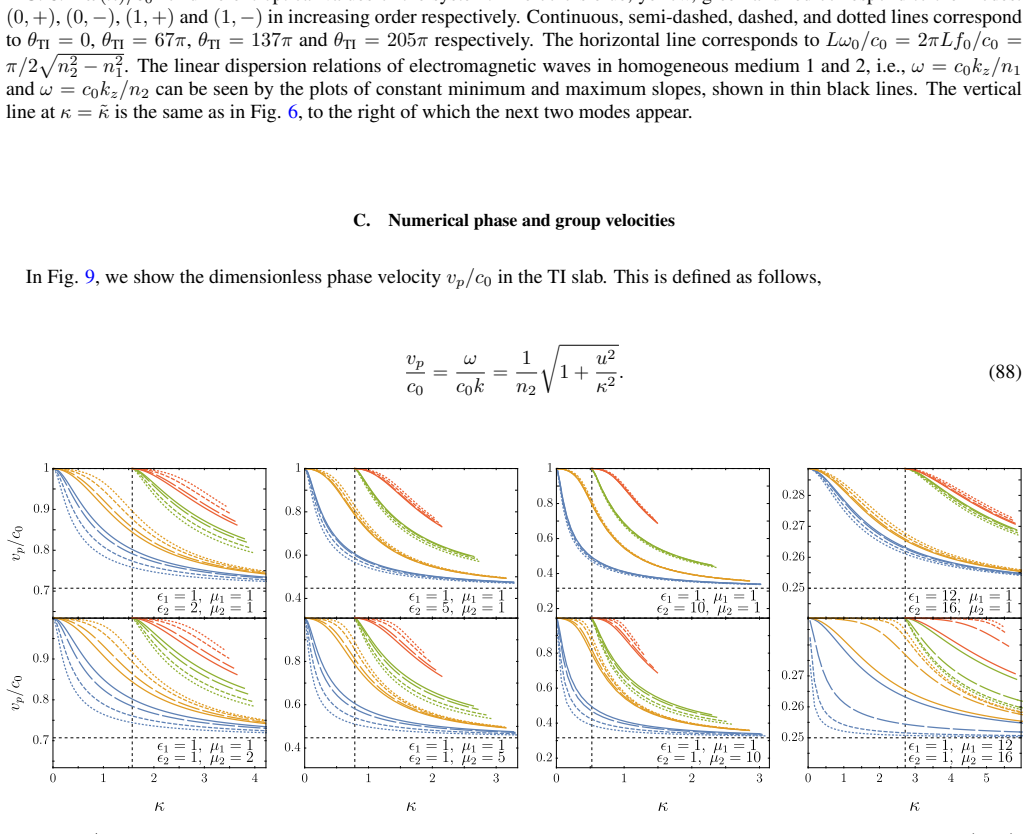
The reading
What carries the argument
The axion-like Θ term modifying Maxwell's electrodynamics, which imposes boundary conditions that force hybridization of all modes.
What would settle it
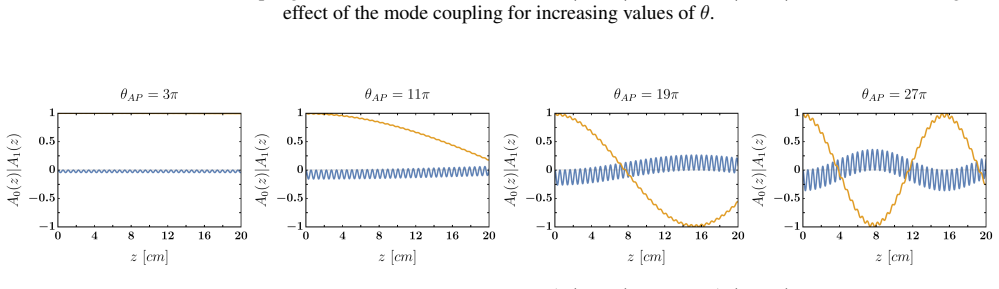
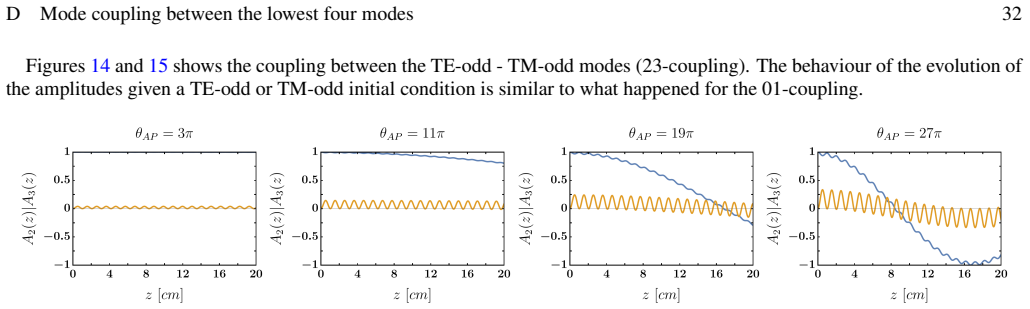
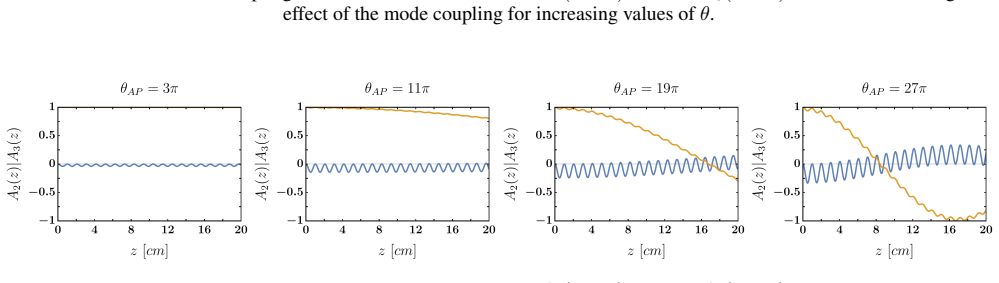
A direct measurement showing that a topological insulator slab waveguide supports modes with longitudinal field components while an identical topologically trivial slab under the same conditions supports only transverse modes.
Extended reading notes
Core claim
All supported modes are exact hybrid modes with nonvanishing longitudinal field components. This hybridization is a consequence of the boundary conditions produced by the Θ term and is absent in topologically trivial, reciprocal and non-chiral slab waveguides. By solving the full Θ-electrodynamics nonperturbatively the modal dispersion relations are derived, polarization rotation and power transfer are explored, and both perturbative and coupled-mode analyses reveal qualitative and quantitative signatures of the topological magnetoelectric response.
Load-bearing premise
The electromagnetic response inside the topological insulator is fully captured by an axion-like Θ term that alters the boundary conditions on the electromagnetic fields.
Editorial extensions
If this is right
- Propagation conditions and field profiles change for asymmetric slabs.
- Exact modal solutions and dispersion relations are obtained for the symmetric slab.
- Mode coupling and polarization rotation exhibit deviations from ordinary coupled-mode theory.
- New observable signatures of the topological magnetoelectric effect appear in guided propagation.
Reading between the lines
- The hybridization mechanism may extend to other waveguide geometries where Θ-term boundary conditions apply.
- Polarization rotation effects could be used to design compact devices for light manipulation that rely on the topological response.
- The perturbative expansion around exact Θ-modes offers a practical route to quantify small effects in experiments.
Editorial analysis
A structured set of objections, weighed in public.
Referee Report
Summary. The paper claims that electromagnetic modes in a topological insulator slab waveguide (with axion-like Θ term modifying Maxwell equations) are necessarily exact hybrid modes with nonzero Ez and Hz components due to Θ-induced boundary conditions; this hybridization is absent in trivial slabs. It derives exact modal dispersion relations nonperturbatively for the symmetric slab, examines polarization rotation and power transfer, and contrasts perturbative analysis (superposition of Θ-ED modes to first order) with coupled-mode theory (superpositions of ordinary-ED modes), reporting qualitative/quantitative deviations from standard CMT.
Significance. If the derivations are correct, the work supplies a nonperturbative framework for topological magnetoelectric effects in guided-wave geometries and identifies new signatures for experimental probes of the ME response. The exact-solution approach and explicit comparison of three methods (nonperturbative, perturbative, CMT) constitute a strength, yielding falsifiable predictions for mode hybridization and power transfer.
major comments (2)
- [Abstract] Abstract and main text: the central claim that “all supported modes are exact hybrid modes” rests on boundary conditions produced by the Θ term, yet the manuscript does not display the explicit boundary-condition equations or the resulting characteristic equation for the dispersion relation, preventing verification that hybridization is forced for every mode.
- [main text] The nonperturbative derivation is described as yielding “modal dispersion relations,” but no explicit dispersion equation, field-component expressions, or numerical verification against the trivial (Θ=0) limit is provided, which is load-bearing for the assertion of qualitative deviation from standard slab waveguides.
minor comments (2)
- [Abstract] Notation for the topological magnetoelectric parameter is introduced as “ME” then switched to Θ; consistent use would improve readability.
- [main text] The distinction between the three solution methods (exact Θ-ED, perturbative expansion of Θ-ED modes, and CMT on ordinary-ED modes) is conceptually clear but would benefit from a short table summarizing the assumptions and order of approximation for each.
Simulated Author's Rebuttal
We thank the referee for the thorough review and for identifying areas where greater explicitness is needed to support the central claims. We will revise the manuscript to include the missing derivations and verifications as detailed below.
read point-by-point responses
-
Referee: [Abstract] Abstract and main text: the central claim that “all supported modes are exact hybrid modes” rests on boundary conditions produced by the Θ term, yet the manuscript does not display the explicit boundary-condition equations or the resulting characteristic equation for the dispersion relation, preventing verification that hybridization is forced for every mode.
Authors: We agree that the explicit boundary conditions arising from the Θ term and the resulting characteristic equation were not displayed. This limits the ability to verify that hybridization is enforced for all modes. In the revised manuscript we will derive the modified continuity conditions at the slab interfaces from the axion term, present the full set of boundary-condition equations, and display the transcendental dispersion relation obtained by imposing continuity of the tangential fields, thereby showing explicitly that every solution requires nonzero Ez and Hz. revision: yes
-
Referee: [main text] The nonperturbative derivation is described as yielding “modal dispersion relations,” but no explicit dispersion equation, field-component expressions, or numerical verification against the trivial (Θ=0) limit is provided, which is load-bearing for the assertion of qualitative deviation from standard slab waveguides.
Authors: We concur that the explicit dispersion equation, the analytic expressions for all six field components of the hybrid modes, and a direct numerical check against the Θ = 0 limit are essential. The revised text will include the closed-form dispersion relation for the symmetric slab, the corresponding field-component formulas, and a side-by-side comparison (both analytic and numerical) demonstrating that the relations reduce exactly to the conventional TE/TM slab modes when Θ vanishes, thereby substantiating the claimed qualitative differences. revision: yes
Circularity Check
Derivation self-contained in modified Maxwell equations
full rationale
The paper derives exact hybrid modes and dispersion relations by solving the full Θ-electrodynamics nonperturbatively from the axion-modified Maxwell equations and their boundary conditions. Hybridization is a direct consequence of the Θ term at interfaces, vanishing when Θ=0, which matches standard decoupling in ordinary slabs. No fitted parameters are renamed as predictions, no load-bearing self-citations, and no ansatz or uniqueness imported circularly. The perturbative and coupled-mode analyses are expansions around the exact Θ-solutions, keeping the chain independent of its outputs.
Assumptions & free parameters
free parameters (1)
- topological magnetoelectric parameter Θ
assumptions (1)
- domain assumption Maxwell electrodynamics modified by axion-like Θ term
Cite this review
Pith. "Pith review of Exact modes, hybridization and polarization rotation of electromagnetic fields propagating in topological insulating slab." pith.science (2026). https://pith.science/paper/QCH7PYVP
@misc{pith2026260625981,
  author       = {Pith},
  title        = {Pith review of: Exact modes, hybridization and polarization rotation of electromagnetic fields propagating in topological insulating slab},
  year         = {2026},
  howpublished = {\url{https://pith.science/paper/QCH7PYVP}},
  note         = {Machine review of arXiv:2606.25981}
}
abstract
We study electromagnetic waves in slab waveguides with a topological insulator core characterized by a topological magnetoelectric parameter (ME). TIs are electrically insulating in the bulk with robust conducting states at their boundaries. Their electromagnetic response is described by an axion-like $\Theta$ term that modifies Maxwell's electrodynamics, leading to rich and unconventional phenomena, as the topological ME effect. All supported modes are exact hybrid modes with nonvanishing longitudinal field components. This hybridization is a consequence of the boundary conditions produced by the $\Theta$ term and is absent in topologically trivial, reciprocal and non-chiral slab waveguides. Modifications to the propagation condition and modes are shown for the asymmetric slab. The detailed solution of the exact modes, coupling of modes and the dispersion relations is made for the symmetric slab. By solving the full $\Theta$-electrodynamics nonperturbatively, we derive the modal dispersion relations and explore polarization rotation and power transfer between modes. Our approach reveals qualitative and quantitative deviations from standard coupled-mode theory and captures new signatures of the topological ME response. Due to the smallness of the $\Theta$-effects, we perform a perturbative analysis of mode propagation, based on writing a general solution as a superposition of exact modes of $\Theta$-ED but expanding to first non-vanishing order. Also, we apply coupled-mode theory, that is predicated on building solutions as superpositions of modes of ordinary electrodynamics that fail to satisfy the boundary conditions imposed by the $\Theta$-term but compensate at the expense of modifying the field profiles. These findings provide a comprehensive framework for light control in topological photonics and potential routes to experimentally probe the ME effect in guided settings.
Figures
Figures from the paper (13 more)
Reference graph
Works this paper leans on
-
[1]
The transverse components of the E and B fields are negligible for the (0−) mode inside the TI slab, while non-vanishing and actually leaking to infinity into the claddings (i.e., the (0−) mode ceases to be confined)
-
[2]
The transverse components of the E and B fields enhanced for the (0+) mode inside the TI slab, while decaying rapidly into the claddings (i.e., the (0+) mode gets highly confined). The above results, together with the vanishing of the longitudinal components, allow us to state that the EM field propagation in the Z2 ≪ Z1 limit of our Θ-slab results in qua...
-
[3]
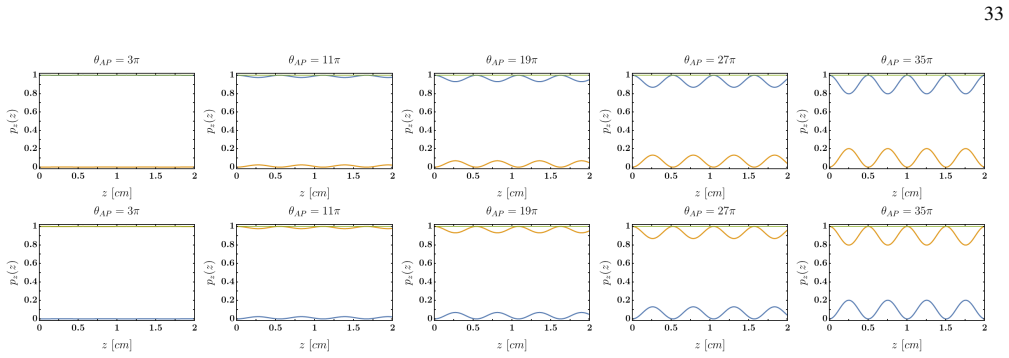
The power transmitted by each mode P θ ±;TEe are dependent of z, i.e., as the EM field propagates along the slab, power from one mode is transferred to the other
-
[4]
The expression for the latter are are exact, i.e., valid to all orders in θ
-
[5]
The last point reveals two important conclusions
The total power transmitted by the EM field as it propagates along the slab is constant, and not dependent on z. The last point reveals two important conclusions. Firstly, we are verifying energy conservation and, secondly, the fact that we build our solutions with the exact Θ-ED modes means that we are satisfying the boundary conditions at every instant ...
-
[6]
For all numerical calculations we will use the speed of light in vacuum as c0 = 299792458 m/s
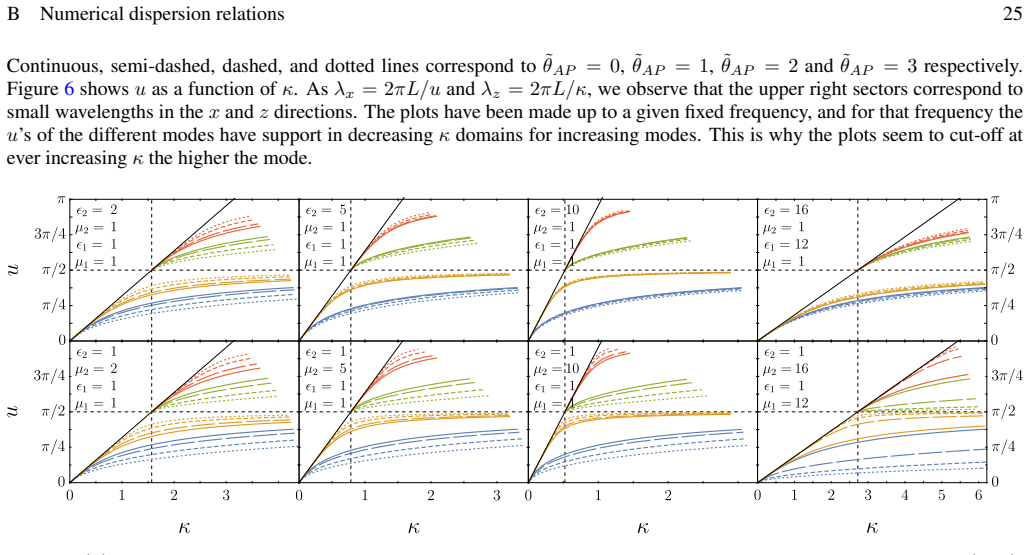
≡ R(ω)2, (86) which corresponds, in the (u, v) coordinates, to a circle of radiusR(ω), and the nη label for the polarizations have been omitted. For all numerical calculations we will use the speed of light in vacuum as c0 = 299792458 m/s. Let us begin by considering the 4 Recall, that for a given frequency the amounts of modes are the same, regardless if...
-
[7]
The vertical line at κ = ˜κ is the same as in Fig
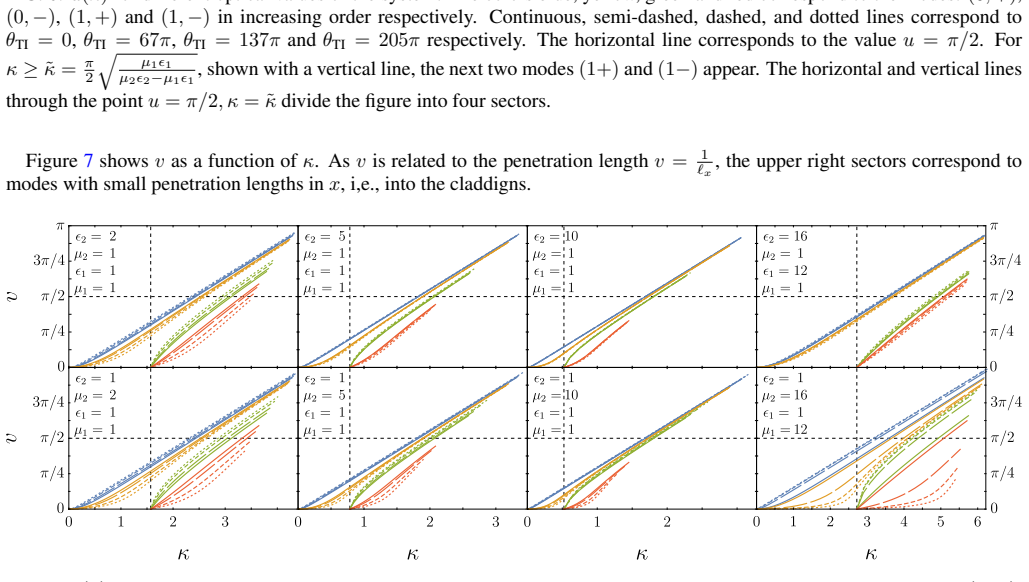
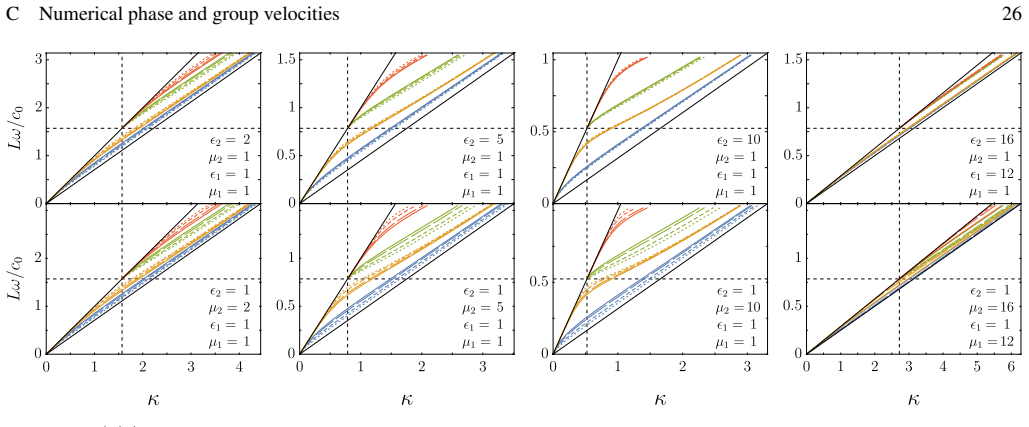
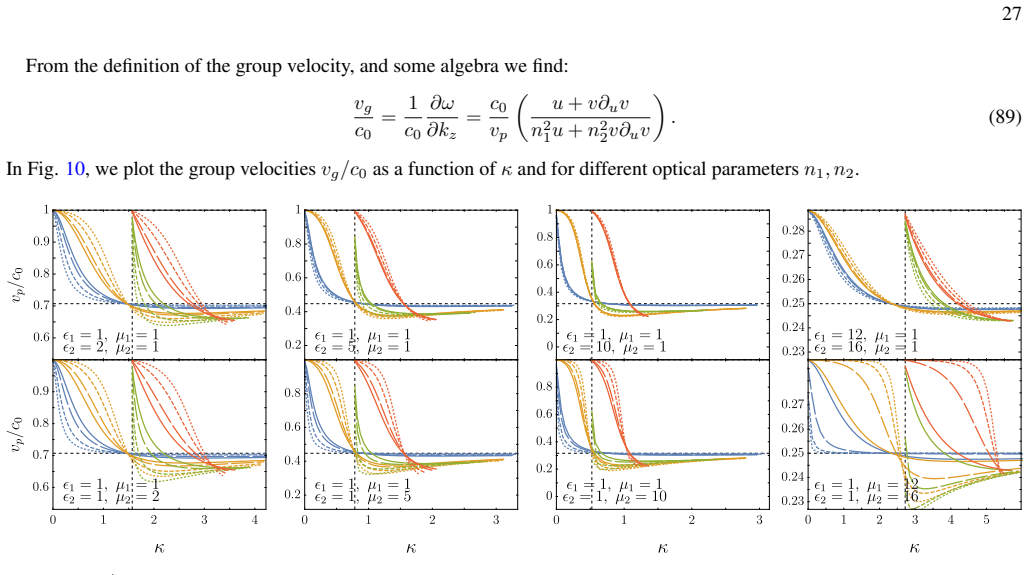
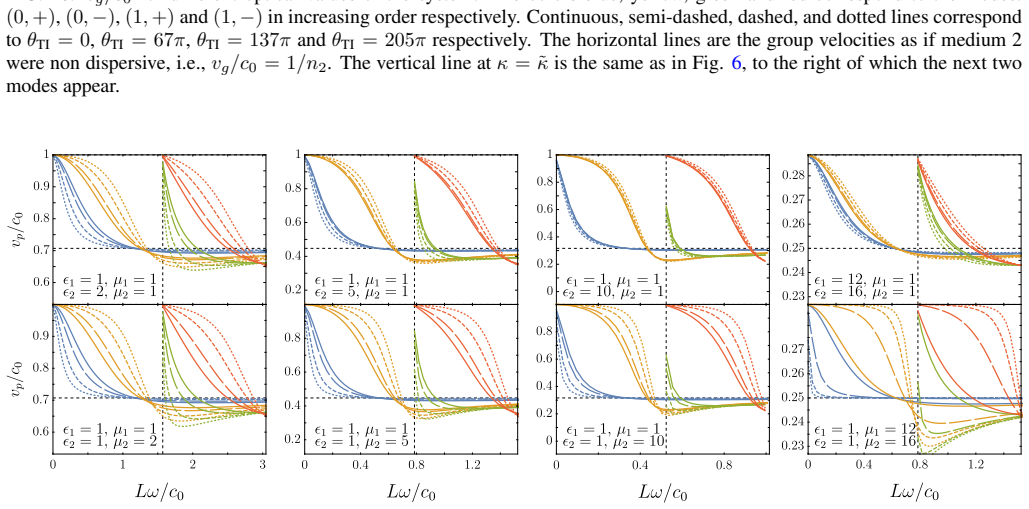
The linear dispersion relations of electromagnetic waves in homogeneous medium 1 and 2, i.e., ω = c0kz/n1 and ω = c0kz/n2 can be seen by the plots of constant minimum and maximum slopes, shown in thin black lines. The vertical line at κ = ˜κ is the same as in Fig. 6, to the right of which the next two modes appear. C. Numerical phase and group velocities ...
-
[8]
sin(2γ0L)]) , a1 = 2ϵ1 p γ3 1 ϵ2p ϵ2k0kz1[2(ϵ2 1γ1L + ϵ2 2 cot γ1L) − (ϵ2 2 − ϵ2
Show all 83 references
-
[9]
sin(2γ1L)]) , a2 = 2µ1 p γ3 2 µ2p k0kz2[2(µ2 1γ2L − µ2 2 tan γ2L) + (µ2 2 − µ2
-
[10]
sin(2γ2L)]) , a3 = 2ϵ1 p γ3 3 µ2p ϵ2k0kz3[2(ϵ2 1γ3L − ϵ2 2 tan γ3L) + (ϵ2 2 − ϵ2
-
[11]
transferred
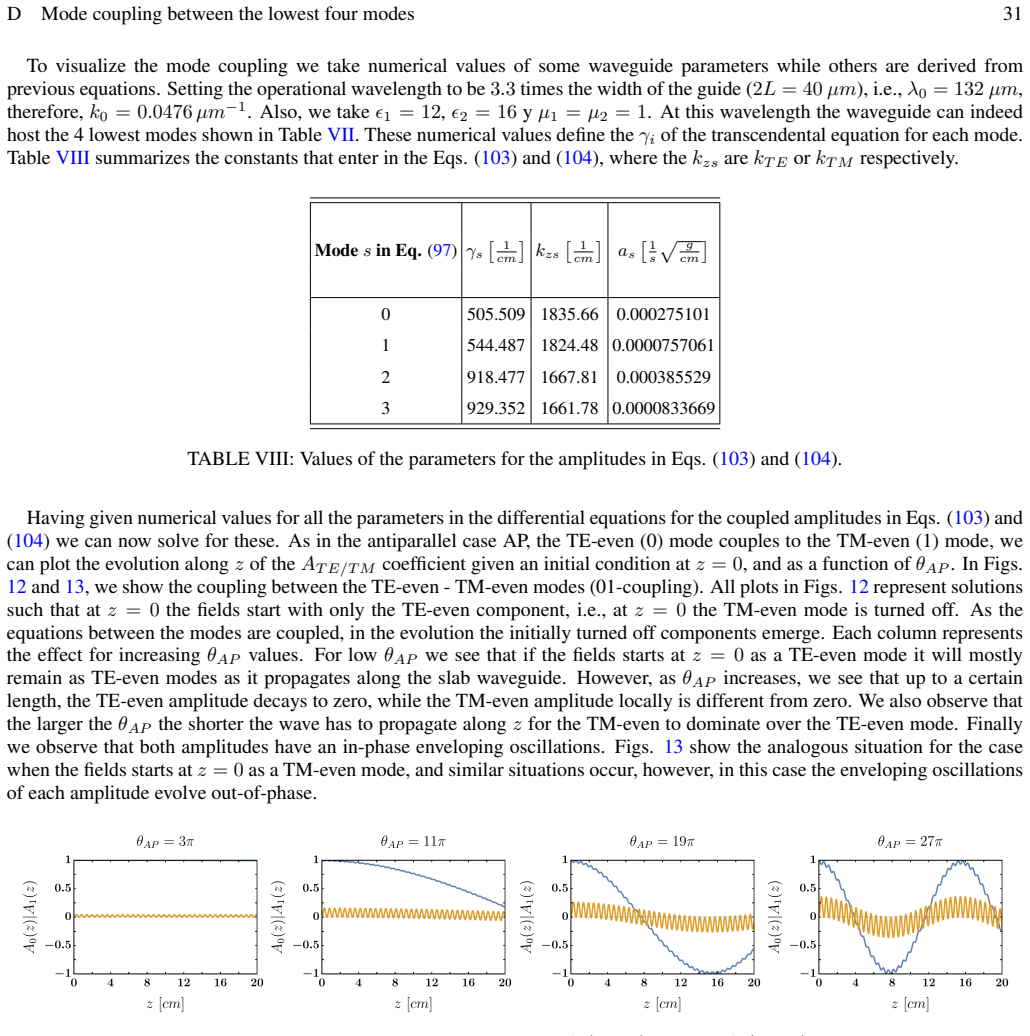
sin(2γ3L)]) . Replacing in Eq. (112), we get: ˜κ(AP) 01 = −a∗ 0a1 c0k0 8πγ0 ˜θAP cos γ0L sin γ1L, ˜κ(AP) 23 = a∗ 2a3 c0k0 8πγ2 ˜θAP cos γ3L sin γ2L. (116) D Mode coupling between the lowest four modes 31 To visualize the mode coupling we take numerical values of some waveguide...
2025
-
[12]
(135) C Explicit forms of the Θ-ED modes 35 B
≡ R2, (132) k2 ≡ k2 x + k2 y + k2 z = k2 ⊥ + k2 z, (133) k0 ≡ ω c0 = 2π λ0 , c 0 = 1/√ϵ0µ0, (134) k2 = k2 ⊥ + k2 z = k2 0µϵ. (135) C Explicit forms of the Θ-ED modes 35 B. Lorentz Reciprocity Theorem in Θ-ED Let us consider the curl equations of the fields for a specific mode,...
-
[13]
A relevant physical quantity is the EM power along the guide direction, Pz = 1 2 Z 1 µRe (E⊥ × B∗ ⊥) · ˆz ds
QTE-even-1 Mode The total EM field for the QTE-even mode labeled as p = 1 is, Ez1(x) = Be1 F+ −eα1(x+L) sin γ1L for x ≤ −L, sin γ1x for −L < x < L, e−α1(x−L) sin γ1L for x ≥ L, Bz1(x) = Be1 −ξ+eα1(x+L) sin γ1L for x ≤ −L, sin γ1x for −L < x < L, ξ+e−α1(x−L)...
-
[14]
The density power is, pz2 = E2 e2 k0kz2 2 sin2(γ2L) µ1α3 2 µ1ϵ1 + F2 −ξ2 − + (γ2L + sin(γ2L) cos(γ2L)) µ2γ3 2 µ2ϵ2 + F2 −
QTM-even-1 Mode The total EM field for the QTM-even mode labeled as p = 2 is, Ez2(x) = Ee2 −eα2(x+L) sin γ2L for x ≤ −L, sin γ2x for −L < x < L, e−α2(x−L) sin γ2L for x ≥ L, Bz2(x) = Ee2F− −ξ−eα2(x+L) sin γ2L for x ≤ −L, sin γ2x for −L < x < L, ξ−e−α2(x−L) ...
-
[15]
S. J. Orfanidis, Electromagnetic waves and antennas (Rutgers University New Brunswick, NJ, 2002). C Explicit forms of the Θ-ED modes 37
2002
-
[16]
B. E. Saleh and M. C. Teich, Fundamentals of photonics, 2 volume set (John Wiley & Sons, 2019)
2019
-
[17]
J. R. Rodrigues, U. D. Dave, A. Mohanty, X. Ji, I. Datta, S. Chaitanya, E. Shim, R. Gutierrez-Jauregui, V . R. Almeida, A. Asenjo-Garcia, and M. Lipson, All-dielectric scale invariant waveguide, Nature Communications14, 6675 (2023)
2023
-
[18]
Saeedkia and S
D. Saeedkia and S. Safavi-Naeini, Modeling and analysis of a multilayer dielectric slab waveguide with applications in edge-coupled terahertz photomixer sources, J. Lightwave Technol.25, 432 (2007)
2007
-
[19]
M. Wang, S. Uusitalo, C. Liedert, J. Hiltunen, L. Hakalahti, and R. Myllyl ¨a, Polymeric dual-slab waveguide interferometer for biochem- ical sensing applications, Appl. Opt. 51, 1886 (2012)
2012
-
[20]
A. M. Essin, J. E. Moore, and D. Vanderbilt, Magnetoelectric polarizability and axion electrodynamics in crystalline insulators, Phys. Rev. Lett. 102, 146805 (2009)
2009
-
[21]
Cao and S
T. Cao and S. Wang, Topological insulator metamaterials with tunable negative refractive index in the optical region, Nanoscale Research Letters 8, 526 (2013)
2013
-
[22]
Al `u and N
A. Al `u and N. Engheta, Dielectric sensing in -near-zero narrow waveguide channels, Phys. Rev. B78, 045102 (2008)
2008
-
[23]
Liang, H
X. Liang, H. Chen, and N. X. Sun, Magnetoelectric materials and devices, APL Materials 9, 041114 (2021), https://pubs.aip.org/aip/apm/article-pdf/doi/10.1063/5.0044532/19761246/041114 1 5.0044532.pdf
2021 doi
-
[24]
X.-L. Qi, T. L. Hughes, and S.-C. Zhang, Topological field theory of time-reversal invariant insulators, Physical Review B 78, 195424 (2008)
2008
-
[25]
Dziom, A
V . Dziom, A. Shuvaev, A. Pimenov, G. V . Astakhov, C. Ames, K. Bendias, J. B¨ottcher, G. Tkachov, E. M. Hankiewicz, C. Br¨une, H. Buh- mann, and L. W. Molenkamp, Observation of the universal magnetoelectric effect in a 3d topological insulator, Nature Communications 8, 15197 (2017)
2017
-
[26]
Ahn, S.-Y
J. Ahn, S.-Y . Xu, and A. Vishwanath, Theory of optical axion electrodynamics and application to the Kerr effect in topological antiferro- magnets, Nature Communications 13, 7615 (2022)
2022
-
[27]
J. A. Crosse, S. Fuchs, and S. Y . Buhmann, Electromagnetic Green’s function for layered topological insulators, Physical Review A 92, 063831 (2015)
2015
-
[28]
J. A. Crosse, Optical properties of topological-insulator Bragg gratings: Faraday-rotation enhancement for TM-polarized light at large incidence angles, Physical Review A 94, 033816 (2016)
2016
-
[29]
Mart ´ın-Ruiz, M
A. Mart ´ın-Ruiz, M. Cambiaso, and L. Urrutia, Green’s function approach to Chern-Simons extended electrodynamics: An effective theory describing topological insulators, Physical Review D 92, 125015 (2015)
2015
-
[30]
Mart ´ın-Ruiz, M
A. Mart ´ın-Ruiz, M. Cambiaso, and L. Urrutia, Electro- and magnetostatics of topological insulators as modeled by planar, spherical, and cylindrical boundaries: Green’s function approach, Physical Review D 93, 045022 (2016)
2016
-
[31]
Mart ´ın-Ruiz, M
A. Mart ´ın-Ruiz, M. Cambiaso, and L. Urrutia, Electromagnetic description of three-dimensional time-reversal invariant ponderable topo- logical insulators, Physical Review D 94, 085019 (2016)
2016
-
[32]
Mart ´ın-Ruiz, M
A. Mart ´ın-Ruiz, M. Cambiaso, and L. F. Urrutia, The magnetoelectric coupling in electrodynamics, International Journal of Modern Physics A 34, 1941002 (2019)
2019
-
[33]
M. Z. Hasan and C. L. Kane, Colloquium : Topological insulators, Reviews of Modern Physics 82, 3045 (2010)
2010
-
[34]
Lakhtakia, V
A. Lakhtakia, V . Varadan, and V . Varadan,Time-Harmonic Electromagnetic Fields in Chiral Media, Lecture Notes in Physics (Springer Berlin Heidelberg, 1989)
1989
-
[35]
Lindell, A
I. Lindell, A. Sihvola, S. Tretyakov, and A. Viitanen, English Electromagnetic waves in chiral and bi-isotropic media (Artech House, United Kingdom, 1994)
1994
-
[36]
A. H. Sihvola and I. V . Lindell, Bi-isotropic constitutive relations, Microwave and Optical Technology Letters 4, 295 (1991), https://onlinelibrary.wiley.com/doi/pdf/10.1002/mop.4650040805
1991 doi
-
[37]
T. G. Mackay and A. Lakhtakia, Chapter 3 electromagnetic fields in linear bianisotropic mediums, in Progress in Optics, Progress in optics (Elsevier, 2008) pp. 121–209
2008
-
[38]
D. L. Jaggard, A. R. Mickelson, and C. H. Papas, On electromagnetic waves in chiral media, Applied physics 18, 211 (1979)
1979
-
[39]
B. D. H. Tellegen, The gyrator, a new electric network element, Philips Research Reports 3, 81 (1948)
1948
-
[40]
E. O. Kamenetskii, Theory of bianisotropic crystal lattices, Phys. Rev. E 57, 3563 (1998)
1998
-
[41]
A. K. Saha, E. O. Kamenetskii, and I. Awai, Electric and magnetic polarization properties of ferrite magnetoelectric particles, Journal of Physics D: Applied Physics 35, 2484 (2002)
2002
-
[42]
Tretyakov, S
S. Tretyakov, S. Maslovski, I. Nefedov, A. Viitanen, P. Belov, and A. Sanmartin, EnglishArtificial tellegen particle, Electromagnetics23, 665 (2003)
2003
-
[43]
F. W. Hehl and Y . N. Obukhov, Linear media in classical electrodynamics and the post constraint, Physics Letters A334, 249 (2005)
2005
-
[44]
Sihvola and S
A. Sihvola and S. Tretyakov, Comments on boundary problems and electromagnetic constitutive parameters, Optik 119, 247 (2008)
2008
-
[45]
Lakhtakia and T
A. Lakhtakia and T. G. Mackay, Axions, surface states, and the post constraint in electromagnetics, in Nanostructured Thin Films VIII, V ol. 9558, edited by A. Lakhtakia, T. G. Mackay, and M. Suzuki, International Society for Optics and Photonics (SPIE, 2015) p. 95580C
2015
-
[46]
Lakhtakia and T
A. Lakhtakia and T. G. Mackay, Classical electromagnetic model of surface states in topological insulators, Journal of Nanophotonics10, 033004 (2016)
2016
-
[47]
Engheta and P
N. Engheta and P. Pelet, Modes in chirowaveguides, Opt. Lett. 14, 593 (1989)
1989
-
[48]
Pelet and N
P. Pelet and N. Engheta, The theory of chirowaveguides, IEEE Transactions on Antennas and Propagation 38, 90 (1990)
1990
-
[49]
Eftimiu and L
C. Eftimiu and L. W. Pearson, Guided electromagnetic waves in chiral media, Radio Science 24, 351
-
[50]
E. U. Condon, Theories of optical rotatory power, Rev. Mod. Phys. 9, 432 (1937)
1937
-
[51]
Cory and I
H. Cory and I. Rosenhous, Electromagnetic wave propagation along a chiral slab, IEEE PROCEEDINGS-H 138, 51 (1991)
1991
-
[52]
Oksanen, P
M. Oksanen, P. K. Koivisto, and I. V . Lindell, Dispersion curves and fields for a chiral slab waveguide, IEEE PROCEEDINGS-H 138, 327 (1991)
1991
-
[53]
Oksanen, P
M. Oksanen, P. Koivisto, and S. Tretyakov, Vector circuit method applied for chiral slab waveguides, Journal of Lightwave Technology 10, 150 (1992). C Explicit forms of the Θ-ED modes 38
1992
-
[54]
M. I. Oksanen, P. K. Koivisto, and S. A. Tretyakov, Plane chiral waveguides with boundary impedance conditions, Microwave and Optical Technology Letters 5, 68 (1992)
1992
-
[55]
A. Topa, C. Paiva, and A. Barbosa, Electromagnetic wave propagation in chiral h-guides, Progress In Electromagnetics Research 103, 285 (2010)
2010
-
[56]
P. K. Koivisto, S. A. Tretyakov, and M. I. Oksanen, Waveguides filled with general biisotropic media, Radio Science28, 675 (1993)
1993
-
[57]
J. R. Canto, C. Paiva, and A. Barbosa, Modal analysis of bi–isotropic h-guides, Progress In Electromagnetics Research 111, 1 (2011)
2011
-
[58]
J. A. Crosse, Theory of topological insulator waveguides: polarization control and the enhancement of the magneto-electric effect, Scientific Reports 7, 43115 (2017)
2017
-
[59]
Talebi, Optical modes in slab waveguides with magnetoelectric effect, Journal of Optics 18, 055607 (2016)
N. Talebi, Optical modes in slab waveguides with magnetoelectric effect, Journal of Optics 18, 055607 (2016)
2016
-
[60]
F. D. M. Haldane, Fractional quantization of the Hall effect: A hierarchy of incompressible quantum fluid states, Phys. Rev. Lett.51, 605 (1983)
1983
-
[61]
vortices
F. D. M. Haldane and L. Chen, Magnetic flux of “vortices” on the two-dimensional Hall surface, Phys. Rev. Lett.53, 2591 (1984)
1984
-
[62]
J. M. Kosterlitz and D. J. Thouless, Ordering, metastability and phase transitions in two-dimensional systems, Journal of Physics C: Solid State Physics 6, 1181 (1973)
1973
-
[63]
R. B. Laughlin, Quantized Hall conductivity in two dimensions, Phys. Rev. B 23, 5632 (1981)
1981
-
[64]
D. J. Thouless, M. Kohmoto, M. P. Nightingale, and M. den Nijs, Quantized Hall conductance in a two-dimensional periodic potential, Phys. Rev. Lett. 49, 405 (1982)
1982
-
[65]
C. L. Kane and E. J. Mele, Z2 topological order and the quantum spin hall effect, Phys. Rev. Lett. 95, 146802 (2005)
2005
-
[66]
B. A. Bernevig, T. L. Hughes, and S.-C. Zhang, Quantum spin Hall effect and topological phase transition in HgTe quantum wells, Science 314, 1757 (2006), https://www.science.org/doi/pdf/10.1126/science.1133734
2006 doi
-
[67]
J. E. Moore and L. Balents, Topological invariants of time-reversal-invariant band structures, Phys. Rev. B75, 121306 (2007)
2007
-
[68]
L. Fu, C. L. Kane, and E. J. Mele, Topological insulators in three dimensions, Phys. Rev. Lett. 98, 106803 (2007)
2007
-
[69]
Fu and C
L. Fu and C. L. Kane, Topological insulators with inversion symmetry, Phys. Rev. B 76, 045302 (2007)
2007
-
[70]
Qi and S.-C
X.-L. Qi and S.-C. Zhang, Topological insulators and superconductors, Rev. Mod. Phys. 83, 1057 (2011)
2011
-
[71]
Y . L. Chen, J. G. Analytis, J.-H. Chu, Z. K. Liu, S.-K. Mo, X. L. Qi, H. J. Zhang, D. H. Lu, X. Dai, Z. Fang, S. C. Zhang, I. R. Fisher, Z. Hussain, and Z.-X. Shen, Experimental realization of a three-dimensional topological insulator, Bi 2Te3, Science 325, 178 (2009), https:...
2009 doi
-
[72]
Hsieh, D
D. Hsieh, D. Qian, L. Wray, Y . Xia, Y . S. Hor, R. J. Cava, and M. Z. Hasan, A topological Dirac insulator in a quantum spin Hall phase, Nature 452, 970 (2008)
2008
-
[73]
T. Sato, K. Segawa, H. Guo, K. Sugawara, S. Souma, T. Takahashi, and Y . Ando, Direct evidence for the Dirac-cone topological surface states in the ternary chalcogenide TlBiSe2, Phys. Rev. Lett. 105, 136802 (2010)
2010
-
[74]
Y . Xia, D. Qian, D. Hsieh, L. Wray, A. Pal, H. Lin, A. Bansil, D. Grauer, Y . S. Hor, R. J. Cava, and M. Z. Hasan, Observation of a large-gap topological-insulator class with a single Dirac cone on the surface, Nature Physics 5, 398 (2009)
2009
-
[75]
Zhang, C.-X
H. Zhang, C.-X. Liu, X.-L. Qi, X. Dai, Z. Fang, and S.-C. Zhang, Topological insulators in Bi 2Se3, Bi 2Te3 and Sb2Te3 with a single Dirac cone on the surface, Nature Physics 5, 438 (2009)
2009
-
[76]
B. D. Tellegen, The gyrator, a new electric network element, Philips Res. Rep 3, 81 (1948)
1948
-
[77]
Visinelli, Axion-Electromagnetic Waves, Modern Physics Letters A 28, 1350162 (2013), arXiv:1401.0709 [hep-ph, physics:hep-th, physics:physics]
L. Visinelli, Axion-Electromagnetic Waves, Modern Physics Letters A 28, 1350162 (2013), arXiv:1401.0709 [hep-ph, physics:hep-th, physics:physics]
2013
-
[78]
A. H. Gomes, J. M. Fonseca, W. A. Moura-Melo, and A. R. Pereira, Testing CPT- and Lorentz-odd electrodynamics with waveguides, Journal of High Energy Physics 2010, 104 (2010)
2010
-
[79]
J. D. Jackson, Classical Electrodynamics (Wiley, 1998)
1998
-
[80]
Dvorquez, B
E. Dvorquez, B. Pavez, Q. Sun, F. Pinto, A. D. Greentree, B. C. Gibson, and J. R. Maze, Perfect conductor and mu-metal enhancement of effects in electromagnetic fields over single emitters near topological insulators, Phys. Rev. B110, 165405 (2024)
2024
-
[81]
Filipini and M
S. Filipini and M. Cambiaso, Polarization rotation and exact transverse electromagnetic wave solutions in topological insulators, Phys. Rev. B 109, 235108 (2024)
2024
-
[82]
Ibanescu, Y
M. Ibanescu, Y . Fink, S. Fan, E. L. Thomas, and J. D. Joannopoulos, An All-Dielectric Coaxial Waveguide, Science289, 415 (2000)
2000
-
[83]
P. B. Catrysse and S. Fan, Transverse Electromagnetic Modes in Aperture Waveguides Containing a Metamaterial with Extreme Anisotropy, Physical Review Letters 106, 223902 (2011)
2011
Reviewed June 25, 2026 · model on record in the stance chip above.
Discussion (0). Continue with ORCID to comment.