Bridging Theory and Observation in the SKA Era: A Cosmological Polarized Radiative Transfer Framework for Point-to-Point Polarized Sky Comparisons
Pith reviewed 2026-06-25 22:47 UTC · model grok-4.3
The pith
The CPRT formalism provides a common framework for observers, theorists, and simulators to compare SKA polarized sky data with models of cosmic magnetism.
A machine-rendered reading of the paper's core claim, the machinery that carries it, and where it could break.
Core claim
The CPRT formalism -- derived from fundamental conservation laws and incorporating relativistic, cosmological, and full radiative-transfer effects -- provides a robust platform and a common framework for observers, theorists, and simulation experts to pursue shared scientific goals. Observers gain synthetic templates to interpret RM grids and polarization maps; theorists can directly confront models of magnetogenesis and magnetic-field evolution with data; and simulation experts obtain a post-processing tool to transform cosmological magneto-hydrodynamic (MHD) outputs into observable skies. Furthermore, CPRT serves as a powerful testbed when traditional RM-based methods reach their limitatio
What carries the argument
The CPRT formalism, a cosmological polarized radiative transfer framework derived from conservation laws that incorporates relativistic, cosmological, and full radiative-transfer effects for point-to-point sky comparisons.
If this is right
- Observers obtain synthetic templates for interpreting RM grids and polarization maps from SKA data.
- Theorists can directly test models of magnetogenesis and magnetic-field evolution against observations.
- Simulation experts gain a post-processing tool that converts cosmological MHD outputs into observable polarized skies.
- CPRT acts as a testbed for interpreting complex Faraday spectra and disentangling multiple intervening magnetized media.
Where Pith is reading between the lines
- The formalism could enable joint analysis of rotation measure, dispersion measure, synchrotron emission, and dust polarization to build a unified view of the magneto-ionic universe.
- Implementation in large-scale simulations would allow statistical forecasts of how magnetic fields evolve with redshift across wide sky areas.
- Extension to other frequency bands might reveal whether the same conservation-law foundation holds for non-SKA instruments probing different cosmic epochs.
Load-bearing premise
A single formalism derived from conservation laws can capture all relevant effects in an evolving universe without missing physics or needing case-by-case approximations for complex SKA Faraday spectra and multi-component media.
What would settle it
A calculation in which CPRT-generated Faraday spectra for a known multi-layer magnetized region deviate systematically from high-resolution SKA observations of that same region would show the formalism does not serve as a complete common framework.
Figures
read the original abstract
Realizing the full scientific potential of the SKA requires not only revolutionary instrumentation but also accurate modeling of light propagation in an evolving, expanding Universe, in order to translate intensity and polarization data into physical insight about magnetic fields and cosmic plasma. When all-sky cosmological polarized radiative transfer (CPRT) calculations meets SKA observations, theory and data interlock to deliver a predictive, and testable picture of the evolving magneto-ionic Universe. This synergy transforms polarization observations -- assembled into empirical maps of diffuse emission and rotation-measure (RM) grids of discrete sources -- from descriptive data products into powerful astrophysical probes, advancing our understanding of cosmic magnetism across space and time. The CPRT formalism -- derived from fundamental conservation laws and incorporating relativistic, cosmological, and full radiative-transfer effects -- provides a robust platform and a common framework for observers, theorists, and simulation experts to pursue shared scientific goals. Observers gain synthetic templates to interpret RM grids and polarization maps; theorists can directly confront models of magnetogenesis and magnetic-field evolution with data; and simulation experts obtain a post-processing tool to transform cosmological magneto-hydrodynamic (MHD) outputs into observable skies. Furthermore, CPRT serves as a powerful testbed when traditional RM-based methods reach their limitations -- for example, in interpreting complex Faraday spectra, disentangling multiple intervening magnetized media, or achieving a coherent picture when diverse observational diagnostics -- such as dispersion measure, synchrotron emission and spectral index, and dust polarization -- are combined.
Editorial analysis
A structured set of objections, weighed in public.
Referee Report
Summary. The paper presents a Cosmological Polarized Radiative Transfer (CPRT) formalism, derived from fundamental conservation laws, that incorporates relativistic, cosmological, and full radiative-transfer effects. It is positioned as a common framework enabling observers to generate synthetic templates for RM grids and polarization maps, theorists to test magnetogenesis models, and simulators to post-process MHD outputs into observable skies, particularly for addressing limitations of traditional RM methods in complex Faraday spectra and multi-component media in the SKA era.
Significance. If the derivation holds and the framework is general without hidden approximations, the CPRT approach would supply a valuable unified platform for point-to-point theory-observation comparisons in polarized cosmology. It directly addresses the need for handling evolving magneto-ionic media and multi-diagnostic combinations (RM, dispersion measure, synchrotron, dust polarization), potentially advancing SKA science on cosmic magnetism beyond descriptive data products.
minor comments (3)
- The abstract and introduction repeatedly state that the formalism is 'derived from fundamental conservation laws,' but §2 (or equivalent derivation section) should explicitly identify the starting equation (e.g., the polarized RTE in curved spacetime) and show the augmentation steps for cosmological expansion and Faraday terms to allow readers to verify consistency with existing literature.
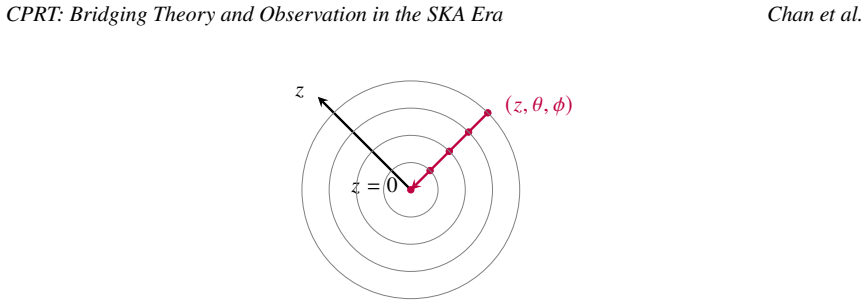
- Figure 1 (schematic of the CPRT pipeline) and any accompanying equations lack labels for the specific radiative-transfer operators or coordinate choices; adding these would improve clarity for simulation experts intending to use the framework as post-processing.
- The discussion of limitations of traditional RM methods (e.g., complex Faraday spectra) would benefit from a short table comparing CPRT predictions against at least one existing code or analytic limit to demonstrate the claimed generality.
Simulated Author's Rebuttal
We thank the referee for the positive assessment of the CPRT formalism and the recommendation for minor revision. No specific major comments were provided in the report.
Circularity Check
No significant circularity; derivation from standard equations
full rationale
The paper's central claim is that the CPRT formalism is derived from fundamental conservation laws and the standard polarized radiative transfer equation in curved spacetime, augmented with cosmological and Faraday terms in a manner consistent with existing literature. No load-bearing step reduces by construction to a fitted parameter, self-definition, or self-citation chain; the derivation is presented as an augmentation of established equations rather than a renaming or tautological prediction. The provided structure shows no internal reduction of outputs to inputs, making the framework self-contained against external benchmarks.
Axiom & Free-Parameter Ledger
axioms (1)
- standard math Fundamental conservation laws of physics apply to polarized radiative transfer in an expanding universe
Reference graph
Works this paper leans on
-
[1]
doi: 10.1093/mnras/sty400. R. Beck.Astron. Astrophys., 578:A93, June
-
[2]
doi: 10.1051/0004-6361/201425572. M. A. Brentjens and A. G. de Bruyn.Astron. Astrophys., 441(3):1217–1228, Oct
-
[3]
doi: 10.1051/0004-6361:20052990. M. Brüggen, S. O’Sullivan, A. Bonafede, and F. Vazza. InIAU General Assembly, pages 303–306, Mar
-
[4]
G.L.Bryanetal.Astrophys.J.Suppl.Ser.,211(2):19,Apr.2014.doi: 10.1088/0067-0049/211/2/19
doi: 10.1017/S1743921319004460. G.L.Bryanetal.Astrophys.J.Suppl.Ser.,211(2):19,Apr.2014.doi: 10.1088/0067-0049/211/2/19. B. J. Burn.Mon. Not. R. Astron. Soc., 133:67, Jan
-
[5]
doi: 10.1093/mnras/133.1.67. M. Carcamo et al. InAdvancing Astrophysics with the SKA – II (AASKAII)
-
[7]
doi: 10.3847/1538-4357/ac94ce. I. Farmakis and M. A. Moskowitz.Fixed point theorems and their applications. World Scientific Publishing, Singapore,
-
[8]
B.M.Gaensleretal.Publ.Astron.Soc.Aust.,42:e091,June2025
doi: 10.1051/0004-6361:20065371. B.M.Gaensleretal.Publ.Astron.Soc.Aust.,42:e091,June2025. doi: 10.1017/pasa.2025.10031. M.Haverkorn. InA.Lazarian,E.M.deGouveiaDalPino,andC.Melioli,editors,MagneticFields in Diffuse Media, volume 407 ofAstrophysics and Space Science Library, page 483, Jan
-
[9]
doi: 10.1007/978-3-662-44625-6_17. I. Heywood et al.Astrophys. J., 925(2):165, Feb
-
[10]
doi: 10.3847/1538-4357/ac449a. J.JonasandMeerKATTeam. InMeerKATScience: OnthePathwaytotheSKA,page1,Jan.2016. doi: 10.22323/1.277.0001. T. W. Jones and S. L. O’Dell.Astrophys. J., 214:522, June
-
[11]
doi: 10.1086/155278. E. Lenc et al.Astrophys. J., 830(1):38, Oct
-
[12]
doi: 10.3847/0004-637X/830/1/38. F. Loi et al. InAdvancing Astrophysics with the SKA – II (AASKAII)
-
[13]
Y.K.Maetal
arXiv search: Report number AASKAII/Loi01. Y.K.Maetal. InAdvancingAstrophysicswiththeSKA–II(AASKAII).2026. arXivsearch: Report number AASKAII/Ma01. S. A. Mao et al. InAdvancing Astrophysics with the SKA – II (AASKAII)
2026
-
[15]
doi: 10.1017/pasa.2020.41. D. Michilli et al.Nature, 553(7687):182–185, Jan
-
[16]
doi: 10.1038/nature25149. R. P. Norris et al.Mon. Not. R. Astron. Soc., 537(1):L42–L48, Feb
-
[17]
doi: 10.1093/mnrasl/ slae114. L. Oberhelman et al.Mon. Not. R. Astron. Soc., Feb
-
[18]
doi: 10.1093/mnras/stag394. A. Y. L. On et al.Mon. Not. R. Astron. Soc., 490(2):1697–1713, Dec
-
[20]
doi: 10.1111/j. 1365-2966.2012.20554.x. S.P.O’Sullivanetal. InAdvancingAstrophysicswiththeSKA–II(AASKAII).2026. arXivsearch: Report number AASKAII/OSullivan01. 12 CPRT: Bridging Theory and Observation in the SKA Era Chan et al. A. G. Pacholczyk.Radio galaxies: Radiation transfer, dynamics, stability and evolution of a synchrotron plasmon. Pergamon Press, Oxford,
work page doi:10.1111/j 2012
-
[22]
doi: 10.3847/1538-4357/ad40aa. A. Pandhi et al.Astrophys. J., 982(2):146, Apr
-
[23]
J.A.Peacock.CosmologicalPhysics
doi: 10.3847/1538-4357/adb8e3. J.A.Peacock.CosmologicalPhysics. CambridgeAstrophysics.CambridgeUniv.Press,Jan.1999. ISBN 9780521422703. A. Pillepich et al.Mon. Not. R. Astron. Soc., 473(3):4077–4106, Jan
-
[24]
doi: 10.1093/mnras/ stx2656. D. Ryu, H. Kang, J. Cho, and S. Das.Science, 320(5878):909, May
-
[25]
doi: 10.1126/science. 1154923. T. W. Shimwell et al.Astron. Astrophys., 598:A104, Feb
-
[28]
doi: 10.1111/j.1365-2966. 2009.15715.x. R. M. Starr.The Brouwer Fixed-Point Theorem, page 99–108. Cambridge University Press, Cambridge, second edition,
-
[29]
doi: 10.1017/CBO9780511975356.014. K. Subramanian.Reports on Progress in Physics, 79(7):076901, July
-
[30]
F.S.Tabatabaeietal
arXiv search: Report number AASKAII/Sun01. F.S.Tabatabaeietal. InAdvancingAstrophysicswiththeSKA–II(AASKAII).2026. arXivsearch: Report number AASKAII/Tabatabaei01. M. Tahani et al. InAdvancing Astrophysics with the SKA – II (AASKAII)
2026
-
[31]
A.R.TaylorandL.S.Legodi.Astron.J.,167(6):273,June2024
arXiv search: Report number AASKAII/Tahani01. A.R.TaylorandL.S.Legodi.Astron.J.,167(6):273,June2024. doi: 10.3847/1538-3881/ad4150. R. Teyssier.Astron. Astrophys., 385:337–364, Apr
-
[32]
13 CPRT: Bridging Theory and Observation in the SKA Era Chan et al
doi: 10.1051/0004-6361:20011817. 13 CPRT: Bridging Theory and Observation in the SKA Era Chan et al. S. J. Tingay et al.Publ. Astron. Soc. Aust., 30:e007, Jan
-
[33]
doi: 10.1017/pasa.2012.007. V. Vacca et al. InAdvancing Astrophysics with the SKA – II (AASKAII). 2026a. arXiv search: Report number AASKAII/Vacca01. V. Vacca et al. InAdvancing Astrophysics with the SKA – II (AASKAII). 2026b. arXiv search: Report number AASKAII/Vacca02. C.L.VanEcketal.Astrophys.J.Suppl.Ser.,283(1):28,Mar.2026.doi: 10.3847/1538-4365/ae3de...
-
[34]
Planck Collaboration et al.Astron
doi: 10.1051/0004-6361/ 201220873. F.Vazza,M.Brüggen,C.Gheller,andP.Wang.Mon.Not.R.Astron.Soc.,445(4):3706–3722,Dec
-
[35]
F.Vazza,G.Brunetti,M.Brüggen,andA.Bonafede.Mon.Not.R.Astron.Soc.,474(2):1672–1687, Feb
doi: 10.1093/mnras/stu1896. F.Vazza,G.Brunetti,M.Brüggen,andA.Bonafede.Mon.Not.R.Astron.Soc.,474(2):1672–1687, Feb
-
[36]
doi: 10.1093/mnras/stx2830. H. Xu et al.Nature, 609(7928):685–688, Sept
-
[37]
doi: 10.1038/s41586-022-05071-8. 14
discussion (0)
Sign in with ORCID, Apple, or X to comment. Anyone can read and Pith papers without signing in.