REVIEW 4 major objections 4 minor 20 references
Topological Interpretation of Interactive Computation
T0 review · 4 major / 4 minor · reviewed 2026-08-14 · deepseek-v4-flash
Pith's one-line read A topological Turing machine, built from persistent Turing machine streams and topology-preserving transformations of a simplicial environment, is claimed to be a universal model for interactive and concurrent computation.
desk verdict A genuinely new but radically under-specified topological proposal for interactive computation; the central theorem is not yet well-formed. read the letter →
The pith
A machine-rendered reading of the paper's core claim, the machinery that carries it, and where it could break.
The reading
What carries the argument
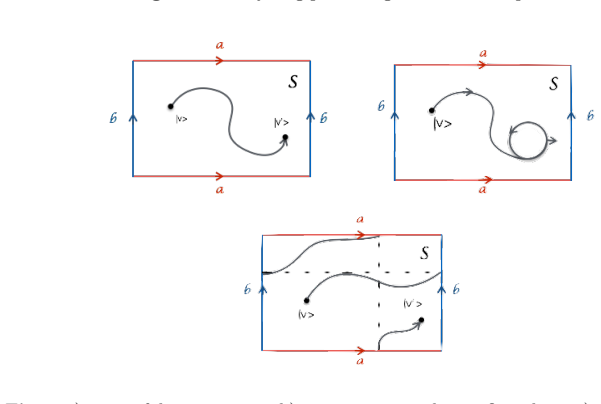
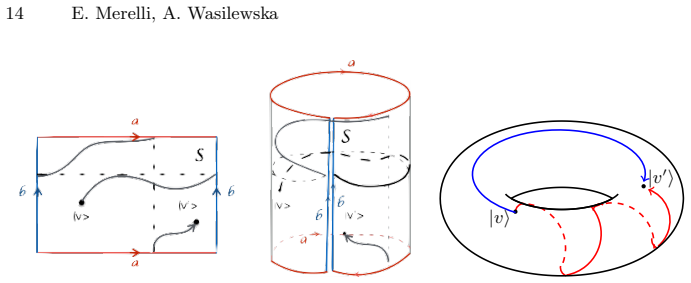
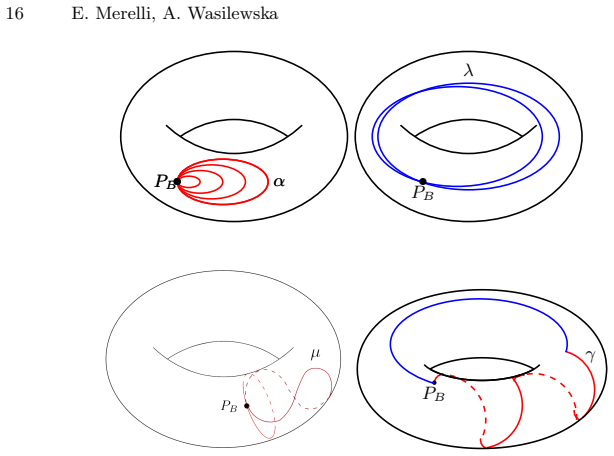
The central object is the gauge group $G = G_{AP} \wedge G_{MC}$: the semi-direct product of the group of PTM interaction streams ($G_{AP}$) and the simplicial analog of the mapping class group ($G_{MC}$), the transformations of the simplicial environment that preserve its topology. This group is realized through a fiber bundle with base space $B$ (input/output strings embedded in a simplicial complex $S_P$), fiber $H$ (all possible computations), and total space $G$; the projection $\pi$ maps total configurations down to feasible paths on the base, where holes in the topology mark relations that are locally consistent but globally inconsistent. The machinery uses persistent homology over PTM configurations to build $S_P$ and path algebra or quiver representations to generate the group.
What would settle it
Construct two interactive machines whose configuration spaces produce simplicial complexes with identical homology groups but that, under the same environment, admit different sets of feasible interaction streams; if such a pair exists, the claim that holes fully encode infeasibility fails and Theorem 4 does not follow.
Extended reading notes
Core claim
The paper's central claim is that a topological Turing machine (TTM)—formed as the group $G = G_{AP} \wedge G_{MC}$ generated by the interaction streams of persistent Turing machines together with topology-preserving transformations of a simplicial environment—is a universal model for interactive computation: any constrained interactive computation is effective for a TTM (Theorem 4), and any concurrent computation can be performed by a TTM (Thesis 2). The argument identifies the environment's constraints with the topological invariants—$n$-dimensional holes, genus, and path structure—of a simplicial complex $S_P$ built over PTM configurations, and treats a computation as a path in that space. The paper also interprets contextuality, locally consistent but globally inconsistent data, as the topological obstruction that distinguishes effective computation from interactive computation.
Load-bearing premise
The whole construction assumes that the constraints an environment places on computation are faithfully captured by the topology of the simplicial complex built over the machine's configurations—holes and genus marking exactly which input-output relations are impossible.
Editorial extensions
If this is right
- Interactive computation becomes a topological phenomenon: feasible computations correspond to paths that avoid holes, while deadlock corresponds to hitting a boundary of the configuration space.
- Combined with the known isomorphism between PTMs and interactive transition systems, Theorem 4 yields a topological model that is universal for sequential interactive computation.
- Concurrent computation is captured by streams of interactions shared over a common topological environment, appearing in higher dimensions as braid-like structures.
- Contextuality—families of data that are locally consistent but globally inconsistent—is represented by the topology of the environment and serves to distinguish effective computation from interactive computation.
- If the TTM group is automatic, the associated language is regular, linking topological structure directly to formal-language syntax and semantics.
Reading between the lines
- If the encoding of constraints by homology is correct, one could predict infeasible input-output relations of an interactive system solely by computing persistent homology of its configuration space, without simulating the computation.
- The gauge-group treatment suggests that different environments are not just different mappings but different topological structures, so machine equivalence becomes environment-dependent in a stronger sense than an observer-based partitioning.
- The braid-stream picture hints at a testable bridge to topological quantum computation: TTMs sharing an environment could be realized as braid representations, and known topological quantum invariants might correspond to constrained computations.
- A concrete extension would be to implement the construction on small PTMs to compute $S_P$ and its homology, then check whether divergent or deadlocked computations correspond to non-null-homotopic loops; this would move the model from interpretive to predictive.
Signed reviews
Editorial analysis
A structured set of objections, weighed in public.
Referee Report
Summary. The paper revisits the persistent Turing machine (PTM) model of Goldin and Smolka and proposes a topological generalization. The environment of a PTM is modeled as a simplicial complex SP built over the machine's configurations at each step, and a topological Turing machine (TTM) is defined as a gauge group G = GAP ∧ GMC, informally the semi-direct product of a group of PTMs and a simplicial analog of the mapping class group. The main claims are Theorem 4, that every constrained interactive computation is an effective computation for a TTM, and Thesis 2, that every concurrent computation can be performed by a TTM. The paper also recalls earlier PTM results, discusses persistent homology and path algebras as tools for representing constraints, and includes an appendix with standard definitions from algebraic and computational topology.
Significance. If the proposed formalization could be made rigorous, the paper would offer an original bridge between topological data analysis and models of interactive and concurrent computation, potentially giving a topological account of when an interaction is feasible. The paper has genuine strengths: it clearly motivates the need to represent the environment explicitly, it correctly situates the PTM in the literature on interaction, and it provides the relevant topological background in an appendix. The authors also honestly state that full formalization is left as future work. However, in its current form the central definitions are informal and the main theorems are unproved, so the paper functions as a position statement rather than a demonstrated technical result.
major comments (4)
- [Definition 7, Section 3] Definition 7 identifies a TTM with the group G = GAP ∧ GMC, but the constituent objects are not defined with enough precision for the definition to be operational. GAP is called 'the group of PTMs' although PTMs are machines, not group elements; GMC is called 'the simplicial analog of the mapping class group' without a precise construction; and ∧ is only informally described as a semi-direct product. No alphabet, generating set, configuration space, transition relation, or acceptance condition is specified for G. Consequently, the phrase 'effective computation for a TTM' in Theorem 4 has no formal semantics.
- [Theorem 4 and Thesis 2, Section 3] Theorem 4 and Thesis 2 are stated without proof, and Section 1 explicitly says 'We leave the formal definition and full formalization of the theory corresponding to the group of computations for an evolving environment as future work.' Since Theorem 4 depends on the undefined notion of a TTM from Definition 7, the claimed universality result is not established. Moreover, because a TTM is defined as the group of all interaction streams generated by PTMs together with environment transformations, Theorem 4 is close to being true by construction; an independent, non-circular characterization is needed.
- [Definition 6 and Figure 1, Section 3] The load-bearing premise of the paper is that the feasibility constraints of an environment are faithfully encoded by the topology of the simplicial complex SP, specifically by its n-dimensional holes, genus, and path structure. This premise is assumed rather than proved: no argument is given that infeasible input-output relations correspond exactly to homology classes or to non-contractible paths. Since the gauge group G is built from this same space, the correspondence between topological invariants and computational constraints must be established before Theorem 4 or Thesis 2 can be derived.
- [Proposition 1, Section 3] Proposition 1 states that if G is automatic then the associated language L is regular, and asserts that the syntax of L is contained in T and its semantics in M. Even if this conditional is accepted, regularity is far too weak to support the claimed universality over all constrained interactive computations. The paper does not show that G is automatic, nor does it show that the language of paths of SP is the language accepted by G, so Proposition 1 does not provide a bridge from the topological construction to Theorem 4.
minor comments (4)
- [Section 2, opening paragraph] The paragraph begins 'n this section', which appears to be a typo for 'In this section'.
- [References] Some reference titles are heavily abbreviated, e.g. 'Why Intera. is More P Than Algorit.' and 'Churchs Thesis and Principles for Mechanisms', and the MathOverflow URL contains a non-ASCII 'fl' ligature in 'mathoverflow'; these should be cleaned up.
- [Figure 6 and surrounding text] The text says the space S is 'homomorphic to 2-manifold with boundary'; the intended term is 'homeomorphic'.
- [Figure 2 caption] The caption lists 'a) homotopic paths a∼b' while the text discusses paths that are not homotopic in part (c); the labeling could be clarified to avoid confusion.
Circularity Check
Theorem 4 is true by construction: constrained interactive computations are defined as paths of SP, and the TTM is defined as the group of all interaction streams over that same SP.
-
self definitional
[Section 3, Definition 7, Definition 8, Theorem 4]
"Definition 7 (Topological Turing machine) A Topological Turing machine (TTM) is a group G consisting of all interaction streams generated by the group of PTMs entangled with the group of all transformations of the topological space SP preserving the topology. Formally G =GAP∧GMC. [...] Definition 8 (Constrained interactive computation) An interactive computation is constrained if it is defined over a topological space SP and it is an element of the language of paths of SP. Theorem 4 Any constrained interactive computation is an effective computation for a TTM."
Definition 8 defines the theorem's antecedent as membership in the language of paths of SP, and earlier the paper states 'The path can be semantically interpreted as an interaction stream.' Definition 7 defines a TTM as the group of all interaction streams generated by PTMs entangled with topology-preserving transformations of that same SP. Thus the conclusion of Theorem 4, that every constrained interactive computation is effective for a TTM, is not derived through an independent computational semantics: the objects quantified over in the antecedent are exactly the objects placed inside the TTM by stipulation.
full rationale
The paper's first part is largely a faithful recollection of the external Goldin–Smolka PTM/ITS results (Theorems 1, 2, Thesis 1) and standard algebraic topology (Appendix 1), and those parts are not circular. The circularity enters at the top-level universality claim. A constrained interactive computation is defined (Definition 8) as an element of the language of paths of SP, and paths are earlier identified with interaction streams; a TTM is then defined (Definition 7) as the group of all interaction streams generated by PTMs entangled with the topology-preserving transformations of the same SP. Under these definitions, Theorem 4 announces that every constrained interactive computation is an effective computation for a TTM. Since no independent formal semantics for effectiveness of the group G = GAP ∧ GMC is given, and the paper explicitly defers that formalization to future work, the theorem cannot fail: its antecedent is packed into its definiens. Thesis 2 is an unsupported assertion without a derivation, but that is a correctness gap rather than a circular reduction. Because the topological-environment construction and the recalled PTM-ITS material have independent mathematical content, the circularity is confined to the central universality claim, which supports a moderate score rather than a maximal one.
Assumptions & free parameters
assumptions (5)
- domain assumption Persistent Turing machines capture sequential interactive computation (Thesis 1 of Goldin/Smolka, restated as Thesis 1).
- ad hoc to paper The environment at step i is representable as a simplicial complex SPi over the set of PTM configurations Pi (Definition 6).
- ad hoc to paper Topological invariants of SP, such as n-dimensional holes and genus, correspond exactly to feasibility constraints on interactive computations.
- ad hoc to paper The gauge group G = GAP ∧ GMC, a semi-direct product of the computation group and the simplicial mapping class group, faithfully represents the joint evolution of machine and environment (Definition 7).
- domain assumption The classical Turing machine corresponds to a state space with invariant topology, and interactive computation is non-linear because of the topology of the base space and the semi-direct product factorization.
invented entities (3)
-
Topological Turing machine (TTM)
-
Topological environment SP
-
Gauge group G = GAP ∧ GMC
Cite this review
Pith. "Pith review of Topological Interpretation of Interactive Computation." pith.science (2026). https://pith.science/paper/QCXSIMWR
@misc{pith2026190804264,
  author       = {Pith},
  title        = {Pith review of: Topological Interpretation of Interactive Computation},
  year         = {2026},
  howpublished = {\url{https://pith.science/paper/QCXSIMWR}},
  note         = {Machine review of arXiv:1908.04264}
}
read the original abstract
It is a great pleasure to write this tribute in honor of Scott A. Smolka on his 65th birthday. We revisit Goldin, Smolka hypothesis that persistent Turing machine (PTM) can capture the intuitive notion of sequential interaction computation. We propose a topological setting to model the abstract concept of environment. We use it to define a notion of a topological Turing machine (TTM) as a universal model for interactive computation and possible model for concurrent computation.
Figures


Figures from the paper (4 more)

Reference graph
Works this paper leans on
-
[1]
D.Q. Goldin, S.A. Smolka, P.C. Attie, E.L. Sondereggera. Turing machines, transi- tion systems, and interaction. Information and Computation 194, 2004. - ENTCS Topological Interpretation of Interactive Computation 17 Vol. 52, No. 1, Elsevier, 2001
work page 2004
-
[2]
D. Goldin. Persistent Turing Machines as a Model of Interactive Computation. LNCS, Vol.1762, Springer, 2000
work page 2000
-
[3]
D.Q. Goldin, S.A. Smolka, P. Wegner. Interacting Computation: The new paradigm. Springer, 2006
work page 2006
-
[4]
P. Wegner. Why Intera. is More P Than Algorit. CACM, Vol. 40, No.5, ACM, 1997
work page 1997
-
[5]
P. Wegner. Interactive foundations of computing. TCS, Vol.192, Elsevier, 1998
work page 1998
-
[6]
Churchs Thesis and Principles for Mechanisms
R.O Gandy. Churchs Thesis and Principles for Mechanisms. J. Barwise, H. J. Keisler and K. Kunen, eds, The Kleene Symposium, North-Holland Publishing Company, 1980
work page 1980
- [7]
-
[8]
S. Garrone, A. Marzuoli, M. Rasetti. Spin networks, quantum automata and link invariants. Journal of Physics: Conference Series 33, 2006
work page 2006
Show all 20 references
-
[9]
Merelli, M
E. Merelli, M. Pettini, M. Rasetti. Topology driven modeling: the IS metaphor. Natural Computing Vol.14, No.3, 2015
2015
-
[10]
Carlsson
G. Carlsson. Topology and data. Bulletin of the American Mathematical Society Vol.46, No.2, 2009
2009
-
[11]
Rasetti, E
M. Rasetti, E. Merelli. Topological Field Theory of Data: mining data beyond complex networks. Ed. P. Contucci, Lagan` a, In Advances in disordered systems, random processes and some applications. Cambridge University Press, 2016
2016
-
[12]
Steenrod
N. Steenrod. The topology of Fiber Bundles. Princeton Mathematical Series. Princeton University Press, 1951
1951
-
[13]
P.J. Landin. A Program Machine Symmetric Automata Theory. Machine Intelli- gence Vol. 5, ed. Meltzer and Michie, Edinburgh University Press
-
[14]
Abramsky
S. Abramsky. An algebraic characterisation of concurrent composition. ArXiv 1406.1965v1, 2014
2014 arXiv
-
[15]
A. M. Turing. Lecture to the London Mathematical Society, 20 February 1947. Quoted in B. E. Carpenter and R. W. Doran (eds.), A. M. Turing’s Ace Report of 1946
1947
-
[16]
Lewis, C.H
H. Lewis, C.H. Papadimitriou. Elements of the Theory of Computation. 2nd Ed. Prentice Hall, 1998
1998
-
[17]
Abramsky
S. Abramsky. Contextuality: At the Borders of Paradox. Categories for the Work- ing Philosophers, Ed. by Elaine Landry.2017
2017
-
[18]
Abramsky
S. Abramsky. Contextual Semantics: From Quantum Mechanics to Logic, Databases, Constraints, and Complexity. arXiv:1406.7386v1, 2014
2014 arXiv
-
[19]
Abramsky
S. Abramsky. What are the Fundamental Structures of Concurrency? We still dont know! Electronic Notes in Theoretical Computer Science Vo.162, 2006
2006
-
[20]
https://mathoverflow.net/questions/88368/can-a-group-be-a- universal-turing-machine 18 E
Mathoverflow. https://mathoverflow.net/questions/88368/can-a-group-be-a- universal-turing-machine 18 E. Merelli, A. Wasilewska Appendix 1: Definitions of Algebraic and Computational Topology Definition 9 Topology A topology on a set X is a family T⊆ 2X such that - If S1,S 2∈T, the...
Reviewed August 14, 2026 · model on record in the stance chip above.
Discussion (0). Continue with ORCID to comment.