REVIEW 3 major objections 5 minor 31 references
RelGAN: Multi-Domain Image-to-Image Translation via Relative Attributes
T0 review · 3 major / 5 minor · reviewed 2026-08-14 · deepseek-v4-flash
Pith's one-line read The paper claims that conditioning facial image translation on relative attribute vectors—the difference between desired and current attributes—enables continuous editing of only selected attributes.
desk verdict RelGAN's relative-attribute conditioning is a genuinely useful twist; the core formulation holds up, but the evaluation has soft spots that are repairable, not fatal. read the letter →
The pith
A machine-rendered reading of the paper's core claim, the machinery that carries it, and where it could break.
The reading
What carries the argument
The load-bearing object is the relative attribute vector $v = \hat{a} - a$. It turns a user's editing intent into a compact conditioning signal whose zero entries encode do-not-touch and whose magnitude encodes how much to change. Three discriminators carry the training: $D_{\text{Real}}$ enforces realism; $D_{\text{Match}}$, inspired by matching-aware discriminators, takes triplets and distinguishes matched real pairs from fake or wrong pairs; $D_{\text{Interp}}$ regresses the interpolation coefficient $\alpha$ on $G(x, \alpha v)$, pushing interpolated frames to look like non-interpolated outputs. Cycle and self-reconstruction losses tie the generator to identity preservation.
What would settle it
Run the trained model on an input whose source attributes are intentionally misclassified by a standard attribute classifier, such as an androgynous face for gender, and pass a non-zero relative attribute for that label; if the output does not move in the intended direction, the premise that $G$ can interpret $v$ without the source vector fails.
Extended reading notes
Core claim
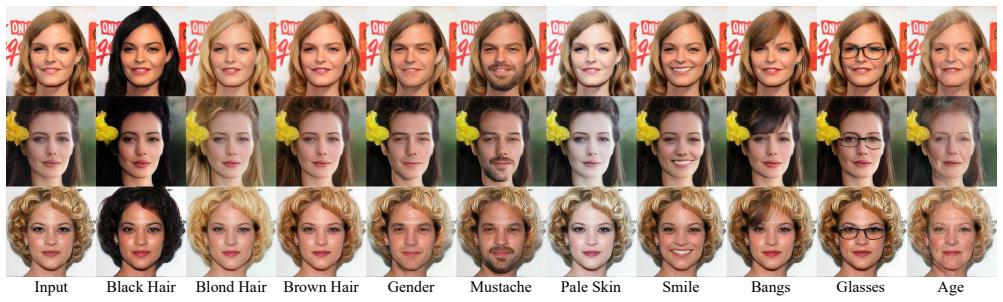
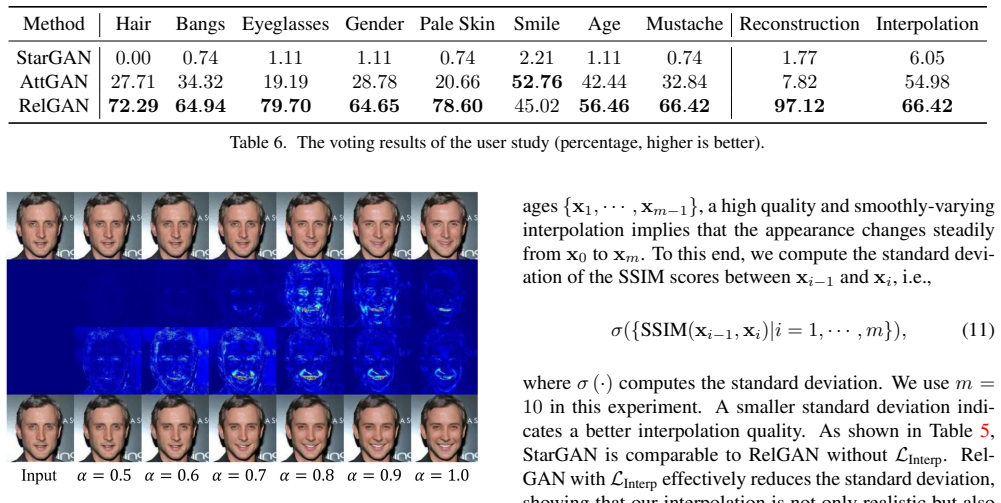
The central claim is that the translation function $G(x, v)$, conditioned on the desired change, can outperform the target-conditioned $G(x, \hat{a})$ at preserving untouched attributes while enabling continuous control. The paper introduces $v = \hat{a} - a$ and trains $G$ with an adversarial loss for realism, a matching-aware discriminator that classifies triplets $(x, v, x')$ as matched, mismatched, or fake, and an interpolation discriminator that predicts the interpolation degree $\alpha$ from $G(x, \alpha v)$. With cycle and self-reconstruction losses, the resulting model is claimed to change only the requested attributes and to interpolate smoothly. The evidence includes quantitative comparisons on CelebA, CelebA-HQ, and FFHQ and a large user study.
Load-bearing premise
The generator must be able to infer each input image's current attribute values from the pixels alone, because only the requested change, not the source values, is supplied as conditioning.
Editorial extensions
If this is right
- A user can edit any subset of attributes without supplying the remaining attribute values; zero entries in $v$ suffice.
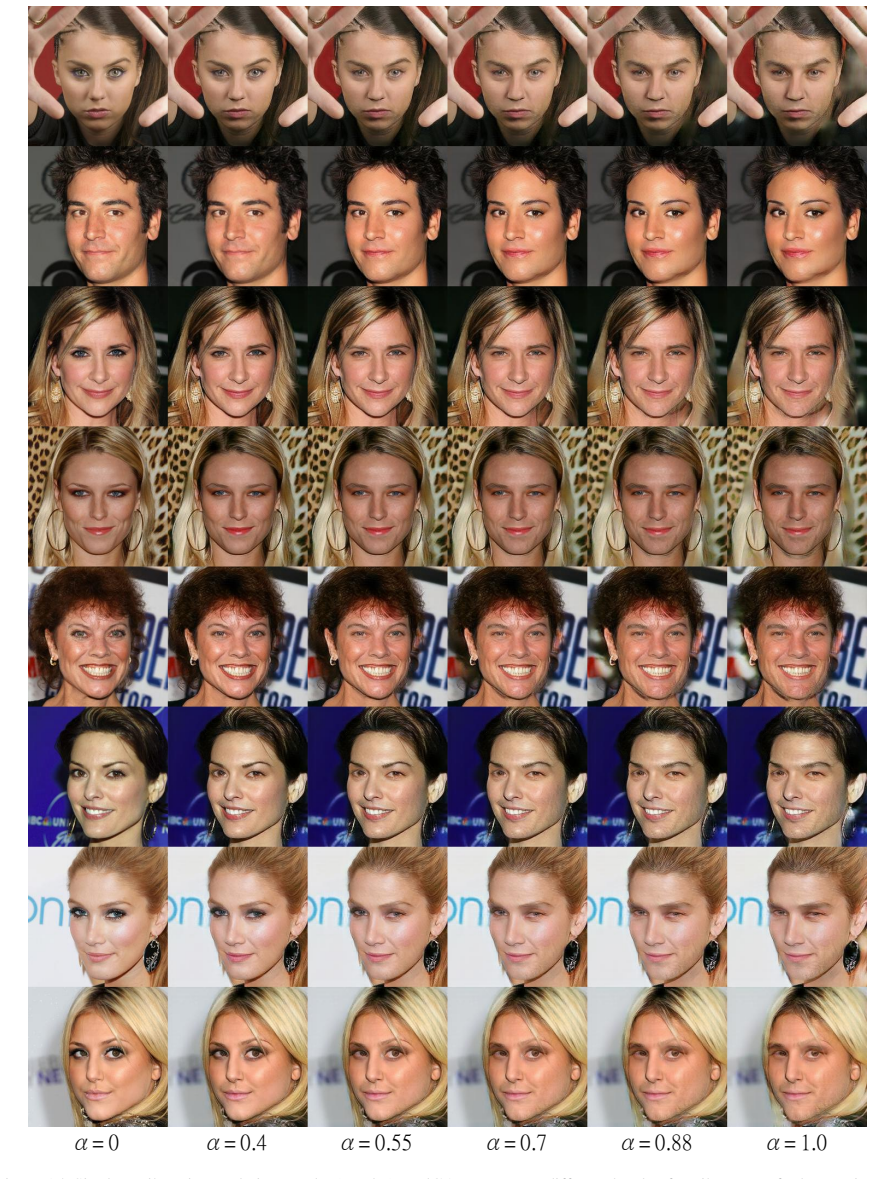
- Interpolation becomes a scalar control: $G(x, \alpha v)$ sweeps from the original to the fully edited image as $\alpha$ goes from 0 to 1.
- Because training uses real-valued relative attributes, the model can express and realize graded changes such as partial hair-color transfer or smile strength.
- The trained model transfers to a new dataset, FFHQ, without retraining and still maintains its editing behavior, as measured by FID.
Reading between the lines
- Beyond the paper, if the relative-attribute formulation is sound, it should generalize to any multi-domain translation task with annotated attributes, such as clothing, scene, or object attributes, since nothing in the design is face-specific.
- The paper leaves implicit that the method's ceiling is set by source-attribute inference; a natural extension is to provide an explicit source-attribute estimate or a classifier-consistency loss, which would likely make the matching discriminator's job easier.
- The interpolation discriminator's alpha-regression objective could be reused as an unsupervised disentanglement regularizer: any latent path whose interpolations fool the regressor is declared semantically meaningful.
- The wrong-triplet construction suggests a testable extension: use continuous attribute regressors instead of binary labels, allowing $v$ to take graded values in training and thereby improving fine-grained control further.
Signed reviews
Editorial analysis
A structured set of objections, weighed in public.
Referee Report
Summary. The paper proposes RelGAN, a GAN-based method for multi-domain facial attribute editing that conditions the generator on a relative attribute vector v = â − a instead of the target attribute vector â. The framework consists of one generator and three discriminators: a realism discriminator, a matching-aware discriminator that classifies real, fake, and wrong triplets (x, v, x′), and an interpolation discriminator that estimates the interpolation coefficient. The paper evaluates attribute transfer, reconstruction, interpolation, and user preference against StarGAN and AttGAN, reporting lower FID, higher classification accuracy, better reconstruction, and lower SSIM-standard-deviation interpolation scores.
Significance. The relative-attribute reparameterization is a genuine interface improvement for attribute editing, and the matching-aware discriminator with its four wrong-triplet types is a correct and clearly specified design. The cycle and self reconstruction losses are principled, and the cross-dataset generalization experiment (CelebA-HQ to FFHQ) is a strong point. If the central mechanism—the generator's implicit inference of the source attribute vector—is confirmed, the method would be a solid contribution to multi-domain image translation. The current evidence does not yet close that gap, and the interpolation metric is degenerate, which tempers the novelty claim.
major comments (3)
- [Section 3.1, Eq. (1); Section 4.4, Table 2] The formulation defines v = â − a, but the generator receives only (x, v) and never the source attribute vector a; therefore G must infer a from x in order for v to be interpretable. This inference is load-bearing because a zero entry v_i must mean "keep the attribute present" when x has the attribute and "keep the attribute absent" when it does not, and the same ambiguity applies to nonzero entries (e.g., v_i = −1 is only meaningful if a_i = 1). The experiments in Table 2 construct v from ground-truth labels, so they provide an oracle for the intended target but do not measure whether G's implicit estimate of a is reliable, nor do they probe generalization to v vectors that are inconsistent with the source image. The reconstruction losses (Eqs. 4 and 5) guarantee G(x, 0) ≈ x and G(G(x, v), −v) ≈ x, but they do not prevent zero-delta attributes from being altered during a nonzero edit. I recommend an explicit diagnostic: measure the classifier-confirmed attribute change for zero-delta entries as a function of the source attribute value, and test with intentionally wrong source attribute vectors to reveal what G actually does.
- [Section 4.6, Eq. (11)] The interpolation metric, the standard deviation of SSIM between consecutive frames, is degenerate: a model that returns the same image for every α (a no-op generator) achieves σ = 0, the best possible score, because all consecutive SSIM values are identically 1. Consequently, Table 5 does not by itself support the claim that RelGAN improves interpolation quality. In addition, the interpolation discriminator (Section 3.5) is explicitly trained to make interpolated frames look like the endpoints, so the reported metric partly measures the training objective rather than an independent property. The paper should supplement Eq. (11) with a measure that the edited attribute actually moves monotonically along the interpolation path (e.g., classifier output for the target attribute as a function of α), and it should include a no-op baseline in the interpolation comparison.
- [Section 4.3, Baselines; Section 5, Conclusion] The empirical comparison is restricted to binary-attribute, target-attribute methods (StarGAN and AttGAN). The conclusion's claim of "superior performance over the state-of-the-art methods" is therefore broader than the evidence, especially because GANimation, which the paper cites and which is designed for continuous facial expression interpolation, is not included in any comparison. A comparison on the overlapping smile/expression task, or a suitably scoped claim about binary target-attribute baselines, would be needed to support the state-of-the-art statement.
minor comments (5)
- [Section 3.5, after Eq. (6)] The text says "the first term aims at recovering ˆa from G(x, α v)"; the symbol should be ˆα (the interpolation coefficient), since DInterp outputs a scalar degree of interpolation and not an attribute vector.
- [Section 4.6] The baseline interpolation formula "G(x, α a + (1−α)â)" appears to have a and â reversed if α = 0 is meant to correspond to the input image in Figure 5; please check and correct the ordering.
- [Section 4.4, Tables 1 and 2] FID and classification results are reported as point estimates from presumably a single run; the paper should report means and standard deviations over multiple training runs, or at least state how many runs were used.
- [Table 3] The ablation study is presented only with qualitative images; adding quantitative metrics (e.g., FID and classification accuracy for each ablation row) would make the contribution of each loss term more convincing.
- [Section 4.6, Figure 14-17] The supplementary interpolation figures are visually informative, but no quantitative measure of attribute monotonicity along α is provided; such a measure would directly address the central claim of fine-grained continuous control.
Circularity Check
Reconstruction L1 equals RelGAN's own self-reconstruction loss, and interpolation smoothness is measured by the same uniformity the interpolation discriminator is trained to enforce; core transfer results still have independent FID/classification/user-study support.
-
fitted input called prediction
[Section 4.5, Table 4, Eq. (5)]
"Self-reconstruction loss. When the relative attribute vector is a zero vector 0, which means that no attribute is changed, the output image G(x, 0) should be as close as possible to x. To this end, we define the self-reconstruction loss as: min G LSelf = Ex [||G(x,0)-x||1] ... We measure L1, L2 norm, and SSIM similarity [26] between the input and the output images."
Section 4.5 uses reconstruction error as the proxy metric for RelGAN's claimed advantage of preserving unchanged attributes. For RelGAN, the L1 reconstruction error with v=0 is precisely the self-reconstruction loss LSelf of Eq. (5) that the generator is trained to minimize. Reporting this L1 as evidence that RelGAN 'better preserves the unchanged attributes' therefore compares RelGAN against StarGAN and AttGAN on RelGAN's own training objective, so the advantage is partly forced by construction. L2 and SSIM are not exactly optimized, but the headline L1 column is the trained loss.
-
fitted input called prediction
[Section 4.6, Eq. (11), Table 5, Eqs. (6)-(8)]
"we propose a regularizer that aims to make G(x, α v) indistinguishable from the non-interpolated output images, i.e., G(x, 0) and G(x, v). ... we compute the standard deviation of the SSIM scores between xi−1 and xi, i.e., σ({SSIM(xi−1, xi)|i = 1,··· ,m}) ... A smaller standard deviation indicates a better interpolation quality."
The interpolation discriminator loss (Eqs. 6-8) is explicitly designed to remove detectable interpolation degree from G(x, α v), i.e., to make the sequence of α steps visually uniform. The quantitative metric in Eq. (11), σ(SSIM) between consecutive frames, measures exactly that uniformity. Consequently Table 5's finding that RelGAN with LInterp 'effectively reduces the standard deviation' largely restates the training objective; it is not an independently defined correctness measure of interpolation quality. Realism of interpolations is separately checked by the user study, so this is partial circularity.
full rationale
The paper's central translation framework is not circular: relative attributes v = â - a reparameterize the conditioning signal, and the matching-aware discriminator, FID, attribute classifier, and user study provide independent evidence that the transfer works. I find no load-bearing self-citation: the only self-reference is [29] in a future-work context. However, two quantitative claims are partly forced by construction. First, the 'preserving unchanged attributes' advantage is demonstrated via reconstruction at v=0, and the primary reported metric L1 is exactly the self-reconstruction loss LSelf that RelGAN minimizes; baselines are not trained with this objective, so the comparison partly measures objective alignment rather than attribute preservation. Second, the 'smooth interpolation' claim is evaluated by σ(SSIM) between adjacent frames, a measure of visual uniformity, while the interpolation discriminator was explicitly trained to make interpolated frames indistinguishable from non-interpolated endpoints, i.e., to suppress detectable interpolation degree. Thus Table 5 mostly confirms that the regularizer worked. The source-attribute inference issue (G never receives a, so v_i=0 means different things depending on the unseen a) is a correctness risk rather than circularity, and is not scored here. Overall, because the core attribute-transfer claim retains independent FID/classification/user-study support, the circularity is partial, not total.
Assumptions & free parameters
free parameters (2)
- loss weights lambda1, lambda2, lambda3, lambda4, lambda5 =
lambda1=1, lambda2=lambda3=lambda4=10, lambda5=1e-6
- number of attributes n =
9 or 17
assumptions (4)
- domain assumption CelebA attribute annotations are ground truth and the binary labels correctly describe the source images.
- ad hoc to paper The generator can learn to estimate source attributes from the input image even though it never receives a explicitly.
- ad hoc to paper The standard deviation of SSIM between adjacent interpolation frames is a valid measure of interpolation quality.
- domain assumption Adversarial training for this architecture converges to a good generator.
Cite this review
Pith. "Pith review of RelGAN: Multi-Domain Image-to-Image Translation via Relative Attributes." pith.science (2026). https://pith.science/paper/QDF2AYTD
@misc{pith2026190807269,
  author       = {Pith},
  title        = {Pith review of: RelGAN: Multi-Domain Image-to-Image Translation via Relative Attributes},
  year         = {2026},
  howpublished = {\url{https://pith.science/paper/QDF2AYTD}},
  note         = {Machine review of arXiv:1908.07269}
}
read the original abstract
Multi-domain image-to-image translation has gained increasing attention recently. Previous methods take an image and some target attributes as inputs and generate an output image with the desired attributes. However, such methods have two limitations. First, these methods assume binary-valued attributes and thus cannot yield satisfactory results for fine-grained control. Second, these methods require specifying the entire set of target attributes, even if most of the attributes would not be changed. To address these limitations, we propose RelGAN, a new method for multi-domain image-to-image translation. The key idea is to use relative attributes, which describes the desired change on selected attributes. Our method is capable of modifying images by changing particular attributes of interest in a continuous manner while preserving the other attributes. Experimental results demonstrate both the quantitative and qualitative effectiveness of our method on the tasks of facial attribute transfer and interpolation.
Figures


Figures from the paper (14 more)






Reference graph
Works this paper leans on
-
[1]
I. Goodfellow, J. Pouget-Abadie, M. Mirza, B. Xu, D. Warde-Farley, S. Ozair, A. Courville, and Y . Bengio, “Generative adversarial nets,” inNIPS, 2014. 1, 2, 3
work page 2014
-
[2]
Conditional generative adversar- ial nets,
M. Mirza and S. Osindero, “Conditional generative adversar- ial nets,”arXiv preprint arXiv:1411.1784, 2014. 1, 2, 3
arXiv 2014
-
[3]
Image-to- image translation with conditional adversarial networks,
P. Isola, J.-Y . Zhu, T. Zhou, and A. A. Efros, “Image-to- image translation with conditional adversarial networks,” in CVPR, 2017. 1, 2
work page 2017
-
[4]
DualGAN: Unsuper- vised dual learning for image-to-image translation,
Z. Yi, H. Zhang, P. Tan, and M. Gong, “DualGAN: Unsuper- vised dual learning for image-to-image translation,” inICCV,
-
[5]
Unpaired image-to-image translation using cycle-consistent adversar- ial networks,
J.-Y . Zhu, T. Park, P. Isola, and A. A. Efros, “Unpaired image-to-image translation using cycle-consistent adversar- ial networks,” inICCV, 2017. 1, 3, 4
work page 2017
-
[6]
Unsupervised image-to- image translation networks,
M.-Y . Liu, T. Breuel, and J. Kautz, “Unsupervised image-to- image translation networks,” inNIPS, 2017. 1, 3
work page 2017
-
[7]
StarGAN: Unified generative adversarial networks for multi-domain image-to-image translation,
Y . Choi, M. Choi, M. Kim, J.-W. Ha, S. Kim, and J. Choo, “StarGAN: Unified generative adversarial networks for multi-domain image-to-image translation,” in CVPR,
-
[8]
AttGAN: Facial attribute editing by only changing what you want,
Z. He, W. Zuo, M. Kan, S. Shan, and X. Chen, “AttGAN: Facial attribute editing by only changing what you want,” IEEE Transactions on Image Processing, 2019. 1, 3, 6
work page 2019
Show all 31 references
-
[9]
Modular generative adversarial networks,
B. Zhao, B. Chang, Z. Jie, and L. Sigal, “Modular generative adversarial networks,” inECCV, 2018. 1, 3, 8
2018
-
[10]
Generative adversarial text to image synthesis,
S. Reed, Z. Akata, X. Yan, L. Logeswaran, B. Schiele, and H. Lee, “Generative adversarial text to image synthesis,” in ICML, 2016. 2, 4
2016
-
[11]
StackGAN++: Realistic image synthesis with stacked generative adversarial networks,
H. Zhang, T. Xu, H. Li, S. Zhang, X. Wang, X. Huang, and D. N. Metaxas, “StackGAN++: Realistic image synthesis with stacked generative adversarial networks,” IEEE Trans- actions on Pattern Analysis and Machine Intelligence, 2018. 2
2018
-
[12]
Multi- modal unsupervised image-to-image translation,
X. Huang, M.-Y . Liu, S. Belongie, and J. Kautz, “Multi- modal unsupervised image-to-image translation,” in ECCV,
-
[13]
Invertible conditional GANs for image editing,
G. Perarnau, J. van de Weijer, B. Raducanu, and J. M. ´Alvarez, “Invertible conditional GANs for image editing,” in NIPS Workshop on Adversarial Training, 2016. 3
2016
-
[14]
Fader networks: Manipulating images by sliding at- tributes,
G. Lample, N. Zeghidour, N. Usunier, A. Bordes, L. Denoyer et al., “Fader networks: Manipulating images by sliding at- tributes,” inNIPS, 2017. 3
2017
-
[15]
GANimation: Anatomically-aware fa- cial animation from a single image,
A. Pumarola, A. Agudo, A. M. Martinez, A. Sanfeliu, and F. Moreno-Noguer, “GANimation: Anatomically-aware fa- cial animation from a single image,” inECCV, 2018. 3, 8
2018
-
[16]
Under- standing and improving interpolation in autoencoders via an adversarial regularizer,
D. Berthelot, C. Raffel, A. Roy, and I. Goodfellow, “Under- standing and improving interpolation in autoencoders via an adversarial regularizer,” inICLR, 2019. 4
2019
-
[17]
Large scale GAN training for high fidelity natural image synthesis,
A. Brock, J. Donahue, and K. Simonyan, “Large scale GAN training for high fidelity natural image synthesis,” in ICLR,
-
[18]
Deep learning face attributes in the wild,
Z. Liu, P. Luo, X. Wang, and X. Tang, “Deep learning face attributes in the wild,” inICCV, 2015. 5
2015
-
[19]
Progressive growing of GANs for improved quality, stability, and varia- tion,
T. Karras, T. Aila, S. Laine, and J. Lehtinen, “Progressive growing of GANs for improved quality, stability, and varia- tion,” inICLR, 2018. 5
2018
-
[20]
A style-based generator architecture for generative adversarial networks,
T. Karras, S. Laine, and T. Aila, “A style-based generator architecture for generative adversarial networks,” in CVPR,
-
[21]
Differen- tiable learning-to-normalize via switchable normalization,
P. Luo, J. Ren, Z. Peng, R. Zhang, and J. Li, “Differen- tiable learning-to-normalize via switchable normalization,” in ICLR, 2019. 5
2019
-
[22]
On the effectiveness of least squares generative adversarial networks,
X. Mao, Q. Li, H. Xie, R. Y . K. Lau, Z. Wang, and S. P. Smolley, “On the effectiveness of least squares generative adversarial networks,”PAMI, 2018. 5
2018
-
[23]
Adam: A method for stochastic optimization,
D. P. Kingma and J. Ba, “Adam: A method for stochastic optimization,” inICLR, 2015. 5
2015
-
[24]
GANs trained by a two time-scale update rule converge to a local Nash equilibrium,
M. Heusel, H. Ramsauer, T. Unterthiner, B. Nessler, and S. Hochreiter, “GANs trained by a two time-scale update rule converge to a local Nash equilibrium,” inNIPS, 2017. 6
2017
-
[25]
Deep residual learning for image recognition,
K. He, X. Zhang, S. Ren, and J. Sun, “Deep residual learning for image recognition,” inCVPR, 2016. 6
2016
-
[26]
Image quality assessment: from error visibility to structural similarity,
Z. Wang, A. C. Bovik, H. R. Sheikh, E. P. Simoncelli et al., “Image quality assessment: from error visibility to structural similarity,” IEEE Transactions on Image Processing , 2004. 7
2004
-
[27]
The relativistic discriminator: a key element missing from standard GAN,
A. Jolicoeur-Martineau, “The relativistic discriminator: a key element missing from standard GAN,” in ICLR, 2019. 8
2019
-
[28]
cGANs with projection discrim- inator,
T. Miyato and M. Koyama, “cGANs with projection discrim- inator,” inICLR, 2018. 8
2018
-
[29]
KG- GAN: Knowledge-guided generative adversarial networks,
C.-H. Chang, C.-H. Yu, S.-Y . Chen, and E. Y . Chang, “KG- GAN: Knowledge-guided generative adversarial networks,” arXiv preprint arXiv:1905.12261, 2019. 8
1905 arXiv
-
[30]
Generative adver- sarial network with spatial attention for face attribute edit- ing,
G. Zhang, M. Kan, S. Shan, and X. Chen, “Generative adver- sarial network with spatial attention for face attribute edit- ing,” inECCV, 2018. 8
2018
-
[31]
Mask-aware photorealistic face attribute manipulation,
R. Sun, C. Huang, J. Shi, and L. Ma, “Mask-aware photorealistic face attribute manipulation,” arXiv preprint arXiv:1804.08882, 2018. 8 9 Appendix A. Network Architecture Figure 7 shows the schematic diagram of RelGAN. Table 7 and 8 show the network architecture of RelGAN. Inpu...
2018 arXiv
Reviewed August 14, 2026 · model on record in the stance chip above.
Discussion (0). Continue with ORCID to comment.