REVIEW 3 major objections 4 minor 53 references
Quasi-parallel anti-sunward propagating whistler waves associated to the electron-deficit in the near-Sun solar wind: Particle-in-Cell simulation
T0 review · 3 major / 4 minor · reviewed 2026-08-10 · deepseek-v4-flash
Pith's one-line read This paper claims that the electron deficit—a missing population of sunward-moving electrons in the near-Sun solar wind—drives anti-sunward whistler waves that resonantly erase the deficit and reduce heat flux.
desk verdict First PIC evidence for deficit-associated anti-sunward whistlers, but the causal role of the deficit itself is not yet secured without a control run or linear theory. read the letter →
The pith
A machine-rendered reading of the paper's core claim, the machinery that carries it, and where it could break.
The reading
What carries the argument
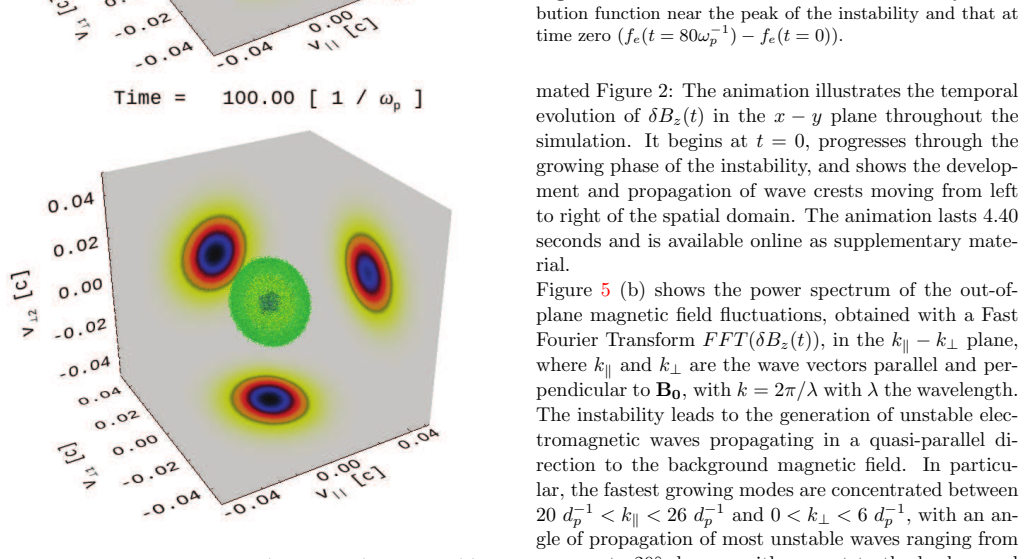
The central object is the electron deficit, a depletion in the sunward part of the electron velocity distribution, modelled here as a drifting Maxwellian with a conical cut: electrons with $v_\parallel < -p\sqrt{v_{\perp1}^2+v_{\perp2}^2}$ are removed, with $p=1$, carving out pitch angles roughly between $144^\circ$ and $216^\circ$. The mechanism that carries the argument is cyclotron resonance with parallel-propagating whistler waves, $\omega_r-\Omega_e=k_\parallel v_\parallel$; since whistlers have $\omega_r<\Omega_e$, resonance requires $k_\parallel v_\parallel<0$, so anti-sunward waves scatter only sunward-moving electrons into the empty region. Whistler waves here are right-hand circularly polarized electromagnetic waves at frequencies below the electron cyclotron frequency. The simulation also supplies the necessary second ingredient: a pre-existing population of scattered suprathermal electrons with $v_\parallel<0$, which the paper argues must be present for the waves to grow rather than damp.
What would settle it
Observe a solar wind interval with a clear sunward electron deficit but no detectable suprathermal electrons at $v_\parallel<0$; if anti-sunward quasi-parallel whistler waves are still present, the deficit-driven instability is not required. Alternatively, compute the linear Vlasov-Maxwell dispersion relation for a measured deficit VDF with that scattered population artificially removed: the model predicts damping, not growth.
Extended reading notes
Core claim
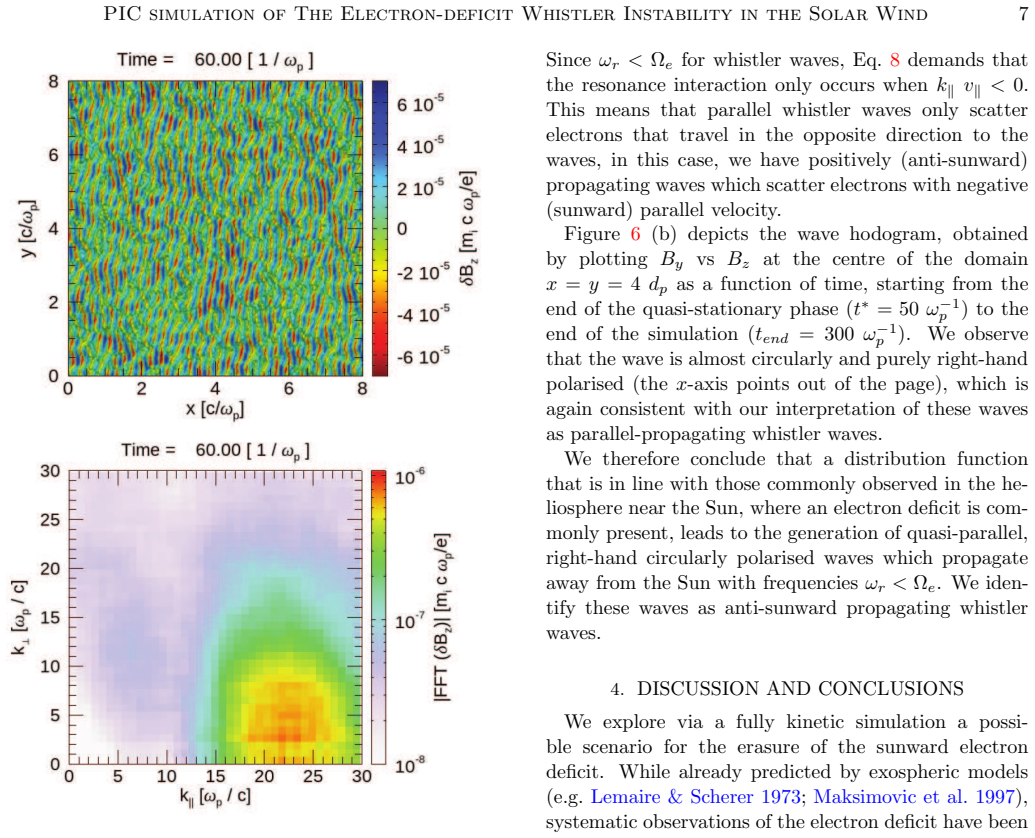
On the paper's own terms, the discovery is that an electron velocity distribution function shaped like those observed near the Sun—a dense isotropic core, an escaping strahl, an incomplete halo, and a sunward deficit cut out by the condition $v_\parallel < -p\sqrt{v_{\perp1}^2+v_{\perp2}^2}$ with $p=1$—is kinetically unstable even when it is stable against the whistler heat flux instability. The instability produces right-hand circularly polarized waves propagating within about $20^\circ$ of the magnetic field, predominantly anti-sunward, with parallel wavenumbers $20$ to $26\,d_p^{-1}$ and frequencies $0.06$ to $0.3\,\Omega_e$. Because the cyclotron resonance condition for parallel whistlers, $\omega_r-\Omega_e=k_\parallel v_\parallel$, requires $k_\parallel v_\parallel<0$, anti-sunward waves resonantly interact only with sunward-moving electrons; those electrons are scattered into the previously empty deficit, filling it and reducing the heat flux carried by the distribution. The authors therefore conclude that the deficit, in the presence of scattered suprathermal electrons with $v_\parallel<0$, is a source of the quasi-parallel anti-sunward whistler waves observed in the inner heliosphere and a non-collisional heat-flux regulation mechanism.
Load-bearing premise
The load-bearing assumption is that the initial velocity distribution—a drifting Maxwellian with a conical sunward deficit cut ($p=1$) plus already-scattered sunward electrons—faithfully represents the transient strahl-halo-deficit state the spacecraft actually encounter near the Sun.
Editorial extensions
If this is right
- The electron deficit is a source of free energy: it can drive an electromagnetic instability on its own, even when the distribution is stable to the whistler heat flux instability.
- Anti-sunward quasi-parallel whistler waves in the inner heliosphere can be read as signatures of deficit-driven instability rather than of strahl-driven heat-flux instability.
- The same instability gradually erases the deficit and isotropizes the electron distribution, providing a non-collisional route to reduce the electron heat flux.
- The radial picture is self-consistent: very close to the Sun, where no scattered sunward electrons exist yet, whistlers are damped; farther out, strahl scattering creates the seed population and anti-sunward whistlers grow, matching the observed onset around a few tens of solar radii.
- The study completes a multistep scenario linking oblique sunward whistlers, strahl-to-halo scattering, deficit-driven anti-sunward whistlers, and deficit erasure into one chain.
Reading between the lines
- A direct test would compare, interval by interval, the presence of a sunward deficit and of scattered electrons at negative parallel velocities with the occurrence of anti-sunward quasi-parallel whistlers; the model predicts they should coincide.
- The growth rate and frequency band should depend on the deficit's depth and angular width; varying the conical cut parameter p would produce a predicted spectrum that spacecraft observations could confirm or rule out.
- If this mechanism dominates deficit erasure, the heliocentric distance where deficits disappear should track where anti-sunward whistler occurrence rises, a correlation that can be checked with combined particle and wave data from the same crossings.
- The mechanism offers a local wave-driven closure for solar wind heat flux: instead of invoking anomalous collisions, models could couple deficit shape to resonant whistler scattering rates.
Editorial analysis
A structured set of objections, weighed in public.
Referee Report
Summary. The paper reports a 2D fully kinetic Particle-in-Cell simulation of a near-Sun solar-wind electron velocity distribution function (VDF) that contains a sunward electron deficit, a strahl, and a nascent halo. The authors observe the growth of quasi-parallel, right-hand circularly polarized magnetic fluctuations with frequencies below the electron cyclotron frequency that propagate anti-sunward, and they identify these as whistler waves. They show that the deficit is gradually filled by resonant scattering and argue that this mechanism explains PSP/Solar Orbiter observations of anti-sunward quasi-parallel whistler waves and contributes to non-collisional heat-flux regulation.
Significance. If the proposed mechanism is correct, it would provide a concrete kinetic scenario linking the electron deficit, strahl-to-halo scattering, and the generation of anti-sunward quasi-parallel whistler waves in the inner heliosphere, with implications for heat-flux regulation. The simulation uses a realistic proton-to-electron mass ratio, a large particle number, and demonstrates good energy conservation (Fig. 2). The wave identification is internally consistent: frequencies ω_r ≈ 0.06–0.3 Ω_e, quasi-parallel propagation, right-hand polarization, and anti-sunward direction are all mutually compatible with the whistler interpretation. The qualitative comparison with recent observations (Berčič et al. 2021b; Choi et al. 2024; Coburn et al. 2024) is appropriate for a mechanism paper. The main weakness is that the causal attribution of the instability to the deficit itself is not fully established, as the initial condition already contains scattered electrons with v_parallel < 0 and no control run or linear dispersion analysis is provided.
major comments (3)
- [Section 2 (Eqs. 1–2) and Section 4 (final paragraphs)] The initial condition (Eq. 1 with the conical cut of Eq. 2, p=1) already contains a population of scattered electrons with v_parallel < 0, because the cut only removes the deep sunward cone and leaves the adjacent region −√(v_⊥1^2+v_⊥2^2) < v_parallel < 0 populated. Section 4 states that 'only in the presence of scattered electrons with v_parallel < 0 can whistler waves grow and become detectable.' Without a control run that removes or reshapes this scattered population, the observed growth cannot be uniquely attributed to the deficit itself; the free energy of the suprathermal v_parallel < 0 population could be the actual driver, with the deficit acting as a passive phase-space hole subsequently filled by scattering. This is load-bearing for the central claim that the instability is 'triggered by the depletion itself' (abstract and Section 4). I recommend adding a control simulation without the scattered v_parallel < 0 component, or a scan over the cut parameter p, to demonstrate that the deficit shape controls the instability.
- [Section 3.2 and Section 4 (ALPS discussion)] The linear Vlasov-Maxwell dispersion analysis is deferred to future work, leaving the causal interpretation of the simulated growth unverified. A single PIC run from one initial condition cannot distinguish whether the growth rate and real frequency are controlled by the deficit depth p, by the pre-existing scattered-electron plateau, or by an interplay of both. Linear theory applied to the exact non-Maxwellian VDF (e.g., with ALPS, as the authors suggest) would provide that information and would also support the identification of this as a new instability. Given that the manuscript explicitly recognizes the limitations of classical dispersion solvers and proposes ALPS as a follow-up, I consider a dispersion calculation or at least a parameter study over p necessary to secure the causal claim.
- [Section 4, first full paragraph (heat-flux claim)] The paper claims that 'a decrease in the electron heat flux (defined as the third moment of the VDF) occurs' as a result of the instability, and this heat-flux regulation is highlighted in the abstract and conclusions. However, no measurement, plot, or numerical value of the third moment is presented in Section 3. The authors should show the time evolution of the parallel heat flux (or its normalized form) to substantiate this claim; otherwise, the statement should be reformulated as a prediction rather than a demonstrated result.
minor comments (4)
- [Throughout] There are several typographical errors that should be corrected: 'supratheraml' (Section 2), 'proprieties' (Section 4), 'collisioness' (Introduction), 'microscope' (last paragraph, should be 'microscopic'), and the phrase 'both the at the same time' in Section 3.1.
- [Figure 6(a) caption] The caption for the spacetime Fourier power spectrum does not specify the color scale, normalization, or whether the spectrum is integrated over the perpendicular wavenumbers; please clarify so that the reader can interpret the plotted quantity.
- [Section 2, after Eq. (2)] The angle definition for the deficit cut is unclear: the expression 'α = 90° + arctan(√(v_⊥1^2+v_⊥2^2)/v_parallel)' appears dimensionally inconsistent for negative v_parallel; please derive the boundary angles directly from v_parallel = −p√(v_⊥1^2+v_⊥2^2) and define the angles with respect to the positive v_parallel axis.
- [Section 2 and acknowledgments] The paper does not include a data or code availability statement. Given that the simulation uses a specific code (iPic3D) and a detailed set of parameters, a statement about availability of the code and/or simulation outputs would improve reproducibility.
Circularity Check
No derivation reduces to its inputs; the PIC instability is a genuine simulation result, with only a minor, non-load-bearing self-citation motivating the initial scattered-electron population.
full rationale
The paper does not fit any parameter to the PSP/SO observations it compares against, and no predicted quantity is defined in terms of the simulation inputs. Equations (1)-(2) define an assumed observational VDF state (core plus strahl/halo with a conical deficit); the growth of quasi-parallel right-hand whistler waves and the gradual filling of the deficit emerge from the PIC evolution rather than being imposed by the initial condition. The main self-citation is the statement that scattered electrons with v_parallel<0 arise from earlier strahl scattering (Micera et al. 2020b, 2021). That prior work is cited as motivation for the initial condition, not as a mathematical constraint on this simulation, and the present run is not a restatement of it. The paper's own Section 4 explicitly concedes that without pre-existing scattered electrons the whistlers would be damped, so the claimed mechanism is conditional; this conditional nature is a scientific limitation (no control run, deferred linear analysis) rather than circularity. The comparison to observations is qualitative and post-hoc. Therefore the derivation chain is self-contained and no circular step can be exhibited.
Assumptions & free parameters
free parameters (3)
- p (deficit cut parameter) =
1
- ue (initial electron drift) =
-0.004 c
- Initial plasma betas =
beta_e_parallel = 1.5, beta_p = 1.7
assumptions (5)
- domain assumption Collisionless plasma dynamics apply on the simulated scales.
- domain assumption The initial VDF with a conical deficit is representative of observed near-Sun electron distributions.
- ad hoc to paper Scattered electrons with v_parallel less than zero are present at initialization.
- standard math Cyclotron resonance condition omega_r - Omega_e = k_parallel v_parallel governs the wave-particle interaction.
- domain assumption The semi-implicit PIC discretization conserves energy to within numerical cooling smaller than the physical signal.
Cite this review
Pith. "Pith review of Quasi-parallel anti-sunward propagating whistler waves associated to the electron-deficit in the near-Sun solar wind: Particle-in-Cell simulation." pith.science (2026). https://pith.science/paper/QDL7XTEZ
@misc{pith2026250101331,
  author       = {Pith},
  title        = {Pith review of: Quasi-parallel anti-sunward propagating whistler waves associated to the electron-deficit in the near-Sun solar wind: Particle-in-Cell simulation},
  year         = {2026},
  howpublished = {\url{https://pith.science/paper/QDL7XTEZ}},
  note         = {Machine review of arXiv:2501.01331}
}
read the original abstract
In-situ observations of the solar wind have shown that the electron velocity distribution function (VDF) consists of a quasi-Maxwellian core, comprising most of the electron population, and two sparser components: the halo, which are suprathermal and quasi-isotropic electrons, and an escaping beam population, the strahl. Recent Parker Solar Probe (PSP) and Solar Orbiter (SO) observations have added one more ingredient to the known non-thermal features, the deficit-a depletion in the sunward region of the VDF, already predicted by exospheric models but never so extensively observed. By employing Particle-in-Cell simulations, we study electron VDFs that reproduce those typically observed in the inner heliosphere and investigate whether the electron deficit may contribute to the onset of kinetic instabilities. Previous studies and in-situ observations show that strahl electrons drive oblique whistler waves unstable, which in turn scatter them. As a result, suprathermal electrons can occupy regions of phase space where they fulfil resonance conditions with the parallel-propagating whistler wave. The suprathermal electrons lose kinetic energy, resulting in the generation of unstable waves. The sunward side of the VDF, initially depleted of electrons, is gradually filled, as this wave-particle interaction process, triggered by the depletion itself, takes place. Our findings are compared and validated against current PSP and SO observations: among others, our study provides a mechanism explaining the presence in the heliosphere of regularly observed parallel anti-sunward whistler waves; suggests why these waves are frequently observed in concomitant with distributions presenting an electron deficit; describes a non-collisional heat flux regulating process.
Figures


Figures from the paper (3 more)

Reference graph
Works this paper leans on
-
[1]
Berˇ ciˇ c, L., Larson, D., Whittlesey, P., et al. 2020, The Astrophysical Journal, 892, 88, doi: 10.3847/1538-4357/ab7b7a Berˇ ciˇ c, L., Maksimovi´ c, M., Halekas, J. S., et al. 2021a, ApJ, 921, 83, doi: 10.3847/1538-4357/ac1f1c Berˇ ciˇ c, L., Verscharen, D., Owen, C. J., et al. 2021b, A&A, 656, A31, doi: 10.1051/0004-6361/202140970
-
[2]
2020, Proceedings of the National Academy of Sciences, 117, 9232
Boldyrev, S., Forest, C., & Egedal, J. 2020, Proceedings of the National Academy of Sciences, 117, 9232
work page 2020
-
[3]
2008, Journal of Geophysical Research, 113, A07107, doi: 10.1029/2008JA013043
Camporeale, E., & Burgess, D. 2008, Journal of Geophysical Research, 113, A07107, doi: 10.1029/2008JA013043
-
[4]
2021, The Astrophysical Journal Letters, 911, L29, doi: 10.3847/2041-8213/abefdd —
Cattell, C., Breneman, A., Dombeck, J., et al. 2021, The Astrophysical Journal Letters, 911, L29, doi: 10.3847/2041-8213/abefdd —. 2022, ApJL, 924, L33, doi: 10.3847/2041-8213/ac4015
-
[5]
Choi, K.-E., Agapitov, O., Colomban, L., et al. 2024, arXiv e-prints, arXiv:2408.00736, doi: 10.48550/arXiv.2408.00736
work page Pith review arXiv doi:10.48550/arxiv.2408.00736 2024
-
[6]
Coburn, J. T., Verscharen, D., Owen, C. J., et al. 2024, ApJ, 964, 100, doi: 10.3847/1538-4357/ad1329
-
[7]
2024, A&A, 684, A143, doi: 10.1051/0004-6361/202347489
Colomban, L., Kretzschmar, M., Krasnoselkikh, V., et al. 2024, A&A, 684, A143, doi: 10.1051/0004-6361/202347489
-
[8]
Feldman, W. C., Asbridge, J. R., Bame, S. J., Montgomery, M. D., & Gary, S. P. 1975, Journal of Geophysical Research, 80, 4181, doi: 10.1029/JA080i031p04181
Show all 53 references
-
[9]
J., Velli, M
Fox, N. J., Velli, M. C., Bale, S. D., et al. 2016, Space Sci Rev, 204, 7, doi: 10.1007/s11214-015-0211-6
2016 doi
-
[10]
V., Krasnoselskikh, V., et al
Froment, C., Agapitov, O. V., Krasnoselskikh, V., et al. 2023, A&A, 672, A135, doi: 10.1051/0004-6361/202245140
2023 doi
-
[11]
S., Whittlesey, P., Larson, D
Halekas, J. S., Whittlesey, P., Larson, D. E., et al. 2020, The Astrophysical Journals, 246, 22, doi: 10.3847/1538-4365/ab4cec
2020 doi
-
[12]
S., Berˇ ciˇ c, L., Whittlesey, P., et al
Halekas, J. S., Berˇ ciˇ c, L., Whittlesey, P., et al. 2021a, ApJ, 916, 16, doi: 10.3847/1538-4357/ac096e
-
[13]
S., Whittlesey, P
Halekas, J. S., Whittlesey, P. L., Larson, D. E., et al. 2021b, Astronomy & Astrophysics (A & A), 650, A15, doi: 10.1051/0004-6361/202039256
-
[14]
W., & Eastwood, J
Hockney, R. W., & Eastwood, J. W. 1988, Computer simulation using particles
1988
-
[15]
E., Boella, E., Tenerani, A., & Velli, M
Innocenti, M. E., Boella, E., Tenerani, A., & Velli, M. 2020, The Astrophysical Journal Letters, 898, L41, doi: 10.3847/2041-8213/aba591
2020 doi
-
[16]
E., Johnson, A., Markidis, S., et al
Innocenti, M. E., Johnson, A., Markidis, S., et al. 2017, Advances in Engineering Software, 111, 3
2017
-
[17]
E., Tenerani, A., Boella, E., & Velli, M
Innocenti, M. E., Tenerani, A., Boella, E., & Velli, M. 2019, The Astrophysical Journal, 883, 146, doi: 10.3847/1538-4357/ab3e40
2019 doi
-
[18]
K., Dudok de Wit, T., Froment, C., et al
Jagarlamudi, V. K., Dudok de Wit, T., Froment, C., et al. 2021, Astronomy & Astrophysics, 650, A9, doi: 10.1051/0004-6361/202039808
2021 doi
-
[19]
T., & Fazakerley, A
Jeong, S.-Y., Verscharen, D., Wicks, R. T., & Fazakerley, A. N. 2020, The Astrophysical Journal, 902, 128, doi: 10.3847/1538-4357/abb099
2020 doi
-
[20]
1970, Astronomy and Astrophysics, Vol
Jockers, K. 1970, Astronomy and Astrophysics, Vol. 6, p. 219 (1970), 6, 219
1970
-
[21]
2018, Journal of Plasma Physics, 84, 905840305, doi: 10.1017/S0022377818000399
Spitkovsky, A. 2018, Journal of Plasma Physics, 84, 905840305, doi: 10.1017/S0022377818000399
2018 doi
-
[22]
2021, in AGU Fall Meeting Abstracts, Vol
Kretzschmar, M., Chust, T., Graham, D., et al. 2021, in AGU Fall Meeting Abstracts, Vol. 2021, SH21A–12
2021
-
[23]
2014, The Astrophysical Journal, 796, 5, doi: 10.1088/0004-637X/796/1/5
Lacombe, C., Alexandrova, O., Matteini, L., et al. 2014, The Astrophysical Journal, 796, 5, doi: 10.1088/0004-637X/796/1/5
2014 doi
-
[24]
2003, Astronomy & Astrophysics, 400, 769
Landi, S., & Pantellini, F. 2003, Astronomy & Astrophysics, 400, 769
2003
-
[25]
2017, Journal of Computational Physics, 334, 349, doi: 10.1016/j.jcp.2017.01.002
Lapenta, G. 2017, Journal of Computational Physics, 334, 349, doi: 10.1016/j.jcp.2017.01.002
2017 doi
-
[26]
U., & Ricci, P
Lapenta, G., Brackbill, J. U., & Ricci, P. 2006, Physics of Plasmas, 13, 055904, doi: 10.1063/1.2173623
2006 doi
-
[27]
Lemaire, J., & Scherer, M. 1971, J. Geophys. Res., 76, 7479, doi: 10.1029/JA076i031p07479 —. 1973, Reviews of Geophysics and Space Physics, 11, 427, doi: 10.1029/RG011i002p00427 Lie-Svendsen, Ø., Hansteen, V. H., & Leer, E. 1997, Journal of Geophysical Research: Space Physics,...
1971 doi
-
[28]
Moya, P. S. 2020, The Astrophysical Journal Letters, 900, L25, doi: 10.3847/2041-8213/abaf56 L´ opez, R. A., Micera, A., Lazar, M., et al. 2022, ApJ, 930, 158, doi: 10.3847/1538-4357/ac66e4
2020 doi
-
[29]
2001, Astrophysics and Space Science, 277, 181
Maksimovic, M., Pierrard, V., & Lemaire, J. 2001, Astrophysics and Space Science, 277, 181
2001
-
[30]
Maksimovic, M., Pierrard, V., & Lemaire, J. F. 1997, Astronomy & Astrophysics, 324, 725
1997
-
[31]
Y., et al
Maksimovic, M., Zouganelis, I., Chaufray, J. Y., et al. 2005, Journal of Geophysical Research, 110, A09104, doi: 10.1029/2005JA011119 PIC simulation of The Electron-deficit Whistler Instability in the Solar Wind 11
2005 doi
-
[32]
2010, Mathematics and Computers in Simulation, 80, 1509, doi: 10.1016/j.matcom.2009.08.038
Markidis, S., Lapenta, G., & Rizwan-uddin. 2010, Mathematics and Computers in Simulation, 80, 1509, doi: 10.1016/j.matcom.2009.08.038
2010 doi
-
[33]
Z., & Tu, C
Marsch, E., Ao, X. Z., & Tu, C. Y. 2004, Journal of Geophysical Research (Space Physics), 109, A04102, doi: 10.1029/2003JA010330
2004 doi
-
[34]
2007, Basics of the solar wind (Cambridge University Press)
Meyer-Vernet, N. 2007, Basics of the solar wind (Cambridge University Press)
2007
-
[35]
1998, Journal of Geophysical Research: Space Physics, 103, 29705
Meyer-Vernet, N., & Issautier, K. 1998, Journal of Geophysical Research: Space Physics, 103, 29705
1998
-
[36]
N., et al
Micera, A., Boella, E., Zhukov, A. N., et al. 2020a, The Astrophysical Journal, 893, 130, doi: 10.3847/1538-4357/ab7faa
-
[37]
N., L´ opez, R
Micera, A., Zhukov, A. N., L´ opez, R. A., et al. 2021, The Astrophysical Journal, 919, 42, doi: 10.3847/1538-4357/ac1067 —. 2020b, The Astrophysical Journal Letters, 903, L23, doi: 10.3847/2041-8213/abc0e8 M¨ uller, D., Marsden, R. G., St. Cyr, O. C., & Gilbert, H. R. 2013, S...
2021 doi
-
[38]
Pierrard, V., & Lemaire, J. 1996, J. Geophys. Res., 101, 7923, doi: 10.1029/95JA03802
1996 doi
-
[39]
1999, Journal of Geophysical Research: Space Physics, 104, 17021
Pierrard, V., Maksimovic, M., & Lemaire, J. 1999, Journal of Geophysical Research: Space Physics, 104, 17021
1999
-
[40]
G., Miggenrieder, H., Montgomery, M
Pilipp, W. G., Miggenrieder, H., Montgomery, M. D., et al. 1987, Journal of Geophysical Research, 92, 1075, doi: 10.1029/JA092iA02p01075
1987 doi
-
[41]
2019, The Astrophysical Journal, 887, 190, doi: 10.3847/1538-4357/ab5114
Swisdak, M. 2019, The Astrophysical Journal, 887, 190, doi: 10.3847/1538-4357/ab5114
2019 doi
-
[42]
1977, Journal of Geophysics Zeitschrift Geophysik, 42, 561
Rosenbauer, H., Schwenn, R., Marsch, E., et al. 1977, Journal of Geophysics Zeitschrift Geophysik, 42, 561
1977
-
[43]
E., Bame, S
Scime, E. E., Bame, S. J., Feldman, W. C., et al. 1994, Journal of Geophysical Research, 99, 23401, doi: 10.1029/94JA02068
1994 doi
-
[44]
Scudder, J. D. 1996, Journal of Geophysical Research: Space Physics, 101, 13461
1996
-
[45]
S., Chen, C
Stansby, D., Horbury, T. S., Chen, C. H. K., & Matteini, L. 2016, The Astrophysical Journal Letters, 829, L16, doi: 10.3847/2041-8205/829/1/L16 Stver´ ak, v., Maksimovic, M., Tr´ avn ´ ıˇ cek, P. M., et al. 2009, Journal of Geophysical Research, 114, A05104, doi: 10.1029/2008JA013883
2016 doi
-
[46]
P., & Kolobov, V
Tang, B., Zank, G. P., & Kolobov, V. I. 2020, The Astrophysical Journal, 892, 95
2020
-
[47]
Y., Pulupa, M., et al
Tong, Y., Vasko, I. Y., Pulupa, M., et al. 2019, The Astrophysical Journal, 870, L6, doi: 10.3847/2041-8213/aaf734
2019 doi
-
[48]
Y., Krasnoselskikh, V., Tong, Y., et al
Vasko, I. Y., Krasnoselskikh, V., Tong, Y., et al. 2019, The Astrophysical Journal Letters, 871, L29, doi: 10.3847/2041-8213/ab01bd
2019 doi
-
[49]
Verscharen, D., Chandran, B. D. G., Jeong, S.-Y., et al. 2019, The Astrophysical Journal, 886, 136, doi: 10.3847/1538-4357/ab4c30
2019 doi
-
[50]
G., Chandran, B
Verscharen, D., Klein, K. G., Chandran, B. D. G., et al. 2018, Journal of Plasma Physics, 84, 905840403, doi: 10.1017/S0022377818000739
2018 doi
-
[51]
G., & Maruca, B
Verscharen, D., Klein, K. G., & Maruca, B. A. 2019, Living Reviews in Solar Physics, 16, 5, doi: 10.1007/s41116-019-0021-0
2019 doi
-
[52]
P., & Mann, G
Vocks, C., Salem, C., Lin, R. P., & Mann, G. 2005, The Astrophysical Journal, 627, 540, doi: 10.1086/430119
2005 doi
-
[53]
2005, The Astrophysical Journal, 626, L117
Zouganelis, I., Meyer-Vernet, N., Landi, S., Maksimovic, M., & Pantellini, F. 2005, The Astrophysical Journal, 626, L117
2005
Reviewed August 10, 2026 · model on record in the stance chip above.
Discussion (0). Continue with ORCID to comment.