REVIEW 2 major objections 3 minor 72 references
CamFlow+: Hybrid Motion Bases for 2D Camera Motion Estimation with Stabilization Applications
T0 review · 2 major / 3 minor · reviewed 2026-06-28 · grok-4.3
Pith's one-line read CamFlow+ uses hybrid motion bases to estimate 2D camera motion in dense flow space, handling translation and parallax without single-plane assumptions.
desk verdict CamFlow+ mixes homography, stochastic, and depth bases in flow space to relax planar assumptions for camera motion, with stabilization wins in a user study but no numbers visible yet. read the letter →
The pith
A machine-rendered reading of the paper's core claim, the machinery that carries it, and where it could break.
The reading
What carries the argument
The hybrid-basis framework that mixes physical, stochastic, and depth-translational bases in dense-flow space along with depth-aware smoothness regularization.
What would settle it
On a video sequence with complex non-planar depth variations and parallax where CamFlow+ either fails to outperform homography methods or produces visible artifacts in the stabilized output.
Extended reading notes
Core claim
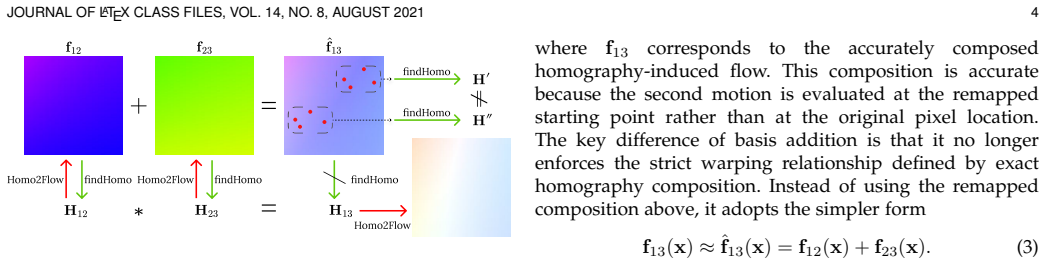
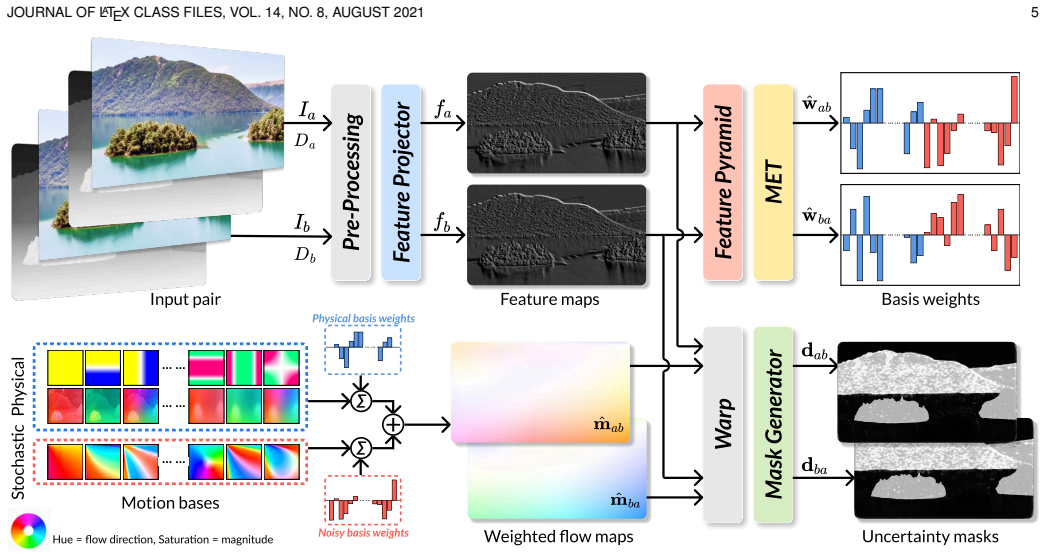
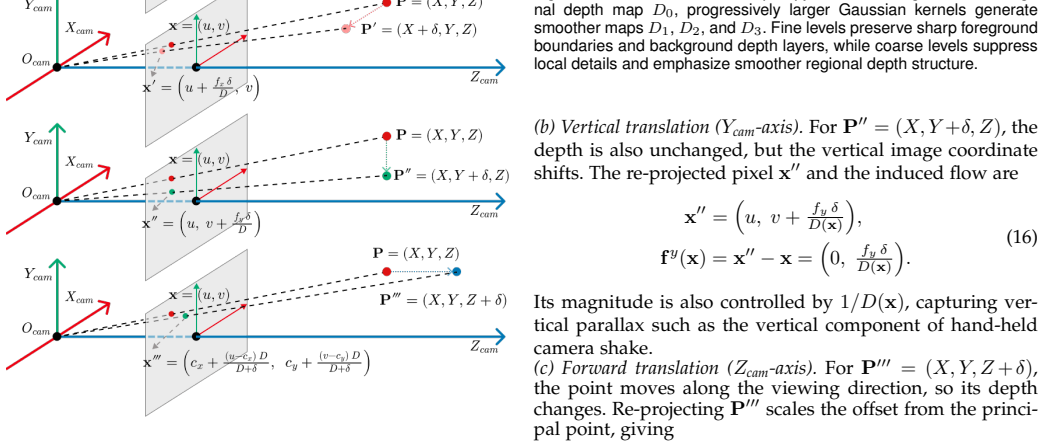
CamFlow+ represents 2D camera motion directly in dense-flow space by combining homography-derived physical bases, stochastic bases sampled from homography flows, and depth-translational bases derived from depth and camera intrinsics, while adding a depth-aware smoothness term to regularize translation-induced parallax.
Load-bearing premise
The combination of the three base types and the depth-aware term captures real-world camera translation and parallax without introducing artifacts or needing per-scene adjustments.
Editorial extensions
If this is right
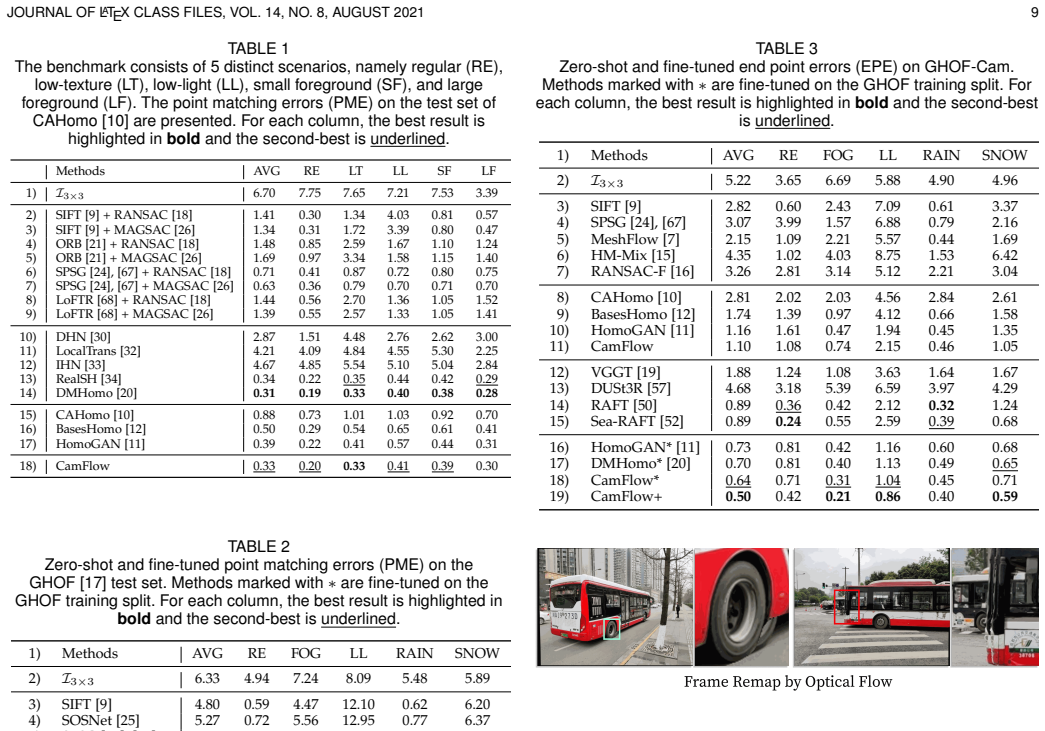
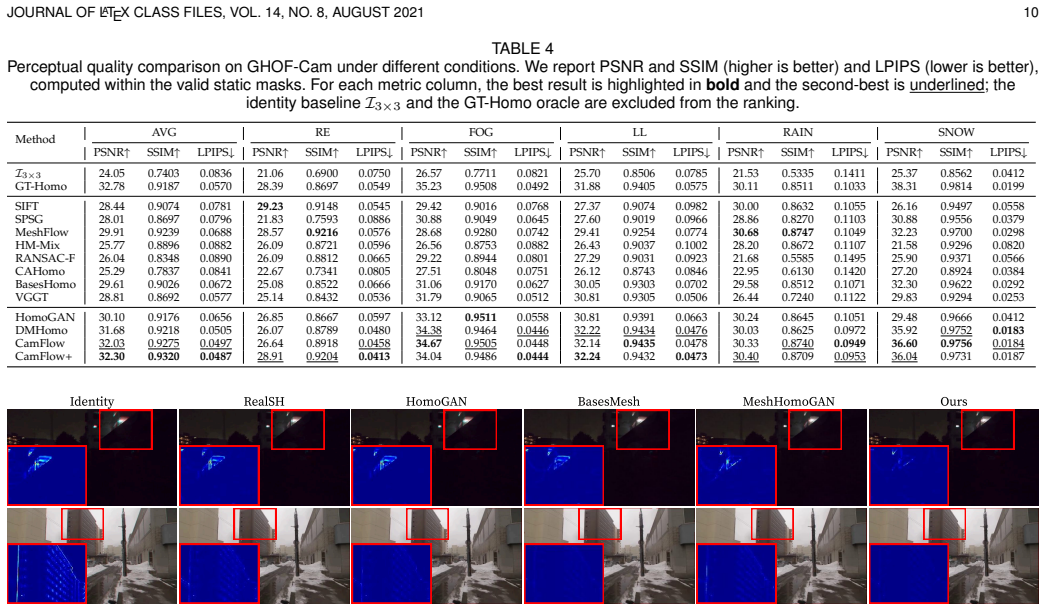
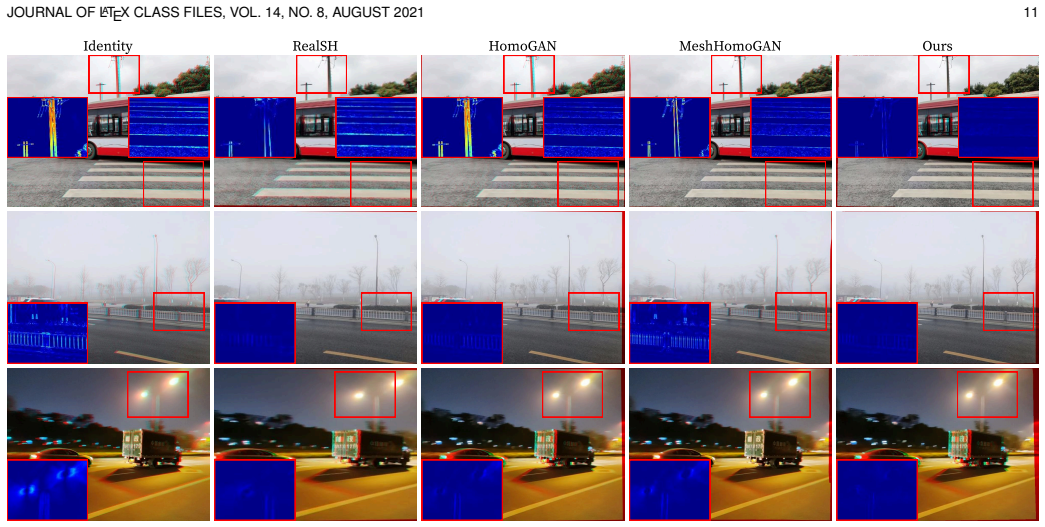
- CamFlow+ improves accuracy in sparse and dense camera-motion estimation on the GHOF-Cam benchmark.
- It enhances global and local stability in digital video stabilization applications.
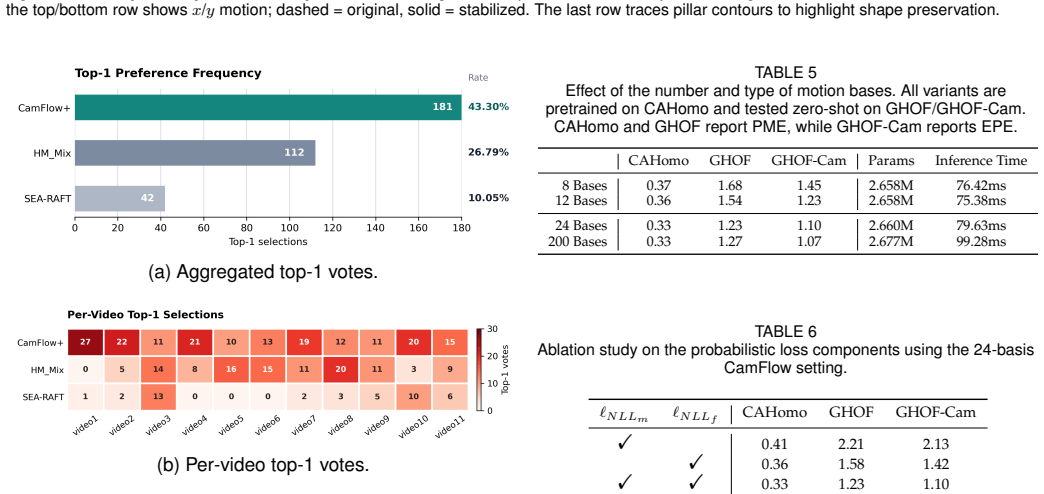
- It achieves the highest top-1 preference rate in a blind user study for stabilized videos.
- The approach relaxes the single-plane constraint while preserving camera-motion regularity.
Reading between the lines
- If the hybrid bases generalize, they could reduce the need for scene-specific tuning in stabilization pipelines.
- Extending the depth-translational bases to dynamic scenes might allow better separation of camera and object motion.
- The dense-flow representation could integrate with learning-based methods for end-to-end training.
Signed reviews
Editorial analysis
A structured set of objections, weighed in public.
Referee Report
Summary. The paper introduces CamFlow+, a hybrid-basis framework for 2D camera motion estimation in dense flow space. It combines homography-derived physical bases, stochastic bases sampled from homography flows, and depth-translational bases derived from depth and intrinsics, plus a depth-aware smoothness term, to relax the single-plane assumption while preserving regularity. Evaluation on the GHOF-Cam benchmark (which masks dynamic objects and occlusions from an optical-flow dataset) reports improvements in sparse and dense camera-motion estimation; in video stabilization it improves global and local stability and achieves the highest top-1 preference in a blind user study.
Significance. If the quantitative gains and user-study results hold under rigorous controls, the hybrid construction offers a principled way to capture translation-induced parallax without piecewise-planar or mesh-based overhead, which could benefit stabilization, SfM, and video processing pipelines. The explicit construction of bases from homography and depth is a strength that keeps the model interpretable.
major comments (2)
- [Abstract, §4] Abstract and §4 (Experiments): the claim of improvement on GHOF-Cam is stated without any reported error metrics, baseline comparisons, ablation tables, or statistical significance tests; because the central claim is empirical superiority, the absence of these numbers in the provided text prevents verification that the hybrid bases actually outperform existing methods by a meaningful margin.
- [§3.3] §3.3 (Depth-aware smoothness): the term is described as regularizing translation-induced parallax in continuous-depth regions while preserving boundaries, but no derivation or weighting schedule is supplied; without an equation or sensitivity analysis it is unclear whether the term is load-bearing or could be replaced by a standard smoothness prior.
minor comments (3)
- [§4.1] The GHOF-Cam construction (masking procedure, exact benchmark split) should be detailed in a dedicated subsection or supplementary material so that the isolation of camera motion can be reproduced.
- [§3] Notation for the three basis families (physical, stochastic, depth-translational) is introduced in the abstract but not consistently labeled in the method section; a single table summarizing their definitions and dimensions would improve clarity.
- [Abstract] The statement that code and datasets will be released is welcome; the camera-ready version should include the exact commit hash or DOI once available.
Simulated Author's Rebuttal
We thank the referee for the constructive feedback on the empirical presentation and the depth-aware smoothness term. We address each major comment below and will update the manuscript to improve clarity and verifiability.
read point-by-point responses
-
Referee: [Abstract, §4] Abstract and §4 (Experiments): the claim of improvement on GHOF-Cam is stated without any reported error metrics, baseline comparisons, ablation tables, or statistical significance tests; because the central claim is empirical superiority, the absence of these numbers in the provided text prevents verification that the hybrid bases actually outperform existing methods by a meaningful margin.
Authors: The experiments section (§4) contains tables reporting quantitative error metrics (e.g., endpoint error for sparse and dense camera-motion estimation), direct comparisons against baselines, and ablation studies on the hybrid bases. However, the abstract summarizes results qualitatively and §4 does not explicitly highlight statistical significance. We will revise the abstract to include key numerical gains and augment §4 with explicit statistical tests or confidence intervals to allow direct verification of the claimed improvements. revision: yes
-
Referee: [§3.3] §3.3 (Depth-aware smoothness): the term is described as regularizing translation-induced parallax in continuous-depth regions while preserving boundaries, but no derivation or weighting schedule is supplied; without an equation or sensitivity analysis it is unclear whether the term is load-bearing or could be replaced by a standard smoothness prior.
Authors: We agree that §3.3 currently provides only a high-level description. In the revised manuscript we will add the explicit equation for the depth-aware smoothness term, derive it from the depth map and translation-induced flow, specify the weighting schedule used during optimization, and include a sensitivity/ablation study comparing it against a standard smoothness prior to demonstrate its contribution. revision: yes
Circularity Check
No significant circularity
full rationale
The paper presents CamFlow+ as a novel hybrid-basis construction (homography physical bases + stochastic bases + depth-translational bases) plus a depth-aware smoothness term, with no equations or claims in the provided text reducing any prediction or result to a fitted parameter, self-definition, or self-citation chain. Evaluation relies on the external GHOF-Cam benchmark (with masking to isolate camera motion) and a blind user study, both independent of the method's internal construction. No load-bearing uniqueness theorems, ansatzes, or renamings of known results are invoked via self-citation. The derivation chain is self-contained against external benchmarks.
Assumptions & free parameters
Cite this review
Pith. "Pith review of CamFlow+: Hybrid Motion Bases for 2D Camera Motion Estimation with Stabilization Applications." pith.science (2026). https://pith.science/paper/QDPOGPIW
@misc{pith2026260605915,
  author       = {Pith},
  title        = {Pith review of: CamFlow+: Hybrid Motion Bases for 2D Camera Motion Estimation with Stabilization Applications},
  year         = {2026},
  howpublished = {\url{https://pith.science/paper/QDPOGPIW}},
  note         = {Machine review of arXiv:2606.05915}
}
read the original abstract
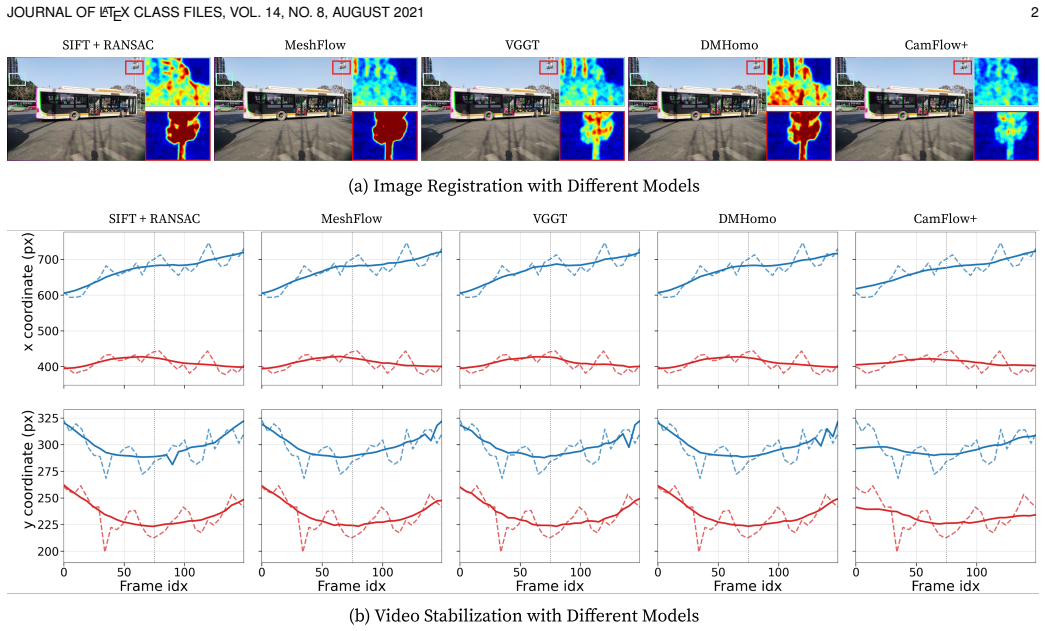
Estimating 2D camera motion is fundamental to computer vision and computational photography. Existing homography-based methods work well for planar scenes or pure rotation, but struggle with camera translation, depth variation, and local parallax; local homography and mesh-based models improve flexibility but still rely on piecewise planar assumptions. We introduce CamFlow+, a hybrid-basis framework that represents 2D camera motion directly in dense-flow space. CamFlow+ combines homography-derived physical bases, stochastic bases sampled from homography flows, and depth-translational bases derived from depth and camera intrinsics, relaxing the single-plane constraint while preserving camera-motion regularity. A depth-aware smoothness term further regularizes translation-induced parallax in continuous-depth regions while preserving motion changes near depth boundaries. We evaluate CamFlow+ on GHOF-Cam, a camera-motion benchmark that masks out dynamic objects and ill-posed occlusion regions in an optical-flow benchmark to isolate camera-induced motion. Experiments show that CamFlow+ improves sparse and dense camera-motion estimation. In digital video stabilization, CamFlow+ also improves global and local stability, achieving the best top-1 preference rate in a blind user study. Code and datasets will be available on the project page: https://lhaippp.github.io/CamFlow+.
Figures
Figures from the paper (13 more)



Reference graph
Works this paper leans on
-
[1]
An iterative image registration technique with an application to stereo vision,
B. D. Lucas and T. Kanade, “An iterative image registration technique with an application to stereo vision,” inProc. IJCAI, vol. 2, 1981, pp. 674–679
1981
-
[2]
Automatic panoramic image stitching using invariant features,
M. Brown and D. G. Lowe, “Automatic panoramic image stitching using invariant features,”International Journal of Computer Vision, vol. 74, no. 1, pp. 59–73, 2007
2007
-
[3]
Video enhance- ment with task-oriented flow,
T. Xue, B. Chen, J. Wu, D. Wei, and W. T. Freeman, “Video enhance- ment with task-oriented flow,”International Journal of Computer Vision, vol. 127, no. 8, pp. 1106–1125, 2019
2019
-
[4]
Burst photography for high dynamic range and low-light imaging on mobile cameras,
S. W. Hasinoff, D. Sharlet, R. Geiss, A. Adams, J. T. Barron, F. Kainz, J. Chen, and M. Levoy, “Burst photography for high dynamic range and low-light imaging on mobile cameras,”ACM T ransactions on Graphics, vol. 35, no. 6, pp. 192:1–192:12, 2016
2016
-
[5]
Deep video deblurring for hand-held cameras,
S. Su, M. Delbracio, J. Wang, G. Sapiro, W. Heidrich, and O. Wang, “Deep video deblurring for hand-held cameras,” inProc. CVPR, 2017, pp. 237–246
2017
-
[6]
Bundled camera paths for video stabilization,
S. Liu, L. Yuan, P . Tan, and J. Sun, “Bundled camera paths for video stabilization,”ACM T ransactions on Graphics, vol. 32, no. 4, pp. 1–10, 2013
2013
-
[7]
Meshflow: Minimum latency online video stabilization,
S. Liu, P . Tan, L. Yuan, J. Sun, and B. Zeng, “Meshflow: Minimum latency online video stabilization,” inProc. ECCV, vol. 9910, 2016, pp. 800–815
2016
-
[8]
Hartley and A
R. Hartley and A. Zisserman,Multiple View Geometry in Computer Vision. Cambridge University Press, 2003
2003
Show all 72 references
-
[9]
Distinctive image features from scale-invariant key- points,
D. G. Lowe, “Distinctive image features from scale-invariant key- points,”International Journal of Computer Vision, vol. 60, no. 2, pp. 91–110, 2004
2004
-
[10]
Content-aware unsupervised deep homography estimation,
J. Zhang, C. Wang, S. Liu, L. Jia, N. Ye, J. Wang, J. Zhou, and J. Sun, “Content-aware unsupervised deep homography estimation,” in Proc. ECCV, 2020, pp. 653–669
2020
-
[11]
Unsupervised homography estimation with coplanarity-aware gan,
M. Hong, Y. Lu, N. Ye, C. Lin, Q. Zhao, and S. Liu, “Unsupervised homography estimation with coplanarity-aware gan,” inProc. CVPR, 2022, pp. 17 663–17 672
2022
-
[12]
Motion basis learning for unsupervised deep homography estimation with subspace projection,
N. Ye, C. Wang, H. Fan, and S. Liu, “Motion basis learning for unsupervised deep homography estimation with subspace projection,” inProc. ICCV, 2021, pp. 13 117–13 125
2021
-
[13]
Content-aware unsupervised deep homography estimation and its extensions,
S. Liu, N. Ye, C. Wang, J. Zhang, L. Jia, K. Luo, J. Wang, and J. Sun, “Content-aware unsupervised deep homography estimation and its extensions,”IEEE T ransactions on Pattern Analysis and Machine Intelligence, vol. 45, no. 3, pp. 2849–2863, 2022
2022
-
[14]
Unsupervised global and local homography estimation with motion basis learn- ing,
S. Liu, Y. Lu, H. Jiang, N. Ye, C. Wang, and B. Zeng, “Unsupervised global and local homography estimation with motion basis learn- ing,”IEEE T ransactions on Pattern Analysis and Machine Intelligence, vol. 45, no. 6, pp. 7885–7899, 2023
2023
-
[15]
Calibration- free rolling shutter removal,
M. Grundmann, V . Kwatra, D. Castro, and I. Essa, “Calibration- free rolling shutter removal,” inProc. ICCP, 2012, pp. 1–8
2012
-
[16]
Ransac-flow: generic two-stage image alignment,
X. Shen, F. Darmon, A. A. Efros, and M. Aubry, “Ransac-flow: generic two-stage image alignment,” inProc. ECCV, 2020, pp. 618– 637
2020
-
[17]
Gyroflow+: Gyroscope-guided unsupervised deep homography and optical flow learning,
H. Li, K. Luo, B. Zeng, and S. Liu, “Gyroflow+: Gyroscope-guided unsupervised deep homography and optical flow learning,”Inter- national Journal of Computer Vision, vol. 132, no. 6, pp. 2331–2349, 2024
2024
-
[18]
Random sample consensus: a paradigm for model fitting with applications to image analysis and automated cartography,
M. A. Fischler and R. C. Bolles, “Random sample consensus: a paradigm for model fitting with applications to image analysis and automated cartography,”Communications of the ACM, vol. 24, no. 6, pp. 381–395, 1981
1981
-
[19]
Vggt: Visual geometry grounded transformer,
J. Wang, M. Chen, N. Karaev, A. Vedaldi, C. Rupprecht, and D. Novotny, “Vggt: Visual geometry grounded transformer,” in Proc. CVPR, 2025, pp. 5294–5306
2025
-
[20]
Dmhomo: Learning homography with diffusion models,
H. Li, H. Jiang, A. Luo, P . Tan, H. Fan, B. Zeng, and S. Liu, “Dmhomo: Learning homography with diffusion models,”ACM T ransactions on Graphics, vol. 43, no. 3, pp. 1–16, 2024
2024
-
[21]
Orb: An efficient alternative to sift or surf,
E. Rublee, V . Rabaud, K. Konolige, and G. Bradski, “Orb: An efficient alternative to sift or surf,” inProc. ICCV, 2011, pp. 2564– 2571
2011
-
[22]
K-nearest neighbour classifiers-a tutorial,
P . Cunningham and S. J. Delany, “K-nearest neighbour classifiers-a tutorial,”ACM Computing Surveys, vol. 54, no. 6, pp. 1–25, 2021
2021
-
[23]
Lift: Learned invariant feature transform,
K. M. Yi, E. Trulls, V . Lepetit, and P . Fua, “Lift: Learned invariant feature transform,” inProc. ECCV, 2016, pp. 467–483
2016
-
[24]
Superpoint: Self- supervised interest point detection and description,
D. DeTone, T. Malisiewicz, and A. Rabinovich, “Superpoint: Self- supervised interest point detection and description,” inProc. CVPRW, 2018, pp. 224–236
2018
-
[25]
Sosnet: Second order similarity regularization for local descriptor learn- ing,
Y. Tian, X. Yu, B. Fan, F. Wu, H. Heijnen, and V . Balntas, “Sosnet: Second order similarity regularization for local descriptor learn- ing,” inProc. CVPR, 2019, pp. 11 016–11 025
2019
-
[26]
Magsac: marginalizing sample consensus,
D. Barath, J. Matas, and J. Noskova, “Magsac: marginalizing sample consensus,” inProc. CVPR, 2019, pp. 10 197–10 205
2019
-
[27]
Magsac++, a fast, reliable and accurate robust estimator,
D. Barath, J. Noskova, M. Ivashechkin, and J. Matas, “Magsac++, a fast, reliable and accurate robust estimator,” inProc. CVPR, 2020, pp. 1304–1312
2020
-
[28]
Clkn: Cascaded lucas- kanade networks for image alignment,
C.-H. Chang, C.-N. Chou, and E. Y. Chang, “Clkn: Cascaded lucas- kanade networks for image alignment,” inProc. CVPR, 2017, pp. 2213–2221
2017
-
[29]
Robust homography estimation via dual principal component pursuit,
T. Ding, Y. Yang, Z. Zhu, D. P . Robinson, R. Vidal, L. Kneip, and M. C. Tsakiris, “Robust homography estimation via dual principal component pursuit,” inProc. CVPR, 2020, pp. 6080–6089
2020
-
[30]
Deep image homography estimation,
D. DeTone, T. Malisiewicz, and A. Rabinovich, “Deep image homography estimation,”arXiv preprint arXiv:1606.03798, 2016
2016 arXiv
-
[31]
Deep homography estimation for dynamic scenes,
H. Le, F. Liu, S. Zhang, and A. Agarwala, “Deep homography estimation for dynamic scenes,” inProc. CVPR, 2020, pp. 7652– 7661
2020
-
[32]
Localtrans: A multiscale local transformer network for cross-resolution homog- raphy estimation,
R. Shao, G. Wu, Y. Zhou, Y. Fu, L. Fang, and Y. Liu, “Localtrans: A multiscale local transformer network for cross-resolution homog- raphy estimation,” inProc. ICCV, 2021, pp. 14 890–14 899
2021
-
[33]
Iterative deep homog- raphy estimation,
S.-Y. Cao, J. Hu, Z. Sheng, and H.-L. Shen, “Iterative deep homog- raphy estimation,” inProc. CVPR, 2022, pp. 1879–1888
2022
-
[34]
Supervised homography learning with realistic dataset generation,
H. Jiang, H. Li, S. Han, H. Fan, B. Zeng, and S. Liu, “Supervised homography learning with realistic dataset generation,” inProc. ICCV, 2023, pp. 9806–9815
2023
-
[35]
Semi-supervised deep large-baseline homography estimation with progressive equiva- lence constraint,
H. Jiang, H. Li, Y. Lu, S. Han, and S. Liu, “Semi-supervised deep large-baseline homography estimation with progressive equiva- lence constraint,” inProc. AAAI, vol. 37, no. 1, 2023, pp. 1024–1032
2023
-
[36]
Supervised small- baseline and large-baseline homography learning with diffusion- based data generation,
H. Jiang, H. Li, S. Han, B. Zeng, and S. Liu, “Supervised small- baseline and large-baseline homography learning with diffusion- based data generation,”IEEE T ransactions on Pattern Analysis and Machine Intelligence, 2026
2026
-
[37]
Codinghomo: Bootstrapping deep homography with video coding,
Y. Liu, H. Li, S. Liu, and B. Zeng, “Codinghomo: Bootstrapping deep homography with video coding,”IEEE T ransactions on Cir- cuits and Systems for Video T echnology, vol. 34, no. 11, pp. 11 214– 11 228, 2024
2024
-
[38]
Unsupervised deep homography: A fast and robust homography estimation model,
T. Nguyen, S. W. Chen, S. S. Shivakumar, C. J. Taylor, and V . Kumar, “Unsupervised deep homography: A fast and robust homography estimation model,”IEEE Robotics and Automation Letters, vol. 3, no. 3, pp. 2346–2353, 2018
2018
-
[39]
Cornet: Unsupervised deep homography estimation for agricultural aerial imagery,
D. E. Kharismawati, H. A. Akbarpour, R. Aktar, F. Bunyak, K. Pala- niappan, and T. Kazic, “Cornet: Unsupervised deep homography estimation for agricultural aerial imagery,” inProc. ECCV, 2020, pp. 400–417
2020
-
[40]
Scpnet: Unsupervised cross-modal homography esti- mation via intra-modal self-supervised learning,
R. Zhang, J. Ma, S.-Y. Cao, L. Luo, B. Yu, S.-J. Chen, J. Li, and H.-L. Shen, “Scpnet: Unsupervised cross-modal homography esti- mation via intra-modal self-supervised learning,” inProc. ECCV. Springer, 2024, pp. 460–477
2024
-
[41]
Mcnet: Rethinking the core ingredients for accurate and efficient homography estimation,
H. Zhu, S.-Y. Cao, J. Hu, S. Zuo, B. Yu, J. Ying, J. Li, and H.-L. Shen, “Mcnet: Rethinking the core ingredients for accurate and efficient homography estimation,” inProc. CVPR, 2024, pp. 25 932–25 941
2024
-
[42]
Constructing image panoramas using dual-homography warping,
J. Gao, S. J. Kim, and M. S. Brown, “Constructing image panoramas using dual-homography warping,” inProc. CVPR, 2011, pp. 49–56
2011
-
[43]
As-projective- as-possible image stitching with moving dlt,
J. Zaragoza, T.-J. Chin, M. S. Brown, and D. Suter, “As-projective- as-possible image stitching with moving dlt,” inProc. CVPR, 2013, pp. 2339–2346
2013
-
[44]
As-rigid-as-possible shape manipulation,
T. Igarashi, T. Moscovich, and J. F. Hughes, “As-rigid-as-possible shape manipulation,”ACM T ransactions on Graphics, vol. 24, no. 3, pp. 1134–1141, 2005
2005
-
[45]
Meshflow: Minimum latency online video stabilization,
S. Liu, P . Tan, L. Yuan, J. Sun, and B. Zeng, “Meshflow: Minimum latency online video stabilization,” inProc. ECCV. Springer, 2016, pp. 800–815
2016
-
[46]
Unsupervised global and local homography estimation with coplanarity-aware gan,
S. Liu, M. Hong, Y. Lu, N. Ye, C. Lin, and B. Zeng, “Unsupervised global and local homography estimation with coplanarity-aware gan,”IEEE T ransactions on Pattern Analysis and Machine Intelligence, 2024
2024
-
[47]
Flownet: Learning optical flow with convolutional networks,
A. Dosovitskiy, P . Fischer, E. Ilg, P . H¨ausser, C. Hazırbas ¸, V . Golkov, P . van der Smagt, D. Cremers, and T. Brox, “Flownet: Learning optical flow with convolutional networks,” inProc. ICCV, 2015, pp. 2758–2766
2015
-
[48]
Optical flow estimation using a spatial pyramid network,
A. Ranjan and M. J. Black, “Optical flow estimation using a spatial pyramid network,” inProc. CVPR, 2017, pp. 4161–4170
2017
-
[49]
Pwc-net: Cnns for optical flow using pyramid, warping, and cost volume,
D. Sun, X. Yang, M.-Y. Liu, and J. Kautz, “Pwc-net: Cnns for optical flow using pyramid, warping, and cost volume,” inProc. CVPR, 2018, pp. 8934–8943
2018
-
[50]
Raft: Recurrent all-pairs field transforms for optical flow,
Z. Teed and J. Deng, “Raft: Recurrent all-pairs field transforms for optical flow,” inProc. ECCV, 2020, pp. 402–419. JOURNAL OF LATEX CLASS FILES, VOL. 14, NO. 8, AUGUST 2021 18
2020
-
[51]
Flowformer: A transformer architecture for optical flow,
Z. Huang, X. Shi, C. Zhang, Q. Wang, K. C. Cheung, H. Qin, J. Dai, and H. Li, “Flowformer: A transformer architecture for optical flow,” inProc. ECCV. Springer, 2022, pp. 668–685
2022
-
[52]
Sea-raft: Simple, efficient, accurate raft for optical flow,
Y. Wang, L. Lipson, and J. Deng, “Sea-raft: Simple, efficient, accurate raft for optical flow,” inProc. ECCV, 2024, pp. 36–54
2024
-
[53]
Recdiffusion: Rectangling for image stitching with diffusion models,
T. Zhou, H. Li, Z. Wang, A. Luo, C.-L. Zhang, J. Li, B. Zeng, and S. Liu, “Recdiffusion: Rectangling for image stitching with diffusion models,” inProc. CVPR, 2024, pp. 2692–2701
2024
-
[54]
Sta- blemotion: Repurposing diffusion-based image priors for motion estimation,
Z. Wang, H. Li, L. Sui, T. Zhou, H. Jiang, L. Nie, and S. Liu, “Sta- blemotion: Repurposing diffusion-based image priors for motion estimation,”arXiv preprint arXiv:2505.06668, 2025
2025
-
[55]
Gyroflow: Gyroscope-guided unsuper- vised optical flow learning,
H. Li, K. Luo, and S. Liu, “Gyroflow: Gyroscope-guided unsuper- vised optical flow learning,” inProc. ICCV, 2021, pp. 12 869–12 878
2021
-
[56]
Deepois: Gyroscope-guided deep optical image stabilizer compensation,
S. Liu, H. Li, Z. Wang, J. Wang, S. Zhu, and B. Zeng, “Deepois: Gyroscope-guided deep optical image stabilizer compensation,” IEEE T ransactions on Circuits and Systems for Video T echnology, vol. 32, no. 5, pp. 2856–2867, 2022
2022
-
[57]
Dust3r: Geometric 3d vision made easy,
S. Wang, V . Leroy, Y. Cabon, B. Chidlovskii, and J. Revaud, “Dust3r: Geometric 3d vision made easy,” inProc. CVPR, 2024
2024
-
[58]
π 3: Scalable permutation-equivariant visual geom- etry learning,
Y. Wanget al., “π 3: Scalable permutation-equivariant visual geom- etry learning,” inProc. ICLR, 2025
2025
-
[59]
Hierarchical neural semantic representation for 3d semantic cor- respondence,
K. Du, J. Hu, H. Li, H. Xu, H. Huang, C.-W. Fu, and S. Liu, “Hierarchical neural semantic representation for 3d semantic cor- respondence,” inProc. SIGGRAPH Asia Conference Papers, 2025, pp. 1–11
2025
-
[60]
Hybridreg: Robust 3d point cloud registration with hybrid motions,
K. Du, H. Xu, H. Li, H. Qu, C.-W. Fu, and S. Liu, “Hybridreg: Robust 3d point cloud registration with hybrid motions,” inProc. AAAI, vol. 39, no. 3, 2025, pp. 2789–2797
2025
-
[61]
Zero-shot image restoration using denoising diffusion null-space model,
Y. Wang, J. Yu, and J. Zhang, “Zero-shot image restoration using denoising diffusion null-space model,” inProc. ICLR, 2023
2023
-
[62]
Uncertainty estimates and multi-hypotheses networks for optical flow,
E. Ilg, O. Cicek, S. Galesso, A. Klein, O. Makansi, F. Hutter, and T. Brox, “Uncertainty estimates and multi-hypotheses networks for optical flow,” inProc. ECCV, 2018, pp. 652–667
2018
-
[63]
Lightweight probabilistic deep networks,
J. Gast and S. Roth, “Lightweight probabilistic deep networks,” in Proc. CVPR, 2018, pp. 3369–3378
2018
-
[64]
Learning accurate dense correspondences and when to trust them,
P . Truong, M. Danelljan, L. Van Gool, and R. Timofte, “Learning accurate dense correspondences and when to trust them,” inProc. CVPR, 2021, pp. 5714–5724
2021
-
[65]
Segment anything,
A. Kirillov, E. Mintun, N. Ravi, H. Mao, C. Rolland, L. Gustafson, T. Xiao, S. Whitehead, A. C. Berg, W.-Y. Loet al., “Segment anything,” inProc. ICCV, 2023, pp. 4015–4026
2023
-
[66]
Adam: A method for stochastic optimiza- tion,
D. P . Kingma and J. Ba, “Adam: A method for stochastic optimiza- tion,”arXiv preprint arXiv:1412.6980, 2014
2014 arXiv
-
[67]
Su- perglue: Learning feature matching with graph neural networks,
P .-E. Sarlin, D. DeTone, T. Malisiewicz, and A. Rabinovich, “Su- perglue: Learning feature matching with graph neural networks,” inProc. CVPR, 2020, pp. 4938–4947
2020
-
[68]
Loftr: Detector-free local feature matching with transformers,
J. Sun, Z. Shen, Y. Wang, H. Bao, and X. Zhou, “Loftr: Detector-free local feature matching with transformers,” inProc. CVPR, 2021, pp. 8922–8931
2021
-
[69]
Microsoft coco: Common objects in context,
T.-Y. Lin, M. Maire, S. Belongie, J. Hays, P . Perona, D. Ramanan, P . Doll´ar, and C. L. Zitnick, “Microsoft coco: Common objects in context,” inProc. ECCV, 2014, pp. 740–755
2014
-
[70]
Steadyflow: Spatially smooth optical flow for video stabilization,
S. Liu, L. Yuan, P . Tan, and J. Sun, “Steadyflow: Spatially smooth optical flow for video stabilization,” inProc. CVPR, 2014, pp. 4209– 4216. Haipeng Lireceived the B.Eng. degree from the University of Electronic Science and Tech- nology of China (UESTC), Chengdu, China, in 2...
2014
-
[71]
Zhen Liureceived the B.S
His research interests include computer vision and computer graphics. Zhen Liureceived the B.S. and M.S. degrees in the College of Computer Science, Sichuan University, Chengdu, China, in 2018 and 2021, respectively. He is currently pursuing the Ph.D. degree with the School of...
2018
-
[72]
He served as an Associate Editor for IEEE TCSVT for 8 years and received the Best Associate Editor Award in 2011
Currently, he leads the Institute of Im- age Processing at UESTC and serves as Vice Chair of the Committee for Academic Affairs. He served as an Associate Editor for IEEE TCSVT for 8 years and received the Best Associate Editor Award in 2011. He was elected as an IEEE Fellow i...
2011
Reviewed June 28, 2026 · model on record in the stance chip above.
Discussion (0). Continue with ORCID to comment.