REVIEW 5 major objections 5 minor 48 references
Jointly Aligning Millions of Images with Deep Penalised Reconstruction Congealing
T0 review · 5 major / 5 minor · reviewed 2026-08-14 · deepseek-v4-flash
Pith's one-line read An unsupervised deep network can jointly align one million images with high accuracy.
desk verdict A plausible scaling trick for unsupervised alignment, but the reconstruction-proxy assumption is asserted rather than shown, and the experiments don't fully support the headline claim. read the letter →
The pith
A machine-rendered reading of the paper's core claim, the machinery that carries it, and where it could break.
The reading
What carries the argument
The load-bearing mechanism is the penalised reconstruction auto-encoder used as an auxiliary alignment signal. The encoder $E_\theta$ maps an aligned image to a non-negative code $z$, the decoder $D_\varphi$ reconstructs the image, and the penalty $f(z)=w^\top z$ with $w_l = l^k/\sum_{l=1}^{b} l^k$ forces the code to concentrate its capacity on early components, so the auto-encoder's representational power is fixed and small. At parity of that capacity, a well-aligned stack contains more inter-image redundancy, so better alignment yields lower reconstruction error; back-propagating that error through the warping module updates the warp parameters. The warping module is the densely fused spatial transformer network, which predicts a global transformation per image and is differentiable, letting the whole pipeline be trained end-to-end by SGD.
What would settle it
A direct test is to take a stack with known ground-truth warps and compare the proposed total loss at the true alignment with the loss at a deliberately degenerate alignment, such as shifting every image onto a uniform background. If any wrong alignment attains a lower objective value, the reconstruction proxy is not monotone in alignment quality and the method's central premise fails on that data.
Extended reading notes
Core claim
The discovery is a way to make congealing scalable and robust by combining a direct similarity measure with an indirect complexity measure in one differentiable loss. The proposed objective is $\sum_{i\ne j} \|I_i\circ p_i - I_j\|_1 + \lambda \sum_i \left(\|D_\varphi(E_\theta(I_i\circ p_i)) - I_i\circ p_i\|_1 + \gamma f(E_\theta(I_i\circ p_i))\right)$, where $p_i$ are warp parameters estimated by a densely fused spatial transformer network, $E_\theta$ and $D_\varphi$ form a low-capacity auto-encoder, and $f(z)=w^\top z$ is a positional weighting penalty that pushes the code to use its first components. Minimising the second term rewards warps that make the image stack easier to reconstruct, the same redundancy principle behind low-rank congealing, while the first term anchors the ensemble to a reference and prevents the whole stack from collapsing. The authors show this objective can be optimised end-to-end with stochastic gradient descent and, in their experiments, aligns millions of digits and thousands of faces more sharply than existing rank-based and deep baselines.
Load-bearing premise
The load-bearing premise is that the reconstruction error of a small auto-encoder, penalised to use little capacity, is a trustworthy and monotone proxy for alignment quality; if the auto-encoder instead learns to discard discriminative detail, minimising this loss will not move the images toward correct alignment.
Editorial extensions
If this is right
- Joint alignment can be applied to ensembles of a million images in a single optimisation, something rank-based methods cannot reach because of repeated SVD computations.
- The same objective can be trained end-to-end on a GPU with standard SGD, so adding new images only requires a forward-backward pass rather than a fresh low-rank optimisation.
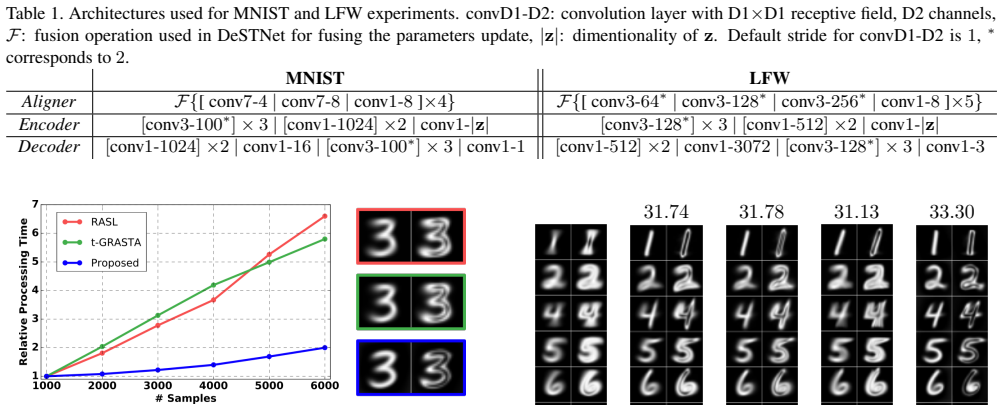
- Alignment accuracy remains high under random perspective warps up to 30% displacement and under highly non-linear deformations as in infiMNIST, where baselines degrade.
- On faces, the method keeps facial landmarks accurate even when the initial bounding box is enlarged by 30%, where rank-based methods blur.
Reading between the lines
- One implication not spelled out in the paper is that the complexity loss could be reused as an unsupervised convergence check, stopping optimisation when reconstruction error plateaus.
- Varying the penalty exponent $k$ or weight $\gamma$ should interpolate between reference-anchored alignment and pure compression alignment, and could be tuned per dataset as a testable extension.
- A natural extension is to replace the fixed reference $I_j$ with a learned template or batch mean, which would remove the need to select a reference image and might improve robustness to a bad initial reference.
Signed reviews
Editorial analysis
A structured set of objections, weighed in public.
Referee Report
Summary. The paper proposes an unsupervised joint image alignment (congealing) method that combines a spatial transformer network (DeSTNet) with a low-capacity auto-encoder. The total loss (Eq. 8) is a weighted sum of an l1 similarity term D against a reference image and a complexity term C that penalizes reconstruction error plus a positional penalty on the latent code. The method is trained end-to-end with SGD. Experiments on MNIST subsets, affNIST, infiMNIST, and LFW report APSNR and landmark errors, and claim robustness to perturbations and initialization as well as scalability to one million images per class, outperforming RASL, t-GRASTA, PSSV, and Deep Congealing.
Significance. If the central claim holds, the paper offers a practically scalable, fully differentiable congealing method that can handle far larger ensembles than existing low-rank or entropy-based approaches. The conceptual idea of using a learned, capacity-controlled auto-encoder as a differentiable proxy for stack complexity is appealing and could be reused in other alignment and co-processing tasks. The experimental scope is unusually large (up to 1M images per digit on infiMNIST), and the paper explicitly investigates robustness to initialization and perturbation type, which is a strength. However, the key theoretical premise—that the reconstruction loss C in Eq. (7) is a faithful and monotone proxy for alignment quality at fixed capacity—is asserted rather than validated, and several experimental comparisons are incomplete or confounded. The paper would be strengthened by directly measuring transformation-parameter accuracy on datasets with known ground-truth warp parameters and by controlling for hardware in the scaling comparison.
major comments (5)
- [Sec. 2.1, Eq. (7); Sec. 3.2] The complexity term C is proposed as a proxy for joint alignment quality, but the auto-encoder E_theta and D_phi are co-trained with the warps, so the capacity is not actually held fixed during optimization. The paper's own ablation (Sec. 3.2, footnote 4) shows that C alone causes shrinking, and the authors rely on the reference term D to prevent collapse. No experiment verifies that minimizing D+C recovers correct warps rather than merely making images more similar to the reference. On affNIST, where ground-truth affine transformation parameters are known by construction, the paper reports only APSNR and visual results, no parameter error; the same holds for infiMNIST. Because all reported metrics measure appearance similarity, and the auxiliary loss could in principle inflate APSNR by collapsing appearance toward a template, the claimed 'high accuracy' lacks a direct test of alignment correctness. I request a parameter-error evaluation on datasets with known transformations, or at least a quantitative comparison against the reference-only loss D on a held-out warp-parameter benchmark.
- [Sec. 3.1, Fig. 3] The scalability comparison is confounded by hardware: the baselines (RASL, t-GRASTA) run on CPUs while the proposed method runs on a GPU, and the authors normalize processing times relative to the 1,000-image run for each method. This normalization removes only the constant factor at the reference size, not the hardware-dependent scaling in per-iteration cost, parallel efficiency, or implementation. Therefore, the conclusion 'the proposed method scales better than the baselines' is not established by Fig. 3. A same-hardware comparison, or a careful analysis of per-iteration complexity with controlled implementations, is needed to support the scalability claim.
- [Sec. 3.2, Fig. 6] The ablation study is qualitative only; no APSNR values are reported for the D-only, C-only, and combined conditions. Given the paper's central claim that C refines the alignment (digits '6' and '9') and acts as a regularizer (digit '3'), quantitative results with variance over runs are necessary. In addition, the hyperparameters lambda, gamma, k, and the latent code dimension b are set to single values (lambda=1, gamma=1, k=1) with no sensitivity analysis. Since the method's premise is that C is a faithful alignment surrogate at controlled capacity, the dependence on gamma (the capacity penalty) is load-bearing and should be studied explicitly.
- [Sec. 3.3 and Sec. 3.4] The affNIST and infiMNIST experiments present results for the proposed method only, with no comparison to any baseline. The abstract and conclusion claim that the method 'outperforms state-of-the-art approaches,' but at these scales no competing method is evaluated. Even if existing methods cannot scale to 100k-1M images, a subsampled comparison or a comparison at the largest scale that baselines can handle would be needed to substantiate the claimed advantage.
- [Sec. 2.1, Eq. (8)] The choice of the reference image I_j is not described. The formulation in Eq. (8) aligns all images to a single reference, and the reported APSNR and landmark errors could be sensitive to which image is chosen as the reference. The score in Eq. (9) uses the average image after alignment, so a poor reference could bias the entire optimization and inflate or deflate the reported metrics. The paper should state how I_j is selected and test robustness to this choice.
minor comments (5)
- [Sec. 3.4] The word 'tickening' appears in the description of infiMNIST deformations; this is a typo for 'thickening'.
- [Table 1] The latent code dimensionality b is denoted '|z|' but its actual value is never specified, which impedes reproducibility.
- [Sec. 3.1] The DeSTNet expansion rate kF=32 is used without definition; readers must consult reference [3] to interpret it. A one-sentence explanation would improve clarity.
- [Eq. (8)] The notation in Eq. (8) is ambiguous: the sum over i includes the reference itself in the complexity term but the similarity term is written as I_{i≠j} ∘ p_{i≠j} − I_j. Clarify the index ranges and whether the reference image is also passed through the auto-encoder.
- [Figs. 4-10] No confidence intervals or multiple-run statistics are reported for any of the APSNR or landmark-error numbers; given the stochastic optimization procedure, at least a few runs with means and standard deviations should be provided for the main comparisons.
Circularity Check
No significant circularity; the penalised-reconstruction objective is a stated assumption rather than a derived prediction, and the only self-citation (DeSTNet) is a component choice, not a load-bearing proof.
full rationale
The central formulation, Eq. (8), is a weighted sum of an L1 similarity-to-reference term D (Eq. 5) and a penalised auto-encoder reconstruction term C (Eq. 7). The claim that minimising C at fixed capacity improves alignment is explicitly motivated as an observation ('we observe that when a set of images are well-aligned, they form a sequence that contains a significant level of redundant information'), not as a quantity defined in terms of the evaluation metric, so it is not self-definitional. No parameter is fitted to a subset of data and then reported as a prediction; the auto-encoder and aligner are co-trained on the same batches, and the paper's own ablation (Section 3.2, footnote 4) concedes that C alone produces a shrinking effect and that D is needed to prevent it, which is a limitation statement rather than a circular derivation. The only self-citation used as a module, DeSTNet [3], supplies the differentiable warping network; it is a design choice, and the paper does not import a uniqueness or correctness theorem from it, so it does not make the derivation circular. The APSNR metric (Eq. 9) is close in spirit to the optimised objective, so the large-scale accuracy claims would be stronger with ground-truth warp-parameter errors on affNIST and infiMNIST; however, the LFW landmark errors provide an external, non-objective evaluation, and metric overlap is an evaluation concern rather than a derivation-level circularity under the stated criteria.
Assumptions & free parameters
free parameters (6)
- lambda =
1
- gamma =
1
- k =
1
- learning rate =
1e-5
- latent code dimension b
- DeSTNet expansion rate kF =
32
assumptions (5)
- domain assumption Well-aligned images require less modelling capacity to be reconstructed well.
- ad hoc to paper A low-capacity auto-encoder with a positional weighting penalty is a valid differentiable proxy for rank-based complexity.
- domain assumption DeSTNet can parameterise the full range of required transformations.
- standard math The L1 norm as distortion measure is robust to occlusions and outliers.
- domain assumption The reference image Ij is fixed and provides a non-degenerate target.
Cite this review
Pith. "Pith review of Jointly Aligning Millions of Images with Deep Penalised Reconstruction Congealing." pith.science (2026). https://pith.science/paper/QDWYUV5B
@misc{pith2026190804130,
  author       = {Pith},
  title        = {Pith review of: Jointly Aligning Millions of Images with Deep Penalised Reconstruction Congealing},
  year         = {2026},
  howpublished = {\url{https://pith.science/paper/QDWYUV5B}},
  note         = {Machine review of arXiv:1908.04130}
}
read the original abstract
Extrapolating fine-grained pixel-level correspondences in a fully unsupervised manner from a large set of misaligned images can benefit several computer vision and graphics problems, e.g. co-segmentation, super-resolution, image edit propagation, structure-from-motion, and 3D reconstruction. Several joint image alignment and congealing techniques have been proposed to tackle this problem, but robustness to initialisation, ability to scale to large datasets, and alignment accuracy seem to hamper their wide applicability. To overcome these limitations, we propose an unsupervised joint alignment method leveraging a densely fused spatial transformer network to estimate the warping parameters for each image and a low-capacity auto-encoder whose reconstruction error is used as an auxiliary measure of joint alignment. Experimental results on digits from multiple versions of MNIST (i.e., original, perturbed, affNIST and infiMNIST) and faces from LFW, show that our approach is capable of aligning millions of images with high accuracy and robustness to different levels and types of perturbation. Moreover, qualitative and quantitative results suggest that the proposed method outperforms state-of-the-art approaches both in terms of alignment quality and robustness to initialisation.
Figures


Figures from the paper (4 more)


Reference graph
Works this paper leans on
-
[1]
Roberto Annunziata, Ahmad Kheirkhah, Shruti Aggarwal, Pedram Hamrah, and Emanuele Trucco. A fully automated tortuosity quantification system with application to corneal nerve fibres in confocal microscopy images. Medical image analysis, 32:216–232, 2016
work page 2016
-
[2]
Scale and curvature invariant ridge detector for tortuous and fragmented structures
Roberto Annunziata, Ahmad Kheirkhah, Pedram Hamrah, and Emanuele Trucco. Scale and curvature invariant ridge detector for tortuous and fragmented structures. In In- ternational Conference on Medical Image Computing and Computer-Assisted Intervention (MICCAI), pages 588–595. Springer, 2015
work page 2015
-
[3]
DeSTNet: Densely fused spatial transformer networks
Roberto Annunziata, Christos Sagonas, and Jacques Cal `ı. DeSTNet: Densely fused spatial transformer networks. Pro- ceedings of British Machine Vision Conference (BMVC) , 2018
work page 2018
-
[4]
Roberto Annunziata and Emanuele Trucco. Accelerating convolutional sparse coding for curvilinear structures seg- mentation by refining SCIRD-TS filter banks.IEEE Transac- tions on Medical Imaging (TMI), 35(11):2381–2392, 2016
work page 2016
-
[5]
Surf: Speeded up robust features
Herbert Bay, Tinne Tuytelaars, and Luc Van Gool. Surf: Speeded up robust features. In Proceedings of European Conference on Computer Vision (ECCV) , pages 404–417, 2006
work page 2006
-
[6]
Ryoma Bise, Yingqiang Zheng, Imari Sato, and Masakazu Toi. Vascular registration in photoacoustic imaging by low- rank alignment via foreground, background and complement decomposition. In Proceedings of International Conference on Medical Image Computing and Computer-Assisted Inter- vention (MICCAI), pages 326–334, 2016
work page 2016
-
[7]
Supervised transformer network for efficient face detection
Dong Chen, Gang Hua, Fang Wen, and Jian Sun. Supervised transformer network for efficient face detection. In Proceed- ings of European Conference on Computer Vision (ECCV) , pages 122–138, 2016
work page 2016
-
[8]
Nonconvex plus quadratic penalized low-rank and sparse decomposition for noisy image alignment
Xiai Chen, Zhi Han, Yao Wang, Yandong Tang, and Haibin Yu. Nonconvex plus quadratic penalized low-rank and sparse decomposition for noisy image alignment. Science China Information Sciences, 59(5):052107, 2016
work page 2016
Show all 48 references
-
[9]
Least squares congealing for unsupervised alignment of images
Mark Cox, Sridha Sridharan, Simon Lucey, and Jeffrey Cohn. Least squares congealing for unsupervised alignment of images. In Proceedings of IEEE International Conference on Computer Vision & Pattern Recognition (CVPR), page 1, 2008
2008
-
[10]
Least-squares congealing for large numbers of im- ages
Mark Cox, Sridha Sridharan, Simon Lucey, and Jeffrey Cohn. Least-squares congealing for large numbers of im- ages. In Proceedings of IEEE International Conference on Computer Vision (ICCV), pages 1949–1956, 2009
1949
-
[11]
Histograms of oriented gra- dients for human detection
Navneet Dalal and Bill Triggs. Histograms of oriented gra- dients for human detection. In Proceedings of IEEE Inter- national Conference on Computer Vision & Pattern Recog- nition (CVPR), volume 1, pages 886–893, 2005
2005
-
[12]
A modern approach
David A Forsyth and Jean Ponce. A modern approach. Com- puter vision: a modern approach, pages 88–101, 2003
2003
-
[13]
Fast r-cnn
Ross Girshick. Fast r-cnn. In Proceedings of the IEEE inter- national conference on computer vision , pages 1440–1448, 2015
2015
-
[14]
Multiple view ge- ometry in computer vision
Richard Hartley and Andrew Zisserman. Multiple view ge- ometry in computer vision . Cambridge university press, 2003
2003
-
[15]
Iterative grassmannian optimization for robust image alignment
Jun He, Dejiao Zhang, Laura Balzano, and Tao Tao. Iterative grassmannian optimization for robust image alignment. Im- age and Vision Computing (IMAVIS), 32(10):800–813, 2014
2014
-
[16]
Learning to align from scratch
Gary Huang, Marwan Mattar, Honglak Lee, and Erik G Learned-Miller. Learning to align from scratch. In Advances in Neural Information Processing Systems (NIPS), 2012
2012
-
[17]
Unsu- pervised joint alignment of complex images
Gary B Huang, Vidit Jain, and Erik Learned-Miller. Unsu- pervised joint alignment of complex images. In Proceed- ings of IEEE International Conference on Computer Vision (ICCV), pages 1–8, 2007
2007
-
[18]
Labeled faces in the wild: A database forstudying face recognition in unconstrained environments
Gary B Huang, Marwan Mattar, Tamara Berg, and Eric Learned-Miller. Labeled faces in the wild: A database forstudying face recognition in unconstrained environments. In Workshop on faces in Real-Life Images: detection, align- ment, and recognition, 2008
2008
-
[19]
Joint registration and synthesis using a probabilistic model for alignment of mri and histo- logical sections
Juan Eugenio Iglesias, Marc Modat, Lo ¨ıc Peter, Allison Stevens, Roberto Annunziata, Tom Vercauteren, Ed Lein, Bruce Fischl, Sebastien Ourselin, Alzheimers Disease Neu- roimaging Initiative, et al. Joint registration and synthesis using a probabilistic model for alignment of ...
2018
-
[20]
Kinectfusion: real-time 3d reconstruction and inter- action using a moving depth camera
Shahram Izadi, David Kim, Otmar Hilliges, David Molyneaux, Richard Newcombe, Pushmeet Kohli, Jamie Shotton, Steve Hodges, Dustin Freeman, Andrew Davison, et al. Kinectfusion: real-time 3d reconstruction and inter- action using a moving depth camera. In Proceedings of the 24th ...
2011
-
[21]
Warpnet: Weakly supervised matching for single- view reconstruction
Angjoo Kanazawa, David W Jacobs, and Manmohan Chan- draker. Warpnet: Weakly supervised matching for single- view reconstruction. In Proceedings of IEEE Interna- tional Conference on Computer Vision & Pattern Recogni- tion (CVPR), pages 3253–3261, 2016
2016
-
[22]
Labeled faces in the wild: A survey
Erik Learned-Miller, Gary B Huang, Aruni RoyChowdhury, Haoxiang Li, and Gang Hua. Labeled faces in the wild: A survey. In Advances in face detection and facial image anal- ysis, pages 189–248. Springer, 2016
2016
-
[23]
Data driven image models through continuous joint alignment
Erik G Learned-Miller. Data driven image models through continuous joint alignment. IEEE Transactions on Pattern Analysis and Machine Intelligence (TPAMI), 28(2):236–250, 2006
2006
-
[24]
The mnist database of handwritten digits
Yann LeCun. The mnist database of handwritten digits. http://yann. lecun. com/exdb/mnist/, 1998
1998
-
[25]
Lagrangian relaxation
Claude Lemar ´echal. Lagrangian relaxation. In Computa- tional combinatorial optimization, pages 112–156. Springer, 2001
2001
-
[26]
Modified robust image alignment by sparse and low rank decomposition for highly linearly correlated data
Habte Tadesse Likassa, Wen-Hsien Fang, and Yung-An Chuang. Modified robust image alignment by sparse and low rank decomposition for highly linearly correlated data. In 2018 3rd International Conference on Intelligent Green Building and Smart Grid (IGBSG), pages 1–4. IEEE, 2018
2018
-
[27]
Inverse compositional spatial transformer networks
Chen-Hsuan Lin and Simon Lucey. Inverse compositional spatial transformer networks. In Proceedings of IEEE Inter- national Conference on Computer Vision & Pattern Recog- nition (CVPR), pages 2568–2576, 2017
2017
-
[28]
Training invariant support vector machines using selective sampling
Ga ¨elle Loosli, St ´ephane Canu, and L ´eon Bottou. Training invariant support vector machines using selective sampling. Large scale kernel machines, 2, 2007
2007
-
[29]
Distinctive image features from scale- invariant keypoints
David G Lowe. Distinctive image features from scale- invariant keypoints. International Journal of Computer Vi- sion (IJCV), 60(2):91–110, 2004
2004
-
[30]
An iterative image reg- istration technique with an application to stereo vision
Bruce D Lucas and Takeo Kanade. An iterative image reg- istration technique with an application to stereo vision. In Proceedings of the International Joint Conference on Artifi- cial Intelligence (IJAI), pages 1568–1575, 1981
1981
-
[31]
Largescale image retrieval with attentive deep local features
Hyeonwoo Noh, Andre Araujo, Jack Sim, Tobias Weyand, and Bohyung Han. Largescale image retrieval with attentive deep local features. In Proceedings of IEEE International Conference on Computer Vision (ICCV), pages 3456–3465, 2017
2017
-
[32]
Partial sum minimization of singular values in robust pca: Algorithm and applications
Tae-Hyun Oh, Yu-Wing Tai, Jean-Charles Bazin, Hyeong- woo Kim, and In So Kweon. Partial sum minimization of singular values in robust pca: Algorithm and applications. IEEE transactions on pattern analysis and machine intelli- gence, 38(4):744–758, 2015
2015
-
[33]
Efficient mo- tion and disparity estimation optimization for low complex- ity multiview video coding
Zhaoqing Pan, Yun Zhang, and Sam Kwong. Efficient mo- tion and disparity estimation optimization for low complex- ity multiview video coding. IEEE Transactions on Broad- casting, 61(2):166–176, 2015
2015
-
[34]
Piefa: Personalized incremental and ensemble face align- ment
Xi Peng, Shaoting Zhang, Yu Yang, and Dimitris N Metaxas. Piefa: Personalized incremental and ensemble face align- ment. In Proceedings of IEEE International Conference on Computer Vision (ICCV), pages 3880–3888, 2015
2015
-
[35]
Rasl: Robust alignment by sparse and low-rank de- composition for linearly correlated images
Yigang Peng, Arvind Ganesh, John Wright, Wenli Xu, and Yi Ma. Rasl: Robust alignment by sparse and low-rank de- composition for linearly correlated images. IEEE Transac- tions on Pattern Analysis and Machine Intelligence (TPAMI), 34(11):2233–2246, 2012
2012
-
[36]
Convo- lutional neural network architecture for geometric matching
Ignacio Rocco, Relja Arandjelovic, and Josef Sivic. Convo- lutional neural network architecture for geometric matching. In IEEE Transactions on Pattern Analysis and Machine In- telligence (TPAMI), 2019
2019
-
[37]
Raps: Robust and efficient automatic construc- tion of person-specific deformable models
Christos Sagonas, Yannis Panagakis, Stefanos Zafeiriou, and Maja Pantic. Raps: Robust and efficient automatic construc- tion of person-specific deformable models. InProceedings of IEEE International Conference on Computer Vision & Pat- tern Recognition (CVPR), pages 1789–1796, 2014
2014
-
[38]
Robust statistical face frontalization
Christos Sagonas, Yannis Panagakis, Stefanos Zafeiriou, and Maja Pantic. Robust statistical face frontalization. In Pro- ceedings of IEEE International Conference on Computer Vi- sion (ICCV), pages 3871–3879, 2015
2015
-
[39]
Robust statistical frontalization of human and animal faces
Christos Sagonas, Yannis Panagakis, Stefanos Zafeiriou, and Maja Pantic. Robust statistical frontalization of human and animal faces. International Journal of Computer Vision (IJCV), 122(2):270–291, 2017
2017
-
[40]
Dis- criminative learning of deep convolutional feature point de- scriptors
Edgar Simo-Serra, Eduard Trulls, Luis Ferraz, Iasonas Kokkinos, Pascal Fua, and Francesc Moreno-Noguer. Dis- criminative learning of deep convolutional feature point de- scriptors. In Proceedings of IEEE International Conference on Computer Vision (ICCV), pages 118–126, 2015
2015
-
[41]
Penalty functions
Alice E Smith and David W Coit. Penalty functions. Hand- book of Evolutionary Computation, 97(1):C5, 1995
1995
-
[42]
Face detection using deep learning: An improved faster rcnn ap- proach
Xudong Sun, Pengcheng Wu, and Steven CH Hoi. Face detection using deep learning: An improved faster rcnn ap- proach. Neurocomputing, 299:42–50, 2018
2018
-
[43]
Tijmen Tieleman. Affnist. https://www.cs.toronto.edu/ tij- men/affNIST/
-
[44]
Joint data alignment up to (lossy) transformations
Andrea Vedaldi, Gregorio Guidi, and Stefano Soatto. Joint data alignment up to (lossy) transformations. In Proceed- ings of IEEE International Conference on Computer Vision & Pattern Recognition (CVPR), 2008
2008
-
[45]
Robust real-time face de- tection
Paul Viola and Michael J Jones. Robust real-time face de- tection. International Journal of Computer Vision (IJCV) , 57(2):137–154, 2004
2004
-
[46]
A survey on face detection in the wild: past, present and future
Stefanos Zafeiriou, Cha Zhang, and Zhengyou Zhang. A survey on face detection in the wild: past, present and future. Computer Vision and Image Understanding (CVIU , 138:1– 24, 2015
2015
-
[47]
Learning to com- pare image patches via convolutional neural networks
Sergey Zagoruyko and Nikos Komodakis. Learning to com- pare image patches via convolutional neural networks. In Proceedings of IEEE International Conference on Computer Vision & Pattern Recognition (CVPR) , pages 4353–4361, 2015
2015
-
[48]
Joint face detection and alignment using multitask cascaded convolutional networks
Kaipeng Zhang, Zhanpeng Zhang, Zhifeng Li, and Yu Qiao. Joint face detection and alignment using multitask cascaded convolutional networks. IEEE Signal Processing Letters , 23(10):1499–1503, 2016
2016
Reviewed August 14, 2026 · model on record in the stance chip above.
Discussion (0). Continue with ORCID to comment.