REVIEW 3 major objections 5 minor 42 references
Boundary interface conditions and solute trapping near the transition to diffusionless solidification
T0 review · 3 major / 5 minor · reviewed 2026-08-14 · deepseek-v4-flash
Pith's one-line read New interface boundary conditions give a solute partition coefficient that rises sharply near the transition to diffusionless solidification.
desk verdict New partition coefficient near diffusionless solidification, but the claimed deviation from the earlier LNM formula rests on an uncalibrated O(1) coefficient. read the letter →
The pith
A machine-rendered reading of the paper's core claim, the machinery that carries it, and where it could break.
The reading
What carries the argument
The load-bearing object is the linear constitutive ansatz (15), $$\mu_i^L(C_L,J_D^L)=\mu_{\mathrm{leq},i}^L(C_L)-\alpha_i\frac{RT}{\rho V_{DI} M}J_D^L,$$ with dimensionless coefficients $\alpha_i$ of order unity and $V_{DI}$ the atomistic diffusive speed at the interface. This ansatz converts the entropy-production balance into boundary condition (25). Setting $C_S=c_0$ and using solute conservation (14) then yields Eq. (28) for $k(V)$. The argument's force is that the unknown interface kinetics enter only through the single combination $\alpha_A+\alpha_B c_0$, so the sharp rise of $k(V)$ near $V_D$ is a direct consequence once that parameter is fixed.
What would settle it
For a dilute alloy with $V_D/V_0\approx 0.5$, measure the partition coefficient at $V=0.9V_D$ and $V=0.99V_D$. Equation (28) predicts a sharp rise toward $k=1$ across that interval, whereas the earlier coefficient (1) predicts a gradual rise; observing the gradual rise would falsify the linearization behind Eq. (28).
Extended reading notes
Core claim
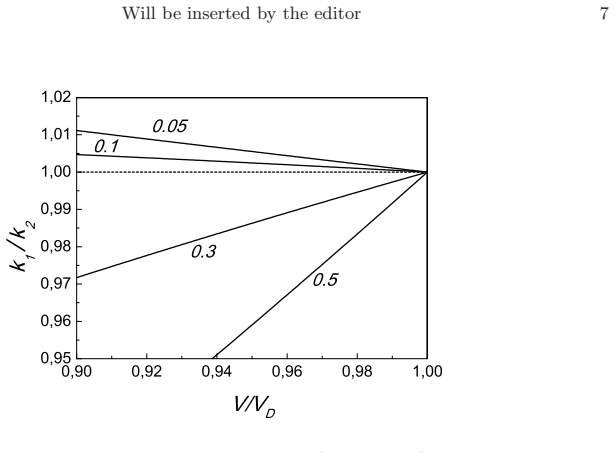
Starting from the entropy production at a sharp interface and the local nonequilibrium premise that bulk liquid diffusion is out of local equilibrium, the paper expands the interfacial chemical potentials linearly in the solute diffusion current $J_D^L$. Combining the resulting Gibbs-energy balance with solute conservation gives the boundary condition (25) and, in the dilute limit $C_S\approx c_0$, the partition coefficient $$k(V)=\frac{c_0(\alpha_A+\alpha_B c_0)V/V_{DI}}{c_0(\alpha_A+\alpha_B c_0)V/V_{DI}+\ln\left(\frac{1-V/V_0}{1-V_D/V_0}\right)}.$$ Near $V=V_D$ this coefficient rises steeply to unity; compared with the partition coefficient (1) from the earlier 2007 work, it differs substantially as $V_D/V_0$ grows, while the two agree at small $V_D/V_0$. The paper's claim is that in the high-speed region the partition coefficient is controlled by macroscopic boundary conditions at the interface rather than by the details of atomic attachment kinetics.
Load-bearing premise
The prediction stands or falls with the assumption that the chemical potential at the interface changes in direct proportion to the solute diffusion current, with two unknown coefficients of order one; if that proportionality or its size is wrong, the partition coefficient changes.
Editorial extensions
If this is right
- If Eq. (28) is correct, the partition coefficient reaches 1 at the finite speed $V_D$, so complete solute trapping is a finite-velocity transition rather than an asymptotic limit.
- At large $V_D/V_0$, the new coefficient rises far more steeply than the earlier 2007 coefficient near $V_D$, changing predicted solid compositions in rapid resolidification.
- The high-speed partition coefficient should be nearly independent of the atomic attachment mechanism, because it follows from macroscopic boundary conditions.
- At small $V_D/V_0$ the new and old coefficients nearly coincide, so experimental and atomistic-simulation data consistent with the older coefficient remain consistent in that regime.
Reading between the lines
- Because only the sum $\alpha_A+\alpha_B c_0$ enters the final formula, the model has effectively one free parameter; fitting it to a single measured $k(V)$ curve would determine the entire high-speed branch.
- Atomistic simulations that compute interfacial chemical potentials under an imposed solute flux could test the linear ansatz (15); a nonlinear response would require higher-order terms.
- Carrying the expansion to second order in $J_D^L$ would recover the $J_D^2$ term used in earlier local nonequilibrium treatments and give corrections to Eq. (28) at intermediate velocities.
- The derivation's dilute-solution and $C_S\approx c_0$ assumptions suggest a natural extension to concentrated alloys, where the logarithmic terms in Eqs. (20)-(21) and the $C_S$ dependence in Eq. (25) must be kept.
Signed reviews
Editorial analysis
A structured set of objections, weighed in public.
Referee Report
Summary. The manuscript derives interface boundary conditions for rapid solidification of a binary mixture in the local nonequilibrium model (LNM), focusing on the velocity range just below the diffusion speed V_D at which diffusionless solidification sets in. The authors expand the interface chemical potentials linearly in the interfacial diffusion current J_D^L (Eq. 15), combine the result with entropy production and mass conservation conditions to obtain boundary conditions (25), and derive a new nonequilibrium solute partition coefficient k(V) in Eq. (28). The new coefficient is compared with the earlier LNM expression (1), and the paper reports that the two differ markedly when the ratio V_D/V_0 is large.
Significance. If the central result holds, the paper provides a new thermodynamically motivated prediction for solute trapping in the high-speed regime that is potentially testable against experimental rapid-solidification data or molecular-dynamics simulations. The derivation is transparent and builds on a standard entropy-production framework, and the algebraic route from Eq. (15) to Eq. (28) is mostly consistent. The main limitations are the undetermined order-unity coefficients alpha_A and alpha_B and the dilute approximations, which leave the quantitative predictions conditional on an uncalibrated parameter.
major comments (3)
- [Section 2, Eq. (24)] Equation (24) states (1-c0)Delta_mu*_A - c0 Delta_mu*_B = (RT/M) ln(1-VD/V0), but insertion of Eqs. (22)-(23) into Eq. (13) and use of the reference-state condition yields Eq. (25) only if the left-hand side is (1-c0)Delta_mu*_A + c0 Delta_mu*_B. The minus sign is therefore a sign error that must be corrected; with the printed sign the derivation does not close.
- [Section 2, Eq. (15) and Section 3, Eq. (28)] The partition coefficient (28) depends on the combination alpha_A + alpha_B c0 introduced through the linearized interface chemical potentials in Eq. (15). No microscopic derivation, numerical estimate, or experimental calibration of alpha_i is provided, and the figures arbitrarily set alpha_A = 1 and alpha_B = 0. Since this combination multiplies the velocity-dependent term in the denominator, the claimed marked deviation from Eq. (1) at large V_D/V_0 is not robust against order-unity variations of alpha_i; the authors should justify these coefficients or provide a sensitivity analysis.
- [Section 3, Figs. 1 and 2] The comparison of k1 and k2 is made for a single choice of alpha_A and alpha_B. Because the central conclusion about sufficiently different behavior rests on this choice, the paper should show curves for several values of alpha_A + alpha_B c0 (for example 0.1, 1, and 10) to demonstrate whether the qualitative conclusion persists.
minor comments (5)
- [Abstract and Introduction] The sentence 'the solute transfer in the liquid bhas no time to occur' contains a typo ('bhas' should be 'has').
- [Introduction, Reference [1]] Reference [1] contains typos in 'Fandamentals' and '2rd ed.'; these should be corrected.
- [Section 2, after Eq. (15)] The phrase 'the sign of which will be discussed later' is never followed by an explicit discussion of the sign of alpha_i; please add such a discussion or remove the promise.
- [Section 3, Eq. (28)] The condition V < V_D should be stated explicitly when Eq. (28) is introduced, along with the statement that k = 1 for V >= V_D, to avoid the apparent singularity of the logarithm for V > V_D.
- [Fig. 1 caption] The caption has minor grammatical issues ('coefficients k1 ... is shown') and should be reworded.
Circularity Check
No circularity: Eq. (28) is an algebraic consequence of stated interface conditions and not a restatement of Eq. (1) or a fitted input.
full rationale
The derivation is self-contained in the sense that Eq. (28) follows algebraically from the paper's stated boundary conditions, not from the target partition coefficient. The chain runs from entropy production (2)/(8) and the kinetic relation (11)-(13), through the linear interfacial chemical-potential expansion (15) and mass conservation (14), to boundary condition (25), and then, under C_S ≈ c0 and 1-c0 ≈ 1, to Eqs. (26)-(28). The earlier coefficient (1) is used only for the comparison in Figs. 1-2, not as a premise in the derivation. The finite-V_D transition and the use of the V=V_D state as a reference are imported from the authors' previous LNM work, but those are background framework assumptions with external experimental/MD support, not a uniqueness theorem or a fitted parameter, and they do not determine the new velocity dependence by themselves. The one substantive caveat is that Eq. (15) is an ansatz with unspecified order-unity parameters α_i, and Eq. (28) depends on α_A+α_B c0; the figures choose α_A=1, α_B=0 for illustration, so the claimed marked difference from Eq. (1) is conditional on that choice. This is an assumption/robustness limitation, not circularity. The sign typo in Eq. (24) should be corrected for checkability, but it does not appear to propagate into Eq. (28) because the subsequent Eq. (25) uses the correct plus-sign form.
Assumptions & free parameters
free parameters (1)
- alpha_A (and alpha_B) =
not determined; alpha_A=1, alpha_B=0 in illustrative figures
assumptions (6)
- standard math Interface entropy production T*sigma = j_A*Delta_mu_A + j_B*Delta_mu_B (Eq. 2)
- domain assumption Kinetic relation V = V0*(1 - exp(M*Delta_G_m/RT)) (Eq. 11)
- ad hoc to paper Linear dependence of interface chemical potential on J_D^L with coefficients alpha_i (Eq. 15)
- domain assumption Dilute solution with Henry's and Raoult's laws (Eqs. 20-21)
- domain assumption At V=V_D the reference state has C_L=C_S=c0 and J_D^L=0
- domain assumption Diffusion current in the solid phase is neglected, J_S^D=0
Cite this review
Pith. "Pith review of Boundary interface conditions and solute trapping near the transition to diffusionless solidification." pith.science (2026). https://pith.science/paper/QELNX75E
@misc{pith2026190802099,
  author       = {Pith},
  title        = {Pith review of: Boundary interface conditions and solute trapping near the transition to diffusionless solidification},
  year         = {2026},
  howpublished = {\url{https://pith.science/paper/QELNX75E}},
  note         = {Machine review of arXiv:1908.02099}
}
abstract
The process of rapid solidification of a binary mixture is considered in the framework of local nonequilibrium model (LNM) based on the assumption that there is no local equilibrium in solute diffusion in the bulk liquid and at the solid-liquid interface. According to LNM the transition to complete solute trapping and diffusionless solidification occurs at a finite interface velocity $V=V_D$, where $V_D$ is the diffusion speed in bulk liquid. In the present work, the boundary conditions at the phase interface moving with the velocity $V$ close to $V_D$ ($V \lesssim V_D$) have been derived to find the non-equilibrium solute partition coefficient. In the high-speed region, its comparison with the partition coefficient from the work [Phys. Rev. E 76 (2007) 031606] is given.
Figures

Reference graph
Works this paper leans on
-
[1]
W. Kurz and D. J. Fisher, Fandamentals of Solidifications , 2rd ed. (Trans.Tech., Aed- ermannsdorf, Switzerland,1992)
work page 1992
-
[2]
D. M. Herlach, Mater. Sci. Eng. R 12, (1994) 177–272
work page 1994
-
[3]
D. Herlach, P. Galenko and D. Holland-Moritz, Metastable Solids From Undercooled Melts (Elsevier, Amsterdam, 2007) 8 Will be inserted by the editor
work page 2007
-
[4]
P.K. Galenko, V. Ankudinov, K. Reuther, M. Rettenmayr, A. Salhoumi, E.V. Kha- ranzhevskiy, Phil. Trans. R. Soc. A 377, (2019) 20180205-1-24
work page 2019
- [5]
-
[6]
R. F. Wood, Appl. Phys. Lett. 37, (1980) 302–304
work page 1980
-
[7]
M. J. Aziz, J. Appl. Phys. 53, (1982) 1158–1168
work page 1982
- [8]
Show all 42 references
-
[9]
M. J. Aziz and C. W. White, Phys. Rev. Lett. 57, (1986) 2675–2678
1986
-
[10]
M. J. Aziz and W. J. Boettinger, Acta Metall. Mater. 42, (1994) 527–537
1994
-
[11]
P. M. Smith and M.J . Aziz , Acta Metall. Mater. 42, (1994) 3515–3525
1994
-
[12]
Reitano, P.M.Smith, M.J.Aziz, J
R. Reitano, P.M.Smith, M.J.Aziz, J. Appl. Phys. 76, (1994) 1518-1529
1994
-
[13]
Brunco, M.O
J.A.Kittl, M.J.Aziz, D.P. Brunco, M.O. Thompson, J. Cry st. Growth 148, (1995) 172– 182
1995
-
[14]
Sanders, M.J.Aziz, D.P
J.A.Kittl, P.A. Sanders, M.J.Aziz, D.P. Brunco, M.O. Th ompson, Acta Mater. 48, (2000) 4797–4811
2000
-
[15]
Jackson, M
K.A. Jackson, M. Kirk, K.M. Beatty, K.A. Gudgel, J. Cryst . Growth 271, (2004) 481– 494
2004
-
[16]
Beatty, K.A
K.M. Beatty, K.A. Jackson, J.Cryst.Growth 271,(2004) 495–512
2004
-
[17]
Eckler, R
K. Eckler, R. F. Cochrane, D. M. Herlach, B. Feuerbacher, and M. Jurisch, Phys. Rev. B 45, (1992) 5019–5022
1992
-
[18]
A. A. Wheeler, W. J. Boettinger, and G. B. McFadden, Phys. Rev. E 47, (1993) 1893– 1909
1993
-
[19]
J. C. Ramirez, C. Beckermann, A. Karma, and H.-J. Diepers , Phys. Rev. E 69, (2004) 051607-1–16
2004
-
[20]
N. A. Ahmad, A. A. Wheeler, W. J. Boettinger, and G. B. McFa dden, Phys. Rev. E 58, (1998) 3436–3450
1998
-
[21]
C. B. Arnold, M. J. Aziz, M. Schwarz, and D. M. Herlach, Phy s. Rev. B 59, (1999) 334–343
1999
-
[22]
S. L. Sobolev, Phys. Lett. A 199, (1995) 383–385
1995
-
[23]
S. L. Sobolev, Phys. Status Solidi A 156, (1996) 293–303
1996
-
[24]
S. L. Sobolev, Phys. Rev. E 55, (1997) 6845–6854
1997
-
[25]
Galenko and S
P. Galenko and S. L. Sobolev, Phys. Rev. E 55, (1997) 343–352
1997
-
[26]
Galenko, Phys
P. Galenko, Phys. Rev. B 65, (2002) 144103-1–11
2002
-
[27]
P. K. Galenko and D. A. Danilov, Phys. Rev. E 69, (2004) 051608-1–14
2004
-
[28]
P. K. Galenko and D. M. Herlach, Phys. Rev. Lett. 96, (2006) 150602-1–4
2006
-
[29]
Galenko , Phys
P. Galenko , Phys. Rev. E 76, 031606 (2007) 031606-1–9
2007
-
[30]
J. C. Baker and J. W. Cahn, Acta Metatall. 17, (1969) 575–578
1969
-
[31]
Duwez, R
P. Duwez, R. H. Willens, and W. Klement, Jr. J. Appl. Phys. 31, (1960) 1136–1137
1960
-
[32]
Biloni and Chalmers, Trans
H. Biloni and Chalmers, Trans. Soc. Min. Eng. AIME 233, (1965) 373–378
1965
-
[33]
Miroshnichenko, Quenching From the Liquid State (in Russian) (Metallurgia, Moscow, 1982)
I.S. Miroshnichenko, Quenching From the Liquid State (in Russian) (Metallurgia, Moscow, 1982)
1982
-
[34]
Willnecker, D.M
R. Willnecker, D.M. Herlach, B. Feuerbacher, Appl. Phys . Lett. 56, (1990) 324–326
1990
-
[35]
Reutzel, D.M.Herlach, D
P.K.Galenko, S. Reutzel, D.M.Herlach, D. Danilov, B. Ne stler, Acta Mater. 55, (2007) 6834–6842
2007
-
[36]
Galenko, D
H.Hartmann, PK. Galenko, D. Holland-Moritz, M.Kolbe, D .M. Herlach, O. Shuleshova, J. Appl. Phys. 403, (2007) 6834–6842
2007
-
[37]
Reutzel, D.M.Herlach, S.G
P.K.Galenko, S. Reutzel, D.M.Herlach, S.G. Fries, I. St einbach, M. Apel, Acta Mater. 57, (2009) 6166–6175
2009
-
[38]
Alexandrov and P.K.Galenko, Acta Mater
D.V. Alexandrov and P.K.Galenko, Acta Mater. 137, (2017) 64–70
2017
-
[39]
Y. Yang, H. Humadi, D. Buta, B.B. Laird, D. SunJ.J. Hoyt, M . Asts, Phys. Rev. Lett, 107, (2011) 025505-1–4
2011
-
[40]
Caroli, C
B. Caroli, C. Caroli, B. Roulet, J. Cryst. Growth 66, (1984) 481–494
1984
-
[41]
Caroli, C
B. Caroli, C. Caroli, B. Roulet, Acta Metall. 34, (1986) 1867–1877
1986
-
[42]
Turnbull, J
D. Turnbull, J. Phys. Chem. 66, (1962) 609–613
1962
Reviewed August 14, 2026 · model on record in the stance chip above.
Discussion (0). Continue with ORCID to comment.