REVIEW 2 major objections 5 minor 8 references
Temperature Effects in the thermal conductivity of aligned amorphous Polyethylene -- A molecular Dynamics study
T0 review · 2 major / 5 minor · reviewed 2026-08-14 · deepseek-v4-flash
Pith's one-line read Stretching amorphous polyethylene shifts the temperature of peak thermal conductivity from 350 K to 100 K.
desk verdict New and likely correct observation that stretching amorphous PE lowers the thermal-conductivity peak temperature, attached to a plausible but under-supported disorder/anharmonicity mechanism. read the letter →
The pith
A machine-rendered reading of the paper's core claim, the machinery that carries it, and where it could break.
The reading
What carries the argument
The central object is the phonon scattering rate, written as $1/\tau_k = (1/\tau_k)_{\mathrm{disorder}} + (1/\tau_k)_{\mathrm{anharmonicity}}$. Disorder scattering is nearly temperature-independent, while anharmonic scattering grows roughly linearly with temperature; thermal conductivity of a mode is proportional to specific heat times group velocity squared times lifetime, so conductivity rises with temperature while disorder dominates (because specific heat increases) and falls once anharmonicity dominates. The crossover temperature is the peak temperature, and alignment reduces disorder so the crossover occurs at lower temperature. The controlled probe is the dihedral energy parameters, which alter the trans/gauche ratio and hence disorder without, the paper argues, changing the bond-stiffness-controlled vibrational frequencies.
What would settle it
Compute the phonon density of states for the original and modified-dihedral polymers; if the vibrational spectrum shifts appreciably, the claim that dihedral changes isolate disorder fails. Alternatively, in a simulation where the aligned chain conformation is held fixed while the dihedral parameters are changed, any change in thermal conductivity would indicate a non-disorder effect.
Extended reading notes
Core claim
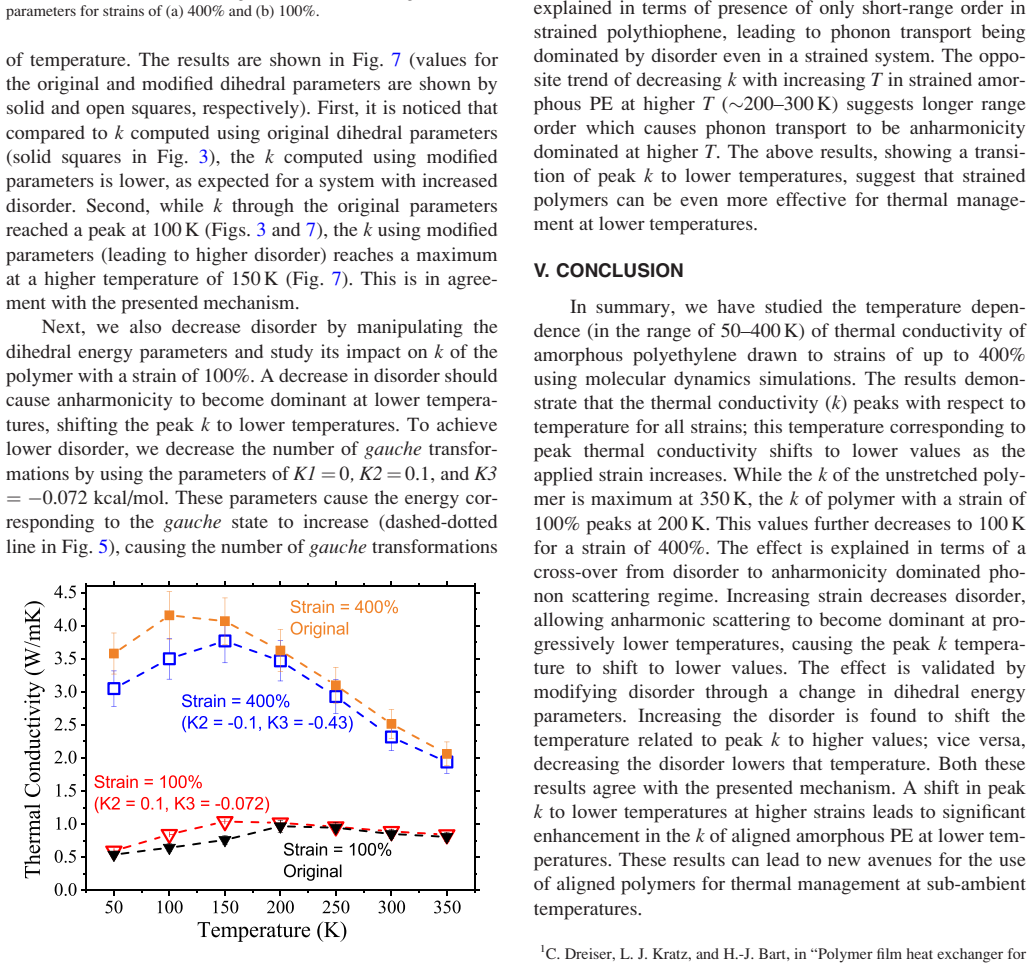
The paper reports a systematic downward shift in the temperature at which thermal conductivity peaks as amorphous polyethylene is stretched: from 350 K unstrained to 200 K at 100% strain and 100 K at 400% strain. It attributes this to a crossover between disorder-dominated and anharmonicity-dominated phonon scattering: strain aligns chains, reduces disorder, so the temperature at which anharmonic scattering overtakes disorder scattering falls. Supporting evidence comes from modifying dihedral potential parameters to change the trans/gauche balance: added disorder moves the peak from 100 K to 150 K at 400% strain, and reduced disorder moves it from 200 K to 150 K at 100% strain.
Load-bearing premise
The manipulation-of-disorder experiment assumes that changing the dihedral energy parameters alters only chain disorder, not the vibrational frequencies or anharmonicity that also control thermal conductivity.
Editorial extensions
If this is right
- Aligned amorphous PE conducts relatively better at low temperatures: stretching to 400% gives an 18-fold enhancement at 200 K versus a 6.5-fold enhancement at 350 K.
- The temperature of peak conductivity is tunable by strain, roughly 350 K at 0% strain, 200 K at 100% strain, and 100 K at 400% strain.
- The disorder-to-anharmonicity crossover explains why the peak shifts, and it predicts that increasing disorder raises the peak temperature while reducing disorder lowers it.
- Strained amorphous PE could be a candidate for sub-ambient heat exchangers and cryogenic thermal management because its conductivity advantage grows as temperature falls.
Reading between the lines
- The crossover picture implies a direct test: extract phonon lifetimes from normal-mode analysis and check that the temperature where anharmonic scattering overtakes disorder scattering matches the peak temperature at each strain.
- A natural extension would apply the same dihedral-parameter perturbation to other amorphous polymers; if the mechanism is general, suppressing gauche conformations should lower the peak temperature for any chain-aligned system.
- Extrapolating the trend, very high draw ratios should push the peak temperature below 50 K, possibly making the peak invisible in the simulated temperature window; this is a testable prediction for longer simulations or experiments.
Signed reviews
Editorial analysis
A structured set of objections, weighed in public.
Referee Report
Summary. This paper uses reverse non-equilibrium molecular dynamics (RNEMD) simulations with the COMPASS force field to study the temperature dependence of thermal conductivity (k) of amorphous polyethylene (PE) under uniaxial strains from 0% to 400% and temperatures from 50 to 400 K. The central observation is that the temperature at which k peaks (T_peak) shifts monotonically downward with increasing strain: from 350 K for unstrained PE to 200 K at 100% strain and 100 K at 400% strain. The authors interpret this as a crossover from disorder-dominated to anharmonicity-dominated phonon transport, arguing that increasing strain reduces structural disorder, so that anharmonic scattering becomes dominant at lower temperatures. To support this mechanism, they modify the C-C-C-C dihedral potential parameters to increase or decrease disorder and find that T_peak shifts upward with increased disorder and downward with decreased disorder, in qualitative agreement with their prediction.
Significance. If the result stands, the paper provides a clear, systematic MD dataset showing a strong strain-induced shift of T_peak in amorphous PE, with potential implications for low-temperature polymer thermal management. The study is carefully executed in terms of structure preparation, equilibration, and size-effect checks (peak position unchanged for a smaller system). The directional test using modified dihedral parameters is a clever attempt at a mechanistic validation, and the observed T_peak shifts are qualitatively consistent. However, the paper does not provide direct phonon-level evidence (lifetimes, group velocities, or mode-resolved conductivities) for the proposed disorder-to-anharmonicity crossover, and the dihedral-parameter validation is undermined by a quantitative issue with the torsional force constant, as detailed below.
major comments (2)
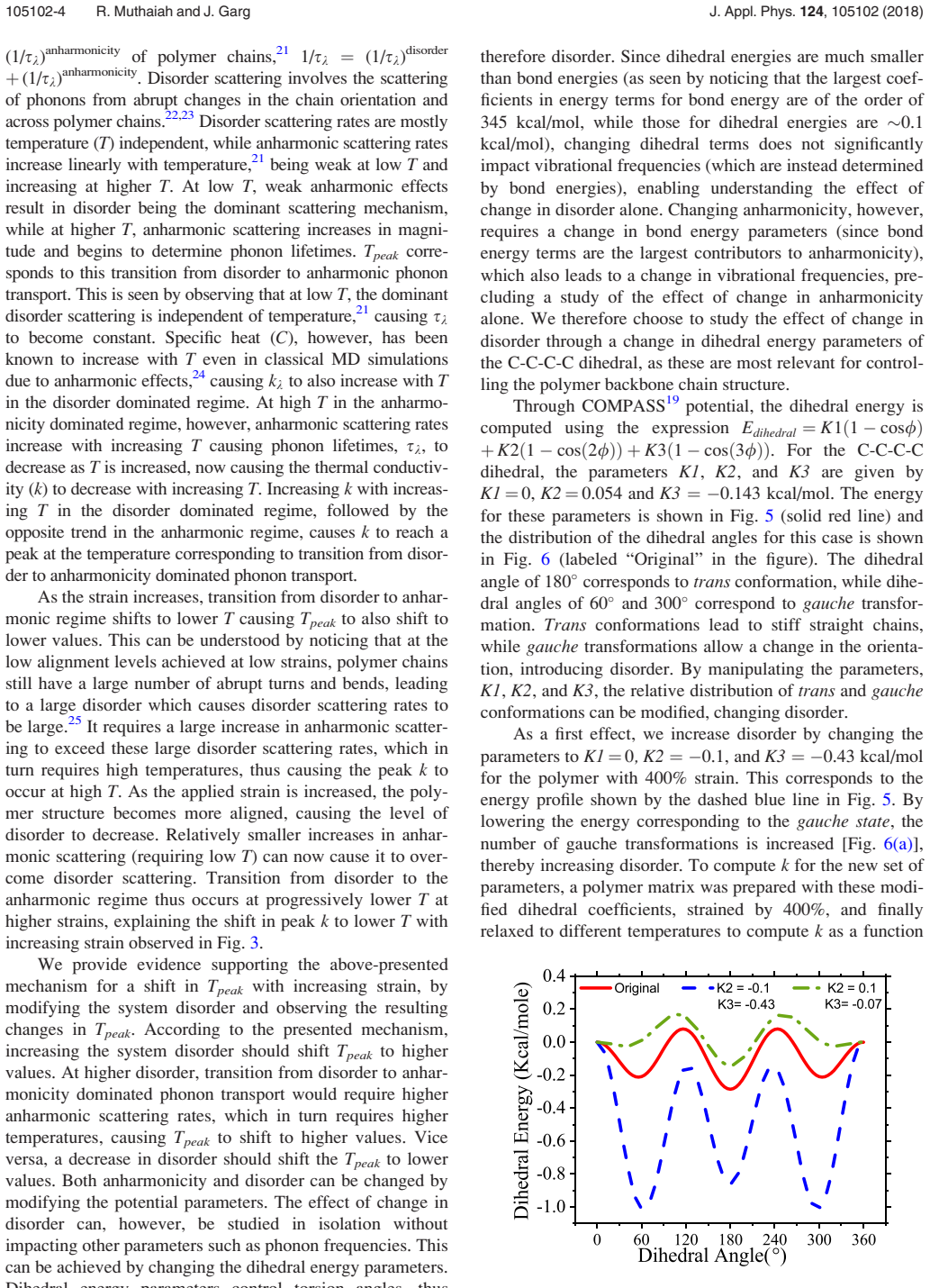
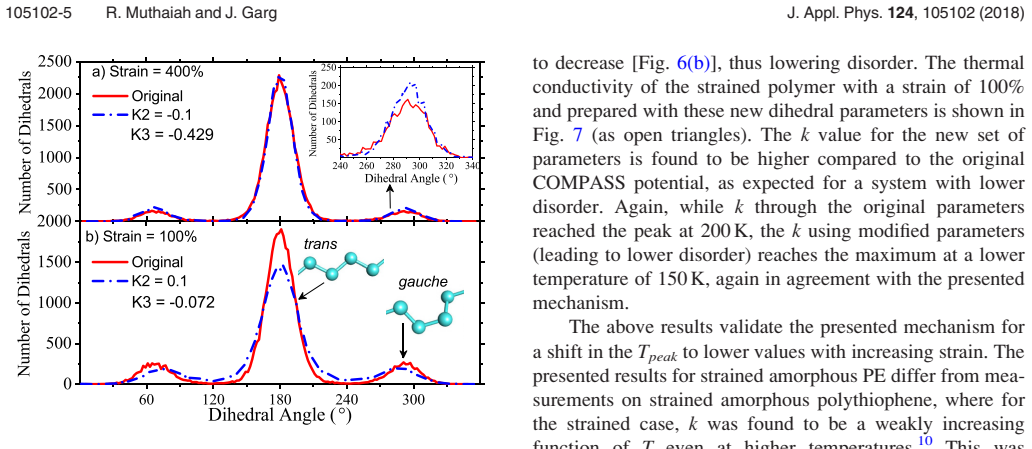
- [Section IV, dihedral energy expression and Fig. 7] The validation in Section IV rests on the claim that changing dihedral energy parameters changes only disorder without significantly affecting vibrational frequencies, based on the small magnitude of dihedral coefficients (~0.1 kcal/mol) relative to bond coefficients (~345 kcal/mol). This argument is invalid because vibrational frequencies depend on the curvature of the potential, not on the absolute energy scale. Evaluating the second derivative of the COMPASS dihedral potential E = K1(1-cos φ) + K2(1-cos 2φ) + K3(1-cos 3φ) at the trans minimum (φ = 180°) gives d²E/dφ² = 4K2 - 9K3. Using the original parameters (K2 = 0.054, K3 = -0.143) yields 1.50 kcal/mol/rad², while the 'increased disorder' parameters (K2 = -0.1, K3 = -0.43) yield 3.47 kcal/mol/rad², and the 'decreased disorder' parameters (K2 = 0.1, K3 = -0.072) yield 1.05 kcal/mol/rad². The resulting factor-of-2.3 change in torsional force constant shifts low-frequency torsional mode frequencies by up to ~50%, and such modes contribute to heat transport in amorphous polymers. Consequently, the modified runs do not isolate disorder; they also alter the phonon spectrum and the anharmonicity of the torsional potential. Because the central mechanistic claim is validated only by these runs (Fig. 7 reports no error bars for the 50 K T_peak shifts), the evidence for the disorder-to-anharmonicity crossover is not yet established.
- [Sections III and IV] The proposed mechanism is inferred rather than directly measured. The paper invokes the standard expression 1/τ_k = (1/τ_k)_disorder + (1/τ_k)_anharmonicity with temperature-independent disorder scattering and anharmonic scattering that increases with T, but it never computes phonon lifetimes, group velocities, or mode-resolved contributions to k. While the monotonic T_peak shift with strain is an interesting and well-documented observation, the attribution to a crossover from disorder to anharmonicity remains a plausible hypothesis. A direct analysis (e.g., normal-mode decomposition or phonon-lifetime calculations at representative strains and temperatures) would be needed to confirm that the peak shift arises from changes in scattering rates rather than from temperature-dependent morphological changes, thermal expansion, or specific-heat variations. This gap is particularly important because the only attempted validation (modified dihedral runs) does not cleanly isolate disorder, as argued above.
minor comments (5)
- [Fig. 7] Figure 7 shows the T_peak shifts between original and modified dihedral runs but does not report error bars. Since the observed shifts are only 50 K, error estimates (from multiple starting configurations, as in Fig. 3) are needed to establish statistical significance.
- [Introduction] There is a typographical artifact in the text: 'k of bulk PE (/C240.5 W/mK)' should presumably read '≈0.5 W/mK'.
- [References] Reference 11 lists 'C. Oilgchleger' but the correct spelling is 'C. Oligschleger'.
- [Section II and strain definition] The strain values (up to 400%) are not explicitly defined as engineering or true strain. Please specify the strain measure used in the deformation simulations, as this affects the comparison with experiments and prior work.
- [Section IV, polythiophene comparison] The comparison with chain-oriented amorphous polythiophene attributes long-range order in strained PE to the observed decreasing k at higher T, but no quantitative order metric (e.g., P2 values or correlation lengths) is given for the polythiophene case, making the comparison informal.
Circularity Check
No significant circularity: the Tpeak shift is an observed MD result, and the disorder-modification test is a falsifiable check, not a fit or self-referential derivation.
full rationale
The paper's central claim that Tpeak decreases with increasing strain is directly read from non-equilibrium MD simulations (Fig. 3), not obtained by fitting the proposed disorder/anharmonicity model to the data. The explanatory mechanism is then tested by altering dihedral parameters to change disorder and observing whether Tpeak shifts in the predicted direction: increasing disorder shifts Tpeak from 100 K to 150 K, and decreasing disorder shifts it from 200 K to 150 K. These are independent checks that could have failed, so the validation is not circular. No equation in the paper defines Tpeak in terms of the disorder parameter, and no fitted parameter is renamed as a prediction. The only self-citation involving an author of the present paper (ref. 7, Saeidijavash et al., with co-author Garg) appears in the introduction as background on aligned polymer nanocomposites and is not load-bearing for the temperature-dependence claim. The assumption that changing dihedral parameters affects only disorder and not vibrational frequencies (Section IV) is a correctness risk, not a circularity: even if the assumption is false, the derivation does not reduce to its own inputs by construction. The paper is self-contained against external MD force fields, experimental benchmarks, and prior simulation results, so the circularity score is 0.
Assumptions & free parameters
free parameters (2)
- Modified dihedral K2, K3 for increased disorder =
K1=0, K2=-0.1 kcal/mol, K3=-0.43 kcal/mol
- Modified dihedral K2, K3 for decreased disorder =
K1=0, K2=0.1 kcal/mol, K3=-0.072 kcal/mol
assumptions (5)
- domain assumption The COMPASS force field accurately represents the interatomic interactions needed to compute PE thermal conductivity.
- domain assumption Classical MD with RNEMD yields reliable thermal conductivity in the 50-400 K range.
- domain assumption Phonon scattering obeys Matthiessen's rule with disorder scattering temperature-independent and anharmonic scattering proportional to temperature.
- domain assumption The temperature of peak k marks the crossover from disorder-dominated to anharmonicity-dominated phonon transport.
- ad hoc to paper Changing dihedral energy parameters changes disorder without significantly changing phonon frequencies or anharmonicity.
Cite this review
Pith. "Pith review of Temperature Effects in the thermal conductivity of aligned amorphous Polyethylene -- A molecular Dynamics study." pith.science (2026). https://pith.science/paper/QENFY5KB
@misc{pith2026190804341,
  author       = {Pith},
  title        = {Pith review of: Temperature Effects in the thermal conductivity of aligned amorphous Polyethylene -- A molecular Dynamics study},
  year         = {2026},
  howpublished = {\url{https://pith.science/paper/QENFY5KB}},
  note         = {Machine review of arXiv:1908.04341}
}
read the original abstract
We analyze, through molecular dynamics simulations, the temperature dependence of the thermal conductivity (k) of chain-oriented amorphous polyethylene (PE). We find that at increasing levels of orientation, the temperature corresponding to a peak k progressively decreases. Un-oriented PE exhibits the peak k at 350 K, while aligned PE under an applied strain of 400% shows a maximum at 100 K. This transition of peak k to lower temperatures with increasing alignment is explained in terms of a crossover from disorder to anharmonicity dominated phonon transport in aligned polymers. Evidence for this crossover is achieved by manipulating the disorder in the polymer structure and studying the resulting change in temperature corresponding to peak k. Disorder is modified through a change in the dihedral parameters of the potential function, allowing a change in the relative fraction of trans and gauche transformations. The results shed light on the underlying thermal transport processes in aligned polymers and hold importance for low temperature applications of polymer materials in thermal management technologies.
Figures


Figures from the paper (3 more)
Reference graph
Works this paper leans on
-
[1]
Temperature effects in the thermal conductivity of aligned amorphous polyethylene—A molecular dynamics study Rajmohan Muthaiah, and Jivtesh Garg Citation: Journal of Applied Physics 124, 105102 (2018); doi: 10.1063/1.5041000 View online: https://doi.org/10.1063/1.5041000 View Table of Contents: http://aip.scitation.org/toc/jap/124/10 Published by the Amer...
-
[3]
Structure preparation of amor- phous polyethylene and its alignment through application of strain. 105102-2 R. Muthaiah and J. Garg J. Appl. Phys. 124, 105102 (2018) terms of increasing alignment of the dominant heat conduct- ing C-C covalent bonds in each polymer chain with the direction of heat transfer. Such polymer chain alignment, typically character...
work page 2018
-
[4]
Increase in the orientation parameter P2 with strain at different temperatures. 105102-3 R. Muthaiah and J. Garg J. Appl. Phys. 124, 105102 (2018) (1/sk)anharmonicity of polymer chains, 21 1/sk ¼ (1/sk)disorder þ (1/sk)anharmonicity. Disorder scattering involves the scattering of phonons from abrupt changes in the chain orientation and across polymer chai...
work page 2018
-
[5]
Polymer film heat exchanger for seawater desalination: Prevention and cleaning of fouling deposits,
Dihedral energy for the original COMPASS potential and for modi- fied dihedral parameters. 105102-4 R. Muthaiah and J. Garg J. Appl. Phys. 124, 105102 (2018) of temperature. The results are shown in Fig. 7 (values for the original and modified dihedral parameters are shown by solid and open squares, respectively). First, it is noticed that compared to k com...
work page 2018
-
[7]
Temperature dependence of k of amorphous PE with modified and original dihedral parameters for strains of 100% and 400%. 105102-5 R. Muthaiah and J. Garg J. Appl. Phys. 124, 105102 (2018) Budapest, Hungary, edited by H. Muller-Steinhagen, A. P. Watkinson, and M. R. Malayeri (2013), p
work page 2018
-
[296]
Thermal analysis of polymer heat exchangers for solar water heating: A case study,
2W. Liu, J. Davidson, and S. Mantell, “Thermal analysis of polymer heat exchangers for solar water heating: A case study,” J. Sol. Energy Eng. 122, 84 (2000). 3S. Mallik, N. Ekere, C. Best, and R. Bhatti, “Investigation of thermal man- agement materials for automotive electronic control units,” Appl. Therm. Eng. 31, 355 (2011). 4X. Lu and G. Xu, “Thermall...
work page 2000
-
[2014]
Thermal conductivity of oriented crystalline polymers,
9C. L. Choy, F. C. Chen, and W. H. Luk, “Thermal conductivity of oriented crystalline polymers,” J. Polym. Sci.: Polym. Phys. 18, 1187–1207 (1980). 10V .S i n g h ,T .L .B o u g h e r ,A .W e a t h e r s ,Y .C a i ,K .B i ,M .T .P e t t e s ,S .A . McMenamin, W. Lv, D. P. Resler, T. R. Gattuso, D. H. Altman, K. H. Sandhage, L. Shi, A. Henry, and B. A. Col...
work page 1980
-
[2018]
We find that at increasing levels of orientation, the temperature corresponding to a peak k progressively decreases
We analyze, through molecular dynamics simulations, the temperature dependence of the thermal conductivity ( k) of chain-oriented amorphous polyethylene (PE). We find that at increasing levels of orientation, the temperature corresponding to a peak k progressively decreases. Un-oriented PE exhibits the peak k at 350 K, while aligned PE under an applied str...
2018
Reviewed August 14, 2026 · model on record in the stance chip above.
Discussion (0). Continue with ORCID to comment.