REVIEW 4 major objections 6 minor 7 cited by
The ACCEL2 Project: Precision Measurements of EFT Parameters and BAO Peak Shifts for the Lyman-$\alpha$ Forest
T0 review · 4 major / 6 minor · reviewed 2026-08-11 · deepseek-v4-flash
Pith's one-line read One-loop EFT puts the Lyman-alpha BAO shift near 0.3 percent.
desk verdict Useful calibration paper with an inflated abstract and a shift error budget that omits truncation sensitivity; the central result is plausible and deserves peer review after revisions. read the letter →
The pith
A machine-rendered reading of the paper's core claim, the machinery that carries it, and where it could break.
The reading
What carries the argument
The load-bearing object is the one-loop EFT flux power spectrum $P^{\rm th}(k,\mu)=P_{\rm tree}+P_{\rm 1\text{-}loop}+P_{\rm ct}+P_{\rm st}$, with redshift-space kernels from the rotationally invariant bias expansion and IR resummation of the BAO wiggle. The BAO shift is carried by the mode-coupling integral $P^{(22)}$, whose dominant piece is $\langle\Psi\delta\rangle\xi'(x)$: long-wavelength displacements contract the BAO sphere around overdensities where the forest signal is suppressed, producing an analytic shift proportional to $\sigma_d^2\,k\,P_w'(k)$ with a bias-dependent prefactor. A Fisher formalism converts this shift into predicted offsets in $\alpha_\parallel$ and $\alpha_\perp$ for a survey of DESI-like volume.
What would settle it
Compute a two-loop Lyman-alpha flux power spectrum at the ACCEL2 cosmology, or perform a field-level comparison on the same simulation boxes, and refit the one-loop model: if the best-fit bias parameters move by more than their quoted uncertainties, the derived BAO-shift budget is not reliable. A second check is to fit the same model to an independent hydrodynamic simulation with different intergalactic-medium thermal physics and see whether the 0.1–0.3 percent shift values persist.
Extended reading notes
Core claim
The paper establishes that a one-loop EFT model for the Lyman-alpha forest—built from the bias expansion invariant under rotations around the line of sight, with counterterms, stochastic terms, and infrared resummation—fits the ACCEL2 simulated flux power spectrum to sub-2% accuracy on small scales and about 10% on large scales across five snapshots at redshifts $z=2$ to $4$. Using the same fitted parameters, the paper derives a closed-form expression for the nonlinear BAO shift and finds that nonlinearities displace the BAO scale by only a few tenths of a percent, with the sign and size set by the quadratic bias coefficients. This result does not support earlier simulation-based claims of a percent-level redshift-space BAO shift, and it supplies both informative priors and a concrete error budget for full-shape and compressed analyses of the forest.
Load-bearing premise
The one-loop EFT is assumed to remain controlled up to $k_{\max}=2\,h\,\mathrm{Mpc}^{-1}$, even though the loop-to-tree ratio crosses unity near $k\sim1.5\,h\,\mathrm{Mpc}^{-1}$, so the fitted bias parameters and the BAO shift built from them could absorb uncontrolled higher-order corrections.
Editorial extensions
If this is right
- DESI Lyman-alpha BAO analyses can add a theory error term of order 0.1–0.3 percent to their covariance, comparable to or below the current statistical precision.
- The measured bias parameters provide informative priors for full-shape analyses of the three-dimensional Lyman-alpha power spectrum.
- The isotropic shift of about $-0.3\%$ is far smaller than the percent-level shift suggested by some simulation-based studies, so the BAO scale in the forest is largely robust to nonlinear modeling.
- The Lyman-alpha–quasar cross-correlation shift is only about $-0.1\%$, so cross-correlation BAO measurements need only a modest theory correction.
- The same EFT framework carries over to future surveys and to field-level analyses, where the bias parameters can be checked against simulation output.
Reading between the lines
- If the small BAO shift relies on an accidental suppression of tree-level terms, a two-loop computation or field-level fit could break the cancellation and enlarge the shift beyond the quoted budget.
- The cross-correlation estimates use quasar bias parameters measured at an effective redshift near $z\simeq1.48$, while the DESI forest measurement sits near $z\simeq2.33$; a bias measurement at the matching redshift could move the cross-correlation shift by an amount comparable to its size.
- The quoted uncertainties on the shifts include only EFT parameter posteriors; they omit the spread across quasar bias models and across choices of $k_{\max}$, so the true cross-correlation error budget may be larger.
- A clean test would be to predict the one-dimensional flux power spectrum or the flux bispectrum from the same bias parameters; either observable would exercise the model in a regime that the BAO-shift calculation does not directly use.
Signed reviews
Editorial analysis
A structured set of objections, weighed in public.
Referee Report
Summary. This paper calibrates the one-loop effective field theory (EFT) power spectrum for the Lyman-α forest, as developed in Ref. [49], against the three-dimensional flux power spectrum measured from the ACCEL2 hydrodynamic simulations at five redshifts z = 2.0–4.0. An 18-parameter model (linear, quadratic, and cubic biases; counterterms; stochastic terms) is fitted with Gaussian priors and analytic marginalization over the linear parameters, and the authors report fit residuals at the 2% level for k ≳ 1 h/Mpc and 5–10% on large scales (k ≲ 0.5 h/Mpc). Using the MCMC chains, the fitted bias parameters are propagated through an analytic expression (Eq. A1) and a Fisher forecast to predict non-linear BAO peak shifts: Δα∥ = −0.20 ± 0.09% and Δα⊥ = −0.31 ± 0.11% at z = 2.0 (Eq. 19), corresponding to Δαiso = −0.28 ± 0.09% and Δαap = 0.11 ± 0.07%, with analogous numbers at z = 2.6 and for the Lyα–quasar cross-correlation using eBOSS quasar biases and analytic/simulation-based bias relations. The paper presents these numbers as a theoretical error budget for DESI Lyα BAO measurements and as informative priors for full-shape analyses.
Significance. The paper is a timely and useful contribution if the quoted error budget can be made robust. Its strengths include: the first precision calibration of the one-loop Lyα-forest EFT with full posterior distributions for the bias set; an analytic extension of the galaxy BAO-shift formalism of Ref. [71] to the anisotropic Lyα forest and to the Lyα–quasar cross-correlation (Appendix A); a transparent, quantified disagreement with the percent-level simulation-based shift of Ref. [72]; and a commendably explicit statement of its own limitations (possible phenomenological status of the model at kmax = 2, resolution differences between the two boxes, and the mismatched effective redshift of the eBOSS quasar biases). The concern about circularity raised in the stress test does not, in my reading, land: the BAO shift is never fitted to the simulations; it is propagated from power-spectrum-calibrated parameters through an independent analytic formula. However, the central deliverable is an error budget, and the omission of a truncation-error term, together with the ambiguity over which chains (minimal vs. stochastic) produce Eq.
major comments (4)
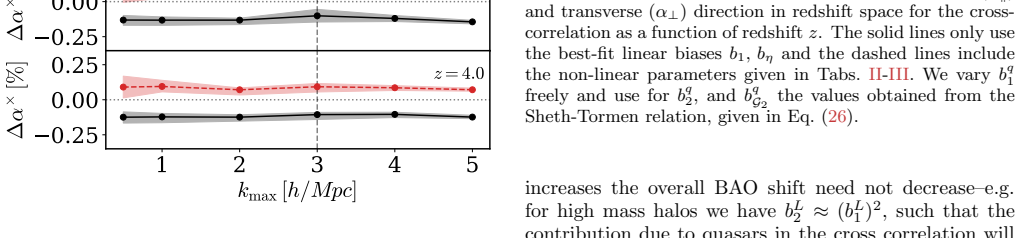
- [Sec. 6.2, Eq. (19), Fig. 7] The quoted error bars in Eqs. (19)–(22) propagate only the MCMC parameter covariance and do not include a truncation-error term, although the one-loop expansion is not manifestly controlled at the fitting scale kmax = 2 h/Mpc: Fig. 2 shows the one-loop-to-tree ratio crossing unity near k ≈ 1.5 h/Mpc at z = 2, and Sec. 6.1 explicitly leaves open the possibility that the model is only phenomenological there. This is directly relevant to the error budget: Fig. 7 shows that the radial shift changes sign as kmax is increased from 0.5 to 2 h/Mpc, a variation far larger than the quoted ±0.09% uncertainty. I request that a systematic truncation error (e.g., from varying kmax, or from a two-loop estimate) be added to Eq. (19), or that the quoted budget be restricted to scales on which the loop expansion is controlled.
- [Abstract; Sec. 6.1, Fig. 1] The abstract states that the EFT model "fits the data with an accuracy of below 2 percent up to a wavenumber of k = 2 h/Mpc." The body (Sec. 6.1 and Fig. 1) instead reports residuals of 5–10% on large scales (k ≲ 0.5 h/Mpc), with sub-2% accuracy only for k ≳ 1 h/Mpc. The body is honest about this scale dependence, but the abstract overstates the accuracy and should be rephrased to describe the scale-dependent residuals, e.g., "below 2% on small scales (k > 1 h/Mpc) and 5–10% on large scales."
- [Sec. 6.2, Table II, Fig. 3] It is not specified which MCMC chains were used to produce the baseline BAO shifts in Eqs. (19)–(22): the minimal model or the model with stochastic terms ("+st."). This matters because Table II shows the stochastic terms are detected at ≫5σ at z = 2.0–3.0, and the minimal versus +st. best fits differ substantially in exactly the quadratic biases entering Eq. (A1) (e.g., at z = 2, bη2 = −0.35 versus −1.18 and bG2 = 0.05 versus −0.17). Since Eq. (A1) is linear in these parameters, the predicted BAO shift will differ by more than the quoted uncertainty between the two model choices. Please state explicitly which configuration was used for Eqs. (19)–(22) and report the shift from both configurations as a robustness check.
- [Sec. 6.1, discussion after Fig. 2] The claim that the BAO shift estimates "will not depend on a particular point of view on the role of the one-loop corrections" is too strong. The fitted quadratic and cubic biases used in Eq. (A1) are obtained from fits at kmax = 2 h/Mpc, where the one-loop-to-tree ratio exceeds unity and the stochastic/counterterm contributions are large; any mis-absorption of two-loop UV physics into those biases propagates directly into Eq. (19) through the analytic relation in Eq. (A1). A concrete, feasible test would be to compute the shift using only fits with kmax ≤ 1 h/Mpc, where the loop expansion is controlled, and to compare the result with Eq. (19); this would place the "phenomenological versus controlled" debate on a quantitative footing for the BAO-shift claim.
minor comments (6)
- [Sec. 2] There are typos in the resolution units: "resolution down to 100 h kpc−1" should read "100 h−1 kpc," and similarly "25 hkpc−1" should read "25 h−1 kpc" (the correct form appears elsewhere in the paper).
- [Sec. 3, Eq. (7)] The symbol kNL is used in Eq. (7) but is not defined at first use; please define it explicitly as the nonlinear scale (e.g., the scale where the dimensionless power spectrum is of order unity).
- [Sec. 6.2, Eqs. (24)–(30)] The eBOSS quasar biases used for the cross-correlation shifts are measured at z_eff = 1.48, while the Lyα parameters are at z = 2.0; the authors appropriately caution that the result "should only be taken indicatively," but the headline cross-correlation numbers (Eqs. 27–30) could be misinterpreted. A direct statement of the implied systematic from the redshift mismatch, or a matched-redshift estimate, would remove ambiguity.
- [Sec. 4, Eq. (13)] The likelihood uses a diagonal Gaussian covariance derived from the number of Fourier modes per bin. Given the very small quoted parameter uncertainties (e.g., b1 to 0.003 in Table II), a short test of sensitivity to off-diagonal or non-Gaussian covariance (e.g., a split-box or jackknife estimate) would increase confidence that the uncertainties are not underestimated.
- [Fig. 3 and Sec. 6.2] The figure legend distinguishes "kmax = 2.0 h/Mpc," "kmax = 3.0 h/Mpc," and "kmax = 3.0 h/Mpc + st.," which implies the baseline kmax = 2 chains do not include stochastic terms. This is also relevant to the major comment about which chains produce Eq. (19); a consistent labeling or an explicit statement in Sec. 6.2 would help the reader.
- [Throughout] The simulation name is written inconsistently as "ACCEL2" and "ACCL2"; please unify.
Circularity Check
No circular reduction: the BAO shift is a derived functional of independently fitted EFT parameters, not a refit of the shift; minor same-author citations are present but not load-bearing.
full rationale
The derivation chain is not circular. The EFT parameters in Eq. (2)-(7) are calibrated to the ACCEL2 3D flux power spectrum through the chi-squared in Eq. (13); this is a fit to simulation data, not an input defined in terms of the later BAO-shift output. The BAO shift is computed from Eq. (A1), an analytic one-loop functional of the fitted quadratic and cubic bias parameters, with the Fisher formalism taken from Ref. [71]. The shift itself is never fitted, and no equation in the paper sets the shift equal to a fit parameter by construction. Varying kmax changes the fitted biases and therefore the shift (Fig. 7), which is error propagation rather than tautology. Same-author references appear in the model construction ([49], [50]) and in the BAO-shift formalism ([71]), but the model is tested against independent hydrodynamic simulation power spectra and Eq. (A1) is derived in the appendix; no uniqueness theorem or ansatz is imported to force the result. The paper explicitly acknowledges the main limitation in Sec. 6.1: Fig. 2 shows the one-loop-to-tree ratio crossing unity near k~1.5 h/Mpc at z=2, and the text states that the model may need to be treated as phenomenological beyond k~1 h/Mpc, deferring a definitive two-loop or field-level check. That is a truncation/correctness risk for the quoted error budget, not a circularity: the fit quality and the shift estimate are not definitions of one another. The cross-correlation shift uses eBOSS quasar biases at zeff=1.48 and external bias relations from Refs. [76] and [110], with the paper itself cautioning that these values are only indicative. Overall, no step reduces by construction to its own input; the only ground for a nonzero score is the presence of minor self-citations in the theoretical machinery, none of which is load-bearing.
Assumptions & free parameters
free parameters (18)
- b1 =
-0.0739 +/- 0.0051 (z=2.0, extended)
- b_eta =
0.1245 +0.0129/-0.0140 (z=2.0, extended)
- b2 =
0.0504 +0.0970/-0.0734 (z=2.0, extended)
- b_G2 =
-0.1684 +0.1039/-0.0765 (z=2.0, extended)
- b_eta2 =
-1.1780 +0.2389/-0.2645 (z=2.0, extended)
- b_delta_eta =
-0.4730 +0.1421/-0.1702 (z=2.0, extended)
- b_(KK)_parallel =
0.7508 +0.1979/-0.1782 (z=2.0, extended)
- b_Pi[2]_parallel =
0.1464 +/- 0.0988 (z=2.0, extended)
- b_Pi[3]_parallel =
0.5863 +/- 0.0393 (z=2.0, extended)
- b_(K Pi[2])_parallel =
-1.0424 +/- 0.0943 (z=2.0, extended)
- b_delta Pi[2]_parallel =
1.6968 +/- 0.0685 (z=2.0, extended)
- b_eta Pi[2]_parallel =
5.1990 +/- 0.1273 (z=2.0, extended)
- c0 =
-0.1557 +/- 0.0072 (z=2.0, extended), h^2/Mpc^2
- c2 =
0.2554 +/- 0.0086 (z=2.0, extended), h^2/Mpc^2
- c4 =
-0.1675 +/- 0.0055 (z=2.0, extended), h^2/Mpc^2
- P_shot =
0.1562 +/- 0.0107 (z=2.0, extended)
- a0 =
-0.1156 +/- 0.0101 (z=2.0, extended)
- a2 =
-0.0409 +/- 0.0330 (z=2.0, extended)
assumptions (8)
- domain assumption The one-loop EFT Lyman-alpha power spectrum (Eqs. 2-7) with kernels from Ref. [49] correctly describes the flux power spectrum at kmax=2 h/Mpc.
- domain assumption IR resummation of long-wavelength displacements is required and correctly implemented.
- domain assumption A diagonal Gaussian covariance based on Fourier mode counts, Eq. (13), is a sufficient description of the ACCEL2 power spectrum errors.
- domain assumption The ACCEL2/Nyx simulations provide unbiased realizations of the Lyman-alpha forest EFT bias parameters at each snapshot.
- domain assumption The Fisher formalism of Ref. [71] correctly maps the analytic P_shift to shifts in alpha_parallel and alpha_perp for BAO fits.
- domain assumption External quasar bias values and relations (Refs. [75,76,110,119]) approximate the nonlinear quasar clustering at the redshifts of interest.
- domain assumption Setting b_Gamma3=0 is harmless because it is degenerate with b_G2.
- domain assumption Stochastic shot-noise terms P_shot, a0, a2 are physically small at high redshift and can be included as Wilson coefficients.
Cite this review
Pith. "Pith review of The ACCEL2 Project: Precision Measurements of EFT Parameters and BAO Peak Shifts for the Lyman-$\alpha$ Forest." pith.science (2026). https://pith.science/paper/QF3MBB4N
@misc{pith2026241206892,
  author       = {Pith},
  title        = {Pith review of: The ACCEL2 Project: Precision Measurements of EFT Parameters and BAO Peak Shifts for the Lyman-$\alpha$ Forest},
  year         = {2026},
  howpublished = {\url{https://pith.science/paper/QF3MBB4N}},
  note         = {Machine review of arXiv:2412.06892}
}
read the original abstract
We present precision measurements of the bias parameters of the one-loop power spectrum model of the Lyman-alpha (Lya) forest, derived within the effective field theory of large-scale structure (EFT). We fit our model to the three-dimensional flux power spectrum measured from the ACCEL2 hydrodynamic simulations. The EFT model fits the data with an accuracy of below 2 percent up to a wavenumber of k = 2 h/Mpc. Further, we analytically derive how non-linearities in the three-dimensional clustering of the Lya forest introduce biases in measurements of the Baryon Acoustic Oscillations (BAO) scaling parameters in radial and transverse directions. From our EFT parameter measurements, we obtain a theoretical error budget of -0.2 (-0.3) percent for the radial (transverse) parameters at redshift two. This corresponds to a shift of -0.3 (0.1) percent for the isotropic (anisotropic) distance measurements. We provide an estimate for the shift of the BAO peak for Lya-quasar cross-correlation measurements assuming analytical and simulation-based scaling relations for the non-linear quasar bias parameters resulting in a shift of -0.2 (-0.1) percent for the radial (transverse) dilation parameters, respectively. This analysis emphasizes the robustness of Lya forest BAO measurements to the theory modeling. We provide informative priors and an error budget for measuring the BAO feature -- a key science driver of the currently observing Dark Energy Spectroscopic Instrument (DESI). Our work paves the way for full-shape cosmological analyses of Lya forest data from DESI and upcoming surveys such as the Prime Focus Spectrograph, WEAVE-QSO, and 4MOST.
Figures


Figures from the paper (5 more)


Forward citations
Cited by 7 Pith papers
-
Constraining Dynamical Dark Energy from Galaxy Clustering with Simulation-Based Priors
Adding BOSS galaxy clustering with simulation-based priors modeled as Gaussian mixtures shifts the DESI plus CMB plus supernova constraints on dark energy toward a cosmological constant and improves the w0-wa figure o...
-
DESI DR2 Results IV: Alcock-Paczy\'nski Measurements from the Lyman Alpha Forest and Cosmological Constraints
The full shape of DESI DR2 Lyman-alpha forest correlations constrains the distance ratio DM/DH at z=2.33 to 1.0%, twice as precise as BAO alone.
-
Bridging Simulations and EFT: A Hybrid Model of the Lyman-Alpha Forest Field
A hybrid EFT forward model using N-body displacements reproduces the simulated Lyman-alpha forest to 5% at k <= 1 h/Mpc with a white-noise residual.
-
The Compressed 3D Lyman-Alpha Forest Bispectrum
The Lyman-alpha forest bispectrum can be compressed into 26 skew spectra, including a new shifted variant, with tree-level EFT predictions matching simulations at 1-2 sigma up to k≈0.17 h/Mpc.
-
Cosmology from Planck CMB Lensing and DESI DR1 Quasar Tomography
DESI DR1 quasars cross-correlated with Planck PR4 lensing give sigma8 = 0.929 and S8 = 0.922, about 1.5 sigma above Planck's LCDM prediction, and a sound-horizon-free H0 = 69.1 km/s/Mpc.
-
Lyman Alpha Forest - Halo Cross-Correlations in Effective Field Theory
A one-loop EFT model jointly fits Lyman alpha forest and halo auto and cross power spectra in redshift space with percent-level accuracy at k up to 1 h/Mpc, sharpening bias constraints.
-
GGI Lectures on Large-Scale Structure Perturbation Theory (Effective Field Theory)
Pedagogical notes derive large-scale-structure EFT from symmetries, covering SPT failures, BAO IR resummation, counterterms, galaxy bias, redshift-space distortions, and Lagrangian PT.
Reference graph
Works this paper leans on
-
[49]
J. J. M. Carrasco, S. Foreman, D. Green and L. Senatore, The Effective Field Theory of Large Scale Structures at Two Loops , JCAP 07 (2014) 057 [1310.0464]
arXiv 2014
-
[71]
A. Arinyo-i Prats, J. Miralda-Escud´ e, M. Viel and R. Cen, The Non-Linear Power Spectrum of the Lyman Alpha Forest, JCAP 12 (2015) 017 [ 1506.04519]
arXiv 2015
-
[72]
J. J. Givans, A. Font-Ribera, A. Slosar, L. Seeyave, C. Pedersen, K. K. Rogers et al., Non-linearities in the Lyman-α forest and in its cross-correlation with dark matter halos , J. Cosmology Astropart. Phys. 2022 (2022) 070 [ 2205.00962]
arXiv 2022
-
[1]
P. McDonald, U. Seljak, S. Burles, D. J. Schlegel, D. H. Weinberg, R. Cen et al., The Ly α Forest Power Spectrum from the Sloan Digital Sky Survey , ApJS 163 (2006) 80 [ astro-ph/0405013]
arXiv 2006
-
[2]
ACCEL 2 SIMULA TIONS In the present work, we perform precision measure- ments of the EFT bias parameters on a suite of ACCEL2 (ACCELerated expansion of the universe with ACCEL- erated computing on GPUs) hydrodynamical simulations of the Ly- α forest [63]. We use the ACCEL 2 simulation with the highest resolution with a box of length L = 160h−1Mpc with N =...
-
[3]
short-range non-locality
THEORETICAL MODEL One of the key advantages of the Ly- α forest is that it probes the Universe at intermediate redshifts (2 ≤ z ≤ 4), with access to many more linear modes than, e.g., galaxy surveys. In the following, we briefly summarize the theoretical model of the Ly- α forest one-loop (auto) power spectrum in the EFT framework [49]. The model consists...
-
[4]
wig- gly
LIKELIHOOD We calibrate the EFT bias parameters for the one-loop Ly-α power spectrum by fitting a model to the power spectrum measured from ACCEL 2 hydrodynamical sim- ulations [63]. Therefore, we follow the procedure outlined in Ref. [49, 66] and fit the power spectrum by sampling the χ2 function χ2 = X i P data i − P model(ki, µi) 2 2 P data i 2 /Ni , (...
-
[5]
fid” and “tem
NON-LINEAR BAO SHIFT Measuring the BAO feature in the distribution of galaxies and 3D clustering of the Ly- α forest is one of the most robust and accurate ways to measure the ex- pansion history of our Universe. Since its detection in spectroscopic surveys by BOSS [101] and the 2dF Galaxy Redshift Survey [69] and subsequently in the 3D cluster- ing of th...
Show all 129 references
-
[6]
RESUL TS In this section, we measure the bias parameters of the one-loop Ly-α forest power spectrum in the EFT frame- work described in Sec. 3. We fit the theory to mea- surements of the three-dimensional power spectrum ob- tained from ACCEL 2 simulations, described in Sec. 2....
1971
-
[7]
SUMMAR Y AND CONCLUSION Measurements of the baryon acoustic oscillation (BAO) feature are one of the pillars of modern cos- mology. High-redshift measurements obtained from the three-dimensional clustering of the Ly- α forest at z ∼ 2 provide measurements of the cosmic expansi...
-
[8]
Palanque-Delabrouille, C
N. Palanque-Delabrouille, C. Y` eche, A. Borde, J.-M. Le Goff, G. Rossi, M. Viel et al., The one-dimensional Lyα forest power spectrum from BOSS , A&A 559 (2013) A85 [ 1306.5896]
2013 arXiv
-
[9]
DESI collaboration, The Dark Energy Spectroscopic Instrument: one-dimensional power spectrum from first Ly α forest samples with Fast Fourier Transform, Mon. Not. Roy. Astron. Soc. 526 (2023) 5118 [ 2306.06311]
2023 arXiv
-
[10]
N. G. Kara¸ caylı et al.,Optimal 1D Ly α Forest Power Spectrum Estimation – III. DESI early data , Mon. Not. Roy. Astron. Soc. 528 (2024) 3941 [ 2306.06316]
2024 arXiv
-
[11]
Seljak, A
U. Seljak, A. Makarov, P. McDonald, S. F. Anderson, N. A. Bahcall, J. Brinkmann et al., Cosmological parameter analysis including SDSS Ly α forest and galaxy bias: Constraints on the primordial spectrum of fluctuations, neutrino mass, and dark energy , Phys. Rev. D 71 (2005) 1...
2005 arXiv
-
[12]
M. Viel, M. G. Haehnelt and V. Springel, The effect of neutrinos on the matter distribution as probed by the intergalactic medium, J. Cosmology Astropart. Phys. 2010 (2010) 015 [ 1003.2422]
2010 arXiv
-
[13]
Palanque-Delabrouille, C
N. Palanque-Delabrouille, C. Y` eche, N. Sch¨ oneberg, J. Lesgourgues, M. Walther, S. Chabanier et al., Hints, neutrino bounds, and WDM constraints from SDSS DR14 Lyman- α and Planck full-survey data , J. Cosmology Astropart. Phys. 2020 (2020) 038 [1911.09073]
2020 arXiv
-
[14]
Afshordi, P
N. Afshordi, P. McDonald and D. N. Spergel, Primordial Black Holes as Dark Matter: The Power Spectrum and Evaporation of Early Structures , ApJ 594 (2003) L71 [ astro-ph/0302035]
2003 arXiv
-
[15]
Murgia, G
R. Murgia, G. Scelfo, M. Viel and A. Raccanelli, Lyman-α Forest Constraints on Primordial Black Holes as Dark Matter , Phys. Rev. Lett. 123 (2019) 071102 [1903.10509]
2019 arXiv
-
[16]
M. Viel, G. D. Becker, J. S. Bolton and M. G. Haehnelt, Warm dark matter as a solution to the small scale crisis: New constraints from high redshift Lyman-α forest data, Phys. Rev. D 88 (2013) 043502 [1306.2314]
2013 arXiv
-
[17]
J. Baur, N. Palanque-Delabrouille, C. Y` eche, C. Magneville and M. Viel, Lyman-alpha forests cool warm dark matter , J. Cosmology Astropart. Phys. 2016 (2016) 012 [ 1512.01981]
2016 arXiv
-
[18]
Irˇ siˇ c, M
V. Irˇ siˇ c, M. Viel, M. G. Haehnelt, J. S. Bolton, S. Cristiani, G. D. Becker et al., New Constraints on the free-streaming of warm dark matter from intermediate and small scale Lyman- α forest data, ArXiv e-prints (2017) [ 1702.01764]
2017 arXiv
-
[19]
Kobayashi, R
T. Kobayashi, R. Murgia, A. De Simone, V. Irˇ siˇ c and M. Viel, Lyman-α constraints on ultralight scalar dark matter: Implications for the early and late universe , Phys. Rev. D 96 (2017) 123514 [ 1708.00015]
2017 arXiv
-
[20]
Armengaud, N
E. Armengaud, N. Palanque-Delabrouille, C. Y` eche, D. J. E. Marsh and J. Baur, Constraining the mass of light bosonic dark matter using SDSS Lyman- α forest, MNRAS 471 (2017) 4606 [ 1703.09126]
2017 arXiv
-
[21]
Murgia, V
R. Murgia, V. Irˇ siˇ c and M. Viel,Novel constraints on noncold, nonthermal dark matter from Lyman- α forest data, Phys. Rev. D 98 (2018) 083540 [ 1806.08371]
2018 arXiv
-
[22]
Garzilli, A
A. Garzilli, A. Magalich, T. Theuns, C. S. Frenk, C. Weniger, O. Ruchayskiy et al., The Lyman- α forest as a diagnostic of the nature of the dark matter , MNRAS 489 (2019) 3456 [ 1809.06585]. 16
2019 arXiv
-
[23]
Irˇ siˇ c, H
V. Irˇ siˇ c, H. Xiao and M. McQuinn,Early structure formation constraints on the ultralight axion in the postinflation scenario, Phys. Rev. D 101 (2020) 123518 [1911.11150]
2020 arXiv
-
[24]
K. K. Rogers, C. Dvorkin and H. V. Peiris, Limits on the Light Dark Matter-Proton Cross Section from Cosmic Large-Scale Structure, Phys. Rev. Lett. 128 (2022) 171301 [ 2111.10386]
2022 arXiv
-
[25]
Villasenor, B
B. Villasenor, B. Robertson, P. Madau and E. Schneider, New constraints on warm dark matter from the Lyman- α forest power spectrum, Phys. Rev. D 108 (2023) 023502 [ 2209.14220]
2023 arXiv
-
[26]
Irˇ siˇ c, M
V. Irˇ siˇ c, M. Viel, M. G. Haehnelt, J. S. Bolton, M. Molaro, E. Puchwein et al., Unveiling Dark Matter free-streaming at the smallest scales with high redshift Lyman-alpha forest, arXiv e-prints (2023) arXiv:2309.04533 [2309.04533]
2023 arXiv
-
[27]
Goldstein, J
S. Goldstein, J. C. Hill, V. Irˇ siˇ c and B. D. Sherwin, Canonical Hubble-Tension-Resolving Early Dark Energy Cosmologies Are Inconsistent with the Lyman-α Forest, Phys. Rev. Lett. 131 (2023) 201001 [2303.00746]
2023 arXiv
-
[28]
Zaldarriaga, Searching for Fluctuations in the Intergalactic Medium Temperature Using the Ly α Forest, ApJ 564 (2002) 153 [ astro-ph/0102205]
M. Zaldarriaga, Searching for Fluctuations in the Intergalactic Medium Temperature Using the Ly α Forest, ApJ 564 (2002) 153 [ astro-ph/0102205]
2002 arXiv
-
[29]
A. A. Meiksin, The physics of the intergalactic medium, Reviews of Modern Physics 81 (2009) 1405 [0711.3358]
2009 arXiv
-
[30]
McQuinn, The Evolution of the Intergalactic Medium, ARA&A 54 (2016) 313 [ 1512.00086]
M. McQuinn, The Evolution of the Intergalactic Medium, ARA&A 54 (2016) 313 [ 1512.00086]
2016 arXiv
-
[31]
M. Viel, J. Lesgourgues, M. G. Haehnelt, S. Matarrese and A. Riotto, Can Sterile Neutrinos Be Ruled Out as Warm Dark Matter Candidates? , Phys. Rev. Lett. 97 (2006) 071301 [ astro-ph/0605706]
2006 arXiv
-
[32]
Walther, J
M. Walther, J. O˜ norbe, J. F. Hennawi and Z. Luki´ c, New Constraints on IGM Thermal Evolution from the Lyα Forest Power Spectrum, ApJ 872 (2019) 13 [1808.04367]
2019 arXiv
-
[33]
J. S. Bolton, M. Viel, T. S. Kim, M. G. Haehnelt and R. F. Carswell, Possible evidence for an inverted temperature-density relation in the intergalactic medium from the flux distribution of the Ly α forest, MNRAS 386 (2008) 1131 [ 0711.2064]
2008 arXiv
-
[34]
Garzilli, J
A. Garzilli, J. S. Bolton, T. S. Kim, S. Leach and M. Viel, The intergalactic medium thermal history at redshift z = 1.7-3.2 from the Ly α forest: a comparison of measurements using wavelets and the flux distribution, MNRAS 424 (2012) 1723 [ 1202.3577]
2012 arXiv
-
[35]
Gaikwad, R
P. Gaikwad, R. Srianand, V. Khaire and T. R. Choudhury, Effect of non-equilibrium ionization on derived physical conditions of the high-z intergalactic medium, MNRAS 490 (2019) 1588 [ 1812.01016]
2019 arXiv
-
[36]
Boera, G
E. Boera, G. D. Becker, J. S. Bolton and F. Nasir, Revealing Reionization with the Thermal History of the Intergalactic Medium: New Constraints from the Ly α Flux Power Spectrum , ApJ 872 (2019) 101 [1809.06980]
2019 arXiv
-
[37]
Gaikwad, R
P. Gaikwad, R. Srianand, M. G. Haehnelt and T. R. Choudhury, A consistent and robust measurement of the thermal state of the IGM at 2 ≤ z ≤ 4 from a large sample of Ly α forest spectra: evidence for late and rapid He II reionization , MNRAS 506 (2021) 4389 [2009.00016]
2021 arXiv
-
[38]
Wilson, V
B. Wilson, V. Irˇ siˇ c and M. McQuinn,A measurement of the Ly β forest power spectrum and its cross with the Ly α forest in X-Shooter XQ-100 , MNRAS 509 (2022) 2423 [ 2106.04837]
2022 arXiv
-
[39]
Villasenor, B
B. Villasenor, B. Robertson, P. Madau and E. Schneider, Inferring the Thermal History of the Intergalactic Medium from the Properties of the Hydrogen and Helium Ly α Forest, ApJ 933 (2022) 59 [2111.00019]
2022 arXiv
-
[40]
McDonald and D
P. McDonald and D. J. Eisenstein, Dark energy and curvature from a future baryonic acoustic oscillation survey using the Lyman- α forest, Phys. Rev. D 76 (2007) 063009 [ astro-ph/0607122]
2007 arXiv
-
[41]
Slosar, V
A. Slosar, V. Irˇ siˇ c, D. Kirkby, S. Bailey, N. G. Busca, T. Delubac et al., Measurement of baryon acoustic oscillations in the Lyman- α forest fluctuations in BOSS data release 9 , J. Cosmology Astropart. Phys. 2013 (2013) 026 [ 1301.3459]
2013 arXiv
-
[42]
N. G. Busca, T. Delubac, J. Rich, S. Bailey, A. Font-Ribera, D. Kirkby et al., Baryon acoustic oscillations in the Ly α forest of BOSS quasars , A&A 552 (2013) A96 [ 1211.2616]
2013 arXiv
-
[43]
du Mas des Bourboux et al., The Completed SDSS-IV Extended Baryon Oscillation Spectroscopic Survey: Baryon Acoustic Oscillations with Ly α Forests, Astrophys
H. du Mas des Bourboux et al., The Completed SDSS-IV Extended Baryon Oscillation Spectroscopic Survey: Baryon Acoustic Oscillations with Ly α Forests, Astrophys. J. 901 (2020) 153 [ 2007.08995]
2020 arXiv
-
[44]
DESI Collaboration, A. G. Adame, J. Aguilar, S. Ahlen, S. Alam, D. M. Alexander et al., DESI 2024 IV: Baryon Acoustic Oscillations from the Lyman Alpha Forest, arXiv e-prints (2024) arXiv:2404.03001 [2404.03001]
2024 arXiv
-
[45]
eBOSS collaboration, The SDSS-IV extended Baryon Oscillation Spectroscopic Survey: Overview and Early Data, Astron. J. 151 (2016) 44 [ 1508.04473]
2016 arXiv
-
[47]
Abareshi, J
B. Abareshi, J. Aguilar, S. Ahlen, S. Alam, D. M. Alexander, R. Alfarsy et al., Overview of the Instrumentation for the Dark Energy Spectroscopic Instrument, arXiv e-prints (2022) arXiv:2205.10939 [2205.10939]
2022 arXiv
-
[48]
Baumann, A
D. Baumann, A. Nicolis, L. Senatore and M. Zaldarriaga, Cosmological Non-Linearities as an Effective Fluid, JCAP 1207 (2012) 051 [ 1004.2488]
2012 arXiv
-
[50]
M. M. Ivanov, Effective Field Theory for Large Scale Structure, 2212.08488
-
[52]
J. J. Givans and C. M. Hirata, Redshift-space streaming velocity effects on the Lyman- α forest baryon acoustic oscillation scale , Phys. Rev. D 102 (2020) 023515 [2002.12296]
2020 arXiv
-
[53]
Desjacques, D
V. Desjacques, D. Jeong and F. Schmidt, The Galaxy Power Spectrum and Bispectrum in Redshift Space , JCAP 1812 (2018) 035 [ 1806.04015]
2018 arXiv
-
[54]
S.-F. Chen, Z. Vlah and M. White, The Lyα forest flux correlation function: a perturbation theory perspective , JCAP 05 (2021) 053 [ 2103.13498]
2021 arXiv
-
[55]
M. M. Ivanov, Lyman alpha forest power spectrum in effective field theory , Phys. Rev. D 109 (2024) 023507 17 [2309.10133]
2024 arXiv
-
[56]
M. M. Ivanov, M. W. Toomey and N. G. Kara¸ caylı, Fundamental physics with the Lyman-alpha forest: constraints on the growth of structure and neutrino masses from SDSS with effective field theory , 2405.13208
-
[57]
Gerardi, A
F. Gerardi, A. Cuceu, A. Font-Ribera, B. Joachimi and P. Lemos, Direct cosmological inference from three-dimensional correlations of the Lyman α forest, Mon. Not. Roy. Astron. Soc. 518 (2022) 2567 [2209.11263]
2022 arXiv
-
[58]
Cuceu, A
A. Cuceu, A. Font-Ribera, B. Joachimi and S. Nadathur, Cosmology beyond BAO from the 3D distribution of the Lyman- α forest, Mon. Not. Roy. Astron. Soc. 506 (2021) 5439 [ 2103.14075]
2021 arXiv
-
[59]
Font-Ribera, P
A. Font-Ribera, P. McDonald and A. Slosar, How to estimate the 3D power spectrum of the Lyman- α forest, J. Cosmology Astropart. Phys. 2018 (2018) 003 [1710.11036]
2018 arXiv
-
[60]
M. L. Abdul-Karim, E. Armengaud, G. Mention, S. Chabanier, C. Ravoux and Z. Luki´ c,Measurement of the small-scale 3D Lyman- α forest power spectrum, JCAP 05 (2024) 088 [ 2310.09116]
2024 arXiv
-
[61]
de Belsunce, O
R. de Belsunce, O. H. E. Philcox, V. Irsic, P. McDonald, J. Guy and N. Palanque-Delabrouille, The 3D Lyman- α forest power spectrum from eBOSS DR16, Mon. Not. Roy. Astron. Soc. 533 (2024) 3756 [2403.08241]
2024 arXiv
-
[62]
Horowitz, R
B. Horowitz, R. de Belsunce and Z. Lukic, Maximum A Posteriori Ly-alpha Estimator (MAPLE): Band-power and covariance estimation of the 3D Ly-alpha forest power spectrum , 2403.17294
-
[63]
M. M. Ivanov, M. Simonovi´ c and M. Zaldarriaga, Cosmological Parameters from the BOSS Galaxy Power Spectrum, JCAP 05 (2020) 042 [ 1909.05277]
2020 arXiv
-
[64]
D’Amico, J
G. D’Amico, J. Gleyzes, N. Kokron, D. Markovic, L. Senatore, P. Zhang et al., The Cosmological Analysis of the SDSS/BOSS data from the Effective Field Theory of Large-Scale Structure , 1909.05271
1909 arXiv
-
[65]
S.-F. Chen, Z. Vlah and M. White, A new analysis of galaxy 2-point functions in the BOSS survey, including full-shape information and post-reconstruction BAO , JCAP 02 (2022) 008 [ 2110.05530]
2022 arXiv
-
[66]
O. H. E. Philcox and M. M. Ivanov, BOSS DR12 full-shape cosmology: ΛCDM constraints from the large-scale galaxy power spectrum and bispectrum monopole, Phys. Rev. D 105 (2022) 043517 [2112.04515]
2022 arXiv
-
[67]
S.-F. Chen, M. White, J. DeRose and N. Kokron, Cosmological analysis of three-dimensional BOSS galaxy clustering and Planck CMB lensing cross correlations via Lagrangian perturbation theory, JCAP 07 (2022) 041 [ 2204.10392]
2022 arXiv
-
[68]
S.-F. Chen, M. M. Ivanov, O. H. E. Philcox and L. Wenzl, Suppression without Thawing: Constraining Structure Formation and Dark Energy with Galaxy Clustering, 2406.13388
-
[69]
Chabanier, C
S. Chabanier, C. Ravoux, L. Latrille, J. Sexton, E. Armengaud, J. Bautista et al., The ACCEL 2 project: simulating Lyman- α forest in large-volume hydrodynamical simulations, 2407.04473
-
[70]
McDonald, Toward a measurement of the cosmological geometry at Z 2: predicting lyman-alpha forest correlation in three dimensions, and the potential of future data sets , Astrophys
P. McDonald, Toward a measurement of the cosmological geometry at Z 2: predicting lyman-alpha forest correlation in three dimensions, and the potential of future data sets , Astrophys. J. 585 (2003) 34 [astro-ph/0108064]
2003 arXiv
-
[73]
DESI Collaboration, A. G. Adame, J. Aguilar, S. Ahlen, S. Alam, D. M. Alexander et al., DESI 2024 VI: Cosmological Constraints from the Measurements of Baryon Acoustic Oscillations , arXiv e-prints (2024) arXiv:2404.03002 [2404.03002]
2024 arXiv
-
[74]
SDSS collaboration, Detection of the Baryon Acoustic Peak in the Large-Scale Correlation Function of SDSS Luminous Red Galaxies , Astrophys. J. 633 (2005) 560 [astro-ph/0501171]
2005 arXiv
-
[75]
2dFGRS collaboration, The 2dF Galaxy Redshift Survey: Power-spectrum analysis of the final dataset and cosmological implications, Mon. Not. Roy. Astron. Soc. 362 (2005) 505 [ astro-ph/0501174]
2005 arXiv
-
[76]
Aghanim, Y
Planck Collaboration, N. Aghanim, Y. Akrami, F. Arroja, M. Ashdown, J. Aumont et al., Planck 2018 results. I. Overview and the cosmological legacy of Planck, A&A 641 (2020) A1 [ 1807.06205]
2020 arXiv
-
[77]
Chen et al., Baryon Acoustic Oscillation Theory and Modelling Systematics for the DESI 2024 results , 2402.14070
S.-F. Chen et al., Baryon Acoustic Oscillation Theory and Modelling Systematics for the DESI 2024 results , 2402.14070
2024 arXiv
-
[78]
Sinigaglia, F.-S
F. Sinigaglia, F.-S. Kitaura, K. Nagamine and Y. Oku, The Negative Baryon Acoustic Oscillation Shift in the Lyα Forest from Cosmological Simulations, Astrophys. J. Lett. 971 (2024) L22 [ 2407.03918]
2024 arXiv
-
[79]
J. Farr, A. Font-Ribera, H. du Mas des Bourboux, A. Mu˜ noz-Guti´ errez, F. J. S´ anchez, A. Pontzen et al., LyaCoLoRe: synthetic datasets for current and future Lyman-α forest BAO surveys , J. Cosmology Astropart. Phys. 2020 (2020) 068 [ 1912.02763]
2020 arXiv
-
[80]
Font-Ribera et al., The large-scale Quasar-Lyman \alpha\ Forest Cross-Correlation from BOSS, JCAP 05 (2013) 018 [ 1303.1937]
A. Font-Ribera et al., The large-scale Quasar-Lyman \alpha\ Forest Cross-Correlation from BOSS, JCAP 05 (2013) 018 [ 1303.1937]
2013 arXiv
-
[81]
Chudaykin and M
A. Chudaykin and M. M. Ivanov, Cosmological constraints from the power spectrum of eBOSS quasars, 2210.17044
-
[82]
M. M. Abidi and T. Baldauf, Cubic Halo Bias in Eulerian and Lagrangian Space , JCAP 1807 (2018) 029 [1802.07622]
2018 arXiv
-
[83]
Planck collaboration, Planck 2015 results. XIII. Cosmological parameters, Astron. Astrophys. 594 (2016) A13 [ 1502.01589]
2016 arXiv
-
[84]
A. S. Almgren, J. B. Bell, M. J. Lijewski, Z. Luki´ c and E. Van Andel, Nyx: A Massively Parallel AMR Code for Computational Cosmology , ApJ 765 (2013) 39 [1301.4498]
2013 arXiv
-
[85]
Sexton, Z
J. Sexton, Z. Lukic, A. Almgren, C. Daley, B. Friesen, A. Myers et al., Nyx: A massively parallel amr code for computational cosmology, Journal of Open Source Software 6 (2021) 3068
2021
-
[86]
Luki´ c, C
Z. Luki´ c, C. W. Stark, P. Nugent, M. White, A. A. Meiksin and A. Almgren, The Lyman α forest in optically thin hydrodynamical simulations , MNRAS 446 (2015) 3697 [ 1406.6361]
2015 arXiv
-
[87]
Nishimichi, G
T. Nishimichi, G. D’Amico, M. M. Ivanov, 18 L. Senatore, M. Simonovi´ c, M. Takada et al.,Blinded challenge for precision cosmology with large-scale structure: results from effective field theory for the redshift-space galaxy power spectrum, Phys. Rev. D 102 (2020) 123541 [ 20...
2020 arXiv
-
[88]
McDonald and A
P. McDonald and A. Roy, Clustering of dark matter tracers: generalizing bias for the coming era of precision LSS, J. Cosmology Astropart. Phys. 8 (2009) 20 [0902.0991]
2009 arXiv
-
[89]
D. Blas, M. Garny, M. M. Ivanov and S. Sibiryakov, Time-Sliced Perturbation Theory for Large Scale Structure I: General Formalism , JCAP 1607 (2016) 052 [1512.05807]
2016 arXiv
-
[90]
D. Blas, M. Garny, M. M. Ivanov and S. Sibiryakov, Time-Sliced Perturbation Theory II: Baryon Acoustic Oscillations and Infrared Resummation , JCAP 1607 (2016) 028 [ 1605.02149]
2016 arXiv
-
[91]
M. M. Ivanov and S. Sibiryakov, Infrared Resummation for Biased Tracers in Redshift Space , JCAP 1807 (2018) 053 [ 1804.05080]
2018 arXiv
-
[92]
Vasudevan, M
A. Vasudevan, M. M. Ivanov, S. Sibiryakov and J. Lesgourgues, Time-sliced perturbation theory with primordial non-Gaussianity and effects of large bulk flows on inflationary oscillating features , JCAP 09 (2019) 037 [ 1906.08697]
2019 arXiv
-
[93]
Z. Vlah, U. Seljak, M. Yat Chu and Y. Feng, Perturbation theory, effective field theory, and oscillations in the power spectrum , J. Cosmology Astropart. Phys. 2016 (2016) 057 [ 1509.02120]
2016 arXiv
-
[94]
S.-F. Chen, Z. Vlah and M. White, The bispectrum in Lagrangian perturbation theory, J. Cosmology Astropart. Phys. 2024 (2024) 012 [ 2406.00103]
2024 arXiv
-
[95]
McDonald, J
P. McDonald, J. Miralda-Escude, M. Rauch, W. L. W. Sargent, T. A. Barlow, R. Cen et al., The Observed probability distribution function, power spectrum, and correlation function of the transmitted flux in the Lyman-alpha forest, Astrophys. J. 543 (2000) 1 [astro-ph/9911196]
2000 arXiv
-
[96]
Kaiser, Clustering in real space and in redshift space, Mon
N. Kaiser, Clustering in real space and in redshift space, Mon. Not. Roy. Astron. Soc. 227 (1987) 1
1987
-
[98]
Irˇ siˇ c and M
V. Irˇ siˇ c and M. McQuinn,Absorber Model: the Halo-like model for the Lyman- α forest, JCAP 04 (2018) 026 [ 1801.02671]
2018 arXiv
-
[99]
O. H. E. Philcox, M. M. Ivanov, M. Zaldarriaga, M. Simonovic and M. Schmittfull, Fewer Mocks and Less Noise: Reducing the Dimensionality of Cosmological Observables with Subspace Projections , Phys. Rev. D 103 (2021) 043508 [ 2009.03311]
2021 arXiv
-
[100]
Sailer et al., Cosmological constraints from the cross-correlation of DESI Luminous Red Galaxies with CMB lensing from Planck PR4 and ACT DR6 , 2407.04607
N. Sailer et al., Cosmological constraints from the cross-correlation of DESI Luminous Red Galaxies with CMB lensing from Planck PR4 and ACT DR6 , 2407.04607
-
[101]
Brinckmann and J
T. Brinckmann and J. Lesgourgues, MontePython 3: boosted MCMC sampler and other features , Phys. Dark Univ. 24 (2019) 100260 [ 1804.07261]
2019 arXiv
-
[102]
Audren and J
B. Audren and J. Lesgourgues, Non-linear matter power spectrum from Time Renormalisation Group: efficient computation and comparison with one-loop , JCAP 1110 (2011) 037 [ 1106.2607]
2011 arXiv
-
[103]
Gelman and D
A. Gelman and D. B. Rubin, Inference from Iterative Simulation Using Multiple Sequences , Statistical Science 7 (1992) 457
1992
-
[104]
Lewis, GetDist: a Python package for analysing Monte Carlo samples , 1910.13970
A. Lewis, GetDist: a Python package for analysing Monte Carlo samples , 1910.13970
1910 arXiv
-
[105]
D. Blas, J. Lesgourgues and T. Tram, The cosmic linear anisotropy solving system (class). part ii: Approximation schemes, Journal of Cosmology and Astroparticle Physics 2011 (2011) 034–034
2011
-
[106]
Chudaykin, M
A. Chudaykin, M. M. Ivanov, O. H. E. Philcox and M. Simonovi´ c,Nonlinear perturbation theory extension of the Boltzmann code CLASS , Phys. Rev. D 102 (2020) 063533 [ 2004.10607]
2020 arXiv
-
[107]
S. Alam, M. Ata, S. Bailey, F. Beutler, D. Bizyaev, J. A. Blazek et al., The clustering of galaxies in the completed SDSS-III Baryon Oscillation Spectroscopic Survey: cosmological analysis of the DR12 galaxy sample, ArXiv e-prints (2016) [ 1607.03155]
2016 arXiv
-
[108]
Alcock and B
C. Alcock and B. Paczynski, An evolution free test for non-zero cosmological constant, Nature 281 (1979) 358
1979
-
[109]
Crocce and R
M. Crocce and R. Scoccimarro, Nonlinear Evolution of Baryon Acoustic Oscillations , Phys. Rev. D77 (2008) 023533 [0704.2783]
2008 arXiv
-
[110]
D. J. Eisenstein, H.-j. Seo and M. J. White, On the Robustness of the Acoustic Scale in the Low-Redshift Clustering of Matter , Astrophys. J. 664 (2007) 660 [astro-ph/0604361]
2007 arXiv
-
[111]
Padmanabhan and M
N. Padmanabhan and M. White, Calibrating the baryon oscillation ruler for matter and halos , Phys. Rev. D 80 (2009) 063508 [ 0906.1198]
2009 arXiv
-
[112]
B. D. Sherwin and M. Zaldarriaga, Shift of the baryon acoustic oscillation scale: A simple physical picture , Phys. Rev. D 85 (2012) 103523 [ 1202.3998]
2012 arXiv
-
[113]
McQuinn and M
M. McQuinn and M. White, Cosmological perturbation theory in 1+1 dimensions , JCAP 01 (2016) 043 [1502.07389]
2016 arXiv
-
[114]
McQuinn and M
M. McQuinn and M. White, On estimating ly α forest correlations between multiple sightlines , Monthly Notices of the Royal Astronomical Society 415 (2011) 2257
2011
-
[115]
Simon, P
T. Simon, P. Zhang and V. Poulin, Cosmological inference from the EFTofLSS: the eBOSS QSO full-shape analysis , JCAP 07 (2023) 041 [ 2210.14931]
2023 arXiv
-
[116]
eBOSS collaboration, Clustering of quasars in SDSS-IV eBOSS : study of potential systematics and bias determination, JCAP 07 (2017) 017 [1705.04718]
2017 arXiv
-
[117]
Schmittfull, M
M. Schmittfull, M. Simonovi´ c, V. Assassi and M. Zaldarriaga, Modeling Biased Tracers at the Field Level, Phys. Rev. D 100 (2019) 043514 [ 1811.10640]
2019 arXiv
-
[118]
Schmittfull, M
M. Schmittfull, M. Simonovi´ c, M. M. Ivanov, O. H. E. Philcox and M. Zaldarriaga, Modeling Galaxies in Redshift Space at the Field Level , JCAP 05 (2021) 059 [2012.03334]
2021 arXiv
-
[119]
M. M. Ivanov, C. Cuesta-Lazaro, S. Mishra-Sharma, A. Obuljen and M. W. Toomey, Full-shape analysis with simulation-based priors: Constraints on single field inflation from BOSS , Phys. Rev. D 110 (2024) 063538 [2402.13310]
2024 arXiv
-
[120]
M. M. Ivanov, A. Obuljen, C. Cuesta-Lazaro and M. W. Toomey, Full-shape analysis with simulation-based priors: cosmological parameters and the structure growth anomaly , 2409.10609
-
[121]
M. M. Ivanov et al., The Millennium and Astrid galaxies in effective field theory: comparison with 19 galaxy-halo connection models at the field level , 2412.01888
-
[122]
J. S. Bolton, E. Puchwein, D. Sijacki, M. G. Haehnelt, T.-S. Kim, A. Meiksin et al., The Sherwood simulation suite: overview and data comparisons with the Lyman α forest at redshifts 2 ¡ z ¡ 5 , MNRAS 464 (2017) 897 [1605.03462]
2017 arXiv
-
[123]
Seljak, Bias, redshift space distortions and primordial nongaussianity of nonlinear transformations: application to Lyman alpha forest , JCAP 03 (2012) 004 [ 1201.0594]
U. Seljak, Bias, redshift space distortions and primordial nongaussianity of nonlinear transformations: application to Lyman alpha forest , JCAP 03 (2012) 004 [ 1201.0594]
2012 arXiv
-
[124]
Bernardeau, S
F. Bernardeau, S. Colombi, E. Gaztanaga and R. Scoccimarro, Large scale structure of the universe and cosmological perturbation theory, Phys. Rep. 367 (2002) 1 [ astro-ph/0112551]
2002 arXiv
-
[125]
White, The Zel’dovich approximation , Mon
M. White, The Zel’dovich approximation , Mon. Not. Roy. Astron. Soc. 439 (2014) 3630 [ 1401.5466]
2014 arXiv
-
[126]
W. H. Press and P. Schechter, Formation of Galaxies and Clusters of Galaxies by Self-Similar Gravitational Condensation, ApJ 187 (1974) 425
1974
-
[127]
R. K. Sheth and G. Tormen, Large-scale bias and the peak background split, MNRAS 308 (1999) 119 [astro-ph/9901122]
1999 arXiv
-
[128]
D. J. Schlegel, J. A. Kollmeier, G. Aldering, S. Bailey, C. Baltay, C. Bebek et al., The MegaMapper: A Stage-5 Spectroscopic Instrument Concept for the Study of Inflation and Dark Energy , arXiv e-prints (2022) arXiv:2209.04322 [ 2209.04322]
2022 arXiv
-
[129]
Aghamousa, J
DESI Collaboration, A. Aghamousa, J. Aguilar, S. Ahlen, S. Alam, L. E. Allen et al., The DESI Experiment Part I: Science,Targeting, and Survey Design, arXiv e-prints (2016) arXiv:1611.00036 [1611.00036]
2016 arXiv
-
[130]
M. M. Pieri, S. Bonoli, J. Chaves-Montero, I. Pˆ aris, M. Fumagalli, J. S. Bolton et al., WEA VE-QSO: A Massive Intergalactic Medium Survey for the William Herschel Telescope, in SF2A-2016: Proceedings of the Annual meeting of the French Society of Astronomy and Astrophysics, ...
2016 arXiv
-
[131]
Greene, R
J. Greene, R. Bezanson, M. Ouchi, J. Silverman and the PFS Galaxy Evolution Working Group, The Prime Focus Spectrograph Galaxy Evolution Survey, arXiv e-prints (2022) arXiv:2206.14908 [ 2206.14908]
2022 arXiv
-
[132]
R. S. de Jong, O. Agertz, A. A. Berbel, J. Aird, D. A. Alexander, A. Amarsi et al., 4MOST: Project overview and information for the First Call for Proposals , The Messenger 175 (2019) 3 [ 1903.02464]
2019 arXiv
Reviewed August 11, 2026 · model on record in the stance chip above.
Discussion (0). Continue with ORCID to comment.