CRB-Optimal Arrays and Waveforms in Active Sensing: Role of Redundancy and Spatial Covariance of Array Geometry
Reviewed by Pith T0 review T1 audit T2 compute T3 formal T4 kernel 2026-06-28 21:35 UTCgrok-4.3pith:QF5XWJ54record.jsonopen to challenge →
The pith
For orthogonal waveforms the single-target CRB depends on the sum of the spatial variances of the transmit and receive arrays.
A machine-rendered reading of the paper's core claim, the machinery that carries it, and where it could break.
Core claim
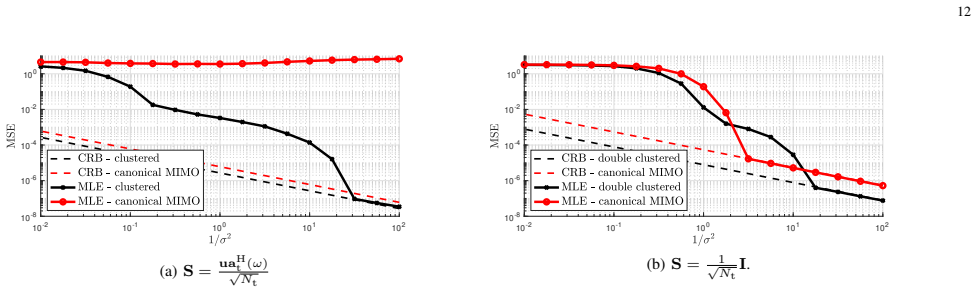
For orthogonal waveforms, the single-target CRB depends on the sum of the spatial variances of the transmit (Tx) and receive (Rx) arrays, or equivalently the spatial variance of the sum co-array weighted by the multiplicities of the virtual sensors. This reveals that CRB-optimal geometries are inherently redundant. Optimal Tx-Rx sensor allocations favor the Rx even for nonredundant arrays. For planar arrays, the spatial covariances of Tx and Rx arrays must satisfy a condition for optimal waveforms to direct power in the target direction. There is a connection between Diophantine equations and array geometries with equal CRB.
What carries the argument
The sum of the spatial variances of the Tx and Rx arrays, or the spatial variance of the sum co-array weighted by virtual sensor multiplicities.
If this is right
- CRB-optimal array geometries must be redundant to minimize the bound.
- With a total sensor budget, unequal allocation favoring receive sensors is optimal.
- Planar array designs require specific spatial covariance conditions between Tx and Rx for power direction.
- Array geometries satisfying certain Diophantine equations achieve equal CRB.
Where Pith is reading between the lines
- If the single-target assumption is relaxed to multiple targets, the redundancy requirement may change due to identifiability needs.
- The MSE-identifiability trade-off suggests exploring hybrid orthogonal-coherent waveform designs.
- Simulations of MIMO radar with the derived allocations could test the sensor allocation result.
Load-bearing premise
The analysis assumes a single far-field point target whose response follows the standard narrowband array manifold model.
What would settle it
Measuring the CRB in an experiment with a near-field target or extended target and finding it does not match the spatial variance prediction would falsify the dependence.
Figures





read the original abstract
This paper characterizes the performance limits of optimal array designs using orthogonal and coherent waveforms for both linear and planar arrays. For orthogonal waveforms, we show that the single-target Cram\'er-Rao Bound (CRB) depends on the sum of the so-called spatial variances of the transmit (Tx) and receive (Rx) arrays, or equivalently, the spatial variance of the sum co-array weighted by the multiplicities of the virtual sensors. This reveals that CRB-optimal geometries are inherently redundant, highlighting a fundamental trade-off between mean squared error (MSE) and identifiability in parameter estimation. Moreover, we derive optimal Tx-Rx sensor allocations given a total sensor budget and show that unequal allocation (favoring the Rx) is optimal even for nonredundant arrays, questioning conventional designs. We extend our results to planar arrays, providing a new general condition that the spatial covariances of the Tx and Rx arrays should satisfy for the optimal waveforms to direct power in the target direction. Additionally, we establish a connection between Diophantine equations and array geometries with equal CRB, along with a constructive method for designing such arrays. Our work provides new guidelines for and insights into optimal array and waveform design with relevance in emerging active sensing multiple-input multiple-output systems.
Editorial analysis
A structured set of objections, weighed in public.
Referee Report
Summary. The manuscript characterizes performance limits for optimal array and waveform design in active sensing for linear and planar arrays. For orthogonal waveforms, the single-target CRB is shown to equal the sum of the spatial variances of the Tx and Rx arrays (equivalently, the multiplicity-weighted spatial variance of the sum co-array). This implies that CRB-optimal geometries are inherently redundant and reveals a trade-off between MSE and identifiability. The work derives optimal Tx-Rx sensor allocations (favoring Rx even for non-redundant arrays), provides a general condition on Tx/Rx spatial covariances for planar arrays so that optimal waveforms direct power toward the target, and establishes a link between Diophantine equations and array geometries that achieve equal CRB, together with a constructive design procedure.
Significance. If the derivations hold, the paper supplies concrete, actionable guidelines for MIMO active-sensing array design by making the dependence of the CRB on array geometry explicit and by identifying the redundancy-identifiability trade-off. The constructive method based on Diophantine equations and the planar-array covariance condition are novel contributions that could directly influence practical system design in radar and sensing applications. The work also supplies falsifiable predictions (e.g., unequal Tx/Rx allocations) that can be tested numerically.
minor comments (4)
- [Abstract] Abstract: the phrase 'inherently redundant' is used without a precise definition of redundancy at first appearance; a one-sentence clarification would help readers.
- [planar arrays section] Section on planar arrays: the new general condition on spatial covariances is stated but not illustrated with a concrete numerical example or figure; adding one would strengthen the claim.
- [Notation/Introduction] Notation: 'spatial variance' and 'sum co-array' are central but introduced without an explicit forward reference to their definitions; a short preliminary subsection or boxed definition would improve accessibility.
- [Diophantine-equation section] The connection to Diophantine equations is interesting but the constructive algorithm is described at a high level; a short pseudocode block or step-by-step example for a small sensor budget would make the method reproducible.
Simulated Author's Rebuttal
We thank the referee for the positive assessment of our manuscript, the accurate summary of its contributions, and the recommendation for minor revision. We are gratified that the significance of the CRB characterizations, the redundancy-identifiability trade-off, the optimal Tx-Rx allocations, the planar-array covariance condition, and the Diophantine construction are recognized as potentially actionable for MIMO active-sensing design.
Circularity Check
CRB-to-spatial-variance reduction is a direct algebraic identity from the standard manifold model
full rationale
The paper's central result equates the single-target CRB (orthogonal waveforms) to the sum of Tx/Rx spatial variances (or multiplicity-weighted second moment of the sum co-array). This follows immediately from differentiating the narrowband steering vector a(θ) = exp(j 2π r_k · u(θ)) inside the Fisher information matrix; the resulting quadratic form in sensor coordinates is an identity under the far-field plane-wave assumption and does not rely on any fitted parameter, self-citation, or prior result from the same authors. No load-bearing step reduces to a definition or to a self-citation chain. The derivation is therefore self-contained against the stated model.
Axiom & Free-Parameter Ledger
axioms (2)
- domain assumption Single far-field point target with standard narrowband array manifold
- domain assumption Waveforms are either fully orthogonal or fully coherent
Reference graph
Works this paper leans on
-
[1]
MIMO Radar for Advanced Driver-Assistance Systems and Autonomous Driving: Advantages and Challenges,
S. Sun, A. P. Petropulu, and H. V . Poor, “MIMO Radar for Advanced Driver-Assistance Systems and Autonomous Driving: Advantages and Challenges,”IEEE Signal Process. Mag., vol. 37, no. 4, pp. 98–117, 2020
2020
-
[2]
Radar Taking Off: New Capabilities for UA Vs,
P. H ¨ugler, F. Roos, M. Schartel, M. Geiger, and C. Waldschmidt, “Radar Taking Off: New Capabilities for UA Vs,”IEEE Microw. Mag., vol. 19, no. 7, pp. 43–53, 2018. 14
2018
-
[3]
Optimal Cognitive Beamform- ing for Target Tracking in MIMO Radar/Sonar,
N. Sharaga, J. Tabrikian, and H. Messer, “Optimal Cognitive Beamform- ing for Target Tracking in MIMO Radar/Sonar,”IEEE J. Sel. Topics Signal Process., vol. 9, no. 8, pp. 1440–1450, 2015
2015
-
[4]
High-resolution two- dimensional imaging using MIMO sonar with limited physical size,
X. Liu, T. Wei, C. Sun, Y . Yang, and J. Zhuo, “High-resolution two- dimensional imaging using MIMO sonar with limited physical size,” Applied Acoustics, vol. 182, p. 108280, 2021
2021
-
[5]
MIMO Radar with Colocated Antennas,
J. Li and P. Stoica, “MIMO Radar with Colocated Antennas,”IEEE Signal Process. Mag., vol. 24, no. 5, pp. 106–114, Sept 2007
2007
-
[6]
On Parameter Identifiability of MIMO Radar,
J. Li, P. Stoica, L. Xu, and W. Roberts, “On Parameter Identifiability of MIMO Radar,”IEEE Signal Process. Lett., vol. 14, no. 12, pp. 968–971, 2007
2007
-
[7]
Cram ´er-Rao bounds on angle estimation with a two-dimensional array,
A. Mirkin and L. Sibul, “Cram ´er-Rao bounds on angle estimation with a two-dimensional array,”IEEE Trans. Signal Process., vol. 39, no. 2, pp. 515–517, 1991
1991
-
[8]
Worst case Cram ´er-Rao bounds for parametric estimation of superimposed signals with applications,
S. Yau and Y . Bresler, “Worst case Cram ´er-Rao bounds for parametric estimation of superimposed signals with applications,”IEEE Trans. Signal Process., vol. 40, no. 12, pp. 2973–2986, 1992
1992
-
[9]
A note on most favorable array geometries for DOA estimation and array interpolation,
A. B. Gershman and J. F. B ¨ohme, “A note on most favorable array geometries for DOA estimation and array interpolation,”IEEE Signal Process. Lett., vol. 4, no. 8, pp. 232–235, 1997
1997
-
[10]
Azimuth and elevation angle estimation with a three- dimensional array,
R. Nielsen, “Azimuth and elevation angle estimation with a three- dimensional array,”IEEE J. Ocean. Eng., vol. 19, no. 1, pp. 84–86, 1994
1994
-
[11]
On the geometry of isotropic arrays,
U. Baysal and R. Moses, “On the geometry of isotropic arrays,”IEEE Trans. Signal Process., vol. 51, no. 6, pp. 1469–1478, 2003
2003
-
[12]
A bayesian approach to array geometry design,
U. Oktel and R. Moses, “A bayesian approach to array geometry design,” IEEE Trans. Signal Process., vol. 53, no. 5, pp. 1919–1923, 2005
1919
-
[13]
Cram ´er-Rao bounds for antenna array design,
H. Gazzah and S. Marcos, “Cram ´er-Rao bounds for antenna array design,”IEEE Trans. Signal Process., vol. 54, no. 1, pp. 336–345, 2006
2006
-
[14]
Target Velocity Estimation and Antenna Placement for MIMO Radar With Widely Separated Antennas,
Q. He, R. S. Blum, H. Godrich, and A. M. Haimovich, “Target Velocity Estimation and Antenna Placement for MIMO Radar With Widely Separated Antennas,”IEEE J. Sel. Topics Signal Process., vol. 4, no. 1, pp. 79–100, 2010
2010
-
[15]
Sparse Antenna and Pulse Placement for Colocated MIMO Radar,
E. Tohidi, M. Coutino, S. P. Chepuri, H. Behroozi, M. M. Nayebi, and G. Leus, “Sparse Antenna and Pulse Placement for Colocated MIMO Radar,”IEEE Trans. Signal Process., vol. 67, no. 3, pp. 579–593, 2019
2019
-
[16]
M. G. Amin, Ed.,Sparse Arrays for Radar, Sonar, and Communications. Wiley-IEEE, 2024
2024
-
[17]
Transmit and Receive Sensor Selection Using the Multiplicity in the Virtual Array,
I. van Der Werf, C. A. Kokke, R. Heusdens, R. C. Hendriks, G. Leus, and M. Coutino, “Transmit and Receive Sensor Selection Using the Multiplicity in the Virtual Array,” inProc. of the European Signal Process. Conf. (EUSIPCO), 2024, pp. 2272–2276
2024
-
[18]
Cram ´er-Rao Bounds and Resolution Benefits of Sparse Arrays in Measurement-Dependent SNR Regimes,
S. Shahsavari and P. Pal, “Cram ´er-Rao Bounds and Resolution Benefits of Sparse Arrays in Measurement-Dependent SNR Regimes,”IEEE Signal Process. Lett., vol. 32, pp. 601–605, 2025
2025
-
[19]
Sparsity-enforcing sensor selection for DOA estimation,
V . Roy, S. P. Chepuri, and G. Leus, “Sparsity-enforcing sensor selection for DOA estimation,” inProc. of the IEEE Int. Wrksp. Computat. Advances Multi-Sensor Adaptive Process. (CAMSAP), 2013, pp. 340– 343
2013
-
[20]
Sparsity-Promoting Sensor Selection for Non-Linear Measurement Models,
S. P. Chepuri and G. Leus, “Sparsity-Promoting Sensor Selection for Non-Linear Measurement Models,”IEEE Trans. Signal Process., vol. 63, no. 3, pp. 684–698, 2015
2015
-
[21]
Array Design for Angle of Arrival Estimation Using the Worst-Case Two-Target Cram ´er- Rao Bound,
C. A. Kokke, M. Coutino, R. Heusdens, and G. Leus, “Array Design for Angle of Arrival Estimation Using the Worst-Case Two-Target Cram ´er- Rao Bound,”IEEE Open J. Signal Process., vol. 6, pp. 453–467, 2025
2025
-
[22]
Receiver Antenna Allocation for Joint Sensing and Communications,
I. van Der Werf, G. Leus, and S. P. Chepuri, “Receiver Antenna Allocation for Joint Sensing and Communications,” inProc. of the IEEE Sensor Array Multichannel Signal Process. Wrksp. (SAM), 2024, pp. 1– 5
2024
-
[23]
Range Com- pression and Waveform Optimization for MIMO Radar: A Cram ´er–Rao Bound Based Study,
J. Li, L. Xu, P. Stoica, K. W. Forsythe, and D. W. Bliss, “Range Com- pression and Waveform Optimization for MIMO Radar: A Cram ´er–Rao Bound Based Study,”IEEE Trans. Signal Process., vol. 56, no. 1, pp. 218–232, 2008
2008
-
[24]
Transmit Waveform Design Based on the Cram ´er-Rao Lower Bound,
I. van der Werf, R. C. Hendriks, R. Heusdens, and G. Leus, “Transmit Waveform Design Based on the Cram ´er-Rao Lower Bound,” inProc. of the IEEE Int. Wrksp. Computat. Advances Multi-Sensor Adaptive Process. (CAMSAP), 2023, pp. 166–170
2023
-
[25]
Optimization of the Receive Filter and Transmit Sequence for Active Sensing,
P. Stoica, H. He, and J. Li, “Optimization of the Receive Filter and Transmit Sequence for Active Sensing,”IEEE Trans. Signal Process., vol. 60, no. 4, pp. 1730–1740, 2012
2012
-
[26]
Radar Waveform Optimization for Target Parameter Estimation in Cooperative Radar-Communications Systems,
M. Bic ˘a and V . Koivunen, “Radar Waveform Optimization for Target Parameter Estimation in Cooperative Radar-Communications Systems,” IEEE Trans. Aerosp. Electron. Syst., vol. 55, no. 5, pp. 2314–2326, 2019
2019
-
[27]
Joint Transmit Beamforming for Multiuser MIMO Communications and MIMO Radar,
X. Liu, T. Huang, N. Shlezinger, Y . Liu, J. Zhou, and Y . C. Eldar, “Joint Transmit Beamforming for Multiuser MIMO Communications and MIMO Radar,”IEEE Trans. Signal Process., vol. 68, pp. 3929– 3944, 2020
2020
-
[28]
Cram ´er-Rao Bound Optimization for Joint Radar-Communication Beamforming,
F. Liu, Y .-F. Liu, A. Li, C. Masouros, and Y . C. Eldar, “Cram ´er-Rao Bound Optimization for Joint Radar-Communication Beamforming,” IEEE Trans. Signal Process., vol. 70, pp. 240–253, 2022
2022
-
[29]
Optimal and Robust Waveform Design for MIMO-OFDM Channel Sensing: A Cram ´er-Rao Bound Perspective,
X. Li, V . C. Andrei, U. J. M ¨onich, and H. Boche, “Optimal and Robust Waveform Design for MIMO-OFDM Channel Sensing: A Cram ´er-Rao Bound Perspective,” inProc. of the IEEE Int. Conf. Commun. (ICC), 2023, pp. 3516–3521
2023
-
[30]
Waveform Correlation and Optimization Issues for MIMO Radar,
K. Forsythe and D. Bliss, “Waveform Correlation and Optimization Issues for MIMO Radar,” inProc. of the Asilomar Conf. Signals, Syst. and Comput., 2005, pp. 1306–1310
2005
-
[31]
Jointly Optimal Array Geometries and Waveforms in Active Sensing: New Insights Into Array Design via the Cram ´er-Rao Bound,
I. van der Werf, G. Leus, and R. Rajam ¨aki, “Jointly Optimal Array Geometries and Waveforms in Active Sensing: New Insights Into Array Design via the Cram ´er-Rao Bound,” inProc. of the IEEE Int. Conf. on Acoustics, Speech and Signal Process. (ICASSP), 2025, pp. 1–5
2025
-
[32]
The unifying role of the coarray in aperture synthesis for coherent and incoherent imaging,
R. T. Hoctor and S. A. Kassam, “The unifying role of the coarray in aperture synthesis for coherent and incoherent imaging,”Proc. IEEE, vol. 78, no. 4, pp. 735–752, Apr 1990
1990
-
[33]
Sparse Antenna Array Design for MIMO Active Sensing Applications,
W. Roberts, L. Xu, J. Li, and P. Stoica, “Sparse Antenna Array Design for MIMO Active Sensing Applications,”IEEE Trans. Antennas Propag., vol. 59, no. 3, pp. 846–858, 2011
2011
-
[34]
Importance of Array Redundancy Pattern in Active Sensing,
R. Rajam ¨aki and P. Pal, “Importance of Array Redundancy Pattern in Active Sensing,” inProc. of the IEEE Int. Wrksp. Computat. Advances Multi-Sensor Adaptive Process. (CAMSAP), 2023, pp. 156–160
2023
-
[35]
DOA Estimation- Oriented Joint Array Partitioning and Beamforming Designs for ISAC Systems,
R. Liu, M. Li, Q. Liu, and A. L. Swindlehurst, “DOA Estimation- Oriented Joint Array Partitioning and Beamforming Designs for ISAC Systems,”IEEE Trans. Wireless Commun., vol. 24, no. 3, pp. 2052–2066, 2025
2052
-
[36]
Optimal Ratio Between Coherent and Orthogonal Signals in Sparse MIMO Radar,
H. Sun, J. Tabrikian, H. Messer, and H. Gao, “Optimal Ratio Between Coherent and Orthogonal Signals in Sparse MIMO Radar,” inProc. of the IEEE Sensor Array Multichannel Signal Process. Wrksp. (SAM), 2024, pp. 1–5
2024
-
[37]
Explicit Ziv–Zakai bound for analysis of DOA estimation performance of sparse linear arrays,
D. Khan and K. L. Bell, “Explicit Ziv–Zakai bound for analysis of DOA estimation performance of sparse linear arrays,”Signal Processing, vol. 93, no. 12, pp. 3449–3458, 2013, special Issue on Advances in Sensor Array Processing in Memory of Alex B. Gershman
2013
-
[38]
Ziv-Zakai Bound for DOAs Estimation,
Z. Zhang, Z. Shi, and Y . Gu, “Ziv-Zakai Bound for DOAs Estimation,” IEEE Trans. Signal Process., vol. 71, pp. 136–149, 2023
2023
-
[39]
Ziv–Zakai Bound for 2D-DOAs Estimation,
Z. Zhang, Z. Shi, C. Shao, J. Chen, M. S. Greco, and F. Gini, “Ziv–Zakai Bound for 2D-DOAs Estimation,”IEEE Trans. Signal Process., vol. 72, pp. 2483–2497, 2024
2024
-
[40]
Cognitive antenna selection for doa estimation in automotive radar,
J. Tabrikian, O. Isaacs, and I. Bilik, “Cognitive antenna selection for doa estimation in automotive radar,” inIEEE Radar Conf., 2016, pp. 1–5
2016
-
[41]
Cognitive Antenna Selection for Automotive Radar Using Bobrovsky-Zakai Bound,
——, “Cognitive Antenna Selection for Automotive Radar Using Bobrovsky-Zakai Bound,”IEEE J. Sel. Topics Signal Process., vol. 15, no. 4, pp. 892–903, 2021
2021
-
[42]
Barankin bounds for target localization by MIMO radars,
J. Tabrikian, “Barankin bounds for target localization by MIMO radars,” inProc. of the IEEE Sensor Array Multichannel Signal Process. Wrksp. (SAM), 2006, pp. 278–281
2006
-
[43]
Barankin bound vs Cram ´er-Rao bound for interferometric-like array design at low SNR,
J. Wang, L. Bacharach, M. N. El Korso, and P. Larzabal, “Barankin bound vs Cram ´er-Rao bound for interferometric-like array design at low SNR,” in31st European Signal Processing Conference (EUSIPCO), 2023, pp. 1554–1558
2023
-
[44]
CRB optimization for joint array partitioning and beamforming design in ISAC systems,
R. Liu, A. L. Swindlehurst, and M. Li, “CRB optimization for joint array partitioning and beamforming design in ISAC systems,” inProc. of the Asilomar Conf. Signals, Syst. and Comput.IEEE, 2024, pp. 898–902
2024
-
[45]
On Jointly CRB-optimal Arrays and Waveforms for Multi-Target Active Sensing,
I. van der Werf and G. Leus, “On Jointly CRB-optimal Arrays and Waveforms for Multi-Target Active Sensing,” inProc. of the Asilomar Conf. Signals, Syst. and Comput., 2025, pp. 1724–1728
2025
-
[46]
Joint Array Partitioning and Beamforming Designs in ISAC Systems: A Bayesian CRB Perspective,
R. Liu, M. Li, and A. Lee Swindlehurst, “Joint Array Partitioning and Beamforming Designs in ISAC Systems: A Bayesian CRB Perspective,” IEEE J. Sel. Areas Commun., vol. 44, pp. 150–164, 2026
2026
-
[47]
Inner Bounds on Performance of Radar and Communications Co-Existence,
A. R. Chiriyath, B. Paul, G. M. Jacyna, and D. W. Bliss, “Inner Bounds on Performance of Radar and Communications Co-Existence,”IEEE Trans. Signal Process., vol. 64, no. 2, pp. 464–474, 2016
2016
-
[48]
Integrated Sensing and Communications: Toward Dual- Functional Wireless Networks for 6G and Beyond,
F. Liu, Y . Cui, C. Masouros, J. Xu, T. X. Han, Y . C. Eldar, and S. Buzzi, “Integrated Sensing and Communications: Toward Dual- Functional Wireless Networks for 6G and Beyond,”IEEE J. Sel. Areas Commun., vol. 40, no. 6, pp. 1728–1767, 2022
2022
-
[49]
Target Detection and Localization Using MIMO Radars and Sonars,
I. Bekkerman and J. Tabrikian, “Target Detection and Localization Using MIMO Radars and Sonars,”IEEE Trans. Signal Process., vol. 54, no. 10, pp. 3873–3883, 2006
2006
-
[50]
MUSIC, maximum likelihood, and Cramer- Rao bound,
P. Stoica and A. Nehorai, “MUSIC, maximum likelihood, and Cramer- Rao bound,”IEEE Trans. Acoust., Speech, Signal Process., vol. 37, no. 5, pp. 720–741, 1989
1989
-
[51]
S. M. Kay,Fundamentals of statistical signal processing: estimation theory. Prentice-Hall, Inc., 1993. 15
1993
-
[52]
Performance Bounds and Angular Resolution Limit for the Moving Colocated MIMO Radar,
R. Boyer, “Performance Bounds and Angular Resolution Limit for the Moving Colocated MIMO Radar,”IEEE Trans. Signal Process., vol. 59, no. 4, pp. 1539–1552, 2011
2011
-
[53]
Hybrid Beamforming for Active Sensing Using Sparse Arrays,
R. Rajam ¨aki, S. P. Chepuri, and V . Koivunen, “Hybrid Beamforming for Active Sensing Using Sparse Arrays,”IEEE Trans. Signal Process., vol. 68, pp. 6402–6417, 2020
2020
-
[54]
MIMO Radar: Joint Array And Waveform Optimization,
D. W. Bliss, K. W. Forsythe, and C. D. Richmond, “MIMO Radar: Joint Array And Waveform Optimization,” inProc. of the Asilomar Conf. Signals, Syst. and Comput., 2007, pp. 207–211
2007
-
[55]
MIMO Radar Space–Time Adaptive Processing Using Prolate Spheroidal Wave Functions,
C.-Y . Chen and P. P. Vaidyanathan, “MIMO Radar Space–Time Adaptive Processing Using Prolate Spheroidal Wave Functions,”IEEE Trans. Signal Process., vol. 56, no. 2, pp. 623–635, 2008
2008
-
[56]
Multiple-input multiple-output (MIMO) radar and imaging: degrees of freedom and resolution,
D. Bliss and K. Forsythe, “Multiple-input multiple-output (MIMO) radar and imaging: degrees of freedom and resolution,” inProc. of the Asilomar Conf. Signals, Syst. and Comput., 2003, pp. 54–59
2003
-
[57]
Further results on the Cram ´er–Rao bound for sparse linear arrays,
M. Wang, Z. Zhang, and A. Nehorai, “Further results on the Cram ´er–Rao bound for sparse linear arrays,”IEEE Transactions on Signal Processing, vol. 67, no. 6, pp. 1493–1507, 2019
2019
-
[58]
Boyd and L
S. Boyd and L. Vandenberghe,Convex Optimization. Cambridge University Press, March 2004
2004
-
[59]
Greedy sensor selection: Leveraging submodularity,
M. Shamaiah, S. Banerjee, and H. Vikalo, “Greedy sensor selection: Leveraging submodularity,” in49th IEEE Conference on Decision and Control (CDC), 2010, pp. 2572–2577
2010
-
[60]
On Equal Sums of Squares,
I. A. Barnett and C. W. Mendel, “On Equal Sums of Squares,”The American Mathematical Monthly, vol. 49, no. 3, pp. 157–170, 1942
1942
-
[61]
82.7 Equal Sums of Squares,
C. J. Bradley, “82.7 Equal Sums of Squares,”The Mathematical Gazette, vol. 82, no. 493, pp. 80–85, 1998
1998
-
[62]
Non-Integer Arrays for Array Signal Processing,
P. Kulkarni and P. P. Vaidyanathan, “Non-Integer Arrays for Array Signal Processing,”IEEE Trans. Signal Process., vol. 70, pp. 5457–5472, 2022
2022
-
[63]
Super Nested Arrays: Linear Sparse Arrays With Reduced Mutual Coupling—Part I: Fundamentals,
C.-L. Liu and P. P. Vaidyanathan, “Super Nested Arrays: Linear Sparse Arrays With Reduced Mutual Coupling—Part I: Fundamentals,”IEEE Trans. Signal Process., vol. 64, no. 15, pp. 3997–4012, 2016
2016
-
[64]
Application of advanced signal processing techniques to angle of arrival estimation in ATC navi- gation and surveillance systems,
J. E. Evans, D. F. Sun, and J. R. Johnson, “Application of advanced signal processing techniques to angle of arrival estimation in ATC navi- gation and surveillance systems,” Massachusetts Inst of Tech Lexington Lincoln Lab, Tech. Rep. 582, 1982. Ids van der Werf(Graduate Student Member, IEEE) received the B.Sc. and MSc degrees in electrical engineering f...
1982
discussion (0)
Sign in with ORCID, Apple, or X to comment. Anyone can read and Pith papers without signing in.