REVIEW 3 major objections 4 minor 106 references
Microscopic Statistical Calculation of Nuclear Level Density Based on Relativistic Density Functional Theory
T0 review · 3 major / 4 minor · reviewed 2026-08-05 · deepseek-v4-flash
Pith's one-line read A relativistic-density-functional statistical model reproduces nuclear level densities and neutron resonance spacings from self-consistent single-particle levels alone.
desk verdict Solid systematic RDFT-based NLD application, but the f_rms validation is partly in-sample because dU is fit to neutron-resonance data, and the claimed parity dependence is really just parity equipartition. read the letter →
The pith
A machine-rendered reading of the paper's core claim, the machinery that carries it, and where it could break.
The reading
What carries the argument
The load-bearing object is the spin cut-off parameter σ², computed by a microscopic sum over the magnetic-substate projections m² of the RDFT single-particle levels, weighted by the thermal occupation factor sech²(E/2T). This replaces fitted empirical spin-cutoff formulas and lets shell closures and deformation imprint themselves on the angular-momentum distribution. Around it sits the finite-temperature BCS saddle-point state density: quasiparticle energies from RDFT levels plus pairing gaps fix entropy and excitation energy, and collective effects enter as a rotational enhancement factor built from the perpendicular moment of inertia, suppressed by pairing, plus a vibrational enhancement f
What would settle it
Measure or calculate parity-resolved level densities near the neutron separation energy for a subset of the 67 nuclei, for example from neutron resonances with assigned parities or from parity-projected shell-model calculations; if the positive-to-negative parity ratio at the relevant spin and energy departs substantially from one, the equipartition assumption fails and the p-wave comparisons become an unreliable test of the model.
Extended reading notes
Core claim
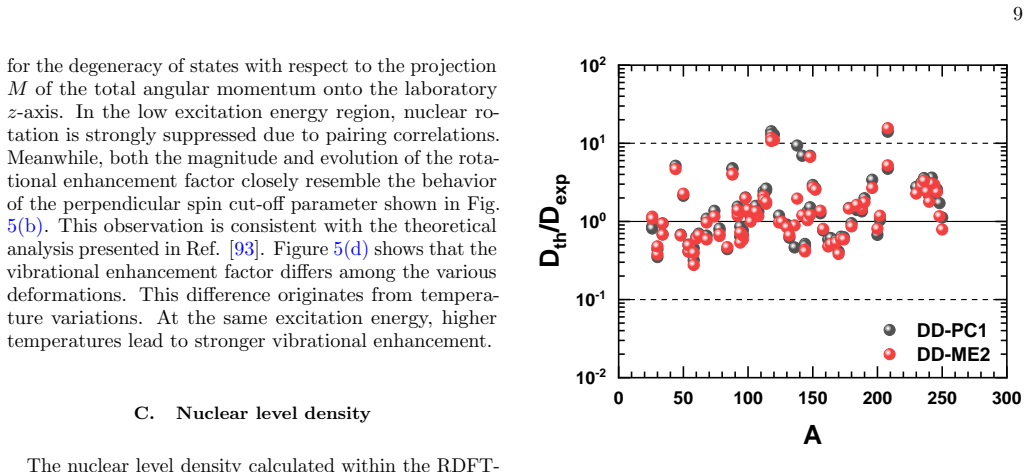
Central claim: a statistical level-density model built from relativistic density functional theory can reasonably reproduce measured nuclear level densities and s- and p-wave neutron resonance spacings. The recipe uses self-consistent RDFT single-particle levels, finite-temperature BCS pairing, saddle-point state density, and rotational plus vibrational enhancement; the spin cut-off parameter is computed microscopically from the same levels. For 67 even-even nuclei with s-wave data, f_rms = 2.29 (DD-ME2) or 2.56 (DD-PC1); including 18 p-wave sets gives 2.41/2.64. The paper reads these as comparable to non-relativistic microscopic models, better than a relativistic combinatorial calculation w
Load-bearing premise
The calculation assumes positive- and negative-parity states are equally numerous at every excitation energy when comparing with neutron resonance data; if real parity distributions are skewed, the quoted p-wave accuracy and the mixed f_rms values would shift.
Editorial extensions
If this is right
- For even-even nuclei without measured resonances, the approach provides level densities with accuracy comparable to existing non-relativistic microscopic models, so it can stand in for them in reaction and astrophysics calculations.
- Because the spin cut-off parameter comes out of the structure calculation, the model automatically carries shell-closure dips and deformation effects that empirical spin-cutoff formulas miss or misplace.
- The DD-ME2 and DD-PC1 interactions give consistent results, with DD-ME2 slightly closer to resonance data; remaining differences quantify functional uncertainty.
- The 98Sr analysis shows that near shape coexistence, level density and rotational enhancement vary with deformation through single-particle level density and pairing gaps, not through collective-phase-space arguments alone.
- The quoted agreement assumes equal positive- and negative-parity level densities, so the parity-blind part of the model is what is tested; parity-dependent extensions are the natural next step.
Reading between the lines
- The parity-equipartition assumption blurs the distinction between spin and parity dependence: the p-wave comparison mostly tests the spin distribution, so a parity-projected version could sharpen the test.
- Because the model computes σ² from thermalized single-particle levels, it could be inserted directly into Hauser–Feshbach reaction codes, replacing empirical spin-cutoff systematics and improving extrapolations to short-lived nuclei.
- The single-particle levels are temperature-independent in this paper; at excitation energies well above the neutron separation energy, thermal reshaping of the mean field may change the high-energy slope, so the method's reach beyond measured energies is the main open question.
- A sharper per-nucleus test than the global f_rms would compare the predicted spin cut-off parameter with values extracted from angular distributions or from shell-model Monte Carlo, since σ² is the channel through which all structure dependence flows.
Editorial analysis
A structured set of objections, weighed in public.
Referee Report
Summary. The paper develops a microscopic statistical model for nuclear level density (NLD) based on relativistic density functional theory (RDFT). It uses self-consistent single-particle levels from RDFT, finite-temperature BCS pairing, and rotational/vibrational collective enhancement factors, with a microscopically computed spin cut-off parameter. The model is applied to 67 even–even nuclei with experimental s-wave neutron resonance spacings, comparisons are made with phenomenological and non-relativistic microscopic models, and a detailed study of shape coexistence in 98Sr is presented. The central claim is that this RDFT-based statistical approach can reasonably reproduce experimental s- and p-wave neutron resonance spacings and NLDs, with f_rms = 2.29 (DD-ME2) and 2.56 (DD-PC1) for s-wave spacings.
Significance. If the reported validation is genuinely predictive, the paper would establish an RDFT-based statistical NLD method with a microscopically computed spin cut-off as a viable tool for practical applications, comparable to existing non-relativistic microscopic methods and useful for nuclei where phenomenological fits are unreliable. The systematic comparison of two covariant interactions, the treatment of deformation effects, and the concrete study of 98Sr are valuable. However, the paper's central quantitative evidence is weakened by a potential in-sample fitting of the damping parameter dU to the same type of neutron resonance data used in the validation, and the assumption of parity equipartition for p-wave spacings. These issues need to be addressed before the central claim is fully supported.
major comments (3)
- [Sec. III.D] The damping parameter dU = 6.27 MeV is stated to be 'determined by fitting experimental data at the neutron separation energy.' The same paper then reports f_rms values for s-wave neutron resonance spacings (Sec. III.D) for 67 even–even nuclei. The manuscript does not state whether these 67 nuclei were excluded from the dU fit. If they were not excluded, the quoted f_rms values (2.29 and 2.56) are in-sample measures of fit quality, not out-of-sample tests of predictive power. This would directly affect the central claim in Sec. IV that the approach 'can reasonably reproduce experimental s- and p-wave neutron resonance spacings' and the comparison to non-relativistic (f_rms=2.14) and phenomenological (f_rms=1.78) methods. The authors must clarify the fitting protocol and, if necessary, perform an out-of-sample validation (e.g., leave-one-out or fit on an independent subset).
- [Sec. III.D] The p-wave resonance spacing analysis assumes that positive and negative parities are equally distributed. The paper does not compute parity-dependent level densities, despite the introduction's claim to treat both spin and parity dependence. Since the p-wave f_rms and the combined s+p f_rms depend on this assumption, the authors should either justify the equipartition assumption with concrete estimates for the nuclei considered or compute parity-dependent NLDs. If parity equipartition is inaccurate for deformed or mid-shell nuclei, the reported p-wave f_rms (2.84/2.93) and combined f_rms (2.41/2.64) could shift significantly.
- [Sec. II, Eq. (14)] The perpendicular spin cut-off parameter σ²⊥ in Eq. (14) uses a simplified moment of inertia I⊥,k = (2/5) m R², with R presumably the nuclear radius. This rigid-body estimate is not derived from the RDFT density or the actual mass distribution. Since the spin cut-off is a claimed improvement in this work, the sensitivity of σ²⊥ to the choice of R (e.g., from RDFT vs. empirical formula) should be discussed. This is not fatal, but it is a load-bearing input for the resonance-spacing predictions and should be validated.
minor comments (4)
- [Abstract] Typo: 'thes- andp-wave' should be 'the s- and p-wave'.
- [Sec. III.D] The f_rms comparison involves different sample sizes (67 vs. 278 vs. 295 nuclei). A statistical measure that accounts for sample size or a match to the same nuclei would make the comparison more meaningful.
- [Sec. III.A, Eq. (19)] The symbol Pa′ in Eq. (19) is not defined in the text; indicate that it is the deuteron pairing energy and give its source.
- [Sec. III.B, Fig. 3] Figure 3 legend is difficult to read; please increase font size and use distinct line styles for the six deformations.
Circularity Check
Resonance-spacing validation is partly in-sample: dU is fit to data at the neutron separation energy, then the same type of data is used for the f_rms evaluation.
-
fitted input called prediction
[Sec. II, Eq. (18); Sec. III.D]
"In the present work, dU = 6.27 MeV is determined by fitting experimental data at the neutron separation energy. ... For the 67 even–even nuclei with available experimental s-wave neutron resonance spacing data [3], the present RDFT-based calculations yield f_rms = 2.29 with DD-ME2 and f_rms = 2.56 with DD-PC1."
The single fitted parameter dU enters every level density through the damping function f_dam(U) = 1/(1+exp[(U-E_def)/dU]). It is fit to 'experimental data at the neutron separation energy' — the same energy at which s- and p-wave neutron resonance spacings are measured, with the level density at S_n being inversely related to D0. The manuscript never states that this fit excluded the 67 even-even nuclei (or the 18 with p-wave data) later used to compute f_rms. Thus the reported f_rms values are in-sample measures of fit quality, not out-of-sample predictions, and the central claim in Sec. IV that the approach 'can reasonably reproduce experimental s- and p-wave neutron resonance spacings' is partly forced by the fitted parameter.
full rationale
The core derivation — RDFT single-particle levels (Eq. 1), finite-temperature BCS (Eqs. 6-10), microscopic spin cut-off (Eq. 13), and collective enhancements — is self-contained and not fitted to NLD data, and comparisons against Oslo-method data and non-relativistic/phenomenological models provide independent content. The only load-bearing reduction is the dU fit: one global parameter is adjusted to reproduce the scale of level densities at the neutron separation energy, and the same energy region/data type is then used to compute the f_rms values that carry the paper's quantitative validation claim. Because dU affects every resonance-spacing prediction via Eq. (17)-(18), the f_rms = 2.29/2.56 (s-wave) and combined 2.41/2.64 values are partially in-sample. This fits the 'fitted input called prediction' pattern and warrants a partial-circularity score of 6; the remainder of the paper's physics is independent. The parity-equipartition assumption is a modeling choice, not a circular step.
Assumptions & free parameters
free parameters (2)
- dU =
6.27 MeV
- G_k (pairing strength) =
not specified
assumptions (5)
- standard math Saddle-point approximation for the state density, Eq. (3)
- domain assumption Finite-temperature BCS treatment of pairing without particle-number projection
- domain assumption Temperature-independent single-particle levels from zero-temperature RDFT
- domain assumption Positive and negative parity are equally distributed
- domain assumption Rotational enhancement based on rigid-body moment of inertia with pairing correction, Eq. (14)
Cite this review
Pith. "Pith review of Microscopic Statistical Calculation of Nuclear Level Density Based on Relativistic Density Functional Theory." pith.science (2026). https://pith.science/paper/QGGHE64A
@misc{pith2026260803663,
  author       = {Pith},
  title        = {Pith review of: Microscopic Statistical Calculation of Nuclear Level Density Based on Relativistic Density Functional Theory},
  year         = {2026},
  howpublished = {\url{https://pith.science/paper/QGGHE64A}},
  note         = {Machine review of arXiv:2608.03663}
}
read the original abstract
A microscopic statistical model based on the relativistic density functional theory (RDFT) is developed to calculate the nuclear level density (NLD). The approach employs self-consistent single-particle levels obtained from RDFT as input, incorporates pairing correlations within a finite-temperature Bardeen-Cooper-Schrieffer (BCS) theory, and accounts for rotational and vibrational collective enhancement effects. The spin cut-off parameter is calculated from the single-particle levels, thereby naturally retaining the shell effects and the structural characteristics of different nuclei. Using the shape-coexisting nucleus 98Sr as a representative example, the microscopic origin of the deformation effect on the NLD is investigated. In addition, the calculated NLDs are systematically compared with those from various phenomenological and microscopic models, as well as with available experimental data. The results indicate that although certain discrepancies exist among different models, they exhibit consistent overall evolutionary trends. Meanwhile, the RDFT-based microscopic statistical approach is capable of providing a reasonable description of the experimental NLDs as well as the s- and p-wave neutron resonance spacings.
Figures


Figures from the paper (4 more)


Reference graph
Works this paper leans on
-
[1]
H. A. Bethe, Nuclear Physics B. Nuclear Dynamics, Theoretical, Rev. Mod. Phys.9, 69 (1937)
1937
-
[2]
A. V. Voinov, S. M. Grimes, C. R. Brune, M. J. Hornish, T. N. Massey, and A. Salas, Test of nuclear level density inputs for Hauser-Feshbach model calculations, Phys. Rev. C76, 044602 (2007). 11
2007
-
[3]
Capote, M
R. Capote, M. Herman, P. Obloˇ zinsk´ y, P. Young, S. Goriely, T. Belgya, A. Ignatyuk, A. Koning, S. Hilaire, V. Plujko, M. Avrigeanu, O. Bersillon, M. Chadwick, T. Fukahori, Z. Ge, Y. Han, S. Kailas, J. Kopecky, V. Maslov, G. Reffo, M. Sin, E. Soukhovitskii, and P. Talou, RIPL – Reference Input Parameter Library for Calculation of Nuclear Reactions and N...
2009
-
[4]
J. H. Luo, J. C. Liang, L. Jiang, F. Tuo, L. Zhou, and L. He, Measurement of 134Xe(n,2n)133m,gXe reaction cross sections in 14-MeV region with detailed uncertainty quantification, Nucl. Sci. Tech34, 4 (2023)
2023
-
[5]
Wilson, J.N., Siem, S., Rose, S.J., Georgen, A., Gunsing, F., Jurado, B., and Bernstein, L., Nuclear Data for Reactor Physics: Cross sections and level densities in the actinide region, EPJ Web Conf.2, 12001 (2010)
2010
-
[6]
M. N. Nasrabadi and M. Sepiani, Study of components and statistical reaction mechanism in simulation of nu- clear process for optimized production of 64Cu and 67Ga medical radioisotopes using TALYS, EMPIRE and LISE + + nuclear reaction and evaporation codes, AIP Conf. Proc.1653, 020076 (2015)
2015
-
[7]
Colombi, F
A. Colombi, F. Barbaro, L. Canton, M. P. Carante, and A. Fontana, Improvement of nuclear reaction modeling for the production of 47Sc on natural vanadium targets for medical applications, EPJ Web Conf.261, 05008 (2022)
2022
-
[8]
Schiller, L
A. Schiller, L. Bergholt, M. Guttormsen, E. Melby, J. Rekstad, and S. Siem, Extraction of level density and γ strength function from primary γ spectra, Nucl. Instrum. Meth. A447, 498 (2000)
2000
Show all 106 references
-
[9]
Spyrou, S
A. Spyrou, S. Liddick, A.-C. Larsen, M. Guttorm- sen, K. Cooper, A. Dombos, D. Morrissey, F. Naqvi, G. Perdikakis, S. Quinn,et al., Novel technique for con- straining r-process (n, γ) reaction rates, Phys. Rev. Lett. 113, 232502 (2014)
2014
-
[10]
V. W. Ingeberg, S. Siem, M. Wiedeking, K. Sieja, D. Bleuel, C. Brits, T. Bucher, T. Dinoko, J. Easton, A. G¨ orgen,et al., First application of the Oslo method in inverse kinematics, Eur. Phys. J. A56, 68 (2020)
2020
-
[11]
Wiedeking, M
M. Wiedeking, M. Guttormsen, A. C. Larsen, F. Zeiser, A. G¨ orgen, S. N. Liddick, D. M¨ ucher, S. Siem, and A. Spyrou, Independent normalization for γ-ray strength functions: The shape method, Phys. Rev. C104, 014311 (2021)
2021
-
[12]
H. A. Bethe, An attempt to calculate the number of energy levels of a heavy nucleus, Phys. Rev.50, 332 (1936)
1936
-
[13]
Gilbert and A
A. Gilbert and A. Cameron, A composite nuclear-level density formula with shell corrections, Can. J. Phys.43, 1446 (1965)
1965
-
[14]
W. Dilg, W. Schantl, H. Vonach, and M. Uhl, Level density parameters for the back-shifted fermi gas model in the mass range 40 < A < 250, Nucl. Phys. A217, 269 (1973)
1973
-
[15]
A. V. Ignatyuk, J. L. Weil, S. Raman, and S. Kahane, Density of discrete levels in 116Sn, Phys. Rev. C47, 1504 (1993)
1993
-
[16]
and EMPIRE [ 17]. However, the parameters of these models rely on fitting existing experimental data, which limits their extrapolation capability and reliability in nuclear regions and energy ranges lacking experimental constraints [18]. To address these challenges, a range of...
2026 arXiv
-
[17]
Koning, S
A. Koning, S. Hilaire, and S. Goriely, TALYS: modeling of nuclear reactions, Eur. Phys. J. A59, 131 (2023)
2023
-
[18]
Herman, R
M. Herman, R. Capote, B. Carlson, P. Obloˇ zinsk´ y, M. Sin, A. Trkov, H. Wienke, and V. Zerkin, EMPIRE: Nuclear Reaction Model Code System for Data Evalua- tion, Nucl. Data Sheets108, 2655 (2007), special Issue on Evaluations of Neutron Cross Sections
2007
-
[19]
Hilaire, J
S. Hilaire, J. Delaroche, and M. Girod, Combinatorial nu- clear level densities based on the Gogny nucleon-nucleon effective interaction, Eur. Phys. J. A12, 169 (2001)
2001
-
[20]
Alhassid, S
Y. Alhassid, S. Liu, and H. Nakada, Particle-Number Reprojection in the Shell Model Monte Carlo Method: Application to Nuclear Level Densities, Phys. Rev. Lett. 83, 4265 (1999)
1999
-
[21]
W. E. Ormand, Estimating the nuclear level density with the Monte Carlo shell model, Phys. Rev. C56, R1678 (1997)
1997
-
[22]
J. A. White, S. E. Koonin, and D. J. Dean, Shell model Monte Carlo investigation of rare earth nuclei, Phys. Rev. C61, 034303 (2000)
2000
-
[23]
Cerf, Combinatorial nuclear level density by a Monte Carlo method, Phys
N. Cerf, Combinatorial nuclear level density by a Monte Carlo method, Phys. Rev. C49, 852 (1994)
1994
-
[24]
Cerf, Realistic microscopic level densities for spherical nuclei, Phys
N. Cerf, Realistic microscopic level densities for spherical nuclei, Phys. Rev. C50, 836 (1994)
1994
-
[25]
Zelevinsky, S
V. Zelevinsky, S. Karampagia, and A. Berlaga, Constant temperature model for nuclear level density, Phys. Lett. B783, 428 (2018)
2018
-
[26]
R. A. Sen’kov and M. Horoi, High-performance algorithm to calculate spin- and parity-dependent nuclear level densities, Phys. Rev. C82, 024304 (2010)
2010
-
[27]
Shimizu, Y
N. Shimizu, Y. Utsuno, Y. Futamura, T. Sakurai, T. Mizusaki, and T. Otsuka, Stochastic estimation of nuclear level density in the nuclear shell model: An ap- plication to parity-dependent level density in 58Ni, Phys. Lett. B753, 13 (2016)
2016
-
[28]
J. Chen, M. Liu, C. Yuan, S. Chen, N. Shimizu, X. Sun, R. Xu, and Y. Tian, Shell-model-based investigation on level density of Xe and Ba isotopes, Phys. Rev. C107, 054306 (2023)
2023
-
[29]
W. E. Ormand and B. A. Brown, Microscopic calcula- tions of nuclear level densities with the Lanczos method, Phys. Rev. C102, 014315 (2020)
2020
-
[30]
J. Wang, S. Dutta, L.-J. Wang, and Y. Sun, Projected shell model description of nuclear level density: Collec- tive, pair-breaking, and multiquasiparticle regimes in even-even nuclei, Phys. Rev. C108, 034309 (2023)
2023
-
[31]
V. M. Kolomietz, A. I. Sanzhur, and S. Shlomo, Self- consistent mean-field approach to the statistical level density in spherical nuclei, Phys. Rev. C97, 064302 (2018)
2018
-
[32]
N. D. Dang, N. Q. Hung, and L. T. Q. Huong, Testing the constant-temperature approach for the nuclear level density, Phys. Rev. C96, 054321 (2017)
2017
-
[33]
N. Q. Hung, N. D. Dang, and L. T. Q. Huong, Simulta- neous Microscopic Description of Nuclear Level Density and Radiative Strength Function, Phys. Rev. Lett.118, 022502 (2017)
2017
-
[34]
B. Dey, D. Pandit, S. Bhattacharya, N. Q. Hung, N. D. Dang, L. T. Phuc, D. Mondal, S. Mukhopadhyay, S. Pal, A. De, and S. R. Banerjee, Level density and thermody- namics in the hot rotating 96Tc nucleus, Phys. Rev. C 96, 054326 (2017)
2017
-
[35]
B. Dey, N. Quang Hung, D. Pandit, S. Bhat- tacharya, N. Dinh Dang, L. Quynh Huong, D. Mondal, S. Mukhopadhyay, S. Pal, A. De, and S. Banerjee, S- shaped heat capacity in an odd–odd deformed nucleus, Phys. Lett. B789, 634 (2019)
2019
-
[36]
Hilaire and S
S. Hilaire and S. Goriely, Global microscopic nuclear level densities within the HFB plus combinatorial method for 12 practical applications, Nucl. Phys. A779, 63 (2006)
2006
-
[37]
Goriely, S
S. Goriely, S. Hilaire, and A. J. Koning, Improved micro- scopic nuclear level densities within the Hartree-Fock- Bogoliubov plus combinatorial method, Phys. Rev. C 78, 064307 (2008)
2008
-
[38]
Hilaire, M
S. Hilaire, M. Girod, S. Goriely, and A. J. Koning, Temperature-dependent combinatorial level densities with the D1M Gogny force, Phys. Rev. C86, 064317 (2012)
2012
-
[39]
Uhrenholt, S
H. Uhrenholt, S. ˚Aberg, A. Dobrowolski, T. Døssing, T. Ichikawa, and P. M¨ oller, Combinatorial nuclear level- density model, Nucl. Phys. A913, 127 (2013)
2013
-
[40]
Geng, P.-X
K.-P. Geng, P.-X. Du, J. Li, and D.-L. Fang, Calculation of microscopic nuclear level densities based on covariant density functional theory, Nucl. Sci. Tech.34, 141 (2023)
2023
-
[41]
Jiang and X.H
X.F. Jiang and X.H. Wu and P.W. Zhao and J. Meng, Nuclear level density from relativistic density functional theory and combinatorial method, Phys. Lett. B849, 138448 (2024)
2024
-
[42]
G. B. He, N. C. Tang, Y. Tian, Y. Cui, J. Li, Y. Xu, and R. R. Xu, Systematic study of microscopic nuclear level densities of Sn isotopes within a relativistic framework*, Chin. Phys. C50, 054107 (2026)
2026
-
[43]
Du and J
P. Du and J. Li, Nuclear level densities in the relativis- tic Hartree-Bogoliubov plus combinatorial framework, (2026), arXiv:2605.04862 [nucl-th]
2026 arXiv
-
[44]
Agrawal and A
B. Agrawal and A. Ansari, Excitation energy and angular momentum dependence of nuclear level densities and spin cut-off factor in SPA and SPA + RPA approaches, Nucl. Phys. A640, 362 (1998)
1998
-
[45]
Goriely, A new nuclear level density formula including shell and pairing correction in the light of a microscopic model calculation, Nucl
S. Goriely, A new nuclear level density formula including shell and pairing correction in the light of a microscopic model calculation, Nucl. Phys. A605, 28 (1996)
1996
-
[46]
Decowski, W
P. Decowski, W. Grochulski, A. Marcinkowski, K. Siwek, and Z. Wilhelmi, On superconductivity effects in nuclear level density, Nucl. Phys. A110, 129 (1968)
1968
-
[47]
Demetriou and S
P. Demetriou and S. Goriely, Microscopic nuclear level densities for practical applications, Nucl. Phys. A695, 95 (2001)
2001
-
[48]
Minato, Nuclear Level Densities with Microscopic Sta- tistical Method Using a Consistent Residual Interaction, J
F. Minato, Nuclear Level Densities with Microscopic Sta- tistical Method Using a Consistent Residual Interaction, J. Nucl. Sci. Technol48, 984 (2011)
2011
-
[49]
A. N. Bezbakh, T. M. Shneidman, G. G. Adamian, and N. V. Antonenko, Level densities of heaviest nuclei, Eur. Phys. J. A50, 97 (2014)
2014
-
[50]
Rahmatinejad, T
A. Rahmatinejad, T. M. Shneidman, N. V. Antonenko, A. N. Bezbakh, G. G. Adamian, and L. A. Malov, Col- lective enhancements in the level densities of Dy and Mo isotopes, Phys. Rev. C101, 054315 (2020)
2020
-
[51]
J. Zhao, T. Nikˇ si´ c, and D. Vretenar, Microscopic model for the collective enhancement of nuclear level densities, Phys. Rev. C102, 054606 (2020)
2020
-
[52]
Zhang, W
W. Zhang, W. Gao, G. T. Zhang, and Z. Y. Li, Level density of odd-A nuclei at saddle point, Nucl. Sci. Tech. 34, 124 (2023)
2023
-
[53]
Auberson, L
G. Auberson, L. Epele, G. Mahoux, and F. R. A. Sim˜ ao, Partition functions of the quark–gluon black body and density of states, J. Math. Phys.27, 1658 (1986)
1986
-
[54]
Rossignoli, A
R. Rossignoli, A. Ansari, and P. Ring, Projected statis- tics and level densities, Phys. Rev. Lett.70, 1061 (1993)
1993
-
[55]
Hilaire, S
S. Hilaire, S. Goriely, S. P´ eru, and G. Gosselin, A new approach to nuclear level densities: The QRPA plus boson expansion, Phys. Lett. B843, 137989 (2023)
2023
-
[56]
Kucharek and P
H. Kucharek and P. Ring, Relativistic field theory of superfluidity in nuclei, Z. Phys. A339, 23 (1991)
1991
-
[57]
Ring, Relativistic mean field theory in finite nuclei, Prog
P. Ring, Relativistic mean field theory in finite nuclei, Prog. Part. Nucl. Phys.37, 193 (1996)
1996
-
[58]
Vretenar, A
D. Vretenar, A. Afanasjev, G. Lalazissis, and P. Ring, Relativistic Hartree–Bogoliubov theory: static and dy- namic aspects of exotic nuclear structure, Phys. Rep. 409, 101 (2005)
2005
-
[59]
J. Meng, H. Toki, S. Zhou, S. Zhang, W. Long, and L. Geng, Relativistic continuum Hartree Bogoliubov theory for ground-state properties of exotic nuclei, Prog. Part. Nucl. Phys.57, 470 (2006)
2006
-
[60]
S.-G. Zhou, J. Meng, P. Ring, and E.-G. Zhao, Neutron halo in deformed nuclei, Phys. Rev. C82, 011301(R) (2010)
2010
-
[61]
Nikˇ si´ c, D
T. Nikˇ si´ c, D. Vretenar, and P. Ring, Relativistic nuclear energy density functionals: Mean-field and beyond, Prog. Part. Nucl. Phys.66, 519 (2011)
2011
-
[62]
L. Li, J. Meng, P. Ring, E.-G. Zhao, and S.-G. Zhou, Deformed relativistic Hartree-Bogoliubov theory in con- tinuum, Phys. Rev. C85, 024312 (2012)
2012
-
[63]
Afanasjev, S
A. Afanasjev, S. Agbemava, D. Ray, and P. Ring, Nuclear landscape in covariant density functional theory, Phys. Lett. B726, 680 (2013)
2013
-
[64]
Meng and S
J. Meng and S. G. Zhou, Halos in medium-heavy and heavy nuclei with covariant density functional theory in continuum, J. Phys. G:Nucl. Part. Phys.42, 093101 (2015)
2015
-
[65]
Meng,Relativistic Density Functional for Nuclear Structure(WORLD SCIENTIFIC, 2016)
J. Meng,Relativistic Density Functional for Nuclear Structure(WORLD SCIENTIFIC, 2016)
2016
-
[66]
Zhou, Multidimensionally constrained covariant density functional theories—nuclear shapes and potential energy surfaces, Phys
S.-G. Zhou, Multidimensionally constrained covariant density functional theories—nuclear shapes and potential energy surfaces, Phys. Scr.91, 063008 (2016)
2016
-
[67]
Z. X. Ren, D. Vretenar, T. Nikˇ si´ c, P. W. Zhao, J. Zhao, and J. Meng, Dynamical Synthesis of 4He in the Scission Phase of Nuclear Fission, Phys. Rev. Lett.128, 172501 (2022)
2022
-
[68]
H. H. Xie and J. Li, Impact of intrinsic electromagnetic structure on the nuclear charge radius in relativistic density functional theory, Phys. Rev. C110, 064319 (2024)
2024
-
[69]
H. H. Xie, J. Li, Y. L. Yang, and P. W. Zhao, Charge radii of calcium isotopes within relativistic density functional theory: The finite size of the nucleon and quadrupole shape-fluctuation effects, Phys. Rev. C112, L021303 (2025)
2025
-
[70]
J.-n. Zang, D. Chen, R. Guo, J. Li, D. Yang, and Y. Shi, Coexistence of possible magnetic and chiral rotation in 129Cs and 131La: A microscopic investigation, Phys. Rev. C112, 034338 (2025)
2025
-
[71]
Ring, Energy density functional theory in nuclei: does it have to be relativistic?, Phys
P. Ring, Energy density functional theory in nuclei: does it have to be relativistic?, Phys. Scr.2012, 014035 (2012)
2012
-
[72]
J. N. Ginocchio, Pseudospin as a Relativistic Symmetry, Phys. Rev. Lett.78, 436 (1997)
1997
-
[73]
J. Meng, K. Sugawara-Tanabe, S. Yamaji, P. Ring, and A. Arima, Pseudospin symmetry in relativistic mean field theory, Phys. Rev. C58, R628 (1998)
1998
-
[74]
J. Meng, K. Sugawara-Tanabe, S. Yamaji, and A. Arima, Pseudospin symmetry in Zr and Sn isotopes from the proton drip line to the neutron drip line, Phys. Rev. C 59, 154 (1999)
1999
-
[75]
Chen, H.-F
T.-S. Chen, H.-F. L¨ u, J. Meng, S.-Q. Zhang, and S.-G. Zhou, Pseudospin Symmetry in Relativistic Framework with Harmonic Oscillator Potential and Woods-Saxon 13 Potential, Chin. Phys. Lett.20, 358 (2003)
2003
-
[76]
J. N. Ginocchio, Relativistic symmetries in nuclei and hadrons, Phys. Rep.414, 165 (2005)
2005
-
[77]
Liang, J
H. Liang, J. Meng, and S.-G. Zhou, Hidden pseudospin and spin symmetries and their origins in atomic nuclei, Phys. Rep.570, 1 (2015)
2015
-
[78]
Shang, Q
T. Shang, Q. Zhao, and J. Li, Pseudospin symmetry: Mi- croscopic origin of the ground-state inversion in neutron- rich odd-A Cu isotopes, Phys. Lett. B850, 138527 (2024)
2024
-
[79]
A. V. Afanasjev and H. Abusara, Time-odd mean fields in covariant density functional theory: Rotating systems, Phys. Rev. C82, 034329 (2010)
2010
-
[80]
J. Meng, J. Peng, S.-Q. Zhang, and P.-W. Zhao, Progress on tilted axis cranking covariant density functional the- ory for nuclear magnetic and antimagnetic rotation, Front. Phys.8, 55–79 (2013)
2013
-
[81]
R. J. Furnstahl and C. E. Price, Relativistic Hartree calculations of odd-A nuclei, Phys. Rev. C40, 1398 (1989)
1989
-
[82]
Hofmann and P
U. Hofmann and P. Ring, A new method to calculate magnetic moments in relativistic mean field theories, Phys. Lett. B214, 307 (1988)
1988
-
[83]
J. M. Yao, H. Chen, and J. Meng, Time-odd triaxial relativistic mean field approach for nuclear magnetic moments, Phys. Rev. C74, 024307 (2006)
2006
-
[84]
J. Li, J. X. Wei, J. N. Hu, P. Ring, and J. Meng, Rela- tivistic description of magnetic moments in nuclei with doubly closed shells plus or minus one nucleon, Phys. Rev. C88, 064307 (2013)
2013
-
[85]
J. Li, Y. Zhang, J. M. Yao, and J. Meng, Magnetic moments of 33Mg in the time-odd relativistic mean field approach, Sci. China, Ser. G:Phys., Mech. Astron.52, 1586 (2009)
2009
-
[86]
Li and J
J. Li and J. Meng, Nuclear magnetic moments in covari- ant density functional theory, Front. Phys.13, 132109 (2018)
2018
-
[87]
Y. Tian, Z. Ma, and P. Ring, A finite range pairing force for density functional theory in superfluid nuclei, Phys. Lett. B676, 44 (2009)
2009
-
[88]
Tian, Z.-y
Y. Tian, Z.-y. Ma, and P. Ring, Separable pairing force for relativistic quasiparticle random-phase approxima- tion, Phys. Rev. C79, 064301 (2009)
2009
-
[89]
Behkami and J
A. Behkami and J. Hulzenga, Comparison of experimen- tal level densities and spin cutoff factors with microscopic theory for nuclei near A = 60, Nucl. Phys. A217, 78 (1973)
1973
-
[90]
Gholami, M
M. Gholami, M. Kildir, and A. N. Behkami, Microscopic study of spin cut-off factors of nuclear level densities, Phys. Rev. C75, 044308 (2007)
2007
-
[91]
von Egidy and D
T. von Egidy and D. Bucurescu, Experimental energy- dependent nuclear spin distributions, Phys. Rev. C80, 054310 (2009)
2009
-
[92]
S. M. Grimes, J. D. Anderson, J. W. McClure, B. A. Pohl, and C. Wong, Level density and spin cutoff parameters from continuum (p, n) and ( α, n) spectra, Phys. Rev. C 10, 2373 (1974)
1974
-
[93]
Nikˇ si´ c, N
T. Nikˇ si´ c, N. Paar, D. Vretenar, and P. Ring, DIRHB—A relativistic self-consistent mean-field framework for atomic nuclei, Comput. Phys. Commun.185, 1808 (2014)
2014
-
[94]
Døssing and S
T. Døssing and S. ˚Aberg, Collective enhancements in nuclear level densities, Eur. Phys. J. A55, 249 (2019)
2019
-
[95]
G. A. Lalazissis, T. Nikˇ si´ c, D. Vretenar, and P. Ring, New relativistic mean-field interaction with density- dependent meson-nucleon couplings, Phys. Rev. C71, 024312 (2005)
2005
-
[96]
Chankova, A
R. Chankova, A. Schiller, U. Agvaanluvsan, E. Al- gin, L. A. Bernstein, M. Guttormsen, F. Ingebretsen, T. L¨ onnroth, S. Messelt, G. E. Mitchell, J. Rekstad, S. Siem, A. C. Larsen, A. Voinov, and S. Ødeg ˚ ard, Level densities and thermodynamical quantities of heated 93−98Mo i...
2006
-
[97]
A. C. Larsen, I. E. Ruud, A. B¨ urger, S. Goriely, M. Gut- tormsen, A. G¨ orgen, T. W. Hagen, S. Harissopulos, H. T. Nyhus, T. Renstrøm, A. Schiller, S. Siem, G. M. Tveten, A. Voinov, and M. Wiedeking, Transitional γ strength in Cd isotopes, Phys. Rev. C87, 014319 (2013)
2013
-
[98]
S. Siem, M. Guttormsen, K. Ingeberg, E. Melby, J. Rek- stad, A. Schiller, and A. Voinov, Level densities and γ- strength functions in 148,149Sm, Phys. Rev. C65, 044318 (2002)
2002
-
[99]
Melby, M
E. Melby, M. Guttormsen, J. Rekstad, A. Schiller, S. Siem, and A. Voinov, Thermal and electromagnetic properties of 166Er and 167Er, Phys. Rev. C63, 044309 (2001)
2001
-
[100]
Giacoppo, F
F. Giacoppo, F. L. Bello Garrote, L. A. Bernstein, D. L. Bleuel, T. K. Eriksen, R. B. Firestone, A. G¨ orgen, M. Guttormsen, T. W. Hagen, B. V. Kheswa, M. Klinte- fjord, P. E. Koehler, A. C. Larsen, H. T. Nyhus, T. Ren- strøm, E. Sahin, S. Siem, and T. Tornyi, Level densities ...
2014
-
[101]
Guttormsen, B
M. Guttormsen, B. Jurado, J. N. Wilson, M. Aiche, L. A. Bernstein, Q. Ducasse, F. Giacoppo, A. G¨ orgen, F. Gun- sing, T. W. Hagen, A. C. Larsen, M. Lebois, B. Leniau, T. Renstrøm, S. J. Rose, S. Siem, T. Tornyi, G. M. Tveten, and M. Wiedeking, Constant-temperature level densi...
2013
-
[102]
¨Ozdo˘ gan, Y
H. ¨Ozdo˘ gan, Y. A.¨Unc¨ u, M.S ¸ekerci, and A. Kaplan, Estimations of level density parameters by using artifi- cial neural network for phenomenological level density models, Appl. Radiat. Isot.169, 109583 (2021)
2021
-
[103]
Du, T.-S
P.-X. Du, T.-S. Shang, K.-P. Geng, J. Li, and D.-L. Fang, Inference of parameters for the back-shifted Fermi gas model using a feedforward neural network, Phys. Rev. C109, 044325 (2024)
2024
-
[104]
Shang, J
T.-S. Shang, J. Li, and Z.-M. Niu, Prediction of nuclear charge density distribution with feedback neural network, Nucl. Sci. Tech.33, 153 (2022)
2022
-
[105]
T. S. Shang, H. H. Xie, J. Li, and H. Liang, Global prediction of nuclear charge density distributions using a deep neural network, Phys. Rev. C110, 014308 (2024)
2024
-
[106]
Wang, T.-S
Y.-D. Wang, T.-S. Shang, H.-H. Xie, P.-X. Du, J. Li, and H.-Z. Liang, Predictions of charge density distributions for nuclei with Z≥8, Nucl. Sci. Tech.37, 93 (2026)
2026
Reviewed August 5, 2026 · model on record in the stance chip above.
Discussion (0). Continue with ORCID to comment.