REVIEW 2 major objections 4 minor 56 references
Entropy of Non-Abelian Anyons from Slow Quasiparticle Dynamics in Quantum Hall Interferometers
T0 review · 2 major / 4 minor · reviewed 2026-07-12 · grok-4.5
Pith's one-line read An antidot inside a quantum Hall interferometer yields the O(1) entropy of a single non-Abelian anyon from the temperature shift of its equilibrium charge curve.
desk verdict Clean CFT isolation of single-anyon entropy plus a practical interferometer charge sensor; the weak-tunneling idealization is real but not fatal. read the letter →
The pith
A machine-rendered reading of the paper's core claim, the machinery that carries it, and where it could break.
The reading
What carries the argument
The modular S-matrix weights that appear in the high-temperature limit of the long-edge CFT characters; they supply the precise degeneracy ratio g(N+e*/e)/g(N)=d that shifts the charging curve and thereby produces ΔS=k_B log d after Maxwell integration.
What would settle it
Measure the gate-voltage shift of the e/4 charge step between two temperatures that both lie inside the claimed intermediate window; if the extracted entropy is not k_B log √2 (or the corresponding d for the state under study), the central claim fails.
Extended reading notes
Core claim
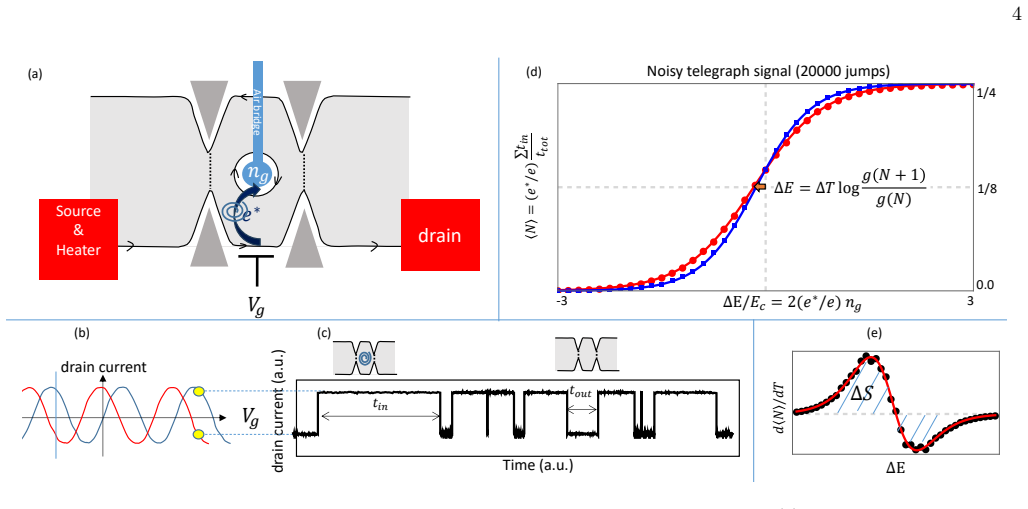
In the temperature window set by the long-edge level spacing ≪ k_B T ≪ antidot level spacing, the entropy change obtained by integrating the Maxwell relation over an e*/e charge step of a gated antidot equals k_B log d, where d is the quantum dimension of the anyon that enters the antidot. The charge curve itself is reconstructed non-locally from the time fractions spent in each telegraph state of the interferometer phase.
Load-bearing premise
Tunneling between the antidot and the long edge must stay weak enough that the system never forms coherent superpositions of different charge states, so the occupations remain classical thermal Boltzmann factors.
Editorial extensions
If this is right
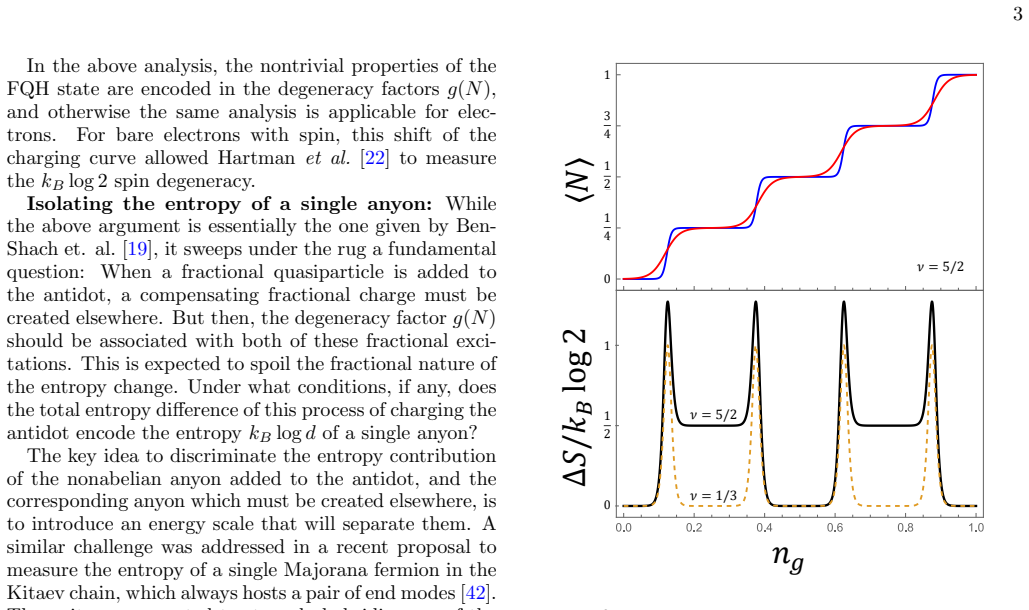
- Even-odd entropy plateaus of (1/2)k_B log 2 appear between successive e/4 steps of a u=5/2 antidot, while Abelian states such as u=1/3 show only ordinary log-2 peaks at the transitions.
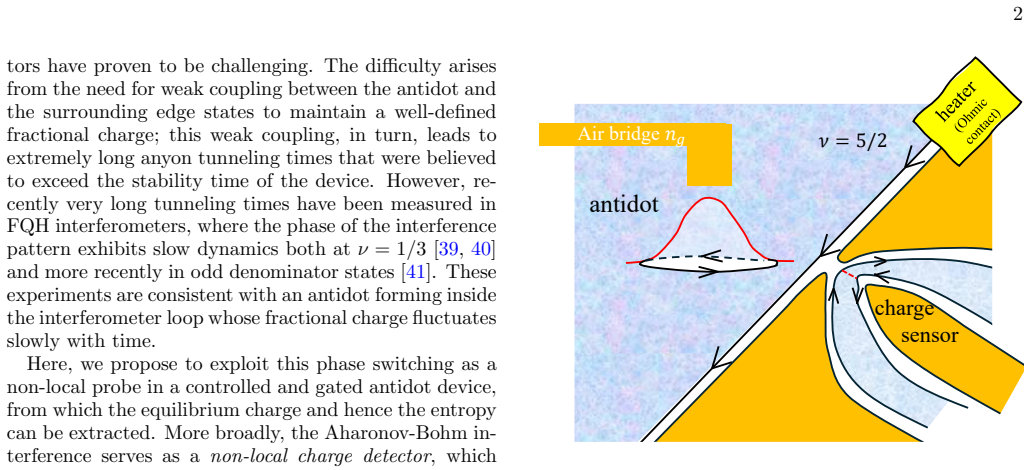
- Existing Fabry-Pérot or Mach-Zehnder interferometers that already exhibit slow anyon telegraph noise can be converted into entropy spectrometers by adding a heater and a calibrated gate on the enclosed antidot.
- The same protocol distinguishes candidate non-Abelian states (Pfaffian, anti-Pfaffian, PH-Pfaffian) once their quantum dimensions differ.
- Charge detection becomes non-local, removing the need for a nearby electrostatic sensor whose coupling would otherwise destroy the fractional charge.
Reading between the lines
- If the intermediate-temperature window can be made wide enough, the same Maxwell protocol could map the full anyon fusion graph by successive addition of several quasiparticles.
- The method supplies an independent thermodynamic cross-check of the half-integer thermal Hall conductance already reported for u=5/2.
- Because the readout is the interference phase rather than local charge, the technique may remain viable even when bulk disorder creates multiple weakly coupled antidots inside a single interferometer loop.
Signed reviews
Editorial analysis
A structured set of objections, weighed in public.
Referee Report
Summary. The manuscript proposes a protocol to extract the O(1) entropy ΔS = k_B log d of non-Abelian anyons (e.g., d_σ = √2 for e/4 quasiparticles in the ν = 5/2 Moore–Read state) from equilibrium charge curves of a gated antidot. The charge is inferred non-locally from the recently observed slow telegraph switching of the Aharonov–Bohm interference phase when the antidot sits inside an interferometer loop. Using Maxwell relations, the temperature-induced shift of the charge steps yields the entropy. The central theoretical result, derived via modular S-matrix evaluation of edge CFT characters in the End Matter, is that in the intermediate-temperature window (long-edge level spacing ≪ k_B T ≪ antidot level spacing) the extracted entropy difference between successive charge plateaus equals exactly k_B log d of the anyon added to the antidot. Explicit charge and entropy curves are given for both ν = 5/2 and the Abelian ν = 1/3 case, and a classical Markov simulation of the telegraph signal is used to illustrate how occupation times convert into charge curves.
Significance. If the intermediate-temperature result holds under realistic conditions, the work supplies a concrete, experimentally motivated route to the long-sought single-anyon entropy that has so far eluded both conventional charge sensing and heat-transport measurements. The proposal directly leverages the recently observed multi-second anyon tunneling times in graphene and GaAs interferometers, converting an experimental nuisance into a non-local charge detector and thereby removing the need for a nearby electrostatic sensor. The CFT derivation that isolates ΔS = k_B log d is clean, parameter-free once the temperature hierarchy is accepted, and yields a sharp, falsifiable even–odd entropy pattern for the Moore–Read state. These features make the paper a timely and potentially high-impact contribution to the experimental search for non-Abelian order.
major comments (2)
- End Matter, partition function (10) and the subsequent reductions (15)–(19): the joint system is written as a classical mixture of charge sectors with independent characters χ_a(p,N)χ_ā(q). The same factorization underlies the Markov rates used for the telegraph simulation. Once a finite tunneling amplitude Γ is present the charge sectors hybridize, the free-energy difference acquires O(Γ) or O(Γ^{2}/ΔE) corrections, and the extracted entropy ratio is no longer pure d_σ/d_I = √2. The manuscript never quantifies how small Γ must be relative to kT, E_c and the two level spacings for the error on log √2 to remain below ~10 %. Because the same Γ also sets the laboratory-scale jump rate, a concrete hierarchy (or a short estimate of the leading correction) is required before the claim ΔS = k_B log d can be regarded as experimentally robust.
- Main text after Eq. (2) and End Matter discussion of the short-antidot limit: the isolation of a single anyon’s entropy relies on the antidot level spacing remaining ≫ k_B T while the long-edge spacing is ≪ k_B T. No estimate is given of the antidot circumference (or gate-defined size) needed to realize this window for realistic edge velocities and the temperatures at which multi-second telegraph signals have been observed. Without such a scale, it is unclear whether the intermediate regime is accessible in present devices or requires further device engineering.
minor comments (4)
- Fig. 3 caption and panel labels: the figure contains duplicate panel letters ((b), (d) appear twice) and the simulated telegraph trace is labeled with both “Noisy telegraph signal (20000 jumps)” and an incomplete set of axes; a single clean labeling would improve readability.
- Eq. (2) and the surrounding text: the degeneracy ratio is written g(N)/g(N+e*/e) in one place and inverted in the subsequent shift formula (3); a consistent convention would avoid momentary confusion.
- End Matter, after Eq. (18): the statement that only the identity sector survives for N = 0 when T ≪ 2π/L_AD is correct, but a brief remark on how large L_AD can become before the ψ sector begins to contaminate the entropy plateau would help experimental design.
- References: the very recent interferometer telegraph-noise papers (Werkmeister et al., Samuelson et al., Kim et al.) are cited, yet a short comparison of the observed jump rates with the Γ hierarchy demanded by the theory would strengthen the experimental connection.
Circularity Check
No significant circularity: ΔS = k_B log d follows from textbook modular S-matrix weights of edge CFT characters under the stated high-T/low-T limits, not from fitted inputs or self-referential definitions.
full rationale
The central claim (End Matter, after Eq. 7 and culminating in Eqs. 5/19) is obtained by writing the joint partition function as a classical sum over charge sectors of products of independent characters χ_a(p,N)χ_ā(q), taking the modular high-T limit of the long edge (χ_a(q o1) o S_a0 e^{…} with S_a0 = d_a/D) and the low-T ground-state limit of the short antidot, then reading the resulting Boltzmann weights into the Maxwell integral of ⟨N⟩. These modular identities and the definition of quantum dimension are standard CFT facts (independent of the present authors). The only self-citation ([42]) is an analogy for energy-scale separation of a Majorana pair and is not used in any equation. There are no fitted parameters, no uniqueness theorems imported from the authors, and no renaming of known empirical patterns. Weak-tunneling factorization is an explicit modeling assumption whose validity can be questioned on physical grounds, but that is a correctness issue, not circularity by construction. The derivation chain is therefore self-contained.
Assumptions & free parameters
assumptions (4)
- domain assumption Chiral edge states of FQH liquids are described by rational conformal field theories whose characters transform under the modular S-matrix with S_a0 = d_a / D.
- domain assumption Tunneling between antidot and long edge is weak enough that the joint density matrix remains diagonal in charge sectors (no coherent superpositions).
- domain assumption There exists an intermediate temperature window level-spacing_long-edge ≪ k_B T ≪ level-spacing_antidot, E_c.
- domain assumption The antidot charging energy is of the classical form E_c (N – n_g)^2 with N quantized in units of the anyon charge.
Cite this review
Pith. "Pith review of Entropy of Non-Abelian Anyons from Slow Quasiparticle Dynamics in Quantum Hall Interferometers." pith.science (2026). https://pith.science/paper/QGM7ABMU
@misc{pith2026260702188,
  author       = {Pith},
  title        = {Pith review of: Entropy of Non-Abelian Anyons from Slow Quasiparticle Dynamics in Quantum Hall Interferometers},
  year         = {2026},
  howpublished = {\url{https://pith.science/paper/QGM7ABMU}},
  note         = {Machine review of arXiv:2607.02188}
}
abstract
Non-Abelian anyons emerging in fractional quantum Hall states carry a characteristic entropy, $\Delta S = k_B \log d$, where $d$ is the anyon's quantum dimension. This $\mathcal{O}(1)$ entropy can, in principle, be extracted from charge measurements of an antidot via Maxwell relations. However, equilibrium charge measurements in fractional antidots have proven to be challenging with conventional charge detectors. Here, we propose a scheme based on an antidot embedded in an interferometer, in which the charge can be inferred from the recently observed time-dependent switching of the interference phase. Performing such non-local charge measurements at equilibrium, the characteristic $\mathcal{O}(1)$ entropy of non-Abelian anyons (e.g., $d = \sqrt{2}$ for the $\nu = 5/2$ state) can be extracted for intermediate temperatures, which exceed the level spacing of the interferometer edge, but are much smaller than the level spacing of the antidot.
Figures
Reference graph
Works this paper leans on
-
[1]
On the other hand, switching toν= 1/3, all the anyons are abelian, d= 1, and there is no change in degeneracy factor
separating the two different entropy values of the paired and unpaired states. On the other hand, switching toν= 1/3, all the anyons are abelian, d= 1, and there is no change in degeneracy factor. 𝜈 = 5/2 𝜈 = 1/3 𝜈 = 5/2 ⟨𝑁⟩Δ𝑆/𝑘𝐵 log 2 𝑛𝑔 1 2 1 0 0 1 4 1 2 3 4 1 FIG. 2. e 4 charge steps, and resulting entropy obtained by in- tegrating the Maxwell relation...
2020
-
[2]
(17) As above, the Dedekind functions factor out, and the factorp 1/16 gives a temperature-independent shift of the degeneracy point
= χσ(p)p1/16 η(p) , χ I,ψ(p,0) = χI,ψ(p) η(p) . (17) As above, the Dedekind functions factor out, and the factorp 1/16 gives a temperature-independent shift of the degeneracy point. We are left with the extra partition functionsχ I,ψ,σ (p) from the Ising CFT. We now consider a short antidot edge so thatp≪1. Then these partition functions are dominated by ...
-
[3]
2, this results in an entropy change between theN= 0 andN= 1/4 charge plateaus of ∆S= 1 2 kB log 2
As shown in Fig. 2, this results in an entropy change between theN= 0 andN= 1/4 charge plateaus of ∆S= 1 2 kB log 2. At the peak, the entropy isk B log(dI +d σ). Physically, this result uses the smallness of the dot. In this limit, due to a large level spacing, the antidot has a single ground state. A similar situation was assumed in the model of Ref. [53...
-
[4]
Moore and N
G. Moore and N. Read, Nonabelions in the fractional quantum hall effect, Nuclear Physics B360, 362 (1991)
1991
-
[5]
Nayak, S
C. Nayak, S. H. Simon, A. Stern, M. Freedman, and S. Das Sarma, Non-abelian anyons and topological quan- tum computation, Reviews of Modern Physics80, 1083 (2008)
2008
-
[6]
Wen and Q
X.-G. Wen and Q. Niu, Ground-state degeneracy of the fractional quantum hall states in the presence of a ran- dom potential and on high-genus riemann surfaces, Phys- ical Review B41, 9377 (1990)
1990
-
[7]
Read and D
N. Read and D. Green, Paired states of fermions in two dimensions with breaking of parity and time-reversal symmetries and the fractional quantum hall effect, Phys- ical Review B61, 10267–10297 (2000)
2000
-
[8]
Willett, J
R. Willett, J. P. Eisenstein, H. L. St¨ ormer, D. C. Tsui, A. C. Gossard, and J. H. English, Observation of an even- denominator quantum number in the fractional quantum hall effect, Phys. Rev. Lett.59, 1776 (1987)
1987
Show all 56 references
-
[9]
Dolev, M
M. Dolev, M. Heiblum, V. Umansky, A. Stern, and D. Mahalu, Observation of a quarter of an electron charge at theν= 5/2 quantum hall state, Nature452, 829–834 (2008)
2008
-
[10]
D.-K. Ki, V. I. Fal’ko, D. A. Abanin, and A. F. Morpurgo, Observation of even denominator fractional quantum hall effect in suspended bilayer graphene, Nano Letters14, 2135–2139 (2014)
2014
-
[11]
Y. Kim, D. S. Lee, S. Jung, V. Sk´ akalov´ a, T. Taniguchi, K. Watanabe, J. S. Kim, and J. H. Smet, Fractional quan- tum hall states in bilayer graphene probed by transcon- ductance fluctuations, Nano Letters15, 7445 (2015)
2015
-
[12]
A. A. Zibrov, C. Kometter, H. Zhou, E. M. Spanton, T. Taniguchi, K. Watanabe, M. P. Zaletel, and A. F. Young, Tunable interacting composite fermion phases in a half-filled bilayer-graphene landau level, Nature549, 360–364 (2017)
2017
-
[13]
J. I. A. Li, C. Tan, S. Chen, Y. Zeng, T. Taniguchi, K. Watanabe, J. Hone, and C. R. Dean, Even- denominator fractional quantum hall states in bilayer graphene, Science358, 648–652 (2017)
2017
-
[14]
Y. Kim, A. C. Balram, T. Taniguchi, K. Watanabe, J. K. Jain, and J. H. Smet, Even denominator fractional quan- tum hall states in higher landau levels of graphene, Na- ture Physics15, 154–158 (2018)
2018
-
[15]
Kumar, A
R. Kumar, A. Haug, J. Kim, M. Yutushui, K. Khudi- akov, V. Bhardwaj, A. Ilin, K. Watanabe, T. Taniguchi, D. F. Mross, and Y. Ronen, Quarter- and half-filled quan- tum hall states and their topological orders revealed by daughter states in bilayer graphene, Nature Communica- ti...
2025 doi
-
[16]
Yang and B
K. Yang and B. I. Halperin, Thermopower as a possi- ble probe of non-abelian quasiparticle statistics in frac- tional quantum hall liquids, Physical Review B79, 10.1103/physrevb.79.115317 (2009)
2009 doi
-
[17]
N. R. Cooper and A. Stern, Observable bulk signatures of non-abelian quantum hall states, Physical Review Letters 102, 10.1103/physrevlett.102.176807 (2009)
2009 doi
-
[18]
Gervais and K
G. Gervais and K. Yang, Adiabatic cooling with non-abelian anyons, Physical Review Letters105, 10.1103/physrevlett.105.086801 (2010)
2010 doi
-
[19]
C.-Y. Hou, K. Shtengel, G. Refael, and P. M. Goldbart, Ettingshausen effect due to majorana modes, New Jour- nal of Physics14, 105005 (2012)
2012
-
[20]
Viola, S
G. Viola, S. Das, E. Grosfeld, and A. Stern, Ther- moelectric probe for neutral edge modes in the frac- tional quantum hall regime, Physical Review Letters109, 10.1103/physrevlett.109.146801 (2012)
2012 doi
-
[21]
B. A. Schmidt, K. Bennaceur, S. Gaucher, G. Gervais, L. N. Pfeiffer, and K. W. West, Specific heat and entropy of fractional quantum hall states in the second landau level, Physical Review B95, 10.1103/physrevb.95.201306 (2017)
2017 doi
-
[22]
Ben-Shach, C
G. Ben-Shach, C. R. Laumann, I. Neder, A. Yacoby, and B. I. Halperin, Detecting non-abelian anyons by charging spectroscopy, Physical Review Letters110, 10.1103/physrevlett.110.106805 (2013)
2013 doi
-
[23]
Schiller, H
N. Schiller, H. Ebisu, G. Refael, and Y. Oreg, Internal en- tropy from heat current (2024), arXiv:2407.03402 [cond- mat.mes-hall]
2024 arXiv
-
[24]
Venkatachalam, A
V. Venkatachalam, A. Yacoby, L. Pfeiffer, and K. West, Local charge of theν= 5/2 fractional quantum hall state, Nature469, 185–188 (2011)
2011
-
[25]
Hartman, C
N. Hartman, C. Olsen, S. L¨ uscher, M. Samani, S. Fallahi, G. C. Gardner, M. Manfra, and J. Folk, Direct entropy measurement in a mesoscopic quantum system, Nature Physics14, 1083–1086 (2018)
2018
-
[26]
Child, O
T. Child, O. Sheekey, S. L¨ uscher, S. Fallahi, G. C. Gardner, M. Manfra, A. Mitchell, E. Sela, Y. Klee- orin, Y. Meir, and J. Folk, Entropy measurement of a strongly coupled quantum dot, Phys. Rev. Lett.129, 227702 (2022)
2022
-
[27]
C. Adam, H. Duprez, N. Lehmann, A. Yglesias, S. Can- ces, M. J. Ruckriegel, M. Masseroni, C. Tong, A. O. Denisov, W. W. Huang, D. Kealhofer, R. Garreis, K. Watanabe, T. Taniguchi, K. Ensslin, and T. Ihn, En- tropy spectroscopy of a bilayer graphene quantum dot (2024), arXiv:24...
2024
-
[28]
Kealhofer, C
D. Kealhofer, C. Adam, M. J. Ruckriegel, P. Tomi´ c, B. Kratochwil, C. Reichl, Y. Meir, W. Wegscheider, T. Ihn, and K. Ensslin, Entropy of a double quantum dot (2025), arXiv:2508.09481 [cond-mat.mes-hall]
2025
-
[29]
Sheekey, T
O. Sheekey, T. Child, E. Cornick, S. Fallahi, G. C. Gardner, M. J. Manfra, E. Sela, Y. Kleeorin, Y. Meir, S. L¨ uscher, and J. Folk, Remote entropy measurement in coupled quantum dots (2026), arXiv:2605.03876 [cond- mat.mes-hall]
2026 arXiv
-
[30]
Piquard, P
C. Piquard, P. Glidic, C. Han, A. Aassime, A. Cavanna, U. Gennser, Y. Meir, E. Sela, A. Anthore, and F. Pierre, Observing the universal screening of a kondo impurity, 8 Nature Communications14, 10.1038/s41467-023-42857- 4 (2023)
2023 doi
-
[31]
Piquard, A
C. Piquard, A. Veillon, Y. Sato, F. Zanichelli, A. Aas- sime, A. Cavanna, U. Gennser, A. K. Mitchell, A. Anthore, and F. Pierre, Experimental evidence of fractional entropy in critical kondo systems (2026), arXiv:2605.00669 [cond-mat.mes-hall]
2026 arXiv
-
[32]
C. Han, Z. Iftikhar, Y. Kleeorin, A. Anthore, F. Pierre, Y. Meir, A. K. Mitchell, and E. Sela, Fractional entropy of multichannel kondo systems from conductance-charge relations, Physical Review Letters128, 10.1103/phys- revlett.128.146803 (2022)
2022 doi
-
[33]
Z. Ma, C. Han, Y. Meir, and E. Sela, Identifying an environment-induced localization transition from en- tropy and conductance, Physical Review Letters131, 10.1103/physrevlett.131.126502 (2023)
2023 doi
-
[34]
Sankar, E
S. Sankar, E. Sela, and C. Han, Measuring topological en- tanglement entropy using maxwell relations, Phys. Rev. Lett.131, 016601 (2023)
2023
-
[35]
Hurvitz, G
N. Hurvitz, G. Finkelstein, and E. Sela, Metallic island array as synthetic quantum matter: fractionalized en- tropy and thermal transport (2025), arXiv:2510.20491 [cond-mat.str-el]
2025 arXiv
-
[36]
Goldman and B
V. Goldman and B. Su, Resonant tunneling in the quan- tum hall regime: measurement of fractional charge, Sci- ence267, 1010 (1995)
1995
-
[37]
Franklin, I
J. Franklin, I. Zailer, C. Ford, P. Simpson, J. Frost, D. Ritchie, M. Simmons, and M. Pepper, The aharonov- bohm effect in the fractional quantum hall regime, Sur- face Science361-362, 17–21 (1996)
1996
-
[38]
Kataoka, C
M. Kataoka, C. J. B. Ford, G. Faini, D. Mailly, M. Y. Simmons, D. R. Mace, C.-T. Liang, and D. A. Ritchie, Detection of coulomb charging around an antidot in the quantum hall regime, Physical Review Letters83, 160–163 (1999)
1999
-
[39]
A. Kou, C. M. Marcus, L. N. Pfeiffer, and K. W. West, Coulomb oscillations in antidots in the integer and frac- tional quantum hall regimes, Physical Review Letters 108, 10.1103/physrevlett.108.256803 (2012)
2012 doi
-
[40]
Mills, D
S. Mills, D. Averin, and X. Du, Localizing fractional quasiparticles on graphene quantum hall antidots, Phys- ical Review Letters125, 10.1103/physrevlett.125.227701 (2020)
2020 doi
-
[41]
M. D. Luca, E. Hajigeorgiou, Z. Zhou, T. Lotriˇ c, T. Feng, K. Watanabe, T. Taniguchi, S. H. Simon, and M. Baner- jee, Quantum hall antidot as a fractional coulombmeter (2025), arXiv:2509.04209 [cond-mat.mes-hall]
2025
-
[42]
Werkmeister, J
T. Werkmeister, J. R. Ehrets, M. E. Wesson, D. H. Na- jafabadi, K. Watanabe, T. Taniguchi, B. I. Halperin, A. Yacoby, and P. Kim, Anyon braiding and telegraph noise in a graphene interferometer, Science388, 730–735 (2025)
2025
-
[43]
N. L. Samuelson, L. A. Cohen, W. Wang, S. Blanch, T. Taniguchi, K. Watanabe, M. P. Zaletel, and A. F. Young, Slow quasiparticle dynamics and anyonic statis- tics in a fractional quantum hall fabry-p´ erot interferom- eter (2025), arXiv:2403.19628 [cond-mat.mes-hall]
2025 arXiv
-
[44]
J. Kim, A. Shaer, R. Kumar, A. Ilin, K. Watanabe, T. Taniguchi, A. Stern, D. F. Mross, and Y. Ronen, Selec- tive braiding of different anyons in the even-denominator fractional quantum hall effect (2026), arXiv:2603.11162 [cond-mat.mes-hall]
2026
-
[45]
E. Sela, Y. Oreg, S. Plugge, N. Hartman, S. L¨ uscher, and J. Folk, Detecting the universal fractional entropy of majorana zero modes, Physical Review Letters123, 10.1103/physrevlett.123.147702 (2019)
2019 doi
-
[46]
Ghosh, M
B. Ghosh, M. Labendik, L. Musina, V. Uman- sky, M. Heiblum, and D. F. Mross, Anyonic braid- ing in a chiral mach-zehnder interferometer (2025), arXiv:2410.16488 [cond-mat.mes-hall]
2025 arXiv
-
[47]
Ghosh, M
B. Ghosh, M. Labendik, V. Umansky, M. Heiblum, and D. F. Mross, Coherent bunching of anyons and their dissociation in interference experiments (2025), arXiv:2412.16316 [cond-mat.mes-hall]
2025 arXiv
-
[48]
Gustavsson, R
S. Gustavsson, R. Leturcq, B. Simoviˇ c, R. Schleser, T. Ihn, P. Studerus, K. Ensslin, D. C. Driscoll, and A. C. Gossard, Counting statistics of single electron transport in a quantum dot, Physical Review Letters96, 10.1103/physrevlett.96.076605 (2006)
2006 doi
-
[49]
Werkmeister, J
T. Werkmeister, J. R. Ehrets, M. E. Wesson, D. H. Na- jafabadi, K. Watanabe, T. Taniguchi, B. I. Halperin, A. Yacoby, and P. Kim, Anyon braiding and telegraph noise in a graphene interferometer, Science388, 730 (2025)
2025
-
[50]
D. F. Mross, The anyon zeno effect (2026), arXiv:2602.22322 [cond-mat.mes-hall]
2026
-
[51]
Banerjee, M
M. Banerjee, M. Heiblum, A. Rosenblatt, Y. Oreg, D. E. Feldman, A. Stern, and V. Umansky, Observed quanti- zation of anyonic heat flow, Nature545, 75–79 (2017)
2017
-
[52]
Fendley, M
P. Fendley, M. P. Fisher, and C. Nayak, Topological en- tanglement entropy from the holographic partition func- tion, Journal of Statistical Physics126, 1111 (2007)
2007
-
[53]
Jezouin, F
S. Jezouin, F. D. Parmentier, A. Anthore, U. Gennser, A. Cavanna, Y. Jin, and F. Pierre, Quantum limit of heat flow across a single electronic channel, Science342, 601–604 (2013)
2013
-
[54]
Levin, B
M. Levin, B. I. Halperin, and B. Rosenow, Particle-hole symmetry and the pfaffian state, Physical Review Letters 99, 10.1103/physrevlett.99.236806 (2007)
2007 doi
-
[55]
D. T. Son, Is the composite fermion a dirac particle?, Physical Review X5, 10.1103/physrevx.5.031027 (2015)
2015 doi
-
[56]
D. V. Averin and J. A. Nesteroff, Coulomb blockade of anyons in quantum antidots, Physical Review Letters99, 10.1103/physrevlett.99.096801 (2007)
2007 doi
Reviewed July 12, 2026 · model on record in the stance chip above.
Discussion (0). Continue with ORCID to comment.