REVIEW 5 major objections 5 minor 15 references
Recon-GLGAN: A Global-Local context based Generative Adversarial Network for MRI Reconstruction
T0 review · 5 major / 5 minor · reviewed 2026-08-14 · deepseek-v4-flash
Pith's one-line read A GAN whose discriminator looks at both the full image and a heart-region crop reconstructs undersampled cardiac MRI more accurately than baseline GAN and U-Net, and the same discriminator can be dropped into other reconstruction GANs to…
desk verdict A plausible ROI-aware GAN for MRI reconstruction whose aggregate direction is positive but whose headline claim outruns its own tables. read the letter →
The pith
A machine-rendered reading of the paper's core claim, the machinery that carries it, and where it could break.
The reading
What carries the argument
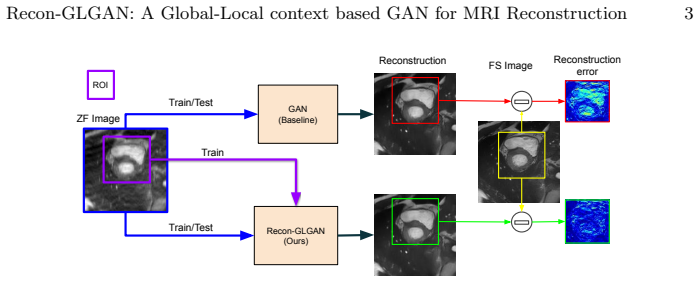
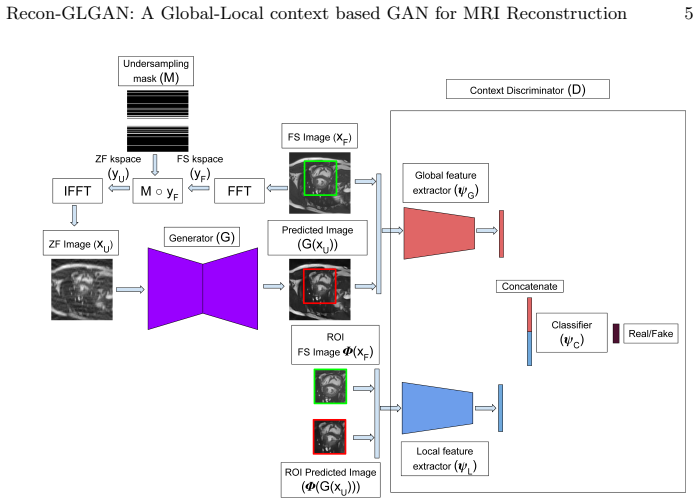
The central object is the context discriminator: a discriminator with two parallel feature extractors whose outputs are concatenated and classified. The global feature extractor sees the entire image; the local feature extractor sees a 60x60 region of interest that, during training, is centered on the bounding box of the heart's segmentation mask. The concatenated 128-dimensional feature vector is passed through one fully connected layer with a sigmoid to yield the real/fake probability. This two-path design carries the argument because it makes the adversarial loss reward reconstructions that are locally convincing inside the clinical region of interest as well as globally coherent, and it is the component the paper swaps into other GAN reconstruction pipelines to show portability.
What would settle it
Run the same training protocol but with a fixed central 60x60 crop as the local input at both train and test; if the segmentation-prior version does not beat this fixed-crop version on held-out slices, the claim that mask-derived ROIs drive the gain is falsified.
Extended reading notes
Core claim
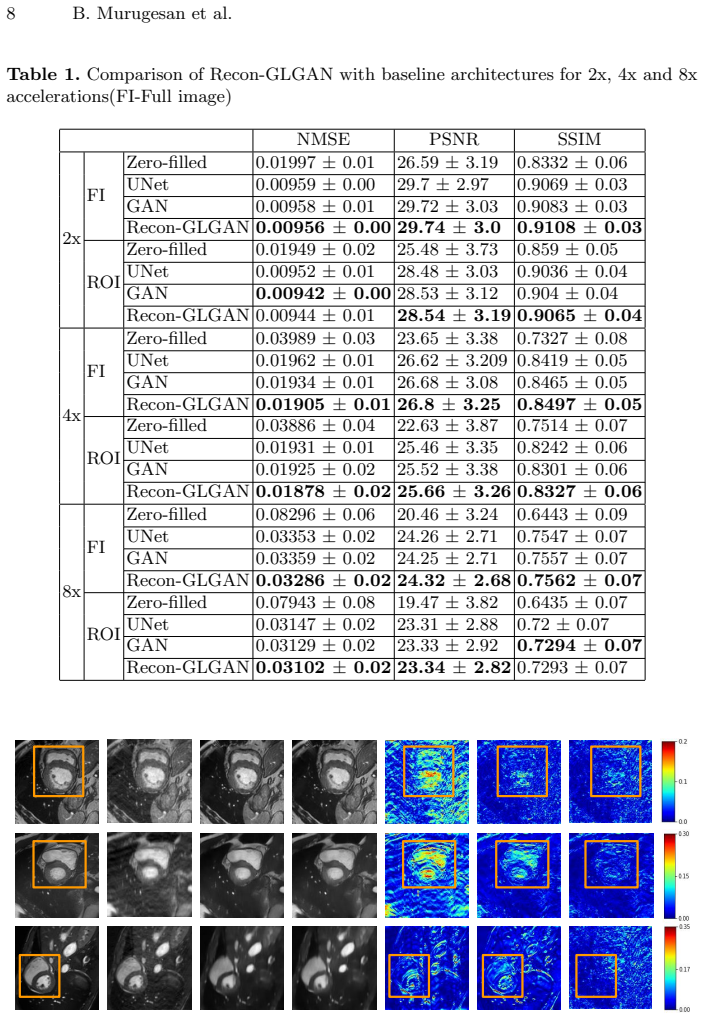
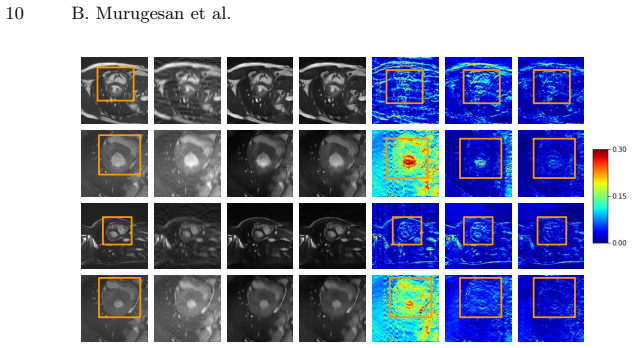
On its own terms, the paper claims that reconstruction quality is governed less by generator capacity than by where the discriminator directs attention. The context discriminator concatenates a 64-dimensional feature vector from a global path over the full 160x160 image with a 64-dimensional vector from a local path over a 60x60 heart-region crop, and a single fully connected layer classifies the resulting 128-dimensional vector as real or fake. Because the local crop at training time is centered on each slice's segmentation-mask bounding box, the generator is pressured to reconstruct the diagnostically relevant region faithfully while the global path maintains whole-image consistency. On the ACDC cardiac MRI data, the paper reports that this design beats the baseline GAN and U-Net on full-image and ROI metrics for 2x, 4x, and 8x accelerations, that retrofitting the discriminator into ReconGAN, SEGAN, ComGAN, and DAGAN improves most of their 4x metrics, and that its reconstructions yield segmentation Dice and Hausdorff scores close to those of fully sampled images.
Load-bearing premise
The training-time heart region is defined by segmentation-mask bounding boxes while test-time regions come from a different algorithm, and the whole region-of-interest benefit rests on these two identifying the same region on every slice.
Editorial extensions
If this is right
- The context discriminator can be treated as a plug-in replacement for the discriminator in other GAN-based MRI reconstruction methods, so an existing pipeline can gain ROI-aware behavior without redesigning its generator or loss.
- Gains are larger for 4x and 8x acceleration than for 2x, so the ROI prior matters most exactly when aliasing is hardest to remove.
- Because the local path reduces reconstruction error in the heart region more than in the whole image, the network is effectively trading global capacity for diagnostic-region fidelity.
- Using Recon-GLGAN reconstructions instead of zero-filled or baseline-GAN images as input to a pre-trained segmentation U-Net gives Dice and Hausdorff scores closer to fully sampled input, so the reconstruction benefit propagates to a downstream segmentation task.
Reading between the lines
- A natural extension the paper does not test is whether the same ROI-prior design helps other organs or imaging contrasts when the region of interest is defined by an automatic localizer; if it does, the principle is general, not cardiac-specific.
- The training-time ROI from segmentation masks and the test-time ROI from a separate localization algorithm are not guaranteed to coincide, so a robustness study that perturbs the test crop or trains with the same localizer at both stages would reveal how dependent the gains are on this assumption.
- The reported improvements are small in absolute metric terms; deciding whether they are clinically meaningful would require task-based tests such as ejection-fraction estimation or expert reading rather than pixel-similarity numbers alone.
Signed reviews
Editorial analysis
A structured set of objections, weighed in public.
Referee Report
Summary. The paper proposes Recon-GLGAN, a GAN-based MRI reconstruction method with a U-Net generator and a context discriminator that combines a global feature extractor on the full image and a local feature extractor on a 60x60 region of interest (ROI) derived from cardiac segmentation masks. The authors evaluate on the ACDC cardiac MRI dataset at 2x, 4x, and 8x acceleration, reporting NMSE, PSNR, and SSIM for both full image and ROI. They further claim that the context discriminator can be dropped into existing GAN-based reconstruction methods (ReconGAN, SEGAN, ComGAN, DAGAN) to improve them, and they present a preliminary segmentation experiment suggesting that reconstructions from their method yield segmentation results similar to fully sampled images. The paper's central claims are that the proposed method outperforms baseline GAN and U-Net across all metrics and acceleration factors, and that the ROI prior improves reconstruction and downstream segmentation.
Significance. If the claims were fully supported, the paper would make a useful contribution by demonstrating that a task-driven ROI prior, extracted from segmentation masks and injected through the discriminator, can improve GAN-based MRI reconstruction and segmentation. The idea is relevant to application-driven MRI and the code release is a positive factor for reproducibility. The controlled comparison in Table 3, where only the generator loss is varied while the generator and discriminator design are fixed, is a reasonable experimental design for isolating the effect of the loss terms. However, the current evidence does not establish the headline claims: the paper's own tables contain counterexamples to the 'across all metrics' statement, no statistical significance tests are provided, the extension to existing methods is not tested with their original architectures, and the segmentation evidence is based on only three samples with a proxy ground truth. The central concept may be sound, but the manuscript requires substantial revision before the claims can be accepted.
major comments (5)
- [Section 3.4, Table 1] The sentence 'Our model Recon-GLGAN performs better than the baseline GAN and U-Net across all metrics for all acceleration factors' is contradicted by the paper's own measurements: at 2x in the ROI, Recon-GLGAN NMSE (0.00944) is worse than GAN (0.00942), and at 8x in the ROI, Recon-GLGAN SSIM (0.7293) is worse than GAN (0.7294). The claim should be revised to report the direction and magnitude of improvements per metric and acceleration factor, acknowledging these exceptions.
- [Abstract, Section 3.4, Tables 1 and 3] The term 'significant' is used repeatedly ('significant performance improvement', 'significantly better reconstruction performance') but no statistical significance tests are reported. The reported standard deviations (e.g., NMSE ±0.01, PSNR ±2.7–3.6 dB) are of the same order as or larger than the mean differences (often 0.01–0.1 dB in PSNR), so the observed differences could well arise from noise. Paired significance tests across test slices (e.g., Wilcoxon signed-rank test) are required to support the word 'significant'.
- [Section 3.4, Table 3] The claim that the context discriminator 'can be extended to existing GAN based reconstruction architectures' is not supported by the experimental design: for all methods (ReconGAN, SEGAN, ComGAN, DAGAN) the generator is replaced by U-Net and the discriminator is either a basic global classifier or the context discriminator, so only the loss terms remain from the original works. This tests adding the context discriminator to a U-Net-based GAN with different losses, not the original architectures. Moreover, Table 3 contains reversals (GL-ReconGAN ROI NMSE 0.01836 vs ReconGAN 0.01800 and ROI PSNR 25.72 vs 25.76; GL-DAGAN full-image SSIM 0.8450 vs DAGAN 0.8452, ROI NMSE 0.01858 vs 0.01838), so the statement that context discriminator variants 'have shown improved results' is not universally true.
- [Sections 3.1 and 3.3] The training-time ROI is defined as the 60x60 bounding box around the segmentation mask, whereas the test-time ROI is obtained from the algorithm in [7]. No evidence is provided that these two ROI definitions identify the same heart region across test slices. Because the local feature extractor is trained only on mask-derived ROIs, the reported ROI improvements evaluated on [7] ROIs may not generalize if the definitions diverge. Report the overlap (e.g., Dice or IoU) between the two ROIs on the test set, or evaluate ROI metrics under both definitions.
- [Section 3.4, Figure 6] The segmentation demonstration is based on only three test images, uses the U-Net output on the fully sampled image as a proxy for ground truth because test masks are unavailable, and provides no error bars or statistical comparison across the 1076 test slices. This evidence is too limited to support the abstract's statement that 'the reconstructions from the proposed method give segmentation results similar to fully sampled images.' Either restrict the claim to a qualitative illustration for the three samples or evaluate segmentation with a dataset that provides test masks.
minor comments (5)
- [Section 4] The first sentence contains a punctuation error: 'In this work. we proposed' should read 'In this work, we proposed.'
- [Section 3.1] The phrase 'The dimensions of the ROI is set' has a subject-verb agreement error; it should be 'are set.'
- [Tables 2 and 3] The naming is inconsistent: the architecture is called 'ComGAN' in the text and 'COMGAN' in Table 2; please standardize the name.
- [Section 2.3, Eq. (1)] The notation pG(xu) in the second expectation is undefined and likely a typo; the expectation should be over the distribution of under-sampled inputs, e.g., x_u ~ p_data(x_u).
- [Section 2.4] The description of the baseline GAN in Table 1 is not explicit; please state clearly that the baseline GAN uses the same generator and a global-only discriminator (i.e., the context discriminator without the local path), or describe the exact baseline architecture in the text.
Circularity Check
No circularity found; the paper's claims are empirical comparisons on held-out test data and do not reduce to their construction.
full rationale
This paper makes no parameter-free derivation claim; its load-bearing assertion is an empirical comparison of reconstruction quality. The training-time ROI is derived from segmentation masks in the training set, while the test-time ROI is obtained from an independent algorithm in reference [7] and used only for evaluation, which separates the construction from the measured quantity. The context adversarial loss in Equations (3)-(5) encourages ROI realism during training, but the reported NMSE, PSNR, and SSIM values are computed on actual reconstructed images using held-out test slices, not read off from the loss terms or from the ROI definition. The global-local discriminator idea is explicitly borrowed from Iizuka et al. [5], an external source, and the application-driven motivation is attributed to Caballero et al. [2]; neither citation is a self-citation that carries a uniqueness theorem or a fitted parameter. The paper's own tables contain entries that contradict the blanket statement of improvement across all metrics (e.g., 2x ROI NMSE 0.00944 for Recon-GLGAN versus 0.00942 for GAN, and 8x ROI SSIM 0.7293 versus 0.7294), but that is an internal-consistency and significance-testing concern, not circularity. No prediction is a renamed fitted parameter, no equation is defined in terms of the result it supports, and no load-bearing premise rests solely on a self-citation. Therefore the circularity score is 0.
Assumptions & free parameters
free parameters (4)
- lambda_2 (context loss weight) =
4e-4
- lambda_1 (image loss weight) =
1
- ROI size =
60x60
- ROI center selection =
midpoint of bounding box of segmentation mask
assumptions (4)
- domain assumption ACDC ground-truth images and masks are accurate fully sampled references.
- domain assumption Cartesian undersampling masks at 2x/4x/8x are a valid proxy for accelerated clinical acquisition.
- domain assumption Adversarial training with the stated losses reaches a stable equilibrium useful for reconstruction.
- domain assumption The algorithm in [7] locates the heart ROI on test images consistently with training masks.
Cite this review
Pith. "Pith review of Recon-GLGAN: A Global-Local context based Generative Adversarial Network for MRI Reconstruction." pith.science (2026). https://pith.science/paper/QGX5FOYM
@misc{pith2026190809262,
  author       = {Pith},
  title        = {Pith review of: Recon-GLGAN: A Global-Local context based Generative Adversarial Network for MRI Reconstruction},
  year         = {2026},
  howpublished = {\url{https://pith.science/paper/QGX5FOYM}},
  note         = {Machine review of arXiv:1908.09262}
}
read the original abstract
Magnetic resonance imaging (MRI) is one of the best medical imaging modalities as it offers excellent spatial resolution and soft-tissue contrast. But, the usage of MRI is limited by its slow acquisition time, which makes it expensive and causes patient discomfort. In order to accelerate the acquisition, multiple deep learning networks have been proposed. Recently, Generative Adversarial Networks (GANs) have shown promising results in MRI reconstruction. The drawback with the proposed GAN based methods is it does not incorporate the prior information about the end goal which could help in better reconstruction. For instance, in the case of cardiac MRI, the physician would be interested in the heart region which is of diagnostic relevance while excluding the peripheral regions. In this work, we show that incorporating prior information about a region of interest in the model would offer better performance. Thereby, we propose a novel GAN based architecture, Reconstruction Global-Local GAN (Recon-GLGAN) for MRI reconstruction. The proposed model contains a generator and a context discriminator which incorporates global and local contextual information from images. Our model offers significant performance improvement over the baseline models. Our experiments show that the concept of a context discriminator can be extended to existing GAN based reconstruction models to offer better performance. We also demonstrate that the reconstructions from the proposed method give segmentation results similar to fully sampled images.
Figures
Figures from the paper (3 more)


Reference graph
Works this paper leans on
-
[7]
Medical Image Analysis 51, 21 – 45 (2019)
Khened, M., Kollerathu, V.A., Krishnamurthi, G.: Fully convolutional multi-scale residual densenets for cardiac segmentation and automated cardiac diagnosis using ensemble of classifiers. Medical Image Analysis 51, 21 – 45 (2019)
work page 2019
-
[1]
Bernard, O., Lalande, A., Zotti, C., Cervenansky, F., et al.: Deep learning tech- niques for automatic mri cardiac multi-structures segmentation and diagnosis: Is the problem solved? IEEE Transactions on Medical Imaging 37(11), 2514–2525 (Nov 2018)
work page 2018
-
[2]
In: Gol- land, P., Hata, N., Barillot, C., Hornegger, J., Howe, R
Caballero, J., Bai, W., Price, A.N., Rueckert, D., Hajnal, J.V.: Application-driven mri: Joint reconstruction and segmentation from undersampled mri data. In: Gol- land, P., Hata, N., Barillot, C., Hornegger, J., Howe, R. (eds.) Medical Image Com- puting and Computer-Assisted Intervention – MICCAI 2014. pp. 106–113 (2014)
work page 2014
-
[3]
In: Machine Learning for Medical Image Reconstruction
Dedmari, M.A., Conjeti, S., Estrada, S., Ehses, P., St¨ ocker, T., Reuter, M.: Com- plex fully convolutional neural networks for mr image reconstruction. In: Machine Learning for Medical Image Reconstruction. pp. 30–38 (2018)
work page 2018
-
[4]
Physics in Medicine and Biology 60(21), R297–R322 (oct 2015)
Hollingsworth, K.G.: Reducing acquisition time in clinical MRI by data under- sampling and compressed sensing reconstruction. Physics in Medicine and Biology 60(21), R297–R322 (oct 2015)
work page 2015
- [5]
-
[6]
In: 2017 IEEE Conference on Computer Vision and Pattern Recognition (CVPR)
Isola, P., Zhu, J., Zhou, T., Efros, A.A.: Image-to-image translation with condi- tional adversarial networks. In: 2017 IEEE Conference on Computer Vision and Pattern Recognition (CVPR). pp. 5967–5976 (July 2017)
work page 2017
-
[8]
SEGAN: Structure-Enhanced Generative Adversarial Network for Compressed Sensing MRI Reconstruction
Li, Z., Zhang, T., Zhang, D.: SEGAN: structure-enhanced generative adversar- ial network for compressed sensing MRI reconstruction. CoRR abs/1902.06455 (2019)
work page Pith review arXiv 2019
Show all 15 references
-
[9]
Zeitschrift fr Medizinische Physik 29(2), 102 – 127 (2019)
Lundervold, A.S., Lundervold, A.: An overview of deep learning in medical imaging focusing on mri. Zeitschrift fr Medizinische Physik 29(2), 102 – 127 (2019)
2019
-
[10]
IEEE Transactions on Medical Imaging 38(1), 167–179 (Jan 2019)
Mardani, M., Gong, E., Cheng, J.Y., Vasanawala, S.S., Zaharchuk, G., Xing, L., Pauly, J.M.: Deep generative adversarial neural networks for compressive sensing mri. IEEE Transactions on Medical Imaging 38(1), 167–179 (Jan 2019)
2019
-
[11]
IEEE Transactions on Medical Imaging 37(6), 1488–1497 (June 2018)
Quan, T.M., Nguyen-Duc, T., Jeong, W.: Compressed sensing mri reconstruction using a generative adversarial network with a cyclic loss. IEEE Transactions on Medical Imaging 37(6), 1488–1497 (June 2018)
2018
-
[12]
In: Medical Image Computing and Computer-Assisted Intervention – MICCAI 2015
Ronneberger, O., Fischer, P., Brox, T.: U-Net: Convolutional Networks for Biomed- ical Image Segmentation. In: Medical Image Computing and Computer-Assisted Intervention – MICCAI 2015. pp. 234–241 (2015)
2015
-
[13]
In: Medical Image Computing and Computer Assisted Intervention – MICCAI 2018
Schlemper, J., Oktay, O., Bai, W., Castro, D.C., Duan, J., Qin, C., Hajnal, J.V., Rueckert, D.: Cardiac mr segmentation from undersampled k-space using deep la- tent representation learning. In: Medical Image Computing and Computer Assisted Intervention – MICCAI 2018. pp. 259–...
2018
-
[14]
In: 2016 IEEE 13th International Symposium on Biomedical Imaging (ISBI)
Wang, S., Su, Z., Ying, L., Peng, X., Zhu, S., Liang, F., Feng, D., Liang, D.: Accelerating magnetic resonance imaging via deep learning. In: 2016 IEEE 13th International Symposium on Biomedical Imaging (ISBI). pp. 514–517 (April 2016)
2016
-
[15]
IEEE Transactions on Medical Imaging 37(6), 1310–1321 (June 2018)
Yang, G., Yu, S., Dong, H., Slabaugh, G., Dragotti, P.L., Ye, X., Liu, F., Arridge, S., Keegan, J., Guo, Y., Firmin, D.: Dagan: Deep de-aliasing generative adversarial networks for fast compressed sensing mri reconstruction. IEEE Transactions on Medical Imaging 37(6), 1310–132...
2018
Reviewed August 14, 2026 · model on record in the stance chip above.
Discussion (0). Continue with ORCID to comment.