REVIEW 2 major objections 1 minor 45 references
Fabric Image Demoir\'eing Benchmark from Synthesis to Restoration
T0 review · 2 major / 1 minor · reviewed 2026-06-26 · grok-4.3
Pith's one-line read A synthesis framework creates the first large paired dataset for training and testing fabric demoiréing models.
desk verdict The paper delivers the first benchmark and synthetic dataset for fabric demoiréing but provides no numbers to back its performance or generalization claims. read the letter →
The pith
A machine-rendered reading of the paper's core claim, the machinery that carries it, and where it could break.
The reading
What carries the argument
The physically motivated synthesis framework that generates paired clean and aliased fabric images by simulating the broadband semi-periodic interaction between textile patterns and sensor grids.
What would settle it
Apply models trained solely on the synthetic pairs to a set of real captured fabric photographs and measure whether demoiréing quality matches or exceeds that of screen-moiré-trained models.
Extended reading notes
Core claim
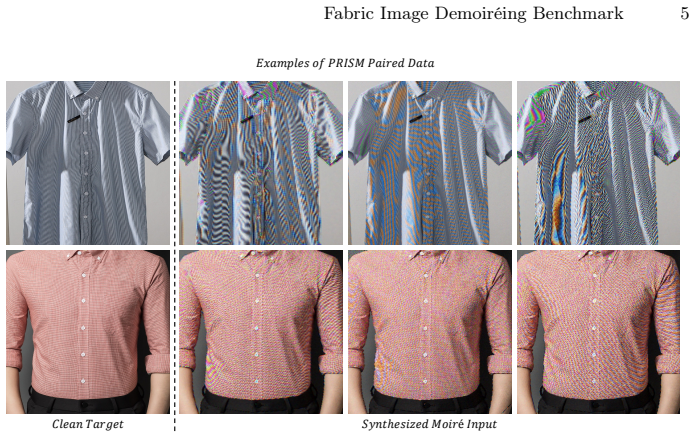
We present the first comprehensive benchmark for fabric image demoiréing. To address the difficulty of acquiring pixel-aligned real-world pairs, we develop a physically motivated synthesis framework and construct a large-scale dataset comprising 16,050 paired multi-resolution fabric images with controllable aliasing severity. Furthermore, we customize a baseline model, which establishes promising performance on the proposed benchmark dataset with strong generalization ability.
Load-bearing premise
The synthetic images reproduce aliasing statistics close enough to real fabric photographs that models trained on them will generalize to actual captures.
Editorial extensions
If this is right
- Models trained on the new pairs can address the spectral overlap between fabric texture and aliasing that defeats screen-moiré methods.
- The controllable severity parameter enables systematic study of how aliasing strength affects restoration difficulty.
- The benchmark supplies a common test set for comparing future fabric-specific restoration algorithms.
- Multi-resolution pairs support evaluation of methods across different capture scales.
Reading between the lines
- The same synthesis approach could be tested on other semi-periodic textures such as woven materials in non-fabric domains.
- If the synthetic statistics prove transferable, the dataset size could be scaled further by varying weave parameters without new real captures.
- The baseline customization step suggests that modest architectural changes may suffice once domain-matched training data exists.
Signed reviews
Editorial analysis
A structured set of objections, weighed in public.
Referee Report
Summary. The paper claims to introduce the first comprehensive benchmark for fabric image demoiréing, an underexplored problem distinct from screen moiré due to broadband semi-periodic textile patterns. To overcome the lack of pixel-aligned real pairs, it develops a physically motivated synthesis framework that generates a dataset of 16,050 paired multi-resolution fabric images with controllable aliasing severity. A customized baseline model is presented that reportedly achieves promising performance and strong generalization on this benchmark.
Significance. If the synthetic pairs faithfully capture real fabric moiré statistics, the work would supply a standardized, large-scale resource for an ill-posed restoration task where existing screen-moiré models fail, potentially accelerating research on spectral-overlap artifacts.
major comments (2)
- [Abstract] Abstract: the claims of 'promising performance' and 'strong generalization ability' are stated without any quantitative metrics, PSNR/SSIM values, error analysis, or comparisons to prior demoiréing methods, leaving the central empirical contribution unsupported in the available text.
- [Abstract] Abstract (synthesis framework paragraph): the assertion that the physically motivated synthesis produces aliasing statistics matching real fabric captures is load-bearing for all generalization claims, yet no spectrum-matching statistics, real-image ablation, or distribution-distance measures are provided to anchor the synthetic distribution inside the real one.
minor comments (1)
- [Abstract] The abstract refers to 'multi-resolution' images but does not specify the exact resolution pyramid or downsampling factors used in dataset construction.
Simulated Author's Rebuttal
We thank the referee for the constructive feedback on the abstract. We agree that the claims require quantitative support and validation of the synthesis framework. We will revise the manuscript to address both points.
read point-by-point responses
-
Referee: [Abstract] Abstract: the claims of 'promising performance' and 'strong generalization ability' are stated without any quantitative metrics, PSNR/SSIM values, error analysis, or comparisons to prior demoiréing methods, leaving the central empirical contribution unsupported in the available text.
Authors: We agree that the abstract should include quantitative evidence. In the revised version, we will add specific PSNR/SSIM values from the baseline model experiments, along with comparisons to prior demoiréing methods, to directly support the performance and generalization claims. revision: yes
-
Referee: [Abstract] Abstract (synthesis framework paragraph): the assertion that the physically motivated synthesis produces aliasing statistics matching real fabric captures is load-bearing for all generalization claims, yet no spectrum-matching statistics, real-image ablation, or distribution-distance measures are provided to anchor the synthetic distribution inside the real one.
Authors: The synthesis is derived from a physical model of broadband aliasing in textile imaging. To strengthen the validation, we will add spectrum-matching comparisons, real-image ablations, and distribution-distance measures (e.g., spectrum analysis and statistical distances) between synthetic and captured real moiré patterns in the revised manuscript. revision: yes
Circularity Check
No circularity: dataset and benchmark construction without self-referential derivations
full rationale
The paper presents a synthesis framework to generate a paired dataset of 16,050 fabric images and a customized baseline model for demoiréing. No equations, predictions, or uniqueness claims appear that reduce by construction to fitted inputs, self-citations, or ansatzes from prior author work. The synthesis is motivated by the acknowledged difficulty of obtaining real pixel-aligned pairs, but the contribution remains an empirical benchmark rather than a closed derivation chain; the central claims rest on the new data and model performance rather than any load-bearing step that is definitionally equivalent to its own inputs.
Assumptions & free parameters
assumptions (1)
- domain assumption Physically motivated synthesis framework produces data whose aliasing matches real fabric photographs sufficiently for generalization
Cite this review
Pith. "Pith review of Fabric Image Demoir\'eing Benchmark from Synthesis to Restoration." pith.science (2026). https://pith.science/paper/QH6IH3SE
@misc{pith2026260624072,
  author       = {Pith},
  title        = {Pith review of: Fabric Image Demoir\'eing Benchmark from Synthesis to Restoration},
  year         = {2026},
  howpublished = {\url{https://pith.science/paper/QH6IH3SE}},
  note         = {Machine review of arXiv:2606.24072}
}
read the original abstract
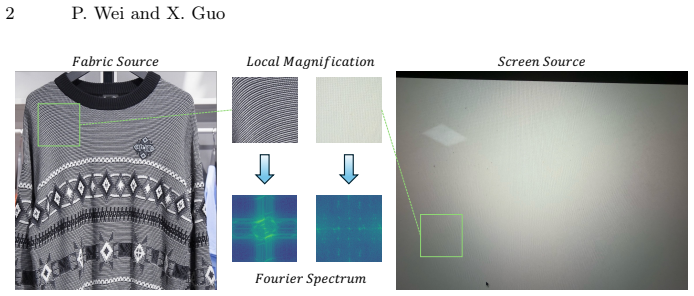
Fabric moir\'e is a sampling-induced aliasing artifact caused by the interaction between fine textile patterns and camera sensor grids, producing structured interference that severely degrades image quality. Unlike screen-induced moir\'e, which stems from strictly periodic display lattices, fabric moir\'e is intrinsically more challenging due to the broadband and semi-periodic nature of textile weaves. The heavy spectral overlap between intrinsic texture and aliasing components renders fabric demoir\'eing substantially more ill-posed. Consequently, existing models trained on screen moir\'e datasets generalize poorly to these complex textile patterns. Despite its practical importance, fabric image demoir\'eing remains underexplored and lacks standardized benchmarks. We present the first comprehensive benchmark for fabric image demoir\'eing. To address the difficulty of acquiring pixel-aligned real-world pairs, we develop a physically motivated synthesis framework and construct a large-scale dataset comprising 16,050 paired multi-resolution fabric images with controllable aliasing severity. Furthermore, we customize a baseline model, which establishes promising performance on the proposed benchmark dataset with strong generalization ability. Our benchmark provides a standardized platform for advancing research in fabric image demoir\'eing.
Figures


Figures from the paper (11 more)




Reference graph
Works this paper leans on
-
[1]
In: Proceedings of the IEEE/CVF Winter Conference on Applications of Computer Vision
Agnolucci, L., Galteri, L., Bertini, M., Del Bimbo, A.: Arniqa: Learning distortion manifold for image quality assessment. In: Proceedings of the IEEE/CVF Winter Conference on Applications of Computer Vision. pp. 189–198 (2024)
2024
-
[2]
Bracewell, R.N., Bracewell, R.N.: The Fourier transform and its applications, vol. 31999. McGraw-hill New York (1986)
1986
-
[3]
In: 2019 IEEE/CVF International Conference on Computer Vision Workshop (ICCVW)
Cheng, X., Fu, Z., Yang, J.: Multi-scale dynamic feature encoding network for image demoiréing. In: 2019 IEEE/CVF International Conference on Computer Vision Workshop (ICCVW). pp. 3486–3493. IEEE (2019)
2019
-
[4]
Chi,L.,Jiang,B.,Mu,Y.:Fastfourierconvolution.AdvancesinNeuralInformation Processing Systems33, 4479–4488 (2020)
2020
-
[5]
Communi- cations of the ACM24(6), 381–395 (1981)
Fischler, M.A., Bolles, R.C.: Random sample consensus: a paradigm for model fitting with applications to image analysis and automated cartography. Communi- cations of the ACM24(6), 381–395 (1981)
1981
-
[6]
In: Proceedings of the IEEE/CVF international conference on computer vision
He, B., Wang, C., Shi, B., Duan, L.Y.: Mop moire patterns using mopnet. In: Proceedings of the IEEE/CVF international conference on computer vision. pp. 2424–2432 (2019)
2019
-
[7]
In: European Conference on Computer Vision
He, B., Wang, C., Shi, B., Duan, L.Y.: Fhde2net: Full high definition demoireing network. In: European Conference on Computer Vision. pp. 713–729. Springer (2020)
2020
-
[8]
Gaussian Error Linear Units (GELUs)
Hendrycks, D., Gimpel, K.: Gaussian error linear units (gelus). arXiv preprint arXiv:1606.08415 (2016)
work page Pith review arXiv 2016
Show all 45 references
-
[9]
arXiv preprint arXiv:1704.04861 (2017)
Howard, A.G., Zhu, M., Chen, B., Kalenichenko, D., Wang, W., Weyand, T., An- dreetto, M., Adam, H.: Mobilenets: Efficient convolutional neural networks for mobile vision applications. arXiv preprint arXiv:1704.04861 (2017)
2017 arXiv
-
[10]
In: European conference on computer vision
Jiang, X., Zhang, X., Gao, N., Deng, Y.: When fast fourier transform meets trans- former for image restoration. In: European conference on computer vision. pp. 381–402. Springer (2024)
2024
-
[11]
arXiv preprint arXiv:1412.6980 (2014)
Kingma, D.P., Ba, J.: Adam: A method for stochastic optimization. arXiv preprint arXiv:1412.6980 (2014)
2014 arXiv
-
[12]
arXiv preprint arXiv:2507.22407 (2025)
Lee, S., Baek, W., Kim, Y., Kim, E., Moon, H., Yoo, D., Park, E.: Moiré zero: An efficient and high-performance neural architecture for moiré removal. arXiv preprint arXiv:2507.22407 (2025)
2025
-
[13]
In: 2015 Visual Communications and Image Processing (VCIP)
Liu, F., Yang, J., Yue, H.: Moiré pattern removal from texture images via low- rank and sparse matrix decomposition. In: 2015 Visual Communications and Image Processing (VCIP). pp. 1–4. IEEE (2015)
2015
-
[14]
In: European conference on com- puter vision
Liu,L.,Liu, J.,Yuan,S.,Slabaugh,G.,Leonardis, A.,Zhou,W., Tian,Q.:Wavelet- based dual-branch network for image demoiréing. In: European conference on com- puter vision. pp. 86–102. Springer (2020)
2020
-
[15]
Advances in Neural Informa- tion Processing Systems33, 22282–22292 (2020)
Liu, L., Yuan, S., Liu, J., Bao, L., Slabaugh, G., Tian, Q.: Self-adaptively learning to demoiré from focused and defocused image pairs. Advances in Neural Informa- tion Processing Systems33, 22282–22292 (2020)
2020
-
[16]
arXiv preprint arXiv:1608.03983 (2016)
Loshchilov, I., Hutter, F.: Sgdr: Stochastic gradient descent with warm restarts. arXiv preprint arXiv:1608.03983 (2016)
2016 arXiv
-
[17]
Interna- tional journal of computer vision60(2), 91–110 (2004)
Lowe, D.G.: Distinctive image features from scale-invariant keypoints. Interna- tional journal of computer vision60(2), 91–110 (2004)
2004
-
[18]
IEEE Transactions on Signal Processing46(4), 1179–1184 (1998) 16 P
Luo, J., De Queiroz, R., Fan, Z.: A robust technique for image descreening based on the wavelet transform. IEEE Transactions on Signal Processing46(4), 1179–1184 (1998) 16 P. Wei and X. Guo
1998
-
[19]
In: 2004 IEEE international conference on acoustics, speech, and signal processing
Malvar, H.S., He, L.w., Cutler, R.: High-quality linear interpolation for demosaic- ing of bayer-patterned color images. In: 2004 IEEE international conference on acoustics, speech, and signal processing. vol. 3, pp. iii–485. IEEE (2004)
2004
-
[20]
Proceedings of the Royal Society of London
Marr, D., Hildreth, E.: Theory of edge detection. Proceedings of the Royal Society of London. Series B. Biological Sciences207(1167), 187–217 (1980)
1980
-
[21]
Transactions of the American Institute of Electrical Engineers47(2), 617–644 (1928)
Nyquist, H.: Certain topics in telegraph transmission theory. Transactions of the American Institute of Electrical Engineers47(2), 617–644 (1928)
1928
-
[22]
IEEE Access10, 16254–16268 (2022)
Park, H., Vien, A.G., Kim, H., Koh, Y.J., Lee, C.: Unpaired screen-shot image demoiréing with cyclic moiré learning. IEEE Access10, 16254–16268 (2022)
2022
-
[23]
In: International conference on machine learning
Radford, A., Kim, J.W., Hallacy, C., Ramesh, A., Goh, G., Agarwal, S., Sastry, G., Askell, A., Mishkin, P., Clark, J., et al.: Learning transferable visual models from natural language supervision. In: International conference on machine learning. pp. 8748–8763. PmLR (2021)
2021
-
[24]
In: International Conference on Medical image computing and computer-assisted intervention
Ronneberger, O., Fischer, P., Brox, T.: U-net: Convolutional networks for biomedi- cal image segmentation. In: International Conference on Medical image computing and computer-assisted intervention. pp. 234–241. Springer (2015)
2015
-
[25]
Proceedings of the IRE 37(1), 10–21 (2006)
Shannon, C.E.: Communication in the presence of noise. Proceedings of the IRE 37(1), 10–21 (2006)
2006
-
[26]
In: Proceedings of the IEEE conference on computer vision and pattern recognition
Shi, W., Caballero, J., Huszár, F., Totz, J., Aitken, A.P., Bishop, R., Rueckert, D., Wang, Z.: Real-time single image and video super-resolution using an efficient sub-pixel convolutional neural network. In: Proceedings of the IEEE conference on computer vision and pattern re...
2016
-
[27]
IEEE transactions on image processing16(3), 789–802 (2007)
Siddiqui, H., Bouman, C.A.: Training-based descreening. IEEE transactions on image processing16(3), 789–802 (2007)
2007
-
[28]
In: Visual Communications and Image Processing 2002
Sidorov, D.N., Kokaram, A.C.: Suppression of moiré patterns via spectral analysis. In: Visual Communications and Image Processing 2002. vol. 4671, pp. 895–906. SPIE (2002)
2002
-
[29]
a talk at the Stanford Artificial Project in1968, 271–272 (1968)
Sobel, I., Feldman, G., et al.: A 3x3 isotropic gradient operator for image process- ing. a talk at the Stanford Artificial Project in1968, 271–272 (1968)
1968
-
[30]
IEEE Transactions on Image Processing27(8), 4160–4172 (2018)
Sun, Y., Yu, Y., Wang, W.: Moiré photo restoration using multiresolution convolu- tional neural networks. IEEE Transactions on Image Processing27(8), 4160–4172 (2018)
2018
-
[31]
Journal of electronic imaging24(1), 013003–013003 (2015)
Sur, F., Grediac, M.: Automated removal of quasiperiodic noise using frequency domain statistics. Journal of electronic imaging24(1), 013003–013003 (2015)
2015
-
[32]
In: Proceedings of the AAAI conference on artificial intelligence
Wang, J., Chan, K.C., Loy, C.C.: Exploring clip for assessing the look and feel of images. In: Proceedings of the AAAI conference on artificial intelligence. vol. 37, pp. 2555–2563 (2023)
2023
-
[33]
IEEE transactions on image processing 13(4), 600–612 (2004)
Wang, Z., Bovik, A.C., Sheikh, H.R., Simoncelli, E.P.: Image quality assessment: from error visibility to structural similarity. IEEE transactions on image processing 13(4), 600–612 (2004)
2004
-
[34]
In: Proceedings of the 32nd ACM inter- national conference on multimedia
Xiao, Z., Lu, Z., Wang, X.: P-bic: Ultra-high-definition image moiré patterns re- moval via patch bilateral compensation. In: Proceedings of the 32nd ACM inter- national conference on multimedia. pp. 8365–8373 (2024)
2024
-
[35]
Xu, S., Song, B., Chen, X., Liu, X., Zhou, J.: Image demoireing in raw and srgb domains.In:Europeanconferenceoncomputervision.pp.108–124.Springer(2024)
2024
-
[36]
IEEE Transactions on Image Processing 32, 694–708 (2023)
Yang, C., Yang, Z., Ke, Y., Chen, T., Grzegorzek, M., See, J.: Doing more with moiré pattern detection in digital photos. IEEE Transactions on Image Processing 32, 694–708 (2023)
2023
-
[37]
IEEE Transactions on Image Processing 26(7), 3528–3541 (2017) Fabric Image Demoiréing Benchmark 17
Yang, J., Liu, F., Yue, H., Fu, X., Hou, C., Wu, F.: Textured image demoiréing via signal decomposition and guided filtering. IEEE Transactions on Image Processing 26(7), 3528–3541 (2017) Fabric Image Demoiréing Benchmark 17
2017
-
[38]
In: Proceedings of the AAAI Conference on Artificial Intelligence
Yang, Z., Sun, Y., Peng, X., Yiu, S.M., Ma, Y.: Unidemoiré: Towards universal image demoiréing with data generation and synthesis. In: Proceedings of the AAAI Conference on Artificial Intelligence. vol. 39, pp. 9354–9362 (2025)
2025
-
[39]
In: European Conference on Computer Vision
Yu, X., Dai, P., Li, W., Ma, L., Shen, J., Li, J., Qi, X.: Towards efficient and scale-robust ultra-high-definition image demoiréing. In: European Conference on Computer Vision. pp. 646–662. Springer (2022)
2022
-
[40]
In: 2019 IEEE/CVF International Conference on Computer Vision Workshop (ICCVW)
Yuan, S., Timofte, R., Slabaugh, G., Leonardis, A., Zheng, B., Ye, X., Tian, X., Chen, Y., Cheng, X., Fu, Z., et al.: Aim 2019 challenge on image demoireing: Methods and results. In: 2019 IEEE/CVF International Conference on Computer Vision Workshop (ICCVW). pp. 3534–3545. IEEE (2019)
2019
-
[41]
Yue, H., Cheng, Y., Mao, Y., Cao, C., Yang, J.: Recaptured screen image demoiréinginrawdomain.IEEETransactionsonMultimedia25,5589–5600(2022)
2022
-
[42]
In: Proceedings of the IEEE conference on computer vision and pattern recognition
Zhang, R., Isola, P., Efros, A.A., Shechtman, E., Wang, O.: The unreasonable effectiveness of deep features as a perceptual metric. In: Proceedings of the IEEE conference on computer vision and pattern recognition. pp. 586–595 (2018)
2018
-
[43]
In: Proceed- ings of the IEEE/CVF Conference on Computer Vision and Pattern Recognition
Zhang, X., Chen, Q., Ng, R., Koltun, V.: Zoom to learn, learn to zoom. In: Proceed- ings of the IEEE/CVF Conference on Computer Vision and Pattern Recognition. pp. 3762–3770 (2019)
2019
-
[44]
In: Proceedings of the IEEE/CVF conference on computer vision and pattern recognition
Zheng, B., Yuan, S., Slabaugh, G., Leonardis, A.: Image demoireing with learnable bandpass filters. In: Proceedings of the IEEE/CVF conference on computer vision and pattern recognition. pp. 3636–3645 (2020)
2020
-
[45]
#$% '$()*+*#$,*
Zhong, Y., Zhou, Y., Zhang, Y., Chao, F., Ji, R.: Learning image demoiréing from unpaired real data. In: Proceedings of the AAAI Conference on Artificial Intelligence. vol. 38, pp. 7623–7631 (2024) Fabric Image Demoiréing Benchmark 1 Supplementary Material A Distinguishing Scr...
2024
Reviewed June 26, 2026 · model on record in the stance chip above.
Discussion (0). Continue with ORCID to comment.