REVIEW 2 major objections 5 minor 25 references
The geodesic structure of BPS one-branes in five dimensions
T0 review · 2 major / 5 minor · reviewed 2026-08-12 · deepseek-v4-flash
Pith's one-line read This paper claims that the geodesic structure of a five-dimensional BPS one-brane is controlled by the sign of a single coupling constant q: positive q gives only open and radial geodesics, while negative q produces a repulsive singular…
desk verdict Positive-q geodesics are a sound but minor result; the negative-q region is not a real solution because σ = ln f becomes complex, so the paper's central claim doesn't hold. read the letter →
The pith
A machine-rendered reading of the paper's core claim, the machinery that carries it, and where it could break.
The reading
What carries the argument
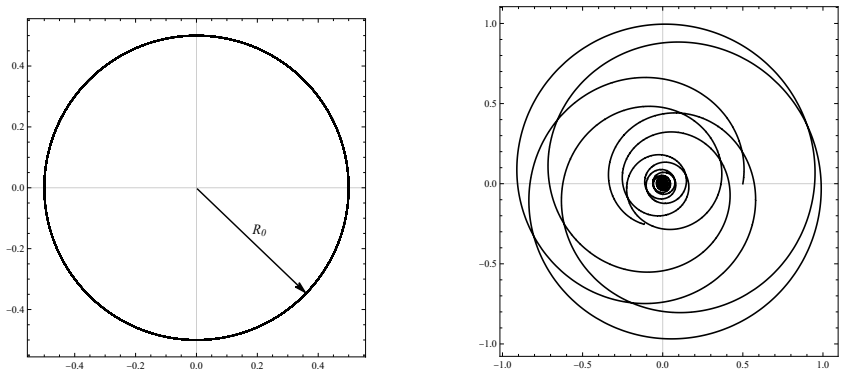
The central object is the one-brane spacetime (4), with warp function $f(r)=1+q/r$ (the constant $m$ is set to $1$ for asymptotic flatness), and the effective potential derived from it, $V_{\mathrm{eff}}(r)=l^2/[f(r)r^2]=l^2/[r(q+r)]$, where $l$ is the conserved angular momentum about the brane. The sign of $q$ fixes where $f$ is positive, which determines the metric signature, the location of naked singularities, the shape of the effective potential, and hence whether bound orbits exist. The five Killing vector fields found in Section III reduce the full geodesic system to the radial equation $\ddot{r}=q\dot{r}^2/[2r(q+r)]+(q+2r)l^2/[2r(q+r)^3]$, and a small-perturbation expansion of this equation around $R_0=|q|/2$ yields the harmonic equation $\ddot{\epsilon}+(l^2/R_0^4)\epsilon=0$ that proves the inner circular orbit is stable.
What would settle it
Substitute the fields (4)-(8) into the full equations of motion derived from the action (3), including the hyperscalar equations, and check whether arbitrary real $q$ really solves them; if the BPS or hyperscalar conditions force $q>0$ or $q=0$, the repulsive shell and its inner stable orbit are ruled out as physical. A separate numerical check would integrate the geodesic equations (33) with $q<0$ and the initial data of Table 1 to verify that outer-region geodesics never cross $r=|q|$.
Extended reading notes
Core claim
The central discovery is that the one-brane metric $ds^2=-dt^2+dx^2+f(r)(dr^2+r^2d\theta^2+r^2\sin^2\theta\,d\phi^2)$ with $f(r)=1+q/r$ carries its entire geodesic structure in the sign of $q$. When $q>0$, the warp function is positive on all $r>0$, the effective potential $V_{\mathrm{eff}}=l^2/[r(q+r)]$ decreases monotonically, and no bound orbital geodesics exist: incoming trajectories either fall to the singularity at $r=0$ or bounce off the potential barrier, so all orbits are open or radial. When $q<0$, the warp function vanishes at $r=|q|$ and becomes negative inside, so the shell at $r=|q|$ is a singular, repulsive barrier; the metric signature flips across it, geodesics in the outer region never enter, and the inner region is causally disconnected from the outside. Inside the shell the effective potential has a minimum, and a linear perturbation calculation shows that the circular orbit at $R_0=|q|/2$ is stable, with oscillatory frequency $\omega=l/R_0^2=4l/|q|^2$. The same classification applies to null, timelike, and spacelike geodesics because changing the geodesic type only shifts the effective potential by a constant.
Load-bearing premise
The load-bearing premise is that the one-brane metric $ds^2=-dt^2+dx^2+(1+q/r)(dr^2+r^2d\theta^2+r^2\sin^2\theta\,d\phi^2)$ together with the hypermultiplet fields quoted from Ref. [15] is an exact solution of the full five-dimensional $N=2$ supergravity-hypermultiplet system with $q$ an unconstrained real number; if the full field equations restrict the allowed values of $q$, the negative-$q$ geodesic structure described here may not correspond to any physical brane.
Editorial extensions
If this is right
- For $q>0$, the one-brane has no bound orbits: every timelike, null, or spacelike geodesic is either radial or open, so matter and light cannot be trapped around the brane.
- For $q<0$, the singular shell at $r=|q|$ is a complete barrier: no geodesic connects the exterior to the interior, so the two regions are causally separated.
- Inside the negative-$q$ shell, there is a unique stable circular geodesic at $r=|q|/2$; small radial perturbations oscillate with frequency $4l/|q|^2$ rather than escaping.
- The repulsive character of the shell distinguishes this solution from earlier five-dimensional brane geometries whose singularities act as attractors, and it holds identically for photons and massive particles because the geodesic type only shifts the effective potential vertically.
Reading between the lines
- If the negative-$q$ branch is physically realized, the causal disconnection found here makes the inner stable orbit at $r=|q|/2$ unobservable from the outside, because any probe sent from infinity is stopped by the repulsive shell at $r=|q|$.
- The paper fixes the warp function's constant $m$ to $1$ for asymptotic flatness; repeating the same effective-potential analysis for $f(r)=m+q/r$ with $m\neq 1$ is a natural extension that would shift the circular-orbit radius away from $|q|/2$.
- The geodesic approximation treats the test particle as non-backreacting; if the inner region were populated by enough matter, its energy density would alter the background, so checking the self-consistency of the stable orbit is a further step the paper does not take.
Editorial analysis
A structured set of objections, weighed in public.
Referee Report
Summary. This paper studies the Killing symmetries and geodesic structure of a five-dimensional spacetime (4), ds² = −dt² + dx² + (1 + q/r)(dr² + r²dθ² + r² sin²θ dφ²), which is presented as a one-brane solution of N = 2 ungauged D = 5 supergravity coupled to hypermultiplets, following earlier work [13,15]. The authors derive the geodesic equations (33), construct an effective potential V_eff = l²/[r(q + r)] in (40), and classify the motion: for q > 0 all geodesics are open or radial, while for q < 0 they claim a repulsive singular shell at r = |q|, a causally disconnected inner region, and a stable circular orbit at r = |q|/2. The paper also claims to have found five Killing vectors (23)-(27) and the associated conserved quantities (28)-(30), and it presents numerical orbital plots for both signs of q.
Significance. If the negative-q conclusions are physically meaningful, the paper reports an unusual and interesting effect: an exact brane background whose geodesics exhibit a repulsive singular shell and stable circular orbits in a signature-changing region. The derivation from the metric to the geodesic equations and to the effective potential is explicit, parameter-free, and largely correct; the q > 0 part of the classification is robust and clearly presented. The paper also provides analytic expressions for the radial geodesics and a stability computation for the circular orbit. However, the significance is currently undercut by two problems: the Killing-vector section contains demonstrable errors, and the negative-q sector is analyzed in a region where the metric is not Lorentzian and where the reality of the underlying supergravity fields is not established. These issues must be resolved before the central claims can be accepted.
major comments (2)
- [III, Eqs. (9), (22)-(27)] The Killing vector analysis is not correct. Equation (9) has a sign error: with the Levi-Civita connection and covariant components, Killing's equation is ∂_μξ_ν + ∂_νξ_μ − 2Γ^ρ_{μν}ξ_ρ = 0, not '+2Γ^ρ_{μν}ξ_ρ'. The subsequent equations (11)-(16) in fact use the correct sign, so this may be a typo, but the final vector fields are genuinely wrong. For example, ξ^(3) = 1/(q+r)^2 ∂_φ is not a Killing field: (L_ξ g)_{rφ} = g_{φφ} ∂_r(1/(q+r)^2) = −2r sin²θ/(q+r)^2 ≠ 0. The true isometry group of (4) is R_t × R_x × SO(3), and the rotational generators have no radial prefactor. Consequently the conserved quantities (29)-(30) are not the standard rotational charges, and this section as written cannot be used. This does not invalidate the later geodesic equations (33)-(40), which use only ∂_t, ∂_x, and ∂_φ, but the symmetry claims of the paper require a full correction.
- [II, IV-VIII (negative-q domain)] The negative-coupling sector is the paper's headline result, but its physical relevance is not established. For q < 0 and 0 < r < |q|, f = (r+q)/r is negative and the metric (4) has signature (−,+,−,−,−); this is acknowledged as a 'causal disconnect' in Section IV. What is not acknowledged is that the supergravity fields quoted from [15] are not shown to be real in this region. The hypermultiplet fields (5)-(8), in particular the prefactors in (7), contain square-root factors whose arguments change sign at r = |q|; for q < 0 and r < |q| they are not real unless an additional continuation is specified. The effective-potential and stability analysis in Sections V-VI is carried out in this non-Lorentzian region: Eq. (41) gives ẏ² = (E − V_eff)/f, so for f < 0 the allowed inequality is reversed, and the 'stable circular orbit' at R0 = |q|/2 lies entirely where the metric is not Lorentzian. Unless the authors verify from [15], or directly from the equations of motion, that q < 0 and r < |q| belong to the physical solution with real fields, the claims about a repulsive shell and inner bound orbits are conclusions about a formal analytic continuation, not about the BPS one-brane spacetime. This is the load-bearing issue for the central claim.
minor comments (5)
- [V, Eqs. (38)-(39)] The symbol E is overloaded: E in (38) denotes the energy ḍṏẏ, while (39) redefines E = E² − p² + ε. A distinct symbol, for example ℰ, would remove a genuine source of confusion.
- [VIII, Table 1] Table 1 is ambiguous: entries such as '100E0 > 0' and '2Rb' mix initial radius, energy, and inequalities in a nonstandard way. Please spell out, for example, r_i = 2R_b, E = 100E_0, and so on.
- [Figures 1, 4-6] Several figures lack axis labels and legends; Figure 1 has only sparse tick marks, and Figures 4-6 do not identify the plotted quantities or the parameter values used for each curve. The plots should be interpretable without referring back to the table.
- [Conclusion] The Conclusion contains a grammatical slip: 'finding the fully calculating the geodesic structure' should be 'finding the full geodesic structure' or similar.
- [V, after Eq. (42)] The statement that the geodesic structure is the same for null, timelike, and spacelike geodesics should be qualified: in the f < 0 region, the sign of the inequality from ẏ² = (E − V_eff)/f differs, so shifting V_eff by ε does not leave the allowed regions unchanged in that region.
Circularity Check
The geodesic analysis is a parameter-free calculation from the quoted metric; no circular reduction to fitted inputs, self-citation chains, or definitional identities was found.
full rationale
The paper's central calculation starts from the five-dimensional one-brane metric (4) with f(r)=1+q/r, quoted from the authors' earlier solution [15], and then derives the Killing symmetries, geodesic equations, effective potential, circular-orbit stability, and radial/orbital geodesics directly from that metric and the velocity normalization U^mu U_mu = epsilon. There is no fitted parameter, no quantity is predicted after being matched to data, and no result is used to define an input: the effective potential V_eff = l^2/[r(q+r)] in Eq. (40) is obtained algebraically from the metric and the conserved angular momentum, the circular radius R0=|q|/2 follows from setting V'_eff=0, and the stability condition (45) follows from perturbing the geodesic equation. These are ordinary consequences of the stated metric, not circular re-statements of the assumption. The paper explicitly acknowledges the signature change for q<0 ('The metric inside this radius switches signature ... which signals a causal disconnect between the two regions') and then nevertheless solves the geodesic equations in that region; whether that region is a physical Lorentzian BPS spacetime is a correctness or validity concern, not an instance of circular reasoning, because the equations are solved as written rather than assumed. The self-citations [13,15] supply the background solution and the symplectic construction method, but the cited solution is parameter-free and does not contain the geodesic results, so it functions as independent prior evidence rather than as a circular justification. No uniqueness theorem, ansatz, or renamed empirical pattern is imported to force the conclusion. Therefore the paper merits a circularity score of 0.
Assumptions & free parameters
free parameters (2)
- q =
free real number; examples use q = +1 and q = -1
- m =
1
assumptions (3)
- domain assumption The spacetime (4)-(8), with f = 1 + q/r, is an exact solution of D=5 N=2 supergravity coupled to hypermultiplets.
- standard math Killing's equation and the geodesic equation with the Levi-Civita connection describe the symmetries and motion.
- standard math The Ricci scalar R = 3q^2 / [2r(q+r)^3] signals curvature singularities at r = 0 and r = |q|.
Cite this review
Pith. "Pith review of The geodesic structure of BPS one-branes in five dimensions." pith.science (2026). https://pith.science/paper/QHLWRLKX
@misc{pith2026241117680,
  author       = {Pith},
  title        = {Pith review of: The geodesic structure of BPS one-branes in five dimensions},
  year         = {2026},
  howpublished = {\url{https://pith.science/paper/QHLWRLKX}},
  note         = {Machine review of arXiv:2411.17680}
}
read the original abstract
In this paper, we continue previous work where one-brane spacetimes coupled to the N=2 ungauged five dimensional hypermultiplets were found. We explore their symmetries as well as study their full geodesic structure. The one-branes are characterized by a coupling constant that distinguishes the behavior of the geodesics from smooth and causally connected in the positive case to singular and repulsive in the negative case.
Figures


Figures from the paper (3 more)


Reference graph
Works this paper leans on
-
[15]
BPS one-branes in five dimensions
M. H. Emam, “BPS one-branes in five dimensions,” Class. Quant. Grav. 30, 055016 (2013) doi:10.1088/0264-9381/30/5/055016 [arXiv:1301.7338 [hep-th]]
work page Pith review arXiv 2013
-
[1]
Component reduction in N=2 supergravity: the vector, tensor, and vector-tensor multiplets,
D. Butter and J. Novak, “Component reduction in N=2 supergravity: the vector, tensor, and vector-tensor multiplets,” JHEP 1205, 115 (2012) [arXiv:1201.5431 [hep-th]]
arXiv 2012
-
[2]
D. Klemm and E. Zorzan, “All null supersymmetric backgrounds of N=2, D=4 gauged su- pergravity coupled to abelian vector multiplets,” Class. Quant. Grav. 26, 145018 (2009) [arXiv:0902.4186 [hep-th]]
work page Pith review arXiv 2009
-
[3]
Instanton solutions for Euclidean N=2 vector multiplets,
T. Mohaupt, “Instanton solutions for Euclidean N=2 vector multiplets,” Fortsch. Phys. 56, 480 (2008)
work page 2008
-
[4]
S. L. Cacciatori, D. Klemm, D. S. Mansi and E. Zorzan, “All timelike supersymmetric solu- tions of N=2, D=4 gauged supergravity coupled to abelian vector multiplets,” JHEP 0805, 097 (2008) [arXiv:0804.0009 [hep-th]]
arXiv 2008
-
[5]
Special geometry of Euclidean super- symmetry. 1. Vector multiplets,
V. Cortes, C. Mayer, T. Mohaupt and F. Saueressig, “Special geometry of Euclidean super- symmetry. 1. Vector multiplets,” JHEP 0403, 028 (2004) [arXiv:hep-th/0312001]
arXiv 2004
-
[6]
Massless Localized Vector Field on a Wall in D=5 SQED with Tensor Multiplets
Y. Isozumi, K. Ohashi and N. Sakai, “Massless localized vector field on a wall in D = 5 SQED with tensor multiplets,” JHEP 0311, 061 (2003) [arXiv:hep-th/0310130]
work page Pith review arXiv 2003
-
[7]
Supersymmetric domain walls and strings in D = 5 gauged supergravity coupled to vector multiplets,
S. L. Cacciatori, D. Klemm and W. A. Sabra, “Supersymmetric domain walls and strings in D = 5 gauged supergravity coupled to vector multiplets,” JHEP0303, 023 (2003) [arXiv:hep- th/0302218]
Show all 25 references
-
[8]
D=4, N=2 Gauged Super- gravity coupled to Vector-Tensor Multiplets,
L. Andrianopoli, R. D’Auria, L. Sommovigo and M. Trigiante, “D=4, N=2 Gauged Super- gravity coupled to Vector-Tensor Multiplets,” Nucl. Phys. B 851, 1 (2011) [arXiv:1103.4813 [hep-th]]
2011 arXiv
-
[9]
Hypermultiplets, hyperKahler cones and quaternion Kahler geometry,
B. de Wit, M. Rocek and S. Vandoren, “Hypermultiplets, hyperKahler cones and quaternion Kahler geometry,” JHEP 0102, 039 (2001) [hep-th/0101161]
2001 arXiv
-
[10]
Supergravity instantons for N=2 hypermultiplets,
M. Gutperle and M. Spalinski, “Supergravity instantons for N=2 hypermultiplets,” Nucl. Phys. B 598, 509 (2001) [arXiv:hep-th/0010192]
2001 arXiv
-
[11]
Five dimensional 2-branes from special Lagrangian wrapped M5-branes,
M. H. Emam, “Five dimensional 2-branes from special Lagrangian wrapped M5-branes,” Phys. Rev. D 71, 125020 (2005) [arXiv:hep-th/0502112]. 15
2005 arXiv
-
[12]
Wrapped M5-branes leading to five dimensional 2-branes,
M. H. Emam, “Wrapped M5-branes leading to five dimensional 2-branes,” Phys. Rev. D 74, 125004 (2006) [arXiv:hep-th/0610161]
2006 arXiv
-
[13]
Symplectic covariance of the N=2 hypermultiplets,
M. H. Emam, “Symplectic covariance of the N=2 hypermultiplets,” Phys. Rev. D 79, 085017 (2009) [arXiv:0904.1951 [hep-th]]
2009 arXiv
-
[14]
Special geometry and symplectic transformations,
B. de Wit and A. Van Proeyen, “Special geometry and symplectic transformations,” Nucl. Phys. Proc. Suppl. 45BC, 196 (1996) [hep-th/9510186]
1996 arXiv
-
[16]
Time like geodesics for five- dimensional Schwarzschild and Reissner–Nordstr¨ om anti-de Sitter black holes,
P. A. Gonz´ alez, M. Olivares, Y. V´ asquez and J. R. Villanueva, “Time like geodesics for five- dimensional Schwarzschild and Reissner–Nordstr¨ om anti-de Sitter black holes,” Eur. Phys. J. C 83, no.9, 853 (2023) doi:10.1140/epjc/s10052-023-12018-4 [arXiv:2308.01498 [gr-qc]]
2023 arXiv
-
[17]
On Integrability of spinning particle motion in higher-dimensional black hole spacetimes,
D. Kubiznak and M. Cariglia, “On Integrability of spinning particle motion in higher-dimensional black hole spacetimes,” Phys. Rev. Lett. 108, 051104 (2012) doi:10.1103/PhysRevLett.108.051104 [arXiv:1110.0495 [hep-th]]
2012 arXiv
-
[18]
Particle and light motion in a space-time of a five-dimensional rotating black hole,
V. P. Frolov and D. Stojkovic, “Particle and light motion in a space-time of a five-dimensional rotating black hole,” Phys. Rev. D 68, 064011 (2003) doi:10.1103/PhysRevD.68.064011 [arXiv:gr-qc/0301016 [gr-qc]]
2003 arXiv
-
[19]
Analytic solutions of the geodesic equation in higher dimensional static spherically symmetric space-times,
E. Hackmann, V. Kagramanova, J. Kunz and C. Lammerzahl, “Analytic solutions of the geodesic equation in higher dimensional static spherically symmetric space-times,” Phys. Rev. D 78, 124018 (2008) doi:10.1103/PhysRevD.78.124018 [arXiv:0812.2428 [gr-qc]]
2008 arXiv
-
[20]
Analytic treatment of geodesics in five-dimensional Myers-Perry space–times,
V. Kagramanova and S. Reimers, “Analytic treatment of geodesics in five-dimensional Myers-Perry space–times,” Phys. Rev. D 86, 084029 (2012) doi:10.1103/PhysRevD.86.084029 [arXiv:1208.3686 [gr-qc]]
2012 arXiv
-
[21]
Bounded orbits for photons as a consequence of extra dimensions,
P. A. Gonzalez, M. Olivares and Y. Vasquez, “Bounded orbits for photons as a consequence of extra dimensions,” Mod. Phys. Lett. A 32, no.32, 1750173 (2017) doi:10.1142/S0217732317501735 [arXiv:1511.08048 [gr-qc]]. 16
2017 arXiv
-
[22]
Geodesic structure of five-dimensional nonasymptotically flat 2-branes,
J. Chandler and M. H. Emam, “Geodesic structure of five-dimensional nonasymptotically flat 2-branes,” Phys. Rev. D 91, no.12, 125024 (2015) doi:10.1103/PhysRevD.91.125024 [arXiv:1506.06054 [gr-qc]]
2015 arXiv
-
[23]
Spherical orbits around a Kerr black hole,
E. Teo, “Spherical orbits around a Kerr black hole,” General Relativity and Gravitation35, no. 11, 1909-1926 (2003)
2003
-
[24]
V. P. Frolov and I. D. Novikov, Black Hole Physics: Basic Concepts and New Developments (Springer, 1998)
1998
-
[25]
Rotating black holes: Locally nonrotating frames, energy extraction, and scalar synchrotron radiation,
J. M. Bardeen, W. H. Press, and S. A. Teukolsky, “Rotating black holes: Locally nonrotating frames, energy extraction, and scalar synchrotron radiation,” The Astrophysical Journal178, 347-369 (1972). 17
1972
Reviewed August 12, 2026 · model on record in the stance chip above.
Discussion (0). Continue with ORCID to comment.