Rethinking Structural Anomaly Detection: From Decision Boundaries to Projection Operators
Pith reviewed 2026-06-27 04:13 UTC · model grok-4.3
The pith
Anomaly detection succeeds by learning a projection operator onto the normal manifold and scoring samples by how much the projection alters them.
A machine-rendered reading of the paper's core claim, the machinery that carries it, and where it could break.
Core claim
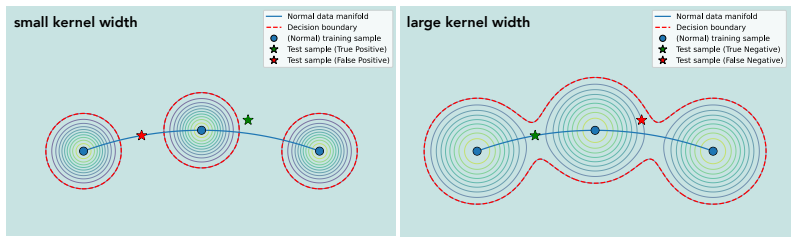
We learn a projection operator onto the manifold of normal samples and define a sample as anomalous if it is altered by this projection. This formulation naturally integrates the inductive bias of manifold-supported data and reframes anomaly detection in terms of a projection residual, thereby resolving issues arising from modeling degenerate distributions. It provides a unifying interpretation of reconstruction-based methods by explaining their success and failure in terms of projection quality. In particular, it explains the strong generalization ability of projection-aligned models as a consequence of contraction behavior toward the manifold. Moreover, by decoupling anomaly detection from
What carries the argument
The projection operator onto the manifold of normal samples, with anomaly defined by the residual between a sample and its projection.
If this is right
- Projection-aligned models generalize better because of contraction toward the manifold.
- The approach reduces misclassification of rare but normal samples by avoiding density estimation.
- Reconstruction-based methods succeed or fail according to the quality of the implicit projection they learn.
- Projection methods outperform boundary-based methods on structural anomaly tasks.
Where Pith is reading between the lines
- The residual score could be combined with explicit manifold parametrizations to improve interpretability.
- The same projection view might apply to denoising or imputation tasks on manifold data.
- Testing whether learned projections remain stable under small perturbations of the normal training set would check robustness.
Load-bearing premise
Normal data lies near a low-dimensional manifold for which a projection operator can be learned effectively without reference to densities.
What would settle it
An experiment on manifold-supported data in which density-based or boundary-based detectors consistently outperform projection-residual detectors would falsify the claim.
Figures




read the original abstract
Most existing anomaly detection methods rely on estimating a probability density or learning an enclosing decision boundary, implicitly assuming that normal data occupies a region of non-zero volume in the ambient space. In contrast, structural anomaly detection considers data that lies near a low-dimensional manifold, creating a mismatch between the inductive bias of existing methods and the structure of the data, often resulting in degraded performance. To address this mismatch, we introduce a geometric perspective. Specifically, we learn a projection operator onto the manifold of normal samples and define a sample as anomalous if it is altered by this projection. This formulation naturally integrates the inductive bias of manifold-supported data and reframes anomaly detection in terms of a projection residual, thereby resolving issues arising from modeling degenerate distributions. Notably, it provides a unifying interpretation of reconstruction-based methods by explaining their success and failure in terms of projection quality. In particular, it explains the strong generalization ability of projection-aligned models as a consequence of contraction behavior toward the manifold. Moreover, by decoupling anomaly detection from probabilistic modeling, it reduces the tendency to misclassify rare but normal samples, a widely recognized limitation of existing approaches. Empirically, we demonstrate that projection-aligned methods achieve strong performance, outperforming boundary-based methods while improving upon existing reconstruction-based approaches.
Editorial analysis
A structured set of objections, weighed in public.
Referee Report
Summary. The paper claims that standard anomaly detection methods based on density estimation or decision boundaries are ill-suited for structural anomalies where normal data lies near low-dimensional manifolds. It proposes learning a projection operator onto the normal manifold and scoring anomalies via the projection residual, which unifies reconstruction-based approaches, explains their generalization through contraction toward the manifold, and avoids misclassifying rare normal samples by decoupling from probabilistic modeling. Empirical results are said to show projection-aligned methods outperforming boundary-based ones.
Significance. If a learnable projection operator can be realized with verifiable quality, the geometric reframing supplies a unifying lens for reconstruction methods and a direct way to encode manifold inductive bias without density estimation, which could reduce false positives on in-manifold outliers and clarify why certain autoencoder-style detectors succeed or fail.
major comments (2)
- [Abstract and §3] Abstract and §3 (method): the claim that the projection residual 'resolves issues arising from modeling degenerate distributions' is load-bearing yet introduced by definition rather than derived; without an explicit construction or loss that guarantees the operator contracts to the manifold (e.g., via a stated fixed-point property or contraction mapping), the unification argument remains interpretive rather than deductive.
- [Empirical evaluation] Empirical evaluation (presumably §4–5): the statement that projection-aligned methods 'outperform boundary-based methods' requires tabulated AUC or F1 deltas on the same benchmarks used by the boundary baselines; absent those numbers or an ablation isolating the projection residual from the underlying network, the performance claim cannot be assessed as evidence for the geometric reframing.
minor comments (2)
- [Abstract] Notation: the symbol for the projection operator is not introduced with a formal definition (e.g., P_θ or similar) before its use in the residual; a single displayed equation would clarify the residual ||x − P(x)||.
- [Introduction] The term 'structural anomaly detection' appears without a reference or one-sentence definition distinguishing it from standard point anomalies.
Simulated Author's Rebuttal
We thank the referee for the constructive comments and the recommendation of minor revision. We address each major comment below and will incorporate the suggested clarifications and additions in the revised manuscript.
read point-by-point responses
-
Referee: [Abstract and §3] Abstract and §3 (method): the claim that the projection residual 'resolves issues arising from modeling degenerate distributions' is load-bearing yet introduced by definition rather than derived; without an explicit construction or loss that guarantees the operator contracts to the manifold (e.g., via a stated fixed-point property or contraction mapping), the unification argument remains interpretive rather than deductive.
Authors: We agree that the current presentation introduces the projection residual primarily by definition and that the unification argument would benefit from a more deductive framing. The manuscript defines the operator P such that anomalies are identified via nonzero residuals ||x - P(x)||, with the fixed-point property P(x) = x holding on the normal manifold by construction of the learning objective. However, we did not explicitly state a contraction-mapping guarantee or derive the resolution of degenerate-distribution issues from first principles. In revision we will add to §3: (i) an explicit statement of the idempotence and fixed-point properties, (ii) the precise form of the training loss that encourages contraction toward the manifold, and (iii) a short derivation showing how operating on residuals rather than densities sidesteps the zero-volume problem. These additions will make the unification argument deductive rather than interpretive. revision: yes
-
Referee: [Empirical evaluation] Empirical evaluation (presumably §4–5): the statement that projection-aligned methods 'outperform boundary-based methods' requires tabulated AUC or F1 deltas on the same benchmarks used by the boundary baselines; absent those numbers or an ablation isolating the projection residual from the underlying network, the performance claim cannot be assessed as evidence for the geometric reframing.
Authors: We acknowledge that the current empirical section reports overall performance but does not present side-by-side tabulated deltas or an explicit ablation isolating the projection residual. In the revised manuscript we will add: (i) a table in §4 or §5 listing AUC and F1 scores (with deltas) for all projection-aligned variants against the boundary-based baselines on the identical benchmark splits, and (ii) an ablation that replaces the projection residual with a standard reconstruction or density score while keeping the underlying network fixed, thereby isolating the contribution of the geometric formulation. revision: yes
Circularity Check
No significant circularity identified
full rationale
The paper presents a geometric reframing of anomaly detection by defining a projection operator onto the normal manifold and using the residual as the anomaly score. This is introduced directly as a perspective that unifies reconstruction methods, without any derivation chain, fitted parameters renamed as predictions, or load-bearing self-citations. No equations appear in the provided text that reduce a claimed result to its own inputs by construction. The central claim remains a consistent definitional shift whose validity is treated as an empirical question rather than a theorem forced by prior steps.
Axiom & Free-Parameter Ledger
axioms (1)
- domain assumption Normal data lies near a low-dimensional manifold
Reference graph
Works this paper leans on
- [1]
-
[2]
Alain and Y
G. Alain and Y . Bengio. What regularized auto-encoders learn from the data-generating distribution.J. Mach. Learn. Res., 15(110):3563–3593, 2014
2014
-
[3]
Bauer, S
A. Bauer, S. Nakajima, N. Görnitz, and K.-R. Müller. Optimizing for measure of performance in max-margin parsing.IEEE Trans. Neural Netw. Learn. Syst., pages 1–5, 2019
2019
-
[4]
Bauer, S
A. Bauer, S. Nakajima, N. Görnitz, and K.-R. Müller. Partial optimality of dual decomposition for MAP inference in pairwise MRFs. InProc. Int. Conf. Artif. Intell. Stat., volume 89 ofProc. Mach. Learn. Res., pages 1696–1703, 2019
2019
-
[5]
Bauer, S
A. Bauer, S. Nakajima, and K.-R. Müller. Efficient exact inference with loss augmented objective in structured learning.IEEE Trans. Neural Netw. Learn. Syst., 28(11):2566–2579, 2017
2017
-
[6]
Bauer, S
A. Bauer, S. Nakajima, and K.-R. Müller. Polynomial-time constrained message passing for exact MAP inference on discrete models with global dependencies.Mathematics, 11(12):2628, 2023
2023
-
[7]
Bauer, S
A. Bauer, S. Nakajima, and K.-R. Müller. Self-supervised autoencoders for visual anomaly detection.Mathematics, 12(24):3988, 2024
2024
-
[8]
Bergmann, K
P. Bergmann, K. Batzner, M. Fauser, D. Sattlegger, and C. Steger. The mvtec anomaly detection dataset: A comprehensive real-world dataset for unsupervised anomaly detection.Int. J. Comput. Vis., 129(4):1038–1059, 2021
2021
-
[9]
Bergmann, S
P. Bergmann, S. Löwe, M. Fauser, D. Sattlegger, and C. Steger. Improving unsupervised defect segmentation by applying structural similarity to autoencoders. InProc. Int. Conf. Comput. Vis. Theory Appl., pages 372–380, 2019
2019
-
[10]
Detecting Anomalous Faces with 'No Peeking' Autoencoders
A. Bhattad, J. Rock, and D. A. Forsyth. Detecting anomalous faces with “no peeking” autoen- coders.CoRR, abs/1802.05798, 2018
work page internal anchor Pith review Pith/arXiv arXiv 2018
-
[11]
Q. Chen, H. Luo, H. Gao, C. Lv, and Z. Zhang. Progressive boundary guided anomaly synthesis for industrial anomaly detection.IEEE Trans. Circuits Syst. Video Technol., 35(2):1193–1208, 2025
2025
-
[12]
Q. Chen, H. Luo, C. Lv, and Z. Zhang. A unified anomaly synthesis strategy with gradient ascent for industrial anomaly detection and localization. InProc. Eur. Conf. Comput. Vis., volume 15125 ofLect. Notes Comput. Sci., pages 37–54, 2024
2024
-
[13]
Cimpoi, S
M. Cimpoi, S. Maji, I. Kokkinos, S. Mohamed, and A. Vedaldi. Describing textures in the wild. InProc. IEEE Conf. Comput. Vis. Pattern Recognit., 2014
2014
-
[14]
Connor, G
M. Connor, G. Canal, and C. Rozell. Variational autoencoder with learned latent structure. In Proc. Int. Conf. Artif. Intell. Stat., volume 130 ofProc. Mach. Learn. Res., pages 2359–2367, 2021
2021
-
[15]
M. Kim, J. Kim, J. Yu, and J. K. Choi. Active anomaly detection based on deep one-class classification.Pattern Recognit. Lett., 167:18–24, 2023
2023
-
[16]
D. P. Kingma and J. Ba. Adam: A method for stochastic optimization. InProc. Int. Conf. Learn. Represent., 2015
2015
-
[17]
C.-L. Li, K. Sohn, J. Yoon, and T. Pfister. Cutpaste: Self-supervised learning for anomaly detection and localization. InProc. IEEE Conf. Comput. Vis. Pattern Recognit., pages 9664– 9674, 2021
2021
-
[18]
L. Li, C. Yan, D. Song, B. Wang, and C. Wang. A prototype correction multi-scale feature reconstruction network for industrial anomaly detection.Pattern Recognit., 177:113331, 2026. 10
2026
-
[19]
Z. Liu, Y . Zhou, Y . Xu, and Z. Wang. Simplenet: A simple network for image anomaly detection and localization. InProc. IEEE Conf. Comput. Vis. Pattern Recognit., pages 20402–20411, 2023
2023
-
[20]
E. Parzen. On estimation of a probability density function and mode.Ann. Math. Stat., 33(3):1065–1076, 1962
1962
-
[21]
Pirnay and K
J. Pirnay and K. Chai. Inpainting transformer for anomaly detection. InProc. Int. Conf. Image Anal. Process., volume 13232 ofLect. Notes Comput. Sci., pages 394–406, 2022
2022
-
[22]
Reiss, N
T. Reiss, N. Cohen, L. Bergman, and Y . Hoshen. PANDA: Adapting pretrained features for anomaly detection and segmentation. InProc. IEEE Conf. Comput. Vis. Pattern Recognit., pages 2806–2814, 2021
2021
-
[23]
Ronneberger, P
O. Ronneberger, P. Fischer, and T. Brox. U-net: Convolutional networks for biomedical image segmentation. InProc. Med. Image Comput. Comput.-Assist. Interv., volume 9351 ofLect. Notes Comput. Sci., pages 234–241, 2015
2015
-
[24]
K. Roth, L. Pemula, J. Zepeda, B. Schölkopf, T. Brox, and P. V . Gehler. Towards total recall in industrial anomaly detection. InProc. IEEE Conf. Comput. Vis. Pattern Recognit., pages 14298–14308, 2022
2022
-
[25]
L. Ruff, N. Görnitz, L. Deecke, S. A. Siddiqui, R. A. Vandermeulen, A. Binder, E. Müller, and M. Kloft. Deep one-class classification. In J. G. Dy and A. Krause, editors,Proc. 35th Int. Conf. Mach. Learn., volume 80 ofProc. Mach. Learn. Res., pages 4390–4399, 2018
2018
-
[26]
L. Ruff, J. R. Kauffmann, R. A. Vandermeulen, W. Samek, M. Kloft, T. G. Dietterich, and K.-R. Müller. A unifying review of deep and shallow anomaly detection.Proc. IEEE, 109(5):756–795, 2021
2021
-
[27]
Schölkopf, J
B. Schölkopf, J. C. Platt, J. Shawe-Taylor, A. J. Smola, and R. C. Williamson. Estimating the support of a high-dimensional distribution.Neural Comput., 13(7):1443–1471, 2001
2001
-
[28]
J. Tack, S. Mo, J. Jeong, and J. Shin. CSI: Novelty detection via contrastive learning on distributionally shifted instances. InAdv. Neural Inf. Process. Syst., 2020
2020
-
[29]
D. M. J. Tax and R. P. W. Duin. Support vector data description.Mach. Learn., 54(1):45–66, 2004
2004
-
[30]
W. Xue, L. Zhang, X. Mou, and A. C. Bovik. Gradient magnitude similarity deviation: A highly efficient perceptual image quality index.IEEE Trans. Image Process., 23(2):684–695, 2014
2014
-
[31]
Zavrtanik, M
V . Zavrtanik, M. Kristan, and D. Skocaj. Dræm – A discriminatively trained reconstruction embedding for surface anomaly detection. InProc. IEEE Int. Conf. Comput. Vis., pages 8310–8319, 2021
2021
-
[32]
Zavrtanik, M
V . Zavrtanik, M. Kristan, and D. Skocaj. Reconstruction by inpainting for visual anomaly detection.Pattern Recognit., 112:107706, 2021
2021
-
[33]
Deep Unsupervised Clustering Using Mixture of Autoencoders
D. Zhang, Y . Sun, B. Eriksson, and L. Balzano. Deep unsupervised clustering using mixture of autoencoders.CoRR, abs/1712.07788, 2017
work page internal anchor Pith review Pith/arXiv arXiv 2017
-
[34]
Zhang, M
X. Zhang, M. Xu, and X. Zhou. Realnet: A feature selection network with realistic synthetic anomaly for anomaly detection. InProc. IEEE Conf. Comput. Vis. Pattern Recognit., pages 16699–16708, 2024
2024
-
[35]
oTTnJqt9X2q/GkWbgheJx/OP4eo=
Y . Zou, J. Jeong, L. Pemula, D. Zhang, and O. Dabeer. Spot-the-difference self-supervised pre-training for anomaly detection and segmentation. InProc. Eur. Conf. Comput. Vis., volume 13690 ofLect. Notes Comput. Sci., pages 392–408, 2022. 11 A Supplementary Material This supplementary material provides additional theoretical analysis and proofs supporting...
2022
discussion (0)
Sign in with ORCID, Apple, or X to comment. Anyone can read and Pith papers without signing in.