REVIEW 2 major objections 1 minor 47 references
Demonstration of unpartible entanglement
T0 review · 2 major / 1 minor · reviewed 2026-06-30 · grok-4.3
Pith's one-line read A two-photon quantum state remains entangled no matter which orthonormal modes define the parties.
desk verdict The paper demonstrates a two-photon state with high fidelity to |1,1> in one basis via a multiplexed interferometer, but the data shown do not establish that entanglement survives every orthonormal mode redefinition. read the letter →
The pith
A machine-rendered reading of the paper's core claim, the machinery that carries it, and where it could break.
The reading
What carries the argument
A fully reconfigurable temporally multiplexed interferometer with measurement-induced nonlinearities that generates the heralded two-photon states.
What would settle it
Performing tomography after an arbitrary orthonormal mode transformation and obtaining a fidelity below the threshold for entanglement in that basis would show the state is not mode-independent.
Extended reading notes
Core claim
The experiment produces heralded two-photon states in two modes that are entangled for all choices of orthonormal mode basis, verified by tailored quantum-state tomography achieving fidelities that confirm the presence of mode-independent entanglement.
Load-bearing premise
The heralded two-photon states are entangled for every possible orthonormal choice of mode basis.
Editorial extensions
If this is right
- The entanglement remains intact when the parties are redefined by any orthonormal transformation.
- The correlation is protected in settings with noise or untrusted parties that alter the effective modes.
- Tailored tomography suffices to certify the resilient correlation across bases.
- The generation method supplies a concrete route to operationally advantageous quantum states.
Reading between the lines
- Protocols could be designed that distribute entanglement without requiring the sender and receiver to agree on a shared mode basis in advance.
- The same independence might be checked experimentally in continuous-variable or multi-photon systems where mode mixing is also common.
- If heralding efficiency can be increased, the approach could be scaled to states with more than two photons while preserving the basis independence.
Signed reviews
Editorial analysis
A structured set of objections, weighed in public.
Referee Report
Summary. The manuscript reports the first experimental realization of mode-independent (or 'unpartible') entanglement in heralded two-photon states. Using a fully reconfigurable temporally multiplexed interferometer with measurement-induced nonlinearities, the authors generate states claimed to remain entangled for every choice of orthonormal mode basis. Certification is performed via tailored quantum-state tomography that yields fidelities validating the presence of this resilient entanglement, with potential benefits for quantum communication in noisy or untrusted settings.
Significance. If the central claim is rigorously established, the work would introduce a qualitatively stronger form of entanglement that does not rely on a pre-fixed mode basis, offering operational robustness beyond conventional party-dependent entanglement. The reconfigurable temporally multiplexed platform itself constitutes a technical contribution for generating such states. The current manuscript, however, provides insufficient evidence that the experimental imperfections are small enough to preserve entanglement under arbitrary basis transformations.
major comments (2)
- [Abstract / certification process] Abstract and certification process: The claim that the generated states 'are entangled for all choices of orthonormal mode basis' rests on fidelities obtained from tailored quantum-state tomography. No explicit calculation or bound is presented showing that an entanglement monotone (e.g., negativity or concurrence) remains positive for every unitary transformation on the two-mode space. Fidelity to the ideal |1,1> state in a single fixed basis does not by itself exclude the possibility that small admixtures of |2,0> or |0,2> components render the state separable for some rotation angle.
- [State generation] State generation section: The heralded two-photon states are produced via measurement-induced nonlinearities in the temporally multiplexed interferometer. Without reported quantitative upper bounds on multi-photon components, loss rates, or mode mismatch (e.g., via measured g^(2) or higher-order correlation functions), it is impossible to verify that the experimental state lies inside the region of the two-photon subspace where entanglement is guaranteed for all bases.
minor comments (1)
- [Title / Abstract] The title uses 'unpartible entanglement' while the abstract uses 'mode-independent entanglement'; consistent terminology would improve clarity.
Simulated Author's Rebuttal
We thank the referee for their thorough review and for acknowledging the potential significance of mode-independent entanglement. We address each major comment below and will revise the manuscript to provide the requested explicit calculations and quantitative bounds.
read point-by-point responses
-
Referee: [Abstract / certification process] Abstract and certification process: The claim that the generated states 'are entangled for all choices of orthonormal mode basis' rests on fidelities obtained from tailored quantum-state tomography. No explicit calculation or bound is presented showing that an entanglement monotone (e.g., negativity or concurrence) remains positive for every unitary transformation on the two-mode space. Fidelity to the ideal |1,1> state in a single fixed basis does not by itself exclude the possibility that small admixtures of |2,0> or |0,2> components render the state separable for some rotation angle.
Authors: We agree that fidelity in a single basis alone is insufficient and that an explicit demonstration via an entanglement monotone is necessary. The tailored QST reconstructs the full two-photon density matrix in a manner that permits this verification. In the revised manuscript we will add a calculation of negativity (or concurrence) as a function of arbitrary orthonormal basis rotation, using the measured state and its error bars, to confirm it remains positive for all angles. revision: yes
-
Referee: [State generation] State generation section: The heralded two-photon states are produced via measurement-induced nonlinearities in the temporally multiplexed interferometer. Without reported quantitative upper bounds on multi-photon components, loss rates, or mode mismatch (e.g., via measured g^(2) or higher-order correlation functions), it is impossible to verify that the experimental state lies inside the region of the two-photon subspace where entanglement is guaranteed for all bases.
Authors: We accept that quantitative bounds on imperfections are required to place the experimental state inside the region where mode-independent entanglement is guaranteed. The revised manuscript will report the measured g^(2)(0) values for the heralded photons, loss rates from the interferometer, and mode-mismatch estimates, together with an analysis showing that these imperfections keep the state within the two-photon subspace supporting the claimed property. revision: yes
Circularity Check
No circularity: experimental certification is independent of the claimed property
full rationale
The paper describes an experimental generation of heralded two-photon states via a temporally multiplexed interferometer and reports fidelities from tailored quantum-state tomography in a fixed basis. No derivation chain, equations, or self-citations are invoked that reduce the central claim (mode-independent entanglement) to a fitted parameter, self-definition, or prior result by the same authors. The certification step consists of direct measurement outcomes rather than a prediction that is forced by construction from the generation method. This is the normal case of an experimental claim whose validity rests on data rather than on any internal logical loop.
Assumptions & free parameters
Cite this review
Pith. "Pith review of Demonstration of unpartible entanglement." pith.science (2026). https://pith.science/paper/QI7JMBH6
@misc{pith2026260630468,
  author       = {Pith},
  title        = {Pith review of: Demonstration of unpartible entanglement},
  year         = {2026},
  howpublished = {\url{https://pith.science/paper/QI7JMBH6}},
  note         = {Machine review of arXiv:2606.30468}
}
read the original abstract
We report on the first experimental verification of mode-independent entanglement. Commonly, the entanglement of a state is firmly based on pre-defined parties that are correlated, and the state might be disentangled when the definition of the parties is changed. Exceeding this party-dependent concept, we realize a type of quantum entanglement that persists even if the parties, in our case modes, are transformed. This safeguards the performance of entanglement in real-world applications, such as quantum communication settings involving noise and untrusted parties. For the state generation, we present an experimental scheme based on a fully reconfigurable temporally multiplexed interferometer with measurement-induced nonlinearities, which generates heralded two-photon states in two modes that are entangled for all choices of orthonormal mode basis. For the certification process, we utilize a tailored quantum-state tomography, achieving fidelities that validate the presence of mode-independent entanglement as a resilient and operationally advantageous quantum correlation.
Figures


Figures from the paper (1 more)
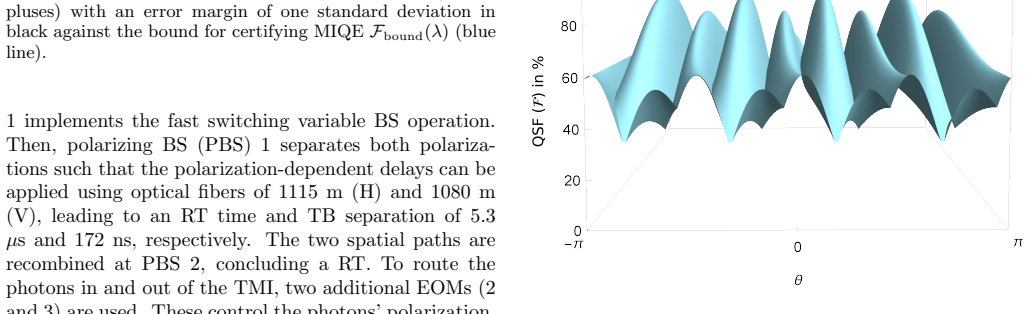
Reference graph
Works this paper leans on
-
[1]
J. v. Neumann,Der Meßprozeß in Mathematische Grundlagen der Quantenmechanik(Springer, Berlin, Heidelberg 1932)
1932
-
[2]
Horodecki, P
R. Horodecki, P. Horodecki, M. Horodecki, and K. Horodecki,Quantum entanglementRev. Mod. Phys.81, 865 (2009)
2009
-
[3]
A. K. Ekert,Quantum cryptography based on Bell’s the- oremPhys. Rev. Lett.67, 661 (1991)
1991
-
[4]
C. P. Lualdi, S. J. Johnson, M. Vayninger, K. A. Meier, S. Sahoo, S. I. Bogdanov, and P. G. Kwiat,Fast quantum interferometry at the nanometer and attosecond scales with energy-entangled photonsSci. Adv.11, eadw4938 (2025)
2025
-
[5]
Raussendorf and H
R. Raussendorf and H. J. Briegel,A one-way quantum computerPhys. Rev. Lett.86, 5188 (2001)
2001
-
[6]
Einstein, B
A. Einstein, B. Podolsky, and N. Rosen,Can Quantum- Mechanical Description of Physical Reality Be Consid- ered Complete?Phys. Rev.47, 777 (1935)
1935
-
[7]
C. H. Bennett, G. Brassard, C. Cr´ epeau, R. Jozsa, A. Peres, and W. K. Wootters,Teleporting an un- known quantum state via dual classical and Ein- stein–Podolsky–Rosen channelsPhys. Rev. Lett.70, 1895 (1993)
1993
-
[8]
Hensen, H
B. Hensen, H. Bernien, A. E. Dr´ eau, A. Reiserer, N. Kalb, M. S. Blok, J. Ruitenberg, R. F. L. Vermeulen, R. N. Schouten, C. Abell´ an et al.,Loophole-free Bell inequality violation using electron spins separated by 1.3 kilometres Nature526, 682 (2015)
2015
Show all 47 references
-
[9]
Azzini, S
S. Azzini, S. Mazzucchi, V. Moretti, D. Pastorello, and L. Pavesi,Single-Particle EntanglementAdv. Quantum Technol.3, 2000014 (2020)
2020
-
[10]
Y. S. Li, B. Zeng, X. S. Liu, and G. L. Long,Entan- glement in a two-identical-particle systemPhys. Rev. A. 64, 054302 (2001)
2001
-
[11]
S. J. van Enk,Entanglement of electromagnetic fields Phys. Rev. A.67, 022303 (2003)
2003
-
[12]
Vieira, E
R. Vieira, E. P. M. Amorim, and G. Rigolin,Dynamically Disordered Quantum Walk as a Maximal Entanglement GeneratorPhys. Rev. Lett.111, 180503 (2013)
2013
-
[13]
Hillery and M
M. Hillery and M. S. Zubairy,Entanglement Conditions for Two-Mode StatesPhys. Rev. Lett.96, 050503 (2006)
2006
-
[14]
M. W. Mitchell, J. S. Lundeen, and A. M. Steinberg, Super-resolving phase measurements with a multiphoton entangled stateNature429, 161 (2004)
2004
-
[15]
Del Santo and B
F. Del Santo and B. Daki´ c,Two-Way Communication with a Single Quantum ParticlePhys. Rev. Lett.120, 060503 (2018)
2018
-
[16]
Weng and C.-S
H.-C. Weng and C.-S. Chuu,Implementation of Shor’s algorithm with a single photon in 32 dimensionsPhys. Rev. Applied22, 034003 (2024)
2024
-
[17]
Fabre and N
C. Fabre and N. Treps,Modes and states in quantum opticsRev. Mod. Phys.92, 035005 (2020)
2020
-
[18]
O. Lib, S. Liu, R. Shekel, Q. He, M. Huber, Y. Bromberg, and G. Vitagliano,Experimental certification of high-dimensional entanglement with randomized mea- surementsPhys. Rev. Lett.134, 210202 (2025)
2025
-
[19]
Sperling, A
J. Sperling, A. Perez-Leija, K. Busch, and C. Silberhorn, Mode-independent quantum entanglement for lightPhys. Rev. A100, 062129 (2019)
2019
-
[20]
Friis, G
N. Friis, G. Vitagliano, M. Malik, and M. Huber,En- tanglement certification from theory to experimentNat. Rev. Phys.1, 72 (2019)
2019
-
[21]
Gurvits,Classical complexity and quantum entangle- mentJournal of Computer and System Sciences69, 448 (2004), special Issue on STOC 2003
L. Gurvits,Classical complexity and quantum entangle- mentJournal of Computer and System Sciences69, 448 (2004), special Issue on STOC 2003
2004
-
[22]
Gharibian,Strong np-hardness of the quantum separa- bility problemQuantum Inf
S. Gharibian,Strong np-hardness of the quantum separa- bility problemQuantum Inf. Comput.10, 343 (2010)
2010
-
[23]
G¨ uhne and G
O. G¨ uhne and G. T´ oth,Entanglement detectionPhys. Rep.474, 1 (2009). 6
2009
-
[24]
B. M. Terhal,Bell inequalities and the separability crite- rionPhys. Lett. A271, 319 (2000)
2000
-
[25]
Sperling and W
J. Sperling and W. Vogel,Multipartite Entanglement WitnessesPhys. Rev. Lett.111, 110503 (2013)
2013
-
[26]
Horodecki, P
M. Horodecki, P. Horodecki, and R. Horodecki,Separa- bility of mixed states: necessary and sufficient conditions Phys. Lett. A223, 1 (1996)
1996
-
[27]
Steffen, M
M. Steffen, M. Ansmann, R. C. Bialczak, N. Katz, E. Lucero, R. McDermott, M. Neeley, E. M. Weig, A. N. Cleland, and J. M. Martinis,Measurement of the Entan- glement of Two Superconducting Qubits via State Tomog- raphyScience313, 1423 (2006)
2006
-
[28]
K. An, Z. Liu, T. Zhang, S. Li, Y. Zhou, X. Yuan, L. Wang, W. Zhang, G. Wang, and H. Lu,Efficient charac- terizations of multiphoton states with an ultra-thin optical deviceNat. Commun.15, 3944 (2024)
2024
-
[29]
D. Zia, L. Innocenti, G. Minati, S. Lorenzo, A. Suprano, R. Di Bartolo, N. Spagnolo, T. Giordani, V. Cimini, G. M. Palma et al.,Quantum reservoir computing for pho- tonic entanglement witnessingSci. Adv.11, eady7987 (2025)
2025
-
[30]
J. L. O’Brien, A. Furusawa, and J. Vuˇ ckovi´ c,Photonic quantum technologiesNat. Photon.3, 687 (2009)
2009
-
[31]
Pegoraro, P
F. Pegoraro, P. Held, J. Lammers, B.Brecht, and C. Sil- berhorn,Demonstration of a quantum C-NOT Gate in a Time-Multiplexed fully reconfigurable photonic processor Accepted for publication in Nat. Com
-
[32]
A. N. Boto, P. Kok, D. S. Abrams, S. L. Braunstein, C. P. Williams, and J. P. Dowling,Quantum Interferomet- ric Optical Lithography: Exploiting Entanglement to Beat the Diffraction LimitPhys. Rev. Lett.85, 2733 (2000)
2000
-
[33]
C. K. Hong, Z. Y. Ou, and L. Mandel,Measurement of subpicosecond time intervals between two photons by in- terferencePhys. Rev. Lett.59, 2044 (1987)
-
[34]
T´ oth,Entanglement witnesses in spin modelsPhys
G. T´ oth,Entanglement witnesses in spin modelsPhys. Rev. A71, 010301(R) (2005)
2005
-
[35]
Pegoraro, P
F. Pegoraro, P. Held, S. Barkhofen, B. Brecht, and C. Sil- berhorn,Dynamic conditioning of two particle discrete- time quantum walksPhys. Scr.98, 034005 (2023)
2023
-
[36]
Schreiber, K
A. Schreiber, K. N. Cassemiro, V. Potoˇ cek, A. G´ abris, P. J. Mosley, E. Andersson, I. Jex, and C. Silberhorn, Photons Walking the Line: A Quantum Walk with Ad- justable Coin OperationsPhys. Rev. Lett.104, 050502 (2010)
2010
-
[37]
L. S. Madsen, F. Laudenbach, M. Falamarzi Askarani, F. Rortais, T. Vincent, J. F. F. Bulmer, F. M. Miatto, L. Neuhaus, L. G. Helt, M. J. Collins, et al.,Quantum computational advantage with a programmable photonic processorNature606, 75 (2022)
2022
-
[38]
Lammers, L
J. Lammers, L. Ares, F. Pegoraro, P. Held, B.Brecht, J. Sperling, and C. Silberhorn,Resource-efficient universal photonic processors based on time-multiplexed hybrid ar- chitecturesPhys. Rev. Appl.25, 054011 (2026)
2026
-
[39]
G. C. Stokes,On the Composition and Resolution of Streams of Polarized Light from different SourcesTrans. Cambridge Philos. Soc.9, 399 (1852)
-
[40]
Vergyris, C
P. Vergyris, C. Babin, R. Nold, E. Gouzien, H. Her- rmann, C. Silberhorn, O. Alibart, S. Tanzilli, F. Kaiser, Two-photon phase-sensing with single-photon detection Appl. Phys. Lett.117, 024001 (2020)
2020
-
[41]
P. Held, L. Ares, F. Pegoraro, J. Lammers, B. Brecht, J. Sperling, and C. Silberhorn, Demonstration of unpartible entanglement: Dataset [Data set], Zenodo (2025)
2025
-
[42]
[θ HWP, θQWP] = [0°, 0°], [0°, 45°], [120°, 0°], [-120°, 30°], [0°, 120°], [-30°, 60°], [60°, 0°], [-90°, 90°]
-
[43]
L. Ares, N. Prasannan, E. Agudelo, A. Luis, B. Brecht, C. Silberhorn, J. Sperling Photonic Entanglement and Polarization Nonclassicality: Two Manifestations, One Nature arXiv:2407.07477 [quant-ph] (2025)
2025
-
[44]
J. C. A. Barata and M. S. Hussein, The Moore–Penrose Pseudoinverse: A Tutorial Review of the Theory, Braz. J. Phys.42, 146 (2012)
2012
-
[45]
D. F. V. James, P. G. Kwiat, W. J. Munro, and A. G. White,Measurement of qubitsPhys. Rev. A64, 052312 (2001)
2001
-
[46]
Schwemmer, L
C. Schwemmer, L. Knips, D. Richart, H. Weinfurter, T. Moroder, M. Kleinmann, and O. G¨ uhne,Systematic Er- rors in Current Quantum State Tomography ToolsPhys. Rev. Lett.114, 080403 (2015). End Matter State reconstruction.—For a tomographically over- complete measurement, we ut...
2015
-
[47]
for values, we restrict the recorded countsCto the two-photon subspace and compute the probabilities of findingkphotons in modeb,p k(l) = Ck,2−k C0,2+C1,1+C2,0 . In terms of the measurement operators, these readp k(l) = tr h ˆρˆΠk(l) i , where each projector ˆΠk(l) is computed...
Reviewed June 30, 2026 · model on record in the stance chip above.
Discussion (0). Continue with ORCID to comment.