REVIEW 3 major objections 8 minor 37 references
Simplify the Usage of Lexicon in Chinese NER
T0 review · 3 major / 8 minor · reviewed 2026-08-14 · deepseek-v4-flash
Pith's one-line read SoftLexicon shows Chinese NER can be both faster and more accurate by encoding lexicon matches directly into character representations.
desk verdict SoftLexicon is a simple, fast, and reproducible lexicon-encoding trick for Chinese NER with real gains; the significance claims need variance reporting. read the letter →
The pith
A machine-rendered reading of the paper's core claim, the machinery that carries it, and where it could break.
The reading
What carries the argument
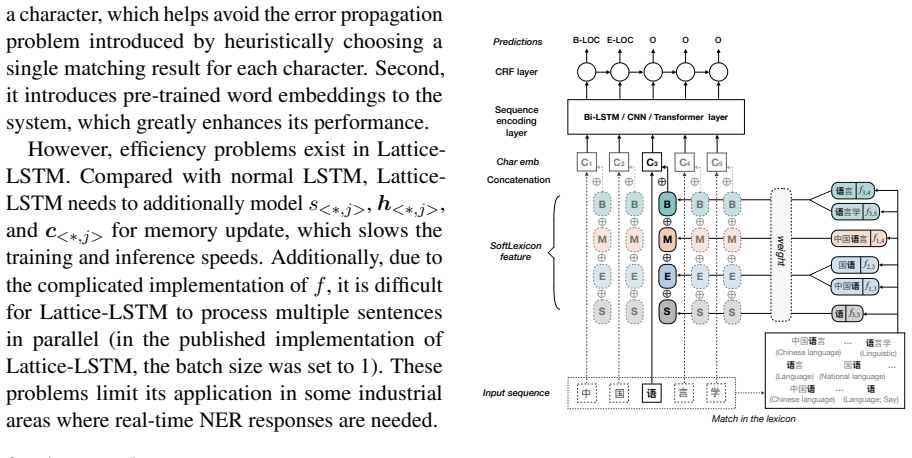
The running gear is the BMES word-set construction: for each character, all lexicon words are partitioned into sets B, M, E, S by whether the character is the start, middle, end, or the whole word. Each set is condensed with a cheap frequency-weighted pooling (with an added NONE placeholder for empty sets), and the four pooled vectors are concatenated to the character embedding. Because the weights are static word frequencies, the pooling adds no extra computation at inference time, which is what makes the speed-up possible. The same feature vector drops into any sequence encoder, which the paper demonstrates with Bi-LSTM, CNN, and Transformer.
What would settle it
Take a Chinese NER test set from a domain with different word statistics than the training domain, keep the frequency table fixed, and compare SoftLexicon with frequency weighting against SoftLexicon with mean pooling; if mean pooling matches or beats the frequency version, the weighting assumption fails.
Extended reading notes
Core claim
The authors propose SoftLexicon, an encoding that attaches to each character four pooled vectors built from lexicon words beginning with, containing, ending with, or equal to the character (the B, M, E, S sets). Each set is condensed by a frequency-weighted average of word embeddings, using static counts from the task's training and development data, and the four vectors are concatenated onto the character representation before a standard Bi-LSTM-CRF. The paper reports better F1 than Lattice-LSTM and LR-CNN on OntoNotes, MSRA, Weibo, and Resume, with up to 6.15 times faster inference, and further gains when BERT is added. The authors argue the design preserves all matching information, including words that merely pass through a character, which Lattice-LSTM drops.
Load-bearing premise
The method's edge rests on word frequencies tallied from the task's own training and development text being good general-purpose weights for pooling word embeddings across the domains the model will see.
Editorial extensions
If this is right
- Chinese NER can be made substantially faster by moving lexicon knowledge into the representation layer rather than complicating the sequence model.
- The same soft-lexicon representation works with CNN and Transformer encoders, so the speed and accuracy benefits are not tied to LSTM architectures.
- BERT and lexicon features combine additively, implying that a pretrained contextual model and static lexicon knowledge capture partly different signal.
- The BMES distinction and overall weight normalization across all matched words are each necessary; removing either costs F1.
- SoftLexicon removes the batch-size-1 constraint of Lattice-LSTM, allowing batched parallel decoding.
Reading between the lines
- A natural extension the authors note but do not test is re-estimating word frequencies from unlabeled in-domain text; if frequency statistics are the key, this could adapt SoftLexicon to new domains without new annotations.
- The same BMES-set encoding could be applied to other character-based Chinese tasks, such as word segmentation or part-of-speech tagging, wherever a lexicon is available.
- The speed comparison is on GPU with batch size 1 up to a finite length; the paper does not report latency for very long sentences, where LSTM recurrence could erode the gap.
- One could test the weighting scheme's robustness to lexicon size: using a smaller or domain-specific lexicon would reveal whether frequency weighting still beats mean pooling.
Signed reviews
Editorial analysis
A structured set of objections, weighed in public.
Referee Report
Summary. The paper proposes SoftLexicon, a method for incorporating lexicon word embeddings into character representations for Chinese NER. For each character, all lexicon-matched words are grouped into four sets (B, M, E, S) according to their position relative to the character; each set is condensed via a frequency-weighted sum of word embeddings; and the four set vectors are concatenated to the character embedding before a BiLSTM-CRF (or other encoder) model. The method is evaluated on OntoNotes, MSRA, Weibo, and Resume NER datasets, with comparisons to Lattice-LSTM, LR-CNN, and BERT-based baselines. The paper reports up to 6.15x faster inference than Lattice-LSTM and improved F1 on most datasets, plus ablations showing contributions of the M group, BMES distinction, weighted pooling, and overall normalization.
Significance. If the empirical claims hold, this is a useful contribution: it simplifies lexicon-augmented Chinese NER, avoids the complex graph structure of Lattice-LSTM, and makes it easy to plug lexicon information into any encoder (BiLSTM, CNN, Transformer, BERT). The code is released, and the method is conceptually clean. The consistent improvements over Lattice-LSTM across four datasets, and the transferability experiments, are valuable. However, the current evidence for the superiority of the frequency weighting and for statistical significance of the small F1 gains is incomplete.
major comments (3)
- [Section 4.3, Tables 3-6] The paper reports that boldface results are statistically significantly better than others with p<0.01 in a pairwise t-test, but it does not state the number of random seeds, the standard deviations, or whether the test is paired across runs or across test subsets. With F1 gaps as small as 0.48 on MSRA and 0.20 in the Table 8 ablation, this information is essential. Please report mean and standard deviation over at least five seeds for the main comparisons and for the ablations, and describe the exact test procedure.
- [Section 4.3, Table 4] On MSRA, the base SoftLexicon (LSTM) obtains 93.66 F1, which is below LR-CNN's 93.71. This contradicts the abstract's and introduction's claim that the method achieves 'better performance' than state-of-the-art methods. Please qualify the claim (e.g., 'better than Lattice-LSTM' for that configuration) or consistently present the +bichar variant as the main result.
- [Section 4.6, Table 8] The ablation ' - Weighted pooling' shows only a 0.20 F1 drop on Resume (95.33 vs 95.53), a difference that is likely within run-to-run variance for LSTM-CRF models. Without variance reporting, the conclusion that frequency weighting (Eq. 10) is a key ingredient is not supported. Please provide significance tests for the ablations, or soften the claim.
minor comments (8)
- [Table 1] In Table 1, the Weibo Dev Char and Resume Dev Char entries (14.5 and 0.46) are missing the 'k' suffix (should be 14.5k and 0.46k).
- [Figure 4] The y-axis label 'st/s' in Figure 4 should be expanded to 'sentences/s' for clarity.
- [Section 3.2, Eq. (10)] The scaling constant 4 in Eq. (10) is not explained; please justify why it is needed and how it is chosen.
- [Section 3.2] The special token 'NONE' introduced for empty word sets is not defined; specify whether it has a learnable embedding and how it is initialized.
- [Section 3.2] The statement that the BMES sets allow exact restoration of all matching results is asserted but not demonstrated; a brief proof or example would strengthen the argument.
- [Section 4.3] The footnote explaining that boldface indicates statistical significance appears only after Table 3; it should be repeated for Tables 4-6 so that the significance claim is understood to apply to all main result tables.
- [Section 4.3] There is a typo in the sentence 'the performance of the proposed Softlexion method is significant better' — it should be 'significantly better'.
- [References] The citation 'Zhang and Yang, (2018)' uses inconsistent punctuation; please standardize the reference style.
Circularity Check
No significant circularity: SoftLexicon's lexicon features and frequency weighting are constructed from the lexicon and corpus statistics, and all headline claims are measured against external baselines.
full rationale
The paper's central claims—higher F1 than Lattice-LSTM and much faster inference—are evaluated against external baselines and measured runtimes, not derived from the method's own assumptions. The SoftLexicon feature construction (Eqs. 8, 10, 11) is a deterministic transformation of the lexicon, pretrained embeddings, and corpus word frequencies; it does not use the NER labels as an input. The frequency weights z(w) are computed from unlabeled training/development text and are not fitted to the target labels, so the weighting scheme is not a fitted parameter masquerading as a prediction. The paper also directly ablates the weighting choice against mean pooling in Table 8, so the claimed benefit is empirically tested rather than true by construction. The only self-citation of note is LR-CNN (Gui et al., 2019a), used as a baseline; it is not load-bearing for the derivation, and the comparison is externally checkable. No uniqueness theorem, ansatz imported via self-citation, or renaming of a known result appears. The absence of variance reporting is a legitimate robustness concern, but it is a question of experimental rigor, not circularity.
Assumptions & free parameters
free parameters (2)
- Word frequency weights z(w) =
Per-word counts from training+dev data
- Scaling constant 4 in Eq. 10 =
4
assumptions (3)
- domain assumption The lexicon and pre-trained character/word embeddings from Lattice-LSTM are reused without modification
- ad hoc to paper BMES grouping of matched words is a meaningful way to organize lexicon information
- domain assumption Word frequency indicates word importance for NER
invented entities (1)
-
Special token NONE
Cite this review
Pith. "Pith review of Simplify the Usage of Lexicon in Chinese NER." pith.science (2026). https://pith.science/paper/QICG54DN
@misc{pith2026190805969,
  author       = {Pith},
  title        = {Pith review of: Simplify the Usage of Lexicon in Chinese NER},
  year         = {2026},
  howpublished = {\url{https://pith.science/paper/QICG54DN}},
  note         = {Machine review of arXiv:1908.05969}
}
read the original abstract
Recently, many works have tried to augment the performance of Chinese named entity recognition (NER) using word lexicons. As a representative, Lattice-LSTM (Zhang and Yang, 2018) has achieved new benchmark results on several public Chinese NER datasets. However, Lattice-LSTM has a complex model architecture. This limits its application in many industrial areas where real-time NER responses are needed. In this work, we propose a simple but effective method for incorporating the word lexicon into the character representations. This method avoids designing a complicated sequence modeling architecture, and for any neural NER model, it requires only subtle adjustment of the character representation layer to introduce the lexicon information. Experimental studies on four benchmark Chinese NER datasets show that our method achieves an inference speed up to 6.15 times faster than those of state-ofthe-art methods, along with a better performance. The experimental results also show that the proposed method can be easily incorporated with pre-trained models like BERT.
Figures


Reference graph
Works this paper leans on
-
[1]
Wanxiang Che, Mengqiu Wang, Christopher D Manning, and Ting Liu. 2013. Named entity recognition with bilingual constraints. In NAACL, pages 52--62
work page 2013
-
[2]
Aitao Chen, Fuchun Peng, Roy Shan, and Gordon Sun. 2006. Chinese named entity recognition with conditional probabilistic models. In SIGHAN Workshop on Chinese Language Processing
work page 2006
-
[3]
Yubo Chen, Liheng Xu, Kang Liu, Daojian Zeng, and Jun Zhao. 2015. Event extraction via dynamic multi-pooling convolutional neural networks. In ACL|IJCNLP, volume 1, pages 167--176
work page 2015
-
[4]
Jason Chiu and Eric Nichols. 2016. Named entity recognition with bidirectional lstm-cnns. Transactions of the Association of Computational Linguistics, 4(1):357--370
work page 2016
-
[5]
Jacob Devlin, Ming-Wei Chang, Kenton Lee, and Kristina Toutanova. 2018. Bert: Pre-training of deep bidirectional transformers for language understanding. arXiv preprint arXiv:1810.04805
arXiv 2018
-
[6]
Dennis Diefenbach, Vanessa Lopez, Kamal Singh, and Pierre Maret. 2018. Core techniques of question answering systems over knowledge bases: a survey. KAIS, 55(3):529--569
work page 2018
-
[7]
Ruixue Ding, Pengjun Xie, Xiaoyan Zhang, Wei Lu, Linlin Li, and Luo Si. 2019. A neural multi-digraph model for chinese ner with gazetteers. In Proceedings of the 57th Annual Meeting of the Association for Computational Linguistics, pages 1462--1467
work page 2019
-
[8]
Chuanhai Dong, Jiajun Zhang, Chengqing Zong, Masanori Hattori, and Hui Di. 2016. Character-based lstm-crf with radical-level features for chinese named entity recognition. In Natural Language Understanding and Intelligent Applications, pages 239--250. Springer
2016
Show all 37 references
-
[9]
G David Forney. 1973. The viterbi algorithm. Proceedings of the IEEE, 61(3):268--278
1973
-
[10]
Tao Gui, Ruotian Ma, Qi Zhang, Lujun Zhao, Yu-Gang Jiang, and Xuanjing Huang. 2019 a . Cnn-based chinese ner with lexicon rethinking. In Proceedings of the 28th International Joint Conference on Artificial Intelligence, pages 4982--4988. AAAI Press
2019
-
[11]
Tao Gui, Yicheng Zou, Qi Zhang, Minlong Peng, Jinlan Fu, Zhongyu Wei, and Xuan-Jing Huang. 2019 b . A lexicon-based graph neural network for chinese ner. In Proceedings of the 2019 Conference on Empirical Methods in Natural Language Processing and the 9th International Joint C...
2019
-
[12]
Hangfeng He and Xu Sun. 2017 a . F-score driven max margin neural network for named entity recognition in chinese social media. In Proceedings of the 15th Conference of the European Chapter of the Association for Computational Linguistics: Volume 2, Short Papers, pages 713--718
2017
-
[13]
Hangfeng He and Xu Sun. 2017 b . A unified model for cross-domain and semi-supervised named entity recognition in chinese social media. In Thirty-First AAAI Conference on Artificial Intelligence
2017
-
[14]
Jingzhou He and Houfeng Wang. 2008. Chinese named entity recognition and word segmentation based on character. In Proceedings of the Sixth SIGHAN Workshop on Chinese Language Processing
2008
-
[15]
Zhiheng Huang, Wei Xu, and Kai Yu. 2015. Bidirectional lstm-crf models for sequence tagging. arXiv preprint arXiv:1508.01991
2015 arXiv
-
[16]
Diederik P Kingma and Jimmy Ba. 2014. Adam: A method for stochastic optimization. arXiv preprint arXiv:1412.6980
2014 arXiv
-
[17]
John Lafferty, Andrew McCallum, and Fernando CN Pereira. 2001. Conditional random fields: Probabilistic models for segmenting and labeling sequence data
2001
-
[18]
Gina-Anne Levow. 2006. The third international chinese language processing bakeoff: Word segmentation and named entity recognition. In SIGHAN Workshop on Chinese Language Processing, pages 108--117
2006
-
[19]
Haibo Li, Masato Hagiwara, Qi Li, and Heng Ji. 2014. Comparison of the impact of word segmentation on name tagging for chinese and japanese. In LREC, pages 2532--2536
2014
-
[20]
Liyuan Liu, Jingbo Shang, Xiang Ren, Frank Xu, Huan Gui, Jian Peng, and Jiawei Han. 2018. Empower sequence labeling with task-aware neural language model. AAAI Conference on Artificial Intelligence
2018
-
[21]
Wei Liu, Tongge Xu, Qinghua Xu, Jiayu Song, and Yueran Zu. 2019. An encoding strategy based word-character lstm for chinese ner. In Proceedings of the 2019 Conference of the North American Chapter of the Association for Computational Linguistics: Human Language Technologies, V...
2019
-
[22]
Zhangxun Liu, Conghui Zhu, and Tiejun Zhao. 2010. Chinese named entity recognition with a sequence labeling approach: based on characters, or based on words? In Advanced intelligent computing theories and applications. With aspects of artificial intelligence, pages 634--640. Springer
2010
-
[23]
Yanan Lu, Yue Zhang, and Dong-Hong Ji. 2016. Multi-prototype chinese character embedding. In LREC
2016
-
[24]
Nanyun Peng and Mark Dredze. 2015. Named entity recognition for chinese social media with jointly trained embeddings. In Proceedings of the 2015 Conference on Empirical Methods in Natural Language Processing, pages 548--554
2015
-
[25]
Nanyun Peng and Mark Dredze. 2016. Improving named entity recognition for chinese social media with word segmentation representation learning. In ACL, page 149
2016
-
[26]
Sebastian Riedel, Limin Yao, Andrew McCallum, and Benjamin M Marlin. 2013. Relation extraction with matrix factorization and universal schemas. In Proceedings of the 2013 Conference of the North American Chapter of the Association for Computational Linguistics: Human Language ...
2013
-
[27]
Dianbo Sui, Yubo Chen, Kang Liu, Jun Zhao, and Shengping Liu. 2019. Leverage lexical knowledge for chinese named entity recognition via collaborative graph network. In Proceedings of the 2019 Conference on Empirical Methods in Natural Language Processing and the 9th Internatio...
2019
-
[28]
Ashish Vaswani, Noam Shazeer, Niki Parmar, Jakob Uszkoreit, Llion Jones, Aidan N Gomez, ukasz Kaiser, and Illia Polosukhin. 2017. Attention is all you need. In Advances in Neural Information Processing Systems, pages 5998--6008
2017
-
[29]
Mengqiu Wang, Wanxiang Che, and Christopher D Manning. 2013. Effective bilingual constraints for semi-supervised learning of named entity recognizers. In AAAI
2013
-
[30]
Ralph Weischedel, Sameer Pradhan, Lance Ramshaw, Martha Palmer, Nianwen Xue, Mitchell Marcus, Ann Taylor, Craig Greenberg, Eduard Hovy, Robert Belvin, et al. 2011. Ontonotes release 4.0. LDC2011T03, Philadelphia, Penn.: Linguistic Data Consortium
2011
-
[31]
Jie Yang, Zhiyang Teng, Meishan Zhang, and Yue Zhang. 2016. Combining discrete and neural features for sequence labeling. In CICLing. Springer
2016
-
[32]
Suxiang Zhang, Ying Qin, Juan Wen, and Xiaojie Wang. 2006. Word segmentation and named entity recognition for sighan bakeoff3. In SIGHAN Workshop on Chinese Language Processing, pages 158--161
2006
-
[33]
Yue Zhang and Jie Yang. 2018. Chinese ner using lattice lstm. Proceedings of the 56th Annual Meeting of the Association for Computational Linguistics (ACL), 1554-1564
2018
-
[34]
Hai Zhao and Chunyu Kit. 2008. Unsupervised segmentation helps supervised learning of character tagging for word segmentation and named entity recognition. In Proceedings of the Sixth SIGHAN Workshop on Chinese Language Processing
2008
-
[35]
Junsheng Zhou, Weiguang Qu, and Fen Zhang. 2013. Chinese named entity recognition via joint identification and categorization. Chinese journal of electronics, 22(2):225--230
2013
-
[36]
URL: " 'urlintro :=
ENTRY address author booktitle chapter edition editor howpublished institution journal key month note number organization pages publisher school series title type volume year eprint doi pubmed url lastchecked label extra.label sort.label short.list INTEGERS output.state before...
-
[37]
write newline
" write newline "" before.all 'output.state := FUNCTION n.dashify 't := "" t empty not t #1 #1 substring "-" = t #1 #2 substring "--" = not "--" * t #2 global.max substring 't := t #1 #1 substring "-" = "-" * t #2 global.max substring 't := while if t #1 #1 substring * t #2 gl...
Reviewed August 14, 2026 · model on record in the stance chip above.
Discussion (0). Continue with ORCID to comment.