Effective masses, Burstein-Moss shift, and bandgap renormalization in degenerate Al-doped ZnO from broadband ellipsometry and Hall measurements
Pith reviewed 2026-06-26 16:18 UTC · model grok-4.3
The pith
A global fit with the Nilsson nonparabolicity model separates Burstein-Moss shift from bandgap renormalization in Al-doped ZnO
A machine-rendered reading of the paper's core claim, the machinery that carries it, and where it could break.
Core claim
The Nilsson model captures band nonparabolicity accurately enough that the extracted electron and hole effective masses and the nonparabolicity parameter remain consistent with the observed carrier-dependent bandgap evolution; the resulting global fit separates the Burstein-Moss shift from bandgap renormalization and reproduces the measured shifts across the full experimental concentration range.
What carries the argument
Nilsson model of nonparabolic dispersion, embedded in a global fit of bandgap and plasma energy versus carrier concentration that uses an Elliott-based dielectric function for the absorption edge and a modified Sernelius formula for free-carrier response
Load-bearing premise
The global fit using the Elliott-based dielectric function and modified Sernelius free-carrier model together with the chosen nonparabolic dispersion produces physically meaningful parameters without large systematic bias from model assumptions or data selection across the annealed samples.
What would settle it
An independent measurement of electron effective mass versus carrier concentration (for example by cyclotron resonance or Shubnikov-de Haas oscillations on the same films) that deviates systematically from the mass values returned by the Nilsson-based global fit.
Figures
read the original abstract
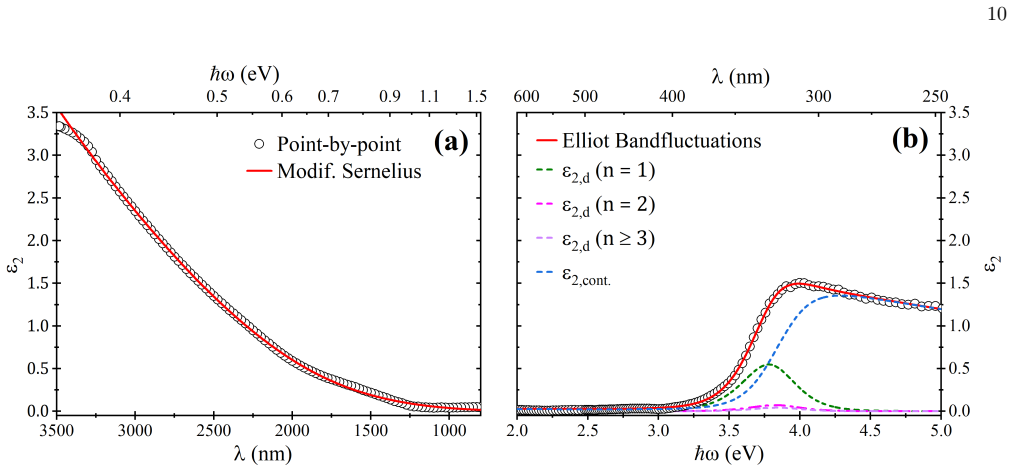
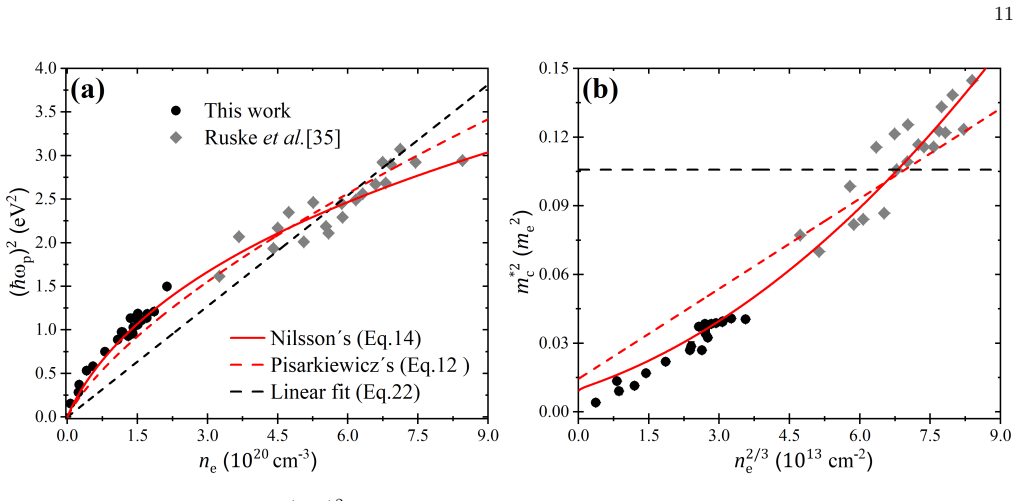
A comprehensive methodology is developed to extract electron and hole effective masses in degenerate semiconductors through a simultaneous global fit of carrier concentration dependence of bandgap and plasma energy, explicitly incorporating band nonparabolicity. Broadband spectroscopic ellipsometry combined with Hall effect analyses enables accurate determination of the bandgap, plasma energy and carrier concentrations. The dielectric function of sputtered Al-doped ZnO thin films are modeled in the fundamental absorption region using an Elliott based model with overlapping excitonic transitions and Urbach tails, while free carrier absorption is described by a modified sernelius formula. Wide carrier concentrations are achieved via controlled deposition and post-annealing, revealing changes in electron effective masses and deviations from parabolic dispersion. Two nonparabolic models are compared, Pisarkiewicz, assuming spherically symmetric band with a step-function approximation of the Fermi-Dirac distribution and Nilsson, incorporating thermal and impurity effects. The latter is shown to capture accurately band nonparabolicity, yielding effective masses and nonparabolicity parameter consistent with bandgap evolution. This approach quantitatively separates Burstein-Moss shift and bandgap renormalization, reproducing carrier dependent bandgap shifts across a wide concentration range. Neglecting valence band contributions introduces systematic bias. Bandgap renormalization is further evaluated using plasmon pole and random phase approximations, underscoring the importance of many-body screening. This framework also enables determination of the Mott critical concentration and the fundamental absorption edge onset. Collectively, these results establish a reliable methodology for extracting band-structure parameters and bandgap shifts, extendable to other transparent conducting oxides.
Editorial analysis
A structured set of objections, weighed in public.
Referee Report
Summary. The manuscript develops a global-fitting methodology to extract electron/hole effective masses and the nonparabolicity parameter in degenerate Al-doped ZnO by simultaneously modeling carrier-density dependence of the optical bandgap (from broadband ellipsometry) and plasma energy (from Hall data). An Elliott dielectric function with Urbach tails is used for the absorption edge and a modified Sernelius model for free-carrier response; two nonparabolic dispersion relations (Pisarkiewicz and Nilsson) are compared, with the Nilsson model reported to yield parameters consistent with the observed bandgap evolution while separating Burstein-Moss shift from bandgap renormalization. The approach is applied to films with carrier densities varied by deposition and post-annealing, and many-body screening is evaluated via plasmon-pole and RPA approximations.
Significance. If the central claims hold after addressing the issues below, the work supplies a practical, experimentally grounded route to band parameters in degenerate TCOs that is directly relevant to transparent-electrode optimization. The explicit model comparison, global fit across a wide doping range, and quantitative separation of BM and BGR shifts are strengths; the additional evaluation of Mott critical density and fundamental edge onset further increases utility for the field.
major comments (3)
- [global fit procedure and results section] The global fit simultaneously determines m_e^*, m_h^*, and the nonparabolicity parameter from the same carrier-dependent bandgap and plasma-energy data sets that are later invoked to demonstrate consistency with bandgap evolution (abstract and the fitting/results sections). This creates a circularity risk: agreement may be enforced by the fitting procedure rather than constituting an independent validation of the Nilsson dispersion. A concrete test—e.g., holding the fitted parameters fixed and predicting an independent observable such as the density-of-states effective mass from transport or cyclotron resonance—would be required to substantiate the claim.
- [sample preparation and global-fit methodology] Post-annealing is used to span the carrier-density range, yet the model does not explicitly account for annealing-induced changes in oxygen-vacancy or grain-boundary densities that alter Urbach-tail energy and excitonic contributions inside the Elliott dielectric function at fixed Fermi level. These effects can be absorbed into the fitted nonparabolicity parameter or BGR term, undermining the attribution of the observed trends solely to band nonparabolicity. The manuscript should quantify the magnitude of such processing-induced shifts (e.g., by comparing as-deposited vs. annealed samples at matched Hall density) or demonstrate that they are negligible relative to the reported parameter uncertainties.
- [discussion of valence-band terms] The abstract notes that neglecting valence-band contributions introduces systematic bias, yet the quantitative size of this bias on the extracted m_e^* and nonparabolicity parameter is not reported. Because the central claim rests on the superiority of the Nilsson model, an explicit sensitivity analysis (with and without valence-band terms) is needed to show that the model ranking and the reported consistency remain robust.
minor comments (2)
- [abstract] The abstract states that the Nilsson model 'captures accurately band nonparabolicity' but supplies no numerical values, uncertainties, or goodness-of-fit metrics for m_e^*, m_h^*, or the nonparabolicity parameter; these should be tabulated with the corresponding Pisarkiewicz results for direct comparison.
- [dielectric-function modeling section] Notation for the modified Sernelius free-carrier model and the precise form of the Elliott dielectric function (including how overlapping excitonic transitions are implemented) should be given explicitly, preferably with the relevant equations numbered.
Simulated Author's Rebuttal
We thank the referee for the constructive and detailed comments on our manuscript. We address each major comment below, indicating the revisions that will be incorporated.
read point-by-point responses
-
Referee: The global fit simultaneously determines m_e^*, m_h^*, and the nonparabolicity parameter from the same carrier-dependent bandgap and plasma-energy data sets that are later invoked to demonstrate consistency with bandgap evolution (abstract and the fitting/results sections). This creates a circularity risk: agreement may be enforced by the fitting procedure rather than constituting an independent validation of the Nilsson dispersion. A concrete test—e.g., holding the fitted parameters fixed and predicting an independent observable such as the density-of-states effective mass from transport or cyclotron resonance—would be required to substantiate the claim.
Authors: We acknowledge the concern about potential circularity. The bandgap (from ellipsometry) and plasma energy (from Hall) are independent experimental inputs. The global fit extracts parameters that describe their carrier dependence, with model superiority established by direct comparison of Nilsson versus Pisarkiewicz on the same dataset. To strengthen validation, the revised manuscript will include a calculation of the density-of-states effective mass from the fitted Nilsson parameters and its comparison to literature transport values. New cyclotron resonance measurements on these samples are not feasible within the present study. revision: partial
-
Referee: Post-annealing is used to span the carrier-density range, yet the model does not explicitly account for annealing-induced changes in oxygen-vacancy or grain-boundary densities that alter Urbach-tail energy and excitonic contributions inside the Elliott dielectric function at fixed Fermi level. These effects can be absorbed into the fitted nonparabolicity parameter or BGR term, undermining the attribution of the observed trends solely to band nonparabolicity. The manuscript should quantify the magnitude of such processing-induced shifts (e.g., by comparing as-deposited vs. annealed samples at matched Hall density) or demonstrate that they are negligible relative to the reported parameter uncertainties.
Authors: We agree this is a valid point. The revised manuscript will add a direct comparison of Urbach tail energies and excitonic parameters extracted from as-deposited versus annealed films at matched Hall carrier densities. This analysis will quantify any processing-induced shifts and demonstrate that they remain within the reported parameter uncertainties, supporting the attribution to band nonparabolicity. revision: yes
-
Referee: The abstract notes that neglecting valence-band contributions introduces systematic bias, yet the quantitative size of this bias on the extracted m_e^* and nonparabolicity parameter is not reported. Because the central claim rests on the superiority of the Nilsson model, an explicit sensitivity analysis (with and without valence-band terms) is needed to show that the model ranking and the reported consistency remain robust.
Authors: We concur that an explicit quantification is needed. The revised manuscript will include a sensitivity analysis performing global fits both with and without valence-band terms, reporting the resulting shifts in m_e^* and the nonparabolicity parameter. This will confirm that the Nilsson model ranking and consistency with bandgap evolution remain robust. revision: yes
Circularity Check
Nonparabolicity and effective-mass parameters fitted to bandgap-vs-n data then declared consistent with the same evolution
specific steps
-
fitted input called prediction
[Abstract]
"The latter is shown to capture accurately band nonparabolicity, yielding effective masses and nonparabolicity parameter consistent with bandgap evolution. This approach quantitatively separates Burstein-Moss shift and bandgap renormalization, reproducing carrier dependent bandgap shifts across a wide concentration range."
Effective masses and the nonparabolicity parameter are obtained by the global fit to the carrier-concentration dependence of bandgap and plasma energy; the reported consistency with bandgap evolution is therefore the direct numerical outcome of that fit rather than an independent test.
full rationale
The paper performs a global fit of the Nilsson (and Pisarkiewicz) nonparabolic dispersion models to the measured carrier-density dependence of both bandgap and plasma energy. The resulting m* and nonparabolicity coefficient are then presented as 'consistent with bandgap evolution' and as enabling quantitative separation of Burstein-Moss shift from renormalization. Because the consistency statement and the separation are direct outputs of the same fit to the identical dataset, the central claim reduces to a fitted-input-called-prediction pattern. No independent, out-of-sample prediction or external benchmark is supplied for the nonparabolicity parameter itself. The remainder of the derivation (Elliott dielectric function, modified Sernelius plasma term, RPA BGR) is not shown to be circular.
Axiom & Free-Parameter Ledger
free parameters (4)
- electron effective mass
- hole effective mass
- nonparabolicity parameter
- Urbach tail energy
axioms (3)
- domain assumption Dielectric function in the fundamental absorption region is described by an Elliott model with overlapping excitonic transitions and Urbach tails
- domain assumption Free carrier absorption follows a modified Sernelius formula
- domain assumption Band dispersion can be approximated by either the Pisarkiewicz step-function or Nilsson thermal-impurity model
Reference graph
Works this paper leans on
-
[1]
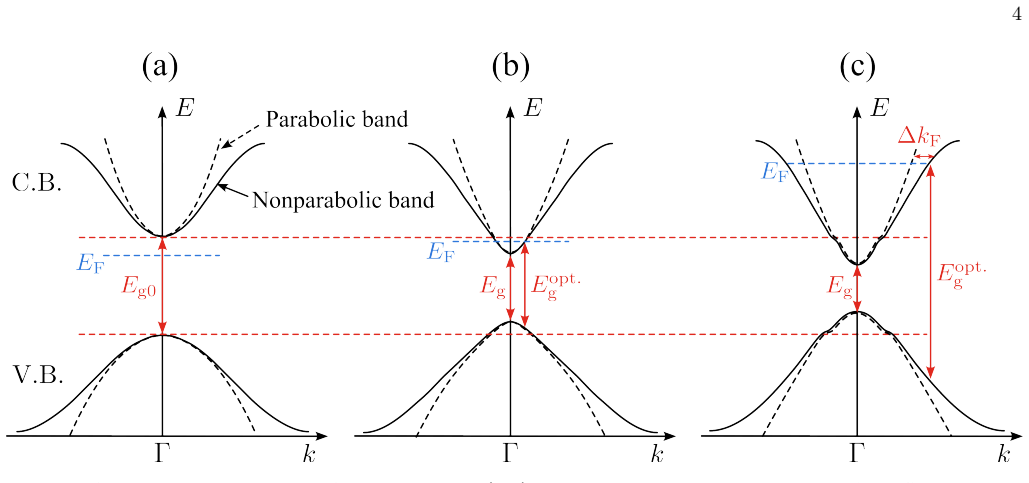
defined as Ecv(1 +CE cv) = ℏ2k2 F 2m∗c0v0 .(17) Here, the nonparabolicity curvature parameterCcan be related to the degree of admixture ofs-like CB states and p-like VB states withC∼ 1/Eg0. Calculations employing both approximations NP(CB)- P(VB) and JNPB yield nearly identical effective mass values and bandgap shifts, indicating weak sensitivity to valen...
-
[2]
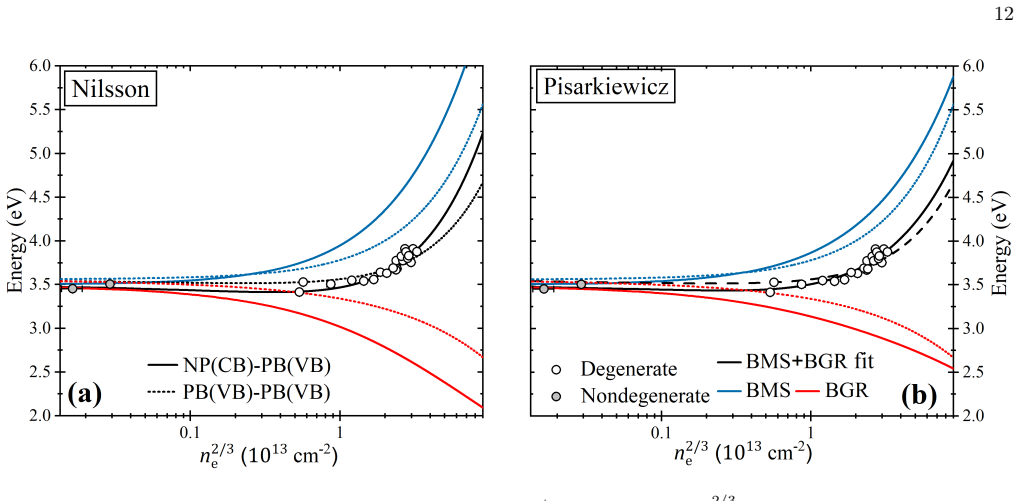
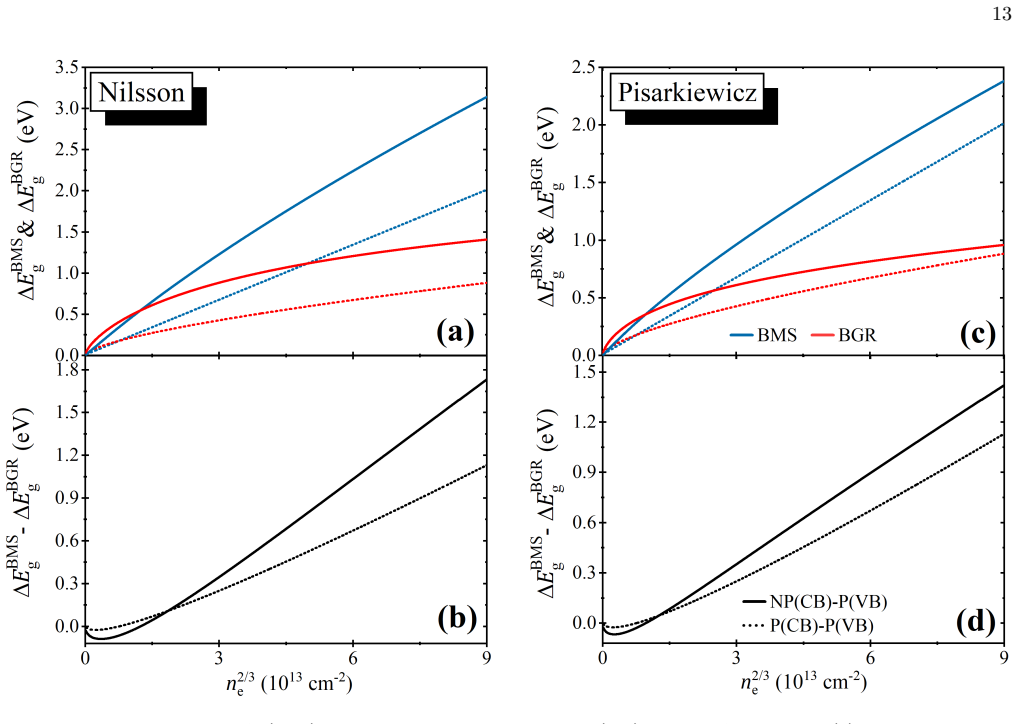
This methodology yields a band edge electron effec- tive mass (m∗ c0), nonparabolicity parameter (C), intrinsic bandgap (Eg0), and mean hole effective mass (m ∗ v0) in a fully self-consistent manner. Fig. 4 also depicts the competing BMS and BGR shifts calculated using parabolic (P(CB)–P(VB)) and nonparabolic (NP(CB)–P(VB)) band edge approxima- tions. A c...
-
[3]
Mishra acknowledges the support from the Pon- tificia Universidad Cat´ olica del Per´ u (PUCP) for the PhD scholarship grant No
S. Mishra acknowledges the support from the Pon- tificia Universidad Cat´ olica del Per´ u (PUCP) for the PhD scholarship grant No. DOC-2023-003. F.Bravo acknowl- edges the support from Vice Chancellorship of research CAP Grant No. PI-0888. L. A. Enrique acknowledges support from PUCP through the PhD scholarship grant No. DOC-2025-007. The authors acknowl...
2023
-
[4]
Hosono and K
H. Hosono and K. Ueda, Transparent conductive oxides, inSpringer Handbook of Electronic and Photonic Mate- rials, edited by S. Kasap and P. Capper (Springer Inter- national Publishing, Cham, 2017) pp. 1–1
2017
-
[5]
H. L. Hartnagel, A. L. Dawar, A. K. Jain, and C. Ja- gadish,Semiconducting Transparent Thin Films(Insti- tute of Physics, London, 1995)
1995
-
[6]
Aydin, M
E. Aydin, M. D. Bastiani, X. Yang, M. Sajjad, F. Al- jamaan, Y. Smirnov, M. N. Hedhili, W. Liu, T. G. Allen, L. Xu, E. V. Kerschaver, M. Morales-Masis, U. Schwingenschl¨ ogl, and S. D. Wolf, Zr-Doped Indium Oxide (IZRO) Transparent Electrodes for Perovskite- Based Tandem Solar Cells, Advanced Functional Mate- rials29, 1901741 (2019)
2019
-
[7]
Ruske, M
F. Ruske, M. Wimmer, G. K¨ oppel, A. Pflug, and B. Rech, Optical characterization of high mobility polycrystalline ZnO:Al films, inOxide-based Materials and Devices III, Proceedings of SPIE, Vol. 8263, edited by F. H. Teherani, D. C. Look, and D. J. Rogers (SPIE OPTO, San Fran- cisco, California, United States, 2012)
2012
-
[8]
Singh, P
J. Singh, P. Bhardwaj, R. Kumar, and V. Verma, Progress in developing highly efficient p-type tcos for transparent electronics: A comprehensive review, Jour- nal of Electronic Materials53, 7179 (2024)
2024
-
[9]
D. L. Young, T. J. Coutts, V. I. Kaydanov, A. S. Gilmore, and W. P. Mulligan, Direct measurement of density-of- states effective mass and scattering parameter in trans- parent conducting oxides using second-order transport phenomena, Journal of Vacuum Science & Technology A 18, 2978 (2000)
2000
-
[10]
H. Wen, B. Weng, B. Wang, W. Xiao, X. Liu, Y. Wang, M. Zhang, and H. Huang, Advancements in transparent conductive oxides for photoelectrochemical applications, Nanomaterials14, 10.3390/nano14070591 (2024)
-
[11]
L. A. Enrique, S. Mishra, E. Serquen, F. Bravo, K. Liz´ arraga, D. Cespedes, M. Pi˜ neiro, P. Llontop, and J. A. Guerra, Revisiting the optoelectronic properties of sputtered aluminium-doped zinc oxide: a study com- bining advanced optical dispersion models, Journal of Physics D: Applied Physics58, 095104 (2025)
2025
-
[12]
Schultes, T
M. Schultes, T. Helder, E. Ahlswede, M. F. Ayg¨ uler, P. Jackson, S. Paetel, J. A. Schwenzer, I. M. Hossain, U. W. Paetzold, and M. Powalla, Sputtered Transpar- ent Electrodes (IO:H and IZO) with Low Parasitic Near- Infrared Absorption for Perovskite–Cu(In,Ga)Se2 Tan- dem Solar Cells, ACS Applied Energy Materials2, 7823 (2019)
2019
-
[13]
L. D. Whalley, J. M. Frost, B. J. Morgan, and A. Walsh, Impact of nonparabolic electronic band structure on the optical and transport properties of photovoltaic materi- als, Phys. Rev. B99, 085207 (2019)
2019
-
[14]
Shirayama, H
M. Shirayama, H. Kadowaki, T. Miyadera, T. Sugita, M. Tamakoshi, M. Kato, T. Fujiseki, D. Murata, S. Hara, T. N. Murakami, S. Fujimoto, M. Chikamatsu, and H. Fujiwara, Optical Transitions in Hybrid Perovskite So- lar Cells: Ellipsometry, Density Functional Theory, and 15 Quantum Efficiency Analyses for CH 3NH3PbI3, Phys. Rev. Appl.5, 014012 (2016)
2016
-
[15]
J. Jia, A. Takasaki, N. Oka, and Y. Shigesato, Experi- mental observation on the Fermi level shift in polycrys- talline Al-doped ZnO films, Journal of Applied Physics 112, 013718 (2012)
2012
-
[16]
L. Y. Lim, S. Lany, Y. J. Chang, E. Rotenberg, A. Zunger, and M. F. Toney, Angle-resolved photoemis- sion and quasiparticle calculation of ZnO: The need for d band shift in oxide semiconductors, Physical Review B 86, 235113 (2012)
2012
-
[17]
A. R. H. Preston, B. J. Ruck, L. F. J. Piper, A. DeMasi, K. E. Smith, A. Schleife, F. Fuchs, F. Bechstedt, J. Chai, et al., Band structure of ZnO from resonant x-ray emis- sion spectroscopy, Physical Review B78, 155114 (2008)
2008
-
[18]
Feneberg, J
M. Feneberg, J. Nixdorf, C. Lidig, R. Goldhahn, Z. Galazka, O. Bierwagen, and J. S. Speck, Many-electron effects on the dielectric function of cubic In 2O3: Effec- tive electron mass, band nonparabolicity, band gap renor- malization, and Burstein-Moss shift, Phys. Rev. B93, 045203 (2016)
2016
-
[19]
Abdolahzadeh Ziabari and S
A. Abdolahzadeh Ziabari and S. Rozati, Carrier trans- port and bandgap shift in n-type degenerate ZnO thin films: The effect of band edge nonparabolicity, Physica B: Condensed Matter407, 4512 (2012)
2012
-
[20]
Jianguo, S
L. Jianguo, S. , T. Kawaharamura, H. Nishinaka, Y. Ka- mada, T. Ohshima, Z. Ye, Y. Zeng, Y. Zhang, L. Zhu, H. He, and B. Zhao, Carrier Concentration Dependence of Band Gap Shift in n-Type ZnO: Al Films, Journal of Applied Physics101(2007)
2007
-
[21]
G. D. Mahan, Excitons in degenerate semiconductors, Phys. Rev.153, 882 (1967)
1967
-
[22]
Ino and N
N. Ino and N. Yamamoto, Low temperature diffu- sion length of excitons in gallium nitride measured by cathodoluminescence technique, Applied Physics Letters 93, 232103 (2008)
2008
-
[23]
Bundesmann, M
C. Bundesmann, M. Schubert, D. Spemann, H. von Wenckstern, H. Hochmuth, E. M. Kaidashev, M. Lorenz, and M. Grundmann, Long-wavelength bound and un- bound charge excitations in doped ZnO and ZnO based alloy thin films, Applied Physics A80, 241 (2005)
2005
-
[24]
D. N. Papadimitriou, Engineering of Optical and Electri- cal Properties of Electrodeposited Highly Doped Al:ZnO and In:ZnO for Cost-Effective Photovoltaic Device Tech- nology, Micromachines13, 10.3390/mi13111966 (2022)
-
[25]
M. H. Kabir, M. M. Ali, M. A. Kaiyum, and M. S. Rah- man, Effect of annealing temperature on structural mor- phological and optical properties of spray pyrolized Al- doped ZnO thin films, Journal of Physics Communica- tions3, 105007 (2019)
2019
-
[26]
A. Esmaeili, Many-body, pauli blocking and carrier- impurity interaction effects on the band gap of aluminum doped zinc oxide thin films: A new method to evalu- ate both hole and electron effective masses of degenerate semiconductors, Current Applied Physics16, 949 (2016)
2016
-
[27]
Spadoni and M
A. Spadoni and M. Addonizio, Effect of the RF sput- tering power on microstructural, optical and electrical properties of Al doped ZnO thin films, Thin Solid Films 589, 514 (2015)
2015
-
[28]
Preissler, O
N. Preissler, O. Bierwagen, A. T. Ramu, and J. S. Speck, Electrical transport, electrothermal transport, and effec- tive electron mass in single-crystalline In2O3 films, Phys. Rev. B88, 085305 (2013)
2013
-
[29]
Krishnaswamy, B
K. Krishnaswamy, B. Himmetoglu, Y. Kang, A. Janotti, and C. G. Van de Walle, First-principles analysis of elec- tron transport in basno3, Phys. Rev. B95, 205202 (2017)
2017
-
[30]
Z. Wang, J. Chu, H. Zhu, Z. Sun, Y. Chen, and S. Huang, Growth of ZnO:Al films by RF sputtering at room tem- perature for solar cell applications, Solid-State Electron- ics53, 1149 (2009)
2009
-
[31]
Misra, V
P. Misra, V. Ganeshan, and N. Agrawal, Low tempera- ture deposition of highly transparent and conducting Al- doped ZnO films by RF magnetron sputtering, Journal of Alloys and Compounds725, 60 (2017)
2017
-
[32]
A. Axelevitch, Hot-probe characterization of transparent conductive thin films, Materials14, 10.3390/ma14051186 (2021)
-
[33]
J. A. Guerra, A. Tejada, L. Korte, L. Kegelmann, J. A. T¨ offlinger, S. Albrecht, B. Rech, and R. Weing¨ artner, De- termination of the complex refractive index and optical bandgap of CH 3NH3PbI3 thin films, Journal of Applied Physics121, 173104 (2017)
2017
-
[34]
Tejada, S
A. Tejada, S. Braunger, L. Korte, S. Albrecht, B. Rech, and J. A. Guerra, Optical characterization and bandgap engineering of flat and wrinkle-textured FA0.83Cs0.17Pb(I1–xBrx)3 perovskite thin films, Journal of Applied Physics123, 175302 (2018)
2018
-
[35]
Liz´ arraga, E
K. Liz´ arraga, E. Serquen, P. Llontop, L. A. Enrique, M. Pi˜ neiro, E. Perez, A. Tejada, F. Ruske, L. Korte, and J. A. Guerra, Description of excitonic absorption using the sommerfeld enhancement factor and band- fluctuations, Journal of Physics D: Applied Physics58, 065102 (2024)
2024
-
[36]
Y. Zhang, Many-Body Calculations of Excitons in Two- Dimensional GaN, Crystals13, 10.3390/cryst13071048 (2023)
-
[37]
Pflug, V
A. Pflug, V. Sittinger, Florian, B. Szyszka, and G. Dittmar, Optical characterization of aluminum-doped zinc oxide films by advanced dispersion theories, Thin Solid Films455-456, 201 (2004), the 3rd International Conference on Spectroscopic Ellipsometry
2004
-
[38]
Ruske, A
F. Ruske, A. Pflug, V. Sittinger, B. Szyszka, D. Greiner, and B. Rech, Optical modeling of free electron behavior in highly doped ZnO films, Thin Solid Films518, 1289 (2009), transparent Conductive Oxides
2009
-
[39]
N. G. Nilsson, An accurate approximation of the gen- eralized einstein relation for degenerate semiconductors, physica status solidi (a)19, K75 (1973)
1973
-
[40]
Ellmer, Resistivity of polycrystalline zinc oxide films: current status and physical limit, Journal of Physics D: Applied Physics34, 3097 (2001)
K. Ellmer, Resistivity of polycrystalline zinc oxide films: current status and physical limit, Journal of Physics D: Applied Physics34, 3097 (2001)
2001
-
[41]
Blakemore, Approximations for Fermi-Dirac integrals, especially the function F 12(η) used to describe electron density in a semiconductor, Solid-State Electronics25, 1067 (1982)
J. Blakemore, Approximations for Fermi-Dirac integrals, especially the function F 12(η) used to describe electron density in a semiconductor, Solid-State Electronics25, 1067 (1982)
1982
-
[42]
D. C. Reynolds, D. C. Look, B. Jogai, C. W. Litton, G. Cantwell, and W. C. Harsch, Valence-band ordering in zno, Phys. Rev. B60, 2340 (1999)
1999
-
[43]
S. L. Shi and S. J. Xu, Determination of effective mass of heavy hole from phonon-assisted excitonic luminescence spectra in ZnO, Journal of Applied Physics109, 053510 (2011)
2011
-
[44]
S. K. Shadangi and G. S. Tripathi, Theory of ⃗k· ⃗ πelectronic structure and some related properties of ZnO, Semiconductor Science and Technology31, 035018 (2016)
2016
-
[45]
Tripathi, S
P. Tripathi, S. Nayak, and G. Tripathi, ⃗k·⃗ πelectronic structure theory of strained wurtzite ZnO, 2020 Phys. Scr. 95 125801, Physica Scripta95, 125801 (2020). 16
2020
-
[46]
Schleife, C
A. Schleife, C. R¨ odl, F. Fuchs, K. Hannewald, and F. Bechstedt, Optical absorption in degenerately doped semiconductors: Mott transition or mahan excitons?, Phys. Rev. Lett.107, 236405 (2011)
2011
-
[47]
Glutsch,Excitons in Low-Dimensional Semicon- ductors: Theory, Numerical Methods, Applications (Springer, New York, 2004)
S. Glutsch,Excitons in Low-Dimensional Semicon- ductors: Theory, Numerical Methods, Applications (Springer, New York, 2004)
2004
-
[48]
B. E. Sernelius, K.-F. Berggren, Z.-C. Jin, I. Ham- berg, and C. G. Granqvist, Band-gap tailoring of ZnO by means of heavy Al doping, Phys. Rev. B37, 10244 (1988)
1988
-
[49]
Gupta, A
L. Gupta, A. Mansingh, and P. Srivastava, Band gap narrowing and the band structure of tin-doped indium oxide films, Thin Solid Films176, 33 (1989)
1989
-
[50]
K. F. Berggren and B. E. Sernelius, Band-gap narrowing in heavily doped many-valley semiconductors, Phys. Rev. B24, 1971 (1981)
1971
-
[51]
Hamberg, C
I. Hamberg, C. Granqvist, K. Berggren, B. Sernelius, and L. Engstr¨ om, Bandgap Widening in Heavily Sn-Doped In2O3, Phys. Rev. B30(1984)
1984
-
[52]
Pisarkiewicz, K
T. Pisarkiewicz, K. Zakrzewska, and E. Leja, Scatter- ing of charge carriers in transparent and conducting thin oxide films with a non-parabolic conduction band, Thin Solid Films174, 217 (1989)
1989
-
[53]
Pisarkiewicz and A
T. Pisarkiewicz and A. Kolodziej, Nonparabolicity of the conduction band structure in degenerate tin dioxide, physica status solidi (b)158, K5 (1990)
1990
-
[54]
Feneberg, S
M. Feneberg, S. Osterburg, K. Lange, C. Lidig, B. Garke, R. Goldhahn, E. Richter, C. Netzel, M. D. Neumann, N. Esser, S. Fritze, H. Witte, J. Bl¨ asing, A. Dadgar, and A. Krost, Band gap renormalization and Burstein-Moss effect in silicon- and germanium-doped wurtzite GaN up to 1020cm−3, Phys. Rev. B90, 075203 (2014)
2014
-
[55]
Walsh, J
A. Walsh, J. L. F. Da Silva, and S.-H. Wei, Origins of band-gap renormalization in degenerately doped semi- conductors, Phys. Rev. B78, 075211 (2008)
2008
-
[56]
E. O. Kane, Band structure of indium antimonide, Jour- nal of Physics and Chemistry of Solids1, 249 (1957)
1957
-
[57]
Ruf and M
T. Ruf and M. Cardona, Nonparabolicity of the conduc- tion band in gaas, Phys. Rev. B41, 10747 (1990)
1990
-
[58]
Shokhovets, O
S. Shokhovets, O. Ambacher, B. Meyer, and G. Gobsch, Anisotropy of the momentum matrix element, dichro- ism, and conduction-band dispersion relation of wurtzite semiconductors, Phys. Rev. B78(2008)
2008
-
[59]
Datta,Quantum Phenomena, edited by R
S. Datta,Quantum Phenomena, edited by R. F. Pierret and G. W. Neudeck, Modular Series on Solid State De- vices, Vol. VIII (Addison-Wesley Publishing Company, Reading, Massachusetts, 1989)
1989
-
[60]
N. W. Ashcroft and N. D. Mermin,Solid State Physics, 1st ed. (Holt, Rinehart and Winston, New York, 1976)
1976
-
[61]
D. Vasileska, Lecture notes on semiconductor physics rel- evant to computational electronics, lecture notes, Czech Technical University in Prague (2023), available athttp: //kfe.fjfi.cvut.cz/src/web/nanohub.org
2023
-
[62]
Bikowski and K
A. Bikowski and K. Ellmer, Analytical model of electron transport in polycrystalline, degenerately doped ZnO films, Journal of Applied Physics116, 143704 (2014)
2014
-
[63]
Ellmer, inTransparent Conductive Zinc Oxide: Ba- sics and Applications in Thin Film Solar Cells, edited by K
K. Ellmer, inTransparent Conductive Zinc Oxide: Ba- sics and Applications in Thin Film Solar Cells, edited by K. Ellmer, A. Klein, and B. Rech (Springer, Berlin,
-
[64]
P. Gori, M. Rakel, C. Cobet, W. Richter, N. Esser, A. Hoffmann, R. Del Sole, A. Cricenti, and O. Pulci, Op- tical spectra of ZnO in the far ultraviolet: First-principles calculations and ellipsometric measurements, Phys. Rev. B81, 125207 (2010)
2010
-
[65]
P. Llontop,Characterization of luminescent ITO:Tb and AZO:Tb thin films prepared by radio frequency magnetron sputtering, Phd thesis, Pontificia Universidad Cat´ olica del Per´ u (2023)
2023
-
[66]
Guerra, A
J. Guerra, A. Tejada, J. T¨ offlinger, R. Grieseler, and L. Korte, Band-fluctuations model for the fundamental absorption of crystalline and amorphous semiconductors: A dimensionless joint density of states analysis, Journal of Physics D Applied Physics52, 105303 (2019)
2019
-
[67]
N. F. Mott, The transition to the metallic state, Philo- sophical Magazine6, 287 (1961)
1961
-
[68]
A. P. Roth, J. B. Webb, and D. F. Williams, Band-gap narrowing in heavily defect-doped ZnO, Phys. Rev. B25, 7836 (1982)
1982
-
[69]
Fujiwara and M
H. Fujiwara and M. Kondo, Effects of carrier concentra- tion on the dielectric function of ZnO:Ga and In 2O3 : Sn studied by spectroscopic ellipsometry: Analysis of free- carrier and band-edge absorption, Phys. Rev. B71, 075109 (2005)
2005
-
[70]
K. Saw, N. Aznan, F. Yam, S. S. Ng, and S. Pung, New insights on the burstein-moss shift and band gap narrow- ing in indium-doped zinc oxide thin films, PLOS ONE10, e0141180 (2015)
2015
-
[71]
Syrbu, I
N. Syrbu, I. Tiginyanu, V. Zalamai, V. Ursaki, and E. Rusu, Exciton polariton spectra and carrier effective masses in ZnO single crystals, Physica B: Condensed Matter353, 111 (2004)
2004
-
[72]
T. G. Castner, N. K. Lee, G. S. Cieloszyk, and G. L. Salinger, Dielectric anomaly and the metal-insulator transition inn-type silicon, Phys. Rev. Lett.34, 1627 (1975)
1975
-
[73]
Klingshirn, J
C. Klingshirn, J. Fallert, H. Zhou, J. Sartor, C. Thiele, F. Maier-Flaig, D. Schneider, and H. Kalt, 65 years of zno research – old and very recent results, physica status solidi (b)247, 1424 (2010)
2010
-
[74]
Klingshirn, B
C. Klingshirn, B. Meyer, A. Hoffmann, and J. Geurts, Zinc oxide – from fundamental properties towards novel applications, inZinc Oxide: From Fundamental Proper- ties Towards Novel Applications, Springer Series in Ma- terials Science, Vol. 120 (Springer-Verlag Berlin Heidel- berg, 2010)
2010
discussion (0)
Sign in with ORCID, Apple, or X to comment. Anyone can read and Pith papers without signing in.