REVIEW 4 major objections 3 minor 300 references
Light-Front approach to $4d$ massless Higher-Spin interactions
T0 review · 4 major / 3 minor · reviewed 2026-08-03 · deepseek-v4-flash
Pith's one-line read The thesis claims that the space of 4d massless higher-spin theories is far richer than previously assumed: infinitely many consistent local theories exist, and the full quartic constraint leaves Yang-Mills, gravity, and new quasi-chiral fa
desk verdict A careful, genuinely original solution of the light-front quartic holomorphic constraint with many new chiral higher-spin theories, but the 'all' claims need a completeness proof and the Chapter 4 determination is announced as a conjecture. read the letter →
The pith
A machine-rendered reading of the paper's core claim, the machinery that carries it, and where it could break.
The reading
What carries the argument
The load-bearing object is the light-front Hamiltonian density h_n(P_ij, Pbar_ij, beta_k), subject to the locality rule that inverse transverse momenta 1/q and 1/qbar are forbidden while inverse beta is allowed. The quartic holomorphic constraint, obtained from the dynamical commutator [J^a-, P^-]=0, is a polynomial identity in three variables whose solution forces C_{lambda1 lambda2 omega} times C_{-omega lambda3 lambda4} to follow a factorial formula. The combinatorial engine is the 'small crystal': the six-product system (2.4.1)-(2.4.2) that lists which cubic couplings must appear together for a consistent two-derivative theory. Carrying the argument are the general even- and odd-derivati
What would settle it
Reduce the standard minimally-coupled gravitational interaction of a massless spin-3 field to light-front gauge and check whether a consistent quartic completion requires an inverse transverse momentum; if yes, the classification covers only light-front-local theories, not all local ones. Alternatively, construct a low-derivative non-chiral four-point vertex with a coloured graviton that satisfies the full quartic constraint; that would falsify the no-go for multi-graviton theories.
Extended reading notes
Core claim
The thesis establishes that the quartic light-front consistency constraint—the condition that the interacting Poincaré algebra closes at four points—does not force a unique higher-spin theory. The general solution of the holomorphic constraint has a factorial form, with products of pairs of cubic couplings fixed by a single overall constant per derivative order, and the thesis shows that the allowed sets of couplings are organized into 'small crystals': a single pair of two-derivative couplings forces six couplings to coexist, with equal products. Iterating this rule produces a complete catalogue of one- and two-derivative theories—nine families of self-dual-gravity-like theories, three infi
Load-bearing premise
The classification's 'all' is asserted inside the light-front locality class: interaction densities must be functions of P_ij, Pbar_ij and beta with no inverse transverse momenta 1/q or 1/qbar; if a manifestly local covariant theory maps to a vertex outside this class, the completeness claim does not cover it.
Editorial extensions
If this is right
- If correct, every one- and two-derivative chiral higher-spin theory is a subsector of the higher-spin extension of self-dual Yang-Mills or self-dual gravity, making the known chiral theory a hub rather than an isolated example.
- The crystal rules imply that turning on a single two-derivative coupling can force a whole finite or infinite spectrum; couplings cannot be switched on independently.
- The non-holomorphic analysis rules out interacting multi-graviton theories at low derivatives, confirming a long-standing no-go within the light-front class, while leaving Yang-Mills and gravity as the lower-spin survivors.
- All local four-point higher-spin amplitudes satisfying factorisation are determined, giving a complete on-shell output for the classified theories.
- New unitary quasi-chiral families provide explicit examples of consistent higher-spin completions with both chiralities interacting, beyond the purely chiral theory.
Reading between the lines
- Because the 'all' in the classification means all theories satisfying the light-front locality criterion, the completeness statement does not automatically cover every manifestly covariant local theory; the thesis itself notes that some light-front vertices become covariant only at the price of non-locality. A natural test is to reduce a known covariant local higher-spin interaction to light-front
- The appearance of fractional helicities (2/3, 4/3, ...) among the solutions suggests the algebraic structure tolerates objects that are not standard integer-spin fields; if these are taken seriously rather than discarded, they would be a new class of 'fractional spin' representations in flat space.
- The unconstrained product C_{lambda,lambda,0} C_{0,lambda',lambda'} indicates that some couplings remain free parameters even inside a classified theory; this means the classification fixes spectra and relations but not every coupling, so amplitudes may carry continuous free parameters that the factorisation analysis should expose.
- The small-crystal iteration could be turned into an algorithmic classification for three- and higher-derivative vertices: if the pattern persists, the full space of local higher-spin theories would be recursively generated from finite seeds, making the quasi-chiral families the first step of an infinite ladder.
Signed reviews
Editorial analysis
A structured set of objections, weighed in public.
Referee Report
Summary. The thesis develops the light-front (light-cone) approach to four-dimensional massless higher-spin interactions, focusing on closure of the Poincaré algebra at quartic order. Chapter 2 solves the holomorphic quartic constraint and claims a complete classification of one- and two-derivative chiral higher-spin theories, recovering HS-SDYM, HS-SDGR, and chiral higher-spin gravity as special cases, and finding new finite and infinite families. Chapter 3 connects the light-cone holomorphic constraint to celestial OPE associativity, Jacobi identities of the kinematical algebra, and vanishing of tree-level amplitudes. Chapter 4 analyzes the full non-holomorphic quartic constraint, recovers Yang-Mills and gravity, reproduces the multi-graviton inconsistency, and proposes new unitary and quasi-chiral higher-spin theories, with a conjectured catalogue of local quartic vertices and four-point amplitudes.
Significance. If the central claims hold, this is a substantial contribution to the classification of 4d higher-spin interactions. The manuscript is anchored by concrete external benchmarks: the constraint equations are solved rather than fitted, the Metsaev Γ-factorial solution is re-derived, and known lower-spin theories (SDYM, SDGR, Yang-Mills, gravity) are reproduced. The explicit identification of infinite families of local higher-spin theories with finite or infinite spectra, and the recovery of the multi-graviton inconsistency, are valuable results that would give new structure to the higher-spin landscape. However, the advertised completeness claims currently outrun the proofs supplied in the text.
major comments (4)
- [§2.4.1, Eqs. (2.4.1)–(2.4.2)] The classification of two-derivative chiral theories is presented as complete, but the enumeration procedure states: 'we iterate this process up to three times and then stop.' No proof is given that every solution of the factorized holomorphic constraint (2.3.51) is generated by a small crystal, nor that three iterations suffice. The later assertion that all one- and two-derivative theories have all possible cubic couplings built from their spectrum is called an 'experimental fact' rather than proved. Since the Chapter 2 abstract and the thesis abstract claim a complete classification, this is a load-bearing gap: a consistent crystal requiring a fourth iteration, or a seed not reachable by the stated equivalence moves, would invalidate the 'all' claim.
- [Ch. 4 outline bullet; §4.6–§4.7] The thesis abstract states that the paper 'determine[s] all local higher-spin four-point amplitudes,' but the Chapter 4 outline explicitly says: 'we conjecture the complete set of quartic vertices satisfying the light-cone consistency conditions.' A conjectured set cannot ground a determination of all amplitudes unless a separate argument shows that the amplitude catalogue is insensitive to the unproven part of the vertex set, or that the conjecture is proven. The manuscript should either provide such an argument or clearly separate the proven results from the conjectural completeness statement.
- [§1.2, Eqs. (1.2.96)–(1.2.100)] The classification's universe of discourse is the space of light-front densities depending on P_ij, \bar P_ij, β_k with no inverse transverse momenta 1/q or 1/\bar q. This is a light-front notion of locality; as the manuscript itself notes via [139], light-front and covariant locality can differ. The abstract's unrestricted phrase 'all local higher-spin theories' and 'all local ... amplitudes' is therefore not supported unless the claims are explicitly scoped to this light-front locality criterion, or an argument is given that every perturbatively local covariant theory satisfies the criterion after light-cone gauge fixing.
- [§2.4.1, 'only report the physical solutions'] In the same section that claims a complete classification, the text says: 'In general, the solutions may also include non-integer helicities... In the classification below, we only report the physical solutions.' This means the enumeration is implicitly restricted to integer helicities, despite the abstract's unqualified 'all.' The manuscript should state this restriction explicitly and justify it on physical grounds (e.g. unitarity, bosonic statistics) rather than leaving it as an unexplained omission from the announced classification.
minor comments (3)
- [§3.6] The claimed equivalence between celestial OPE associativity, the Jacobi identity, vanishing of tree-level amplitudes, and the light-cone holomorphic constraint should be stated with explicit directionality and domain (tree-level, all helicities, with/without gauge group). Some intermediate equations in this section are not numbered, making the logical chain harder to verify.
- [§2.3, Eqs. (2.3.44)–(2.3.45)] The derivation of the Metsaev solution assumes all even couplings are non-vanishing, and similarly for the odd case. This assumption should be stated before the uniqueness step, since the subsequent conclusion that no mixed even/odd solution exists depends on it.
- [General] There are numerous typos and formatting issues, e.g. 'responsable', 'complexifactors', 'garzie', and an unnumbered displayed equation in §2.3.2. A careful proofread is needed before publication.
Circularity Check
No load-bearing circularity: core constraints are solved and cross-checked against known lower-spin theories; the main caveats are completeness gaps, not circular reductions.
full rationale
The central derivation chain is self-contained. The holomorphic constraint (2.3.5) is solved case-by-case, yielding the general and even-derivative solutions (2.3.50)-(2.3.51). The factorial form (2.3.9) is stated as the pattern that emerges ('As we will see, we always end up with a system of the general form...'), but the case analysis determines the polynomial functions f from the constraint itself rather than fitting parameters, and the Metsaev solution (2.3.44) is re-derived from factorization of the products C^1234_omega, not imported as an unverified input. The small-crystal rules (2.4.1)-(2.4.2) are presented as consequences of the solved two-derivative specialization of the constraint, and the classification enumerates crystals satisfying those rules; no fitted quantity is later renamed as a prediction. Known lower-spin results (SDYM, SDGR, Yang-Mills, GR) are recovered as external anchors, which is evidence that the machinery is not merely self-referential. The real weaknesses are completeness gaps, not circularity: Section 2.4.1 says 'we iterate this process up to three times and then stop' without proving that every consistent crystal is generated within three iterations, and the outline explicitly states that the Chapter 4 quartic-vertex set is 'conjecture[d]' before the abstract-style claim to 'determine all local higher-spin four-point amplitudes'. These are unsupported or overbroad claims, but they do not reduce the conclusions to the assumptions by construction. Self-citations (the chapters are stated to be identical to the author's papers [7]-[9]; the solution procedure references Appendix A of [6]) are not load-bearing: [6] is an external anchor, and the key constraints are solved in-text against known benchmarks. Score 2 reflects minor self-citation and acknowledged completeness caveats without any circular derivation step.
Assumptions & free parameters
free parameters (3)
- cubic coupling constants C_{λ1,λ2,λ3} =
constrained by (2.3.50)-(2.3.51), (2.4.2); overall scales k± and products C_{λ,λ,0}C_{0,μ,μ} free
- fractional-helicity parameter in infinite crystal families =
e.g. λ ≡ 2 (mod 4), λ odd, or λ ∈ Z_{≥0} in families (2.4.27)-(2.4.51)
- length scale ℓ_p in Metsaev couplings =
C ~ (ℓ_p)^{λ123−1}/Γ(λ123)
assumptions (8)
- domain assumption ∂+ is invertible (no zero modes p+ = 0)
- domain assumption Light-front locality = no inverse powers of q or q̄; inverse β allowed
- domain assumption Holomorphic/quartic chiral-sector decoupling ('miracle')
- ad hoc to paper Coupling symmetry C_{λ1,λ2,λ3} = (−)^{λ123} C_{λσ1,λσ2,λσ3} and cyclic symmetry (U(N) case)
- ad hoc to paper Solution form (2.3.9): C1234ω ∝ (Λ−2)!/(2^{Λ−2}(λ12+ω−1)!(λ34−ω−1)!)
- ad hoc to paper U(N) phase θ_ω = (−)^ω
- domain assumption Kinematical constraint solution: densities h_n(P_ij, P̄_ij, β_k) with homogeneity (1.2.96)-(1.2.100)
- standard math Combinatorial identities (2.3.17), (2.3.61): sums over ω of (Λ−2)!/(2^{Λ−3}(λ12+ω−1)!(λ34−ω−1)!) = 1
invented entities (2)
-
Fractional-helicity fields (λ = 2/3, 4/3, ...)
-
Quasi-chiral higher-spin theories (Chapter 4 families)
Cite this review
Pith. "Pith review of Light-Front approach to $4d$ massless Higher-Spin interactions." pith.science (2026). https://pith.science/paper/QIZ7H4RJ
@misc{pith2026260728183,
  author       = {Pith},
  title        = {Pith review of: Light-Front approach to $4d$ massless Higher-Spin interactions},
  year         = {2026},
  howpublished = {\url{https://pith.science/paper/QIZ7H4RJ}},
  note         = {Machine review of arXiv:2607.28183}
}
abstract
This thesis studies $4d$ massless higher-spin interactions in the Light-Front approach by analysing the closure of the Poincar\'e algebra at quartic order. We first solve the light-cone quartic holomorphic constraint in flat space and show the existence of infinitely many interacting local higher-spin theories with either a finite or infinite number of fields. We classify all one- and two-derivative theories, corresponding to higher-spin extensions of gauge and gravitational interactions. These are consistent subsectors of higher-spin extensions of self-dual Yang--Mills and gravity, themselves truncations of Chiral Higher-Spin Gravity. We then clarify the relation between the OPE associativity in celestial CFT, the vanishing of tree-level amplitudes for generic kinematics, the Jacobi identity of the associated ''gauge algebra'' (kinematical algebra), and the light-cone holomorphic constraints. Finally, we investigate the non-holomorphic quartic constraint involving both MHV and anti-MHV vertices. We recover the existence of Yang-Mills theory and gravity, and the inconsistency of interacting multi-graviton theories. We then show that once higher-derivative cubic vertices are included, nontrivial solutions to the full quartic constraint exist. We classify all unitary local higher-spin theories, identify new families of local quasi-chiral theories, and determine all local higher-spin four-point amplitudes using the spinor-helicity formalism together with locality in the form of consistent factorisation.
Figures
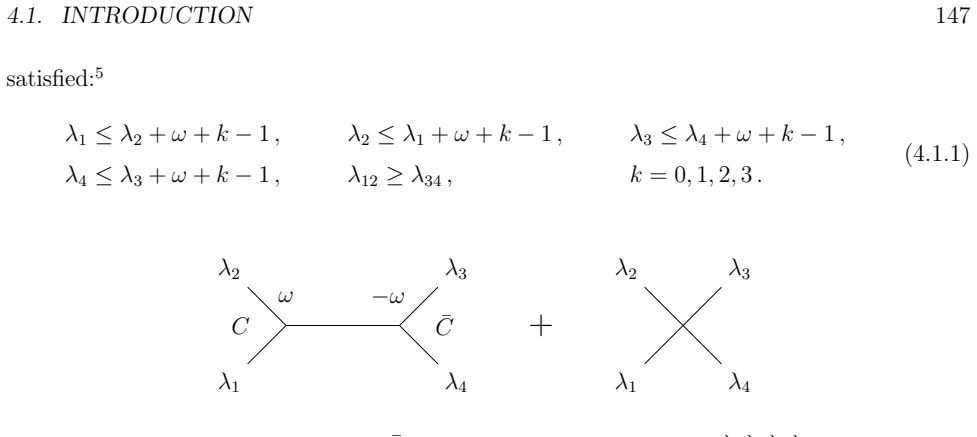


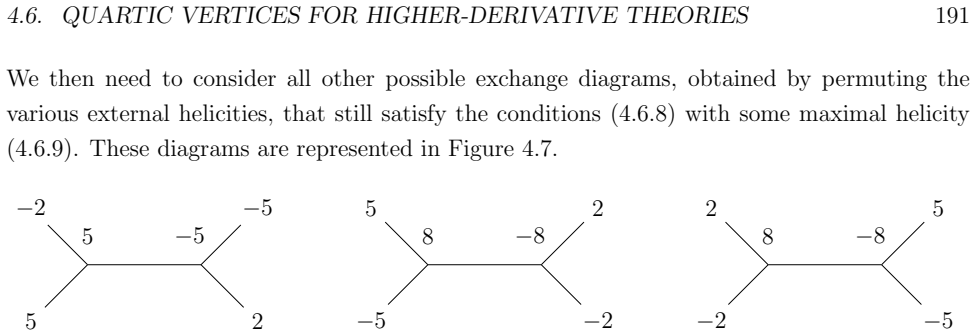
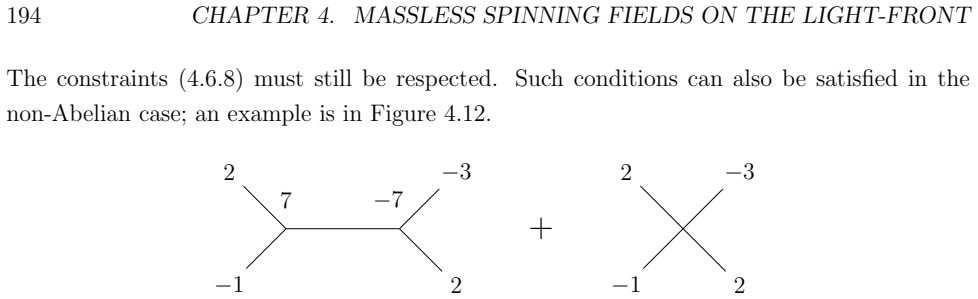
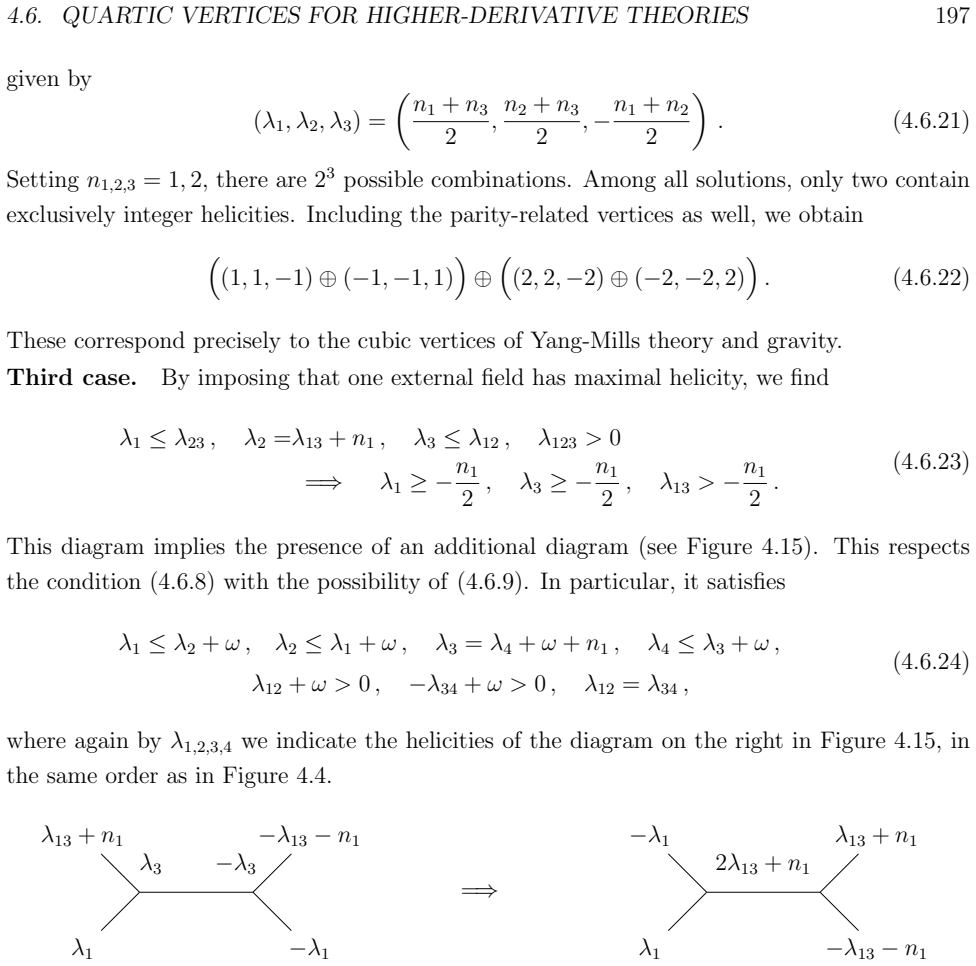
Figures from the paper (19 more)










Reference graph
Works this paper leans on
-
[139]
Spinor-Helicity Three-Point Amplitudes from Local Cubic Interactions,
E. Conde, E. Joung, and K. Mkrtchyan, “Spinor-Helicity Three-Point Amplitudes from Local Cubic Interactions,”JHEP08(2016) 040,1605.07402
arXiv 2016
-
[1]
Cubic interaction terms for arbitrary spin,
A. K. H. Bengtsson, I. Bengtsson, and L. Brink, “Cubic interaction terms for arbitrary spin,”Nucl. Phys.B227(1983) 31
1983
-
[2]
Cubic interaction terms for arbitrarily extended Supermultiplets,
A. K. H. Bengtsson, I. Bengtsson, and L. Brink, “Cubic interaction terms for arbitrarily extended Supermultiplets,”Nucl. Phys.B227(1983) 41
1983
-
[3]
Interacting Higher Spin Gauge Fields on the Light Front,
A. K. H. Bengtsson, I. Bengtsson, and N. Linden, “Interacting Higher Spin Gauge Fields on the Light Front,”Class. Quant. Grav.4(1987) 1333
1987
-
[4]
Poincare invariant dynamics of massless higher spins: Fourth order analysis on mass shell,
R. R. Metsaev, “Poincare invariant dynamics of massless higher spins: Fourth order analysis on mass shell,”Mod. Phys. Lett.A6(1991) 359–367
1991
-
[5]
Smatrix approach to massless higher spins theory. 2: The Case of internal symmetry,
R. R. Metsaev, “Smatrix approach to massless higher spins theory. 2: The Case of internal symmetry,” Mod. Phys. Lett.A6(1991) 2411–2421
1991
-
[6]
Light-Front Higher-Spin Theories in Flat Space,
D. Ponomarev and E. D. Skvortsov, “Light-Front Higher-Spin Theories in Flat Space,”J. Phys.A50 (2017), no. 9, 095401,1609.04655
arXiv 2017
-
[7]
On classification of (self-dual) higher-spin gravities in flat space,
M. Serrani, “On classification of (self-dual) higher-spin gravities in flat space,”JHEP08(2025) 032, 2505.12839
arXiv 2025
Show all 300 references
-
[8]
Associativity of celestial OPE, higher spins and self-duality,
M. Serrani, “Associativity of celestial OPE, higher spins and self-duality,”JHEP04(2026) 047, 2508.16804
2026 arXiv
-
[9]
Massless spinning fields on the Light-Front: quartic vertices and amplitudes,
M. Serrani, “Massless spinning fields on the Light-Front: quartic vertices and amplitudes,”2602.12826
-
[10]
Snowmass White Paper: Higher Spin Gravity and Higher Spin Symmetry,
X. Bekaert, N. Boulanger, A. Campoleoni, M. Chiodaroli, D. Francia, M. Grigoriev, E. Sezgin, and E. Skvortsov, “Snowmass White Paper: Higher Spin Gravity and Higher Spin Symmetry,”2205.01567
-
[11]
The foundation of the general theory of relativity.,
A. Einstein, “The foundation of the general theory of relativity.,”Annalen Phys.49(1916), no. 7, 769–822
1916
-
[12]
The Making of the standard model,
S. Weinberg, “The Making of the standard model,”Eur. Phys. J. C34(2004) 5–13,hep-ph/0401010
2004 arXiv
-
[13]
Lights all askew in the heavens
New York Times, “Lights all askew in the heavens.” http://graphics8.nytimes.com/packages/pdf/arts/LightsAllAskew.pdf, Nov., 1919
1919
-
[14]
A Determination of the Deflection of Light by the Sun’s Gravitational Field, from Observations Made at the Total Eclipse of May 29, 1919,
F. W. Dyson, A. S. Eddington, and C. Davidson, “A Determination of the Deflection of Light by the Sun’s Gravitational Field, from Observations Made at the Total Eclipse of May 29, 1919,”Phil. Trans. Roy. Soc. Lond. A220(1920) 291–333. [15]LIGO Scientific, VirgoCollaboration, B...
1919 arXiv
-
[17]
Measurement of the Electron Magnetic Moment,
X. Fan, T. G. Myers, B. A. D. Sukra, and G. Gabrielse, “Measurement of the Electron Magnetic Moment,”Phys. Rev. Lett.130(2023), no. 7, 071801,2209.13084
2023 arXiv
-
[18]
Revised and Improved Value of the QED Tenth-Order Electron Anomalous Magnetic Moment,
T. Aoyama, T. Kinoshita, and M. Nio, “Revised and Improved Value of the QED Tenth-Order Electron Anomalous Magnetic Moment,”Phys. Rev. D97(2018), no. 3, 036001,1712.06060
2018 arXiv
-
[19]
Invariant Variation Problems,
E. Noether, “Invariant Variation Problems,”Gott. Nachr.1918(1918) 235–257,physics/0503066
1918 arXiv
-
[20]
The Swampland: Introduction and Review,
E. Palti, “The Swampland: Introduction and Review,”Fortsch. Phys.67(2019), no. 6, 1900037, 1903.06239. 231 232CHAPTER 4. BIBLIOGRAPHY
2019 arXiv
-
[21]
Broken Symmetry and the Mass of Gauge Vector Mesons,
F. Englert and R. Brout, “Broken Symmetry and the Mass of Gauge Vector Mesons,”Phys. Rev. Lett. 13(1964) 321–323
1964
-
[22]
Broken Symmetries and the Masses of Gauge Bosons,
P. W. Higgs, “Broken Symmetries and the Masses of Gauge Bosons,”Phys. Rev. Lett.13(1964) 508–509
1964
-
[23]
Global Conservation Laws and Massless Particles,
G. S. Guralnik, C. R. Hagen, and T. W. B. Kibble, “Global Conservation Laws and Massless Particles,” Phys. Rev. Lett.13(1964) 585–587
1964
-
[24]
Prospects for Fundamental Physics with LISA,
E. Barausseet al., “Prospects for Fundamental Physics with LISA,”Gen. Rel. Grav.52(2020), no. 8, 81,2001.09793
2020 arXiv
-
[25]
The Science of the Einstein Telescope,
A. Abacet al., “The Science of the Einstein Telescope,”2503.12263
-
[26]
Maggiore,Gravitational Waves
M. Maggiore,Gravitational Waves. Vol. 1: Theory and Experiments. Oxford University Press, 2007
2007
-
[27]
Effective one-body approach to general relativistic two-body dynamics,
A. Buonanno and T. Damour, “Effective one-body approach to general relativistic two-body dynamics,” Phys. Rev. D59(1999) 084006,gr-qc/9811091
1999 arXiv
-
[28]
Legacy of Boson Clouds on Black Hole Binaries,
G. M. Tomaselli, T. F. M. Spieksma, and G. Bertone, “Legacy of Boson Clouds on Black Hole Binaries,” Phys. Rev. Lett.133(2024), no. 12, 121402,2407.12908
2024 arXiv
-
[29]
One-loop divergencies in the theory of gravitation,
G. ’t Hooft and M. J. G. Veltman, “One-loop divergencies in the theory of gravitation,”Ann. Inst. H. Poincare Phys. Theor. A20(1974), no. 1, 69–94
1974
-
[30]
The Ultraviolet Behavior of Einstein Gravity,
M. H. Goroff and A. Sagnotti, “The Ultraviolet Behavior of Einstein Gravity,”Nucl. Phys.B266(1986) 709–736
1986
-
[31]
Gravitational collapse and space-time singularities,
R. Penrose, “Gravitational collapse and space-time singularities,”Phys. Rev. Lett.14(1965) 57–59
1965
-
[32]
The occurrence of singularities in cosmology. III. Causality and singularities,
S. Hawking, “The occurrence of singularities in cosmology. III. Causality and singularities,”Proc. Roy. Soc. Lond. A300(1967) 187–201
1967
-
[33]
Tabletop experiments for quantum gravity: a user’s manual,
D. Carney, P. C. E. Stamp, and J. M. Taylor, “Tabletop experiments for quantum gravity: a user’s manual,”Class. Quant. Grav.36(2019), no. 3, 034001,1807.11494
2019 arXiv
-
[34]
Phenomenological Lagrangians,
S. Weinberg, “Phenomenological Lagrangians,”Physica A96(1979), no. 1-2, 327–340
1979
-
[35]
Effective field theory,
H. Georgi, “Effective field theory,”Ann. Rev. Nucl. Part. Sci.43(1993) 209–252
1993
-
[36]
General relativity as an effective field theory: The leading quantum corrections,
J. F. Donoghue, “General relativity as an effective field theory: The leading quantum corrections,” Phys. Rev. D50(1994) 3874–3888,gr-qc/9405057
1994 arXiv
-
[37]
Quantum gravity in everyday life: General relativity as an effective field theory,
C. P. Burgess, “Quantum gravity in everyday life: General relativity as an effective field theory,”Living Reviews in Relativity7(Apr., 2004)
2004
-
[38]
N. D. Birrell and P. C. W. Davies,Quantum Fields in Curved Space. Cambridge Monographs on Mathematical Physics. Cambridge University Press, Cambridge, UK, 1982
1982
-
[39]
Black hole explosions,
S. W. Hawking, “Black hole explosions,”Nature248(1974) 30–31
1974
-
[40]
Particle Creation by Black Holes,
S. W. Hawking, “Particle Creation by Black Holes,”Commun. Math. Phys.43(1975) 199–220. [Erratum: Commun.Math.Phys. 46, 206 (1976)]
1975
-
[41]
Black holes and entropy,
J. D. Bekenstein, “Black holes and entropy,”Phys. Rev. D7(1973) 2333–2346
1973
-
[42]
The Four laws of black hole mechanics,
J. M. Bardeen, B. Carter, and S. W. Hawking, “The Four laws of black hole mechanics,”Commun. Math. Phys.31(1973) 161–170
1973
-
[43]
A Planar Diagram Theory for Strong Interactions,
G. ’t Hooft, “A Planar Diagram Theory for Strong Interactions,”Nucl. Phys. B72(1974) 461
1974
-
[44]
Dimensional reduction in quantum gravity,
G. ’t Hooft, “Dimensional reduction in quantum gravity,”Conf. Proc. C930308(1993) 284–296, gr-qc/9310026
1993 arXiv
-
[45]
One Massless Particle Equals Two Dirac Singletons: Elementary Particles in a Curved Space. 6.,
M. Flato and C. Fronsdal, “One Massless Particle Equals Two Dirac Singletons: Elementary Particles in a Curved Space. 6.,”Lett.Math.Phys.2(1978) 421–426
1978
-
[46]
Central Charges in the Canonical Realization of Asymptotic Symmetries: An Example from Three-Dimensional Gravity,
J. D. Brown and M. Henneaux, “Central Charges in the Canonical Realization of Asymptotic Symmetries: An Example from Three-Dimensional Gravity,”Commun. Math. Phys.104(1986) 207–226
1986
-
[47]
The World as a hologram,
L. Susskind, “The World as a hologram,”J. Math. Phys.36(1995) 6377–6396,hep-th/9409089
1995 arXiv
-
[48]
String theory and quark confinement,
A. M. Polyakov, “String theory and quark confinement,”Nucl. Phys. B Proc. Suppl.68(1998) 1–8, hep-th/9711002. 233
1998 arXiv
-
[49]
The large N limit of superconformal field theories and supergravity,
J. M. Maldacena, “The large N limit of superconformal field theories and supergravity,”Adv. Theor. Math. Phys.2(1998) 231–252,hep-th/9711200
1998 arXiv
-
[50]
Supergauge Transformations in Four-Dimensions,
J. Wess and B. Zumino, “Supergauge Transformations in Four-Dimensions,”Nucl. Phys. B70(1974) 39–50
1974
-
[51]
M. B. Green, J. H. Schwarz, and E. Witten,SUPERSTRING THEORY. VOL. 1: INTRODUCTION. Cambridge Monographs on Mathematical Physics. Cambridge University Press, 7, 1988
1988
-
[52]
M. B. Green, J. H. Schwarz, and E. Witten,SUPERSTRING THEORY. VOL. 2: LOOP AMPLITUDES, ANOMALIES AND PHENOMENOLOGY. Cambridge University Press, 7, 1988
1988
-
[53]
Light Cone Superspace and the Ultraviolet Finiteness of the N=4 Model,
S. Mandelstam, “Light Cone Superspace and the Ultraviolet Finiteness of the N=4 Model,”Nucl. Phys. B213(1983) 149–168
1983
-
[54]
The Ultraviolet Finiteness of the N=4 Yang-Mills Theory,
L. Brink, O. Lindgren, and B. E. W. Nilsson, “The Ultraviolet Finiteness of the N=4 Yang-Mills Theory,”Phys. Lett. B123(1983) 323–328
1983
-
[55]
Supergravity and the S Matrix,
M. T. Grisaru, H. N. Pendleton, and P. van Nieuwenhuizen, “Supergravity and the S Matrix,”Phys. Rev. D15(1977) 996
1977
-
[56]
Renormalizability Properties of Supergravity,
S. Deser, J. H. Kay, and K. S. Stelle, “Renormalizability Properties of Supergravity,”Phys. Rev. Lett. 38(1977) 527,1506.03757
1977 arXiv
-
[57]
Supergravity,
P. Van Nieuwenhuizen, “Supergravity,”Phys. Rept.68(1981) 189–398
1981
-
[58]
Wess and J
J. Wess and J. Bagger,Supersymmetry and supergravity. Princeton University Press, Princeton, NJ, USA, 1992
1992
-
[59]
Candidate to the role of higher spin symmetry,
E. S. Fradkin and M. A. Vasiliev, “Candidate to the role of higher spin symmetry,”Ann. Phys.177 (1987) 63
1987
-
[60]
Open strings,
C. Angelantonj and A. Sagnotti, “Open strings,”Phys. Rept.371(2002) 1–150,hep-th/0204089. [Erratum: Phys.Rept. 376, 407 (2003)]
2002 arXiv
-
[61]
Anomaly cancellations in type I D-9 - anti-D-9 system and the USp(32) string theory,
S. Sugimoto, “Anomaly cancellations in type I D-9 - anti-D-9 system and the USp(32) string theory,” Prog. Theor. Phys.102(1999) 685–699,hep-th/9905159
1999 arXiv
-
[62]
New Non-Supersymmetric Tachyon-Free Strings,
Z. K. Baykara, H.-C. Tarazi, and C. Vafa, “New Non-Supersymmetric Tachyon-Free Strings,” 2406.00185
-
[63]
String Theory Beyond the Planck Scale,
D. J. Gross and P. F. Mende, “String Theory Beyond the Planck Scale,”Nucl. Phys. B303(1988) 407–454
1988
-
[64]
The High-Energy Behavior of String Scattering Amplitudes,
D. J. Gross and P. F. Mende, “The High-Energy Behavior of String Scattering Amplitudes,”Phys. Lett. B197(1987) 129–134
1987
-
[65]
High-Energy Symmetries of String Theory,
D. J. Gross, “High-Energy Symmetries of String Theory,”Phys. Rev. Lett.60(1988) 1229
1988
-
[66]
Free massless fields of arbitrary spin in the de sitter space and initial data for a higher spin superalgebra,
M. A. Vasiliev, “Free massless fields of arbitrary spin in the de sitter space and initial data for a higher spin superalgebra,”Fortsch. Phys.35(1987) 741–770
1987
-
[67]
Consistent equations for interacting massless fields of all spins in the first order in curvatures,
M. A. Vasiliev, “Consistent equations for interacting massless fields of all spins in the first order in curvatures,”Annals Phys.190(1989) 59–106
1989
-
[68]
Relativistic theory of particles with arbitrary intrinsic angular momentum,
E. Majorana, “Relativistic theory of particles with arbitrary intrinsic angular momentum,”Nuovo Cim. 9(1932) 335–344
1932
-
[69]
Relativistic wave equations,
P. A. M. Dirac, “Relativistic wave equations,”Proc. Roy. Soc. Lond. A155(1936) 447–459
1936
-
[70]
On unitary representations of the inhomogeneous lorentz group,
E. P. Wigner, “On unitary representations of the inhomogeneous lorentz group,”Annals Math.40 (1939) 149–204
1939
-
[71]
The unitary representations of the Poincar\’e group in any spacetime dimension,
X. Bekaert and N. Boulanger, “The unitary representations of the Poincar\’e group in any spacetime dimension,”SciPost Phys. Lect. Notes30(2021) 1,hep-th/0611263
2021 arXiv
-
[72]
The continuous spin limit of higher spin field equations,
X. Bekaert and J. Mourad, “The continuous spin limit of higher spin field equations,”JHEP01(2006) 115,hep-th/0509092
2006 arXiv
-
[73]
Elementary particles with continuous spin,
X. Bekaert and E. D. Skvortsov, “Elementary particles with continuous spin,”Int. J. Mod. Phys. A32 (2017), no. 23n24, 1730019,1708.01030. 234CHAPTER 4. BIBLIOGRAPHY
2017 arXiv
-
[74]
Group Theoretical Discussion of Relativistic Wave Equations,
V. Bargmann and E. P. Wigner, “Group Theoretical Discussion of Relativistic Wave Equations,”Proc. Nat. Acad. Sci.34(1948) 211
1948
-
[75]
Relativistic Field Theories in Three-dimensions,
B. Binegar, “Relativistic Field Theories in Three-dimensions,”J. Math. Phys.23(1982) 1511–1517
1982
-
[76]
Lagrangian formulation for arbitrary spin. 1. the boson case,
L. P. S. Singh and C. R. Hagen, “Lagrangian formulation for arbitrary spin. 1. the boson case,”Phys. Rev.D9(1974) 898–909
1974
-
[77]
Lagrangian formulation for arbitrary spin. 2. the fermion case,
L. P. S. Singh and C. R. Hagen, “Lagrangian formulation for arbitrary spin. 2. the fermion case,”Phys. Rev.D9(1974) 910–920
1974
-
[78]
On relativistic wave equations for particles of arbitrary spin in an electromagnetic field,
M. Fierz and W. Pauli, “On relativistic wave equations for particles of arbitrary spin in an electromagnetic field,”Proc. Roy. Soc. Lond.A173(1939) 211–232
1939
-
[79]
On a theory of particles with half integral spin,
W. Rarita and J. Schwinger, “On a theory of particles with half integral spin,”Phys. Rev.60(1941) 61
1941
-
[80]
Massless fields with integer spin,
C. Fronsdal, “Massless fields with integer spin,”Phys. Rev.D18(1978) 3624
1978
-
[81]
Massless Fields with Half Integral Spin,
J. Fang and C. Fronsdal, “Massless Fields with Half Integral Spin,”Phys. Rev.D18(1978) 3630
1978
-
[82]
Singletons and Massless, Integral Spin Fields on de Sitter Space (Elementary Particles in a Curved Space. 7.,
C. Fronsdal, “Singletons and Massless, Integral Spin Fields on de Sitter Space (Elementary Particles in a Curved Space. 7.,”Phys.Rev.D20(1979) 848–856
1979
-
[83]
Massless particles in arbitrary representations of the lorentz group,
J. M. F. Labastida, “Massless particles in arbitrary representations of the lorentz group,”Nucl. Phys. B322(1989) 185
1989
-
[84]
Elements of Vasiliev Theory,
V. E. Didenko and E. D. Skvortsov, “Elements of Vasiliev Theory,”Lect. Notes Phys.1028(2024) 269–456,1401.2975
2024 arXiv
-
[85]
General Relativity with Spin and Torsion: Foundations and Prospects,
F. Hehl, P. Von Der Heyde, G. Kerlick, and J. Nester, “General Relativity with Spin and Torsion: Foundations and Prospects,”Rev.Mod.Phys.48(1976) 393–416
1976
-
[86]
Deduzione invariantiva delle equazioni gravitazionali dal principio di Hamilton,
A. Palatini, “Deduzione invariantiva delle equazioni gravitazionali dal principio di Hamilton,”Rend. Circ. Mat. Palermo43(1919), no. 1, 203–212
1919
-
[87]
A Remarkable representation of the 3 + 2 de Sitter group,
P. A. M. Dirac, “A Remarkable representation of the 3 + 2 de Sitter group,”J. Math. Phys.4(1963) 901–909
1963
-
[88]
Zero rest mass fields including gravitation: Asymptotic behavior,
R. Penrose, “Zero rest mass fields including gravitation: Asymptotic behavior,”Proc. Roy. Soc. Lond. A284(1965) 159
1965
-
[89]
L. P. Hughston, R. S. Ward, M. G. Eastwood, M. L. Ginsberg, A. P. Hodges, S. A. Huggett, T. R. Hurd, R. O. Jozsa, R. Penrose, A. Popovich,et al., eds.,Advances in Twistor Theory, vol. 37 of Research Notes in Mathematics. Pitman, San Francisco, USA, 1979
1979
-
[90]
Cohomology and Massless Fields,
M. G. Eastwood, R. Penrose, and R. O. Wells, “Cohomology and Massless Fields,”Commun. Math. Phys.78(1981) 305–351
1981
-
[91]
Real methods in twistor theory,
N. M. J. Woodhouse, “Real methods in twistor theory,”Class. Quant. Grav.2(1985) 257–291
1985
-
[92]
Notes on higher-spin algebras: minimal representations and structure constants,
E. Joung and K. Mkrtchyan, “Notes on higher-spin algebras: minimal representations and structure constants,”JHEP05(2014) 103,1401.7977
2014 arXiv
-
[93]
Forms of Relativistic Dynamics,
P. A. M. Dirac, “Forms of Relativistic Dynamics,”Rev. Mod. Phys.21(1949) 392–399
1949
-
[94]
Relativistic Dynamics on a Null Plane,
H. Leutwyler and J. Stern, “Relativistic Dynamics on a Null Plane,”Annals Phys.112(1978) 94
1978
-
[95]
Renormalization effects for partially conserved currents,
S. Fubini and G. Furlan, “Renormalization effects for partially conserved currents,”Physics Physique Fizika1(1965), no. 4, 229–247
1965
-
[96]
R. A. Neville,Quantum Electrodynamics in a Laser Pulse. PhD thesis, Syracuse University, 1968
1968
-
[97]
Quantum electrodynamics on null planes and applications to lasers,
R. A. Neville and F. Rohrlich, “Quantum electrodynamics on null planes and applications to lasers,” Phys. Rev. D3(1971) 1692–1707
1971
-
[98]
Quantum Electrodynamics in the Infinite Momentum Frame,
J. B. Kogut and D. E. Soper, “Quantum Electrodynamics in the Infinite Momentum Frame,”Phys. Rev. D1(1970) 2901–2913
1970
-
[99]
Quantum Electrodynamics at Infinite Momentum: Scattering from an External Field,
J. D. Bjorken, J. B. Kogut, and D. E. Soper, “Quantum Electrodynamics at Infinite Momentum: Scattering from an External Field,”Phys. Rev. D3(1971) 1382
1971
-
[100]
Exclusive Processes in Perturbative Quantum Chromodynamics,
G. P. Lepage and S. J. Brodsky, “Exclusive Processes in Perturbative Quantum Chromodynamics,” Phys. Rev. D22(1980) 2157
1980
-
[101]
Very high-energy collisions of hadrons,
R. P. Feynman, “Very high-energy collisions of hadrons,”Phys. Rev. Lett.23(1969) 1415–1417. 235
1969
-
[102]
Ultraviolet Behavior of Nonabelian Gauge Theories,
D. J. Gross and F. Wilczek, “Ultraviolet Behavior of Nonabelian Gauge Theories,”Phys. Rev. Lett.30 (1973) 1343–1346
1973
-
[103]
Reliable Perturbative Results for Strong Interactions?,
H. D. Politzer, “Reliable Perturbative Results for Strong Interactions?,”Phys. Rev. Lett.30(1973) 1346–1349
1973
-
[104]
Quantum chromodynamics and other field theories on the light cone,
S. J. Brodsky, H.-C. Pauli, and S. S. Pinsky, “Quantum chromodynamics and other field theories on the light cone,”Phys. Rept.301(1998) 299–486,hep-ph/9705477
1998 arXiv
-
[105]
Quantum dynamics of a massless relativistic string,
P. Goddard, J. Goldstone, C. Rebbi, and C. B. Thorn, “Quantum dynamics of a massless relativistic string,”Nucl. Phys. B56(1973) 109–135
1973
-
[106]
Superstring Theory,
J. H. Schwarz, “Superstring Theory,”Phys. Rept.89(1982) 223–322
1982
-
[107]
Eleven-dimensional supergravity in light-cone superspace,
S. Ananth, L. Brink, and P. Ramond, “Eleven-dimensional supergravity in light-cone superspace,” JHEP05(2005) 003,hep-th/0501079
2005 arXiv
-
[108]
Eleven dimensional supergravity in light cone gauge,
R. R. Metsaev, “Eleven dimensional supergravity in light cone gauge,”Physical Review D71(Apr., 2005)
2005
-
[109]
Oxidizing superYang-Mills from (N=4,d = 4) to (N=1,d = 10),
S. Ananth, L. Brink, and P. Ramond, “Oxidizing superYang-Mills from (N=4,d = 4) to (N=1,d = 10),” JHEP07(2004) 082,hep-th/0405150
2004 arXiv
-
[110]
On spin three selfinteractions,
F. A. Berends, G. J. H. Burgers, and H. Van Dam, “On spin three selfinteractions,”Z. Phys.C24 (1984) 247–254
1984
-
[111]
Inconsistency of Spin 4 - Spin-2 Gauge Field Couplings,
S. Deser and Z. Yang, “Inconsistency of Spin 4 - Spin-2 Gauge Field Couplings,”Class. Quant. Grav.7 (1990) 1491–1498
1990
-
[112]
Strong obstruction of the Berends-Burgers-van Dam spin-3 vertex,
X. Bekaert, N. Boulanger, and S. Leclercq, “Strong obstruction of the Berends-Burgers-van Dam spin-3 vertex,”J.Phys.A43(2010) 185401,1002.0289
2010 arXiv
-
[113]
On the theoretical problems in constructing interactions involving higher spin massless particles,
F. A. Berends, G. J. H. Burgers, and H. van Dam, “On the theoretical problems in constructing interactions involving higher spin massless particles,”Nucl. Phys.B260(1985) 295
1985
-
[114]
On Gauge Invariance for Spin 3 Fields,
A. K. H. Bengtsson, “On Gauge Invariance for Spin 3 Fields,”Phys. Rev. D32(1985) 2031
1985
-
[115]
Explicit construction of conserved currents for massless fields of arbitrary spin,
F. A. Berends, G. J. H. Burgers, and H. van Dam, “Explicit construction of conserved currents for massless fields of arbitrary spin,”Nucl. Phys. B271(1986) 429–441
1986
-
[116]
Consistency Problems of Hypergravity,
C. Aragone and S. Deser, “Consistency Problems of Hypergravity,”Phys. Lett.B86(1979) 161
1979
-
[117]
ON SPIN 5/2 GAUGE FIELDS,
F. A. Berends, J. W. van Holten, B. de Wit, and P. van Nieuwenhuizen, “ON SPIN 5/2 GAUGE FIELDS,”J. Phys. A13(1980) 1643–1649
1980
-
[118]
Cubic Interaction in Extended Theories of Massless Higher Spin Fields,
E. S. Fradkin and M. A. Vasiliev, “Cubic Interaction in Extended Theories of Massless Higher Spin Fields,”Nucl. Phys.B291(1987) 141
1987
-
[119]
On the Gravitational Interaction of Massless Higher Spin Fields,
E. S. Fradkin and M. A. Vasiliev, “On the Gravitational Interaction of Massless Higher Spin Fields,” Phys. Lett.B189(1987) 89–95
1987
-
[120]
On The Uniqueness of Minimal Coupling in Higher-Spin Gauge Theory,
N. Boulanger, S. Leclercq, and P. Sundell, “On The Uniqueness of Minimal Coupling in Higher-Spin Gauge Theory,”JHEP08(2008) 056,0805.2764
2008 arXiv
-
[121]
Light-cone gauge cubic interaction vertices for massless fields in AdS(4),
R. R. Metsaev, “Light-cone gauge cubic interaction vertices for massless fields in AdS(4),”Nucl. Phys. B936(2018) 320–351,1807.07542
2018 arXiv
-
[122]
Actions for self-dual Higher Spin Gravities,
K. Krasnov, E. Skvortsov, and T. Tran, “Actions for self-dual Higher Spin Gravities,”JHEP08(2021) 076,2105.12782
2021 arXiv
-
[123]
Chiral Higher Spin Theories and Self-Duality,
D. Ponomarev, “Chiral Higher Spin Theories and Self-Duality,”JHEP12(2017) 141,1710.00270
2017 arXiv
-
[124]
Self-Dual Gravity,
K. Krasnov, “Self-Dual Gravity,”Class. Quant. Grav.34(2017), no. 9, 095001,1610.01457
2017 arXiv
-
[125]
Bassetto, G
A. Bassetto, G. Nardelli, and R. Soldati,Yang-Mills theories in algebraic noncovariant gauges: Canonical quantization and renormalization. World Scientific, 1991
1991
-
[126]
Comparing light-front quantization with instant-time quantization,
P. D. Mannheim, P. Lowdon, and S. J. Brodsky, “Comparing light-front quantization with instant-time quantization,”Phys. Rept.891(2021) 1–65,2005.00109
2021 arXiv
-
[127]
Off-Shell Spinor-Helicity Amplitudes from Light-Cone Deformation Procedure,
D. Ponomarev, “Off-Shell Spinor-Helicity Amplitudes from Light-Cone Deformation Procedure,”JHEP 12(2016) 117,1611.00361. 236CHAPTER 4. BIBLIOGRAPHY
2016 arXiv
-
[128]
Cubic interaction vertices for massive and massless higher spin fields,
R. R. Metsaev, “Cubic interaction vertices for massive and massless higher spin fields,”Nucl. Phys. B759(2006) 147–201,hep-th/0512342
2006 arXiv
-
[129]
Systematics of Higher-spin Light-front Interactions,
A. K. H. Bengtsson, “Systematics of Higher-spin Light-front Interactions,” 5, 2012.1205.6117
2012
-
[130]
Basic Introduction to Higher-Spin Theories,
D. Ponomarev, “Basic Introduction to Higher-Spin Theories,”Int. J. Theor. Phys.62(2023), no. 7, 146, 2206.15385
2023 arXiv
-
[131]
Hamiltonian light front field theory and quantum chromodynamics,
R. J. Perry, “Hamiltonian light front field theory and quantum chromodynamics,” inHadrons 94 Workshop. 7, 1994.hep-th/9407056
1994 arXiv
-
[132]
Light front quantization,
M. Burkardt, “Light front quantization,”Adv. Nucl. Phys.23(1996) 1–74,hep-ph/9505259
1996 arXiv
-
[133]
Ligterink,Light-front hamiltonian field theory
N. Ligterink,Light-front hamiltonian field theory. Covariance and renormalization.Phd-thesis - research and graduation internal, VU, Amsterdam, 1996. Naam instelling promotie: VU, Amsterdam Naam instelling onderzoek: VU, Amsterdam
1996
-
[134]
An Introduction to light front dynamics for pedestrians,
A. Harindranath, “An Introduction to light front dynamics for pedestrians,” inInternational School on Light-Front Quantization and Non-Perturbative QCD (To be followed by the Workshop 3-14 Jun 1996). 5, 1996.hep-ph/9612244
1996 arXiv
-
[135]
Light cone quantization: Foundations and applications,
T. Heinzl, “Light cone quantization: Foundations and applications,”Lect. Notes Phys.572(2001) 55–142,hep-th/0008096
2001 arXiv
-
[136]
Henneaux and C
M. Henneaux and C. Teitelboim,Quantization of gauge systems. Princeton University Press, 1992
1992
-
[137]
D. M. Gitman and I. V. Tyutin,Quantization of Fields with Constraints. Springer Series in Nuclear and Particle Physics. Springer, Berlin, Germany, 1990
1990
- [138]
-
[140]
Consistency Conditions on the S-Matrix of Massless Particles,
P. Benincasa and F. Cachazo, “Consistency Conditions on the S-Matrix of Massless Particles,” 0705.4305
-
[141]
Exploring the S-Matrix of Massless Particles,
P. Benincasa and E. Conde, “Exploring the S-Matrix of Massless Particles,”Phys. Rev. D86(2012) 025007,1108.3078
2012 arXiv
-
[142]
The Selfdual sector of QCD amplitudes,
G. Chalmers and W. Siegel, “The Selfdual sector of QCD amplitudes,”Phys. Rev.D54(1996) 7628–7633,hep-th/9606061
1996 arXiv
-
[143]
On DIS and Racs,
M. Flato and C. Fronsdal, “On DIS and Racs,”Phys. Lett. B97(1980) 236–240
1980
-
[144]
Massless higher spins and holography,
E. Sezgin and P. Sundell, “Massless higher spins and holography,”Nucl.Phys.B644(2002) 303–370, hep-th/0205131
2002 arXiv
-
[145]
AdS dual of the criticalO(N) vector model,
I. R. Klebanov and A. M. Polyakov, “AdS dual of the criticalO(N) vector model,”Phys. Lett.B550 (2002) 213–219,hep-th/0210114
2002 arXiv
-
[146]
Holography in 4D (super) higher spin theories and a test via cubic scalar couplings,
E. Sezgin and P. Sundell, “Holography in 4D (super) higher spin theories and a test via cubic scalar couplings,”JHEP0507(2005) 044,hep-th/0305040
2005 arXiv
-
[147]
Holography of the N=1 higher spin theory on AdS(4),
R. G. Leigh and A. C. Petkou, “Holography of the N=1 higher spin theory on AdS(4),”JHEP0306 (2003) 011,hep-th/0304217
2003 arXiv
-
[148]
Chern-Simons Theory with Vector Fermion Matter,
S. Giombi, S. Minwalla, S. Prakash, S. P. Trivedi, S. R. Wadia, and X. Yin, “Chern-Simons Theory with Vector Fermion Matter,”Eur. Phys. J.C72(2012) 2112,1110.4386
2012 arXiv
-
[149]
Photons and Gravitons in S Matrix Theory: Derivation of Charge Conservation and Equality of Gravitational and Inertial Mass,
S. Weinberg, “Photons and Gravitons in S Matrix Theory: Derivation of Charge Conservation and Equality of Gravitational and Inertial Mass,”Phys. Rev.135(1964) B1049–B1056
1964
-
[150]
All Possible Symmetries of the S Matrix,
S. R. Coleman and J. Mandula, “All Possible Symmetries of the S Matrix,”Phys. Rev.159(1967) 1251–1256
1967
-
[151]
Constraining Conformal Field Theories with A Higher Spin Symmetry,
J. Maldacena and A. Zhiboedov, “Constraining Conformal Field Theories with A Higher Spin Symmetry,”J. Phys. A46(2013) 214011,1112.1016
2013 arXiv
-
[152]
AdS Field Theory from Conformal Field Theory,
A. L. Fitzpatrick and J. Kaplan, “AdS Field Theory from Conformal Field Theory,”JHEP02(2013) 054,1208.0337. 237
2013 arXiv
-
[153]
On the uniqueness of higher-spin symmetries in AdS and CFT,
N. Boulanger, D. Ponomarev, E. D. Skvortsov, and M. Taronna, “On the uniqueness of higher-spin symmetries in AdS and CFT,”Int. J. Mod. Phys.A28(2013) 1350162,1305.5180
2013 arXiv
-
[154]
Constraining conformal field theories with a higher spin symmetry in d=4,
V. Alba and K. Diab, “Constraining conformal field theories with a higher spin symmetry in d=4,” 1307.8092
-
[155]
Constraining conformal field theories with a higher spin symmetry ind >3 dimensions,
V. Alba and K. Diab, “Constraining conformal field theories with a higher spin symmetry ind >3 dimensions,”JHEP03(2016) 044,1510.02535
2016 arXiv
-
[156]
On the consistency of (partially-)massless matter couplings in de Sitter space,
C. Sleight and M. Taronna, “On the consistency of (partially-)massless matter couplings in de Sitter space,”JHEP10(2021) 156,2106.00366
2021 arXiv
-
[157]
On four-point interactions in massless higher spin theory in flat space,
R. Roiban and A. A. Tseytlin, “On four-point interactions in massless higher spin theory in flat space,” JHEP04(2017) 139,1701.05773
2017 arXiv
-
[158]
Quartic AdS Interactions in Higher-Spin Gravity from Conformal Field Theory,
X. Bekaert, J. Erdmenger, D. Ponomarev, and C. Sleight, “Quartic AdS Interactions in Higher-Spin Gravity from Conformal Field Theory,”JHEP11(2015) 149,1508.04292
2015 arXiv
-
[159]
Looking for a bulk point,
J. Maldacena, D. Simmons-Duffin, and A. Zhiboedov, “Looking for a bulk point,”JHEP01(2017) 013, 1509.03612
2017 arXiv
-
[160]
Higher-Spin Gauge Theories and Bulk Locality,
C. Sleight and M. Taronna, “Higher-Spin Gauge Theories and Bulk Locality,”Phys. Rev. Lett.121 (2018), no. 17, 171604,1704.07859
2018 arXiv
-
[161]
A Note on (Non)-Locality in Holographic Higher Spin Theories,
D. Ponomarev, “A Note on (Non)-Locality in Holographic Higher Spin Theories,”Universe4(2018), no. 1, 2,1710.00403
2018 arXiv
-
[162]
Quartic locality of higher-spin gravity in de Sitter and Euclidean anti-de Sitter space,
Y. Neiman, “Quartic locality of higher-spin gravity in de Sitter and Euclidean anti-de Sitter space,” Phys. Lett. B843(2023) 138048,2302.00852
2023 arXiv
-
[163]
A Consistent Interacting Massless Higher Spin Field Theory inD= (2+1),
M. Blencowe, “A Consistent Interacting Massless Higher Spin Field Theory inD= (2+1),” Class.Quant.Grav.6(1989) 443
1989
-
[164]
Area Preserving Diffeomorphisms and Higher Spin Algebra,
E. Bergshoeff, M. P. Blencowe, and K. S. Stelle, “Area Preserving Diffeomorphisms and Higher Spin Algebra,”Commun. Math. Phys.128(1990) 213
1990
-
[165]
Asymptotic symmetries of three-dimensional gravity coupled to higher-spin fields,
A. Campoleoni, S. Fredenhagen, S. Pfenninger, and S. Theisen, “Asymptotic symmetries of three-dimensional gravity coupled to higher-spin fields,”JHEP1011(2010) 007,1008.4744
2010 arXiv
-
[166]
NonlinearW ∞ as Asymptotic Symmetry of Three-Dimensional Higher Spin Anti-de Sitter Gravity,
M. Henneaux and S.-J. Rey, “NonlinearW ∞ as Asymptotic Symmetry of Three-Dimensional Higher Spin Anti-de Sitter Gravity,”JHEP1012(2010) 007,1008.4579
2010 arXiv
-
[167]
Matter-free higher spin gravities in 3D: Partially-massless fields and general structure,
M. Grigoriev, K. Mkrtchyan, and E. Skvortsov, “Matter-free higher spin gravities in 3D: Partially-massless fields and general structure,”Phys. Rev. D102(2020), no. 6, 066003,2005.05931
2020 arXiv
-
[168]
Conformal Higher Spin in (2+1)-dimensions,
C. N. Pope and P. K. Townsend, “Conformal Higher Spin in (2+1)-dimensions,”Phys. Lett. B225 (1989) 245–250
1989
-
[169]
A Superconformal Theory of Massless Higher Spin Fields inD= (2+1),
E. S. Fradkin and V. Y. Linetsky, “A Superconformal Theory of Massless Higher Spin Fields inD= (2+1),”Mod. Phys. Lett. A4(1989) 731
1989
-
[170]
New Conformal Higher Spin Gravities in 3d,
M. Grigoriev, I. Lovrekovic, and E. Skvortsov, “New Conformal Higher Spin Gravities in 3d,”JHEP01 (2020) 059,1909.13305
2020 arXiv
-
[171]
Matter-coupled higher spin gravities in 3d: no- and yes-go results,
A. Sharapov, E. Skvortsov, and A. Sukhanov, “Matter-coupled higher spin gravities in 3d: no- and yes-go results,”JHEP04(2025) 155,2409.12830
2025 arXiv
-
[172]
On BF-type higher-spin actions in two dimensions,
K. Alkalaev and X. Bekaert, “On BF-type higher-spin actions in two dimensions,”JHEP05(2020) 158, 2002.02387
2020 arXiv
-
[173]
Conformal higher spin theory,
A. Y. Segal, “Conformal higher spin theory,”Nucl. Phys.B664(2003) 59–130,hep-th/0207212
2003 arXiv
-
[174]
On limits of superstring inAdS 5 ×S 5,
A. A. Tseytlin, “On limits of superstring inAdS 5 ×S 5,”Theor. Math. Phys.133(2002) 1376–1389, hep-th/0201112. [Teor. Mat. Fiz.133,69(2002)]
2002 arXiv
-
[175]
Effective action in a higher-spin background,
X. Bekaert, E. Joung, and J. Mourad, “Effective action in a higher-spin background,”JHEP02(2011) 048,1012.2103
2011 arXiv
-
[176]
Covariant action for conformal higher spin gravity,
T. Basile, M. Grigoriev, and E. Skvortsov, “Covariant action for conformal higher spin gravity,”J. Phys. A56(2023), no. 38, 385402,2212.10336
2023 arXiv
-
[177]
Chiral higher-spin double copy,
D. Ponomarev, “Chiral higher-spin double copy,”JHEP01(2025) 143,2409.19449. 238CHAPTER 4. BIBLIOGRAPHY
2025 arXiv
-
[178]
Higher-spin Yang–Mills, amplitudes and self-duality,
T. Adamo and T. Tran, “Higher-spin Yang–Mills, amplitudes and self-duality,”Lett. Math. Phys.113 (2023), no. 3, 50,2210.07130
2023 arXiv
-
[179]
Covariant 4-dimensional fuzzy spheres, matrix models and higher spin,
M. Sperling and H. C. Steinacker, “Covariant 4-dimensional fuzzy spheres, matrix models and higher spin,”J. Phys.A50(2017), no. 37, 375202,1704.02863
2017 arXiv
-
[180]
AdS Maps and Diagrams of Bi-local Holography,
R. de Mello Koch, A. Jevicki, K. Suzuki, and J. Yoon, “AdS Maps and Diagrams of Bi-local Holography,”JHEP03(2019) 133,1810.02332
2019 arXiv
-
[181]
Generating function for cubic interaction vertices of higher spin fields in any dimension,
R. R. Metsaev, “Generating function for cubic interaction vertices of higher spin fields in any dimension,”Mod. Phys. Lett.A8(1993) 2413–2426
1993
-
[182]
Cubic interaction vertices for fermionic and bosonic arbitrary spin fields,
R. R. Metsaev, “Cubic interaction vertices for fermionic and bosonic arbitrary spin fields,”Nucl. Phys. B859(2012) 13–69,0712.3526
2012 arXiv
-
[183]
A Generating function for the cubic interactions of higher spin fields,
R. Manvelyan, K. Mkrtchyan, and W. Ruehl, “A Generating function for the cubic interactions of higher spin fields,”Phys.Lett.B696(2011) 410–415,1009.1054
2011 arXiv
-
[184]
Non-abelian cubic vertices for higher-spin fields in anti-de Sitter space,
N. Boulanger, D. Ponomarev, and E. Skvortsov, “Non-abelian cubic vertices for higher-spin fields in anti-de Sitter space,”JHEP1305(2013) 008,1211.6979
2013 arXiv
-
[185]
Cubic interactions of Maxwell-like higher spins,
D. Francia, G. L. Monaco, and K. Mkrtchyan, “Cubic interactions of Maxwell-like higher spins,”JHEP 04(2017) 068,1611.00292
2017 arXiv
-
[186]
Consistent deformations of dual formulations of linearized gravity: A no-go result,
X. Bekaert, N. Boulanger, and M. Henneaux, “Consistent deformations of dual formulations of linearized gravity: A no-go result,”Phys. Rev.D67(2003) 044010,hep-th/0210278
2003 arXiv
-
[187]
Minimal model of Chiral Higher Spin Gravity,
A. Sharapov, A. Sharapov, E. Skvortsov, E. Skvortsov, A. Sukhanov, A. Sukhanov, R. Van Dongen, and R. Van Dongen, “Minimal model of Chiral Higher Spin Gravity,”JHEP09(2022) 134,2205.07794. [Erratum: JHEP 02, 183 (2023)]
2022 arXiv
-
[188]
Chiral higher spin gravity and convex geometry,
A. Sharapov, E. Skvortsov, and R. Van Dongen, “Chiral higher spin gravity and convex geometry,” SciPost Phys.14(2023), no. 6, 162,2209.01796
2023 arXiv
-
[189]
Chiral higher spin gravity in (A)dS4 and secrets of Chern–Simons matter theories,
A. Sharapov and E. Skvortsov, “Chiral higher spin gravity in (A)dS4 and secrets of Chern–Simons matter theories,”Nucl. Phys. B985(2022) 115982,2205.15293
2022 arXiv
-
[190]
More on Chiral Higher Spin Gravity and convex geometry,
A. Sharapov, E. Skvortsov, A. Sukhanov, and R. Van Dongen, “More on Chiral Higher Spin Gravity and convex geometry,”Nucl. Phys. B990(2023) 116152,2209.15441
2023 arXiv
-
[191]
Strong homotopy algebras for chiral higher spin gravity via Stokes theorem,
A. Sharapov, E. Skvortsov, and R. Van Dongen, “Strong homotopy algebras for chiral higher spin gravity via Stokes theorem,”JHEP06(2024) 186,2312.16573
2024 arXiv
-
[192]
Low spin solutions of higher spin gravity: BPST instanton,
E. Skvortsov and Y. Yin, “Low spin solutions of higher spin gravity: BPST instanton,”JHEP07(2024) 032,2403.17148
2024 arXiv
-
[193]
Self-dual pp-wave solutions in chiral higher-spin gravity,
T. Tran, “Self-dual pp-wave solutions in chiral higher-spin gravity,”JHEP03(2025) 041,2501.06445
2025
-
[194]
Quantum Chiral Higher Spin Gravity,
E. D. Skvortsov, T. Tran, and M. Tsulaia, “Quantum Chiral Higher Spin Gravity,”Phys. Rev. Lett.121 (2018), no. 3, 031601,1805.00048
2018 arXiv
-
[195]
More on Quantum Chiral Higher Spin Gravity,
E. Skvortsov, T. Tran, and M. Tsulaia, “More on Quantum Chiral Higher Spin Gravity,”Phys. Rev. D101(2020), no. 10, 106001,2002.08487
2020 arXiv
-
[196]
One-loop Finiteness of Chiral Higher Spin Gravity,
E. Skvortsov and T. Tran, “One-loop Finiteness of Chiral Higher Spin Gravity,”JHEP07(2020) 021, 2004.10797
2020 arXiv
-
[197]
Supersymmetric quantum chiral higher spin gravity,
M. Tsulaia and D. Weissman, “Supersymmetric quantum chiral higher spin gravity,”JHEP12(2022) 002,2209.13907
2022 arXiv
-
[198]
Higher-spin self-dual General Relativity: 6d and 4d pictures, covariant vs. lightcone,
Y. Neiman, “Higher-spin self-dual General Relativity: 6d and 4d pictures, covariant vs. lightcone,” JHEP07(2024) 178,2404.18589
2024 arXiv
-
[199]
Light-Front Bootstrap for Chern-Simons Matter Theories,
E. Skvortsov, “Light-Front Bootstrap for Chern-Simons Matter Theories,”JHEP06(2019) 058, 1811.12333
2019 arXiv
-
[200]
Hidden sectors of Chern-Simons matter theories and exact holography,
S. Jain, D. K. S, and E. Skvortsov, “Hidden sectors of Chern-Simons matter theories and exact holography,”Phys. Rev. D111(2025), no. 10, 106017,2405.00773
2025
-
[201]
A chiral limit for Chern-Simons-matter theories,
O. Aharony, R. R. Kalloor, and T. Kukolj, “A chiral limit for Chern-Simons-matter theories,”JHEP10 (2024) 051,2405.01647. 239
2024 arXiv
-
[202]
From Moyal deformations to chiral higher-spin theories and to celestial algebras,
R. Monteiro, “From Moyal deformations to chiral higher-spin theories and to celestial algebras,”JHEP 03(2023) 062,2212.11266
2023 arXiv
-
[203]
Inconsistency of interacting, multigraviton theories,
N. Boulanger, T. Damour, L. Gualtieri, and M. Henneaux, “Inconsistency of interacting, multigraviton theories,”Nucl. Phys.B597(2001) 127–171,hep-th/0007220
2001 arXiv
-
[204]
Scattering amplitudes for all masses and spins,
N. Arkani-Hamed, T.-C. Huang, and Y.-t. Huang, “Scattering amplitudes for all masses and spins,” JHEP11(2021) 070,1709.04891
2021 arXiv
-
[205]
Celestial chiral algebras, colour-kinematics duality and integrability,
R. Monteiro, “Celestial chiral algebras, colour-kinematics duality and integrability,”JHEP01(2023) 092,2208.11179
2023 arXiv
-
[206]
Feynman Rules for Any Spin. 2. Massless Particles,
S. Weinberg, “Feynman Rules for Any Spin. 2. Massless Particles,”Phys. Rev.134(1964) B882–B896
1964
-
[207]
Twistor constructions for higher-spin extensions of (self-dual) Yang-Mills,
T. Tran, “Twistor constructions for higher-spin extensions of (self-dual) Yang-Mills,”JHEP11(2021) 117,2107.04500
2021 arXiv
-
[208]
Higher-spin self-dual Yang-Mills and gravity from the twistor space,
Y. Herfray, K. Krasnov, and E. Skvortsov, “Higher-spin self-dual Yang-Mills and gravity from the twistor space,”JHEP01(2023) 158,2210.06209
2023 arXiv
-
[209]
Toward a twistor action for chiral higher-spin gravity,
T. Tran, “Toward a twistor action for chiral higher-spin gravity,”Phys. Rev. D107(2023), no. 4, 046015,2209.00925
2023 arXiv
-
[210]
Conformal higher spin scattering amplitudes from twistor space,
T. Adamo, P. H¨ ahnel, and T. McLoughlin, “Conformal higher spin scattering amplitudes from twistor space,”JHEP04(2017) 021,1611.06200
2017 arXiv
-
[211]
Chiral higher-spin theories from twistor space,
L. Mason and A. Sharma, “Chiral higher-spin theories from twistor space,”2505.09419
-
[212]
Self-dual gravity in de Sitter space: Light-cone ansatz and static-patch scattering,
Y. Neiman, “Self-dual gravity in de Sitter space: Light-cone ansatz and static-patch scattering,”Phys. Rev. D109(2024), no. 2, 024039,2303.17866
2024 arXiv
-
[213]
Self-Dual Gravity and Color-Kinematics Duality in AdS4,
A. Lipstein and S. Nagy, “Self-Dual Gravity and Color-Kinematics Duality in AdS4,”Phys. Rev. Lett. 131(2023), no. 8, 081501,2304.07141
2023 arXiv
-
[214]
Light-cone actions and correlators of self-dual theories in AdS 4,
C. Chowdhury, G. Doran, A. Lipstein, R. Monteiro, S. Nagy, and K. Singh, “Light-cone actions and correlators of self-dual theories in AdS 4,”JHEP01(2025) 172,2411.04172
2025 arXiv
-
[215]
Constraining higher-spin S-matrices,
T. Tran, “Constraining higher-spin S-matrices,”JHEP02(2023) 001,2212.02540
2023 arXiv
-
[216]
Anomaly-free twistorial higher-spin theories,
T. Tran, “Anomaly-free twistorial higher-spin theories,”2505.13785
-
[217]
On effective field theories with celestial duals,
L. Ren, M. Spradlin, A. Yelleshpur Srikant, and A. Volovich, “On effective field theories with celestial duals,”JHEP08(2022) 251,2206.08322
2022 arXiv
-
[218]
Invariant traces of the flat space chiral higher-spin algebra as scattering amplitudes,
D. Ponomarev, “Invariant traces of the flat space chiral higher-spin algebra as scattering amplitudes,” JHEP09(2022) 086,2205.09654
2022 arXiv
-
[219]
Towards higher-spin holography in flat space,
D. Ponomarev, “Towards higher-spin holography in flat space,”JHEP01(2023) 084,2210.04035
2023 arXiv
-
[220]
Chiral higher-spin holography in flat space: the Flato-Fronsdal theorem and lower-point functions,
D. Ponomarev, “Chiral higher-spin holography in flat space: the Flato-Fronsdal theorem and lower-point functions,”JHEP01(2023) 048,2210.04036
2023 arXiv
-
[221]
A Riccati type PDE for light-front higher helicity vertices,
A. K. H. Bengtsson, “A Riccati type PDE for light-front higher helicity vertices,”JHEP09(2014) 105, 1403.7345
2014 arXiv
-
[222]
Massless chiral fields in six dimensions,
T. Basile, “Massless chiral fields in six dimensions,”2409.12800
-
[223]
Quantum field theory off null planes,
R. A. Neville and F. Rohrlich, “Quantum field theory off null planes,”Nuovo Cim. A1(1971) 625–644
1971
-
[224]
Tree Level Constraints on Gauge Groups for Type I Superstrings,
N. Marcus and A. Sagnotti, “Tree Level Constraints on Gauge Groups for Type I Superstrings,”Phys. Lett. B119(1982) 97–99
1982
-
[225]
Celestial operator products of gluons and gravitons,
M. Pate, A.-M. Raclariu, A. Strominger, and E. Y. Yuan, “Celestial operator products of gluons and gravitons,”Rev. Math. Phys.33(2021), no. 09, 2140003,1910.07424
2021 arXiv
-
[226]
Celestial operator product expansions and w 1+∞ symmetry for all spins,
E. Himwich, M. Pate, and K. Singh, “Celestial operator product expansions and w 1+∞ symmetry for all spins,”JHEP01(2022) 080,2108.07763
2022 arXiv
-
[227]
w 1+∞ Algebra and the Celestial Sphere: Infinite Towers of Soft Graviton, Photon, and Gluon Symmetries,
A. Strominger, “w 1+∞ Algebra and the Celestial Sphere: Infinite Towers of Soft Graviton, Photon, and Gluon Symmetries,”Phys. Rev. Lett.127(2021), no. 22, 221601,2105.14346
2021 arXiv
-
[228]
Associativity of One-Loop Corrections to the Celestial Operator Product Expansion,
K. Costello and N. M. Paquette, “Associativity of One-Loop Corrections to the Celestial Operator Product Expansion,”Phys. Rev. Lett.129(2022), no. 23, 231604,2204.05301. 240CHAPTER 4. BIBLIOGRAPHY
2022 arXiv
-
[229]
On the associativity of 1-loop corrections to the celestial operator product in gravity,
R. Bittleston, “On the associativity of 1-loop corrections to the celestial operator product in gravity,” JHEP01(2023) 018,2211.06417
2023 arXiv
-
[230]
Deformedw 1+∞ Algebras in the Celestial CFT,
J. Mago, L. Ren, A. Y. Srikant, and A. Volovich, “Deformedw 1+∞ Algebras in the Celestial CFT,” SIGMA19(2023) 044,2111.11356
2023 arXiv
-
[231]
The Kinematic Algebra From the Self-Dual Sector,
R. Monteiro and D. O’Connell, “The Kinematic Algebra From the Self-Dual Sector,”JHEP07(2011) 007,1105.2565
2011 arXiv
-
[232]
Celestial locality and the Jacobi identity,
A. Ball, “Celestial locality and the Jacobi identity,”JHEP01(2023) 146,2211.09151
2023 arXiv
-
[233]
Multicollinear singularities in celestial CFT,
A. Ball, Y. Hu, and S. Pasterski, “Multicollinear singularities in celestial CFT,”JHEP02(2024) 219, 2309.16602
2024 arXiv
-
[234]
Supersymmetry and the celestial Jacobi identity,
A. Ball, M. Spradlin, A. Yelleshpur Srikant, and A. Volovich, “Supersymmetry and the celestial Jacobi identity,”JHEP04(2024) 099,2311.01364
2024 arXiv
-
[235]
Currents in celestial CFT,
A. Ball, “Currents in celestial CFT,”Mod. Phys. Lett. A39(2024), no. 29n30, 2430007,2407.13558
2024 arXiv
-
[236]
Associativity is enough: an all-orders 2d chiral algebra for 4d form factors,
V. E. Fern´ andez and N. M. Paquette, “Associativity is enough: an all-orders 2d chiral algebra for 4d form factors,”2412.17168
-
[237]
Multiparticle contributions to the celestial OPE,
A. Guevara, Y. Hu, and S. Pasterski, “Multiparticle contributions to the celestial OPE,”JHEP07 (2025) 178,2402.18798
2025 arXiv
-
[238]
The sky remembers everything: Celestial amplitude, shadow and OPE in quadratic EFT of gravity,
A. Bhattacharyya, S. Ghosh, and S. Pal, “The sky remembers everything: Celestial amplitude, shadow and OPE in quadratic EFT of gravity,”SciPost Phys.19(2025), no. 2, 041,2505.02899
2025 arXiv
-
[239]
Lectures on celestial amplitudes,
S. Pasterski, “Lectures on celestial amplitudes,”Eur. Phys. J. C81(2021), no. 12, 1062,2108.04801
2021 arXiv
-
[240]
Lectures on Celestial Holography,
A.-M. Raclariu, “Lectures on Celestial Holography,”2107.02075
-
[241]
From the lorentz group to the celestial sphere,
B. Oblak, “From the lorentz group to the celestial sphere,” 2018
2018
-
[242]
Conformal basis for flat space amplitudes,
S. Pasterski and S.-H. Shao, “Conformal basis for flat space amplitudes,”Phys. Rev. D96(2017), no. 6, 065022,1705.01027
2017 arXiv
-
[243]
Soft Limits of Yang-Mills Amplitudes and Conformal Correlators,
W. Fan, A. Fotopoulos, and T. R. Taylor, “Soft Limits of Yang-Mills Amplitudes and Conformal Correlators,”JHEP05(2019) 121,1903.01676
2019 arXiv
-
[244]
Loop-level gluon OPEs in celestial holography,
R. Bhardwaj, L. Lippstreu, L. Ren, M. Spradlin, A. Yelleshpur Srikant, and A. Volovich, “Loop-level gluon OPEs in celestial holography,”JHEP11(2022) 171,2208.14416
2022 arXiv
-
[245]
Celestial gluon and graviton OPE at loop level,
H. Krishna, “Celestial gluon and graviton OPE at loop level,”JHEP03(2024) 176,2310.16687
2024 arXiv
-
[246]
Celestial soft currents at one-loop and their OPEs,
R. Bhardwaj and A. Yelleshpur Srikant, “Celestial soft currents at one-loop and their OPEs,”JHEP07 (2024) 034,2403.10443
2024 arXiv
-
[247]
Logarithmic doublets in CCFT,
A. Bissi, L. Donnay, and B. Valsesia, “Logarithmic doublets in CCFT,”JHEP12(2024) 031, 2407.17123
2024 arXiv
-
[248]
All-order celestial OPE in the MHV sector,
T. Adamo, W. Bu, E. Casali, and A. Sharma, “All-order celestial OPE in the MHV sector,”JHEP03 (2023) 252,2211.17124
2023 arXiv
-
[249]
All-order celestial OPE from on-shell recursion,
L. Ren, A. Schreiber, A. Sharma, and D. Wang, “All-order celestial OPE from on-shell recursion,” JHEP10(2023) 080,2305.11851
2023 arXiv
-
[250]
Holographic symmetry algebras for gauge theory and gravity,
A. Guevara, E. Himwich, M. Pate, and A. Strominger, “Holographic symmetry algebras for gauge theory and gravity,”JHEP11(2021) 152,2103.03961
2021 arXiv
-
[251]
Moyal deformations, W 1+∞ and celestial holography,
W. Bu, S. Heuveline, and D. Skinner, “Moyal deformations, W 1+∞ and celestial holography,”JHEP12 (2022) 011,2208.13750
2022 arXiv
-
[252]
Towards Gravity From a Color Symmetry,
A. Guevara, “Towards Gravity From a Color Symmetry,”2209.00696
-
[253]
Celestialw 1+∞ Symmetries from Twistor Space,
T. Adamo, L. Mason, and A. Sharma, “Celestialw 1+∞ Symmetries from Twistor Space,”SIGMA18 (2022) 016,2110.06066
2022 arXiv
-
[254]
Chiral higher-spin symmetry of the celestial twistor sphere,
T. Tran, “Chiral higher-spin symmetry of the celestial twistor sphere,”2507.00340
- [255]
-
[256]
A Cubic interaction of totally symmetric massless representations of the Lorentz group in arbitrary dimensions,
E. S. Fradkin and R. R. Metsaev, “A Cubic interaction of totally symmetric massless representations of the Lorentz group in arbitrary dimensions,”Class. Quant. Grav.8(1991) L89–L94. 241
1991
-
[257]
Consistent couplings between spin-2 and spin-3 massless fields,
N. Boulanger and S. Leclercq, “Consistent couplings between spin-2 and spin-3 massless fields,”JHEP 11(2006) 034,hep-th/0609221
2006 arXiv
-
[258]
On spin 3 interacting with gravity,
Y. M. Zinoviev, “On spin 3 interacting with gravity,”Class. Quant. Grav.26(2009) 035022,0805.2226
2009 arXiv
-
[259]
Spinor helicity structures in higher spin theories,
S. Ananth, “Spinor helicity structures in higher spin theories,”JHEP11(2012) 089,1209.4960
2012 arXiv
-
[260]
Quartic amplitudes for Minkowski higher spin,
A. K. H. Bengtsson, “Quartic amplitudes for Minkowski higher spin,” inInternational Workshop on Higher Spin Gauge Theories, pp. 353–370. 2017.1605.02608
2017
-
[261]
Investigations into Light-front Quartic Interactions for Massless Fields (I): Non-constructibility of Higher Spin Quartic Amplitudes,
A. K. H. Bengtsson, “Investigations into Light-front Quartic Interactions for Massless Fields (I): Non-constructibility of Higher Spin Quartic Amplitudes,”JHEP12(2016) 134,1607.06659
2016 arXiv
-
[262]
Constructing the Tree-Level Yang-Mills S-Matrix Using Complex Factorization,
P. C. Schuster and N. Toro, “Constructing the Tree-Level Yang-Mills S-Matrix Using Complex Factorization,”JHEP06(2009) 079,0811.3207
2009 arXiv
-
[263]
On the Tensionless Limit of String theory, Off - Shell Higher Spin Interaction Vertices and BCFW Recursion Relations,
A. Fotopoulos and M. Tsulaia, “On the Tensionless Limit of String theory, Off - Shell Higher Spin Interaction Vertices and BCFW Recursion Relations,”JHEP11(2010) 086,1009.0727
2010 arXiv
-
[264]
On the Structure of Quartic Vertices for Massless Higher Spin Fields on Minkowski Background,
P. Dempster and M. Tsulaia, “On the Structure of Quartic Vertices for Massless Higher Spin Fields on Minkowski Background,”Nucl. Phys.B865(2012) 353–375,1203.5597
2012 arXiv
-
[265]
On the Non-Local Obstruction to Interacting Higher Spins in Flat Space,
M. Taronna, “On the Non-Local Obstruction to Interacting Higher Spins in Flat Space,”JHEP05 (2017) 026,1701.05772
2017 arXiv
-
[266]
New recursion relations for tree amplitudes of gluons,
R. Britto, F. Cachazo, and B. Feng, “New recursion relations for tree amplitudes of gluons,”Nucl. Phys. B715(2005) 499–522,hep-th/0412308
2005 arXiv
-
[267]
Direct proof of tree-level recursion relation in Yang-Mills theory,
R. Britto, F. Cachazo, B. Feng, and E. Witten, “Direct proof of tree-level recursion relation in Yang-Mills theory,”Phys. Rev. Lett.94(2005) 181602,hep-th/0501052
2005 arXiv
-
[268]
On the Tree-Level Structure of Scattering Amplitudes of Massless Particles,
P. Benincasa and E. Conde, “On the Tree-Level Structure of Scattering Amplitudes of Massless Particles,”JHEP11(2011) 074,1106.0166
2011 arXiv
-
[269]
Higher-spin masslessS-matrices in four-dimensions,
D. A. McGady and L. Rodina, “Higher-spin masslessS-matrices in four-dimensions,”Phys. Rev. D90 (2014), no. 8, 084048,1311.2938
2014 arXiv
-
[270]
Consistent couplings between fields with a gauge freedom and deformations of the master equation,
G. Barnich and M. Henneaux, “Consistent couplings between fields with a gauge freedom and deformations of the master equation,”Phys. Lett.B311(1993) 123–129,hep-th/9304057
1993 arXiv
-
[271]
Gravitational interaction of massless high spin (s >2) fields,
M. A. Vasiliev and E. S. Fradkin, “Gravitational interaction of massless high spin (s >2) fields,”JETP Lett.44(1986) 622–627
1986
-
[272]
Spinor-Helicity Formalism for Massless Fields in AdS 4,
B. Nagaraj and D. Ponomarev, “Spinor-Helicity Formalism for Massless Fields in AdS 4,”Phys. Rev. Lett.122(2019), no. 10, 101602,1811.08438
2019 arXiv
-
[273]
Higher-spins on Taub-NUT and higher-spin Taub-NUT,
E. Skvortsov and Y. Yin, “Higher-spins on Taub-NUT and higher-spin Taub-NUT,”JHEP12(2025) 099,2508.18804
2025 arXiv
-
[274]
Massless fields in plane wave geometry,
R. R. Metsaev, “Massless fields in plane wave geometry,”J. Math. Phys.38(1997) 648–667, hep-th/9701141
1997 arXiv
-
[275]
Light front quantization as an initial boundary value problem,
T. Heinzl and E. Werner, “Light front quantization as an initial boundary value problem,”Z. Phys. C 62(1994) 521–532,hep-th/9311108
1994 arXiv
-
[276]
Lessons from discrete light-cone quantization for physics at null infinity: bosons in two dimensions,
G. Barnich, S. Majumdar, S. Speziale, and W.-D. Tan, “Lessons from discrete light-cone quantization for physics at null infinity: bosons in two dimensions,”JHEP05(2024) 326,2401.14873
2024 arXiv
-
[277]
Gauge theories from scattering amplitudes with minimal assumptions,
R. M. Fonseca, C. Hernandez-Garcia, J. M. Lizana, and M. Perez-Victoria, “Gauge theories from scattering amplitudes with minimal assumptions,”2511.21664
-
[278]
Spin-2 Fields and General Covariance,
R. M. Wald, “Spin-2 Fields and General Covariance,”Phys. Rev. D33(1986) 3613
1986
-
[279]
Local BRST cohomology in gauge theories,
G. Barnich, F. Brandt, and M. Henneaux, “Local BRST cohomology in gauge theories,”Phys. Rept. 338(2000) 439–569,hep-th/0002245
2000 arXiv
-
[280]
N=4 Yang-Mills Theory on the Light Cone,
L. Brink, O. Lindgren, and B. E. W. Nilsson, “N=4 Yang-Mills Theory on the Light Cone,”Nucl. Phys. B212(1983) 401–412
1983
-
[281]
LIGHT CONE ACTIONS FOR GRA VITY AND HIGHER SPINS: SOME FURTHER RESULTS,
I. Bengtsson, M. Cederwall, and O. Lindgren, “LIGHT CONE ACTIONS FOR GRA VITY AND HIGHER SPINS: SOME FURTHER RESULTS,”. 242CHAPTER 4. BIBLIOGRAPHY
-
[282]
Scattering of glue by glue on the light-cone worldsheet. I. Helicity non-conserving amplitudes,
D. Chakrabarti, J. Qiu, and C. B. Thorn, “Scattering of glue by glue on the light-cone worldsheet. I. Helicity non-conserving amplitudes,”Phys. Rev.D72(2005) 065022,hep-th/0507280
2005 arXiv
-
[283]
Scattering of glue by glue on the light-cone worldsheet. II. Helicity conserving amplitudes,
D. Chakrabarti, J. Qiu, and C. B. Thorn, “Scattering of glue by glue on the light-cone worldsheet. II. Helicity conserving amplitudes,”Phys. Rev.D74(2006) 045018,hep-th/0602026. [Erratum: Phys. Rev.D76,089901(2007)]
2006 arXiv
-
[284]
Deriving spin-1 quartic interaction vertices from closure of the Poincar´ e algebra,
S. Ananth, A. Kar, S. Majumdar, and N. Shah, “Deriving spin-1 quartic interaction vertices from closure of the Poincar´ e algebra,”Nucl. Phys. B926(2018) 11–19,1707.05871
2018 arXiv
-
[285]
’Geometry’ of Spin 3 Gauge Theories,
T. Damour and S. Deser, “’Geometry’ of Spin 3 Gauge Theories,”Ann. Inst. H. Poincare Phys. Theor. 47(1987) 277
1987
-
[286]
Higher Derivative Interactions of Higher Spin Gauge Fields,
T. Damour and S. Deser, “Higher Derivative Interactions of Higher Spin Gauge Fields,”Class. Quant. Grav.4(1987) L95
1987
-
[287]
Minimal models of field theories: Chiral higher spin gravity,
E. Skvortsov and R. Van Dongen, “Minimal models of field theories: Chiral higher spin gravity,”Phys. Rev. D106(2022), no. 4, 045006,2204.10285
2022 arXiv
-
[288]
Exploration of the Tree-Level S-Matrix of Massless Particles,
P. Benincasa, “Exploration of the Tree-Level S-Matrix of Massless Particles,”Fortsch. Phys.60(2012) 889–895,1201.3191
2012 arXiv
-
[289]
Deriving interaction vertices in higher derivative theories,
S. Ananth, N. Bhave, C. Pandey, and S. Pant, “Deriving interaction vertices in higher derivative theories,”Phys. Lett. B853(2024) 138704,2306.05074
2024 arXiv
-
[290]
The duality between color and kinematics and its applications,
Z. Bern, J. J. Carrasco, M. Chiodaroli, H. Johansson, and R. Roiban, “The duality between color and kinematics and its applications,”J. Phys. A57(2024), no. 33, 333002,1909.01358
2024 arXiv
-
[291]
The SAGEX review on scattering amplitudes Chapter 2: An invitation to color-kinematics duality and the double copy,
Z. Bern, J. J. Carrasco, M. Chiodaroli, H. Johansson, and R. Roiban, “The SAGEX review on scattering amplitudes Chapter 2: An invitation to color-kinematics duality and the double copy,”J. Phys. A55(2022), no. 44, 443003,2203.13013
2022 arXiv
-
[292]
A Relation Between Tree Amplitudes of Closed and Open Strings,
H. Kawai, D. C. Lewellen, and S. H. H. Tye, “A Relation Between Tree Amplitudes of Closed and Open Strings,”Nucl. Phys. B269(1986) 1–23
1986
-
[293]
An Amplitude fornGluon Scattering,
S. J. Parke and T. R. Taylor, “An Amplitude fornGluon Scattering,”Phys. Rev. Lett.56(1986) 2459
1986
-
[294]
Recursive Calculations for Processes with n Gluons,
F. A. Berends and W. T. Giele, “Recursive Calculations for Processes with n Gluons,”Nucl. Phys. B 306(1988) 759–808
1988
-
[295]
A Recursion relation for gravity amplitudes,
J. Bedford, A. Brandhuber, B. J. Spence, and G. Travaglini, “A Recursion relation for gravity amplitudes,”Nucl. Phys. B721(2005) 98–110,hep-th/0502146
2005 arXiv
-
[296]
A simple formula for gravitational MHV amplitudes,
A. Hodges, “A simple formula for gravitational MHV amplitudes,”1204.1930
1930 arXiv
-
[297]
New Relations for Gauge-Theory Amplitudes,
Z. Bern, J. J. M. Carrasco, and H. Johansson, “New Relations for Gauge-Theory Amplitudes,”Phys. Rev. D78(2008) 085011,0805.3993
2008 arXiv
-
[298]
Perturbative Quantum Gravity as a Double Copy of Gauge Theory,
Z. Bern, J. J. M. Carrasco, and H. Johansson, “Perturbative Quantum Gravity as a Double Copy of Gauge Theory,”Phys. Rev. Lett.105(2010) 061602,1004.0476
2010 arXiv
-
[299]
Amplitudes in self-dual (higher-spin) theories,
M. Serrani and E. Skvortsov, “Amplitudes in self-dual (higher-spin) theories,”2604.24873
-
[300]
Single-minus gluon tree amplitudes are nonzero,
A. Guevara, A. Lupsasca, D. Skinner, A. Strominger, and K. Weil, “Single-minus gluon tree amplitudes are nonzero,”2602.12176
-
[301]
Higher-Spin Algebras, Holography and Flat Space,
C. Sleight and M. Taronna, “Higher-Spin Algebras, Holography and Flat Space,”JHEP02(2017) 095, 1609.00991
2017 arXiv
-
[302]
Multi-particle Celestial Operator Product Expansions from the Boundary,
M. Calkins and M. Pate, “Multi-particle Celestial Operator Product Expansions from the Boundary,” 2601.04329
Reviewed August 3, 2026 · model on record in the stance chip above.
Discussion (0). Continue with ORCID to comment.