REVIEW 3 major objections 3 minor 7 references
Exploring Co, Fe, and Ni Reference Layers for Single-Pulse All-Optical Reversal in Ferromagnetic Spin Valves
T0 review · 3 major / 3 minor · reviewed 2026-08-05 · deepseek-v4-flash
Pith's one-line read This paper claims that single-pulse parallel-to-antiparallel reversal of a ferromagnetic free layer works only when the reference layer is cobalt, and that the reason is cobalt's fast remagnetization producing a negative spin-current tail.
desk verdict Solid experimental observation—only Co enables single-pulse P-to-AP reversal in in-plane Gd-free spin valves—but the mechanistic story leans on borrowed TR-MOKE data from thick films and a confounding thickness variation; send to review with a request for in-stack dynamics. read the letter →
The pith
A machine-rendered reading of the paper's core claim, the machinery that carries it, and where it could break.
The reading
What carries the argument
The central object is the spin valve with in-plane magnetizations: an artificial antiferromagnet Co(3)/Ru(0.72)/FM(y) provides the rigid reference, and a CoFeB free layer is separated from the FM layer by 5 nm of Cu. The argument uses the dM/dt model, in which the spin current emitted by each ferromagnetic layer is proportional to the negative time derivative of its magnetization; the sign and duration of that derivative during remagnetization decide whether the free layer receives a torque that can reverse it. TR-MOKE traces of thick reference trilayers provide the input dynamics, and the computed -dM/dt profiles show the crucial bipolar Co pulse with its negative tail.
What would settle it
Fabricate the same Co-reference spin valve with a Co reference layer thick enough to slow its remagnetization, or alloy it to reduce TC, and test whether P-to-AP switching disappears; conversely, measure TR-MOKE directly on the thin reference layers in the AAF stack and check whether Co's negative spin-current tail is present while Ni's and Fe's are not.
Extended reading notes
Core claim
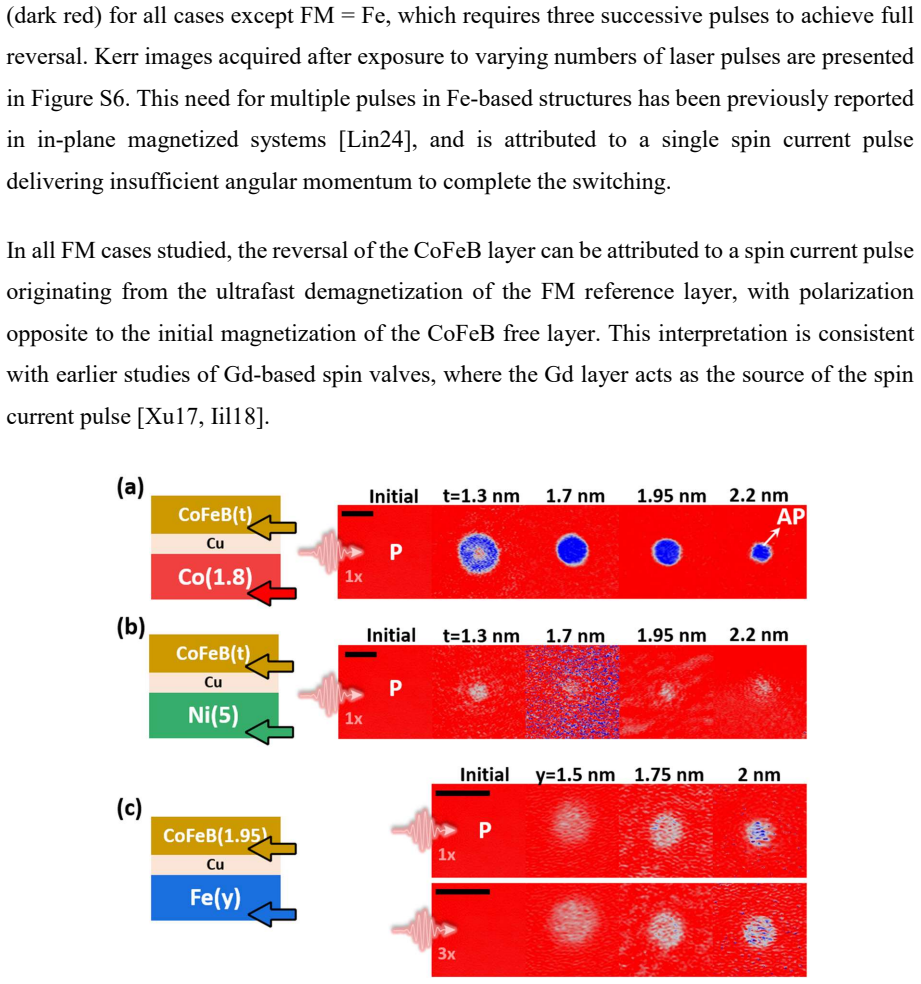
The authors establish that deterministic single-pulse parallel-to-antiparallel reversal of the CoFeB free layer occurs only when the reference layer is Co, and is absent for Ni and Fe, across the studied thickness and fluence ranges. AP-to-P reversal, by contrast, is material-independent, with thresholds set mainly by the CoFeB thickness. The deciding mechanism is the sign of the spin current delivered to the free layer during the recovery phase: calculating -dM/dt from TR-MOKE dynamics of Co, Fe, and Ni shows that Co alone develops a strong negative spin-current tail after demagnetization, whereas Fe and Ni remagnetize too slowly and produce predominantly unipolar positive pulses. The paper
Load-bearing premise
The paper assumes that the ultrafast remagnetization dynamics measured on thick 12 nm trilayers also describe the much thinner reference layers inside the spin valve; if the thin, exchange-coupled layers remagnetize differently, the negative-tail argument for Co loses its experimental footing.
Editorial extensions
If this is right
- P-to-AP single-pulse switching can be achieved in in-plane Gd-free spin valves, extending earlier demonstrations from perpendicular to in-plane geometries.
- Reference-layer remagnetization speed, governed by its Curie temperature, becomes a tunable design parameter for all-optical switching.
- Engineering the free layer's Curie temperature (e.g., via boron content) could lower the fluence needed to reach the demagnetized state and make P-to-AP possible with Ni as well.
- The absence of a material-correlated effect from spin polarization at the Fermi level argues against interface STT-like scattering as the dominant P-to-AP mechanism.
- Threshold fluences for AP-to-P switching are set by free-layer thickness, not reference material, giving a predictable scaling rule.
Reading between the lines
- A direct test would be to measure TR-MOKE on the actual thin exchange-coupled reference layers in the AAF stack; if Co's negative tail shrinks or Ni/Fe develop one, the material assignment would need revision.
- The framework implies that the same delay in remagnetization could apply to other high-TC metals; Pd or Co alloys with tuned TC might show P-to-AP switching where pure Ni and Fe fail.
- Because the reference-layer thickness was deliberately varied with material (Co 1.8 nm, Ni 5 nm, Fe 1.5–2.0 nm), part of the observed difference may be a thermal-load effect; equalizing the thermal response would isolate the dynamics.
- If correct, the negative spin-current tail could be used as a spectroscopic signature: its presence in -dM/dt traces would predict P-to-AP capability without fabricating a full spin valve.
Signed reviews
Editorial analysis
A structured set of objections, weighed in public.
Referee Report
Summary. The paper studies single-pulse all-optical switching in in-plane magnetized ferromagnetic spin valves with Co, Fe, or Ni reference layers in an artificial antiferromagnet (AAF) structure. The authors report that antiparallel-to-parallel (AP-to-P) switching of the CoFeB free layer occurs for all three reference materials, whereas parallel-to-antiparallel (P-to-AP) switching occurs only when the reference layer is Co. This material dependence is attributed to the ultrafast remagnetization dynamics of the reference layer: a rapidly remagnetizing Co reference layer generates a negative spin-current tail that is opposite to the free-layer magnetization, which is claimed to be essential for P-to-AP reversal. The spin-current tails are computed via -dM/dt from TR-MOKE measurements on Glass/Ta(2)/FM(12)/Pt(2) trilayers taken from a prior study [Sch23]. The paper concludes that tuning the Curie temperature and remagnetization rate of the reference layer, rather than interface scattering, controls P-to-AP switching.
Significance. If the central claim were fully established, the paper would be significant: it provides a systematic material comparison in a Gd-free, in-plane spin-valve geometry and identifies a criterion (rapid reference-layer remagnetization) with direct implications for designing all-optical switching devices. The key empirical observation—P-to-AP switching only with a Co reference layer—is clearly presented in Kerr images and threshold fluence measurements, and the AP-to-P switching behavior across materials is a useful systematic result. However, the mechanistic conclusion rests on assumptions that are not directly verified, as detailed in the major comments. The paper is therefore valuable as an empirical study, but its mechanistic explanation requires substantially stronger evidence.
major comments (3)
- [Section II C, Figure 4] The central mechanism relies on TR-MOKE dynamics measured on Glass/Ta(2 nm)/FM(12 nm)/Pt(2 nm) trilayers from [Sch23], not on the actual reference layers in the AAF spin valve (Co 1.8 nm, Ni 5 nm, Fe 1.5–2.0 nm) exchange-coupled to Co(3) via Ru(0.72). The remagnetization rates and deduced spin-current tails are assumed to transfer unchanged to the thinner, multilayer-embedded, exchange-coupled films. Since the material ordering of remagnetization rates (Co fast, Ni/Fe slow) is load-bearing for the explanation, the absence of in-stack dynamics is a serious gap. Direct TR-MOKE on the device stacks, or a quantitative justification of the transferability, is required to support the claim.
- [Section II C, Figure 4d and Discussion] Figure 4d shows that at matched 20% demagnetization both Co and Ni exhibit bipolar spin-current profiles with a negative tail, yet Ni does not switch from the P state in the device. This directly contradicts the statement that 'only Co produces a pronounced negative spin-current tail' and demonstrates that the negative tail is not sufficient for P-to-AP reversal. The essential condition—amplitude or timing of the negative tail relative to the free-layer demagnetization—is never quantified. The paper's own Discussion ('such reversal could be achieved through careful thermal and structural tuning') acknowledges this but does not reconcile it with the central claim.
- [Section II A] The reference-layer thickness is deliberately varied with material: Co 1.8 nm, Ni 5 nm, Fe 1.5–2.0 nm. This introduces a thickness and thermal-load confound. For example, the higher F_th^Dem for Ni is attributed to its greater thickness/lower T_C, but the absence of P-to-AP switching in Ni and Fe could equally arise from thickness-dependent demagnetization/remagnetization rates, heat transport, or exchange coupling, rather than from the material identity per se. Without decoupling material and thickness—e.g., by measuring multiple thicknesses for each material—the conclusion that only Co's intrinsic dynamics enable P-to-AP switching is not established.
minor comments (3)
- [Section III, paragraph 3] The phrase 'thickness of the Ni layer temperate by its lower TC' appears to have a typo; 'temperate' should likely be 'tempered' or 'compensated'.
- [Section II C, Figure 4 caption] The figure caption states 'Data are adapted from [Sch23]' but does not specify the exact fluences used in panel (b) or the absolute demagnetization amplitudes. Providing these numbers would improve reproducibility and clarify the matched-20% condition.
- [Section III, paragraph 4] The argument that the absence of divergent behavior between Fe (positive spin polarization) and Co/Ni (negative) rules out STT-like interface scattering is based on static Fermi-level spin polarization. Hot-electron transport and energy-dependent spin polarizations may be more relevant; a brief justification or caveat would be appropriate.
Circularity Check
No significant circularity; the central claim is an experimental observation and the supporting TR-MOKE dynamics are independent external data, not fitted to the switching result.
full rationale
The paper's central claim is empirical: single-pulse P-to-AP reversal occurs only with a Co reference layer, while AP-to-P reversal occurs for Co, Ni, and Fe. The proposed explanation invokes reference-layer remagnetization dynamics, with spin-current profiles computed as -dM/dt from TR-MOKE traces on Glass/Ta(2)/FM(12)/Pt(2) trilayers taken from [Sch23]. These traces are not fitted to reproduce the switching data; they are independent experimental inputs. The overlap of authors with [Sch23] does not make the citation circular, because the cited TR-MOKE data are externally falsifiable measurements, not an unverified uniqueness theorem or an ansatz introduced solely to force the conclusion. The paper also acknowledges an internal tension: at matched 20% demagnetization, both Co and Ni exhibit negative spin-current contributions (Fig. 4d), yet Ni does not switch in the device, and the authors attribute this to insufficient remagnetization speed or amplitude. That is an underdetermined mechanism, not a tautology. The main weakness—extrapolating dynamics from thick single FM films to thin, exchange-coupled reference layers inside the AAF stack, with deliberately varied reference-layer thicknesses—is a model-validity and confounding-variable concern, not a circular reduction. No fitted parameter is renamed as a prediction, and no load-bearing argument reduces by definition to its own input.
Assumptions & free parameters
free parameters (1)
- Reference-layer thickness y =
Co: 1.8 nm; Ni: 5 nm; Fe: 1.5-2.0 nm
assumptions (4)
- domain assumption Spin current from a magnetic layer is proportional to -dM/dt (the dM/dt model), so the polarity and magnitude of the spin current pulse are read directly from TR-MOKE traces.
- ad hoc to paper TR-MOKE dynamics of Glass/Ta(2)/FM(12)/Pt(2) trilayers from [Sch23] are representative of the 1.8-5 nm FM reference layers inside the AAF spin valve.
- domain assumption Literature values of Ms and TC for Co, Fe, Ni and CoFeB (Table 1) are accurate for the sputtered films.
- domain assumption The reversal of the CoFeB free layer is driven by the spin current from the reference layer through the Cu spacer, not by direct laser action on CoFeB alone.
Cite this review
Pith. "Pith review of Exploring Co, Fe, and Ni Reference Layers for Single-Pulse All-Optical Reversal in Ferromagnetic Spin Valves." pith.science (2026). https://pith.science/paper/QJ45TQII
@misc{pith2026250821234,
  author       = {Pith},
  title        = {Pith review of: Exploring Co, Fe, and Ni Reference Layers for Single-Pulse All-Optical Reversal in Ferromagnetic Spin Valves},
  year         = {2026},
  howpublished = {\url{https://pith.science/paper/QJ45TQII}},
  note         = {Machine review of arXiv:2508.21234}
}
read the original abstract
We investigate the magnetization reversal process induced by a single femtosecond laser pulse in ferromagnetic spin valves by systematically comparing reference layers composed of pure Co, Ni, and Fe. To circumvent the loss of perpendicular magnetic anisotropy associated with changes in reference layer material and thickness, we design spin valves with in plane magnetizations. While antiparallel to parallel switching is observed for all three elements, parallel to antiparallel switching occurs only with a Co reference layer and is absent with Ni and Fe. This difference is attributed to the distinct ultrafast magnetization dynamics of the reference materials. Our results support the hypothesis that parallel to antiparallel switching requires a rapid remagnetization of the reference layer, which generates a substantial negative spin current polarized opposite to the free layer magnetization an essential condition for triggering its reversal.
Figures


Figures from the paper (1 more)

Reference graph
Works this paper leans on
-
[1]
[Kim19] A. V. Kimel and M. Li, Writing magnetic memory with ultrashort light pulses, Nat. Rev. Mater. 4, 189–200 (2019). [Tud04] I. Tudosa et al., The ultimate speed of magnetic switching in granular recording media. Nature 428, 831–833 (2004). [Vah09] K. Vahaplar et al., Ultrafast path for optical magnetization reversal via a strongly nonequilibrium stat...
work page 2019
-
[2]
Kapteyn, M. M. Murnane, C. M. Schneider, and P. M. Oppeneer, Ultrafast magnetization enhancement in metallic multilayers driven by superdiffusive spin current, Nat. Commun. 3, 1037 (2012). [Choi15] G.-M. Choi, C.-H. Moon, B.-C. Min, K.-J. Lee, and D. G. Cahill, Thermal spin- transfer torque driven by the spin-dependent Seebeck effect in metallic spin-valv...
work page 2012
-
[3]
Mangin, Single-shot multi-level all-optical magnetization switching mediated by spin transport, Adv. Mater. 30, 1804004 (2018). [Rem20] Q. Remy, J. Igarashi, S. Iihama, G. Malinowski, M. Hehn, J. Gorchon, J. Hohlfeld, S
work page 2018
-
[4]
Fukami, H. Ohno, and S. Mangin, Energy efficient control of ultrafast spin current to induce single femtosecond pulse switching of a ferromagnet, Adv. Sci. 7, 2001996 (2020). [Iga20] J. Igarashi, Q. Remy, S. Iihama, G. Malinowski, M. Hehn, J. Gorchon, J. Hohlfeld, S
work page 2020
-
[5]
Fukami, H. Ohno, and S. Mangin, Engineering Single-Shot All-Optical Switching of Ferromagnetic Materials, Nano Lett. 20, 8654 (2020). [Lin24] J.-X. Lin, Y. Le Guen, J. Hohlfeld, J. Igarashi, Q. Remy, J. Gorchon, G. Malinowski, S. Mangin, T. Hauet, and M. Hehn, Femtosecond-laser-induced reversal in in-plane-magnetized spin valves, Phys. Rev. Appl. 22, 0440...
work page 2020
-
[6]
Malinowski, Ultrafast Spin Accumulations Drive Magnetization Reversal in Multilayers , arXiv:2508.19675 [pdf] cond-mat.mes-hall cond-mat.mtrl-sci [Bor21] M. Borchert, C. von Korff Schmising, D. Schick, D. Engel, S. Sharma, S. Shallcross, S. Eisebitt, Uncovering the role of the density of states in controlling ultrafast spin dynamics, arXiv:2008.12612. [Sc...
-
[7]
Malinowski, W. Zhao and S. Mangin Deterministic Ultra-fast All-Optical Switching in Gd-Free Ferrimagnetic Spin-Valve Structures Advanced Functional Materials accepted (2025). Exploring Co, Fe, and Ni Reference Layers for Single-Pulse All-Optical Reversal in Ferromagnetic Spin Valves Jun-Xiao Lin, Yann Le Guen, Julius Hohlfeld, Jon Gorchon, Grégory Malinow...
work page 2025
Reviewed August 5, 2026 · model on record in the stance chip above.
Discussion (0). Continue with ORCID to comment.