REVIEW 3 major objections 6 minor 33 references
Towards Lensless Image Deblurring with Prior-Embedded Implicit Neural Representations in the Low-Data Regime
T0 review · 3 major / 6 minor · reviewed 2026-08-12 · deepseek-v4-flash
Pith's one-line read An untrained SIREN with a PSF-informed loss outperforms low-shot lensless deblurring methods.
desk verdict New combination of INR and known-PSF untrained optimization for lensless deblurring, but the synthetic same-model evaluation leaves the claimed margin unproven. read the letter →
The pith
A machine-rendered reading of the paper's core claim, the machinery that carries it, and where it could break.
The reading
What carries the argument
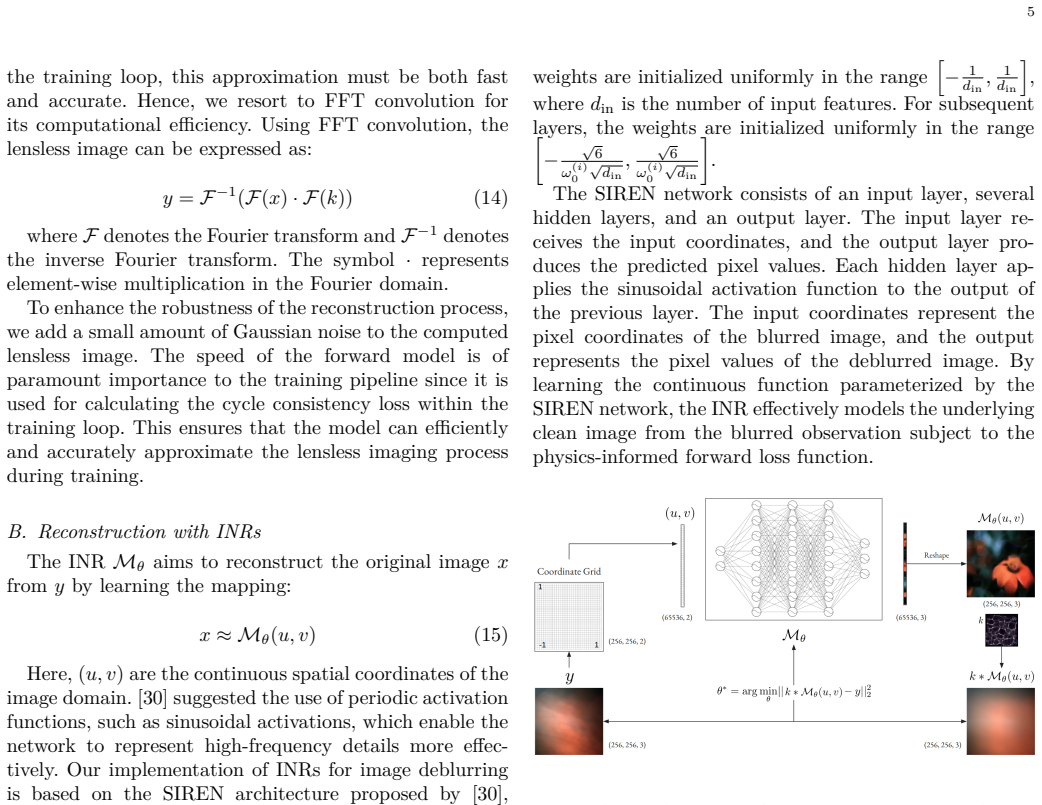
The central object is a SIREN, an MLP with sinusoidal activations that maps continuous coordinates $(u,v)$ to RGB values, kept under-parameterized relative to the $256 \times 256 \times 3$ image space. The mechanism that carries the argument is the physics-informed forward loss: at every optimization step the network's intermediate image is convolved with the known DiffuserCam PSF using FFT convolution, small Gaussian noise is added, and the error against the observed lensless image is backpropagated. Prior embedding is the second mechanism: before inverse optimization, the network is trained to fit one image from the target domain, producing a weight initialization that accelerates the subsequent PSF-informed reconstruction. The Under-Parameterization Ratio, defined as image-space dimensionality divided by network parameter count, supplies the comparison metric across architectures.
What would settle it
Apply the same untrained SIREN to real lensless captures from a DiffuserCam-style camera with a calibrated PSF and compare against a sharp reference; if the margin over the Deep Decoder shrinks or reverses under PSF mismatch or real sensor noise, the claimed superiority depends on the exact forward model.
Extended reading notes
Core claim
On its own terms, the paper's discovery is that the inductive bias of a sinusoidal coordinate network is enough to turn a lensless measurement back into a clean image when the PSF is known: the network's output is convolved with the PSF in the Fourier domain and compared to the measurement, and that loss alone drives reconstruction. The authors report that this untrained SIREN outperforms the modified Deep Decoder at matched parameter counts, and that embedding a single domain image into the network's weights before optimization outperforms a 10-shot decoder baseline. They also introduce the Under-Parameterization Ratio to quantify how far below image dimensionality a network operates, and show that reconstructions improve as UPR decreases toward 1.
Load-bearing premise
The evaluation assumes the FFT-convolution forward model with the known DiffuserCam PSF and small Gaussian noise exactly generates the test measurements, because those measurements were synthesized by that same model.
Editorial extensions
If this is right
- A roughly 132k-parameter SIREN can reconstruct 256x256 lensless images without paired training data, outperforming the untrained Deep Decoder at similar parameter counts.
- Prior embedding from a single domain image gives faster convergence and better PSNR and SSIM than the 10-shot domain-restricted decoder baseline.
- The Under-Parameterization Ratio provides a transferable way to compare untrained networks across architectures at matched under-parameterization.
- Because the PSF is inside the loss, the same optimization procedure applies to any calibrated lensless camera by swapping the kernel, with no retraining.
Reading between the lines
- The paper leaves untested the natural extension that a converged coordinate network can be sampled at arbitrary resolutions, since the INR is a continuous function rather than a pixel grid.
- The monotone UPR-SSIM trend suggests a practical design rule: choose network width by sweeping UPR on synthetic examples before full optimization for a new PSF.
- The evaluation never exposes the method to PSF mismatch or real sensor noise, so a testable next step is to add a calibration or mismatch-robust term before claiming real-world applicability.
Editorial analysis
A structured set of objections, weighed in public.
Referee Report
Summary. The paper proposes an untrained implicit neural representation (SIREN) for lensless image deblurring. Reconstruction is performed by optimizing the INR to minimize the discrepancy between the PSF-convolved network output and the measured lensless image, with FFT-based convolution as the forward model. The method is extended with a prior-embedding step: the INR is first fit to a single domain-specific image and then used as the initialization for the physics-informed optimization. The authors report PSNR/SSIM improvements over Deep Decoder, ADMM, Learned-ADMM-UNet, and a 10-shot domain-restricted method on synthetic lensless images generated from the DiffuserCam PSF, and introduce the Under-Parameterization Ratio (UPR) to compare network sizes in the untrained regime.
Significance. If the reported results were validated under realistic lensless imaging conditions, the method would be a useful data-efficient alternative to GAN-based reconstructions, with the potential to adapt to new PSFs without retraining. The UPR metric is a simple and potentially useful tool for comparing under-parameterized network families. The paper includes thorough comparisons against several baselines and clear visualizations. However, the current evaluation is entirely based on synthetic measurements generated with the same forward model that is used inside the reconstruction loss, which severely limits the external validity of the central claim of superiority. The prior-embedded comparison is also confined to a single narrow domain, making the claimed generalization to the low-data regime insufficiently supported.
major comments (3)
- [Sec. V-A, V-C; Eq. (14)] All quantitative evaluations are performed on synthetic lensless images created by convolving clean images with the same DiffuserCam PSF k and adding small Gaussian noise, which is exactly the forward model used in the reconstruction loss inside the optimization loop. The authors themselves note in Sec. IV-A (citing [29]) that the shift-invariant PSF assumption is physically inexact and error-prone. Under model mismatch, such as real sensor noise, PSF calibration error, or shift variance, an untrained network can fit artifacts of the assumed forward model, and the reported margin over Deep Decoder and ADMM may shrink or reverse. To substantiate the claim of 'superior performance by a significant margin' for practical lensless imaging, the paper needs at least one experiment with real DiffuserCam measurements or with a deliberately mismatched PSF (e.g., synthesizing with a different PSF than the one used in the loss).
- [Sec. V-C; Fig. 6] The prior-embedded experiment uses a single microorganism image as the prior and a second microorganism image as the test target, both from the same narrow domain and dataset. This setup does not demonstrate that prior embedding provides a general advantage in the low-data regime; the improvement may largely reflect that the prior and target images are nearly identically distributed. The claim of 'bridging the gap between no-data and high-data regimes' (Abstract, Sec. VI) requires evaluation across multiple domains or at least on a more diverse test set, together with a sensitivity analysis with respect to the choice of the prior image (e.g., using an unrelated-domain prior or a degraded prior).
- [Sec. V-A; Table I and Fig. 3] The reported quantitative results are single-seed and given for fixed iteration counts, but the paper provides no analysis of sensitivity to the random initialization of the INR, the learning rate, the optimizer choice, or the Gaussian noise level in the forward model. Since the method is untrained and the entire reconstruction depends on the optimization trajectory, the absence of variance or statistical significance measures makes the claim of a 'significant margin' difficult to assess. The authors should report mean and standard deviation over multiple random seeds, or at least show that the ranking of methods is stable across hyperparameter choices.
minor comments (6)
- [Sec. IV-B, Eq. (17)] The notation ω(i)0 for the frequency scaling parameter of each SIREN layer is nonstandard; in the original SIREN paper, a single ω0 is used only in the first layer and subsequent layers use ω0=1. The authors should clarify whether they use a per-layer frequency scaling and how it affects initialization.
- [Algorithm 1 and Sec. IV-C] The loss function is described inconsistently: Algorithm 1 says 'L1 loss function', the text in Sec. IV-C says 'mean-squared error', Eq. (10) writes an L2 norm, and Fig. 1 says 'LMSE'. The exact loss used in all experiments should be stated unambiguously.
- [Sec. IV-D, Eq. (18)] The objective for prior embedding is written with malformed triple norms, and the subsequent equation 'θ∗ = arg min θ ||Mθ−y;Mprior||2 2' is not a well-formed optimization problem; the forward model k∗ and the initialization from Mprior should be stated explicitly.
- [Table I] The claimed trend 'increasing SSIM with decreasing UPR' is not strictly monotonic in the reported numbers (e.g., MDD at 10k iterations: UPR 1.47 gives 0.76, UPR 3.46 gives 0.73). The discussion should acknowledge this and avoid overstating the monotonicity.
- [Sec. V-C] The 'microorganism preprocessed images dataset [33]' is only cited as a Kaggle dataset; the exact dataset name, version, and any preprocessing steps should be provided for reproducibility.
- [Sec. I and II] The claim of being 'the first to leverage INRs for lensless image reconstruction' should be supported by a more exhaustive related-work search, since there may be concurrent or earlier works using implicit neural representations for lensless or coded-aperture imaging.
Circularity Check
No significant circularity: the claimed reconstruction is an untrained optimization against a PSF-informed forward loss, and the authors' self-citations appear only as baselines, not as load-bearing premises.
full rationale
The paper's central derivation is the physics-informed forward loss in Algorithm 1 and Eq. (10): an untrained SIREN maps coordinates to an image, the image is convolved with a known PSF via Eq. (14), and the network is updated against the measurement. The PSF and the measurement are inputs to this optimization, not outputs of a fitted model, so the reconstruction is not a renamed fit. The prior-embedded variant (Eq. 18) fits an INR to one domain-restricted image and uses it only as an initialization; the subsequent reconstruction is still driven by the forward loss and is therefore not statistically forced. The comparisons against the authors' prior methods [16] and [18] use those methods as baselines in quantitative and visual evaluations; no theorem or uniqueness claim from those papers is invoked to constrain the method, so self-citation is not load-bearing. The SIREN architecture and prior-embedding idea are attributed to external works [30] and [31]. The main substantive concern is external validity: quantitative tests are generated with the same FFT-convolution forward model used inside the reconstruction loop, and the authors themselves note that the shift-invariant PSF assumption is physically inexact (Sec. IV-A). That is a soundness or generalization limitation, not circular reasoning, because the solver and the test generator sharing an operator does not make the reported reconstruction equivalent to an input by construction. No step in the paper reduces a claimed prediction to a fitted parameter, a self-definition, or a renamed known result, so the appropriate circularity score is 0.
Assumptions & free parameters
free parameters (3)
- SIREN architecture and training hyperparameters =
3 hidden layers, 208 nodes, UPR 1.49, steps 5000; learning rate and omega0 not reported
- Prior image for embedding =
One image from microorganism dataset [33]
- Gaussian noise level in forward model =
unspecified ('small amount')
assumptions (5)
- domain assumption Lensless image formation is modeled as shift-invariant convolution with a known PSF plus Gaussian noise (Eq. 13).
- domain assumption The PSF is known exactly and available to the algorithm.
- domain assumption Untrained SIREN optimization acts as a natural image prior.
- domain assumption Prior embedding transfers from one domain image to another image in the same domain.
- standard math FFT-based convolution in Eq. 14 is implemented with appropriate padding so it matches linear convolution of the PSF.
Cite this review
Pith. "Pith review of Towards Lensless Image Deblurring with Prior-Embedded Implicit Neural Representations in the Low-Data Regime." pith.science (2026). https://pith.science/paper/QJO7DHI3
@misc{pith2026241118189,
  author       = {Pith},
  title        = {Pith review of: Towards Lensless Image Deblurring with Prior-Embedded Implicit Neural Representations in the Low-Data Regime},
  year         = {2026},
  howpublished = {\url{https://pith.science/paper/QJO7DHI3}},
  note         = {Machine review of arXiv:2411.18189}
}
read the original abstract
The field of computational imaging has witnessed a promising paradigm shift with the emergence of untrained neural networks, offering novel solutions to inverse computational imaging problems. While existing techniques have demonstrated impressive results, they often operate either in the high-data regime, leveraging Generative Adversarial Networks (GANs) as image priors, or through untrained iterative reconstruction in a data-agnostic manner. This paper delves into lensless image reconstruction, a subset of computational imaging that replaces traditional lenses with computation, enabling the development of ultra-thin and lightweight imaging systems. To the best of our knowledge, we are the first to leverage implicit neural representations for lensless image deblurring, achieving reconstructions without the requirement of prior training. We perform prior-embedded untrained iterative optimization to enhance reconstruction performance and speed up convergence, effectively bridging the gap between the no-data and high-data regimes. Through a thorough comparative analysis encompassing various untrained and low-shot methods, including under-parameterized non-convolutional methods and domain-restricted low-shot methods, we showcase the superior performance of our approach by a significant margin.
Figures


Figures from the paper (4 more)


Reference graph
Works this paper leans on
-
[29]
Robust reconstruction with deep learning to handle model mismatch in lensless imaging,
T. Zeng and E. Y. Lam, “Robust reconstruction with deep learning to handle model mismatch in lensless imaging,” IEEE Transactions on Computational Imaging, vol. 7, pp. 1080–1092, 2021
work page 2021
-
[16]
Physics-informed deep deblurring: Over-parameterized vs. under-parameterized,
A. Banerjee, S. Saurav, and S. Singh, “Physics-informed deep deblurring: Over-parameterized vs. under-parameterized,” in 2023 IEEE International Conference on Image Processing (ICIP), pp. 1615–1619, IEEE, 2023
work page 2023
-
[18]
Reconstruct- ing synthetic lensless images in the low-data regime.,
A. Banerjee, H. Kumar, S. Saurav, and S. Singh, “Reconstruct- ing synthetic lensless images in the low-data regime.,” inBMVC, pp. 765–766, 2023
work page 2023
-
[1]
Diffusercam: lensless single-exposure 3d imag- ing,
N. Antipa, G. Kuo, R. Heckel, B. Mildenhall, E. Bostan, R. Ng, and L. Waller, “Diffusercam: lensless single-exposure 3d imag- ing,” Optica, vol. 5, no. 1, pp. 1–9, 2018
work page 2018
-
[2]
Generative adversarial nets,
I. Goodfellow, J. Pouget-Abadie, M. Mirza, B. Xu, D. Warde- Farley, S. Ozair, A. Courville, and Y. Bengio, “Generative adversarial nets,” Advances in neural information processing systems, vol. 27, 2014
2014
-
[3]
Compressed sensing using generative models,
A. Bora, A. Jalal, E. Price, and A. G. Dimakis, “Compressed sensing using generative models,” inInternational conference on machine learning, pp. 537–546, PMLR, 2017
2017
-
[4]
Global Guarantees for Enforcing Deep Generative Priors by Empirical Risk
P. Hand and V. Voroninski, “Global guarantees for en- forcing deep generative priors by empirical risk,” CoRR, vol. abs/1705.07576, 2017
work page Pith review arXiv 2017
-
[5]
W. Huang, P. Hand, R. Heckel, and V. Voroninski, “A provably convergent scheme for compressive sensing under random gen- 11 Fig. 5. Visual comparison of reconstruction results of our untrained INR against a modified Deep Decoder. The parameter count of the network and the quantitative scores, presented in Parameter Count — PSNR (in dB) — SSIM format, are ...
work page 2018
Show all 33 references
-
[6]
Image-adaptive gan based reconstruction,
S. A. Hussein, T. Tirer, and R. Giryes, “Image-adaptive gan based reconstruction,” in Proceedings of the AAAI Conference on Artificial Intelligence, vol. 34, pp. 3121–3129, 2020
2020
-
[7]
Deep compressed sensing,
Y. Wu, M. Rosca, and T. Lillicrap, “Deep compressed sensing,” in International Conference on Machine Learning , pp. 6850– 6860, PMLR, 2019
2019
-
[8]
Phase retrieval under a generative prior,
P. Hand, O. Leong, and V. Voroninski, “Phase retrieval under a generative prior,” Advances in Neural Information Processing Systems, vol. 31, 2018
2018
-
[9]
Robust compressive phase re- trieval via deep generative priors,
F. Shamshad and A. Ahmed, “Robust compressive phase re- trieval via deep generative priors,” ArXiv, vol. abs/1808.05854, 2018
2018 arXiv
-
[10]
Blind image decon- volution using deep generative priors,
M. Asim, F. Shamshad, and A. Ahmed, “Blind image decon- volution using deep generative priors,” IEEE Transactions on Computational Imaging, vol. 6, pp. 1493–1506, 2018
2018
-
[11]
Global guarantees for blind demodula- tion with generative priors,
P. Hand and B. Joshi, “Global guarantees for blind demodula- tion with generative priors,” ArXiv, vol. abs/1905.12576, 2019
1905 arXiv
-
[12]
Flatcam: Thin, lensless cameras using coded aperture and computation,
M. S. Asif, A. Ayremlou, A. Sankaranarayanan, A. Veeraragha- van, and R. G. Baraniuk, “Flatcam: Thin, lensless cameras using coded aperture and computation,” IEEE Transactions on Computational Imaging, vol. 3, no. 3, pp. 384–397, 2016
2016
-
[13]
Deep image prior,
D. Ulyanov, A. Vedaldi, and V. S. Lempitsky, “Deep image prior,” International Journal of Computer Vision , vol. 128, pp. 1867–1888, 2017
2017
-
[14]
Deep decoder: Concise image repre- sentations from untrained non-convolutional networks,
R. Heckel and P. Hand, “Deep decoder: Concise image repre- sentations from untrained non-convolutional networks,” Inter- national Conference on Learning Representations, 2019
2019
-
[15]
Untrained networks for compressive lensless photography,
K. Monakhova, V. Tran, G. Kuo, and L. Waller, “Untrained networks for compressive lensless photography,”Optics Express, vol. 29, no. 13, pp. 20913–20929, 2021
2021
-
[17]
Low shot learning with untrained neural networks for imaging inverse problems,
O. Leong and W. Sakla, “Low shot learning with untrained neural networks for imaging inverse problems,” arXiv preprint arXiv:1910.10797, 2019
1910 arXiv
-
[19]
Nonlinear total vari- ation based noise removal algorithms,
L. I. Rudin, S. Osher, and E. Fatemi, “Nonlinear total vari- ation based noise removal algorithms,” Physica D: Nonlinear Phenomena, vol. 60, pp. 259–268, 1992
1992
-
[20]
A fast iterative shrinkage- thresholding algorithm for linear inverse problems,
A. Beck and M. Teboulle, “A fast iterative shrinkage- thresholding algorithm for linear inverse problems,” SIAM J. Imaging Sci., vol. 2, pp. 183–202, 2009
2009
-
[21]
Dis- tributed optimization and statistical learning via the alternating direction method of multipliers,
S. Boyd, N. Parikh, E. Chu, B. Peleato, J. Eckstein, et al., “Dis- tributed optimization and statistical learning via the alternating direction method of multipliers,” Foundations and Trends® in Machine learning, vol. 3, no. 1, pp. 1–122, 2011
2011
-
[22]
Regularizing linear inverse problems with convolu- tional neural networks,
R. Heckel, “Regularizing linear inverse problems with convolu- tional neural networks,” ArXiv, vol. abs/1907.03100, 2019
1907 arXiv
-
[23]
Algorithmic guarantees for inverse imaging with untrained network priors,
G. Jagatap and C. Hegde, “Algorithmic guarantees for inverse imaging with untrained network priors,” Advances in neural information processing systems, vol. 32, 2019
2019
-
[24]
Compressed sensing with deep image prior and learned regularization,
D. V. Veen, A. Jalal, E. Price, S. Vishwanath, and A. G. Di- makis, “Compressed sensing with deep image prior and learned regularization,” ArXiv, vol. abs/1806.06438, 2018
2018 arXiv
-
[25]
Physics-driven machine learning for computational imaging 12 [from the guest editor],
B. Wen, S. Ravishankar, Z. Zhao, R. Giryes, and J. C. Ye, “Physics-driven machine learning for computational imaging 12 [from the guest editor],” IEEE Signal Processing Magazine , vol. 40, no. 1, pp. 28–30, 2023
2023
-
[26]
Physics-informed deep learning for dual-energy com- puted tomography image processing,
M. G. Poirot, R. H. Bergmans, B. R. Thomson, F. C. Jolink, S. J. Moum, R. G. Gonzalez, M. H. Lev, C. O. Tan, and R. Gupta, “Physics-informed deep learning for dual-energy com- puted tomography image processing,” Scientific reports, vol. 9, no. 1, p. 17709, 2019
2019
-
[27]
On the interplay between physical and content priors in deep learning for computational imaging,
M. Deng, S. Li, Z. Zhang, I. Kang, N. X. Fang, and G. Barbas- tathis, “On the interplay between physical and content priors in deep learning for computational imaging,” Optics Express, vol. 28, no. 16, pp. 24152–24170, 2020
2020
-
[28]
Physics-informed machine learning,
G. E. Karniadakis, I. G. Kevrekidis, L. Lu, P. Perdikaris, S. Wang, and L. Yang, “Physics-informed machine learning,” Nature Reviews Physics, vol. 3, no. 6, pp. 422–440, 2021
2021
-
[30]
Implicit neural representations with periodic activation functions,
V. Sitzmann, J. Martel, A. Bergman, D. Lindell, and G. Wet- zstein, “Implicit neural representations with periodic activation functions,” Advances in neural information processing systems, vol. 33, pp. 7462–7473, 2020
2020
-
[31]
Nerp: implicit neural repre- sentation learning with prior embedding for sparsely sampled image reconstruction,
L. Shen, J. Pauly, and L. Xing, “Nerp: implicit neural repre- sentation learning with prior embedding for sparsely sampled image reconstruction,” IEEE Transactions on Neural Networks and Learning Systems, 2022
2022
-
[32]
Learned reconstructions for practical mask-based lensless imaging,
K. Monakhova, J. Yurtsever, G. Kuo, N. Antipa, K. Yanny, and L. Waller, “Learned reconstructions for practical mask-based lensless imaging,” Optics express , vol. 27, no. 20, pp. 28075– 28090, 2019
2019
-
[33]
Microorganism preprocessed images dataset,
“Microorganism preprocessed images dataset,” in Kaggle, 2022
2022
Reviewed August 12, 2026 · model on record in the stance chip above.
Discussion (0). Continue with ORCID to comment.