REVIEW 3 major objections 2 minor 1 cited by
TIDE: Task-Isolated Diffusion for Unified Video Editing and Generation
T0 review · 3 major / 2 minor · reviewed 2026-06-27 · grok-4.3
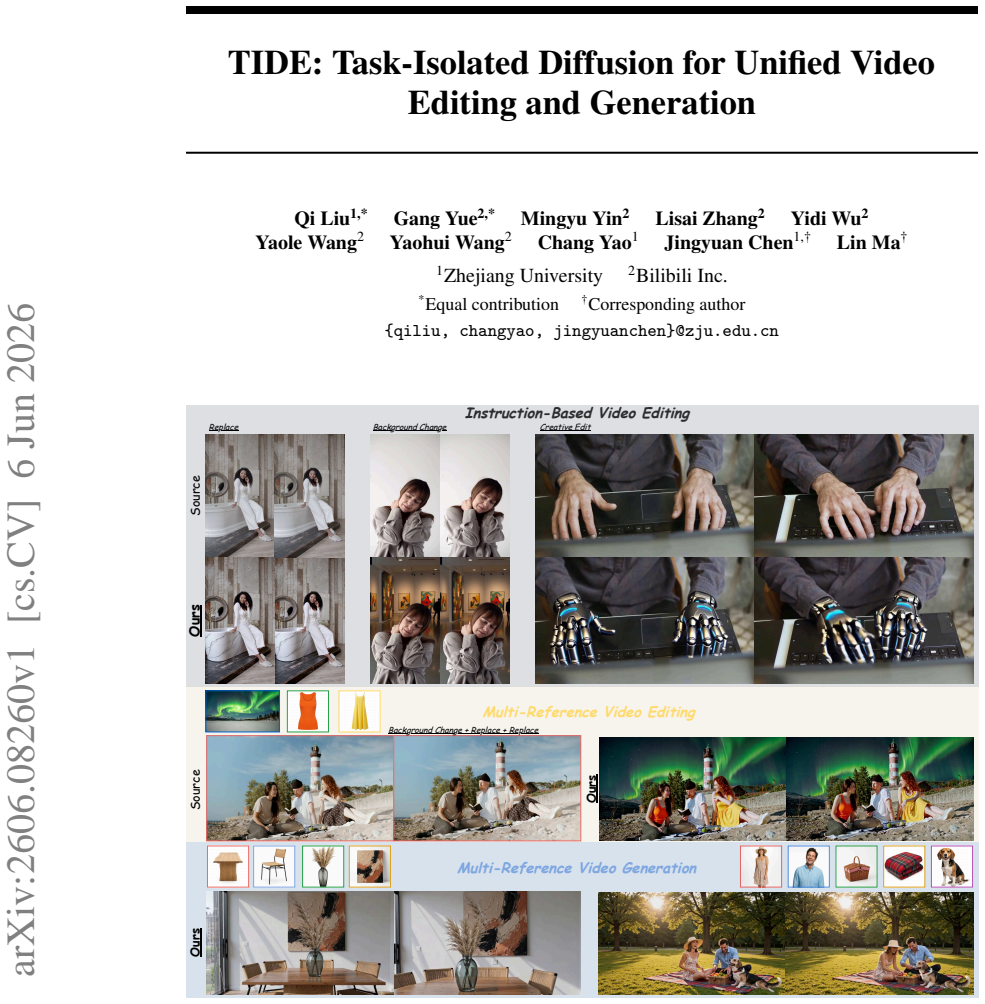
Pith's one-line read TIDE shows a single diffusion model can handle instruction-based video editing, reference-guided editing, and multi-reference generation together.
desk verdict TIDE's per-token task embeddings plus dual VLM-VAE path aim to unify video tasks without auxiliary encoders, but the SOTA claim cannot be checked from the given details. read the letter →
The pith
A machine-rendered reading of the paper's core claim, the machinery that carries it, and where it could break.
The reading
What carries the argument
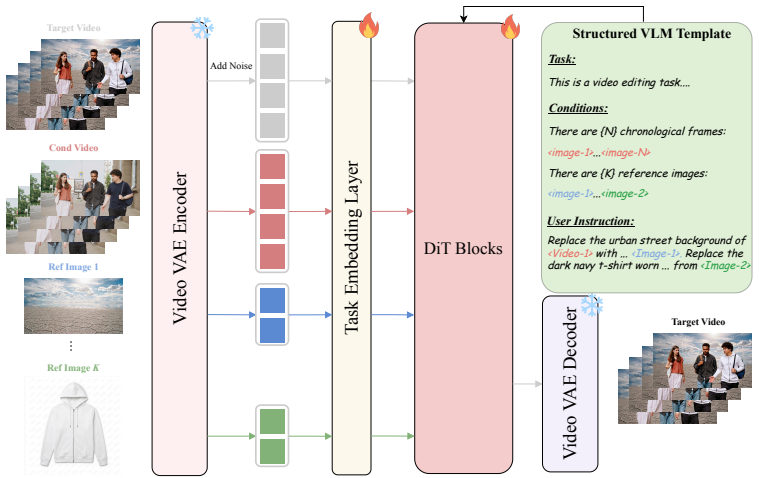
Per-token task embeddings that assign each input token a task-specific identifier, paired with a dual-path conditioning scheme that couples a vision-language model and a VAE latent path.
What would settle it
A benchmark run that adds an unseen combination of reference types or increases the number of conditions beyond the training distribution and measures whether performance falls below specialized per-task models.
Extended reading notes
Core claim
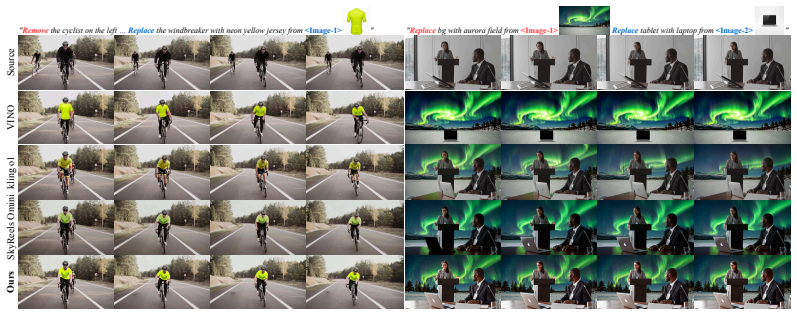
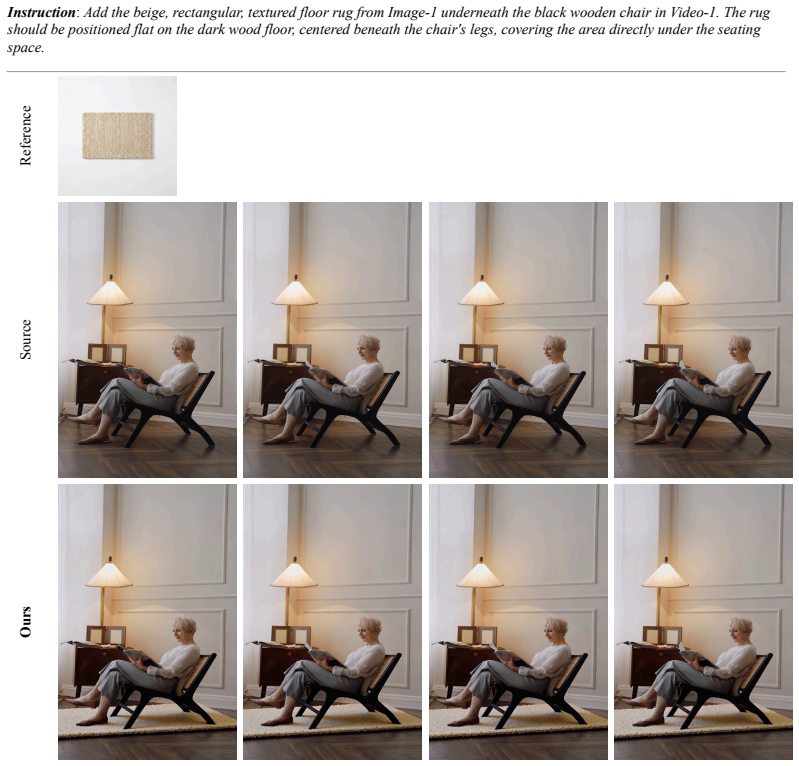
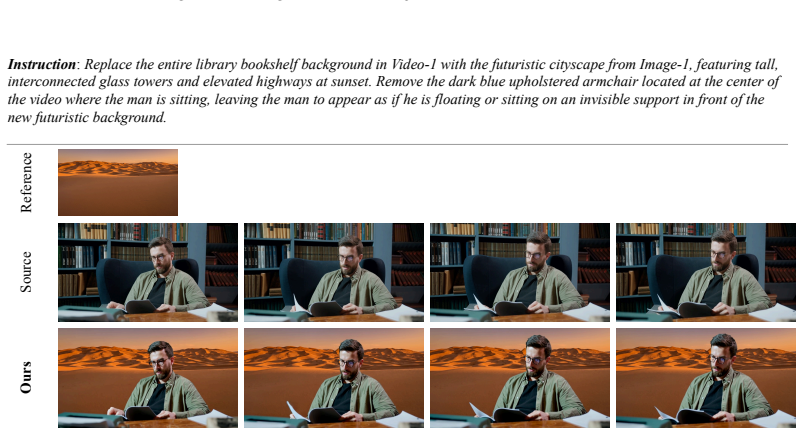
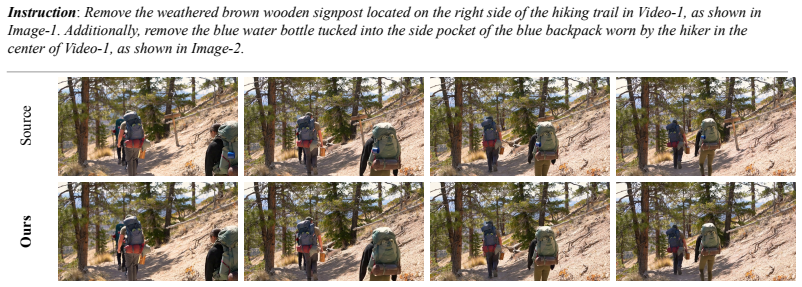
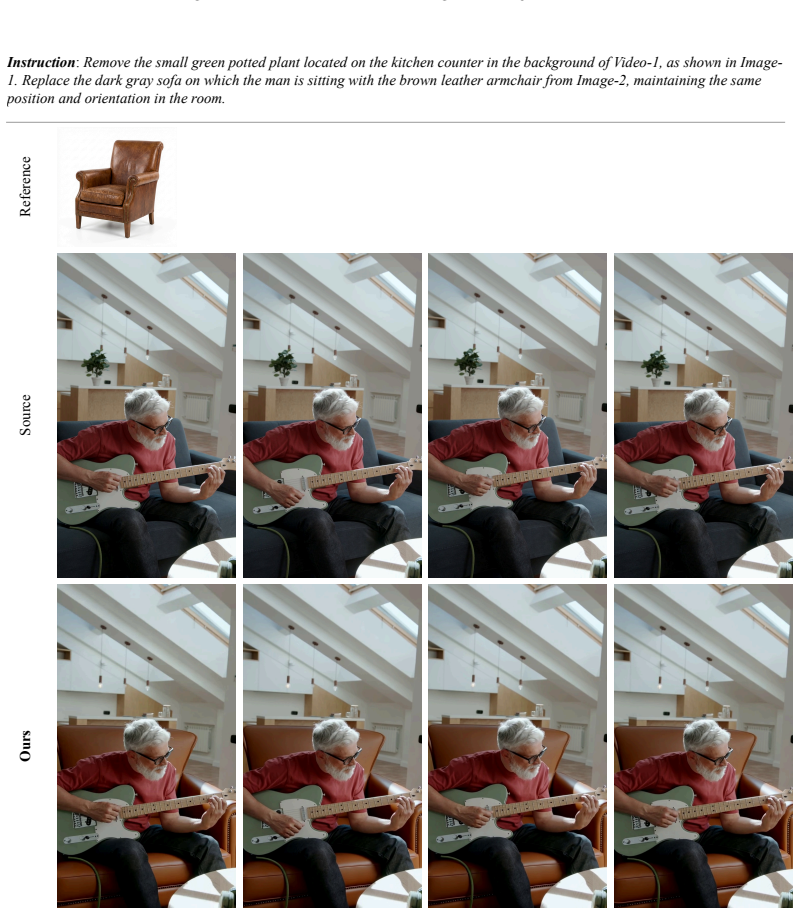
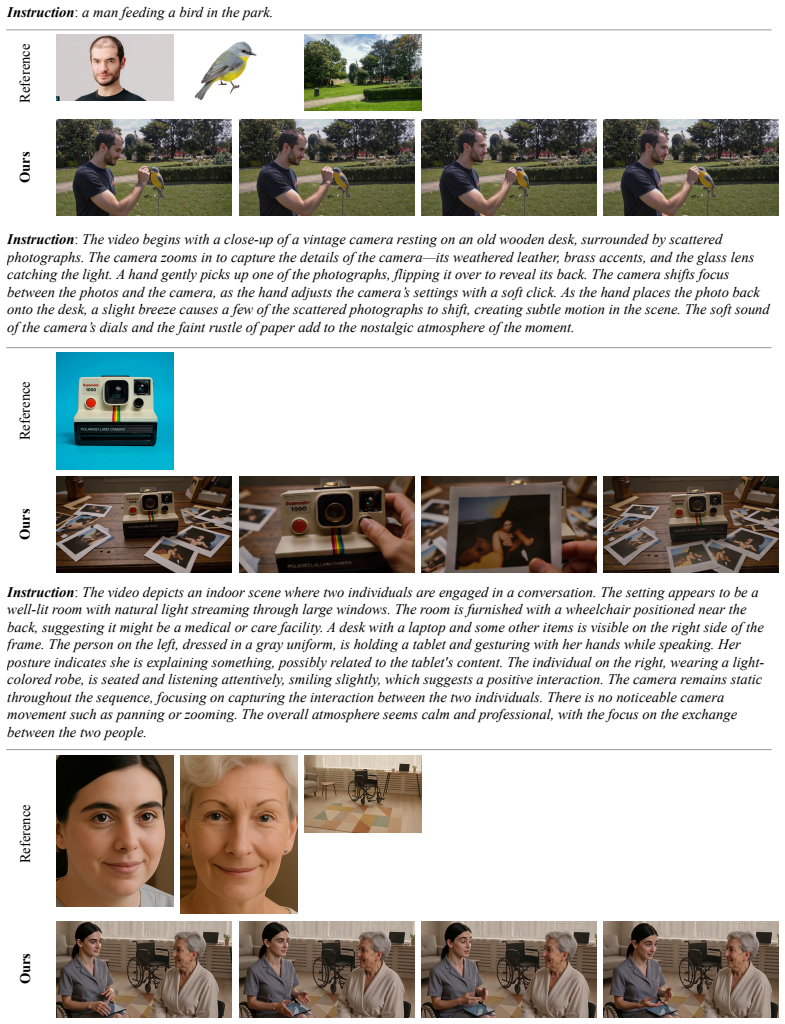
TIDE integrates instruction-based editing, reference-guided editing, and multi-reference generation in one model. Per-token task embeddings assign each input token a task-specific identifier to disambiguate heterogeneous conditions. The dual-path conditioning scheme couples a vision-language model with a VAE latent path for complementary signals. A multi-task progressive training strategy incrementally introduces tasks of increasing complexity.
Load-bearing premise
Per-token task embeddings plus the dual VLM-VAE conditioning path are sufficient to disambiguate heterogeneous visual conditions without dedicated auxiliary encoders, even when the number and type of conditions vary across tasks.
Signed reviews
Editorial analysis
A structured set of objections, weighed in public.
Referee Report
Summary. The manuscript introduces TIDE, a unified Diffusion Transformer framework supporting instruction-based video editing, reference-guided editing, and multi-reference generation. It proposes per-token task embeddings to explicitly disambiguate target/source/reference tokens, a dual-path conditioning scheme coupling a vision-language model with VAE latents, and a multi-task progressive training strategy that incrementally adds tasks of increasing complexity. The paper claims these components enable a single model to achieve state-of-the-art performance across all evaluated tasks without dedicated auxiliary encoders.
Significance. If the experimental claims hold, the work would represent a meaningful step toward unified video models by addressing the challenge of handling heterogeneous conditioning signals with varying cardinality. The per-token task embedding mechanism and progressive training strategy are potentially reusable ideas for multi-task diffusion systems. No machine-checked proofs or parameter-free derivations are present, but the project page link suggests reproducibility resources may be available.
major comments (3)
- [Abstract and §3] Abstract and §3 (method): The central claim that per-token task embeddings plus the dual VLM-VAE path suffice to disambiguate tokens when the number and type of visual conditions vary (without auxiliary encoders) is load-bearing for the unified-architecture contribution. No ablation is described that isolates this mechanism under changing condition cardinality, leaving the skeptic concern unaddressed by direct evidence.
- [Abstract] Abstract: The SOTA claim across all three tasks is stated without any quantitative metrics, dataset names, baselines, or error bars. This prevents assessment of whether the data actually support the performance assertions.
- [§4] §4 (experiments): The multi-task progressive training strategy is presented as harmonizing objectives, yet no analysis is supplied showing how task ordering or incremental introduction affects generalization when condition counts differ across tasks.
minor comments (2)
- [§3] Notation for the per-token task embeddings is introduced without an explicit equation or diagram showing how the identifier is added to the token sequence.
- [§3] The dual-path conditioning description would benefit from a figure illustrating the VLM and VAE signal fusion inside the Diffusion Transformer blocks.
Simulated Author's Rebuttal
We thank the referee for the thoughtful review and constructive suggestions. We address each major comment below, providing clarifications from the manuscript and committing to revisions where the concerns identify gaps in evidence or presentation.
read point-by-point responses
-
Referee: [Abstract and §3] Abstract and §3 (method): The central claim that per-token task embeddings plus the dual VLM-VAE path suffice to disambiguate tokens when the number and type of visual conditions vary (without auxiliary encoders) is load-bearing for the unified-architecture contribution. No ablation is described that isolates this mechanism under changing condition cardinality, leaving the skeptic concern unaddressed by direct evidence.
Authors: We agree that an explicit ablation isolating per-token task embeddings under varying condition cardinality would provide stronger direct evidence for the claim. While §4 reports consistent SOTA results across tasks with differing numbers of conditions (instruction editing with 1-2 visuals, reference-guided with 2, multi-reference generation with 3+), and the method section details how the embeddings explicitly tag target/source/reference tokens to enable disambiguation without auxiliary encoders, we did not include a controlled cardinality sweep. In the revision we will add such an ablation (e.g., performance with/without task embeddings at 1, 2, and 4+ conditions) to directly address this concern. revision: yes
-
Referee: [Abstract] Abstract: The SOTA claim across all three tasks is stated without any quantitative metrics, dataset names, baselines, or error bars. This prevents assessment of whether the data actually support the performance assertions.
Authors: The abstract is intentionally concise and high-level, as is conventional; the quantitative support—including specific metrics, dataset names (e.g., the video editing and generation benchmarks referenced in §4), baselines, and error bars—is fully detailed in the experimental section and tables. To improve immediate readability we will revise the abstract to include one or two key quantitative highlights (e.g., average improvement margins) while remaining within length limits. revision: yes
-
Referee: [§4] §4 (experiments): The multi-task progressive training strategy is presented as harmonizing objectives, yet no analysis is supplied showing how task ordering or incremental introduction affects generalization when condition counts differ across tasks.
Authors: The manuscript describes the progressive schedule in §3 and demonstrates its effectiveness through the final multi-task results in §4, but we acknowledge the absence of an explicit sensitivity analysis on ordering or incremental steps under varying condition cardinalities. In the revision we will add a short analysis or supplementary experiment examining performance when tasks are introduced in different orders or with different condition-count progressions, to quantify the contribution of the incremental strategy. revision: yes
Circularity Check
No circularity; claims rest on experimental benchmarks, not derivations or self-referential fits
full rationale
The manuscript presents an architectural proposal (per-token task embeddings, dual VLM-VAE path, progressive training) whose performance claims are supported solely by empirical results on external benchmarks. No equations, fitted parameters renamed as predictions, or load-bearing self-citations appear in the abstract or method description. The central assertion that the proposed conditioning suffices is an empirical hypothesis tested experimentally rather than a quantity defined in terms of itself.
Assumptions & free parameters
Cite this review
Pith. "Pith review of TIDE: Task-Isolated Diffusion for Unified Video Editing and Generation." pith.science (2026). https://pith.science/paper/QK4L6HQH
@misc{pith2026260608260,
  author       = {Pith},
  title        = {Pith review of: TIDE: Task-Isolated Diffusion for Unified Video Editing and Generation},
  year         = {2026},
  howpublished = {\url{https://pith.science/paper/QK4L6HQH}},
  note         = {Machine review of arXiv:2606.08260}
}
read the original abstract
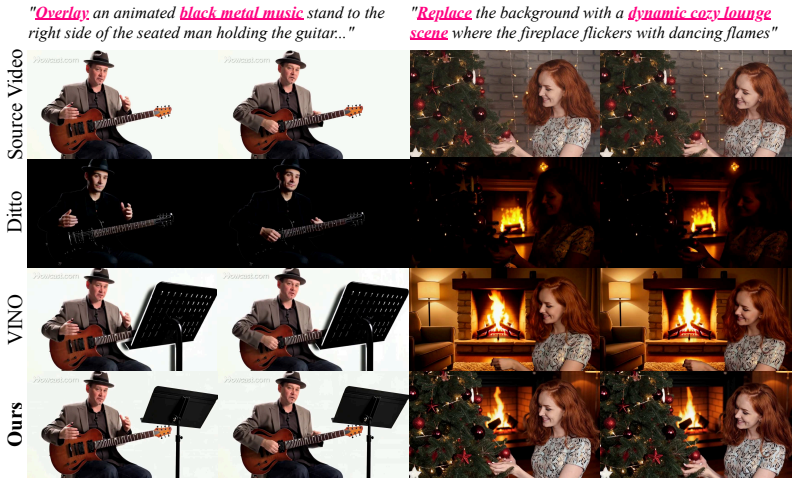
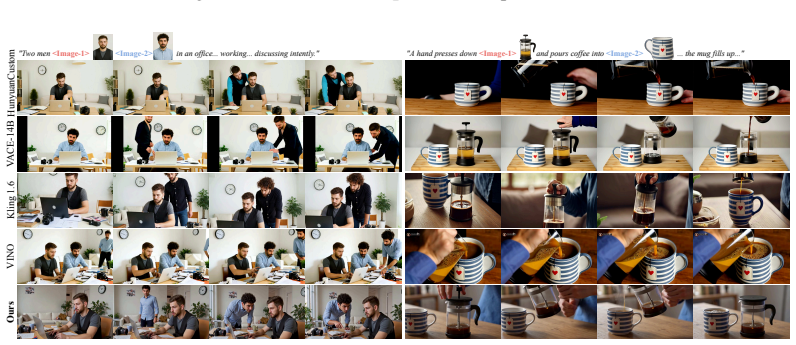
Recent advances in Diffusion Transformers have driven rapid progress in video generation and editing, yet these capabilities are still handled by separate, task-specific models. Building a unified framework that supports diverse video tasks remains an open challenge: existing unified attempts either require dedicated auxiliary encoders or lack explicit mechanisms to distinguish heterogeneous conditioning tokens, struggling when the number and type of visual conditions vary across tasks. We propose TIDE, a unified framework that integrates instruction-based editing, reference-guided editing, and multi-reference generation. At its core, we introduce per-token task embeddings that assign each input token a task-specific identifier, enabling the model to explicitly disambiguate target, source, and reference tokens. To simultaneously capture high-level semantic understanding and fine-grained structural fidelity, we design a dual-path conditioning scheme that couples a vision-language model with a VAE latent path for complementary signals. We further devise a multi-task progressive training strategy that incrementally introduces tasks of increasing complexity, effectively harmonizing diverse objectives and enabling smooth generalization across heterogeneous task distributions. Extensive experiments on multiple video editing and generation benchmarks demonstrate that TIDE achieves state-of-the-art performance across all evaluated tasks. Our project page is available at https://LittleWork123.github.io/tide.
Figures
Figures from the paper (11 more)
Forward citations
Cited by 1 Pith paper
-
ReBind: Multi-Reference Video Editing via Structured Instructions with Explicit Reference Relationships
Writing editing instructions that explicitly bind each attribute to a reference image via `<Image_N>` tokens substantially improves multi-reference video editing, and a specialized MLLM trained with GRPO generates the...
Reviewed June 27, 2026 · model on record in the stance chip above.
Discussion (0). Continue with ORCID to comment.