REVIEW 3 major objections 4 minor 24 references
Real-time observation of single atoms trapped and interfaced to a nanofiber cavity
T0 review · 3 major / 4 minor · reviewed 2026-08-14 · deepseek-v4-flash
Pith's one-line read A single cesium atom can be trapped on an optical nanofiber cavity and observed in real time through the fiber's guided modes.
desk verdict A genuinely new side-illumination tweezer trap for single atoms on a nanofiber cavity, with a solid qualitative demonstration but headline coupling numbers that depend on an untested motion-averaging assumption. read the letter →
The pith
A machine-rendered reading of the paper's core claim, the machinery that carries it, and where it could break.
The reading
What carries the argument
The central mechanism is the side-illuminated optical tweezer on a single-mode nanofiber whose waist is about 300 nm in diameter. The 938-nm tweezer beam is focused to a 1-$\mu$m waist and aimed perpendicular to the fiber; interference between the incident and reflected light creates a one-dimensional array of red-detuned nanotraps, and the first lattice site sits roughly 190 nm from the fiber surface, where the channeling efficiency of atomic emission into the guided mode is about 10%. The nanofiber cavity itself is formed by two photonic-crystal mirrors written by femtosecond laser ablation, so an atom at that site is coupled to the cavity mode and its scattered light is counted by single-photon modules at both ends. Photon-statistics fits using $C' = g_0^2/[(\kappa/2-i\Delta_c)(\gamma_0/2-i\Delta_a)]$ and the antibunching time constant $t_0=1/(P_0\gamma_0+4g_0^2/\kappa)$ convert the observed count rates and correlations into the effective coupling $g_0$.
What would settle it
Cool a single trapped atom into its axial ground state, hold it at one cavity antinode, and remeasure the photon-statistics coupling; if the extracted $g_0/2\pi$ stays near 34 MHz instead of approaching the geometric 63 MHz, the motion-averaging explanation is false and the cavity parameters used to predict 63 MHz are wrong.
Extended reading notes
Core claim
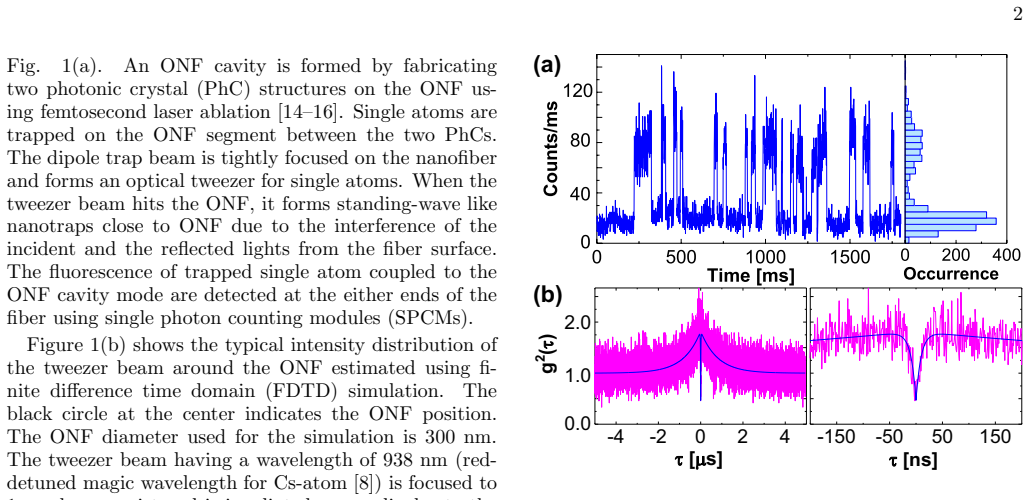
The paper's central claim is that a single cesium atom can be loaded into a standing-wave nanotrap near a 300-nm-diameter optical nanofiber cavity and that its fluorescence, captured by the cavity mode, is observable in real time at the fiber ends. The signal appears as step-like jumps of 62±13 counts/ms over a background of 17±7 counts/ms, and the atom number is confirmed by antibunching with $g^{(2)}(0)\simeq0.47$. From the dependence of the fluorescence count rate and of the antibunching rise time on the cavity linewidth, the paper extracts $g_0/2\pi=34\pm2$ MHz. This implies a single-atom cooperativity $C=5.4\pm0.6$ and a cavity-enhanced channeling efficiency $85\pm2\%$ for a cavity mode of 164 MHz linewidth, meaning that a photon emitted by the atom goes into the fiber most of the time.
Load-bearing premise
The whole result assumes that the 1.9-fold gap between the expected coupling strength (63 MHz) and the measured one (34 MHz) comes entirely from the atom moving across the cavity's bright and dark spots; if the gap instead comes from a wrong cavity length, a wrong atom position, or a failure of the two-level model, the reported coupling strength and channeling fraction are not established.
Editorial extensions
If this is right
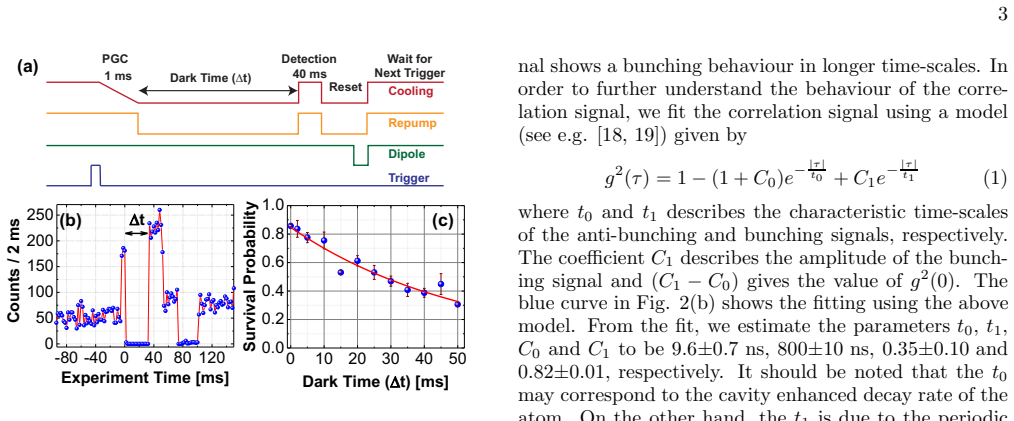
- Real-time detection makes the trap suitable for triggered experiments: a confirmed single atom can start a sequence, as the lifetime demonstration shows.
- The measured cooperativity of 5.4 means a single atom substantially changes the transmission of the cavity mode, so all-fiber single-photon-level nonlinearity becomes realistic.
- The trap lifetime of 52±5 ms is comparable to guided-mode nanofiber traps, and the paper points to blue-detuned axial confinement and Raman cooling as routes to longer lifetimes.
- The side-illumination scheme gives individual-atom addressability that the usual two-color guided-mode trap lacks, and the choice of a ~300-nm fiber diameter is what makes the channeling efficiency high enough for real-time observation.
Reading between the lines
- If the motion-averaging explanation is correct, freezing the atom at a single axial antinode should recover the geometric coupling near $2\pi\times63$ MHz, which would raise the cooperativity by roughly a factor of three; this is not demonstrated in the paper.
- The same side-illuminated tweezer could be extended to a multi-site array along the fiber by using multiple tweezer foci or a standing-wave trap, leading to several individually addressable atoms in one cavity; the paper does not test that.
- A direct check of the two-level model would be to measure the fluorescence spectrum or the Autler-Townes splitting under a stronger drive; if the line shape deviates from the model, the extracted $g_0$ would need reinterpretation.
- Because the signal is available in the fiber in real time, one could close a feedback loop that holds the atom or triggers a quantum protocol; this is a natural follow-up rather than a claim of the paper.
Signed reviews
Editorial analysis
A structured set of objections, weighed in public.
Referee Report
Summary. The manuscript reports an experiment in which a single cesium atom is trapped in an optical tweezer near a tapered optical nanofiber that forms an in-line cavity. The authors observe step-like fluorescence through the fiber, antibunching in the second-order correlation function, and a trap lifetime of 52±5 ms. From fits of the fluorescence counts and the antibunching rise time versus cavity linewidth, they extract an effective atom-cavity coupling g0/2π = 34±2 MHz and, using this value, report a cooperativity C = 5.4±0.6 and a cavity-enhanced channeling efficiency ηc = 85±2% for a cavity mode of linewidth 164 MHz.
Significance. The qualitative result — deterministic loading of a single atom into an all-fiber cavity using a side-illumination tweezer, with real-time readout through the fiber — is a useful and believable advance for nanofiber-based quantum interfaces. The control measurements (signal disappears when the tweezer or repump is off), the antibunching signature, and the lifetime measurement are all consistent with single-atom trapping. If the quantitative claims survive scrutiny, the paper would demonstrate a practical all-fiber platform with moderate cooperativity. The quantitative claims, however, are not yet fully supported: the extracted coupling rate differs from the geometric prediction by nearly a factor of two, and the reconciliation offered in the manuscript is an unquantified motion-averaging assumption. For this reason the significance of the reported C and ηc values is conditional on additional analysis or more cautious framing.
major comments (3)
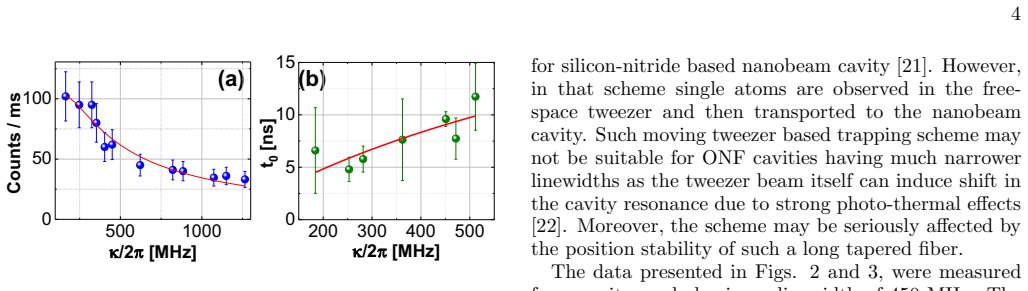
- [Paragraph after Fig. 4 beginning 'However, it must be noted...'] The factor-of-1.9 discrepancy between the geometric coupling g0/2π = 63±3 MHz, estimated from the cavity length, and the fitted effective coupling g0/2π = 34±2 MHz (Eq. (2)) and 36±1 MHz (t0 = 1/(P0γ0 + 4g0^2/κ)) is attributed entirely to axial motion of the atom sampling nodes and antinodes. This attribution is stated as an assumption and is not derived or independently measured. Because C = 4g0^2/(κγ0) and ηc = (P0η + C)/(P0 + C) are computed directly from the fitted g0, the reported values C = 5.4±0.6 and ηc = 85±2% stand or fall with this assumption. If the discrepancy actually originates in an inaccurate cavity length, an incorrect atom-surface distance, or a breakdown of the two-level model, these headline quantities are unsupported. The authors should either provide a quantitative motion-averaging model (for example, averaging g(z)^2 over the axial distribution and checking consistency with the bunching timescale t1 = 800 ns) or explicitly present C and ηc as effective values conditioned on that model.
- [Eq. (2) and the t0 fit in Fig. 4(b)] The two fitting routes are not independent verifications of the coupling rate. Both the fluorescence-count fit and the t0 fit use the same single effective g0 inserted into zero-temperature, motionless cavity-QED formulas, and both are applied to data from the same atom-cavity interface. The agreement between 34±2 MHz and 36±1 MHz therefore confirms internal consistency of the parametrization but does not test the motion-averaging explanation for the factor-of-two gap. This distinction should be stated, and the paper should not claim that the two fits validate the effective-coupling interpretation.
- [Discussion of Fig. 2(b) and Eq. (1)] The bunching feature with t1 = 800±10 ns is presented as evidence of periodic modulation of the fluorescence due to atomic motion, but no quantitative link is made between t1 and the axial trap frequency (80 kHz, corresponding to a 12.5 µs period) or the expected spatial modulation of η. Making this connection quantitative would strengthen the motion-averaging argument; without it, the bunching is only suggestive.
minor comments (4)
- [Abstract and text] The phrase 'α and Ω are just proportional factors' in the paragraph after Eq. (2) is misleading: α is the detection efficiency and Ω is the driving Rabi frequency, both physical parameters. The sentence should be reworded to say that the fit constrains them only through their product with the detection efficiency and the saturation behavior.
- [Fig. 1] The caption and text would benefit from explicit axis labels and error bars in panels (c) and (d); in particular, the upper panel of (c) plots two quantities with different units, but the axes are not labeled clearly in the manuscript text.
- [Throughout] There are minor typographical issues, including 'interfac ed' in the running title, missing commas in some references (e.g., Ref. [17]), and the use of 'nanofiber' with ligature artifacts. These should be corrected in the final version.
- [After Fig. 2] The text states that the data in Figs. 2 and 3 were taken for a cavity linewidth of 450 MHz and that the observed counts and t0 are 'well understood' from the fits, but no explicit comparison with the Fig. 4 curves is shown. A brief quantitative statement (e.g., predicted versus measured counts/ms) would make this claim verifiable.
Circularity Check
No significant circularity: the cavity-QED quantities are explicitly computed from a fitted g0 and labeled as estimates, not predictions.
full rationale
The paper's central claims are experimental: step-like single-atom fluorescence in the nanofiber cavity, g2(0)≈0.47 antibunching, and a directly measured trap lifetime of 52±5 ms. These are self-contained and do not reduce to an input. The quantitative cavity-QED parameters are obtained by fitting the fluorescence data with Eq. (2) and with t0=1/(P0γ0+4g0²/κ), giving g0/2π = 34±2 MHz and 36±1 MHz. The cooperativity C=4g0²/(κγ0) and channeling efficiency ηc=(P0η+C)/(P0+C) are then explicitly computed from the fitted g0, with the paper stating 'From the g0 value, we estimate...' rather than calling them predictions. This is ordinary parameter inference and reparametrization, not circularity. The acknowledged factor-of-1.9 discrepancy between the geometric estimate g0=2π×63±3 MHz and the fitted value is attributed to unverified axial motion averaging; this is an unvalidated modeling assumption and a correctness risk, but it is not circular because the fit does not presuppose the motion-averaging conclusion. Self-citations to Refs. [4], [12], [14]–[16], and [22] are to standard cavity-QED formulas, fabrication methods, or photothermal effects, and none of them carries the derivation by itself. No load-bearing self-citation chain or definitional equivalence is present.
Assumptions & free parameters
free parameters (4)
- g0/2π, atom-cavity coupling rate =
34±2 MHz from count-rate fit; 36±1 MHz from t0 fit
- Ω/2π, driving Rabi frequency =
5.4±0.2 MHz
- α, detection efficiency =
4%
- g2(τ) fit parameters (t0, C0, C1, t1) =
For the 450 MHz cavity, t0=9.6±0.7 ns, C0=0.35±0.10, C1=0.82±0.01, t1=800±10 ns
assumptions (4)
- domain assumption FDTD simulations and the van der Waals potential correctly predict the trapping potential and channeling efficiency around the nanofiber.
- domain assumption The cavity QED rate equation in Eq. (2) accurately describes the fluorescence of a driven atom-cavity system under the experimental conditions.
- ad hoc to paper The discrepancy between the geometric g0 (63 MHz) and the fitted g0 (34 MHz) is caused by axial motion averaging over cavity nodes and antinodes, and the motion-averaged value can be used in the same zero-temperature cavity QED formulas.
- domain assumption Photon anti-bunching with g2(0)=0.47, after accounting for background, is a sufficient signature of a single trapped atom.
Cite this review
Pith. "Pith review of Real-time observation of single atoms trapped and interfaced to a nanofiber cavity." pith.science (2026). https://pith.science/paper/QKRHCG5M
@misc{pith2026190803319,
  author       = {Pith},
  title        = {Pith review of: Real-time observation of single atoms trapped and interfaced to a nanofiber cavity},
  year         = {2026},
  howpublished = {\url{https://pith.science/paper/QKRHCG5M}},
  note         = {Machine review of arXiv:1908.03319}
}
abstract
We demonstrate an optical tweezer based single atom trapping on an optical nanofiber cavity. We show that the fluorescence of single atoms trapped on the nanofiber cavity can be readily observed in real-time through the fiber guided modes. The photon correlation measurements further clarify the atom number and the dynamics of the trap. The trap lifetime is measured to be 52$\pm$5 ms. From the photon statistics measured for different cavity decay rates, the effective coupling rate of the atom-cavity interface is estimated to be 34$\pm$2 MHz. This yields a cooperativity of 5.4$\pm$0.6 and a cavity enhanced channeling efficiency of 85$\pm$2% for a cavity mode having a linewidth of 164 MHz. These results may open new possibilities for building trapped single atom based quantum interfaces on an all-fiber platform.
Figures

Figures from the paper (1 more)
Reference graph
Works this paper leans on
-
[1]
H. J. Kimble, Nature 453, 1023 (2008)
2008
-
[2]
Reiserer and G
A. Reiserer and G. Rempe, Rev. Mod. Phys. 87, 1379 (2015)
2015
-
[3]
F. L. Kien, S. D. Gupta, V. I. Balykin, and K. Hakuta, Phys. Rev. A 72, 032509 (2005)
work page 2005
-
[4]
K. P. Nayak, M. Sadgrove, R. Yalla, F. L. Kien, and K. Hakuta, J. Opt. 20, 073001 (2018)
work page 2018
-
[5]
K. P. Nayak, F. L. Kien, M. Morinaga, and K. Hakuta, Phys. Rev. A 79, 021801(R) (2009)
work page 2009
- [6]
-
[7]
F. L. Kien, V. I. Balykin, and K. Hakuta, Phys. Rev. A 70, 063403 (2004)
work page 2004
-
[8]
F. L. Kien, V. I. Balykin, and K. Hakuta, J. Phys. Soc. Jpn. 74, 910 (2005)
work page 2005
Show all 24 references
-
[9]
Vetsch, D
E. Vetsch, D. Reitz, G. Sague, R. Schmidt, S. T. Dawkins, and A. Rauschenbeutel, Phys. Rev. Lett. 104, 203603 (2010)
2010
-
[10]
Sayrin, C
C. Sayrin, C. Clausen, B. Albrecht, P. Schneeweiss, and A. Rauschenbeutel, Optica 2, 353 (2015)
2015
-
[11]
N. V. Corzo, B. Gouraud, A. Chandra, A. Goban, A. S. Sheremet, D. V. Kupriyanov, and J. Laurat, Phys. Rev. Lett. 117, 133603 (2016)
2016
-
[12]
F. L. Kien and K. Hakuta, Phys. Rev. A 80, 053826 (2009)
2009
-
[13]
Kato and T
S. Kato and T. Aoki, Phys. Rev. Lett. 115, 093603 (2015)
2015
-
[14]
K. P. Nayak and K. Hakuta, Opt. Express 21, 2480 (2013)
2013
-
[15]
K. P. Nayak, P. Zhang, and K. Hakuta, Opt. Lett. 39, 232 (2014)
2014
-
[16]
Keloth, K
J. Keloth, K. P. Nayak, and K. Hakuta, Opt. Lett. 42, 1003 (2017)
2017
-
[17]
Schlosser, G
N. Schlosser, G. Reymond, and P. Grangier Phys. Rev. Lett. 89, 023005 (2002)
2002
-
[18]
S. C. Kitson, P. Jonsson, J. G. Rarity, and P. R. Tapster, Phys. Rev. A 58, 620 (1998)
1998
-
[19]
Gallego, W
J. Gallego, W. Alt, T. Macha, M. Martinez-Dorantes, D. Pandey, and D. Meschede, Phys. Rev. Lett. 121, 173603 (2018)
2018
-
[20]
Y. H. Lien, G. Barontini, M. Scheucher, M. Mergen- thaler, J. Goldwin, and E. A. Hinds, Nature Commu- nications 7, 13933 (2016)
2016
-
[21]
J. D. Thompson, T. G. Tiecke, N. P. de Leon, J. Feist, A. V. Akimov, M. Gullans, A. S. Zibrov, V. Vuleti, and M. D. Lukin, Science 340, 1202 (2013)
2013
-
[22]
J. Wang, K. P. Nayak, and J. Keloth, Opt. Lett., Doc. ID 367036 (posted 17 July 2019, in press)
2019
-
[23]
Hmmer, P
D. Hmmer, P. Schneeweiss, A. Rauschenbeutel, and O. Romero-Isart, arXiv:1902.02200 (2019)
2019 arXiv
-
[24]
Y. Meng, A. Dareau, P. Schneeweiss, and A. Rauschen- beutel, Phys. Rev. X 8, 031054 (2018)
2018
Reviewed August 14, 2026 · model on record in the stance chip above.
Discussion (0). Continue with ORCID to comment.