REVIEW 6 minor 32 references
Status of commissioning stabilized infrared Fizeau interferometry with LBTI
T0 review · 0 major / 6 minor · reviewed 2026-08-14 · deepseek-v4-flash
Pith's one-line read A Fourier-phase readout closes LBTI's Fizeau correction loop
desk verdict A solid, honest commissioning report: the PTF-slope tip/tilt retrieval is a real new step, but the full correction loop is untested on sky and the authors say so clearly. read the letter →
The pith
A machine-rendered reading of the paper's core claim, the machinery that carries it, and where it could break.
The reading
What carries the argument
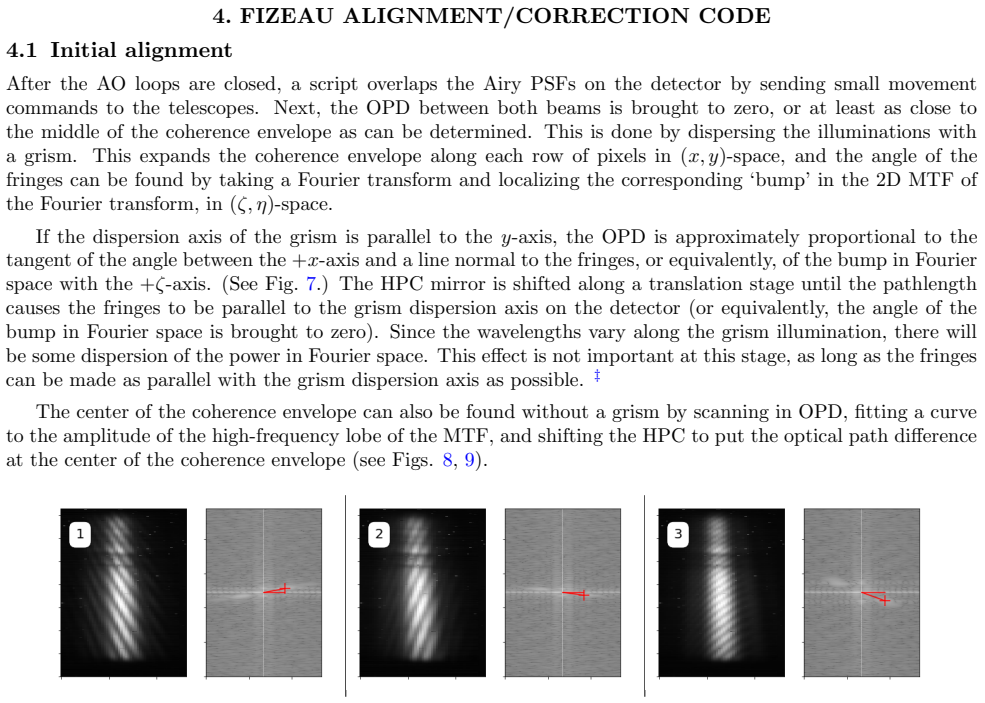
The central object is the phase transfer function slope formula, Eqn. 8: $\vec{\Theta} = [\Omega_x N_x,\ \Omega_y N_y]^T (PS\cdot\Delta)/(\pi\,\mathrm{pix}_{DFT})$, which converts the per-pixel slope of the PTF into the differential wavefront tip/tilt between the two apertures. The factor of two from the partial translation of the composite PSF and the independence from science wavelength make the formula directly usable across filters. A companion observable, the amplitude of the high-frequency lobe of the MTF, locates the center of the coherence envelope and senses OPD; a stairstep pattern in the PTF also flags OPD. The code applies the negative of the measured vector, $\vec{\Gamma}=-\vec{\Theta}$, as corrective setpoints to the phase PID loop and to internal mirrors.
What would settle it
On a bright point source, inject a sequence of known tip and tilt steps with the fast pathlength corrector mirror while the phase loop is closed, and compare the tip/tilt retrieved from the science-detector PTF slope against the commanded values; if the retrieved angles do not track the injections to within a small fraction of the plate scale, or if applying $\vec{\Gamma}=-\vec{\Theta}$ fails to hold fringe contrast on the science detector over a full exposure, the PTF-slope model is not accurate enough for closed-loop Fizeau operation.
Extended reading notes
Core claim
The paper claims that differential tip $\Theta_y$ and tilt $\Theta_x$ between the two LBT beams on the science detector can be read out directly from the slope $\vec{\Omega}$ of the phase transfer function (PTF) of the science image's Fourier transform, using $\vec{\Theta} = [\Omega_x N_x,\ \Omega_y N_y]^T (PS\cdot\Delta)/(\pi\,\mathrm{pix}_{DFT})$ (Eqn. 8), while optical path difference is sensed from the amplitude of the high-frequency MTF lobe. The required correction is $\vec{\Gamma} = -\vec{\Theta}$. Because the phase-sensing camera is blind to the science detector illumination in Fizeau mode, this science-detector readout closes the loop between the science focal plane and the phase-control setpoints, removing non-common-path aberrations without modifying the PhaseCam PID loop. The paper states that on-sky Fizeau engineering tests were carried out in fall 2018 and spring 2019.
Load-bearing premise
The correction formula was validated on monochromatic, diffraction-limited simulated PSFs with only OPD, tip, and tilt as degrees of freedom, so the load-bearing premise is that the PTF-slope readout remains accurate enough on real on-sky PSFs, which include imperfect AO correction, NCPA, ghosts, speckles, detector and photon noise, and phase smearing, to close the correction loop.
Editorial extensions
If this is right
- Fizeau observations no longer require manual alignment or "lucky" fringing: the code automates co-aligning the Airy PSFs, centering the coherence envelope with the grism, and closing the phase loop.
- Closing the correction loop increases fringe contrast, enables longer integrations, and reduces time overheads for Fizeau science.
- Phase-controlled Fizeau imaging becomes feasible for targets fainter or more extended than the current bright, point-like limit set by PhaseCam's read noise and visibility requirements.
- Even with an open phase loop, the science-detector readout can partly compensate by making periodic pathlength corrections.
- With capacitive position sensors installed behind the corrector mirrors, mirror commands gain closed-loop feedback, improving the reliability of both alignment and open-loop corrections.
Reading between the lines
- The PTF-slope method is wavelength-independent in its derivation, so the same correction code could be ported between LMIRcam and NOMIC bands without re-deriving the calibration, a step the paper does not explicitly take.
- If closed-loop Fizeau imaging becomes routine, LBTI's 22.7-m baseline in the thermal infrared would let it image circumstellar disks and giant-planet environments at angular resolutions comparable to future ELTs, extending the science cases the paper lists.
- A testable extension would apply the same Fourier-phase readout to a single-aperture PSF to sense low-order aberrations on the science camera itself, which could complement or replace dedicated wavefront sensors in other instruments.
- The correction loop's reliance on science-detector readouts means it can also serve as a fallback when the phase loop drops out mid-observation, a robustness benefit the authors mention only partially.
Signed reviews
Editorial analysis
A structured set of objections, weighed in public.
Referee Report
Summary. The manuscript reports the current commissioning status of LBTI's Fizeau interferometric mode. It describes the available Fizeau-Airy, non-redundant-mask, and Fizeau-grism observing modes; recent hardware upgrades (SOUL adaptive optics, OVMS+ vibration feed-forward); and the development of a correction loop that uses science-camera images to estimate differential OPD, tip, and tilt. The key algorithmic contribution is Eq. (1)/(8), which converts the slope of the phase transfer function (PTF) of the science-detector image into a wavefront tip/tilt estimate, with OPD sensed separately from a stairstep pattern in the PTF. The correction loop is validated on simulated monochromatic 3.7 micron Fizeau PSFs in which OPD, tip, or tilt performs a known random walk. The paper also reports on-sky engineering tests from fall 2018 and spring 2019, including partial phase-loop closure after the SOUL upgrade, and it closes with lessons learned and concrete next steps (capacitive mirror feedback, code porting, additional on-sky time).
Significance. If the proposed correction loop works on sky, it would be an important step toward routine phase-stabilized Fizeau imaging at LBTI and would provide a useful template for future ELT-scale interferometric imagers. The paper's strengths are its parameter-free derivation of the PTF-slope formula from the Fourier shift theorem, direct simulated validation with injected random walks, quantitative hysteresis measurements, and unusually candid statements of the gap between the simulated validation and the real on-sky regime. The paper does not overclaim: full closed-loop NCPA removal is explicitly deferred to future work, and the on-sky tests are presented as engineering milestones rather than as a demonstration of the complete correction loop. The main uncertainty identified by the stress-test note is real but is already acknowledged by the authors in Sec. 4.4, and it does not undermine the paper's actual status-report claim.
minor comments (6)
- [Sec. 4.3 / Fig. 11] The validation section shows a retrieval example for the tilt random-walk dataset, but it does not report quantitative residuals or error statistics for the OPD-only and tip-only datasets. Reporting the RMS retrieval error for all three datasets would make the simulation evidence much easier to evaluate.
- [Appendix C / Sec. 4.2] Equation (1) uses Nx, Ny, PS, and Delta, but those symbols are only fully defined in the appendix (Table 3). Adding a pointer to Table 3 at the first occurrence of Eq. (1), or defining the symbols inline, would improve readability.
- [Sec. 4.3] The sentence about the wrap-around degeneracy and the PSF elongation is vague; please state more concretely how the degeneracy is broken in the code or in post-processing.
- [Fig. 4] The figure legend describes colored status categories that appear only in grayscale in the printed version; using distinct symbols or hatching in addition to color would make the statuses legible in monochrome print.
- [Sec. 5] Several small typographical issues are present, e.g., 'adviseable' in the last bullet; a careful proofread of the lessons-learned section is recommended.
- [Sec. 2.1] The reference style 'See Fig. 1, or 8 or bottom-left panels in Fig. 11' is awkward; please rephrase as 'Fig. 1, Fig. 8, or the bottom-left panels of Fig. 11'.
Circularity Check
No circularity: the PTF-slope correction is a parameter-free Fourier-shift derivation and the simulated validation is a direct recovery test, not a fit renamed as prediction.
full rationale
The paper's central derivation (Appendix C, Eqs. 1 and 8) is a parameter-free application of the Fourier shift theorem, supplemented by an explicit physical assumption that the Fizeau illumination centroid shifts by half the single-aperture Airy-pattern shift. That assumption is stated in the derivation, not fitted to data, and the resulting relation is independent of the simulated validation. The code-performance test in Sec. 4.3 injects known random walks in OPD, tip, and tilt separately into monochromatic diffraction-limited simulated PSFs and then recovers them with Eq. 1; this is a direct consistency test of the derived formula, not a fit of a parameter that is later relabeled as a prediction. The empirical MTF comparison in Sec. 5 is checked against predictions of Ref. [20], and although that reference shares an author with the present paper, it is used as an external sensitivity prediction rather than as the load-bearing justification for the correction formula. Self-citations such as Ref. [3] are used only to describe prior commissioning context. The paper explicitly identifies on-sky validation of the full loop as future work (Sec. 4.4 and Sec. 6), so the feasibility claim is not presented as already demonstrated by circular reasoning. No step reduces, by construction or by self-citation, to its own inputs.
Assumptions & free parameters
assumptions (3)
- standard math The Fourier transform of the PSF yields the optical transfer function, and a pure translation produces a linear phase slope (Fourier shift theorem).
- domain assumption When only the left-side Airy pattern is shifted, the center of the combined illumination shifts by half the distance.
- domain assumption The plate scale and pixel sampling of LMIRcam and NOMIC are known.
Cite this review
Pith. "Pith review of Status of commissioning stabilized infrared Fizeau interferometry with LBTI." pith.science (2026). https://pith.science/paper/QL5WJJLK
@misc{pith2026190811023,
  author       = {Pith},
  title        = {Pith review of: Status of commissioning stabilized infrared Fizeau interferometry with LBTI},
  year         = {2026},
  howpublished = {\url{https://pith.science/paper/QL5WJJLK}},
  note         = {Machine review of arXiv:1908.11023}
}
read the original abstract
The Large Binocular Telescope Interferometer (LBTI) has the longest baseline in the world, 22.7 m, for performing astronomical interferometry in Fizeau mode, which involves beam combination in a focal plane and preserves a wide field-of-view. LBTI can operate in this mode at wavelengths of 1.2 to 5 and 8 to 12 {\mu}m, making it a unique platform for carrying out high-resolution imaging of circumstellar disks, evolved stars, solar system objects, and possibly searches for planets, in the thermal infrared. Over the past five years, LBTI has carried out a considerable number of interferometric observations by combining the beams near a pupil plane to carry out nulling interferometry. This mode is useful for measuring small luminosity level offsets, such as those of exozodiacal dust disks. The Fizeau mode, by contrast, is more useful for generating an image of the target because it has more (u, v) (Fourier) plane coverage. However, the Fizeau mode is still in an ongoing process of commissioning. Sensitive Fizeau observations require active phase control, increased automation, and the removal of non-common-path aberrations (NCPA) between the science and phase beams. This increased level of control will increase the fringe contrast, enable longer integrations, and reduce time overheads. We are in the process of writing a correction loop to remove NCPA, and have carried out tests on old and synthetic data. We have also carried out on-sky Fizeau engineering tests in fall 2018 and spring 2019. In this article, we share lessons learned and strategies developed as a result of these tests.
Figures


Figures from the paper (11 more)




Reference graph
Works this paper leans on
-
[1]
First ao-corrected interferometry with lbti: steps towards routine coherent imaging observations,
Hinz, P., Arbo, P., Bailey, V., Connors, T., Durney, O., Esposito, S., Hoffmann, W., Jones, T., Leisenring, J., Montoya, M., et al., “First ao-corrected interferometry with lbti: steps towards routine coherent imaging observations,” in [Optical and Infrared Interferometry III ], 8445, 84450U, International Society for Optics and Photonics (2012)
work page 2012
-
[2]
The hosts surveyexozodiacal dust measurements for 30 stars,
Ertel, S., Defr` ere, D., Hinz, P., Mennesson, B., Kennedy, G., Danchi, W., Gelino, C., Hill, J., Hoffmann, W., Rieke, G., et al., “The hosts surveyexozodiacal dust measurements for 30 stars,” The Astronomical Journal 155(5), 194 (2018)
work page 2018
-
[3]
Towards controlled fizeau observations with the large binocular telescope,
Spalding, E., Hinz, P., Ertel, S., Maier, E., and Stone, J., “Towards controlled fizeau observations with the large binocular telescope,” in [ Optical and Infrared Interferometry and Imaging VI ], 10701, 107010J, International Society for Optics and Photonics (2018)
work page 2018
-
[4]
The large binocular telescope as an early elt,
Hill, J., Hinz, P., and Ashby, D., “The large binocular telescope as an early elt,” in [3rd AO4ELT Conference- Adaptive Optics for Extremely Large Telescopes ], (2013)
work page 2013
-
[5]
Commissioning the lbti for use as a nulling interferometer and coherent imager,
Hinz, P., Bailey, V. P., Defr` ere, D., Downey, E., Esposito, S., Hill, J., Hoffmann, W. F., Leisenring, J., Montoya, M., McMahon, T., et al., “Commissioning the lbti for use as a nulling interferometer and coherent imager,” in [ Optical and Infrared Interferometry IV ], 9146, 91460T, International Society for Optics and Photonics (2014)
work page 2014
-
[6]
Operation and performance of the mid-infrared camera, nomic, on the large binocular telescope,
Hoffmann, W. F., Hinz, P. M., Defr` ere, D., Leisenring, J. M., Skemer, A. J., Arbo, P. A., Montoya, M., and Mennesson, B., “Operation and performance of the mid-infrared camera, nomic, on the large binocular telescope,” in [Ground-based and Airborne Instrumentation for Astronomy V ], 9147, 91471O, International Society for Optics and Photonics (2014)
work page 2014
-
[7]
Accreting protoplanets in the lkca 15 transition disk,
Sallum, S., Follette, K., Eisner, J. A., Close, L. M., Hinz, P., Kratter, K., Males, J., Skemer, A., Macintosh, B., Tuthill, P., et al., “Accreting protoplanets in the lkca 15 transition disk,” Nature 527(7578), 342 (2015)
work page 2015
-
[8]
Data reduction and image reconstruction techniques for non-redundant masking,
Sallum, S. and Eisner, J., “Data reduction and image reconstruction techniques for non-redundant masking,” The Astrophysical Journal Supplement Series 233, 9 (nov 2017)
work page 2017
Show all 32 references
-
[9]
Improved constraints on the disk around mwc 349a from the 23 m lbti,
Sallum, S., Eisner, J. A., Hinz, P. M., Sheehan, P., Skemer, A., Tuthill, P., and Young, J., “Improved constraints on the disk around mwc 349a from the 23 m lbti,” The Astrophysical Journal 844(1), 22 (2017)
2017
-
[10]
Fizeau interferometric imaging of io volcanism with lbti/lmircam,
Leisenring, J., Hinz, P. M., Skrutskie, M., Skemer, A., Woodward, C., Veillet, C., Arcidiacono, C., Bailey, V., Bertero, M., Boccacci, P., et al., “Fizeau interferometric imaging of io volcanism with lbti/lmircam,” in [Optical and Infrared Interferometry IV ], 9146, 91462S, In...
2014
-
[11]
Spatially resolved m-band emission from ios loki patera–fizeau imaging at the 22.8 m lbt,
Conrad, A., De Kleer, K., Leisenring, J., La Camera, A., Arcidiacono, C., Bertero, M., Boccacci, P., Defr` ere, D., De Pater, I., Hinz, P., et al., “Spatially resolved m-band emission from ios loki patera–fizeau imaging at the 22.8 m lbt,” The Astronomical Journal 149(5), 175 (2015)
2015
-
[12]
The role of fizeau interferometry in planetary science,
Conrad, A. R., “The role of fizeau interferometry in planetary science,” in [ Optical and Infrared Interfer- ometry and Imaging V ], 9907, 99070L, International Society for Optics and Photonics (2016)
2016
-
[13]
Multi-phase volcanic resurfacing at loki patera on io,
De Kleer, K., Skrutskie, M., Leisenring, J., Davies, A., Conrad, A., De Pater, I., Resnick, A., Bailey, V., Defrere, D., Hinz, P., et al., “Multi-phase volcanic resurfacing at loki patera on io,” Nature 545(7653), 199 (2017)
2017
-
[14]
Pseudomag- nitudes and differential surface brightness: Application to the apparent diameter of stars,
Chelli, A., Duvert, G., Bourg` es, L., Mella, G., Lafrasse, S., Bonneau, D., and Chesneau, O., “Pseudomag- nitudes and differential surface brightness: Application to the apparent diameter of stars,” Astronomy & Astrophysics 589, A112 (2016)
2016
-
[15]
The limb-darkened arcturus: imaging with the iota/ionic interferometer,
Lacour, S., Meimon, S., Thi´ ebaut, E., Perrin, G., Verhoelst, T., Pedretti, E., Schuller, P., Mugnier, L., Monnier, J., Berger, J., et al., “The limb-darkened arcturus: imaging with the iota/ionic interferometer,” Astronomy & Astrophysics 485(2), 561–570 (2008)
2008
-
[16]
Soul: the single conjugated adaptive optics upgrade for lbt,
Pinna, E., Esposito, S., Hinz, P., Agapito, G., Bonaglia, M., Puglisi, A., Xompero, M., Riccardi, A., Briguglio, R., Arcidiacono, C., et al., “Soul: the single conjugated adaptive optics upgrade for lbt,” in [Adaptive Optics Systems V ], 9909, 99093V, International Society for...
2016
-
[17]
Adaptive optics systems at the large binocular telescope: status, upgrades, and improve- ments,
Christou, J. C., Zappellini, G. B., Conrad, A., Hill, J., Miller, D. L., Rahmer, G., Taylor, G. E., Veillet, C., and Zhang, X., “Adaptive optics systems at the large binocular telescope: status, upgrades, and improve- ments,” in [Adaptive Optics Systems VI ], 10703, 107030A, I...
2018
-
[18]
Ovms-plus at the lbt: disturbance compensation simplified,
B¨ ohm, M., Pott, J.-U., Borelli, J., Hinz, P., Defr` ere, D., Downey, E., Hill, J., Summers, K., Conrad, A., K¨ urster, M., et al., “Ovms-plus at the lbt: disturbance compensation simplified,” in [ Ground-based and Airborne Telescopes VI], 9906, 99062R, International Society f...
2016
-
[19]
Improving the performance of interferometric imaging through the use of disturbance feedforward,
B¨ ohm, M., Gl¨ uck, M., Keck, A., Pott, J.-U., and Sawodny, O., “Improving the performance of interferometric imaging through the use of disturbance feedforward,” JOSA A 34(5), A10–A21 (2017)
2017
-
[20]
The lbti fizeau imager–ii. sensitivity of the psf and the mtf to adaptive optics errors and to piston errors,
Patru, F., Esposito, S., Puglisi, A., Riccardi, A., Pinna, E., Arcidiacono, C., Antichi, J., Mennesson, B., Defr` ere, D., Hinz, P., et al., “The lbti fizeau imager–ii. sensitivity of the psf and the mtf to adaptive optics errors and to piston errors,” Monthly Notices of the Ro...
2017
-
[21]
Co-phasing the large binocular telescope: status and performance of lbti/phasecam,
Defrere, D., Hinz, P., Downey, E., Ashby, D., Bailey, V., Brusa, G., Christou, J., Danchi, W., Grenz, P., Hill, J., et al., “Co-phasing the large binocular telescope: status and performance of lbti/phasecam,” in [ Optical and Infrared Interferometry IV ], 9146, 914609, Interna...
2014
-
[22]
Target selection for the lbti exozodi key science program,
Weinberger, A. J., Bryden, G., Kennedy, G. M., Roberge, A., Defrere, D., Hinz, P. M., Millan-Gabet, R., Rieke, G., Bailey, V. P., Danchi, W. C., et al., “Target selection for the lbti exozodi key science program,” The Astrophysical Journal Supplement Series 216(2), 24 (2015)
2015
-
[23]
FFTCam: Enabling Imaging Interferometry with a 23 m telescope and LBTI to Directly Probe Planet Formation
Stone, Jordan, “FFTCam: Enabling Imaging Interferometry with a 23 m telescope and LBTI to Directly Probe Planet Formation.” NSF-ATI proposal
-
[24]
A two-band approach to n λ phase error cor- rections with lbti’s phasecam,
Maier, E., Hinz, P., Defr` ere, D., Ertel, S., and Downey, E., “A two-band approach to n λ phase error cor- rections with lbti’s phasecam,” in [ Optical and Infrared Interferometry and Imaging VI ], 10701, 107011M, International Society for Optics and Photonics (2018)
2018
-
[25]
“INDI.” https://indilib.org
-
[26]
Improvements for group delay fringe tracking,
Basden, A. G. and Buscher, D. F., “Improvements for group delay fringe tracking,” Monthly Notices of the Royal Astronomical Society 357, 656–668 (02 2005)
2005
-
[27]
Buscher, D., [ Practical Optical Interferometry], Cambridge University Press (2015)
2015
-
[28]
Nulling data reduction and on-sky performance of the large binocular telescope interferometer,
Defr` ere, D., Hinz, P. M., Mennesson, B., Hoffmann, W., Millan-Gabet, R., Skemer, A., Bailey, V., Danchi, W., Downey, E., Durney, O., et al., “Nulling data reduction and on-sky performance of the large binocular telescope interferometer,” The Astrophysical Journal 824(2), 66 (2016)
2016
-
[29]
Dewarp: Distortion removal and on-sky orientation solution for lbti detectors,
Spalding, E. and Stone, J., “Dewarp: Distortion removal and on-sky orientation solution for lbti detectors,” Astrophysics Source Code Library (2019)
2019
-
[30]
Daophot: A computer program for crowded-field stellar photometry,
Stetson, P. B., “Daophot: A computer program for crowded-field stellar photometry,” Publications of the Astronomical Society of the Pacific 99(613), 191 (1987)
1987
-
[31]
The astropy project: building an open-science project and status of the v2. 0 core package,
Price-Whelan, A., Sip˝ ocz, B., G¨ unther, H., Lim, P., Crawford, S., Conseil, S., Shupe, D., Craig, M., Dencheva, N., Ginsburg, A., et al., “The astropy project: building an open-science project and status of the v2. 0 core package,” The Astronomical Journal 156(3), 123 (2018)
2018
-
[32]
Williams, C. S. and Becklund, O. A., [ Introduction to the optical transfer function ], Wiley New York (1989)
1989
Reviewed August 14, 2026 · model on record in the stance chip above.
Discussion (0). Continue with ORCID to comment.