REVIEW 4 major objections 6 minor 2 cited by
Caloric curves of classical self-gravitating systems in general relativity
T0 review · 4 major / 6 minor · reviewed 2026-08-14 · deepseek-v4-flash
Pith's one-line read A self-gravitating gas in a box has no equilibrium state in general relativity once its compactness parameter exceeds 0.1764; below that threshold the temperature-energy curve is a double spiral that shrinks with compactness.
desk verdict Solid numerical extension of Roupas with an honest but unproven global existence bound; worth refereeing, not a new discovery. read the letter →
The pith
A machine-rendered reading of the paper's core claim, the machinery that carries it, and where it could break.
The reading
What carries the argument
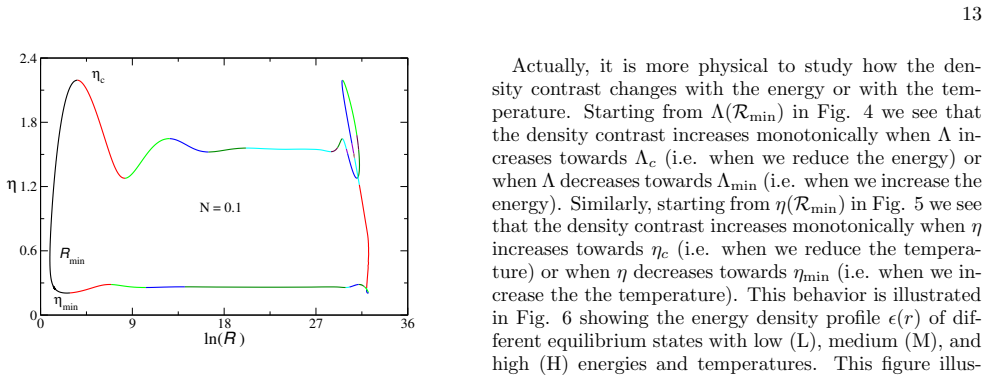
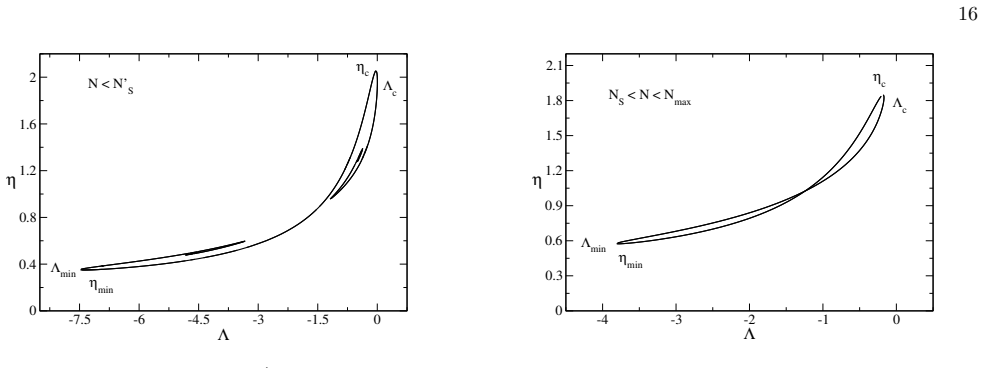
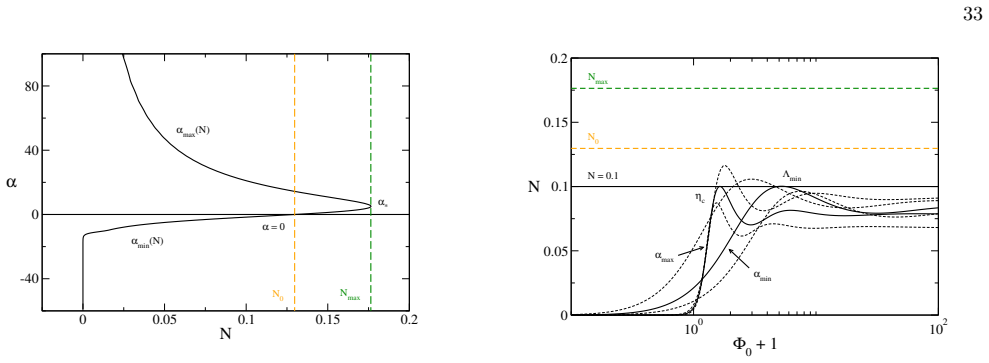
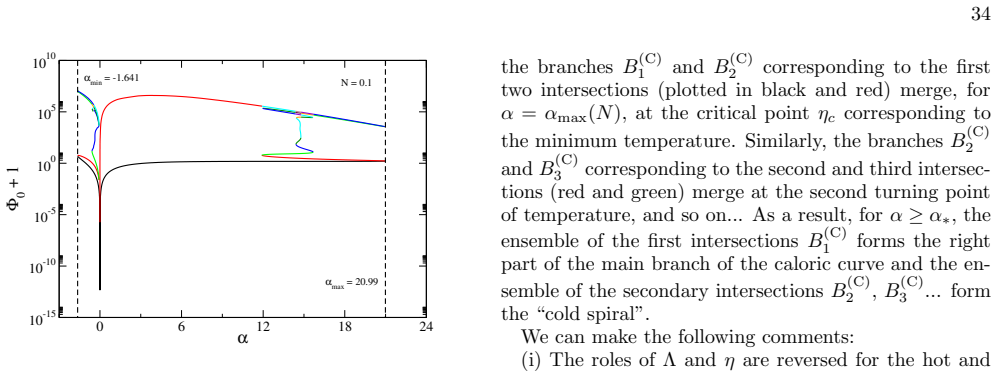
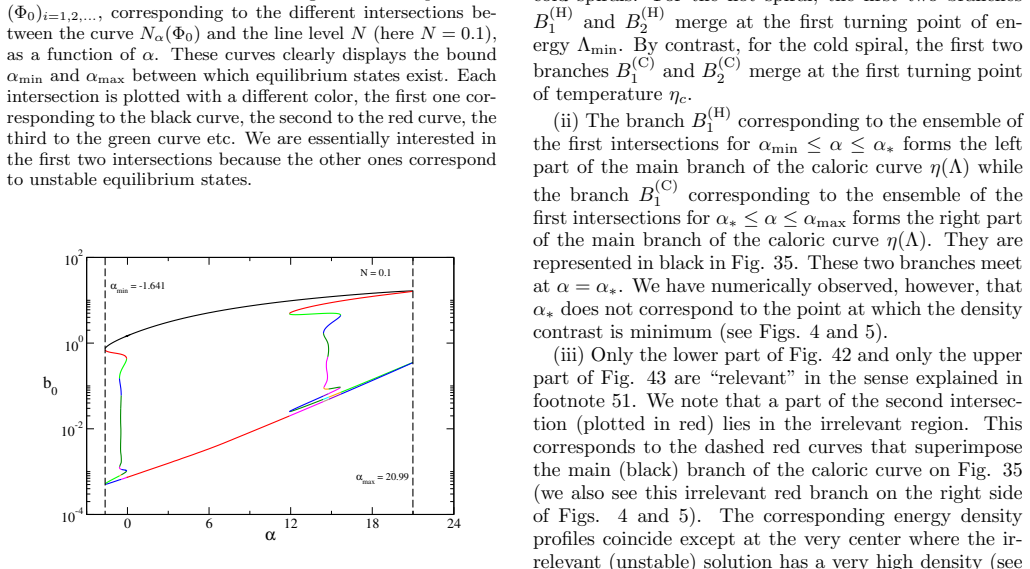
The argument runs on the series of equilibria of the general-relativistic hydrostatic equilibrium equations, closed with the relativistic equilibrium distribution function of a classical gas and parametrised by the uniform ratio $\alpha$ of chemical potential to temperature and by the central gravitational potential $\Phi_0$. Equilibrium states for a fixed particle number $N$ are exactly the intersections of the curve $N_\alpha(\Phi_0)$ with the horizontal level $N$; varying $\alpha$ sweeps out branches of the caloric curve, and the turning points of these branches locate the stability changes through the classical turning-point criterion for linear series of equilibria. Two normalisations do the conceptual work: $(\Lambda,\eta)$ is adapted to the nonrelativistic limit and exposes the cold spiral, while $(M,B)$ is adapted to the ultrarelativistic limit and exposes the hot spiral as an asymptotic curve when $\nu\to0$. The maxima and minima of the curve $N_\alpha(\Phi_0)$ directly explain the critical particle numbers $N'_S=0.128$, $N_S=0.1415$ and $N_{\max}=0.1764$ that organise the changes of topology.
What would settle it
An independent high-precision integration of the same equilibrium equations that finds any equilibrium state for $\nu>0.1764$, at any energy and temperature, would refute the claimed maximum compactness; conversely, a relativistic Vlasov-Einstein or N-body simulation starting from a classical gas in a box with $\nu>0.1764$ that does not collapse would challenge the conclusion.
Extended reading notes
Core claim
The central claim is that the caloric curve $\eta(\Lambda)$, with $\eta$ the dimensionless inverse global temperature and $\Lambda$ the dimensionless binding energy, captures the stability of the gas in both the microcanonical and canonical ensembles, and that for small compactness this curve is a double spiral. The cold spiral is the relativistic generalisation of the classical nonrelativistic spiral; the hot spiral, made visible by an ultrarelativistic normalisation, resembles the spiral of self-gravitating radiation with the same maximum mass-energy $GM_{\max}/(Rc^2)=0.24632$ in the $\nu\to0$ limit. The claimed topology is a one-parameter family: well-separated double spirals for $\nu<0.128$, touching truncated spirals for $0.128<\nu<0.1415$, a single loop for $0.1415<\nu<0.1764$, a single equilibrium point at $\nu_{\max}=0.1764$ with $\Lambda_*=-0.9829$ and $\eta_*=1.2203$, and no equilibrium at all above. If this is right, the gas has a maximum compactness $\nu_{\max}=0.1764$, equivalently a minimum box radius $R_{\min}=5.67\,GNm/c^2$, and increasing compactness advances both the low-energy and high-energy collapse thresholds.
Load-bearing premise
The load-bearing premise is that the numerical construction of the series of equilibria is complete: every equilibrium state corresponds to an intersection of the curve $N_\alpha(\Phi_0)$ with the level $N$, and the revived high-density branches at very large central potentials are unstable and can be discarded; the paper states that it has no mathematical proof that successive branches merge exactly at the turning points that define the spiral structure.
Editorial extensions
If this is right
- For fixed box radius $R$, equilibrium exists only up to the particle number $N_{\max}=0.1764\,Rc^2/(Gm)$; above it the gas has no equilibrium at any energy or temperature and is expected to collapse.
- For fixed particle number $N$, there is a minimum box radius $R_{\min}=5.67\,GNm/c^2$ below which no equilibrium state exists.
- Raising the compactness parameter lowers the critical energy and critical temperature of the cold spiral relative to the nonrelativistic values $\Lambda_c=0.335$ and $\eta_c=2.52$, so general relativity makes the gas unstable earlier than nonrelativistic gravity does.
- The hot spiral endows high positive energies with a new instability: above a maximum energy and above a maximum global temperature the gas collapses, in analogy with the self-gravitating radiation case.
- The two collapse routes differ in timescale: the low-energy (cold-spiral) instability is slow and secular, while the high-energy (hot-spiral) instability is fast and dynamical, so the two ends of the caloric curve correspond to different physical collapse mechanisms.
Reading between the lines
- The square-root scalings $\Lambda_X-\Lambda_*\sim\pm 6.7\,(N_{\max}-N)^{1/2}$ and $\eta_X-\eta_*\sim\pm 3.9\,(N_{\max}-N)^{1/2}$ suggest that the disappearance of equilibria at $\nu_{\max}$ is a fold (saddle-node) bifurcation of the equilibrium family; if so, the critical point should be reproducible by a normal-form expansion without resolving every spiral turn.
- The 'irrelevant' high-density branches are set aside because they are unstable; if quantum degeneracy or a short-distance repulsion stabilised them, the caloric-curve topology and the maximum compactness would change, so the bound $\nu_{\max}=0.1764$ is specific to a purely classical gas.
- The same maximum mass-energy $GM_{\max}/(Rc^2)=0.24632$ appearing for both the classical hot spiral and self-gravitating radiation hints at a universal ultrarelativistic limit; a natural extension is to check whether the hot spiral of a self-gravitating Fermi gas approaches the same value as degeneracy is lowered.
- A direct numerical-relativity test is available: a box-confined classical gas started with $\nu>0.1764$ should collapse at every scanned energy and temperature, and finding even one long-lived equilibrium would contradict the existence bound.
Signed reviews
Editorial analysis
A structured set of objections, weighed in public.
Referee Report
Summary. The paper studies box-confined classical self-gravitating gases in general relativity, modeled by the Maxwell-Juttner distribution with the TOV equations and the Tolman-Klein relations. It claims that the caloric curves η(Λ) depend on a single compactness parameter ν = GNm/Rc², and that these curves have a double-spiral structure: a cold spiral (weakly relativistic, generalizing the nonrelativistic curve) and a hot spiral (strongly relativistic, similar to the black-body radiation curve). As ν increases, the spirals approach, merge at ν'_S = 0.128, form a loop above ν_S = 0.1415, reduce to a point at ν_max = 0.1764, and then disappear. The central claim is that for ν > ν_max no equilibrium state exists at any energy or temperature. The paper describes the numerical construction of the caloric curves (Appendix C), the N→0 limits in both normalizations (Sec. VI), and the evolution of critical points (Sec. VII). It also discusses astrophysical consequences, including the distinction between slow thermodynamical and fast dynamical collapse.
Significance. If the result holds, the paper establishes a concrete compactness threshold beyond which a classical self-gravitating gas confined in a box has no isothermal statistical-equilibrium state at all, sharply illustrating how general relativity renders such systems more unstable than Newtonian gravity. The claimed double-spiral topology is a novel and physically suggestive generalization of the known Newtonian spiral and the black-body-radiation spiral. The paper deserves credit for presenting a clearly described numerical method (Appendix C), for openly flagging where results are numerical rather than proven (Appendix C.4, footnote 51, footnote 41), and for making falsifiable quantitative predictions (e.g., ν_max = 0.1764, Λ* = −0.9829, η* = 1.2203). The central quantitative claim is, however, not yet mathematically established; in particular, the global statement that no equilibrium exists for N > Nmax rests on a finite numerical scan and on dismissing high-central-potential branches rather than on a proof of the global supremum of Nα(Φ0).
major comments (4)
- [Abstract, Sec. V.E, and Appendix C.4] The central no-equilibrium claim for N>Nmax requires proving that sup_{\alpha,\Phi_0} N_\alpha(\Phi_0) is attained at Nmax=0.1764 and never exceeded for any \alpha \in (-∞,∞) and \Phi_0 \in [-1,∞). The numerical construction in Appendix C, however, scans only a finite range of \Phi_0, and footnote 51 explicitly dismisses the revived high-\Phi_0 oscillations as a "mathematical curiosity" whose solutions are "unstable" and hence "irrelevant". Instability of those branches does not remove their existence: they are equilibrium solutions of the same TOV plus Tolman-Klein system, and the paper itself includes unstable branches on the caloric curves (e.g., Fig. 3). If any revived local maximum anywhere in the high-\Phi_0 region exceeded Nmax, equilibrium states with N>Nmax would exist at high central densities, contradicting the statement in the abstract and Sec. V.E that no equilibrium state is possible whatever the energy and temperature. The manuscript explicitly concedes "we do not have a mathematical proof" for the merging of branches that defines the spiral topology, so the global supremum claim is a load-bearing assertion that is not presently supported.
- [Sec. VII and footnote 41] The quantitative output of the paper — the critical particle number Nmax=0.1764, the critical point (Λ*, η*)=(−0.9829, 1.2203), the scaling laws in Eqs. (35), (38), (41), (44), (45)–(48), and the contrast values — is presented at an "indicative level" because "the numerics is not very accurate close to Nmax". No convergence test, tolerance, or error estimate is given for the numerical location of the peak of Nα(Φ0), nor for the determination of Λc, Λmin, ηc, ηmin by hand from the caloric curves (Appendix C.4). Since these numbers are the main quantitative results and since the entire existence bound rests on them, a convergence or error analysis is required before the claim can be considered established.
- [Sec. VI.B and Sec. III.B] The hot-spiral limit values Mmax = 0.24632 and Bmin = 17.809 are cited from the authors' own preprints (refs. [1], [3], [170]) rather than derived in this paper; the same applies to the asymptotic curve in Fig. 19. The comparison with the self-gravitating black-body radiation in Sec. III.B, where Mmax = 0.24632 is quoted from Refs. [162, 163], also relies on those external results. For a paper whose abstract emphasizes the hot spiral and its critical parameters, a self-contained derivation of these limit values (or at least a concise indication of the equations used to obtain them) should be included or made reproducible, otherwise the reader cannot verify a key input to the central scenario.
- [Appendix C.1 and footnote 51] The assertion that the high-\Phi_0 revived oscillations are unstable and can therefore be ignored is itself not demonstrated. The paper presents no stability analysis (eigenvalue equation or second-variation calculation) for those branches; the instability claim in footnote 51 appears to be an inference from the fact that the corresponding solutions lie deep in the spirals of the caloric curve, but no explicit check is reported. Since these branches are the ones whose existence could overturn the N>Nmax conclusion, the instability assertion is load-bearing and should be supported by a computation or by an argument that the extrema of the same variational problem are captured by the lower-\Phi_0 branches.
minor comments (6)
- [Sec. V.B] The word "amputed" appears twice (Sec. V.B and the conclusion); it should be "amputated".
- [Abstract and Sec. IV.A] The abstract states that the caloric curves "typically" have the form of a double spiral, but for NS<N<Nmax the curve is described as a single loop resembling the symbol ∞ (Fig. 13). The phrasing is not contradictory, but the abstract could be clearer that the double spiral is the typical shape only for N<N'S.
- [Eq. (19)] The dimensionless relation ν=N with ℏ=c=G=m=g/2=R=1 is stated without comment. Since the figures use N as the control parameter, an explicit sentence reminding the reader that ν=N in these units would improve accessibility.
- [References [1], [3], [170]] Several references are listed only as "preprint" or "arXiv" with no arXiv number or publication status (e.g., refs. [1], [3], [170]). This makes it difficult for the reader to verify the cited values Mmax = 0.24632 and Bmin = 17.809 and the asymptotic caloric curves; the authors should provide arXiv identifiers or complete publication data.
- [Fig. 16] The dashed line in Fig. 16 is mentioned in the caption and text as corresponding to ηc = 2.52, but it is not labeled in the figure itself; adding a small label would aid the reader.
- [Sec. II and Appendix C.2] The replacement of b0 by Φ0 via Eq. (16) introduces a division by |α|; the paper correctly notes that α=0 gives a singular presentation of Nα(Φ0) as a function of Φ0. This is a useful clarification, but a statement that the physical quantities remain regular at α=0 would be helpful, as the singularity is only in the plotting variable.
Circularity Check
The central νmax calculation is self-contained in Appendix C, but the paper's hot-spiral limiting curve and its characteristic numbers are imported from the authors' own unpublished preprint [1], making a supporting limb of the abstract self-citation-dependent.
-
self citation load bearing
[Sec. VI.B, Eqs. (31)-(32) and Fig. 19 caption; reused in Sec. VII.A, Eqs. (33) and (36)]
"The maximum temperature and the corresponding energy density contrast of the hot spiral when N → 0 are [1] Bmin ≡ Rc4/GNkB(T∞)max = 17.809, R′c = 10.3. These values differ from those of the self-gravitating black-body radiation (see Sec. III B) for the reasons explained in [1]. ... The manner to obtain this asymptotic curve is explained in [1]."
The paper's hot-spiral limiting curve and the numerical values Mmax = 0.24632 and Bmin = 17.809 are not derived in the present paper; they are quoted from [1], an unpublished preprint by the same author. These values are then used as the paper's own asymptotic predictions (ηmin ∼ 17.809 N², Λmin ∼ −(0.24632 − N)/N²) in Sec. VII. The abstract's claim that the hot spiral is 'similar (but not identical) to the caloric curve of the ultrarelativistic self-gravitating black-body radiation' therefore relies on [1] for the quantitative limiting curve rather than on an in-paper derivation. This is a self-citation load-bearing step for the hot-spiral limb, although the central bound νmax = 0.1764 is computed independently in Appendix C from the TOV integration and the maximum of Nα(Φ0).
full rationale
The central derivation is self-contained and does not reduce to a fit or to a definition. Appendix C constructs equilibria by fixing α, integrating the TOV equations, plotting Nα(Φ0), and intersecting with the level N; the critical values N′S = 0.128, NS = 0.1415, Nmax = 0.1764, and α∗ = 5.012 are read from the computed curve Nα∗(Φ0). The no-equilibrium assertion for ν > νmax follows from the maximum of this curve, so it is a numerical consequence of the TOV system rather than an input renamed as a prediction. The main claim is also externally benchmarked by Roupas [167], as the paper itself states. The only notable circularity burden is the N → 0 hot-spiral limit: the normalization M, B, the asymptotic curve in Fig. 19, and the values Mmax = 0.24632 and Bmin = 17.809 are attributed to [1], an unpublished preprint by the same author. The value Mmax = 0.24632 is additionally confirmed by the independent black-body radiation results [162, 163], but Bmin = 17.809 rests on [1] alone. This self-citation supports the abstract's hot-spiral similarity statement, though it does not enter the computation of νmax. The paper also contains explicit limitations that are correctness gaps, not circularity: footnote 51 dismisses the revived high-Φ0 oscillations of Nα(Φ0) as unstable and 'irrelevant' without proving that their maxima never exceed Nmax, and Appendix C 4.a twice states 'we do not have a mathematical proof' for the merging of successive branches that defines the spiral topology. These caveats weaken the rigor of the global no-equilibrium claim but do not make the derivation circular, because the central numerical construction is performed in this paper rather than imported. Overall, the score reflects one supporting self-citation with the central claim retaining independent content.
Assumptions & free parameters
assumptions (5)
- domain assumption The equilibrium distribution is the Maxwell-Juttner distribution with Tolman-Klein relations.
- domain assumption The system is confined in a spherical box of radius R with reflecting walls.
- standard math Stability along the series of equilibria changes only at turning points (Poincaré criterion).
- ad hoc to paper The revived high-Φ0 oscillatory branches of Nα(Φ0) are unstable and therefore irrelevant to statistical equilibrium.
- domain assumption The numerical search over (α, Φ0) is complete and accurate enough to determine the maximum Nmax = 0.1764.
Cite this review
Pith. "Pith review of Caloric curves of classical self-gravitating systems in general relativity." pith.science (2026). https://pith.science/paper/QL7AHY6N
@misc{pith2026190810316,
  author       = {Pith},
  title        = {Pith review of: Caloric curves of classical self-gravitating systems in general relativity},
  year         = {2026},
  howpublished = {\url{https://pith.science/paper/QL7AHY6N}},
  note         = {Machine review of arXiv:1908.10316}
}
abstract
We determine the caloric curves of classical self-gravitating systems at statistical equilibrium in general relativity. In the classical limit, the caloric curves of a self-gravitating gas depend on a unique parameter $\nu=GNm/Rc^2$, called the compactness parameter, where $N$ is the particle number and $R$ the system's size. Typically, the caloric curves have the form of a double spiral. The "cold spiral", corresponding to weakly relativistic configurations, is a generalization of the caloric curve of nonrelativistic classical self-gravitating systems. The "hot spiral'", corresponding to strongly relativistic configurations, is similar (but not identical) to the caloric curve of the ultrarelativistic self-gravitating black-body radiation. We introduce two types of normalization of energy and temperature in order to obtain asymptotic caloric curves describing respectively the cold and the hot spirals in the limit $\nu\rightarrow 0$. As the number of particles increases, the cold and the hot spirals approach each other, merge at $\nu'_S=0.128$, form a loop above $\nu_S=0.1415$, reduce to a point at $\nu_{\rm max}=0.1764$, and finally disappear. Therefore, the double spiral shrinks when the compactness parameter $\nu$ increases, implying that general relativistic effects render the system more unstable. We discuss the nature of the gravitational collapse at low and high energies with respect to a dynamical (fast) or a thermodynamical (slow) instability.
Figures


Figures from the paper (26 more)




Forward citations
Cited by 2 Pith papers
-
Statistical mechanics of self-gravitating systems in general relativity: II. The classical Boltzmann gas
A box-confined classical self-gravitating gas in general relativity has an ultrarelativistic limiting caloric curve with one hot spiral, a maximum mass 0.24632 Rc2/G, and a minimum inverse-temperature parameter 17.809.
-
Statistical mechanics of self-gravitating systems in general relativity: I. The quantum Fermi gas
Maximizing entropy at fixed mass-energy and particle number in general relativity yields the Tolman-Oppenheimer-Volkoff equations and the Tolman-Klein relations for a Fermi gas, for any convex form of entropy.
Reference graph
Works this paper leans on
-
[167]
Shapiro, S.A
S.L. Shapiro, S.A. Teukolsky, Astrophys. J. 298, 58 (1985)
1985
-
[1]
the weight of heat
coinciding with the value obtained in Refs. [162, 163] for the self-gravitating black-body radiation (see Secs. III B and VI B). As N increases, we see on Fig. 24 that Mc increases monotonically while Mmax first increases (zoom not shown), reaches a maximum value 0.24642 at N = 0.0418(137), and decreases. For N → Nmax = 0.1764, they tend to the common valu...
1918
-
[3]
Extremal values of α for a given N Let us select a value of N and progressively increase α, starting from α→−∞ (see Fig. 39). For small values of α, there is no intersection between the line level N and the curve Nα(Φ0). However, as the peakN (α) grows as α increases, some intersections be- come possible. The first intersection with the line level N occurs...
- [170]
-
[2]
squeezed
Evolution of Nα(Φ0) with α We now describe how the curve Nα(Φ0) changes with α (as explained in footnote 51, we only consider the rel- evant part of the curve Nα(Φ0)). To facilitate the dis- cussion, we introduce some notations. We call N (α) the maximum value of the curve Nα(Φ0) and we denote by Ψ(α) the value of the central potential Φ 0 corresponding t...
-
[4]
hot spiral
Relation with the caloric curves for different values of N We are now ready to discuss the relation between the topological properties of the curves Nα(Φ0) and the caloric curves η(Λ) analyzed in Sec. V. a. N <N′ S Let us consider the case N <N′ S = 0.128 (for illustra- tion we take N = 0.1). We first consider the possible intersections between the curveNα(...
-
[5]
irrelevant
The principle of the method Let us recall the procedure and illustrate it with a sim- ple example. To construct the caloric curve η(Λ) corre- sponding to N = 0.1 (see Fig. 31), we proceeed as fol- lows. We first fix a value of α. For this value of α, we can solve the TOV equations (7) and (8) by prescribing the value Φ 0 of the potential at the origin [we w...
-
[6]
Jeans, Mon
J.H. Jeans, Mon. Not. R. Astron. Soc. 74, 109 (1913)
1913
Show all 239 references
-
[7]
collisions
mentioned that the effect of “collisions” (encoun- ters) between stars would tend to establish an isother- mal (Maxwell-Boltzmann) distribution. However, since the density of an isothermal sphere decreases as r−2 at large distances (implying an infinite mass) the collisions woul...
-
[8]
Jeans, Problems of cosmogony and stellar dynamics (Cambridge University Press, 1919)
J.H. Jeans, Problems of cosmogony and stellar dynamics (Cambridge University Press, 1919)
1919
- [10]
-
[11]
Chavanis, preprint
P.H. Chavanis, preprint
-
[12]
Chavanis, Phys
P.H. Chavanis, Phys. Rev. D 84, 043531 (2011)
2011
-
[13]
Chandrasekhar, Principles of Stellar Dynamics (Uni- versity of Chicago Press, 1942)
S. Chandrasekhar, Principles of Stellar Dynamics (Uni- versity of Chicago Press, 1942)
1942
-
[14]
Smart, Stellar Dynamics (Cambridge University Press, 1938)
W.M. Smart, Stellar Dynamics (Cambridge University Press, 1938)
1938
-
[15]
Jeans, Mon
J.H. Jeans, Mon. Not. R. Astron. Soc. 76, 552 (1916)
1916
-
[16]
Mineur, Ann
H. Mineur, Ann. Astrophys. 2, 1 (1939)
1939
-
[17]
Jeans, Astronomy and Cosmogony (Cambridge University Press, 1929)
J.H. Jeans, Astronomy and Cosmogony (Cambridge University Press, 1929)
1929
-
[18]
Eddington, Stellar movements and the structure of the Universe (MacMillan, London, 1914)
A.S. Eddington, Stellar movements and the structure of the Universe (MacMillan, London, 1914)
1914
-
[19]
Charlier, Lund Meddelanden 28, 16 (1917)
C.V.L. Charlier, Lund Meddelanden 28, 16 (1917)
1917
-
[20]
Schwarzschild, Seeliger Festschrift, P
K. Schwarzschild, Seeliger Festschrift, P. 94 (1924)
1924
-
[21]
Rosseland, Mon
S. Rosseland, Mon. Not. R. Astron. Soc., 88, 208 (1928)
1928
-
[22]
Chandrasekhar, An Introduction to the Theory of Stellar Structure (Dover, New York, 1939)
S. Chandrasekhar, An Introduction to the Theory of Stellar Structure (Dover, New York, 1939)
1939
-
[23]
Ambartsumian, Ann
V.A. Ambartsumian, Ann. Leningrad State Univ. 22, 19 (1938)
1938
-
[24]
Eddington, Mon
A.S. Eddington, Mon. Not. R. Astron. Soc. 76, 572 (1916)
1916
-
[25]
Spitzer, Mon
L. Spitzer, Mon. Not. R. Astron. Soc. 100, 396 (1940)
1940
-
[26]
Jeans, Mon
J.H. Jeans, Mon. Not. R. Astron. Soc. 76, 70 (1915)
1915
-
[27]
Vlasov, Zh
A.A. Vlasov, Zh. Eksp. i Teor. Fiz. 8, 291 (1938)
1938
-
[28]
H´ enon, Astron
M. H´ enon, Astron. Astrophys.114, 211 (1982)
1982
-
[29]
Emden, Gaskugeln (Leipzig, 1907)
R. Emden, Gaskugeln (Leipzig, 1907)
1907
-
[30]
Michie, Mon
R.W. Michie, Mon. Not. R. Astron. Soc.125, 127 (1963)
1963
-
[31]
Eddington, Mon
A.S. Eddington, Mon. Not. R. Astron. Soc. 75, 366 (1915)
1915
-
[32]
Chandrasekhar, Astrophys
S. Chandrasekhar, Astrophys. J. 97, 255 (1943)
1943
-
[33]
Heckmann and H
O. Heckmann and H. Siedentopf, Zs. f. Ap. 1, 67 (1930)
1930
-
[34]
Dicke, Astron
R.H. Dicke, Astron. J. 48, 108 (1939)
1939
-
[35]
Z¨ ollner, ¨Uber die stabilit¨ at kosmischer Massen , Leipzig, (1871)
E. Z¨ ollner, ¨Uber die stabilit¨ at kosmischer Massen , Leipzig, (1871)
-
[36]
Ritter, Wiedemann’s Annalen 16, 166 (1882)
A. Ritter, Wiedemann’s Annalen 16, 166 (1882)
-
[37]
Woolley, Mon
R. Woolley, Mon. Not. R. Astron. Soc. 114, 191 (1954)
1954
-
[38]
von Hoerner, Zeit
S. von Hoerner, Zeit. Astr. 44, 221 (1958)
1958
-
[39]
King, Astron
I. King, Astron. J. 70, 376 (1965)
1965
-
[40]
King, Astron
I. King, Astron. J. 63, 114 (1958)
1958
-
[41]
Chandrasekhar, Astrophys
S. Chandrasekhar, Astrophys. J. 97, 263 (1943)
1943
-
[42]
Chandrasekhar, Astrophys
S. Chandrasekhar, Astrophys. J. 98, 54 (1943)
1943
-
[43]
Chavanis, Astron
P.-H. Chavanis, Astron. Astrophys. 556, A93 (2013)
2013
-
[44]
White, Astrophys
M.L. White, Astrophys. J. 109, 159 (1949)
1949
-
[45]
Spitzer, R
L. Spitzer, R. H¨ arm, Astrophys. J.127, 544 (1958)
1958
-
[46]
H´ enon, Ann
M. H´ enon, Ann. Astrophys.24, 369 (1961)
1961
-
[47]
King, Astron
I. King, Astron. J. 63, 109 (1958)
1958
-
[48]
H´ enon, Astron
M. H´ enon, Astron. Astrophys.2, 151 (1969)
1969
-
[49]
King, Astron
I. King, Astron. J. 63, 465 (1958)
1958
-
[50]
King, Astron
I. King, Astron. J. 64, 351 (1959)
1959
-
[51]
King, Astron
I. King, Astron. J. 65, 122 (1960)
1960
-
[52]
King, Astron
I.R. King, Astron. J. 71, 64 (1966)
1966
-
[53]
H´ enon, Ann
M. H´ enon, Ann. Astrophys.23, 668 (1960)
1960
-
[54]
Ogorodnikov, Sov
K.F. Ogorodnikov, Sov. Astron. 1, 748 (1957)
1957
-
[55]
H´ enon, Ann
M. H´ enon, Ann. Astrophys.28, 62 (1965)
1965
-
[56]
Lynden-Bell, Mon
D. Lynden-Bell, Mon. Not. R. Astron. Soc. 136, 101 (1967)
1967
-
[57]
Michie, Astrophys
R.W. Michie, Astrophys. J. 133, 781 (1961)
1961
-
[58]
the weight of heat
for nonrelativistic classical stellar systems. This also corresponds to the nondegenerate limit of the self- gravitating Fermi gas studied by Hertel and Thirring [203], Bilic and Viollier [204] and Chavanis [101, 205] in the nonrelativistic limit and by Bilic and Viollier [168...
-
[59]
Michie, P.H
R.W. Michie, P.H. Bodenheimer, Mon. Not. R. Astron. Soc. 126, 269 (1963)
1963
-
[60]
Michie, Mon
R.W. Michie, Mon. Not. R. Astron. Soc.126, 331 (1963)
1963
-
[61]
Miller, E.N
R.H. Miller, E.N. Parker, Astrophys. J. 140, 50 (1964)
1964
-
[62]
Spitzer, W.C
L. Spitzer, W.C. Saslaw, Astrophys. J. 143, 400 (1966)
1966
-
[63]
Ogorodnikov, Sov
K.F. Ogorodnikov, Sov. Astron. 1, 787 (1957)
1957
-
[64]
Poincar´ e, Acta Math.7, 259 (1885)
H. Poincar´ e, Acta Math.7, 259 (1885)
-
[65]
Antonov, Vest
V.A. Antonov, Vest. Leningr. Gos. Univ. 7, 135 (1962)
1962
-
[66]
Lynden-Bell and R
D. Lynden-Bell and R. Wood, Mon. Not. R. Astron. Soc. 138, 495 (1968)
1968
-
[67]
Lynden-Bell, Bull
D. Lynden-Bell, Bull. Astron. 3, 305 (1968)
1968
-
[68]
von Hoerner, Zeit
S. von Hoerner, Zeit. Astr. 50, 184 (1960)
1960
-
[69]
von Hoerner, Zeit
S. von Hoerner, Zeit. Astr. 57, 47 (1963)
1963
-
[70]
von Hoerner, Bull
S. von Hoerner, Bull. Astron. (Paris) 3, 147 (1968)
1968
-
[71]
Aarseth, Mon
S.J. Aarseth, Mon. Not. R. Astron. Soc. 132, 35 (1966)
1966
-
[72]
Thirring, Z
W. Thirring, Z. Physik 235, 339 (1970)
1970
-
[73]
Lyttleton, Stability of Rotating Liquid Masses (Cambridge University Press, 1953)
R.A. Lyttleton, Stability of Rotating Liquid Masses (Cambridge University Press, 1953)
1953
-
[74]
Ledoux, in Handbook Der Physik, Ed
P. Ledoux, in Handbook Der Physik, Ed. S. Fl¨ ugge, Vol. 51 (Springer, Berlin, 1958)
1958
-
[75]
Ebert, Z
R. Ebert, Z. Astrophys. 37, 217 (1955)
1955
-
[76]
Ebert, Z
R. Ebert, Z. Astrophys. 42, 263 (1957)
1957
-
[77]
Bonnor, Mon
W.B. Bonnor, Mon. Not. R. Astron. Soc. 116, 351 (1956)
1956
-
[78]
McCrea, Mon
W.H. McCrea, Mon. Not. R. Astron. Soc. 117, 562 (1957)
1957
-
[79]
Sch¨ onberg, S
M. Sch¨ onberg, S. Chandrasekhar, Astrophys. J.96, 161 (1942)
1942
-
[80]
Padmanabhan, Astrophys
T. Padmanabhan, Astrophys. J. Supp. 71, 651 (1989)
1989
-
[81]
Horwitz, J
G. Horwitz, J. Katz, Astrophys. J. 211, 226 (1977)
1977
-
[82]
Horwitz, J
G. Horwitz, J. Katz, Astrophys. J. 222, 941 (1978) 36
1978
-
[83]
Lynden-Bell, N
D. Lynden-Bell, N. Sanitt, Mon. Not. Roy. Astr. Soc. 143, 167 (1969)
1969
-
[84]
Katz, Mon
J. Katz, Mon. Not. R. Astron. Soc. 183, 765 (1978)
1978
-
[85]
Katz, Mon
J. Katz, Mon. Not. R. Astron. Soc. 189, 817 (1979)
1979
-
[86]
Lecar, J
M. Lecar, J. Katz, Astrophys. J. 243, 983 (1981)
1981
-
[87]
Padmanabhan, Phys
T. Padmanabhan, Phys. Rep. 188, 285 (1990)
1990
-
[88]
Inagaki, Publ
S. Inagaki, Publ. Astron. Soc. Japan 32, 213 (1980)
1980
-
[89]
Yabushita, Mon
S. Yabushita, Mon. Not. R. Astron. Soc.140, 109 (1968)
1968
-
[90]
Yabushita, Mon
S. Yabushita, Mon. Not. R. Astron. Soc. 171, 85 (1975)
1975
-
[91]
Taff, H.M
L.G. Taff, H.M. van Horn, Mon. Not. R. Astron. Soc. 167, 427 (1974)
1974
-
[92]
Taff, H.M
L.G. Taff, H.M. van Horn, Astrophys. J. 197, L23 (1975)
1975
-
[93]
Nakada, Publ
Y. Nakada, Publ. Astron. Soc. Japan 30, 57 (1978)
1978
-
[94]
Hachisu, D
I. Hachisu, D. Sugimoto, Prog. Theor. Phys. 60, 123 (1978)
1978
-
[95]
Hachisu, Y
I. Hachisu, Y. Nakada, K. Nomoto, D. Sugimoto, Prog. Theor. Phys. 60, 393 (1978)
1978
-
[96]
Chavanis, C
P.H. Chavanis, C. Sire, Phys. Rev. E 73, 066104 (2006)
2006
-
[97]
Chavanis, Astron
P.H. Chavanis, Astron. Astrophys. 381, 340 (2002)
2002
-
[98]
Chavanis, Astron
P.H. Chavanis, Astron. Astrophys. 401, 15 (2003)
2003
-
[99]
Chavanis, C
P.H. Chavanis, C. Rosier, C. Sire, Phys. Rev. E 66, 036105 (2002)
2002
-
[100]
Sire, P.H
C. Sire, P.H. Chavanis, Phys. Rev. E 66, 046133 (2002)
2002
-
[101]
Sire, P.H
C. Sire, P.H. Chavanis, Phys. Rev. E 69, 066109 (2004)
2004
-
[102]
Chavanis, C
P.H. Chavanis, C. Sire, Phys. Rev. E 70, 026115 (2004)
2004
-
[103]
Chavanis, C
P.H. Chavanis, C. Sire, Phys. Rev. E 73, 066103 (2006)
2006
-
[104]
de Vega, N
H.J. de Vega, N. Sanchez, F. Combes, Phys. Rev. D 54, 6008 (1996)
1996
-
[105]
Chavanis, C
P.H. Chavanis, C. Sire, Phys. Rev. E 83, 031131 (2011)
2011
-
[106]
J. Katz, I. Okamoto, Mon. Not. R. Astron. Soc. 317, 163 (2000)
2000
-
[107]
Katz, Found
J. Katz, Found. Phys. 33, 223 (2003)
2003
-
[108]
Chavanis, Astron
P.H. Chavanis, Astron. Astrophys. 432, 117 (2005)
2005
-
[109]
Chavanis, Int
P.H. Chavanis, Int. J. Mod. Phys. B 20, 3113 (2006)
2006
-
[110]
de Vega, N
H.J. de Vega, N. Sanchez, Nucl. Phys. B625, 409 (2002)
2002
-
[111]
de Vega, N
H.J. de Vega, N. Sanchez, Nucl. Phys. B625, 460 (2002)
2002
-
[112]
Katz, Mon
J. Katz, Mon. Not. R. Astron. Soc. 190, 497 (1980)
1980
-
[113]
Semelin, H.J
B. Semelin, H.J. de Vega, N. Sanchez, F. Combes, Phys. Rev. D 59, 125021 (1999)
1999
-
[114]
Semelin, N
B. Semelin, N. Sanchez, H.J. de Vega, Phys. Rev. D 63, 084005 (2001)
2001
-
[115]
Messer, H
J. Messer, H. Spohn, J. Stat. Phys. 29, 561 (1982)
1982
-
[116]
Kiessling, J
M. Kiessling, J. Stat. Phys. 55, 203 (1989)
1989
-
[117]
Gabrielli, M
A. Gabrielli, M. Joyce, B. Marcos, F. Sicard, J. Stat. Phys. 141, 970 (2010)
2010
-
[118]
Champion, A
M. Champion, A. Alastuey, T. Dauxois, S. Ruffo, J. Phys. A 47, 225001 (2014)
2014
-
[119]
J. Katz, G. Horwitz, A. Dekel, Astrophys. J. 223, 299 (1978)
1978
-
[120]
Cohn, Astrophys
H. Cohn, Astrophys. J. 242, 765 (1980)
1980
-
[121]
Casetti, C
L. Casetti, C. Nardini, Phys. Rev. E 85, 061105 (2012)
2012
-
[122]
Chavanis, M
P.H. Chavanis, M. Lemou, F. M´ ehats, Phys. Rev. D91, 063531 (2015)
2015
-
[123]
Larson, Mon
R.B. Larson, Mon. Not. R. Astron. Soc. 147, 323 (1970)
1970
-
[124]
Larson, Mon
R.B. Larson, Mon. Not. R. Astron. Soc. 150, 93 (1970)
1970
-
[125]
H´ enon, Astrophys
M. H´ enon, Astrophys. Space Sci.13, 284 (1971)
1971
-
[126]
Aarseth, Astron
S.J. Aarseth, Astron. Astrophys. 35, 237 (1974)
1974
-
[127]
Lynden-Bell, P.P
D. Lynden-Bell, P.P. Eggleton, Mon. Not. R. Astron. Soc. 191, 483 (1980)
1980
-
[128]
Kandrup, J.F
H. Kandrup, J.F. Sygnet, Astrophys. J. 298, 27 (1985)
1985
-
[129]
Inagaki, D
S. Inagaki, D. Lynden-Bell, Mon. Not. R. Astron. Soc. 205, 913 (1983)
1983
-
[130]
Sugimoto, E
D. Sugimoto, E. Bettwieser, Mon. Not. R. Astron. Soc. 204, 19 (1983)
1983
-
[131]
Heggie, N
D. Heggie, N. Ramamani, Mon. Not. R. Astron. Soc. 237, 757 (1989)
1989
-
[132]
Doremus, M.R
J.P. Doremus, M.R. Feix, G. Baumann, Phys. Rev. Lett. 26, 725 (1971)
1971
-
[133]
Doremus, M.R
J.P. Doremus, M.R. Feix, G. Baumann, Astron. Astro- phys. 29, 401 (1973)
1973
-
[134]
Gillon, M
D. Gillon, M. Cantus, J.P. Doremus, G. Baumann, As- tron. Astrophys. 50, 467 (1976)
1976
-
[135]
Sygnet, G
J.F. Sygnet, G. Des Forets, M. Lachieze-Rey, R. Pellat, Astrophys. J. 276, 737 (1984)
1984
-
[136]
Wheeler, The American Scholar 37, 248 (1968)
J.A. Wheeler, The American Scholar 37, 248 (1968)
1968
-
[137]
Kandrup, Astrophys
H. Kandrup, Astrophys. J. 370, 312 (1991)
1991
-
[138]
Ipser, G
J.R. Ipser, G. Horwitz, Astrophys. J. 232, 863 (1979)
1979
-
[139]
Campa, P.H
A. Campa, P.H. Chavanis, J. Stat. Mech. 06, 06001 (2010)
2010
-
[140]
Zel’dovich, M.A
Y.B. Zel’dovich, M.A. Podurets, Soviet Astron. – AJ 9, 742 (1966)
1966
-
[141]
Fackerell, Ph.D
E.D. Fackerell, Ph.D. thesis (University of Sydney, 1966)
1966
-
[142]
Dmitriev, S.A
N.A. Dmitriev, S.A. Kholin, Voprosy kosmogonii 9, 254 (1963)
1963
-
[143]
Wheeler, American Scientist 56, 1 (1968)
J.A. Wheeler, American Scientist 56, 1 (1968)
1968
-
[144]
Suffern, E.D
K.G. Suffern, E.D. Fackerell, Astrophys. J. 203, 477 (1976)
1976
-
[145]
Ewing, Sci
A. Ewing, Sci. News Lett. 85, 39 (1964)
1964
-
[146]
Rosenfeld, Life Magazine 24, 11 (1964)
A. Rosenfeld, Life Magazine 24, 11 (1964)
1964
- [147]
-
[148]
Ipser, Astrophys
J.R. Ipser, Astrophys. J. 158, 17 (1969)
1969
-
[149]
Ipser, K.S
J.R. Ipser, K.S. Thorne, Astrophys. J. 154, 251 (1968)
1968
-
[150]
Ipser, Astrophys
J.R. Ipser, Astrophys. J. 156, 509 (1969)
1969
-
[151]
J. Katz, G. Horwitz, M. Klapisch, Astrophys. J. 199, 307 (1975)
1975
-
[152]
J. Katz, G. Horwitz, Astrophys. J. 33, 251 (1977)
1977
-
[153]
Fackerell, K.G
E.D. Fackerell, K.G. Suffern, Aust. J. Phys. 29, 311 (1976)
1976
-
[154]
Merafina, R
M. Merafina, R. Ruffini, Astron. Astrophys. 221, 4 (1989)
1989
-
[155]
Merafina, R
M. Merafina, R. Ruffini, Europhys. Lett. 9, 621 (1989)
1989
-
[156]
Merafina, R
M. Merafina, R. Ruffini, Astron. Astrophys. 227, 415 (1990)
1990
-
[157]
Bisnovatyi-Kogan, M
G.S. Bisnovatyi-Kogan, M. Merafina, R. Ruffini, E. Ves- perini, Astrophys. J. 414, 187 (1993)
1993
-
[158]
Bisnovatyi-Kogan, M
G.S. Bisnovatyi-Kogan, M. Merafina, R. Ruffini, E. Ves- perini, Astrophys. J. 500, 217 (1998)
1998
-
[159]
Fackerell, J
D. Fackerell, J. Ipser, K. Thorne, Comments Ap. and Space Phys. 1, 134 (1969)
1969
-
[160]
Shapiro, S.A
S.L. Shapiro, S.A. Teukolsky, Astrophys. J. 307, 575 (1986)
1986
-
[161]
J. Katz, G. Horwitz, Astrophys. J. 194, 439 (1974)
1974
-
[162]
Horwitz, J
G. Horwitz, J. Katz, Astrophys. J. 223, 311 (1978)
1978
-
[163]
Ipser, Astrophys
J.R. Ipser, Astrophys. J. 238, 1101 (1980)
1980
-
[164]
hot spiral
(energy is mass so that it gravitates). The two spi- rals approach each other as the compactness parameter ν = GNm/Rc 2 increases, indicating that general rela- tivistic effects advance the onset of gravitational collapse. There is a maximum compactness νmax = 0.1764 above whic...
-
[165]
Ipser, Astrophys
J.R. Ipser, Astrophys. J. 193, 463 (1974)
1974
-
[166]
Shapiro, S.A
S.L. Shapiro, S.A. Teukolsky, Astrophys. J. 298, 34 (1985)
1985
-
[168]
Shapiro, S.A
S.L. Shapiro, S.A. Teukolsky, Astrophys. J. 292, L41 (1985)
1985
-
[169]
Shapiro, S.A
S.L. Shapiro, S.A. Teukolsky, Phil. Trans. R. Soc. Lond. A 340, 365 (1992)
1992
-
[171]
Chavanis, Astron
P.H. Chavanis, Astron. Astrophys. 483, 673 (2008)
2008
-
[172]
Tolman, Phys
R.C. Tolman, Phys. Rev. 35, 904 (1930)
1930
-
[173]
Oppenheimer, G.M
J.R. Oppenheimer, G.M. Volkoff, Phys. Rev. 55, 374 (1939)
1939
-
[174]
Chavanis, Astron
P.H. Chavanis, Astron. Astrophys. 381, 709 (2002)
2002
-
[175]
Roupas, Class
Z. Roupas, Class. Quantum Grav. 32, 135023 (2015)
2015
-
[176]
Bilic, R.D
N. Bilic, R.D. Viollier, Eur. Phys. J. C 11, 173 (1999)
1999
-
[177]
Roupas, P.H
Z. Roupas, P.H. Chavanis, Class. Quant. Grav. 36, 065001 (2019)
2019
-
[178]
Chavanis, G
P.H. Chavanis, G. Alberti, arXiv
-
[179]
Klein, Rev
O. Klein, Rev. Mod. Phys. 21, 531 (1949)
1949
-
[180]
Misner, H.S
C.W. Misner, H.S. Zapolsky, Phys. Rev. Lett. 12, 635 (1964)
1964
-
[181]
Harrison, Phys
B.K. Harrison, Phys. Rev. 137, 1644 (1965)
1965
-
[182]
Harrison, K.S
B.K. Harrison, K.S. Thorne, M. Wakano, J.A. Wheeler, Gravitation Theory and Gravitational Col- lapse, (Chicago University Press, Chicago, 1965)
1965
-
[183]
Bisnovatyi-Kogan, Ya
G.S. Bisnovatyi-Kogan, Ya. B. Zel’dovich, Astrofizika5, 223 (1969)
1969
-
[184]
Bisnovatyi-Kogan, K.S
G.S. Bisnovatyi-Kogan, K.S. Thorne, Astrophys. J.160, 875 (1970)
1970
-
[185]
A limiting case of relativistic equilibrium
Chandrasekhar S., 1972, “A limiting case of relativistic equilibrium” in General Relativity, papers in honour of J.L. Synge, Edited by L.O’ Raifeartaigh (Oxford)
1972
-
[186]
Yabushita, Mon
S. Yabushita, Mon. Not. R. Astron. Soc. 165, 11 (1973)
1973
-
[187]
Yabushita, Mon
S. Yabushita, Mon. Not. R. Astron. Soc. 165, 17 (1973)
1973
-
[188]
Yabushita, Mon
S. Yabushita, Mon. Not. R. Astron. Soc. 167, 95 (1974)
1974
-
[189]
Schmidt, F
H.J. Schmidt, F. Homann, Gen. Rel. Grav. 32, 919 (2000)
2000
-
[190]
Banks, W
T. Banks, W. Fischler, A. Kashani-Poor, R. McNees, S. Paban, Class. Quant. Grav. 19, 4717 (2002)
2002
-
[191]
Pesci, Class
A. Pesci, Class. Quant. Grav. 24, 2283 (2007)
2007
-
[192]
Ya. B. Zel’dovich, Soviet Phys. JETP 14, 1143 (1962)
1962
-
[193]
Dauxois, S
Dynamics and thermodynamics of systems with long range interactions, edited by T. Dauxois, S. Ruffo, E. Arimondo, M. Wilkens, Lecture Notes in Physics 602, (Springer, 2002)
2002
-
[194]
Campa, T
A. Campa, T. Dauxois, S. Ruffo, Physics Reports 480, 57 (2009)
2009
-
[195]
Campa, T
A. Campa, T. Dauxois, D. Fanelli, S. Ruffo, Physics of long-range interacting systems (Oxford University Press, 2014)
2014
-
[196]
Chavanis, Astron
P.H. Chavanis, Astron. Astrophys. 451, 109 (2006)
2006
-
[197]
Roupas, Class
Z. Roupas, Class. Quantum Grav. 30, 115018 (2013)
2013
-
[198]
Roupas, Class
Z. Roupas, Class. Quantum Grav. 32, 119501 (2015)
2015
-
[199]
X. Fang, X. He, J. Jing, Eur. Phys. J. C 77, 893 (2017)
2017
-
[200]
Green, J.S
S.R. Green, J.S. Schiffrin, R.M. Wald, Class. Quantum Grav. 31, 035023 (2014)
2014
-
[201]
Buchdahl, Phys
H.A. Buchdahl, Phys. Rev. 116, 1027 (1959)
1959
-
[202]
Zel’dovich, Soviet Phys
Ya.B. Zel’dovich, Soviet Phys. JETP 15, 1158 (1962)
1962
-
[203]
Penston, Mon
M.V. Penston, Mon. Not. R. Astron. Soc. 144, 425 (1969)
1969
-
[204]
Pomeau, M
Y. Pomeau, M. Le Berre, P.H. Chavanis and B. Denet, Eur. Phys. J. E 37, 26 (2014)
2014
-
[205]
Chavanis, M
P.H. Chavanis, M. Lemou, F. M´ ehats, Phys. Rev. D92, 123527 (2015)
2015
- [206]
- [207]
-
[208]
Balberg, S.L
S. Balberg, S.L. Shapiro, S. Inagaki, Astrophys. J. 568, 475 (2002)
2002
-
[209]
Sormani, G
M.C. Sormani, G. Bertin, Astron. Astrophys. 552, 37 (2013)
2013
-
[210]
Chavanis, Y
P.H. Chavanis, Y. Pomeau, M. Le Berre and B. Denet, arXiv
-
[211]
Hertel and W
P. Hertel and W. Thirring, Thermodynamic Instabil- ity of a System of Gravitating Fermions. In: H.P. D¨ urr (Ed.): Quanten und Felder (Brauschweig: Vieweg 1971)
1971
-
[212]
Bilic, R.D
N. Bilic, R.D. Viollier, Phys. Lett. B 408, 75 (1997)
1997
-
[213]
Chavanis, Phys
P.H. Chavanis, Phys. Rev. E 65, 056123 (2002)
2002
- [214]
-
[215]
Roupas, Universe 5, 12 (2019)
Z. Roupas, Universe 5, 12 (2019)
2019
-
[216]
von Zeipel, C
H. von Zeipel, C. R. 144, 361 (1907)
1907
-
[217]
Plummer, Mon
H.C. Plummer, Mon. Not. R. Astron. Soc. 71, 460 (1911)
1911
-
[218]
Lord Kelvin, Math. Phys. Papers 3, 255 (1862)
-
[219]
Lord Kelvin, Phil. Mag. 22, 287 (1887)
-
[220]
Lane, Amer
J.H. Lane, Amer. J. Sci. 50, 57 (1869)
-
[221]
Ritter, Wiedemann’s Annalen 11, 338 (1880)
A. Ritter, Wiedemann’s Annalen 11, 338 (1880)
-
[222]
Schuster, Brit
A. Schuster, Brit. Assoc. Rept., P. 427 (1883)
-
[223]
Eddington, Mon
A.S. Eddington, Mon. Not. R. Astron. Soc. 74, 5 (1913)
1913
-
[224]
Binney, S
J. Binney, S. Tremaine, Galactic Dynamics (Princeton Series in Astrophysics, 1987)
1987
-
[225]
Jeans, Mon
J.H. Jeans, Mon. Not. R. Astron. Soc. 76, 567 (1916)
1916
-
[226]
Eddington, The Internal Constitution of the Stars (Cambridge, 1926)
A.S. Eddington, The Internal Constitution of the Stars (Cambridge, 1926)
1926
-
[227]
Eddington, Mon
A.S. Eddington, Mon. Not. R. Astron. Soc. 76, 525 (1916)
1916
-
[228]
Landau and E.M
L.D. Landau and E.M. Lifshitz, Statistical Physics (Pergamon Press, New York, 1958)
1958
-
[229]
Thirring, Gen
W. Thirring, Gen. Rel. Grav. 1, 31 (1970)
1970
-
[230]
Chandrasekhar, Astrophys
S. Chandrasekhar, Astrophys. J. 74, 81 (1931)
1931
-
[231]
ter Haar, Proc
D. ter Haar, Proc. Int. Conf. on Statistical Mechanics (Kyoto, 1968)
1968
-
[232]
Hertel and W
P. Hertel and W. Thirring, Ann. Phys. 63, 520 (1971)
1971
-
[233]
Aronson, C.J
E.B. Aronson, C.J. Hansen, Astrophys. J. 177, 145 (1972)
1972
-
[234]
van Kampen, Phys
N.G. van Kampen, Phys. Rev. 135, 362 (1964)
1964
-
[235]
Carlitz, Phys
R.D. Carlitz, Phys. Rev. D 5, 3231 (1972)
1972
-
[236]
Bekenstein, Phys
J.D. Bekenstein, Phys. Rev. D 9, 3292 (1974)
1974
-
[237]
Hawking, Nature 248, 30 (1974)
S. Hawking, Nature 248, 30 (1974)
1974
-
[238]
Hawking, Phys
S. Hawking, Phys. Rev. D 13, 191 (1976)
1976
-
[239]
Lynden-Bell, R.M
D. Lynden-Bell, R.M. Lynden-Bell, Mon. Not. R. As- tron. Soc. 181, 405 (1977)
1977
-
[240]
Lynden-Bell, Physica A 263, 293 (1999)
D. Lynden-Bell, Physica A 263, 293 (1999)
1999
Reviewed August 14, 2026 · model on record in the stance chip above.
Discussion (0). Continue with ORCID to comment.