Bayesian Predictive Synthesis for Dynamic Networks: Forecasting and Identifying Structural Mechanisms
Pith reviewed 2026-06-26 14:44 UTC · model grok-4.3
The pith
Bayesian predictive synthesis combines mechanism forecasts with time-varying weights to identify the dominant structure from one network snapshot.
A machine-rendered reading of the paper's core claim, the machinery that carries it, and where it could break.
Core claim
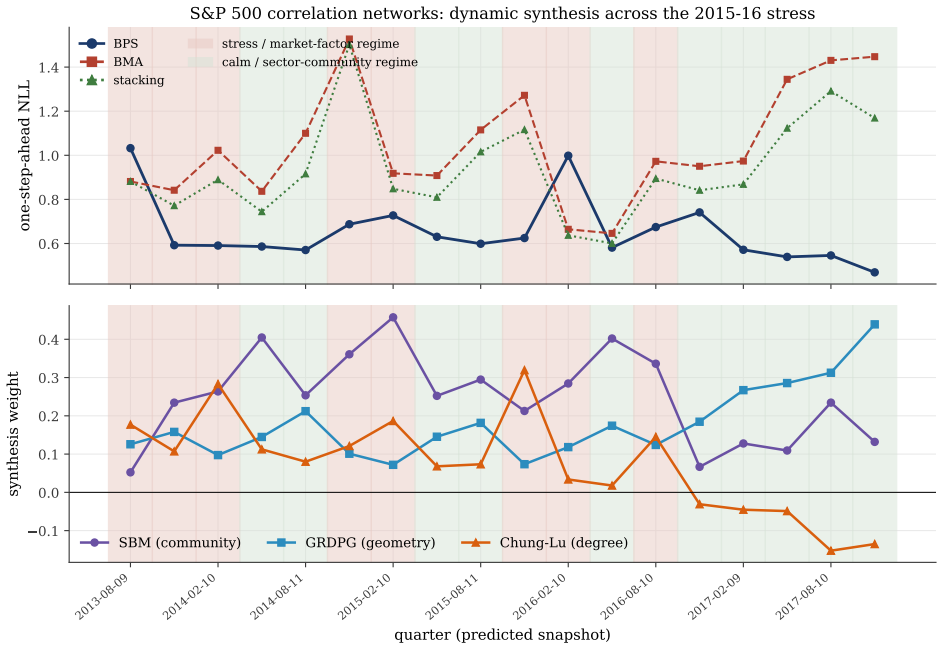
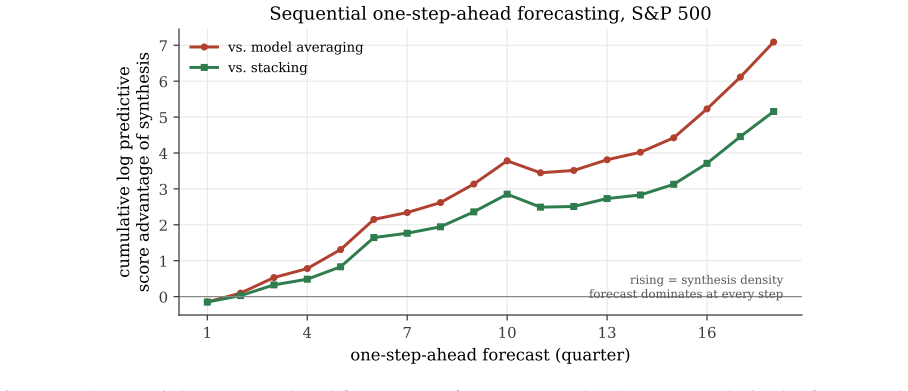
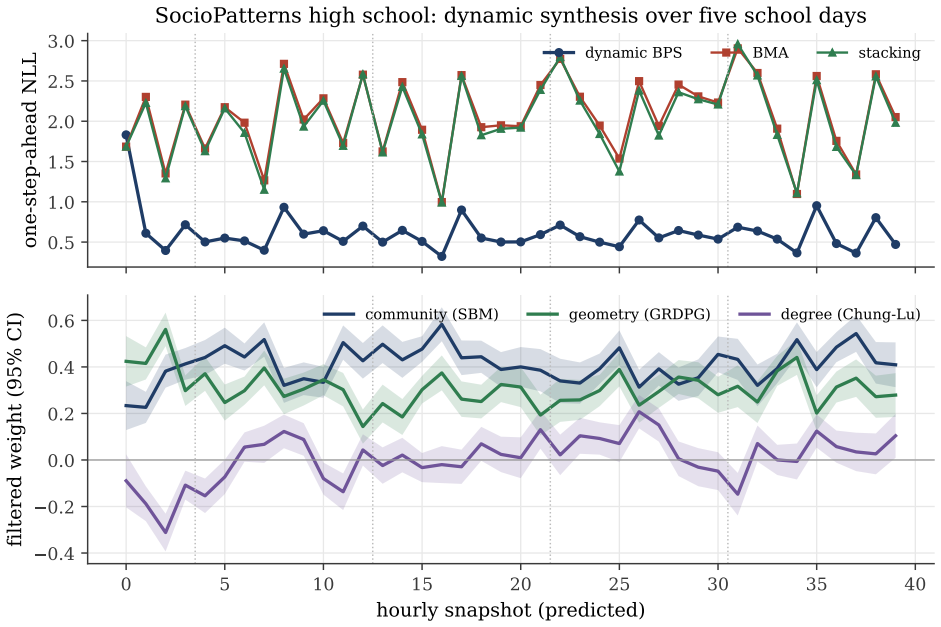
Dynamic Bayesian predictive synthesis represents each candidate mechanism as an agent that issues an edge forecast for the next time step; a synthesis layer then forms a convex combination of those forecasts using time-varying weights that are identifiable from observed snapshots under a sparse-safe parametrization. The resulting procedure returns calibrated edge probabilities together with inference on the active mechanism, separates distinguishable from indistinguishable mechanisms by a sharp threshold, tracks mechanism changes at optimal per-switch cost, and reduces exactly to calibrated link prediction when only one snapshot is available.
What carries the argument
The synthesis layer that forms time-varying convex combinations of mechanism-specific edge forecasts, together with the identification theory that recovers those weights from a single graph snapshot.
If this is right
- The method yields both edge forecasts and statements about which mechanism is currently dominant, with valid intervals conditional on the fitted agents.
- A change in the dominant mechanism is detected at the lowest possible per-switch cost permitted by the information in the snapshots.
- When only one snapshot is observed the procedure supplies calibrated probabilities for each possible edge.
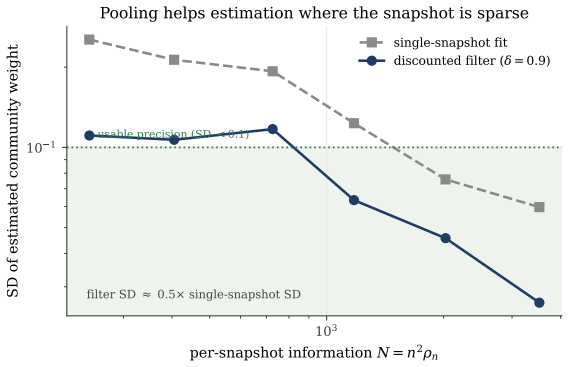
- Mechanisms that fall below the sharp distinguishability threshold cannot have their weights reliably recovered.
- The same synthesis layer can be applied to any collection of forecasting agents that produce edge probabilities.
Where Pith is reading between the lines
- The framework could be used to test whether a proposed new mechanism adds predictive value beyond an existing set of agents without refitting the entire model.
- Because weights are recovered from a single snapshot, the approach may allow retrospective analysis of historical networks where only isolated observations survive.
- If the independence assumption among agents is relaxed, the identification theory would need to be extended to account for correlated forecast errors.
Load-bearing premise
Mechanisms can be treated as independent forecasting agents whose weights remain identifiable from graph snapshots under the sparse-safe parametrization and identification conditions given in the paper.
What would settle it
Simulated dynamic networks in which the true active mechanism is known at every step, yet the estimated weights fail to concentrate on that mechanism or the method produces miscalibrated forecasts after a switch, would falsify the central claim.
Figures
read the original abstract
Networks are shaped by competing structural mechanisms, such as communities, geometry, or hubs. In a dynamic network the most predictive mechanism can change, and a model tied to one mechanism, or to fixed weights, cannot adapt as the dominant structure shifts. We develop dynamic Bayesian predictive synthesis for networks, in which a mechanism is an agent forecasting the next snapshot's edges and a synthesis layer combines them with time-varying weights. At each step the method returns a calibrated edge forecast and inference on the mechanism weights, with intervals valid given the fitted agents, so it also reports which mechanism is most informative. Inference of this kind requires a sparse-safe parametrization and an identification theory, under which a single graph identifies and estimates the weights. A sharp threshold separates distinguishable from indistinguishable mechanisms, a change in the active mechanism is tracked at an optimal per-switch cost, and for a single snapshot the method reduces to calibrated link prediction. On real networks, simulations, and benchmarks, the synthesis gives accurate, calibrated forecasts and recovers the leading mechanism when
Editorial analysis
A structured set of objections, weighed in public.
Referee Report
Summary. The manuscript develops dynamic Bayesian predictive synthesis for networks (BPSDN), modeling structural mechanisms (e.g., communities, geometry, hubs) as independent forecasting agents whose edge predictions are combined via time-varying weights in a synthesis layer. It supplies an identification theory under a sparse-safe parametrization under which a single observed graph snapshot identifies and estimates the weights, with a sharp threshold separating distinguishable from indistinguishable mechanisms, optimal per-switch tracking of mechanism changes, and reduction to calibrated link prediction in the static case. The method outputs calibrated forecasts together with valid intervals and mechanism-inference diagnostics. Empirical evaluation on real networks, simulations, and benchmarks is claimed to show accurate calibrated forecasts and recovery of the leading mechanism.
Significance. If the identification theory is internally consistent and the empirical calibration results hold under the stated assumptions, the framework would offer a principled way to adaptively forecast and diagnose evolving networks without committing to a single fixed mechanism, extending Bayesian predictive synthesis to the network setting with explicit uncertainty quantification and mechanism tracking.
major comments (1)
- [Abstract] Abstract: the central claims concerning a sharp identification threshold, optimal per-switch tracking cost, and single-graph weight recovery are stated without any derivation, proof sketch, or statement of the sparse-safe parametrization; these load-bearing theoretical results cannot be assessed for internal consistency or hidden circularity from the supplied text.
minor comments (1)
- [Abstract] The abstract sentence is truncated at 'recovers the leading mechanism when'.
Simulated Author's Rebuttal
We thank the referee for their report. The sole major comment concerns the level of detail in the abstract regarding the theoretical claims. We respond point-by-point below.
read point-by-point responses
-
Referee: [Abstract] Abstract: the central claims concerning a sharp identification threshold, optimal per-switch tracking cost, and single-graph weight recovery are stated without any derivation, proof sketch, or statement of the sparse-safe parametrization; these load-bearing theoretical results cannot be assessed for internal consistency or hidden circularity from the supplied text.
Authors: We agree that the abstract presents the main results concisely without derivations, a proof sketch, or an explicit definition of the sparse-safe parametrization. This is standard for abstracts given length constraints, but we recognize it limits immediate assessability. The full development appears in the manuscript: the sparse-safe parametrization is introduced in Section 2.3, the identification theory with the sharp threshold is stated and proved in Theorem 3.1 and its corollaries, the optimal per-switch tracking cost is derived in Proposition 4.1, and single-snapshot weight recovery is shown in Section 3.4. To address the concern, we will revise the abstract to include a brief inline statement of the sparse-safe parametrization and a parenthetical reference to the relevant sections for the proofs. This change will be made in the next version. revision: yes
Circularity Check
No significant circularity detected from available text
full rationale
The abstract describes a synthesis layer combining mechanism agents with time-varying weights, an identification theory under sparse-safe parametrization, and reductions to calibrated link prediction, but provides no equations, fitted-parameter renamings, or self-citation chains that reduce any claimed prediction or identification result to its inputs by construction. No load-bearing steps can be quoted or exhibited as circular; the derivation chain is therefore treated as self-contained on the given material.
Axiom & Free-Parameter Ledger
axioms (1)
- domain assumption Structural mechanisms can be treated as independent forecasting agents whose weights are identifiable from a single graph snapshot.
Reference graph
Works this paper leans on
-
[1]
Journal of econometrics , volume=
Dynamic Bayesian predictive synthesis in time series forecasting , author=. Journal of econometrics , volume=. 2019 , publisher=
2019
-
[2]
1997 , publisher=
Bayesian forecasting and dynamic models , author=. 1997 , publisher=
1997
-
[3]
The Annals of Mathematical Statistics , volume=
Limiting behavior of posterior distributions when the model is incorrect , author=. The Annals of Mathematical Statistics , volume=. 1966 , publisher=
1966
-
[4]
Journal of the American statistical Association , volume=
Strictly proper scoring rules, prediction, and estimation , author=. Journal of the American statistical Association , volume=. 2007 , publisher=
2007
-
[5]
Sankhya A , volume=
A limit theorem for scaled eigenvectors of random dot product graphs , author=. Sankhya A , volume=. 2016 , publisher=
2016
-
[6]
Journal of the Royal Statistical Society Series B: Statistical Methodology , volume=
A statistical interpretation of spectral embedding: the generalised random dot product graph , author=. Journal of the Royal Statistical Society Series B: Statistical Methodology , volume=. 2022 , publisher=
2022
-
[7]
The Annals of Statistics , pages=
Rate-optimal graphon estimation , author=. The Annals of Statistics , pages=. 2015 , publisher=
2015
-
[8]
Journal of the american statistical association , volume=
Latent space models for dynamic networks , author=. Journal of the american statistical association , volume=. 2015 , publisher=
2015
-
[9]
Journal of the Royal Statistical Society Series B: Statistical Methodology , volume=
Statistical clustering of temporal networks through a dynamic stochastic block model , author=. Journal of the Royal Statistical Society Series B: Statistical Methodology , volume=. 2017 , publisher=
2017
-
[10]
Spectral clustering in the dynamic stochastic block model , author=
-
[11]
IEEE Journal of Selected Topics in Signal Processing , volume=
Dynamic stochastic blockmodels for time-evolving social networks , author=. IEEE Journal of Selected Topics in Signal Processing , volume=. 2014 , publisher=
2014
-
[12]
Social networks , volume=
Friends and neighbors on the web , author=. Social networks , volume=. 2003 , publisher=
2003
-
[13]
Biometrika , volume=
Nonparametric Bayes dynamic modelling of relational data , author=. Biometrika , volume=. 2014 , publisher=
2014
-
[14]
Random Structures & Algorithms , volume=
Concentration and regularization of random graphs , author=. Random Structures & Algorithms , volume=. 2017 , publisher=
2017
-
[15]
Introduction to Nonparametric Estimation , pages=
Nonparametric estimators , author=. Introduction to Nonparametric Estimation , pages=. 2008 , publisher=
2008
-
[16]
Journal of the Royal Statistical Society: Series A (General) , volume=
Present position and potential developments: Some personal views statistical theory the prequential approach , author=. Journal of the Royal Statistical Society: Series A (General) , volume=. 1984 , publisher=
1984
-
[17]
Using stacking to average Bayesian predictive distributions (with discussion) , author=
-
[18]
Journal of the american Statistical association , volume=
Latent space approaches to social network analysis , author=. Journal of the american Statistical association , volume=. 2002 , publisher=
2002
-
[19]
Social networks , volume=
Stochastic blockmodels: First steps , author=. Social networks , volume=. 1983 , publisher=
1983
-
[20]
Physical Review E—Statistical, Nonlinear, and Soft Matter Physics , volume=
Stochastic blockmodels and community structure in networks , author=. Physical Review E—Statistical, Nonlinear, and Soft Matter Physics , volume=. 2011 , publisher=
2011
-
[21]
Annals of combinatorics , volume=
Connected components in random graphs with given expected degree sequences , author=. Annals of combinatorics , volume=. 2002 , publisher=
2002
-
[22]
The Annals of Statistics , pages=
Consistency of spectral clustering in stochastic block models , author=. The Annals of Statistics , pages=. 2015 , publisher=
2015
-
[23]
Journal of Complex Networks , volume=
Learning latent block structure in weighted networks , author=. Journal of Complex Networks , volume=. 2015 , publisher=
2015
-
[24]
Proceedings of the twelfth international conference on Information and knowledge management , pages=
The link prediction problem for social networks , author=. Proceedings of the twelfth international conference on Information and knowledge management , pages=
-
[25]
Clyde, David Draper and EI George, and a rejoinder by the authors , author=
Bayesian model averaging: a tutorial (with comments by M. Clyde, David Draper and EI George, and a rejoinder by the authors , author=. Statistical science , volume=. 1999 , publisher=
1999
-
[26]
Neural networks , volume=
Stacked generalization , author=. Neural networks , volume=. 1992 , publisher=
1992
-
[27]
1991 , publisher=
Modelling with mixtures , author=. 1991 , publisher=
1991
-
[28]
Limit theorems for eigenvectors of the normalized Laplacian for random graphs , author=
-
[29]
Statistics surveys , volume=
A review of dynamic network models with latent variables , author=. Statistics surveys , volume=
-
[30]
arXiv preprint arXiv:2512.18584 , year=
State-Space Modeling of Time-Varying Spillovers on Networks , author=. arXiv preprint arXiv:2512.18584 , year=
-
[31]
arXiv preprint arXiv:2512.18587 , year=
Graphon-Level Bayesian Predictive Synthesis for Random Network , author=. arXiv preprint arXiv:2512.18587 , year=
-
[32]
arXiv preprint arXiv:2606.15836 , year=
Minimax Synthesis of Network Mechanisms , author=. arXiv preprint arXiv:2606.15836 , year=
-
[33]
Econometrica: Journal of the econometric society , pages=
Maximum likelihood estimation of misspecified models , author=. Econometrica: Journal of the econometric society , pages=. 1982 , publisher=
1982
-
[34]
Political analysis , volume=
Cluster--robust variance estimation for dyadic data , author=. Political analysis , volume=. 2015 , publisher=
2015
-
[35]
The Annals of Probability , pages=
Normal convergence by higher semiinvariants with applications to sums of dependent random variables and random graphs , author=. The Annals of Probability , pages=. 1988 , publisher=
1988
-
[36]
The Annals of Statistics , pages=
Convergence of estimates under dimensionality restrictions , author=. The Annals of Statistics , pages=. 1973 , publisher=
1973
-
[37]
Biometrika , volume=
Logistic disease incidence models and case-control studies , author=. Biometrika , volume=. 1979 , publisher=
1979
-
[38]
Statistical science: a review journal of the Institute of Mathematical Statistics , volume=
On the question of effective sample size in network modeling: An asymptotic inquiry , author=. Statistical science: a review journal of the Institute of Mathematical Statistics , volume=
-
[39]
Journal of the Royal Statistical Society Series A: Statistics in Society , volume=
On the reconciliation of probability assessments , author=. Journal of the Royal Statistical Society Series A: Statistics in Society , volume=. 1979 , publisher=
1979
-
[40]
Journal of the Royal Statistical Society: Series A (General) , volume=
Bayesian aggregation , author=. Journal of the Royal Statistical Society: Series A (General) , volume=. 1984 , publisher=
1984
-
[41]
Technometrics , volume=
Online prediction under model uncertainty via dynamic model averaging: Application to a cold rolling mill , author=. Technometrics , volume=. 2010 , publisher=
2010
-
[42]
Nature Communications , volume=
Sequential stacking link prediction algorithms for temporal networks , author=. Nature Communications , volume=. 2024 , publisher=
2024
-
[43]
Misspecification in infinite-dimensional Bayesian statistics , author=
-
[44]
Oracle inequalities for network models and sparse graphon estimation , author=
-
[45]
Handbook of econometrics , volume=
Network data , author=. Handbook of econometrics , volume=. 2020 , publisher=
2020
-
[46]
Proceedings of the National Academy of Sciences , volume=
Stacking models for nearly optimal link prediction in complex networks , author=. Proceedings of the National Academy of Sciences , volume=. 2020 , publisher=
2020
-
[47]
Journal of Machine Learning Research , volume=
Community detection and stochastic block models: recent developments , author=. Journal of Machine Learning Research , volume=
-
[48]
Physical Review E—Statistical, Nonlinear, and Soft Matter Physics , volume=
Asymptotic analysis of the stochastic block model for modular networks and its algorithmic applications , author=. Physical Review E—Statistical, Nonlinear, and Soft Matter Physics , volume=. 2011 , publisher=
2011
-
[49]
Probability Theory and Related Fields , volume=
Reconstruction and estimation in the planted partition model , author=. Probability Theory and Related Fields , volume=. 2015 , publisher=
2015
-
[50]
Random Structures & Algorithms , volume=
Testing for high-dimensional geometry in random graphs , author=. Random Structures & Algorithms , volume=. 2016 , publisher=
2016
-
[51]
Journal of the American Statistical Association , volume=
Multivariate Bayesian predictive synthesis in macroeconomic forecasting , author=. Journal of the American Statistical Association , volume=. 2020 , publisher=
2020
-
[52]
Econometric Theory , pages=
DOUBLE/DEBIASED MACHINE LEARNING FOR DYADIC DATA , author=. Econometric Theory , pages=. 2026 , publisher=
2026
-
[53]
arXiv preprint arXiv:1710.00862 , year=
Testing for global network structure using small subgraph statistics , author=. arXiv preprint arXiv:1710.00862 , year=
-
[54]
International conference on machine learning , pages=
Network global testing by counting graphlets , author=. International conference on machine learning , pages=. 2018 , organization=
2018
-
[55]
2016 IEEE 16th international conference on data mining (ICDM) , pages=
Edge weight prediction in weighted signed networks , author=. 2016 IEEE 16th international conference on data mining (ICDM) , pages=. 2016 , organization=
2016
-
[56]
ACM Transactions on Intelligent Systems and Technology (TIST) , volume=
Snap: A general-purpose network analysis and graph-mining library , author=. ACM Transactions on Intelligent Systems and Technology (TIST) , volume=. 2016 , publisher=
2016
-
[57]
ACM transactions on Knowledge Discovery from Data (TKDD) , volume=
Graph evolution: Densification and shrinking diameters , author=. ACM transactions on Knowledge Discovery from Data (TKDD) , volume=. 2007 , publisher=
2007
-
[58]
nature , volume=
Collective dynamics of ‘small-world’networks , author=. nature , volume=. 1998 , publisher=
1998
-
[59]
Proceedings of the 3rd international workshop on Link discovery , pages=
The political blogosphere and the 2004 US election: divided they blog , author=. Proceedings of the 3rd international workshop on Link discovery , pages=
2004
-
[60]
arXiv preprint arXiv:2505.22289 , year=
Network Model Averaging Prediction for Latent Space Models by K-Fold Edge Cross-Validation , author=. arXiv preprint arXiv:2505.22289 , year=
-
[61]
Advances in neural information processing systems , volume=
Mixed membership stochastic blockmodels , author=. Advances in neural information processing systems , volume=
-
[62]
Biometrika , volume=
Network cross-validation by edge sampling , author=. Biometrika , volume=. 2020 , publisher=
2020
-
[63]
The Annals of Statistics , pages=
Modeling expert judgments for Bayesian updating , author=. The Annals of Statistics , pages=. 1985 , publisher=
1985
-
[64]
Statistical Science , volume=
Combining probability distributions: A critique and an annotated bibliography , author=. Statistical Science , volume=. 1986 , publisher=
1986
-
[65]
Journal of the Royal Statistical Society Series B: Statistical Methodology , volume=
Modelling probabilistic agent opinion , author=. Journal of the Royal Statistical Society Series B: Statistical Methodology , volume=. 1992 , publisher=
1992
-
[66]
Journal of the Royal Statistical Society Series C: Applied Statistics , volume=
Mixed-frequency Bayesian predictive synthesis for economic nowcasting , author=. Journal of the Royal Statistical Society Series C: Applied Statistics , volume=. 2021 , publisher=
2021
-
[67]
Journal of Econometrics , volume=
Optimal prediction pools , author=. Journal of Econometrics , volume=. 2011 , publisher=
2011
-
[68]
Physica A: statistical mechanics and its applications , volume=
Link prediction in complex networks: A survey , author=. Physica A: statistical mechanics and its applications , volume=. 2011 , publisher=
2011
-
[69]
Foundations and Trends
A survey of statistical network models , author=. Foundations and Trends. 2010 , publisher=
2010
-
[70]
arXiv preprint arXiv:2305.06465 , year=
Occam Factor for Random Graphs: Erd " \ o \ sR ' \ e \ nyi, Independent Edge, and Rank-1 Stochastic Blockmodel , author=. arXiv preprint arXiv:2305.06465 , year=
-
[71]
Journal of the Royal Statistical Society Series C: Applied Statistics , volume=
Analysis of the formation of the structure of social networks by using latent space models for ranked dynamic networks , author=. Journal of the Royal Statistical Society Series C: Applied Statistics , volume=. 2015 , publisher=
2015
-
[72]
Discrete temporal models of social networks , author=
-
[73]
Journal of the Royal Statistical Society Series B: Statistical Methodology , volume=
A separable model for dynamic networks , author=. Journal of the Royal Statistical Society Series B: Statistical Methodology , volume=. 2014 , publisher=
2014
-
[74]
Journal of Multimedia Information System , volume=
A Growing Stochastic Block Model with Preferential Attachment , author=. Journal of Multimedia Information System , volume=. 2025 , publisher=
2025
-
[75]
Journal of the Royal Statistical Society Series A: Statistics in Society , volume=
Zero-inflated stochastic block modelling of efficiency-security trade-offs in weighted criminal networks , author=. Journal of the Royal Statistical Society Series A: Statistics in Society , volume=. 2026 , publisher=
2026
-
[76]
Journal of Complex Networks , volume=
Scaling laws for properties of random graphs that grow via successive combination , author=. Journal of Complex Networks , volume=. 2022 , publisher=
2022
-
[77]
Symmetry , volume=
A novel algorithm for merging Bayesian networks , author=. Symmetry , volume=. 2023 , publisher=
2023
-
[78]
2017 , school=
Bayesian predictive synthesis: Forecast calibration and combination , author=. 2017 , school=
2017
-
[79]
Journal of the Royal Statistical Society Series B: Statistical Methodology , volume=
Bayesian predictive decision synthesis , author=. Journal of the Royal Statistical Society Series B: Statistical Methodology , volume=. 2024 , publisher=
2024
-
[80]
arXiv preprint arXiv:2311.12671 , year=
Predictive density combination using a tree-based synthesis function , author=. arXiv preprint arXiv:2311.12671 , year=
discussion (0)
Sign in with ORCID, Apple, or X to comment. Anyone can read and Pith papers without signing in.